

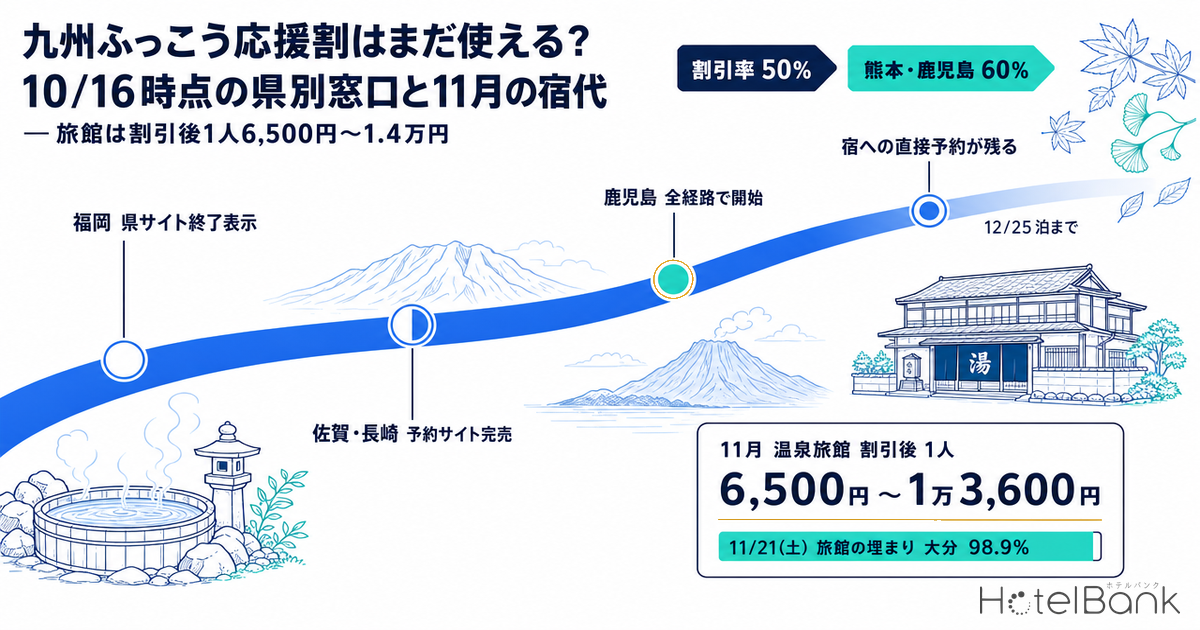
As of October 16, 2026, the Kyushu Fukko Ouenwari travel discount has reached the stage where booking-site allocations are almost gone, and what remains is direct booking with properties, plus Kagoshima. According to the Japan Tourism Agency’s guidance (updated October 16), the discount is 50% of the travel or accommodation price (60% in Kumamoto and Kagoshima), capped at ¥20,000 per person per night for accommodation-only stays. Eligible stays run through the night of December 15 in Fukuoka and December 25 in the five prefectures of Saga, Nagasaki, Kumamoto, Oita and Miyazaki, while Kagoshima, the last to launch, covers stays from October 14, 2026 to January 31, 2027 (February 28 for direct bookings with properties). The scheme is first-come, first-served, though, and each channel closes as its budget runs out. When we checked each prefecture’s official site on October 16, the booking-site allocations for Saga and Nagasaki were marked “sold out,” and Fukuoka’s prefectural site showed “The campaign has ended” in its usage-period field.
So if you start planning now, where can you still stay, and for how much? This article sorts out the status of each prefecture’s booking channels, then applies the discount rate directly to the listed prices for November and December stays (2 guests per room, tax included) to estimate what each person actually pays. We also look at how full the Saturday of the November long weekend already is, and how many days in advance onsen ryokan filled up over the October long weekend, to give a rough booking deadline.
• “Listed price” = the average, by prefecture, of the published rates for rooms on sale on OTAs (2 guests per room, per room, tax included, all plans). It differs from actual transaction prices or amounts paid. Monthly figures are aggregated as of October 16, 2026; figures by stay date are the average as of 45 days before each stay date.
• “Per-person payment after discount” = an estimate that takes half the listed price as the per-person rate and mechanically applies the prefecture’s discount rate (50% or 60%) and the ¥20,000 cap. Rounded to the nearest ¥100. Travel-inclusive packages and the caps for stays of two nights or more (¥30,000 and ¥35,000) are not considered.
• “Fill rate” = for ryokan in each prefecture that list at least 30% of their rooms on OTAs, the share of total rooms already sold (an estimate based on OTA sales inventory, observed October 15, 2026). It is not the occupancy rate of the whole property.
• Scheme details are based on the Japan Tourism Agency’s “Kyushu Fukko Ouenwari” page (updated October 16, 2026) and each prefecture’s official site (checked October 16). Channel status changes daily, so always confirm with the prefecture’s official site or the property before booking.
• Source: HotelBank Editorial Team research
- — The doors still open are Kagoshima and “direct booking with properties.” Kagoshima only launched on all channels on October 14. Direct booking opened in Oita on October 16 and in Saga on October 13, and Nagasaki’s Phase 2 direct booking opens October 23 at 10:00. Fukuoka’s prefectural site shows the campaign as ended (as of October 16).
- — November onsen ryokan cost ¥6,500–¥13,600 per person after the discount. Listed prices range from ¥26,100 in Miyazaki to ¥54,400 in Saga (2 guests per room, tax included). In 60%-discount Kumamoto, a ¥47,000 ryokan comes to ¥9,400 per person; in Kagoshima, ¥36,500 becomes ¥7,300.
- — Almost no properties reach the ¥20,000 cap. The cap only bites above ¥40,000 per person per night (about ¥33,300 in the 60% prefectures), or above ¥80,000 (about ¥67,000) for a room for two. At an average property, the discount rate applies in full.
- — For Saturday, November 21 (long weekend), ryokan fill rates are 98.9% in Oita, 97.6% in Kagoshima and 97.2% in Kumamoto (as of October 15). Rooms remain for the night of Monday, November 23 (public holiday), at 58–80% filled, and prices in Oita, Kumamoto and Nagasaki are around 30% lower than on the Saturday.
- — For the first night of the October long weekend (October 10), ryokan in Oita and Kumamoto were over 90% full three weeks out. If you are aiming for a weekend ryokan stay in November, secure your shortlist at least a month ahead.
Which Prefectures Can You Still Book? Channel Status as of October 16
The discount is offered through three channels, “direct booking with properties,” “travel agencies” and “booking sites,” and each prefecture runs its own budget and start dates. The pattern in mid-October is that the booking-site allocations, which opened first, are closing first, while the direct-booking allocations that opened later are still available. Table 1 summarizes what we found on the Japan Tourism Agency page and each prefecture’s official site on October 16.
| Prefecture | Discount | Eligible stays | Channel status as of October 16 |
|---|---|---|---|
| Fukuoka | 50% | Stays 10/1–12/15 | The usage-period field on the official prefectural site reads “The campaign has ended” (checked 10/16). Assume new applications are unlikely; only confirm existing bookings |
| Saga | 50% | Stays 10/1–12/25 | All seven booking sites show “sold out.” Direct booking with properties began 10/13 at 13:00, rolling out as properties become ready (prefectural site, updated 10/13). Travel agencies from 10/2 in stages |
| Nagasaki | 50% | Stays 10/1–12/25 | The two major booking sites show “sold out.” Phase 1 direct booking has suspended coupon issuance (budget cap reached). Phase 2 direct booking opens 10/23 at 10:00, covering check-ins from 10/23 through stays on 12/25 |
| Kumamoto | 60% | Stays 10/1–12/25 | Sales opened 9/15 at 10:00. The prefectural page carries no suspension or end notice (updated 9/15). Press reports say some booking sites opened on 10/15 at 12:00, so availability varies by channel |
| Oita | 50% | Stays 10/1–12/25 | Booking sites from 9/25, travel agencies from 10/9. A notice says direct booking with properties starts 10/16, yet the usage-period field on the same prefectural site reads “The campaign has ended” (checked 10/16). Calling the property you want is the reliable way to confirm |
| Miyazaki | 50% | Stays 10/1–12/25 | Booking sites from 9/25; properties and travel agencies from 9/28 in stages. Direct bookings require a coupon issued on the coupon site. No suspension notice on the prefectural site (updated 9/25) |
| Kagoshima | 60% | Stays 10/14/2026–1/31/2027 (direct bookings through 2/28) *Stays 12/26–1/3 excluded | The last of the seven to launch (10/14), with every channel open. Booking sites are being added in stages from 10/14 to 10/26 (one shows sold out), and direct booking with properties also began rolling out on 10/14. Each operator closes when its budget cap is reached |
Source: Compiled by the HotelBank Editorial Team from the Japan Tourism Agency’s “Kyushu Fukko Ouenwari” page (updated October 16, 2026) and each prefecture’s official site (checked October 16, 2026). Caps: ¥20,000 per person for accommodation-only or travel-inclusive one-night stays, ¥30,000 for travel-inclusive stays of two nights or more, and ¥35,000 for multi-prefecture tours
There are three ways to read this. First, Kagoshima is the only one of the seven prefectures that has just started. Booking sites and direct booking opened together on October 14, and more booking sites are being added through October 26. Its eligible period also runs long, to stays on January 31, 2027 (February 28 for direct bookings), so apart from the New Year holidays (stays December 26 to January 3) it works for winter trips too. Second, Oita, Saga and Nagasaki are designed so that direct-booking allocations open after the booking-site allocations close, and Nagasaki’s Phase 2 begins October 23 at 10:00. Direct booking works by contacting the property through its official website or by phone and saying you want to use the discount, so these rooms do not appear in booking-site listings. The fastest route is to choose the property first, then call. Third, Fukuoka’s prefectural site shows the campaign as ended, so as of October 16 it is safer to assume new applications are unlikely. Oita’s site likewise shows the October 16 start notice side by side with an “ended” message, so confirm directly with the property before building your itinerary. Note also that in Oita the eligible stay dates differ by channel: direct bookings with properties cover stays from October 16 onward.
Bookings made before a channel’s sales start date are not eligible, and direct bookings and travel-agency bookings require identity verification of the lead guest and a completed application form (stated on the Fukuoka and Kagoshima prefectural sites). In Miyazaki, direct bookings require you to obtain a discount coupon on the coupon site after booking, and once coupons run out, no discount applies even if the booking remains.
What Will a November Stay Cost After the Discount? Estimates by Prefecture and Property Type
Now to the money. We lined up listed prices for November stays (2 guests per room, tax included, monthly average as of October 16) by prefecture and property type, then applied each prefecture’s discount rate and the ¥20,000 cap to the per-person amount. Table 2 and Figure 1 show the results.
| Prefecture (discount) | Onsen ryokan / ryokan Listed price → per-person payment |
Business hotels Listed price → per-person payment |
City hotels Listed price → per-person payment |
|---|---|---|---|
| Fukuoka (50%) | ¥36,900→¥9,200 N=74 | ¥22,300→¥5,600 N=350 | ¥41,300→¥10,300 N=44 |
| Saga (50%) | ¥54,400→¥13,600 N=92 | ¥14,700→¥3,700 N=48 | ¥25,600→¥6,400 N=9 |
| Nagasaki (50%) | ¥35,100→¥8,800 N=72 | ¥14,100→¥3,500 N=128 | ¥32,100→¥8,000 N=25 |
| Kumamoto (60%) | ¥47,000→¥9,400 N=236 | ¥15,300→¥3,100 N=122 | ¥24,600→¥4,900 N=19 |
| Oita (50%) | ¥44,900→¥11,200 N=328 | ¥13,700→¥3,400 N=86 | ¥23,900→¥6,000 N=15 |
| Miyazaki (50%) | ¥26,100→¥6,500 N=46 | ¥13,300→¥3,300 N=83 | ¥18,900→¥4,700 N=18 |
| Kagoshima (60%) | ¥36,500→¥7,300 N=83 | ¥13,200→¥2,600 N=153 | ¥19,600→¥3,900 N=25 |
Source: HotelBank Editorial Team research (OTA listed prices as of October 16, 2026; N = number of listed properties of each type in the prefecture). Post-discount amounts are estimates applying the discount rate and the ¥20,000 cap to half the listed price, rounded to the nearest ¥100
Figure 1: Estimated per-person payment after discount, based on listed prices for November stays (prefecture × property type).
Source: HotelBank Editorial Team research (estimated from OTA listed prices as of October 16, 2026)
For onsen ryokan and ryokan, listed prices before the discount vary twofold, from ¥26,100 in Miyazaki to ¥54,400 in Saga, yet the per-person payment after the discount falls within a band of ¥6,500 to ¥13,600. In Kumamoto, where the 60% rate applies, the listed ryokan price of ¥47,000 (N=236) is higher than Oita’s (¥44,900), but the per-person payment of ¥9,400 is lower than Oita’s ¥11,200. A ¥36,500 ryokan in Kagoshima comes to ¥7,300, on a par with Miyazaki (50%) at ¥6,500. Business hotels cost ¥2,600–¥5,600 per person in all seven prefectures and city hotels ¥3,900–¥10,300, with only Fukuoka’s city hotels (¥41,300, N=44) above ¥10,000.
Mathematically, the ¥20,000 cap only starts to bite once the rate exceeds ¥40,000 per person per night (about ¥33,300 in the 60% prefectures). For a room for two, that is ¥80,000, or about ¥67,000 in the 60% prefectures, and the averages in Table 2 are below that for every prefecture and property type (even the highest, Saga ryokan, is ¥54,400). In other words, at an average property, the headline discount rate is exactly the discount you get on what you pay. Some high-end detached villas or rooms with private open-air baths will hit the cap, but even then you still get ¥20,000 off per person. Counting from the price distribution, only about 4–10% of properties across the seven prefectures reach the cap. Which price bands trigger the cap, and how to choose when crossing prefectural borders, are covered in our earlier guide, Kyushu Fukko Ouenwari: 60% Off in Kumamoto, Kagoshima, ¥20,000 Cap.
| Listed price, 2 guests per room | Per person | 50% prefectures (Fukuoka, Saga, Nagasaki, Oita, Miyazaki) | 60% prefectures (Kumamoto, Kagoshima) |
|---|---|---|---|
| ¥20,000 | ¥10,000 | ¥5,000 Effective 50% off | ¥4,000 Effective 60% off |
| ¥40,000 | ¥20,000 | ¥10,000 Effective 50% off | ¥8,000 Effective 60% off |
| ¥60,000 | ¥30,000 | ¥15,000 Effective 50% off | ¥12,000 Effective 60% off |
| ¥80,000 | ¥40,000 | ¥20,000 Effective 50% off (cap) | ¥20,000 Effective 50% off (cap) |
| ¥100,000 | ¥50,000 | ¥30,000 Effective 40% off (cap) | ¥30,000 Effective 40% off (cap) |
| ¥120,000 | ¥60,000 | ¥40,000 Effective 33% off (cap) | ¥40,000 Effective 33% off (cap) |
Source: Compiled by the HotelBank Editorial Team from the discount rates and caps on the Japan Tourism Agency’s “Kyushu Fukko Ouenwari” page (updated October 16, 2026). Estimates multiply half the listed price by the discount rate, with the discount truncated at ¥20,000 where it would exceed that amount. Shaded cells are price bands where the cap applies
As Table 3 shows, properties up to ¥60,000 for a room for two get the full headline discount in every prefecture. In the 60% prefectures the cap kicks in from about ¥67,000, and at an ¥80,000 property the per-person payment after discount is ¥20,000, the same as in the 50% prefectures. At a ¥100,000 property both work out to an effective 40% off, and at ¥120,000 the effective discount falls to 33%. If you are choosing a high-end detached villa or a room with a private open-air bath, think of the discount as a flat “¥20,000 off” rather than a percentage, so you do not misjudge what you will pay.
One more point: November listed prices are up on the same month last year. For ryokan, prices rose 13.0% in Kagoshima, 11.9% in Saga, 11.8% in Kumamoto, 7.7% in Miyazaki, 6.0% in Nagasaki, 5.2% in Oita and 4.1% in Fukuoka, with the largest increases in the 60% prefectures of Kagoshima and Kumamoto, and in Saga. Still, these increases are small next to a 50–60% discount, and in terms of what you pay, it is clearly cheaper than last November. Booking the same property on the same day of the week as last year works out to a difference of anywhere from a few thousand yen to around ¥10,000 per person.
Saturday vs. Weekday vs. November 23: Onsen Ryokan Prices and Fill Rates by Stay Date
Monthly averages hide the day-of-week gap. Table 4 shows, for onsen ryokan and ryokan in the seven prefectures, the listed price for six representative November stay dates (average as of 45 days before each stay), the per-person payment after discount, and how full each date was as of October 15.
| Prefecture | 11/14 (Sat) | 11/18 (Wed) | 11/21 (Sat) | 11/22 (Sun) | 11/23 (Mon, holiday) | 11/28 (Sat) |
|---|---|---|---|---|---|---|
| Fukuoka N=51 | ¥52,300 →¥13,100 96% filled | ¥33,300 →¥8,300 73% filled | ¥53,700 →¥13,400 99% filled | ¥42,200 →¥10,600 93% filled | ¥31,400 →¥7,800 58% filled | ¥47,200 →¥11,800 85% filled |
| Saga N=68 | ¥59,500 →¥14,900 96% filled | ¥37,700 →¥9,400 77% filled | ¥72,000 →¥18,000 96% filled | ¥54,100 →¥13,500 90% filled | ¥42,300 →¥10,600 70% filled | ¥58,000 →¥14,500 94% filled |
| Nagasaki N=49 | ¥49,200 →¥12,300 92% filled | ¥31,800 →¥7,900 69% filled | ¥46,400 →¥11,600 92% filled | ¥42,300 →¥10,600 83% filled | ¥33,600 →¥8,400 59% filled | ¥37,800 →¥9,400 81% filled |
| Kumamoto N=147 | ¥44,000 →¥8,800 96% filled | ¥34,900 →¥7,000 86% filled | ¥51,900 →¥10,400 97% filled | ¥46,800 →¥9,400 94% filled | ¥37,700 →¥7,500 80% filled | ¥45,100 →¥9,000 93% filled |
| Oita N=225 | ¥49,000 →¥12,200 97% filled | ¥39,000 →¥9,700 83% filled | ¥56,700 →¥14,200 99% filled | ¥50,500 →¥12,600 95% filled | ¥38,200 →¥9,600 78% filled | ¥46,800 →¥11,700 89% filled |
| Miyazaki N=22 | ¥30,100 →¥7,500 84% filled | ¥23,900 →¥6,000 81% filled | ¥24,000 →¥6,000 88% filled | ¥22,500 →¥5,600 81% filled | ¥21,100 →¥5,300 64% filled | ¥21,800 →¥5,500 83% filled |
| Kagoshima N=65 | ¥34,300 →¥6,900 92% filled | ¥26,000 →¥5,200 80% filled | ¥27,800 →¥5,600 98% filled | ¥35,700 →¥7,100 93% filled | ¥27,300 →¥5,500 76% filled | ¥24,200 →¥4,800 89% filled |
Source: HotelBank Editorial Team research. Prices are the average of rooms on sale on OTAs 45 days before each stay date; fill rates are estimates based on the sales inventory of ryokan that list at least 30% of their rooms on OTAs (observed October 15, 2026). N = number of ryokan covered in each prefecture
Figure 2: Onsen ryokan / ryokan listed price by stay date (2 guests per room, tax included, 45 days out) for four prefectures: Oita, Kumamoto, Kagoshima and Saga.
Source: HotelBank Editorial Team research (OTA listed prices 45 days before each stay date)
Saturday nights are expensive, and the last night of a long weekend is cheap. Ryokan in Oita list at ¥56,700 for Saturday, November 21, 1.45 times the ¥39,000 for Wednesday of the same week (November 18) and 1.48 times the ¥38,200 for the last night of the long weekend, Monday, November 23 (public holiday). The gap is even wider in Saga: ¥72,000 for Saturday, November 21 versus ¥42,300 for November 23. Looking at the per-person payment after discount, Oita comes to ¥14,200 on the Saturday, ¥9,700 on the weekday and ¥9,600 on the holiday, while Kumamoto (60%) comes to ¥10,400, ¥7,000 and ¥7,500 respectively. Simply shifting the day changes the cost by ¥3,000–¥5,000 per person, or ¥6,000 to nearly ¥10,000 for two.
Fill rates move the opposite way from prices. As of October 15, ryokan for the night of Saturday, November 21 were 98.9% filled in Oita (38 of 3,531 rooms left), 97.6% in Kagoshima (35 of 1,483 left), 97.2% in Kumamoto (73 of 2,634 left), 95.7% in Saga, 91.7% in Nagasaki and 98.6% in Fukuoka. They are nearly closed, and even with more than a month to go, there are hardly any rooms left to choose from. By contrast, for the night of Monday, November 23 (public holiday), fill rates are 58.4% in Fukuoka, 58.9% in Nagasaki, 64.0% in Miyazaki, 70.5% in Saga, 76.3% in Kagoshima, 77.5% in Oita and 79.7% in Kumamoto, leaving 20–40% of rooms open in every prefecture. If you stay the night of Labor Thanksgiving Day and head home on Tuesday the 24th, you pay around 70% of the Saturday price and still have a choice of properties. Saturday, November 14 is also already tight, at 97.4% in Oita, 96.4% in Saga and 95.6% in Kumamoto, as it coincides with peak autumn foliage.
Fukuoka’s urban hotels are a slightly different story: in November, prices spike every Saturday as the Grand Sumo Kyushu Tournament and concerts at the dome overlap. Day-by-day prices for Hakata and Chuo wards are laid out in Why Are Fukuoka Hotels So Expensive? November’s Expensive and Cheap Days (2026) (HotelPicks, in Japanese).
How Soon Should You Book? When Onsen Ryokan Filled Up Over the October Long Weekend
Whether you can afford to wait because “there is still a month to go” depends on how quickly Kyushu’s onsen ryokan normally fill. A useful reference is the night of Saturday, October 10, the first long weekend after the discount launched. Figure 3 shows how fill rates for ryokan in Oita, Kumamoto, Kagoshima and Saga evolved from 45 days before the stay date to the day before.
Figure 3: Fill-rate trend for onsen ryokan / ryokan for the night of October 10, 2026 (Saturday, first night of the long weekend), from 45 days out to the day before. Oita N=218, Kumamoto N=143, Kagoshima N=63, Saga N=69.
Source: HotelBank Editorial Team research (estimates based on the sales inventory of ryokan that list at least 30% of their rooms on OTAs)
Ryokan in Oita were 77.0% filled 45 days out, 87.3% at 30 days, 92.1% three weeks (21 days) out and 96.2% two weeks out, meaning they had already passed 90% three weeks before the stay. Kumamoto followed the same curve, from 74.2% at 45 days to 87.6% at 30 days and 93.9% three weeks out, closing early as demand shifted to direct booking after the booking-site allocations sold out. Kagoshima (71.3% at 45 days to 89.7% three weeks out) and Saga (68.4% to 83.8%) were somewhat slower, but both still reached 90% two weeks out. The rooms left the day before were just 1.4–3.4% in all four prefectures, so the strategy of “waiting for last-minute availability” barely works for ryokan.
Applying this pace to November, the Saturday of the long weekend is already at the level the October long weekend reached “two weeks out,” so assume only cancellations are left. For the night of Monday, November 23 (public holiday), Oita, Kumamoto, Kagoshima and Saga are all in the 70% range (70.5–79.7%), about the same as the night of October 10 was 45 days out (68.4–77.0%); the weekday night of November 18 stands at 77–86%. In Oita, Nagasaki and Saga, where direct-booking allocations are just opening, and in Kagoshima, where all channels have just opened, these dates are likely to fill toward 90% over the next three weeks. The realistic approach is to pick two or three candidate properties and call them in October to confirm their discount allocation.
What About December? Most Prefectures End on December 25, Only Kagoshima Continues Into Winter
Listed prices for December ryokan stays are ¥37,200 in Fukuoka, ¥54,900 in Saga, ¥37,700 in Nagasaki, ¥47,300 in Kumamoto, ¥46,700 in Oita, ¥28,400 in Miyazaki and ¥37,000 in Kagoshima, roughly the same as November (monthly average as of October 16). The per-person payment after discount is also little changed from November: ¥9,500 for Kumamoto ryokan, ¥7,400 in Kagoshima and ¥11,700 in Oita. What needs attention is the period. The discount ends with stays on December 15 in Fukuoka and on December 25 in Saga, Nagasaki, Kumamoto, Oita and Miyazaki. Stay at the same property on or after December 26, and by simple calculation you pay 2 to 2.5 times as much. If you are planning a late-December trip home or a year-end getaway, whether you can bring it forward to a stay on or before the 25th makes the difference.
Kagoshima is the exception, running through stays on January 31, 2027 (February 28 for direct bookings), excluding stays from December 26 to January 3. The 60% discount continues in Kagoshima through January. Outside the first three days of the New Year, Ibusuki and Kirishima in January will be the last destinations among the seven prefectures where the discount can still be used.
Finally, on the property side of the discount, which this article does not cover, our tracking of how inventory moved on launch day by prefecture and property type shows that on Kagoshima’s launch day (October 14), listed ryokan inventory fell at 22.5 times the normal pace. That supports the pattern seen here of ryokan filling up first.
For a Closer Look
For specific property comparisons, these articles go into more detail (in Japanese).
Why Are Fukuoka Hotels So Expensive? November’s Expensive and Cheap Days (2026) (HotelPicks)
Lays out listed prices for 358 properties in Hakata and Chuo wards by November date, pinpointing the Saturdays that overlap with the Grand Sumo Kyushu Tournament (November 8–22) and events at Mizuho PayPay Dome Fukuoka (such as a median of ¥56,000 on November 14), and the dates that stay within ¥15,800–¥16,100: Monday, November 30, and the public holidays of Tuesday, November 3 and Monday, November 23. It also shows how many days out rooms typically remain available.
Five Kyushu Onsen Inns with Detached Villas: Yufu, Kurokawa and Kirishima (yadolist)
Compares Sanso Murata (山荘 無量塔) in Yufuin (all 12 rooms are detached villas, each with a hot-spring bath) and Kamenoi Bessou (亀の井別荘; 11 villas in a garden of about 33,000 m²), Sanso Takefue (山荘 竹ふえ) in Kurokawa Onsen (12 villas on about 16,500 m², with 30 baths fed by its own spring), and Wasure-no-Sato Gajoen (忘れの里 雅叙苑) and Tenku no Mori (天空の森) in Kirishima, by number of villas, grounds and the character of their hot springs. The inns span Oita, Kumamoto and Kagoshima, making it useful if you are weighing stays across the 50% and 60% prefectures.
Frequently Asked Questions
Q. Can I still book with the Kyushu Fukko Ouenwari discount?
A. As of October 16, 2026, Kagoshima is accepting bookings on all channels (launched October 14). Direct booking with properties opened in Oita on October 16 and in Saga on October 13, and Nagasaki’s Phase 2 direct booking opens October 23 at 10:00. The booking-site allocations for Saga and Nagasaki are sold out, and Fukuoka’s prefectural site shows the campaign as ended. Each channel closes in turn as its budget cap is reached, so check the prefecture’s official site or the property before booking.
Q. How much will an onsen ryokan cost in November after the discount?
A. Applying the discount rate to November listed prices (2 guests per room, tax included, monthly average), the per-person payment is ¥6,500 in Miyazaki, ¥7,300 in Kagoshima, ¥8,800 in Nagasaki, ¥9,200 in Fukuoka, ¥9,400 in Kumamoto, ¥11,200 in Oita and ¥13,600 in Saga. Saturday nights cost more than weekdays (Oita’s November 21 is 1.45 times the Wednesday of the same week), so even after the discount the difference is ¥3,000–¥5,000 per person. The ¥20,000 cap only applies to properties above ¥40,000 per person per night (about ¥33,300 in Kumamoto and Kagoshima).
Q. Are rooms still available for the November long weekend? How soon should I book?
A. As of October 15, onsen ryokan for the night of Saturday, November 21 were 98.9% filled in Oita, 97.6% in Kagoshima and 97.2% in Kumamoto. Rooms remain for the night of Monday, November 23 (public holiday), at 58–80% filled. For the first night of the October long weekend (October 10), ryokan in Oita and Kumamoto passed 90% three weeks out, so for November weekend and holiday ryokan stays it is safest to book at least a month ahead, ideally within October.
Q. How do I use the discount when booking directly with a property?
A. Book through the property’s official website or by phone and tell them you want to use the discount. These rooms do not appear in booking-site listings, so the quickest route is to choose the property first and then contact it. Direct and travel-agency bookings require identity verification of the lead guest and a completed application form (stated on the Fukuoka and Kagoshima prefectural sites), and in Miyazaki you must obtain a discount coupon on the coupon site after booking. Bookings made before each prefecture’s sales start date are not eligible.
Q. Which properties hit the ¥20,000 cap?
A. For a one-night accommodation-only stay, the cap applies at properties where the rate exceeds ¥40,000 per person per night (about ¥33,300 in the 60% prefectures of Kumamoto and Kagoshima). For a room for two, that means above ¥80,000 (about ¥67,000). Even the highest November prefectural average, Saga ryokan, is ¥54,400 (2 guests per room, tax included), so at an average property the discount rate applies in full. At an ¥80,000 property, each person pays ¥20,000 in both the 50% and 60% prefectures (Table 3).
Q. What happens if I stay on or after December 26?
A. The discount ends with stays on December 15 in Fukuoka and on December 25 in the five prefectures of Saga, Nagasaki, Kumamoto, Oita and Miyazaki, so from December 26 the same property costs 2 to 2.5 times as much by simple calculation. Only Kagoshima continues, through stays on January 31, 2027 (February 28 for direct bookings with properties), excluding stays from December 26 to January 3.
Q. Which November dates are cheapest?
A. For onsen ryokan, the night of Monday, November 23 (public holiday) is the one to target. Oita ryokan list at ¥38,200 (2 guests per room, tax included, 45 days out), about 30% cheaper than the ¥56,700 for Saturday, November 21, for a per-person payment of ¥9,600 after the discount. As of October 15, that night was only 58–80% filled, with 20–40% of rooms open in all seven prefectures. Weekday nights such as Wednesday, November 18 are also cheaper than Saturdays, at 69–86% filled.
Methodology and Sources
■ Data Sources
Listed prices for rooms on sale on OTAs (2 guests per room, per room, tax included, all plans) were aggregated by prefecture and property type for the seven Kyushu prefectures (HotelBank Editorial Team research). Table 2, Figure 1 and the December prices are monthly averages as of October 16, 2026 (N = number of listed properties of each type in the prefecture, shown in Table 2). Table 4 and Figure 2 are averages of rooms on sale 45 days before each stay date. Fill rates (Table 4 and Figure 3) treat ryokan in each prefecture that list at least 30% of their rooms on OTAs as a fixed set and estimate the share of total rooms sold; they differ from the occupancy rate of the whole property. Table 4 fill rates were observed on October 15, 2026; Figure 3 uses daily observations from August 26 to October 9, 2026.
■ Estimation Assumptions
The per-person payment after discount takes half the listed price as the per-person rate, multiplies it by each prefecture’s discount rate (50% for Fukuoka, Saga, Nagasaki, Oita and Miyazaki; 60% for Kumamoto and Kagoshima), truncates the discount at ¥20,000 where it would exceed that amount, and subtracts it. It uses the cap for accommodation-only products and does not consider travel-inclusive products (¥30,000 for two nights or more) or multi-prefecture tours (¥35,000). Figures are rounded to the nearest ¥100. The quick-reference Table 3 applies the same calculation to listed prices of ¥20,000 to ¥120,000 for 2 guests per room.
■ Limitations
Listed prices are the prices of rooms on sale and differ from actual transaction prices or amounts paid. Rooms already sold out 45 days before the stay are not included in the averages. Channel status for each prefecture reflects what the official sites showed on October 16, 2026, and changes daily with budget caps and cancellations. Whether a property handles the discount, and how much allocation remains, varies by property, so make the final check with the property or the prefecture’s official site.
■ Sources and Aggregation Details
- Japan Tourism Agency, “Kyushu Fukko Ouenwari” (updated October 16, 2026): discount rates, caps, eligible periods and booking start dates by prefecture
- Kagoshima Prefecture, “Kyushu Fukko Ouenwari (Kagoshima Fukko Ouenwari)” (updated October 10, 2026), Kagoshima Prefecture campaign site (checked October 16, 2026): start dates, eligible periods by channel, excluded dates, identity verification
- Kyushu Fukko Ouenwari Fukuoka Campaign (checked October 16, 2026): eligible period, end notice, direct-booking procedure
- Kyushu Fukko Ouenwari, Oita Prefecture (checked October 16, 2026): start dates by channel (direct booking October 16)
- Kyushu Fukko Ouenwari Saga Campaign (updated October 13, 2026): booking sites sold out, direct booking from October 13
- Kyushu Fukko Ouenwari, Nagasaki Prefecture (checked October 16, 2026): Phase 1 coupons suspended, Phase 2 from October 23
- Kyushu Fukko Ouenwari, Miyazaki Prefecture (updated September 25, 2026): start dates by channel, coupon issuance procedure
- Kumamoto Prefecture, “Kumamoto Fukko Ouenwari” (updated September 15, 2026): 60% discount rate, eligible period, sales launch
- Travel Watch (October 15, 2026): report on the launch of booking sites for Kagoshima
- Listed prices and fill rates: HotelBank Editorial Team research (OTA listed prices as of October 16, 2026; sales inventory observed August 26 to October 15, 2026).