

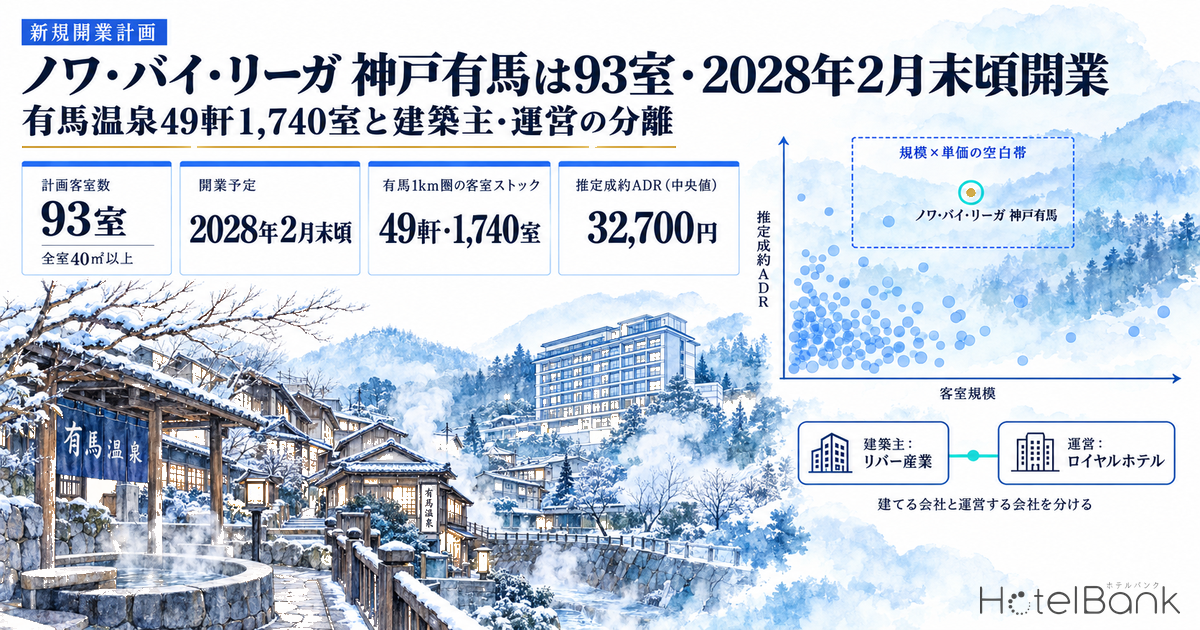
Noir by RIHGA Kobe Arima (ノワ・バイ・リーガ 神戸有馬), the first property under the new onsen-resort brand that The Royal Hotel (ロイヤルホテル) announced on November 14, 2025, is planned at 93 rooms, all of 40 sqm or more, in an eight-story building, with opening scheduled for around the end of February 2028. The building owner is River Sangyo (リバー産業); Royal Hotel will be the operator. Within a 1 km radius of the center of Arima Onsen, 49 lodging properties with 1,740 rooms can be confirmed as on sale, and the median estimated settled ADR of the onsen town averaged ¥32,700 over the latest 12 months (N=38-41). This article examines which size band and price band those 93 rooms enter, and what a structure that separates the company that builds from the company that operates signals to developers, operators and existing owners.
Metric Definitions Used in This Article
ADR (average daily rate) = an estimated settled rate (tax-exclusive equivalent) calculated by applying a segment-specific adjustment factor to the lowest plan level each property publishes on OTAs (per-room rate for two guests in one room, tax included). When reconciled against the property-level results disclosed by listed hotel REITs (91 properties, latest three months), the median error is about 7%. These are estimates and differ from each property’s actual settled prices and accounting figures. Area-level ADR is the median of the properties covered (the level of a typical property in the area). Where listed prices are mentioned, they are per-room rates for two guests in one room (tax included). LT (lead time) = the number of days until the check-in date. A sell-out observation = the state in which the number of rooms remaining on booking sites reaches zero; this article uses only observations from 45 days before the stay date through the day before. Data source: MetroEngines Research.
- — 93 rooms, all 40 sqm or more, with total floor area of 9,698 sqm (about 104 sqm per room). The building owner is River Sangyo and the operator is Royal Hotel, with opening planned for around the end of February 2028.
- — The 1 km radius around Arima Onsen holds 49 properties and 1,740 rooms. New openings since 2017 total 9 properties and 88 rooms (22 rooms at most), so 93 rooms is comparable to roughly a decade of new supply.
- — The median estimated settled ADR is ¥32,700 (latest 12-month average, N=38-41). No existing property sits in the band of 60-100 rooms above ¥40,000.
- — Over six days of Obon and Silver Week, zero remaining rooms were observed in 60.0% of property-days even at inns priced at ¥50,000 or more. Winter (December-March) rates are about 1.3 times summer rates.
- — The indicative construction cost is about ¥7.06-7.80 billion (statistical unit cost, excluding land). In all three of the company’s 2028 projects, 395 rooms in total, the building owner is a separate company.
The Project at a Glance — 93 Rooms, All 40 sqm or More, About 104 sqm of Floor Area per Room
We first confirm the outline of the project from published materials. According to Royal Hotel’s release, the site is in Arima-cho, Kita-ku, Kobe, about a 10-minute walk from Arima Onsen Station on the Kobe Electric Railway, with 93 rooms (planned) in seven types, all of 40 sqm or more. Facilities include a restaurant with a private room featuring a chef’s table, a tea and bar lounge, a large communal bath, private baths and a spa. Completion is planned for around November 2027 and opening for around the end of February 2028. The main target clientele is reported to be upper-middle-class domestic guests in their 40s to 60s.
The scale of the building can be read from materials that Hyogo Prefecture published under its landscape impact assessment procedure based on the prefectural landscape ordinance. The “(tentative name) Arima Project”, with River Sangyo as the project owner, is a steel-frame, eight-story building on a 8,339.84 sqm site with total floor area of 9,698.37 sqm; the notification was filed on July 15, 2026 and the procedure ended on the 28th of the same month. Dividing the total floor area by 93 rooms gives about 104 sqm per room, and even counting every room at the minimum 40 sqm, guest rooms account for only about 38% of the floor area (3,720 sqm). The remainder appears to go to shared areas such as the large bath, spa and restaurant, making this a building with a different design philosophy from a limited-service hotel.
| Item | Details | Source checked |
|---|---|---|
| Name | Noir by RIHGA Kobe Arima | Royal Hotel release (November 14, 2025) |
| Location and access | Arima-cho, Kita-ku, Kobe / about a 10-minute walk from Arima Onsen Station on the Kobe Electric Railway | Same as above |
| Guest rooms | 93 rooms (planned), seven types, all 40 sqm or more | Same as above |
| Facilities | Restaurant (private room with chef’s table), tea and bar lounge, large communal bath, private baths, spa | Same as above |
| Building owner / operator | River Sangyo / Royal Hotel | Same as above |
| Schedule | Completion planned around November 2027; opening planned around end-February 2028 | Same as above |
| Building scale | Steel frame, eight stories above ground; site 8,339.84 sqm; total floor area 9,698.37 sqm | Hyogo Prefecture landscape impact assessment (notification filed July 15, 2026) |
Published materials do not state whether the contract between River Sangyo and Royal Hotel is a lease or a management contract. This article proceeds only on the confirmed fact that the building owner and the operator are separate companies. As a general matter, who bears which risk differs across leases, management contracts and franchise agreements, so the contract type will matter in reading how risk is shared in this project.
Supply in the Onsen Town — 49 Properties and 1,740 Rooms Within 1 km; Recent Openings Are Mostly 22 Rooms or Fewer
Next we look at the room stock of the onsen town that these 93 rooms will enter. Within the scope tracked by MetroEngines Research, 49 properties with 1,740 rooms lie within a 1 km radius of the center of Arima Onsen (near the Kin-no-Yu bathhouse) and had observable selling prices in July-September 2026 (properties not listed on booking sites, such as members-only facilities, are excluded). The median room count is 22. Four properties with 100 or more rooms hold 615 rooms, or 35.3% of the total, while 26 properties have 29 rooms or fewer. The town combines a handful of large properties with a thick layer of small inns.
At 93 rooms, the project falls in the 50-99 room band (7 properties, 440 rooms) and would rank fifth by room count today. It adds 5.3% to the 1,740 rooms. Compared with recent openings, however, its position looks different. Among properties whose opening year can be confirmed, those that opened in 2017 or later and are still on sale number 9 properties and 88 rooms (including openings through renovation of existing buildings), and the largest has only 22 rooms. Even adding one 6-room property that opened in September 2026, the total is 10 properties and 94 rooms, so this single building roughly equals all the rooms added to the onsen town over the past decade or so.
At the same time, existing buildings are also changing hands. Kobe Shimbun reported that Motoyu Kosenkaku (元湯 古泉閣), which ended operations in June 2025, has been taken over by Iconia Hospitality and will open as Arima Onsen Waraya Jinsen (有馬温泉 わらや仁泉) as early as winter 2026. A newly built 93 rooms and the revival of an existing ryokan are thus arriving in the same period, and new options are being added in succession to the upper price tier of the onsen town.
Positioning — No Existing Property Has 60-100 Rooms Above ¥40,000
So where on the map of price and scale is there open space? Averaging each property’s estimated settled ADR over the past 12 months (September 2025-August 2026; 11 months with values), the median across the 39 properties and 1,640 rooms covered was ¥32,200, with an interquartile range of ¥18,200-47,700. The average for Kita-ku, Kobe as a whole over the same period was ¥31,400 (N=41-42), almost the same level as the ¥32,700 average of monthly medians for inns in Arima-cho alone.
Placed alongside other major onsen destinations on the same basis, Arima’s rate level stands out clearly. In municipality-level estimated settled ADR (each month’s area median averaged over September 2025-August 2026), Kita-ku, Kobe, which includes Arima Onsen, stands at ¥31,400, above Hakone Town at ¥26,400 and Atami City at ¥24,600, and is the highest of the eight municipalities compared. Meanwhile, the winter-to-summer ratio, the December-March average divided by the June-August average, is 1.33x, second only to Toyooka City (1.65x), where demand concentrates in the crab season. Arima is an onsen destination with a high rate level and a clear skew toward winter.
| Municipality | Estimated settled ADR (monthly average) | Properties covered (monthly N) | Winter-to-summer ratio (Dec-Mar / Jun-Aug) |
|---|---|---|---|
| Kita-ku, Kobe (includes Arima Onsen) | ¥31,419 | 41-42 | 1.33x |
| Hakone Town (Kanagawa) | ¥26,385 | 170-187 | 1.10x |
| Atami City (Shizuoka) | ¥24,594 | 99-108 | 1.15x |
| Toyooka City (Hyogo; includes Kinosaki Onsen) | ¥23,330 | 93-104 | 1.65x |
| Kaga City (Ishikawa) | ¥19,827 | 44-47 | 1.23x |
| Kusatsu Town (Gunma) | ¥17,644 | 77-92 | 1.13x |
| Gero City (Gifu) | ¥17,497 | 42-49 | 1.23x |
| Beppu City (Oita) | ¥15,660 | 113-126 | 1.22x |
| Estimated settled ADR band | Properties | Rooms | Share of rooms |
|---|---|---|---|
| Under ¥20,000 | 11 | 405 rooms | 24.7% |
| ¥20,000-30,000 | 5 | 228 rooms | 13.9% |
| ¥30,000-50,000 | 15 | 603 rooms | 36.8% |
| ¥50,000-70,000 | 4 | 336 rooms | 20.5% |
| ¥70,000 or more | 4 | 68 rooms | 4.1% |
By band, the thickest in room count is ¥30,000-50,000 (15 properties, 603 rooms). There are 8 properties and 404 rooms at ¥50,000 or more, but apart from two properties with 246 and 50 rooms, all have 31 rooms or fewer, and the four properties at ¥70,000 or more total only 68 rooms. In other words, the high-rate tier is split between “one large property” and “small inns”, with little in between. The chart below, which overlays room count and rate, confirms that not a single existing property lies in the area of 60-100 rooms above ¥40,000.
Dense40 rooms or fewer, ¥25,000-55,000
17 properties cluster here. This is the band where long-established small and mid-sized ryokan compete, and for a new entrant at the same scale and price, projecting a distinct character is the key.
Whitespace60-100 rooms, above ¥40,000
0 properties. A product specification of 93 rooms, all 40 sqm or more, sits in this whitespace in terms of scale. Where its rate lands will have to await post-opening results.
High rate¥50,000 or more
8 properties, 404 rooms. Apart from two properties with 246 and 50 rooms, all have 31 rooms or fewer, pointing to a structure in which the scarcity that comes with small scale supports the rate.
Rates for Noir by RIHGA Kobe Arima have not been announced, and its actual rate band is not yet known. Still, given the specification of all rooms at 40 sqm or more, a chef’s table and a spa, and the intended “upper-middle-class” clientele, it is natural to assume that the range from the upper part of the ¥30,000-50,000 band to above ¥50,000 is in view. The fact that no inn with 60-100 rooms currently exists in that range means the project is positioned where it is unlikely to overlap head-on with existing properties. As a reference for where rates start relative to the market right after opening, our separate tracking of 137 hotels that opened in 2025 found new hotels’ ADR at 1.16 times the market from the first month (that sample covers properties with 100 or more rooms, a different scale condition from this 93-room plan).
Inventory on Peak Days — Even Inns at ¥50,000 or More Showed Zero Rooms Left on 60% of Property-Days
Is there demand to support the whitespace band? We checked the movement of remaining rooms on booking sites for peak days that have already passed. The sample is 29 properties with 1,084 rooms (based on listings on major booking sites) whose publicly offered allotment on booking sites was at least 30% of total rooms on an ordinary day (Wednesday, September 9, 2026). Holding this set fixed, we tracked stay dates on three days of Obon (August 13-15) and three days of Silver Week (September 19-21). The tally uses the 121 property-days (24 properties) on which the public allotment was also at least 30% for that stay date.
Of the 121 property-days, zero remaining rooms were observed by the day before the stay date on 91 (75.2%), and on 62 (51.2%) inventory had already reached zero 14 or more days before. On the ordinary day of September 9, the figure was only 8 of 29 properties (27.6%), so the tightness on peak days is clear. By period, the three days of Obon came to 43 of 71 property-days (60.6%), whereas the three days of Silver Week, a five-day holiday run this year, reached 48 of 50 property-days (96.0%), with 41 of them at zero remaining rooms 14 or more days before.
By price band as well, higher-priced inns are not being left unsold. The ¥50,000-plus band (7 of the fixed 29 properties; 6 in the tally) showed zero remaining rooms on 21 of 35 property-days (60.0%), 13 of them (37.1%) 14 or more days before. The ¥30,000-50,000 band (7 properties; 5 in the tally) came to 15 of 23 property-days (65.2%), with 7 (30.4%) at 14 or more days before, and the under-¥30,000 band (11 properties; 9 in the tally) came to 33 of 41 property-days (80.5%), with 24 (58.5%) at 14 or more days before. Even in the high-rate band, inventory disappeared early on nearly 40% of peak property-days, suggesting depth of demand to absorb rooms in the upper price tier. Note that zero remaining rooms here is an observation of the public allotment on booking sites and does not indicate that the whole property was full, including allotments on official websites or by phone.
Seasonality — Winter Peaks at ¥38,400 in January; June-July Sits in the ¥27,000 Range
Rate seasonality is also essential when thinking about the opening date. The monthly median estimated settled ADR for properties in Arima-cho peaks in winter, at ¥38,400 in January 2026 (N=38) and ¥38,000 in December 2025 (N=38), and falls to ¥27,300 in June 2026 (N=39) and ¥27,700 in July (N=41). Against a December-March average of ¥37,300, the June-August average is ¥28,600, putting winter at about 1.3 times the summer level.
Year on year, winter growth stands out. January 2026 was up 27.3% YoY, December 2025 up 16.2% and March 2026 up 18.7%, while July 2026 was down 9.4% and August down 7.6%, with summer below the previous year. The pattern of rates rising in winter and settling in summer has become sharper than a year earlier. An opening around the end of February falls at the tail end of the winter peak, so the hotel will enter the calmer spring-to-summer period right after opening. Put another way, the schedule can also be read as allowing time to refine operations before the first full winter season.
The Company That Builds and the Company That Operates — In All Three Announced Projects the Building Owner Is a Separate Company
From here we turn to the operating structure. In its Medium-Term Management Plan 2026 “ReRISE” (fiscal 2024-2026), Royal Hotel sets out a policy of converting its business model to an operations-focused one and shifting to asset-light management. In January 2023 it announced the transfer of the land and building of its flagship RIHGA Royal Hotel (Osaka) to the BentallGreenOak group (the transfer took place in March of that year), changing to a form in which it continues to operate the hotel after the sale. Arima lies on the extension of this path of adding operated hotels without owning land or buildings.
According to the company’s release dated December 18, 2025, RIHGA Royal Hotels consisted of 15 hotels in Japan and overseas as of December 2025, with six new hotel openings planned from 2026 onward. For the three projects scheduled to open in 2028, published materials confirm that the building owner or project owner is a separate company.
| Project | Rooms (planned) | Planned opening | Building owner / project owner (as stated in published materials) | Operator |
|---|---|---|---|---|
| Noir by RIHGA Kobe Arima | 93 rooms | Around end-February 2028 | River Sangyo | Royal Hotel |
| RIHGA Gran Hiroshima | 168 rooms | Around end-June 2028 | JA Mitsui Leasing Tatemono | Royal Hotel |
| New hotel in Nakijin, Okinawa | 134 rooms | Around end-October 2028 | Keihan Real Estate, Sekisui Heim Tokai | Royal Hotel |
The three projects total 395 rooms, and their building owners come from different industries: condominium development, lease-affiliated real estate and railway-affiliated real estate. Noir by RIHGA has also announced an opening in Hakone Gora for around the end of December 2028, and the company has disclosed plans to open in Chitose (227 rooms planned) around the end of March 2029. A division of roles, in which a company with brand and operating capability keeps opening hotels without owning buildings while companies with capital and land provide the buildings, can be said to have spread to onsen destinations as well.
Seen from Arima’s side, this division of roles is new. No property in Arima-cho is found among the holdings of the seven listed investment corporations: Ichigo Hotel REIT Investment Corporation (3463), Invincible Investment Corporation (8963), Nippon Hotel & Residential Investment Corporation (3472), Japan Hotel REIT Investment Corporation (8985), Hoshino Resorts REIT, Inc. (3287), MORI TRUST REIT, Inc. (8961) and Kasumigaseki Hotel REIT Investment Corporation (401A) (listed hotel REIT holdings data as of October 3, 2026). In an onsen town where many inns, centered on long-established ryokan, combine ownership and operation, a 93-room property pairing an outside building owner with an operating company also draws attention as a case of separating ownership and operation.
Indicative Project Scale — 9,698 sqm of Floor Area at Statistical Unit Costs Comes to ¥7.0-7.8 Billion
The project cost of this plan has not been announced. We therefore set out a general indication of what it would cost to newly build a building of the same scale, using unit costs from official statistics. Total floor area of 9,698.37 sqm is equivalent to about 2,934 tsubo (one tsubo is about 3.3 sqm). Applying the 2025 unit cost for steel-frame construction of ¥2.405 million per tsubo, based on the Ministry of Land, Infrastructure, Transport and Tourism (MLIT) Building Starts Statistics, gives about ¥7.06 billion, or about ¥75.9 million per room. Given completion around November 2027, compounding the construction cost escalation rates indicated by Turner & Townsend (+5.3% in 2026, +5.0% in 2027) brings the unit cost to about ¥2.659 million per tsubo, the construction cost to about ¥7.80 billion and the per-room figure to about ¥83.9 million.
| Assumption | Unit cost per tsubo | Indicative construction cost | Per room |
|---|---|---|---|
| Based on 2025 actuals (steel frame) | ¥2.405 million | About ¥7.06 billion | About ¥75.9 million |
| Including escalation during construction (2027 level) | About ¥2.659 million | About ¥7.80 billion | About ¥83.9 million |
| Indicative range for high-end hotels (¥2.5-3.5 million) | ¥2.5-3.5 million | About ¥7.33-10.27 billion | About ¥78.9-110.4 million |
Revenue, on the other hand, varies with the assumptions for rate and occupancy. With 93 rooms operating 365 days, available room nights total 33,945, and room revenue ranges from ¥0.88 billion to ¥1.73 billion a year as shown in the table below. Rising construction costs also raise the barrier to new entry, and for existing properties they can work as a tailwind in that new supply will be limited for the time being.
| Assumed ADR | Occupancy (year-round, assumed) 65% | Occupancy (year-round, assumed) 75% | Occupancy (year-round, assumed) 85% |
|---|---|---|---|
| ¥40,000 | ¥0.88 billion | ¥1.02 billion | ¥1.15 billion |
| ¥50,000 | ¥1.10 billion | ¥1.27 billion | ¥1.44 billion |
| ¥60,000 | ¥1.32 billion | ¥1.53 billion | ¥1.73 billion |
The table below multiplies the three construction cost assumptions by the assumed ADR and shows room revenue as a percentage of construction cost (occupancy assumed at 75% year-round). Against construction cost of ¥7.80 billion at the 2027 level, room revenue is about 13.1% at an ADR of ¥40,000 and about 19.6% at ¥60,000. Even compared with construction cost alone, excluding land, onsen facilities and pre-opening costs, the level does not reach 20%, which suggests that feasibility hinges on how far food and beverage and spa revenue and winter rates can be built up.
| Construction cost assumption | ADR ¥40,000 | ADR ¥50,000 | ADR ¥60,000 |
|---|---|---|---|
| Based on 2025 actuals (about ¥7.06 billion) | 14.4% | 18.0% | 21.6% |
| 2027 level (about ¥7.80 billion) | 13.1% | 16.3% | 19.6% |
| Upper end for high-end hotels (¥3.5 million per tsubo) (about ¥10.27 billion) | 9.9% | 12.4% | 14.9% |
Note: The above is a simplified estimate based on unit costs from official statistics and assumed values; actual investment decisions require a detailed feasibility study.
Site Conditions — Land Prices Up 7.1% in Four Years; 44 Landslide Hazard Zones Within About 1 km Square
Basic site conditions were checked in MLIT’s Real Estate Information Library. The official land price survey point 650 m from Arima Onsen Station (Kobe-Kita-24, Aza Togedo, Arima-cho) rose 7.1% in four years, from ¥46,700 per sqm in 2022 to ¥50,000 per sqm in 2026, and has been positive in each of the latest three years. The prefectural land price survey point 800 m from the station (Kita-3, Aza Ishikura, Arima-cho) also stood at ¥36,000 per sqm in 2026, up 2.9% from the previous year.
| Survey point | 2022 | 2023 | 2024 | 2025 | 2026 | 2026 YoY change |
|---|---|---|---|---|---|---|
| Official land price, Kobe-Kita-24 (Aza Togedo, Arima-cho; residential) | ¥46,700 | ¥46,700 | ¥47,500 | ¥48,800 | ¥50,000 | +2.5% |
| Prefectural land price survey, Kita-3 (Aza Ishikura, Arima-cho; residential) | ¥34,500 | ¥35,000 | ¥35,000 | ¥35,000 | ¥36,000 | +2.9% |
The center of the onsen town is a commercial zone (floor-area ratio 400%, building coverage 80%), surrounded by Category 1 and Category 2 residential zones (200% and 60%), with a quasi-fire-prevention district designation.
44 zones within about 1 km square including the onsen town (37 steep-slope failure zones, of which 18 are special hazard zones, and 7 debris-flow zones). As is typical of an onsen town in a valley, site-by-site confirmation is a prerequisite.
Per day: 3,384 in 2019, 2,005 in 2020 and 3,576 in 2023. Numbers have recovered to above the 2019 level.
The project site is 8,339.84 sqm, and total floor area is about 116% of that. Compared with either the 400% floor-area ratio of the commercial zone or the 200% of the residential zones, the plan clearly leaves ample room on the site. Together with the fact that it went through the landscape impact assessment procedure, it can be described as a low-density plan that takes into account the townscape of the onsen town and the conditions of sloping land. How hazard-zone designation affects building permission has to be confirmed site by site.
Resident Population and Workforce — 1,473 Residents Within 1 km; Commuting Range and Staff Housing Become the Axis of Pre-Opening Preparation
On the operating side, the resident population of the surrounding area deserves attention. According to MLIT’s projected population by 250 m mesh, the resident population within a 1 km radius goes from 1,648 in 2020 to an estimated 1,473 in 2025 and is projected at 1,108 in 2040 (down 32.8% from 2020). The share aged 65 or over in 2025 is 49.0%, and those aged 15-64 number only 671. It is not realistic to recruit the staff needed to run a 93-room high-value-added property from the immediate neighborhood alone, and commuting from central Kobe or the Sanda area, or securing staff dormitories, is likely to be a pillar of pre-opening preparation.
Securing workers is also a shared theme for existing inns. A large new opening stimulates the hiring market, while it can also prompt the whole area to raise the level of training programs and compensation.
Arima’s Strengths as Seen in Guest Reviews — 21.2% Mention the Onsen, 10.3% Room Size
Finally, we check from guest reviews what guests value in Arima’s inns. In 17,139 guest reviews of the 49 properties within the 1 km radius compiled by the HotelBank Editorial Team (latest 24 months, October 2024-September 2026), mentions of the onsen itself reached 3,638 (a mention rate of 21.2%), followed by room size at 1,770 (10.3%), open-air baths at 1,382 (8.1%) and private baths at 1,048 (6.1%). There were also a certain number of mentions of rooms with open-air baths (591) and anniversary stays (647), and reviewers commonly remark on being glad a private bath was available and on enjoying both the baths and the meals.
| Item mentioned | Mentions | Mention rate |
|---|---|---|
| Onsen (spring quality, the water itself) | 3,638 | 21.2% |
| Room size | 1,770 | 10.3% |
| Open-air baths | 1,382 | 8.1% |
| Private baths | 1,048 | 6.1% |
| Anniversary stays | 647 | 3.8% |
| Rooms with open-air baths | 591 | 3.4% |
The new hotel’s specification of all rooms at 40 sqm or more, a large bath, private baths and a spa overlaps with the elements that guests already value in Arima. The point to watch is how the strengths of the place, its onsen and its room size, will be expressed through hotel-style service.
Implications by Reader — What Developers, Operators, Successors and Lenders Should Look At
To sum up so far, Arima’s 93 rooms can be summarized as “a plan that supplies in a single building the equivalent of the rooms of the 10 most recent openings and enters a whitespace band in scale and rate”. We list the points to watch for each position.
| Position | Points to watch |
|---|---|
| Developers considering projects in onsen destinations | The method of overlaying scale and rate to find an open band, such as 60-100 rooms above ¥40,000, can be applied to other onsen destinations. A design with generous shared areas, at about 104 sqm of total floor area per room, serves as a starting point for a business plan together with the indicative construction cost (¥75.9-83.9 million per room). |
| Operators seeking to expand management contracts | Building owners are diversifying across condominium development, leasing and railway-affiliated companies. The room to team up with players from other industries that hold land and capital, by presenting a brand and an operating organization, can be said to be widening in onsen destinations too. |
| Owners considering ryokan succession or reinvestment | Even in the ¥50,000-plus band, zero remaining rooms were observed on 60% of peak property-days, so demand in the upper price tier is deep. The scarcity that comes with small scale remains a strength, and investment in room size and private baths matches what guests value in reviews. |
| Regional financial institutions | In deals that separate ownership and operation, the metrics to watch change depending on whether the building side’s repayment source is rent or operating results. The seasonality in which rates differ by about 1.3 times between winter and summer should be built into the assumptions of the repayment plan. |
From any of these positions, where rate and occupancy land in the first winter after opening (December 2028-March 2029) will be the first evidence for gauging the size of the whitespace band.
Summary
Noir by RIHGA Kobe Arima is a plan for 93 rooms, all of 40 sqm or more, in an eight-story building, with River Sangyo as building owner and Royal Hotel as operator, scheduled to open around the end of February 2028. The room stock within 1 km of Arima Onsen is 49 properties and 1,740 rooms; new openings since 2017 total 9 properties and 88 rooms, with 22 rooms at most. The median estimated settled ADR is ¥32,700, no existing property sits in the band of 60-100 rooms above ¥40,000, and even at inns priced at ¥50,000 or more, zero remaining rooms were observed on 60% of property-days on peak days. Opening hotels with ownership and operation separated is common to the company’s three 2028 projects totaling 395 rooms, and as a case showing a new way of teaming up for development in onsen destinations, its post-opening performance will be watched.
Frequently Asked Questions
Q. When will Noir by RIHGA Kobe Arima open?
A. According to Royal Hotel’s announcement, it is scheduled to be completed around November 2027 and to open around the end of February 2028.
Q. How many rooms will it have, and how large are they?
A. There will be 93 rooms (planned) in seven types, all of 40 sqm or more. The building is announced as steel-frame, eight stories above ground, with total floor area of 9,698.37 sqm.
Q. Are the company that builds and the company that operates the same?
A. They are separate companies. The building owner is River Sangyo and the operator is Royal Hotel; the form of contract between the two is not stated in published materials.
Q. What are room rates like at inns in Arima Onsen?
A. The estimated settled ADR (median) within the 1 km radius averaged ¥32,700 over the latest 12 months (N=38-41). There is a seasonal gap, with ¥38,400 in January and the ¥27,000 range in June-July.
Note on ADR for future dates: In this article, ADR for September-December 2026 is an estimate based on selling prices published at the time of the survey and will change as check-in dates approach. Please note that prices currently set high may come down through last-minute adjustments. They are not compared on the same footing as finalized months (through August 2026).
Methodology
Room stock was counted by consolidating, at the property level, the properties located within a 1 km radius of the center of Arima Onsen (34.7975 degrees north, 135.2480 degrees east) for which selling prices could be observed in July-September 2026 (49 properties, 1,740 rooms). Estimated settled ADR is the average of the months with values among the finalized months of September 2025-August 2026, covering the 39 properties in segments for which it can be calculated. For peak-day inventory, the 29 properties with 1,084 rooms whose public allotment was at least 30% of total rooms on September 9, 2026 were held fixed, and the number of remaining rooms (room basis) from 45 days before through the day before the stay date was tallied for stay dates of August 13-15 and September 19-21. Reviews cover 17,139 reviews from the latest 24 months. All figures are survey values as of October 4, 2026.
Related Articles
| Hyogo’s Hotel Market in 5 Layers 2026: ADR from ¥10,700 to ¥29,600 |
| Hakone’s 126-Room Luxury Supply: Listed +30.9%, Settled ADR +5.7% |
References and Sources
■ Data Sources
Room stock, estimated settled ADR and the movement of remaining rooms on peak days are compiled by MetroEngines Research (based on OTA public prices and public inventory). The project outline is from Royal Hotel’s press release and Hyogo Prefecture’s landscape impact assessment; land prices, zoning, landslide hazard zones, station passenger numbers and projected population are from data published by MLIT; construction unit costs are from MLIT’s Building Starts Statistics and Turner & Townsend’s forecast.
■ Estimation Assumptions
Construction cost was set at total floor area of 9,698.37 sqm (about 2,934 tsubo) x the steel-frame unit cost of ¥2.405 million per tsubo (2025), and at about ¥2.659 million per tsubo after compounding increases of +5.3% in 2026 and +5.0% in 2027. Room revenue is 93 rooms x 365 days x assumed ADR (¥40,000-60,000) x occupancy (assumed at 65-85% year-round). Land, onsen facilities, furniture, fixtures and equipment and pre-opening costs, as well as food and beverage, spa and other revenue, are not included.
■ Limitations and Caveats
Estimated settled ADR is an estimate derived from public prices and differs from actual settled prices. Zero remaining rooms is an observation of the public allotment on booking sites and does not indicate that the whole property was full. Inns not listed on booking sites (such as some members-only facilities) are not included in the tally. The rates, project cost and contract form of this project have not been announced, and all estimates are general indications. ADR for September-December 2026 is an estimate based on listed levels at the time of the survey and is not final.
■ Market Data
MetroEngines Research & Consulting — estimated settled ADR (N=39 properties), room stock (N=49 properties, 1,740 rooms), movement of remaining rooms on peak days (N=29 properties, 1,084 rooms)
HotelBank Editorial Team research — mention analysis of guest reviews (N=17,139 reviews)
■ Government Statistics and Public Data
Hyogo Prefecture, Landscape Impact Assessment under the Landscape Ordinance ((tentative name) Arima Project, notification filed July 15, 2026)
MLIT Real Estate Information Library — official land prices, prefectural land price survey, zoning, landslide hazard zones, station passenger numbers
MLIT National Land Numerical Information (projected population by 250 m mesh)
MLIT, Building Starts Statistics
■ Corporate Disclosures and Industry Reports
The Royal Hotel, Limited, press release on the opening of Noir by RIHGA Kobe Arima (November 14, 2025)
The Royal Hotel, Limited, press release on the new hotel in Nakijin, Okinawa (December 18, 2025)
The Royal Hotel, Limited, press release on RIHGA Gran Hiroshima (May 14, 2026)
The Royal Hotel, Limited, Medium-Term Management Plan 2026 “ReRISE” (as described in the annual securities report)
Turner & Townsend, “Trends shaping Japan’s construction market in 2026”
■ News
Travel Voice, on Royal Hotel’s new onsen-resort brand in Arima (November 17, 2025)
TRAICY, on Royal Hotel opening Noir by RIHGA Kobe Arima around the end of February 2028 (January 27, 2026)
TRAICY, on RIHGA Gran Chitose opening in March 2029 (July 26, 2026)
Travel Voice, on the transfer of the land and building of RIHGA Royal Hotel (Osaka) and continued operation (January 23, 2023)
Kobe Shimbun, on Waraya Jinsen opening as successor to Kosenkaku (July 2, 2026)