

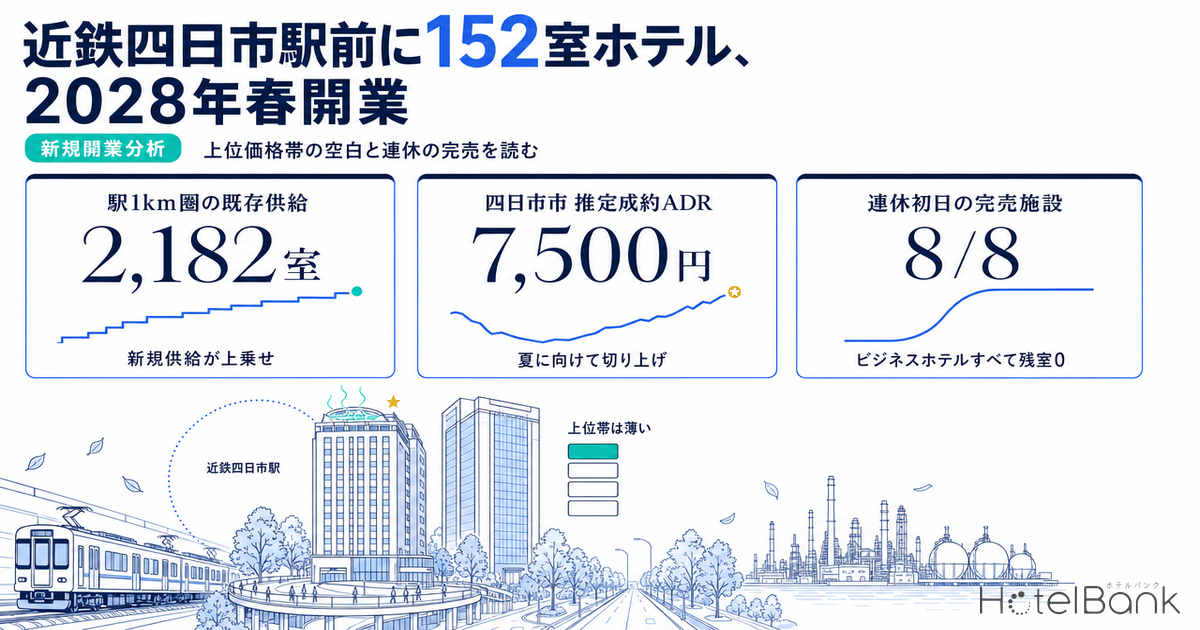
Sanco Real Estate (三交不動産, Tsu) and Sanco Inn Hotels (三交インホテルズ, Nagoya) broke ground on Thursday, April 9, 2026 on the “Yokkaichi Sanco Building ANNEX” (四日市三交ビルANNEX), which they are building along Chuo-dori avenue on the east side of Kintetsu-Yokkaichi Station. Floors 2 through 13 of the 13-story building will house a 152-room hotel, tentatively named “Sanco Inn Grande Yokkaichi” ((仮称)三交イン Grande 四日市), scheduled to open in spring 2028. With a large public bath, open-air bath and sauna on the top (13th) floor and the front desk and breakfast lounge on the 12th, the layout is the Yokkaichi version of “Grande,” the upper-grade brand the company operates in front of Iseshi Station. Existing supply within 1 km of the station is 22 properties and 2,182 rooms, so the 152 rooms equal 7.0% of that base. This article quantifies how open the price band these 152 rooms will enter really is around the station, using recent estimated settled ADR and the pace at which rooms sold down over the September holiday weekend, and evaluates the site — where the Chuo-dori redevelopment and Busta Yokkaichi are under way — in terms of zoning, land prices and flood hazard assumptions.
Metric Definitions Used in This Article
- ADR (average daily rate): An estimated settled rate (tax-exclusive equivalent) calculated by applying segment-specific adjustment factors to the lowest-plan price level each property publishes on OTAs (two guests per room, per-room rate, tax included). When checked against property-level results disclosed by listed hotel REITs (91 properties, most recent three months), the median error is about 7%. These are estimates and differ from each property’s actual settled prices and accounting figures. Area-level ADR is the median of the properties covered (the level of a typical property in the area). This article uses confirmed months through August 2026 as its basis; forward-looking values for September onward are not used as a basis in the text.
- Listed price: The average selling price across all plans published on major booking sites (two guests per room, per-room rate, tax included). This is a separate metric from ADR.
- OCC (occupancy rate): The share of rooms sold relative to total rooms in the area (an estimate based on OTA sales inventory). In this article it is calculated for a fixed cohort of properties that list at least 30% of their total rooms on major booking sites (11 business hotels in Yokkaichi City, 1,307 rooms), and it differs from the actual occupancy of each property as a whole.
- LT (lead time): The number of days until the check-in date. LT0 = the day of arrival. This article uses only observations from LT45 to LT1; properties whose remaining rooms were already at zero before the 45-day mark are described as “sold out 45 or more days before the stay date.” Sell-out LT = the lead time at which remaining rooms first reached zero within LT45 (the larger the value, the earlier the sell-out).
- Data sources: MetroEngines Research & Consulting (property, price and inventory data; all compiled as of the survey date, October 4, 2026); Ministry of Land, Infrastructure, Transport and Tourism (MLIT) Real Estate Information Library (zoning, published land prices, prefectural land price survey, flood assumptions); MLIT National Land Numerical Information (250 m mesh projected future population); Ministry of Internal Affairs and Communications / Ministry of Economy, Trade and Industry Economic Census (employment)
- — 152 rooms, +7.0%: Sanco Inn Grande Yokkaichi (tentative name), opening in spring 2028, adds 7.0% to the existing 22 properties and 2,182 rooms within 1 km of Kintetsu-Yokkaichi Station.
- — ¥9,000 and above is 28.9%: Of the 18 properties and 2,108 rooms for which estimated settled ADR can be calculated, the upper band is 5 properties and 610 rooms, and only 2 properties and 183 rooms (8.7%) are at ¥12,000 or above (confirmed values for August 2026).
- — 8 of 8 properties sold out on the first day of the holiday weekend: On Saturday, September 19, 2026, all 8 business hotels in Yokkaichi City listing at least 30% of their rooms had zero rooms remaining. On weekdays, 11 of 12 sell-out observations occurred within LT13.
- — August ADR −10.1%: Citywide estimated settled ADR was ¥7,500 in August 2026 (the −10.1% is year on year). By contrast, March, the turnaround season, reached ¥9,900 (+45.9% YoY), the peak of the year.
- — About ¥11,800 for a 5% yield: The estimated settled ADR at which room revenue alone reaches 5%, assuming a total project cost of ¥5.0 billion, full-year OCC of 85% and a GOP margin of 45%. Yields across the three scenarios range from 3.3% to 6.0%.
Executive Summary — Upper Band Is 5 Properties and 610 Rooms; 8 Properties Sold Out on the First Day of the Holiday Weekend
To state the conclusion first: the ¥9,000-and-above band that the 152 rooms are aiming for is limited to 5 properties and 610 rooms (28.9%) of the 18 properties and 2,108 rooms within 1 km of the station for which estimated settled ADR can be calculated, and only 2 properties and 183 rooms of those are at ¥12,000 or above. Citywide estimated settled ADR was ¥7,500 in August 2026 (−10.1% year on year); in the summer of the year a large 200-room property opened in March 2026, the market absorbed the supply through occupancy rather than rate. At the same time, on Saturday, September 19, the first day of the three-day weekend, all 8 business hotels in Yokkaichi City that list at least 30% of their rooms on major booking sites reached zero remaining rooms, and on Sunday, September 20, the middle day of the weekend, the cohort of 11 properties and 1,307 rooms reached an (estimated) occupancy rate of 100% at LT15 (September 2026, same-cohort aggregate). Because many properties still have rooms on sale up to the day of arrival on weekdays, revenue for the 152 rooms will have to be built in two layers: “the upper band during holiday weekends and the turnaround season” and “weekday business demand.”
The site sits in a station-front block zoned commercial with a designated floor-area ratio of 600%, and the 2026 published land price at the station-front point was ¥495,000/㎡ (+6.9% year on year), up 22.5% over four years. The Chuo-dori redevelopment and the Busta Yokkaichi bus terminal (12 berths) are moving forward, and Kintetsu-Yokkaichi Station handles 40,407 passengers a day (second on the Kintetsu Nagoya Line after Kintetsu-Nagoya). However, the same block falls within a storm surge inundation assumption of 3 m to under 5 m and a landform category prone to liquefaction, and the product design that places the front desk and baths on the 12th and 13th floors can be read as reflecting both the value of the location and this hazard.
Project Overview — The Second of the Station-Front Twin Towers, Total Project Cost of About ¥5.0 Billion
First, the primary information. According to YOU Yokkaichi (March 26 and April 9, 2026) and the Nikkei (April 9, 2026), the Yokkaichi Sanco Building ANNEX is a 13-story, 64 m-tall mixed-use building rising immediately east of the Yokkaichi Sanco Building (四日市三交ビル) in Hamada-cho (opened August 7, 2025; 14 stories above ground; one of the largest leased office buildings in Mie Prefecture). The site area is about 1,120 ㎡, with retail on the 1st floor and the hotel on floors 2 through 13. The hotel will be operated by Sanco Inn Hotels and will have 152 rooms, with a minimum room size of 15 ㎡ and separate bath and toilet; the front desk, lobby and breakfast lounge will be on the 12th floor, and a large public bath, open-air bath, sauna and after-bath lounge on the 13th. Total project cost is about ¥5.0 billion, the design is by Ishimoto Architectural & Engineering Firm (石本建築事務所), the contractor is Nakano Doken (中野土建), and opening is planned for spring 2028. With the existing Yokkaichi Sanco Building themed on a “great camphor tree” and the ANNEX on a “bright young tree,” the twin towers are intended as a landmark on Chuo-dori.
The brand positioning is also clear. Sanco Inn Hotels operates 15 hotels and 2,092 rooms across Tokyo, Shizuoka, Aichi, Mie, Kyoto and Osaka (company website), and “Grande” is the upper-grade concept it launched in July 2023 with an annex in front of Iseshi Station. Whereas the existing Sanco Inn Yokkaichi-Ekimae (三交イン四日市駅前; 140 rooms, opened 2010) serves business demand, the Nikkei reports that the new hotel aims to welcome tourism, leisure and inbound guests more comfortably, so the company will line up two hotels in different price bands in front of the same station.
On the supply side, the area within 1 km of the station grew from 18 properties and 1,680 rooms in 2016 to 21 properties and 1,995 rooms in 2019 and, after one closure in March 2024, stood at 22 properties and 2,182 rooms in 2026. The 200-room opening in March 2026 is the most recent increment; when the 152 rooms are added in 2028, the total will reach 2,334 rooms if there are no closures, up 38.9% from 2016. A net increase of about 650 rooms in ten years in front of the station of a regional core city is not small.
On the rate side, the market is in the process of taking in this added supply. Yokkaichi City’s estimated settled ADR (all hotel types, N=25 properties) fell from ¥8,300 in August 2025 to ¥7,500 in August 2026, down 10.1% year on year; for business hotels alone it went from ¥8,600 to ¥8,100, down 5.2%. In the summer of the year 200 new rooms came in, rates were below the prior year. That said, looking at June through August of the same period, rates stepped up toward summer — ¥6,300 in June, ¥7,100 in July and ¥7,500 in August — and the (estimated) occupancy rate in September rose to 92.5%, as discussed below. The reasonable reading is that the market absorbed the supply through occupancy while carrying the recovery in rates over to the next phase.
One piece of background that needs to be mentioned is the periodic maintenance shutdowns (turnarounds) at the Yokkaichi petrochemical complex. Estimated settled ADR in March 2026 was ¥9,900 citywide and ¥10,200 for business hotels, jumping 45.9% and 42.4% respectively from March of the prior year (¥6,800 and ¥7,200) to become the highest month of the year. Because worker lodging in a turnaround year fills the low-to-mid price bands around the station all at once, the effect spills over to upper-band properties and pushes up the citywide median. In the business plan for the 152 rooms as well, where to place this “March peak” and the holiday-weekend peaks within annual revenue is a premise of rate design.
Site Evaluation — Commercial Zone at 600%, Station-Front Land Price +6.9%, a Block With a 3–5 m Storm Surge Assumption
The site is in a block on the south side of Chuo-dori, a three-minute walk from Kintetsu-Yokkaichi Station. According to zoning data from the MLIT Real Estate Information Library, the area along Chuo-dori east of the station is a commercial zone with a designated floor-area ratio of 600% and a building coverage ratio of 80%, and the plan to stack 13 stories and 152 rooms on a site of about 1,120 ㎡ works within that allowance. Yokkaichi City is reorganizing Chuo-dori into a pedestrian-centered space under the name “Niwamichi Yokkaichi”; the circular deck “Yonmaru Terrace” was completed on December 20, 2025, and the connecting walkway to Kintetsu-Yokkaichi Station opened on June 13, 2026. On the east side of the station, development of Busta Yokkaichi, a project under direct national government control (12 berths in total for local and highway buses), is progressing, but the designation of its operator was revoked and the operator is undecided at present (Bus Magazine, June 6, 2026).
| Zoning | Commercial zone |
| Designated floor-area ratio / building coverage ratio | 600% / 80% |
| Storm surge inundation assumption (maximum assumed scale) | 3 m to under 5 m |
| Liquefaction tendency | Prone to liquefaction (delta / coastal lowland) |
Land prices are rising with a concentration on a single point in front of the station. The station-front published land price point (Suwasakae-machi 212) went from ¥404,000/㎡ in 2022 to ¥495,000/㎡ in 2026, up 22.5% in four years and 6.9% in 2026 alone, a rate of increase that stands out against Hamada-cho 262 (¥85,900/㎡, +2.8%) and Unomori 1-chome 238 (¥123,000/㎡, +4.2%), both within 400 m of the planned site. In the prefectural land price survey as well, Yasujima 1-chome 124 on the west side of the station was ¥362,000/㎡ (July 1, 2026; +5.5% year on year), so on both sides of the station only the central points are moving at +5–7% a year. This is a phase in which the Chuo-dori redevelopment and the opening of the office building have begun to be priced into station-front land, and Sanco Real Estate’s building a second tower on land it already owns can be described as a choice to receive this land price appreciation on the asset value side rather than through construction cost.
The hazards need to be looked at squarely. The block east of the station falls within Mie Prefecture’s storm surge inundation assumption area (maximum assumed scale, 2021) at an inundation depth of 3 m to under 5 m, within the flood inundation assumption for the Mitaki and Tempaku rivers (maximum assumed scale) at under 0.5 m, and within the tsunami inundation assumption at 0.3 m to under 1 m; the landform classification is delta / coastal lowland, rated “prone to liquefaction.” Yokkaichi is a city where a high share of hotel rooms sits in storm surge inundation assumption areas: in our earlier analysis, 2,512 of the 2,776 rooms assessed were within areas with an inundation depth of 0.5 m or more. The ANNEX plan places the front desk and lobby on the 12th floor and the baths on the 13th, and assigns the low-rise 1st floor to retail. The design intent is not stated in the reports, but a configuration that gathers the core lodging functions on upper floors is consistent with the approach outlined in that earlier analysis of placing power receiving and transforming equipment and guest circulation on upper floors in areas with an inundation depth of 3 m or more.
| Item | Around the planned site (east of the station, along Chuo-dori) | How to read it |
|---|---|---|
| Zoning / floor-area ratio | Commercial zone, 600% / 80% | Suited to a high-rise hotel |
| Storm surge inundation assumption (maximum assumed scale) | 3 m to under 5 m | Move electrical equipment and circulation to upper floors |
| Flood inundation assumption (Mitaki and Tempaku rivers) | Under 0.5 m | Handle with flood barriers and waterproofing of service entry points |
| Tsunami inundation assumption | 0.3 m to under 1 m | Plan for vertical evacuation |
| Liquefaction tendency (landform classification) | Delta / coastal lowland; prone to liquefaction | Foundations and ground improvement are a given |
Residents and employment, the foundation of demand, are also worth a look. The resident population within 1 km of the station is 20,963 (based on the 2020 census), with an estimated 20,861 in 2025 and 19,445 in 2040, down 7.2% from 2020 (down 6.8% from 2025); the share of seniors is 23.7%. On the employment side, there are 2,446 establishments and 28,786 workers within a 1 km radius, of which office-type sectors account for 22.4%, a business cluster with 13.2 workers per hotel room. While the resident population declines gradually, station-front office supply (the Yokkaichi Sanco Building, total floor area of about 13,660 ㎡) is being added, and weekday business demand is expected to move in step with tenant occupancy on the office side.
Competitive Landscape — 18 Properties and 2,108 Rooms Within 1 km of the Station; 5 Properties at ¥9,000 and Above
Within 1 km of the station, there are 18 hotels with 2,108 rooms that are confirmed to be operating and for which estimated settled ADR for August 2026 can be calculated (the 22 properties and 2,182 rooms in the area include small lodging facilities, wedding venues and the like). By type, 16 are business hotels and 2 are city hotels, and opening years range widely from 1974 to 2026. Properties opened in 2000 or earlier number 9 with 1,033 rooms, half of the property count; most recently, 149 rooms were added in December 2022 and 200 rooms in March 2026.
| Property | Rooms | Type | Year opened | Estimated settled ADR band (August 2026) |
|---|---|---|---|---|
| Miyako Hotel Yokkaichi (都ホテル 四日市) | 118 | City | 1991 | ¥12,000 and above |
| Heal Inn Yokkaichi (ヒールイン四日市) | 65 | Business | 1980 | ¥12,000 and above |
| Dormy Inn Yokkaichi (天然温泉緋衣の湯ドーミーイン四日市) | 200 | Business | 2026 | ¥9,000–12,000 |
| Comfort Hotel Yokkaichi (コンフォートホテル四日市) | 149 | Business | 2022 | ¥9,000–12,000 |
| Hotel LiVEMAX Yokkaichi-Ekimae (ホテルリブマックス四日市駅前) | 78 | Business | 2018 | ¥9,000–12,000 |
| Sanco Inn Yokkaichi-Ekimae (三交イン四日市駅前) | 140 | Business | 2010 | ¥7,000–9,000 |
| Super Hotel Kintetsu Yokkaichi-Ekimae Non-Smoking (スーパーホテル近鉄四日市駅前禁煙館) | 80 | Business | 2002 | ¥7,000–9,000 |
| Super Hotel Yokkaichi Route 1 (スーパーホテル 四日市・国道1号沿) | 105 | Business | 2010 | ¥7,000–9,000 |
| Toyoko Inn Kintetsu Yokkaichi Station North Exit (東横INN近鉄四日市駅北口) | 220 | Business | 2017 | ¥7,000–9,000 |
| Yokkaichi Urban Hotel (四日市アーバンホテル) | 141 | Business | 1999 | ¥7,000–9,000 |
| Platon Hotel Yokkaichi (プラトンホテル四日市) | 144 | City | 1979 | ¥7,000–9,000 |
| Yokkaichi City Hotel Annex (四日市シティホテルアネックス) | 152 | Business | 1994 | ¥7,000–9,000 |
| Hotel Econo Yokkaichi (ホテルエコノ四日市) | 144 | Business | 1999 | Under ¥7,000 |
| Reia Hotel Yokkaichi (レイアホテル四日市) | 86 | Business | 2014 | Under ¥7,000 |
| Toei Hotel (トウエイホテル) | 73 | Business | 1990 | Under ¥7,000 |
| Business Hotel Nishiura (ビジネスホテル西浦) | 17 | Business | 2019 | Under ¥7,000 |
| Apoa Hotel Yokkaichi (アポアホテル四日市) | 88 | Business | 1974 | Under ¥7,000 |
| Hotel Castle Inn Yokkaichi (ホテルキャッスルイン四日市) | 108 | Business | 1986 | Under ¥7,000 |
| Total | 2,108 | 18 properties | ||
Recounting rooms by price band makes clear how thin the upper band the 152 rooms will enter is.
| Estimated settled ADR band (August 2026) | Properties | Rooms | Share | Characteristics |
|---|---|---|---|---|
| ¥12,000 and above | 2 | 183 | 8.7% | One city hotel and one small property. No large limited-service hotel |
| ¥9,000–12,000 | 3 | 427 | 20.3% | New, large properties opened in 2022 and 2026, plus a small station-front property |
| ¥7,000–9,000 | 7 | 982 | 46.6% | The core band where station-front limited-service chains cluster. The city’s business hotel median of ¥8,100 also falls here |
| Under ¥7,000 | 6 | 516 | 24.5% | Mainly properties open for more than 20 years. Absorbs turnaround-season demand |
The ¥9,000-and-above band is 5 properties and 610 rooms, a 28.9% share, and narrowing to ¥12,000 and above leaves only 2 properties and 183 rooms (8.7%). If the 152 rooms enter the ¥9,000-and-above band, that band widens to 762 rooms, or 33.7% of 2,260 rooms. Whether the band can make up a third of the market after opening depends on how far the existing upper band is already selling on holiday weekends. The next section looks at that pace of sell-through.
Positioning — Average Sell-Out LT Over the Three-Day Weekend Is 11–43 Days; Weekdays Cluster Within LT13
We start with how bookings come in for the city as a whole. For a cohort of 11 business hotels with 1,307 rooms in Yokkaichi City that list at least 30% of their total rooms on major booking sites, we tracked the (estimated) occupancy rate for each stay date from LT45 to LT1.
For Saturday, September 19, the first day of the holiday weekend, the (estimated) occupancy rate was 67.1% at LT45, 76.2% at LT30, 92.2% at LT14 and 97.9% at LT7, building from an early stage; for Sunday, September 20, the middle day, it was 85.4% at LT30, 99.5% at LT20 and reached 100% at LT15. By contrast, the weekday of Wednesday, September 16 stood at 59.9% at LT30, 78.8% at LT14 and 87.3% at LT7, and Wednesday, September 30 at 84.0% at LT14 and 92.2% at LT7 — a pattern of filling in the final week. Weekdays also ultimately reach around 99% at LT1, but the gap between two weeks out for holiday weekends and one week out for weekdays translates into a difference in the length of time over which rates can be raised. On a monthly basis too, the average (estimated) occupancy rate for September was a high 92.5% (85.2% in August, same cohort), and business hotels around the station can be said to be in a state where demand has caught up with supply.
Next, at the property level, for the 8 properties in Yokkaichi City where a sell-out was observed on Saturday, September 19, we lined up the sell-out LT (the lead time at which remaining rooms first reached zero within LT45) for each stay date in the same week. Of the 189 business hotels in Mie Prefecture, 92 have inventory data and 45 passed the condition of listing at least 30% of their rooms; among those, all 8 properties in Yokkaichi City recorded zero remaining rooms on September 19. We note in advance that N=8 is small, and that the remaining rooms of an individual property are what is left within the allotment published on major booking sites and do not mean that the property as a whole is full.
| Property (anonymized) | Rooms | ADR band | Sep 16 (Wed) | Sep 19 (Sat) | Sep 20 (Sun) | Sep 21 (Mon, holiday) | Sep 22 (Tue) | Sep 23 (Wed, holiday) | Sep 30 (Wed) |
|---|---|---|---|---|---|---|---|---|---|
| Property A | 200 | ¥10,000s | 7 left | LT16 | LT21 | LT18 | 12 left | 43 left | 8 left |
| Property B | 149 | ¥10,000s | LT8 | 45+ days out | 45+ days out | LT40 | LT41 | 17 left | 1 left |
| Property C | 78 | ¥9,000s | LT1 | LT1 | LT18 | LT13 | 22 left | 25 left | 4 left |
| Property D | 140 | ¥8,000s | LT1 | LT7 | LT20 | LT18 | LT1 | 6 left | LT4 |
| Property E | 80 | ¥8,000s | LT1 | LT12 | LT28 | LT18 | 10 left | 4 left | LT20 |
| Property F | 105 | ¥8,000s | LT9 | LT12 | LT28 | LT19 | 12 left | LT1 | LT13 |
| Property G | 144 | ¥6,000s | LT2 | LT18 | LT23 | LT25 | LT5 | 3 left | LT12 |
| Property H | 108 | ¥5,000s | LT2 | LT22 | LT33 | LT26 | LT12 | 8 left | LT5 |
There are two ways to read the table. First, sell-out LT over the three days of the holiday weekend (September 19–21) ranges by property from 1 day to more than 45 days, and there is no simple relationship in which higher-priced properties sell out earlier. Property B, in the ¥10,000s, had zero rooms remaining from 45 or more days out for both September 19 and 20 (for September 19, 24 rooms of returned inventory were observed at LT25 and it sold out again at LT4), while Property H, in the ¥5,000s, also sold out at LT22–33 on all three days. How early a property sells out is determined less by rate than by the size of the allotment it puts on major booking sites and by its sales policy. Second, on the weekdays of Wednesday, September 16 and Wednesday, September 30, 11 of the 12 sell-out observations were concentrated close to arrival, within LT13 (LT20 at the longest), and several properties, including the 200-room Property A and Property B in the ¥10,000s, still had rooms remaining up to the day of arrival. The larger the property, the more it keeps rooms on sale on weekdays to catch last-minute demand, and the character of the market switches between holiday weekends and weekdays.
Plotted as a scatter chart, the ¥9,000-and-above band has only three points — Properties A, B and C — and their sell-out LTs are scattered from 10.7 to 43.3 days. Overlaying the assumed band for the 152 rooms (¥10,000–13,000), there is one data point in the same band, Property B, that sells out early on holiday weekends, while Property C, in the ¥9,000s, is a close-to-arrival type even on the holiday weekend, at an average of 10.7 days. In other words, “properties that sell out early” and “properties that hold out at high prices until close to arrival” coexist in the upper band, and the feasibility of the ADR the 152 rooms need changes depending on which way of selling they choose.
Movements in listed prices also serve as a guide. Listed prices (all-plan average, tax included) for Saturday, September 19, the first day of the holiday weekend, were ¥43,600 at Property B and ¥40,200 at Property A, both in the ¥10,000s, and ¥51,700 at Property C in the ¥9,000s — running at 1.7 to 3.0 times the levels for the weekday of Wednesday, September 16 (¥18,000, ¥23,800 and ¥17,400 respectively) before reaching zero remaining rooms. The upper band on holiday weekends has demand that sells out even at listed levels of ¥40,000–50,000, and this is the deepest source of revenue in rate design for the 152 rooms.
Crowded ¥7,000–9,000 × 80–220 rooms
7 properties, 982 rooms (46.6%). Station-front limited-service chains line up here; it is the core band for business demand, filling between the day of arrival and LT13 on weekdays. If the 152 rooms enter the same band, they overlap head-on with existing properties.
Whitespace 1 ¥10,000–13,000 × limited-service hotel with 100–200 rooms
Currently 3 properties and 427 rooms. There is a track record of selling out at listed levels of ¥40,000–50,000 on holiday weekends, and a product design with a large public bath, sauna and separate bath and toilet can aim for the top end of this band.
Whitespace 2 ¥12,000 and above × large scale
Only 2 properties and 183 rooms, and no large limited-service hotel exists. A band reachable only in the turnaround season (March) and on holiday weekends; difficult to set as a full-year base rate.
A product design that places a large public bath, open-air bath and sauna on the top floor provides grounds for a premium into this band. In our earlier analysis of large public baths and rate differentials at business hotels (4,925 properties), after matching on municipality, scale, building age and brand, full-spec large baths with both hot spring water and a sauna showed a differential of +9.3% (95% interval +6.5% to +12.1%), and +14.8% when limited to mid-tier cities where the business hotel median is ¥7,000–9,000. Yokkaichi City’s business hotel median is ¥8,100, which fits this mid-tier city condition. Adding 14.8% to ¥8,100 gives about ¥9,300, and adding the premium for room specifications — a 15 ㎡ minimum and separate bath and toilet — makes around ¥10,000 the full-year base rate that can be derived from the product design. It would be realistic to treat ¥12,000 and above separately as an upside band for holiday weekends and the turnaround season.
Development Scenario Estimates — The Rate Needed for a 5% Yield on a Total Project Cost of ¥5.0 Billion
Taking the reported total project cost of about ¥5.0 billion as given, we made a simple estimate of how far the investment yield (GOP ÷ total project cost) can reach on room revenue from the 152 rooms alone. Project cost per room is about ¥33 million, a figure that includes the 1st-floor retail and the bath floor. We set the GOP margin at 45%. GOP results for the 91 operating properties disclosed by Invincible Investment Corporation (インヴィンシブル投資法人) were 38.9% (fiscal period ended December 2024), and the rule of thumb for limited-service hotels is said to be 50–60%, so we adopted 45% as a midpoint for a limited-service hotel carrying a large public bath. Because retail rent, ancillary revenue from breakfast and bathing facilities, and the company-owned land are not included, actual project economics will come out above this table.
| Estimated settled ADR (tax-exclusive equivalent) | Room revenue (full-year OCC 80%) | Yield | Room revenue (full-year OCC 85%) | Yield | Room revenue (full-year OCC 90%) | Yield |
|---|---|---|---|---|---|---|
| ¥9,000 | ¥399 million | 3.6% | ¥424 million | 3.8% | ¥449 million | 4.0% |
| ¥10,500 Assumed band | ¥466 million | 4.2% | ¥495 million | 4.5% | ¥524 million | 4.7% |
| ¥12,000 Assumed band | ¥533 million | 4.8% | ¥566 million | 5.1% | ¥599 million | 5.4% |
| ¥13,500 | ¥599 million | 5.4% | ¥637 million | 5.7% | ¥674 million | 6.1% |
Achieving a 5.0% yield on room revenue alone requires an estimated settled ADR of about ¥11,800 on the premise of full-year OCC of 85%, rising to about ¥13,300 if the GOP margin is set at 40%. This is a level that runs from the top end of the station-front upper band (¥10,000–12,000) into the ¥12,000-and-above band that only one city hotel has reached. Conversely, at the full-year base of around ¥10,000 derived from the product design, the yield stays in the low 4% range, and the structure is one in which the gap is filled by upside during holiday weekends and the turnaround season and by retail and ancillary revenue. Cross-checking from the construction cost side, multiplying the 2025 actual figure based on MLIT’s Building Starts Statistics (steel structure, ¥2.405 million per tsubo) by a gross floor area of 40 ㎡ per room (including common areas) gives a construction cost of about ¥4.4 billion for 152 rooms, and once the bath floor and construction cost increases in 2027–28 are factored in, a total project cost of ¥5.0 billion is within a reasonable range. In a phase where construction costs keep rising, later entrants into the same band are held back, so some easing of competition with the existing upper band can also be factored in.
Three Scenarios and the Range of Rates Needed for a 5% Yield
The table above fixes the GOP margin at 45%. When rate, occupancy and GOP margin are all varied at once, the yield on room revenue alone falls within the following range. The pessimistic case assumes about ¥9,300, reflecting only the large-bath premium (business hotel median of ¥8,100 × 1.148), with full-year OCC of 80% and a GOP margin of 40%; the base case assumes ¥10,500, the bottom of the assumed band, with full-year OCC of 85% and a GOP margin of 45%; and the optimistic case assumes ¥12,000 with full-year OCC of 90% and a GOP margin of 50% (the lower bound of the rule of thumb for limited-service hotels).
| Scenario | Estimated settled ADR | Full-year OCC | GOP margin | Room revenue | GOP | Yield |
|---|---|---|---|---|---|---|
| Pessimistic | ¥9,300 | 80% | 40% | ¥413 million | ¥165 million | 3.3% |
| Base | ¥10,500 | 85% | 45% | ¥495 million | ¥223 million | 4.5% |
| Optimistic | ¥12,000 | 90% | 50% | ¥599 million | ¥300 million | 6.0% |
| GOP margin | Full-year OCC 80% | Full-year OCC 85% | Full-year OCC 90% |
|---|---|---|---|
| 40% | About ¥14,100 | About ¥13,300 | About ¥12,500 |
| 45% | About ¥12,500 | About ¥11,800 | About ¥11,100 |
| 50% | About ¥11,300 | About ¥10,600 | About ¥10,000 |
Even the base case, at 4.5%, falls short of 5%, and the pessimistic case drops to 3.3%. The required rate moves by about ¥1,100–1,600 for every 5-point change in GOP margin; at full-year OCC of 85%, it is about ¥13,300 at 40% and about ¥10,600 at 50%. In other words, whether 5% can be reached hinges, before rate, on whether the operating structure can lift the GOP margin close to 50% while carrying a large public bath and sauna. The 6.0% in the optimistic case is reasonably read as the upper limit for a case in which upside during holiday weekends and the turnaround season pushes the full-year average up to ¥12,000 and weekday occupancy is locked in at 90%.
The above is a simple estimate based on reported figures and industry benchmarks; an actual investment decision requires a detailed feasibility study.
Framing the Investment Decision — Conditions for Entering the Upper Band in a Regional Business City
Yokkaichi has 1.7 times the station passengers of the prefectural capital, Tsu, and thick business demand from turnarounds at the petrochemical complex and from station-front office supply, yet its upper band of limited-service hotels is thin. The 152-room plan is a project that sets out to fill this band with a product design of “large public bath, sauna, and separate bath and toilet,” and it serves as a reference case for developers, railway-affiliated real estate companies and regional banks considering regional core cities with the same structure (second cities whose hotel rates exceed those of their prefectural capital, or Toyohashi and Toyokawa, where 327 rooms are opening). Risk factors and opportunity factors are set out below.
| Item | Details | Assessment |
|---|---|---|
| Demand (holiday weekends / turnarounds) | 8 properties sold out on Sep 19 (Sat); (estimated) occupancy rate of 100% at LT15 for Sep 20 (Sun) (September 2026 aggregate). Estimated settled ADR +45.9% in March | Upside potential for the upper band |
| Demand (weekdays) | Sell-outs concentrate at LT1–13, and several properties have rooms remaining up to the day of arrival. Weekday base rates center on the ¥7,000–9,000 band | A full-year ADR of around ¥10,000 is realistic |
| Supply | +200 rooms in 2026 and +152 rooms in 2028 bring the 1 km area to 2,334 rooms (+38.9% vs. 2016). ADR in August 2026 was −10.1% year on year | Absorption requires an occupancy-first period |
| Location | Commercial zone at 600%, station-front land price +6.9%, Chuo-dori redevelopment and Busta Yokkaichi (operator undecided) | Benefits from concentration at the station front |
| Hazards | Storm surge of 3–5 m and liquefaction-prone landform. Front desk and baths placed on the 12th–13th floors | Upper-floor placement of electrical equipment and ground measures |
| Economics | Total project cost ¥5.0 billion; a 5% yield requires estimated settled ADR of about ¥12,000 (full-year OCC 85%, GOP 45%). Supplemented by retail and ancillary revenue | A two-pillar approach of rate and ancillary revenue |
There are three things to confirm over the two and a half years until opening. The first is how far absorption of the 200 rooms that opened in March 2026 brings rates back by the summer of 2027. If the −10.1% of August 2026 has reversed the following year, the 152 rooms can enter at a higher base rate. The second is the operator and opening timing of Busta Yokkaichi: if highway bus arrivals and departures are consolidated on the east side of the station, the flow of leisure and inbound travelers from the Nagoya and Osaka directions will pass right in front of the planned site. The third is the turnaround cycle: if 2026 is a turnaround year, the next peak in 2028–29 will shape revenue immediately after opening.
Conclusion
The 152 rooms in front of Kintetsu-Yokkaichi Station are a 7.0% addition to the 2,182 rooms within 1 km of the station and, at the same time, a plan that brings the first large limited-service hotel into the ¥9,000-and-above band, which currently holds only 5 properties and 610 rooms. Over the three-day weekend in September, all 8 properties listing at least 30% of their rooms sold out on the first day, and even the upper band sold out at listed levels of ¥40,000–50,000; on weekdays, however, many properties still have rooms on sale up to the day of arrival, and citywide ADR in August 2026 was down 10.1% year on year, with the market still in the middle of absorbing the added supply through occupancy. The full-year base rate that can be derived from the product design is around ¥10,000, while the rate at which the yield reaches 5% on a total project cost of ¥5.0 billion is about ¥12,000, and the structure is one in which that gap is filled by upside during holiday weekends and the turnaround season and by retail and ancillary revenue. The site is a central block zoned commercial at 600% with station-front land prices up 6.9%, and against the storm surge hazard of 3–5 m the developer chose a design that places the front desk and baths on the 12th and 13th floors. For operators considering the upper band in regional business cities, this is a project in which the two-layer revenue design — “lock in occupancy with weekday business demand, and capture rate on holiday weekends and during turnarounds” — can be confirmed in numbers.
References and Sources
■ Data sources
Property, price and inventory data are compiled by MetroEngines Research & Consulting (based on listings on major booking sites, as of October 4, 2026). The area within 1 km of the station is a 1 km radius centered on Kintetsu-Yokkaichi Station (lat34.9667/lng136.6186); estimated settled ADR uses confirmed months only (July 2024 to August 2026). The (estimated) occupancy rate and booking curves are for a fixed cohort of 11 business hotels with 1,307 rooms in Yokkaichi City that list at least 30% of their total rooms (LT45 to LT1). Zoning, land prices and flood assumptions are from the MLIT Real Estate Information Library; the project overview is based on reports by the Nikkei and YOU Yokkaichi.
■ Estimate assumptions
152 rooms × 365 days, total project cost of about ¥5.0 billion (reported figure), yield = GOP ÷ total project cost. The basic case uses a GOP margin of 45%; the three scenarios use 40% for the pessimistic case and 50% for the optimistic case, with full-year OCC of 80–90%. Retail rent, ancillary revenue from breakfast and bathing facilities, and the company-owned land are not included. The starting point for the full-year base rate is about ¥9,300, obtained by adding the +14.8% differential for full-spec large baths (from our earlier analysis) to the Yokkaichi City business hotel median of ¥8,100. Construction cost was cross-checked at ¥2.405 million per tsubo for steel structures (2025 Building Starts Statistics) × a gross floor area of 40 ㎡ per room.
■ Limitations and caveats
Estimated settled ADR is an estimate derived from prices published on OTAs and differs from each property’s actual settled prices and accounting figures. The sell-out observations are a small sample (N=8), and remaining rooms are figures within the allotment published on major booking sites and do not mean that a property as a whole is full. The position of the planned site and the floor configuration are approximations based on news reports. The estimates are simple calculations on room revenue only and do not reflect changes in construction costs, labor costs or interest rates at the time of opening (2028), or differences in operating structure such as a lease versus a management contract.
■ Market data
- MetroEngines Research & Consulting — Room supply time series within 1 km of the station (based on listings on major booking sites); Yokkaichi City estimated settled ADR (all hotel types N=25 properties, business hotels N=18 properties; confirmed months from July 2024 to August 2026); property-level estimated settled ADR (N=18 properties); booking curves and (estimated) occupancy rate (11 business hotels with 1,307 rooms in Yokkaichi City); property-level remaining-room trends (92 properties with inventory data and 45 listing at least 30% of rooms, among 189 business hotels in Mie Prefecture); listed prices (stays from September 14 to 23, 2026). All as of October 4, 2026
■ Government statistics and public data
- MLIT Real Estate Information Library — Zoning, published land prices (2022–2026), prefectural land price survey (2022–2026), storm surge inundation assumption areas (Mie Prefecture, 2021), flood inundation assumption areas (maximum assumed scale), tsunami inundation assumptions, liquefaction tendency map based on landform classification
- MLIT National Land Numerical Information — Projected future population by 250 m mesh (2024 National Spatial Planning and Regional Policy Bureau estimate)
- Ministry of Internal Affairs and Communications / Ministry of Economy, Trade and Industry, “Economic Census for Business Activity” (2021); 2020 Population Census, small areas (e-Stat Statistics GIS)
- Kintetsu Railway, “Passengers by Station: Nagoya Line and Suzuka Line” (survey date: November 11, 2025)
- MLIT, “Building Starts Statistics Survey” (2025 estimated construction cost by structure; steel structure, ¥2.405 million per tsubo)
- Yokkaichi City, “Yonmaru Terrace connecting walkway opens” (June 2026)
■ REIT and industry reports
- Invincible Investment Corporation, hotel portfolio (operating results and GOP)
- Sanco Inn Hotels, “Company Profile” (15 hotels, 2,092 rooms)
■ News and press releases
- YOU Yokkaichi, report on the “Yokkaichi Sanco Building ANNEX” plan (March 26, 2026)
- YOU Yokkaichi, “Groundbreaking ceremony held at the Yokkaichi Sanco Building ANNEX construction site; a new landmark to rise on Chuo-dori” (April 9, 2026)
- Nikkei, “Sanco Real Estate holds groundbreaking for hotel-led mixed-use building; to open in Yokkaichi, Mie, in spring 2028” (April 9, 2026)
- YOU Yokkaichi, “Yokkaichi Sanco Building opens on Chuo-dori, where redevelopment is advancing” (August 7, 2025)
- Bus Magazine, “Yokkaichi’s new symbol ‘Yonmaru Terrace’ is complete! But the Busta operator is undecided after its designation was revoked?” (June 6, 2026)
- Iseshima Tourism & Convention Organization, “Sanco Inn Iseshi-Ekimae Annex Grande”