

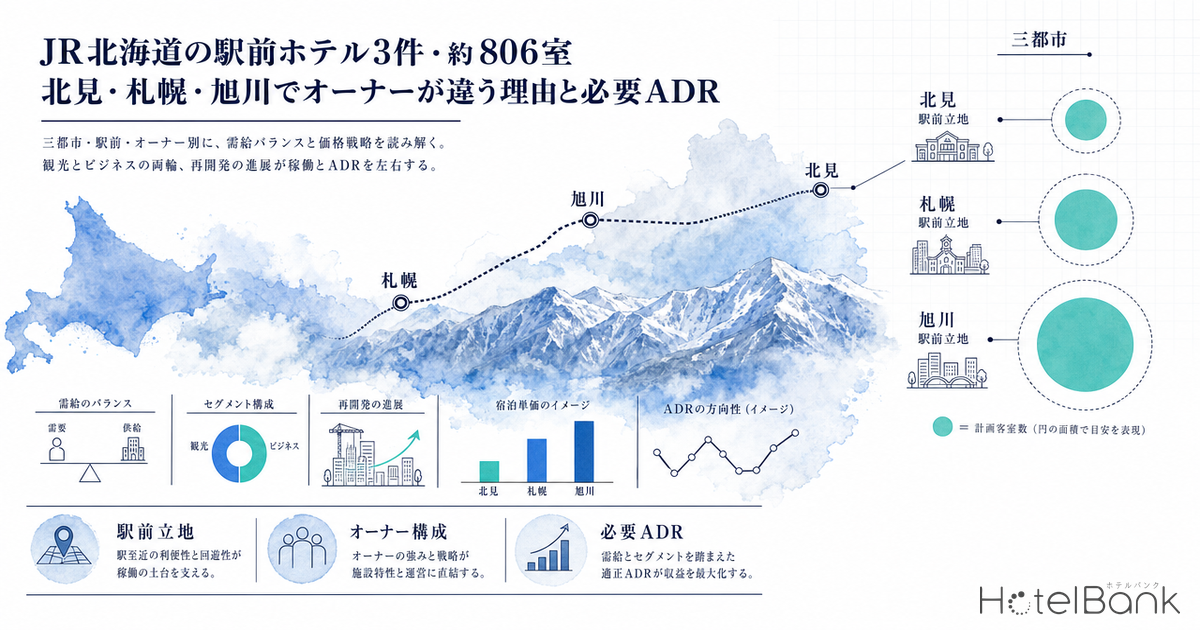
On May 20, 2026, the JR Hokkaido Group announced plans for three new hotels: 206 rooms in Kitami, about 280 rooms in Sapporo, and about 320 rooms in Asahikawa, for a total of roughly 806 rooms. All three will be operated by JR Hokkaido Hotels (JR北海道ホテルズ), but the entity that owns each building is different: Alpha Court (アルファコート) in Kitami, ESCON (エスコン) in Sapporo, and JR Hokkaido itself in Asahikawa. This article looks at how this “one operator, separate owners” structure affects rent design and exit options, and sets the estimated settled ADR and estimated OCC of the three cities beside the required ADR back-calculated from each project’s gross floor area.
Metric Definitions Used in This Article
*Metric definitions used in this article: ADR (average daily rate) = an estimated settled rate (tax-exclusive equivalent) calculated by applying a category-specific adjustment factor to the lowest plan level each property publishes on OTAs (two guests in one room, price per room, tax included). When checked against the property-level results disclosed by listed hotel REITs (184 property-months, April–May 2026), the median error is 7.5%. These are estimates and differ from each property’s actual settled prices and accounting figures. Area-level ADR is the median of the properties covered (the level of a typical property in the area). OCC (occupancy rate) = rooms sold as a share of total rooms in the area (an estimate based on OTA sales inventory; consistency checks against monthly REIT disclosures confirm accuracy to within a few points). Where listed prices are mentioned, they are the price per room for two guests in one room (tax included).
LT (lead time) = the number of days until the check-in date. The booking curves in this article run from LT45 to LT1. Estimated OCC is an estimate based on how inventory sold on OTAs is being taken up, and differs from a property’s actual overall occupancy. All ADR figures are for closed months (September 2025–August 2026), and the survey date is October 3, 2026. Data source: MetroEngines Research.
- — 3 projects, approx. 806 rooms: Kitami 206, Sapporo approx. 280, Asahikawa approx. 320. JR Hokkaido Hotels operates all three, but the project owners are Alpha Court, ESCON and JR Hokkaido respectively.
- — Seasonal spread of 1.31x versus 2.39x: The peak-to-trough range of estimated settled ADR is narrow in Kitami, which suits fixed rent, and wide in Sapporo’s Chuo Ward, a market where variable rent or a management contract is easier to consider.
- — Required ADR (building only, 80% occupancy): Kitami ¥7,200–9,000 (1.07–1.34x the market), Sapporo ¥12,300–16,100 (0.85–1.12x), Asahikawa ¥13,700–18,700 (1.6–2.2x).
- — Sapporo depends on land: Every additional ¥10 million of investment per room raises required ADR by about ¥5,100. Once the land burden exceeds ¥4.5 million per room, the ward average is no longer enough.
- — Asahikawa needs touring-base pricing: In July, estimated settled ADR in Furano and Biei is about twice that of Asahikawa. Asahikawa’s estimated OCC in July is 94.3% (at LT1), and the question is whether the hotel can create a new price tier.
The Plan at a Glance: Limited-Service in Kitami, a New Brand in Sapporo and Asahikawa
We start with what the announcement says. Kitami will be the seventh property of the limited-service “JR Inn” brand: 206 rooms in a building with nine floors above ground and one below, a one-minute walk from Kitami Station, opening in FY2027. In Sapporo, a new-brand hotel with 17 floors above ground, one below and about 280 rooms is planned for FY2028 at Kita 3-jo Nishi 2-chome, a five-minute walk from the south exit of Sapporo Station. In Asahikawa, the second property of the new brand, with 16 floors above ground and about 320 rooms, is planned for FY2029 on company-owned land next to the Asahikawa branch office, a four-minute walk from Asahikawa Station. For Sapporo and Asahikawa the company states that the details are “currently under consideration and may change,” and the figures in this article should be read on that basis.
| Item | JR Inn Kitami (JRイン北見) | (Tentative) Chuo-ku Kita 3 Nishi 2 Hotel | (Tentative) Asahikawa Miyashita-dori 6-chome Hotel |
|---|---|---|---|
| Type | Limited-service | New brand (under consideration) | New brand (under consideration; second property) |
| Location | Odori Higashi 1-chome 5, Kitami | Kita 3-jo Nishi 2-chome 1, Chuo Ward, Sapporo | Miyashita-dori 6-chome 1, Asahikawa |
| Distance from station | 1-minute walk from Kitami Station | 5-minute walk from Sapporo Station south exit | 4-minute walk from Asahikawa Station |
| Site area | 1,151㎡ | 1,076㎡ | 3,420㎡ |
| Gross floor area | 5,298㎡ | approx. 11,000㎡ | approx. 14,000㎡ |
| Floors | 9 above ground, 1 below | 17 above ground, 1 below | 16 above ground |
| Rooms | 206 | approx. 280 | approx. 320 |
| Gross floor area per room | approx. 25.7㎡ | approx. 39.3㎡ | approx. 43.8㎡ |
| Planned opening | FY2027 | FY2028 | FY2029 |
| Project owner | Alpha Court Co., Ltd. | ESCON Co., Ltd. | Hokkaido Railway Company |
| Operator | JR Hokkaido Hotels Co., Ltd. (all three projects) | ||
What stands out in the table is gross floor area per room. Kitami’s roughly 25.7㎡ is a standard figure for a limited-service hotel, whereas Sapporo allocates about 39.3㎡ and Asahikawa about 43.8㎡ per room, 1.5–1.7 times as much floor as Kitami. Because the figure includes common areas it says nothing direct about guest room size, but it suggests the new brand is being designed with generous common functions such as a lobby, food and beverage outlets and bathing facilities. The company is reported to be launching a new brand from FY2028, following “Hotel Nikko” and “JR Inn,” but its price positioning has not been announced.
Three Owner Types: Same Operator, Different Sources of Capital
The defining feature of the three projects is that the operator is fixed while the entity holding the building changes from project to project. Railway companies have traditionally built hotels on their own land and held them on their own balance sheet; this time a local developer, a listed developer and the company itself appear side by side. Below we set out each structure, separating announced facts from general contracting practice. Note that the contract type (lease or management contract) and rent terms have not been disclosed for any of the three; what follows is an outline of the options the structure allows.
How rent and management fees are set depends on the character of the owner. In Kitami and Sapporo, where a third party holds the building, an owner that prioritizes stable income will lean toward a lease weighted to fixed rent, while one that wants a share of hotel earnings growth will lean toward variable rent or a management contract (MC). Fixed rent weighs heavily on the operator in slow months, but any sales upside stays with the operator. As a rule of thumb in practice, the smaller the seasonal swing in a market, the better it suits fixed rent; the larger the swing, the more both sides benefit from building in a variable component. As discussed below, the seasonal spread in ADR is a narrow 1.31x in Kitami and a wide 2.39x in Sapporo’s Chuo Ward. Even within the same “third-party ownership” category, the market environment makes a fixed-leaning design easier to consider in Kitami and a variable-leaning one in Sapporo.
Exit options also differ by type. A hotel with a long-term lease is an asset that private funds and REITs find easy to acquire, because the rent is fixed as cash flow. A special-purpose company cannot operate a hotel itself and therefore acquires on the premise of a lease, and a contract with a railway-affiliated operator as tenant fits that premise well. Self-developed Asahikawa will presumably be held without a sale in mind, but once occupancy stabilizes there is room to recover capital through a sale-and-leaseback and recycle it into the next opening.
| Aspect | Type 1: Local developer (Kitami) | Type 2: Listed developer (Sapporo) | Type 3: Self-development (Asahikawa) |
|---|---|---|---|
| Land | Secured by the project owner | Acquired by the project owner in October 2023 | Company-owned land (no acquisition cost) |
| Who bears the building investment | Project owner | Project owner | JR Hokkaido |
| Operator’s initial outlay | Mainly FF&E and pre-opening costs | Mainly FF&E and pre-opening costs | The full amount, as a group |
| Possible contracts | Lease based mainly on fixed rent | Fixed plus variable rent, or MC | Intra-group lease or management contract |
| Who bears earnings volatility | Mainly the operator | Shared, depending on rent design | The group as a whole |
| Likely exit | Long-term hold, or sale with lease in place to a private fund or REIT | Sale to lock in development profit, or long-term hold within the group | Continued ownership; sale-and-leaseback after stabilization is an option |
Do hotels in regional cities find buyers? There are precedents. Among properties held by listed hotel REITs, Invincible Investment Corporation (インヴィンシブル投資法人) acquired Comfort Hotel Kitami (コンフォートホテル北見, 127 rooms) for ¥851 million in January 2016 and Art Hotel Asahikawa (アートホテル旭川, 265 rooms) for ¥3,197 million in July 2019, and Hoshino Resorts REIT (星野リゾート・リート投資法人) acquired Hotel WBF Grande Asahikawa (ホテルWBFグランデ旭川, 120 rooms) for ¥3,000 million in May 2025. Per room, that works out to about ¥6.7 million, about ¥12.1 million and about ¥25 million; the more recent the acquisition, the higher the level. It is worth noting that station-front hotels with leases in place have been acquisition targets for institutional investors even in cities the size of Kitami and Asahikawa.
Location and Land Prices: Land Weighs Heavily in Sapporo; in Kitami and Asahikawa the Building Is Nearly the Whole Investment
All three sites are in station-front commercial districts, but land prices differ by orders of magnitude. Taking the commercial standard sites around each site from the Ministry of Land, Infrastructure, Transport and Tourism’s 2026 official land prices, Kitami is ¥54,500 per ㎡ (−1.8% YoY) and Asahikawa ¥253,000 (0.0%), whereas Sapporo reaches ¥1,180,000 (+12.4%) at a point about 320m from the site and ¥7,300,000 (+5.0%) about 220m away on the Sapporo Ekimae-dori side. Compared with 2021, five years earlier, the two Sapporo points rose +67.6% and +36.4%, while Kitami fell −4.0% and Asahikawa −2.3%.
| Project site | Nearby standard site (commercial) | Distance from project site | 2026 official land price (¥/㎡) | YoY | vs. 2021 | Designated floor area ratio |
|---|---|---|---|---|---|---|
| Kitami | Kitami 5-1 (Odori Nishi 2-chome) | approx. 270m | 54,500 | −1.8% | −4.0% | 600% |
| Sapporo | Sapporo Chuo 5-23 (Kita 2-jo Higashi 1-chome) | approx. 320m | 1,180,000 | +12.4% | +67.6% | 600% |
| Sapporo | Sapporo Chuo 5-34 (Kita 4-jo Nishi 4-chome) | approx. 220m | 7,300,000 | +5.0% | +36.4% | 800% |
| Asahikawa | Asahikawa 5-7 (2-jo-dori 8-chome) | approx. 320m | 253,000 | 0.0% | −2.3% | 600% |
This gap changes the makeup of the investment. Simply multiplying Kitami’s 1,151㎡ site by the unit price of the nearby standard site gives only about ¥60 million, or about ¥0.3 million per room, so the investment is determined almost entirely by the building. The same calculation for Asahikawa gives about ¥870 million, or about ¥2.7 million per room, but because the land is already owned it involves no new outlay. Sapporo’s 1,076㎡, by contrast, comes to a range of about ¥1.3–7.9 billion, or about ¥4.5–28 million per room, when the unit prices of the two surrounding points are applied (reference values from mechanically multiplying official land prices, not actual transaction prices). Sapporo is the only site where land may weigh as much as the building, and it is a location where a division of labor makes sense: a listed developer secures the land first, and the operator responds with rent.
Estimated Settled ADR in the Three Cities: Flat in Kitami, Twin Peaks in Asahikawa, a February Peak in Sapporo Chuo Ward
Next we look at pricing in the markets that will receive these rooms. According to MetroEngines Research data, the 12-month average estimated settled ADR for September 2025–August 2026 was about ¥6,700 in Kitami (N=26–29), about ¥8,600 in Asahikawa (N=34–38) and about ¥14,400 in Sapporo’s Chuo Ward (N=130–139). Compared with the preceding 12 months, Kitami rose +5.4% and Sapporo Chuo Ward +11.1%, while Asahikawa was roughly flat at −1.2%.
More notable than the level is the seasonal shape. In Kitami the lowest month, April, is about ¥5,900 and the highest, August, about ¥7,800, a peak-to-trough spread of just 1.31x. Asahikawa has two peaks, in January (about ¥10,100) and February (about ¥10,500) and in July (about ¥12,100), with a floor of about ¥5,700 in April, widening the spread to 2.13x. Sapporo Chuo Ward peaks at about ¥20,600 in February and bottoms at about ¥8,600 in April, a spread of 2.39x and the largest swing of the three. Year on year, Kitami’s August 2026 was +8.2% and Asahikawa’s January 2026 +32.7%, showing winter gains, while Asahikawa’s July was −10.6% and Sapporo Chuo Ward’s August −10.5%, with summer rates below the prior year.
| Month | Kitami (¥) | YoY | Asahikawa (¥) | YoY | Sapporo Chuo Ward (¥) | YoY |
|---|---|---|---|---|---|---|
| Jan 2026 | 6,116 | +7.8% | 10,101 | +32.7% | 14,921 | +30.2% |
| Feb 2026 | 6,729 | +11.2% | 10,508 | +7.6% | 20,635 | +6.1% |
| Mar 2026 | 6,229 | +9.5% | 6,836 | +8.1% | 12,401 | +19.2% |
| Apr 2026 | 5,926 | −1.4% | 5,679 | −2.8% | 8,641 | +5.2% |
| May 2026 | 6,582 | +3.6% | 6,956 | −9.8% | 13,025 | +5.9% |
| Jun 2026 | 6,962 | +3.6% | 8,884 | −21.9% | 13,820 | −2.1% |
| Jul 2026 | 7,696 | +7.1% | 12,092 | −10.6% | 18,147 | +3.9% |
| Aug 2026 | 7,767 | +8.2% | 9,991 | −24.0% | 16,413 | −10.5% |
| Sep 2025 | 7,332 | +5.0% | 9,811 | +8.0% | 15,035 | +18.6% |
| Oct 2025 | 6,736 | +0.7% | 8,456 | +11.8% | 12,688 | +22.9% |
| Nov 2025 | 6,204 | +6.6% | 7,134 | +18.2% | 12,654 | +29.7% |
| Dec 2025 | 5,993 | +3.1% | 6,814 | +5.1% | 14,704 | +30.8% |
| 12-month average | 6,689 | +5.4% | 8,605 | −1.2% | 14,424 | +11.1% |
This difference in shape determines which months new rooms will matter in. Kitami is a flat market underpinned by business demand, and its shallow trough makes it easier to build revenue at a similar rate throughout the year. Asahikawa and Sapporo have higher peaks but a deep trough in April, and in half the months of the year rates sit below the average. The new brand’s choice of generous common areas can also be read as an attempt to give guests reasons other than lodging to choose it in trough months.
Room Stock and Estimated OCC: +9.3% in Kitami, +6.7% in Asahikawa, +1.0% in Sapporo Chuo Ward
How large, then, are the planned rooms relative to the existing market? Counting properties for which listed prices were observed between October 2025 and August 2026, Kitami had 37 properties and 2,208 rooms, Asahikawa 103 properties and 4,766 rooms, and Sapporo Chuo Ward 236 properties and 29,146 rooms. Adding the planned rooms increases stock by +9.3% in Kitami, +6.7% in Asahikawa and +1.0% in Sapporo Chuo Ward. Narrowed to business and city hotels, the addition is +11.2% against 25 properties and 1,846 rooms in Kitami and +7.8% against 33 properties and 4,123 rooms in Asahikawa, so the new hotels loom even larger among their direct comparables.
| City | Properties with listed prices | Rooms | Of which business / city hotels | Planned rooms | vs. total | vs. business / city |
|---|---|---|---|---|---|---|
| Kitami | 37 properties | 2,208 rooms | 25 properties / 1,846 rooms | 206 rooms | +9.3% | +11.2% |
| Asahikawa | 103 properties | 4,766 rooms | 33 properties / 4,123 rooms | approx. 320 rooms | +6.7% | +7.8% |
| Sapporo Chuo Ward | 236 properties | 29,146 rooms | 138 properties / 25,408 rooms | approx. 280 rooms | +1.0% | +1.1% |
We also check how full the receiving markets are. Looking at the monthly average of estimated OCC as of the day before the stay (LT1), June–September 2026 ran at 84.8–89.7% in Kitami, 87.4–94.3% in Asahikawa and 92.5–94.0% in Sapporo Chuo Ward. All three cities are at high levels from summer into early autumn, and Asahikawa’s July in particular, at 94.3%, is on par with Sapporo Chuo Ward’s 94.0%.
| Month (2026) | Kitami | Asahikawa | Sapporo Chuo Ward |
|---|---|---|---|
| June (10th–30th) | 85.7% | 89.2% | 92.5% |
| July | 86.2% | 94.3% | 94.0% |
| August | 84.8% | 87.4% | 92.9% |
| September | 89.7% | 89.7% | 92.7% |
| Coverage (properties listed on major booking sites) | 14–17 properties / 941–1,250 rooms | 19–29 properties / 2,414–2,826 rooms | 88–112 properties / 14,188–15,981 rooms |
Each city fills in its own way. For September 2026 stays, Kitami built up 22.9pt, from 66.8% at LT45 to 89.7% at LT1, the largest late pickup of the three cities. The pattern suggests a high share of demand decided at short notice, such as business trips. Asahikawa built up 17.3pt, from 72.4% to 89.7%, and Sapporo Chuo Ward 20.0pt, from 72.7% to 92.7%; in Asahikawa’s July alone, 80.4% was already filled at LT45. The Asahikawa market has two faces: it fills early at tourism peaks and picks up late in ordinary periods.
If rooms alone were added while total demand stayed unchanged, simple arithmetic puts September estimated OCC at LT1 down from 89.7% to about 82% in Kitami, from 89.7% to about 84% in Asahikawa, and from 92.7% to about 92% in Sapporo Chuo Ward. For summer through early autumn, the markets are at levels that can absorb the new rooms and still stay in the 80% range. However, estimated OCC has been observed only from June 2026 onward, and this data cannot confirm how full the markets are around April, when ADR bottoms out. For now, the capacity to absorb supply in slow months is best inferred from the depth of the ADR trough seen in the previous section (89 against an average of 100 in Kitami, 66 in Asahikawa and 60 in Sapporo Chuo Ward). Kitami, with its shallow trough, is easier to fill year-round; in Asahikawa and Sapporo, generating early-spring demand will be the focus after opening.
Can Asahikawa Become a “Touring Base”? Furano and Biei Are About Twice Asahikawa in July
For the Asahikawa project, the company says it aims for a hotel that serves as a base not only for visitors to the city but also for those touring surrounding areas such as Furano and Biei. We test that positioning against rates. The 12-month average estimated settled ADR is about ¥14,200 in Furano (N=11–13) and about ¥13,900 in Biei (N=5–6), roughly 60% above Asahikawa’s ¥8,600 or so. The gap is widest in July, the height of the lavender season, when Furano reached about ¥24,500 and Biei about ¥24,700, nearly twice Asahikawa’s roughly ¥12,100.
| Municipality | N (properties) | 12-month average (¥) | Jul 2026 | Feb 2026 | Apr 2026 | July multiple vs. Asahikawa |
|---|---|---|---|---|---|---|
| Asahikawa | 34–38 | 8,605 | 12,092 | 10,508 | 5,679 | — |
| Furano | 11–13 | 14,158 | 24,458 | 19,015 | 9,778 | 2.02x |
| Biei | 5–6 | 13,900 | 24,652 | 12,344 | 11,679 | 2.04x |
| Kamifurano | 4 | 10,310 | 15,231 | 10,335 | 7,541 | 1.26x |
| Nakafurano | 3–4 | 17,835 | 35,385 | 20,999 | 9,680 | 2.93x |
| Higashikawa | 4 | 20,842 | 28,153 | 20,842 | 16,503 | 2.33x |
In other words, Furano and Biei at their peak are expensive and have a limited number of places to stay. From Asahikawa Station, the Furano Line reaches Biei in a little over 30 minutes and Furano in just over an hour, so staying in Asahikawa and touring by day holds up well on price. The same pattern applies in winter: in February, Furano was about ¥19,000 against about ¥10,500 in Asahikawa. The higher the rates in the surrounding area in a given month, the more room a base-type hotel with around 300 rooms in front of the station has to raise its prices. Taken together with Asahikawa’s July estimated OCC of 94.3%, the “base” positioning is consistent with the data.
Back-Calculating Required ADR: ¥7,200–9,000 in Kitami, ¥13,700–18,700 in Asahikawa
On top of the market data so far, we overlay the required ADR back-calculated from the building investment. Construction cost is assumed in the range of ¥2 million-plus per tsubo (approx. 3.3㎡). Based on MLIT’s Building Starts Statistics, hotel construction cost in 2025 was ¥2.026 million per tsubo for reinforced concrete (RC) and ¥2.405 million for steel (S) structures, and we use these two as the lower and upper bounds. A second stage then factors in price escalation of around 5% a year up to the midpoint of construction (Turner & Townsend forecasts +5.3% for 2026 and +5.0% for 2027; for 2028 we assume +4.5% in light of the firm’s outlook for a slowdown). We set the required GOP (gross operating profit) yield on building investment at 7%, occupancy at 80%, the GOP margin at 50% for limited-service Kitami and 40% for the new brand in Sapporo and Asahikawa with its larger common areas, and rooms revenue as a share of total revenue at 95% for Kitami and 85% for Sapporo and Asahikawa. The GOP margins draw on the 38.9% actual (fiscal period ended December 2024) for the 91 properties run by the main operator as disclosed by Invincible Investment Corporation, and on a guideline of 40–60% for business (limited-service) hotels.
| Project | Stage | Construction unit cost | Construction cost | Per room | Required RevPAR | Required ADR (80% occupancy) | vs. market ADR |
|---|---|---|---|---|---|---|---|
| Kitami | Stage 1 (2025 actual) | RC ¥2.026m/tsubo | ¥3.25bn | ¥15.8m | ¥5,700 | ¥7,200 | 1.07x |
| Kitami | Stage 1 (2025 actual) | S ¥2.405m/tsubo | ¥3.85bn | ¥18.7m | ¥6,800 | ¥8,500 | 1.27x |
| Kitami | Stage 2 (with escalation) | RC ¥2.026m/tsubo | ¥3.42bn | ¥16.6m | ¥6,000 | ¥7,600 | 1.13x |
| Kitami | Stage 2 (with escalation) | S ¥2.405m/tsubo | ¥4.06bn | ¥19.7m | ¥7,200 | ¥9,000 | 1.34x |
| Sapporo | Stage 1 (2025 actual) | RC ¥2.026m/tsubo | ¥6.74bn | ¥24.1m | ¥9,800 | ¥12,300 | 0.85x |
| Sapporo | Stage 1 (2025 actual) | S ¥2.405m/tsubo | ¥8.00bn | ¥28.6m | ¥11,600 | ¥14,600 | 1.01x |
| Sapporo | Stage 2 (with escalation) | RC ¥2.026m/tsubo | ¥7.45bn | ¥26.6m | ¥10,800 | ¥13,600 | 0.94x |
| Sapporo | Stage 2 (with escalation) | S ¥2.405m/tsubo | ¥8.85bn | ¥31.6m | ¥12,900 | ¥16,100 | 1.12x |
| Asahikawa | Stage 1 (2025 actual) | RC ¥2.026m/tsubo | ¥8.58bn | ¥26.8m | ¥10,900 | ¥13,700 | 1.59x |
| Asahikawa | Stage 1 (2025 actual) | S ¥2.405m/tsubo | ¥10.19bn | ¥31.8m | ¥13,000 | ¥16,200 | 1.88x |
| Asahikawa | Stage 2 (with escalation) | RC ¥2.026m/tsubo | ¥9.91bn | ¥31.0m | ¥12,600 | ¥15,800 | 1.83x |
| Asahikawa | Stage 2 (with escalation) | S ¥2.405m/tsubo | ¥11.77bn | ¥36.8m | ¥15,000 | ¥18,700 | 2.18x |
The results differ in character across the three projects. Kitami’s required ADR is about ¥7,200–9,000, or 1.07–1.34x the market’s 12-month average (about ¥6,700). Among the 13 business and city hotels with 50 or more rooms in the city (1,550 rooms), the median property-level estimated settled ADR (average for October 2025–August 2026) was about ¥6,600, and the top two properties were at about ¥8,600–8,900. For a new build one minute’s walk from the station, the required level falls within the market’s upper tier.
For Sapporo, the building alone implies about ¥12,300–16,100, or 0.85–1.12x the Chuo Ward average (about ¥14,400), landing in line with the market. As noted, however, land weighs heavily, and every additional ¥10 million of investment per room raises required ADR by about ¥5,100. Viability including land depends on whether the hotel can target the band of about ¥19,400 and above, the top quartile of the 133 business and city hotels with 50 or more rooms in the ward. That the ward average reaches about ¥20,600 in February lends that band some realism.
Asahikawa requires about ¥13,700–18,700, 1.6–2.2x the city average (about ¥8,600). The roughly 43.8㎡ of floor per room shows up directly in the investment amount. Of the 25 business and city hotels with 50 or more rooms in the city (3,857 rooms), five properties with 862 rooms have an estimated settled ADR of ¥13,000 or more, and the highest was about ¥15,900. JR Inn Asahikawa (JRイン旭川, 198 rooms) is also in the city’s upper tier at about ¥13,200. What the new brand needs is to create a new price tier one step above this upper tier, and the conditions supporting that headroom are that surrounding municipalities are in the ¥24,000 range in July, that there is no land cost, and that the design allows substantial non-rooms revenue.
| Sensitivity (Stage 1, S ¥2.405m/tsubo) | 75% occupancy | 80% occupancy | 85% occupancy |
|---|---|---|---|
| Kitami required ADR | ¥9,100 | ¥8,500 | ¥8,000 |
| Sapporo required ADR | ¥15,500 | ¥14,600 | ¥13,700 |
| Asahikawa required ADR | ¥17,300 | ¥16,200 | ¥15,300 |
Moving two variables at once, land and operating efficiency, makes the range of conclusions clear. For Sapporo, adding a per-room land burden to the building (RC, Stage 1) gives a required ADR at 80% occupancy of about ¥12,300 with no land cost, about ¥14,600 at ¥4.5 million, about ¥17,400 at ¥10 million and about ¥19,900 at ¥15 million. The ward average (about ¥14,400) covers the investment only up to a land burden of around ¥4.5 million per room; beyond that, the ward’s top quartile (about ¥19,400 and above) becomes the practical target. Asahikawa has no land cost, but its required ADR moves substantially with the GOP margin assumed. Against about ¥13,700 at a 40% GOP margin and 80% occupancy, a 45% GOP margin gives about ¥13,000 even at 75% occupancy, which pencils out in the same band as the five properties in the city with an estimated settled ADR of ¥13,000 or more. How far the new brand, with its generous common areas, can hold margins in food and beverage, bathing facilities and the like will decide Asahikawa’s viability.
| Sapporo: land burden per room | 75% occupancy | 80% occupancy | 85% occupancy | 90% occupancy |
|---|---|---|---|---|
| ¥0 (building only) | ¥13,100 | ¥12,300 | ¥11,500 | ¥10,900 |
| ¥4.5m | ¥15,500 | ¥14,600 | ¥13,700 | ¥12,900 |
| ¥10m | ¥18,500 | ¥17,400 | ¥16,300 | ¥15,400 |
| ¥15m | ¥21,200 | ¥19,900 | ¥18,700 | ¥17,700 |
| ¥28m | ¥28,300 | ¥26,500 | ¥25,000 | ¥23,600 |
| Asahikawa: GOP margin | 75% occupancy | 80% occupancy | 85% occupancy | 90% occupancy |
|---|---|---|---|---|
| 35% | ¥16,700 | ¥15,600 | ¥14,700 | ¥13,900 |
| 40% (this article’s assumption) | ¥14,600 | ¥13,700 | ¥12,900 | ¥12,100 |
| 45% | ¥13,000 | ¥12,100 | ¥11,400 | ¥10,800 |
| 50% | ¥11,700 | ¥10,900 | ¥10,300 | ¥9,700 |
Rising construction costs push required ADR up, but they also work to restrain the new supply that would follow. In Kitami and Asahikawa land prices have been flat to slightly down, and the longer construction costs stay high, the longer the advantage of projects already under way and of operators holding their own land is likely to last.
Implications for Developers, Lenders and Funds: The Question Is Who Carries the Volatility
To sum up so far, under a single operator the three projects are arranged so that the low-volatility market has third-party ownership, the land-heavy market has a listed developer, and the market with the largest investment and a bet on rate upside is held in-house. Rather than a coincidental mix, it reads as an allocation of capital providers according to the nature of the risk.
| Reader | Focus point | Implication from this article’s data |
|---|---|---|
| Developers | Development with the operator secured first | A flat market like Kitami, with a seasonal ADR spread of 1.31x, makes it easier to build a business plan on a fixed-rent lease. Required ADR falls within the market’s upper tier |
| Regional banks | Stability of repayment sources | Kitami’s estimated OCC is 84.8–89.7% in June–September. Even simply diluting it by the +9.3% in rooms leaves September at about 82%, which gives a basis for checking rent-paying capacity month by month |
| Private funds | Exit precedents and pricing | Asahikawa saw an acquisition at about ¥25 million per room in May 2025. Station-front hotels with leases in place can be acquisition targets even in regional core cities |
There are three risks to keep in view. The first is construction cost: Sapporo and Asahikawa have a long gap between groundbreaking and opening, and if the Stage 2 estimate holds, construction cost will swell by about 11–16% from Stage 1. The second is early-spring demand: April is the ADR floor in all three cities, and in Asahikawa and Sapporo it falls to around 60% of the average. The third is the possibility that the plans themselves change: the content of the new brand, room counts and opening dates are described as under consideration. All of these are items whose terms may move before opening, and required ADR should be recalculated when further news emerges.
| Fiscal year | Schedule | Indicators to watch |
|---|---|---|
| FY2026 | Kitami was reported to start construction as early as April 2026. In Sapporo, the old building is reported to have been demolished, leaving a vacant lot | Kitami’s winter estimated OCC; outline of the new brand in Sapporo |
| FY2027 | JR Inn Kitami scheduled to open | Whether it lands in Kitami’s upper ADR tier (about ¥8,600–8,900) |
| FY2028 | First new-brand property scheduled to open in Sapporo | Chuo Ward’s April ADR and the distance to the ward’s top quartile (about ¥19,400 and above) |
| FY2029 | Second new-brand property scheduled to open in Asahikawa | Asahikawa’s July and February ADR; the rate gap with Furano and Biei |
Conclusion
More than their scale of roughly 806 rooms, the JR Hokkaido Group’s three projects are notable for a structure that fixes the operator and varies the owner. Kitami, with its small seasonal spread, is held by a local developer; Sapporo, where land is heavy, by a listed developer; and Asahikawa, the largest investment, is self-developed on the company’s own land. Market character and capital provider line up neatly. Required ADR likewise rises in order: the market’s upper tier in Kitami, dependent on land in Sapporo, and 1.6–2.2x the market average in Asahikawa.
The receiving markets have estimated OCC from the high 80% range into the 90% range in all three cities from summer to early autumn, so the ground is prepared for new rooms. The April trough is common to all three, however, and early spring is where operators will have to prove themselves after opening. Because parts of the plans are still under consideration, we intend to rerun the numbers once the details of the new brand and the contract structures become clear.
References and Sources
■ Data sources
OTA public price and sales inventory data collected by MetroEngines Research (estimated settled ADR for the closed months of September 2025–August 2026; estimated OCC at LT1 for June–September 2026; room stock for the 376 properties with listed prices observed between October 2025 and August 2026). Project outlines are from JR Hokkaido’s announcement (May 20, 2026), land prices from MLIT official land prices (2021 and 2026), construction unit costs from the Building Starts Statistics (2025), and listed REIT acquisition cases from each investment corporation’s disclosures.
■ Estimation assumptions
Required ADR = building investment per room × GOP yield of 7% ÷ GOP margin × rooms revenue share ÷ 365 ÷ occupancy. GOP margin is 50% for Kitami and 40% for Sapporo/Asahikawa; rooms revenue share is 95% for Kitami and 85% for Sapporo/Asahikawa; occupancy is 80% (75–90% in the sensitivity tables). Construction unit costs of ¥2.026m/tsubo for RC and ¥2.405m/tsubo for S (2025) are the lower and upper bounds, and Stage 2 factors in price escalation up to the midpoint of construction (+5.3% in 2026 and +5.0% in 2027; +4.5% in 2028 is an assumption). Land, pre-opening costs and FF&E are excluded (only the Sapporo case in Table 10 is a reference estimate with a land burden added).
■ Limitations and caveats
Estimated settled ADR and estimated OCC are values estimated from public prices and sales inventory on OTAs and differ from each property’s actual results and accounting figures. Estimated OCC has been observed only from June 2026 onward, and how full the markets are around April, when ADR bottoms out, is unverified. Room counts, floor areas and opening dates for Sapporo and Asahikawa are described as “under consideration” and may change. Contract types and rent terms are undisclosed, and the outline of owner types is based on general practice. Biei, Kamifurano, Nakafurano and Higashikawa are reference values with N=3–6. Land price × site area is a reference value from mechanically multiplying official land prices and is not an actual transaction price.
■ Market data
| MetroEngines Research & Consulting — estimated settled ADR (Kitami N=26–29, Asahikawa N=34–38, Sapporo Chuo Ward N=130–139, plus five surrounding municipalities), estimated occupancy (OCC), booking curves, and room stock of properties with listed prices (N=376 properties) |
■ Primary sources and press releases
■ Government statistics and public data
| MLIT Real Estate Information Library — official land prices (2021 and 2026) |
| MLIT, “Building Starts Statistics” (hotel construction cost by structure, 2025) |
■ REITs and industry reports
| Invincible Investment Corporation, Portfolio (Hotels) — acquisition prices of Comfort Hotel Kitami and Art Hotel Asahikawa; GOP results |
| Hoshino Resorts REIT, Portfolio List — acquisition price and room count of Hotel WBF Grande Asahikawa |
| Relo Hotel Solutions, “What Is GOP?” (in Japanese) — guideline GOP margins by hotel type |
| Turner & Townsend, “Trends shaping Japan’s construction market in 2026” — outlook for construction cost escalation (+5.3% in 2026, +5.0% in 2027) |
■ News