

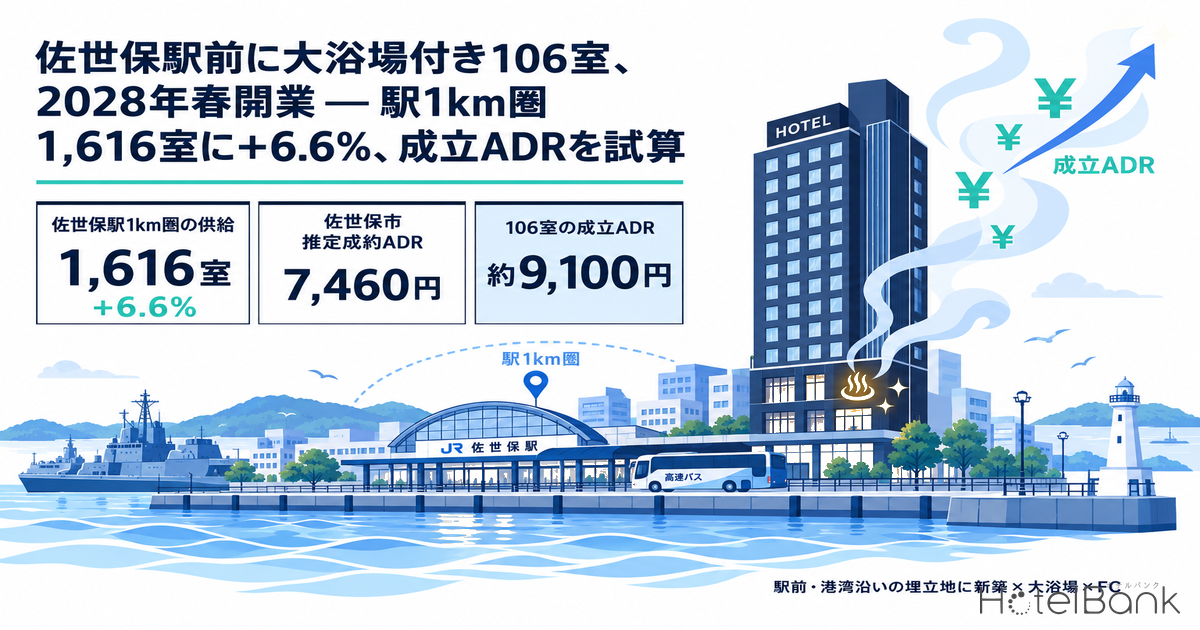
In Sasebo, Nagasaki Prefecture, local hotel operator Hakataya Co., Ltd. (株式会社博多屋) has broken ground on a new hotel in the city’s Shiomi-cho district. According to the Nagasaki Shimbun (September 8, 2026), the building is a 10-story reinforced-concrete structure with 106 rooms and a large public bath, “SPA Yoko no Yu (SPA葉港の湯),” on the first and second floors, with completion scheduled for December 2027 and opening for spring 2028. The franchisor, Fujita Kanko (藤田観光), announced the project in an October 1 press release as “SPA Yoko no Yu Washington Hotel Sasebo Ekimae (SPA葉港の湯 ワシントンホテル佐世保駅前, tentative name),” describing it as the 16th franchised Washington Hotel and its second collaboration with Hakataya after the existing Sasebo Washington Hotel (佐世保ワシントンホテル, 190 rooms). This article sets out the supply and pricing within 1 km of Sasebo Station that will absorb this station-front development, reviews the urban-planning and hazard conditions that come with a harbor-side site, and runs a simple estimate of the room rate at which 106 rooms become viable.
Metric Definitions Used in This Article
- ADR (average daily rate): An estimated settled rate (tax-exclusive equivalent) calculated by applying a correction factor for each hotel type to the lowest-plan price level each property publishes on OTAs and similar channels (two guests in one room, price per room, tax included). When checked against the property-level results disclosed by listed hotel REITs (91 properties, most recent three months), the median error is about 7%. These are estimates and differ from each property’s actual transacted rates and accounting figures. Area-level ADR is the median of the properties covered (the level of a typical property in the area), and the number of properties covered in each month is shown as N=.
- OCC (occupancy): The share of rooms sold out of total rooms in the area (an estimate based on inventory sold through OTAs). In the text it is written as “occupancy (estimated, based on OTA-listed inventory)” and differs from the actual occupancy of the whole property.
- LT (lead time): The number of days until the check-in date. Early sell-out LT = the lead time at which remaining rooms first reached zero (the larger the value, the earlier the sell-out). Because observations more than 45 days before the stay date include the period before inventory is fully loaded, anything beyond 45 days is described only as “sold out 45 or more days before the stay date.”
- References to the listed price mean the price per room for two guests in one room (tax included).
- Data source: MetroEngines Research & Consulting (tracks about 168,000 properties in Japan, of which about 27,000 properties and about 1.26 million rooms with confirmed activity on major booking sites are analyzed). Public statistics are cited where used.
- — 106 rooms, opening spring 2028: A 10-story reinforced-concrete building on which Hakataya has broken ground in Shiomi-cho, Sasebo. It has a large public bath on the first and second floors and will be Fujita Kanko’s 16th franchised Washington Hotel (the name is tentative).
- — +6.6% on 25 properties and 1,616 rooms within 1 km of the station: Room count has been flat at +20 rooms since 2012, and about 70% of rooms opened in 1995 or earlier. This will be the first new build of more than 50 rooms since 2012.
- — Estimated settled ADR: ¥7,460 in Sasebo City, ¥9,952 in Nagasaki City: Average for September 2025 to August 2026 (N=34–37 / 62–64). Among properties with 20 or more rooms within 1 km of the station, only one sits in the ¥9,000–13,000 band.
- — Commercial district at 600% FAR, land price ¥310,000/㎡ (+3.3% YoY): The harbor side is reclaimed land prone to liquefaction and falls within the tsunami inundation projection (under 0.3 m, partly 1–2 m), making the use of the lower floors and the foundation design key issues.
- — Break-even ADR of about ¥9,100: The level that earns a 6% yield on building cost, assuming building cost of about ¥2.1 billion (excluding land), a GOP margin of 45% and full-year occupancy of 80%. That is about 1.2 times the city average.
Executive Summary — 106 Rooms With a Large Bath Enter a Port Town With 1,616 Station-Area Rooms
To state the conclusion first: the Sasebo Station area is a market where “rates are around the prefectural average, but inventory fills early on long weekends.” Sasebo City’s estimated settled ADR averaged ¥7,460 over the most recent 12 months, below the ¥7,813 for Nagasaki Prefecture as a whole (N=250–258), yet over the five-day holiday in September 2026 three business hotels near the station reached zero remaining rooms more than a month before the stay dates. Of the 25 properties and 1,616 rooms within 1 km of the station, properties opened in 1995 or earlier account for about 70% of rooms, and new builds since 2012 are limited to one business hotel and six small lodgings. Into this structure comes a newly built 106-room hotel with a large public bath.
The site conditions are clear. The station front, including the planned site, is zoned as a commercial district (floor-area ratio 600%, building coverage ratio 80%), and commercial land along the national highway in Miura-cho was assessed at ¥310,000/㎡ in the 2026 official land prices (+3.3% YoY), with the rate of increase widening for five consecutive years. At the same time, it is reclaimed land along the harbor: Nagasaki Prefecture’s tsunami inundation projection (2016) shows zones of under 0.3 m to under 1 m, and in part 1–2 m, on the harbor side of the station, and the liquefaction tendency map in the National Land Numerical Information classifies it as “reclaimed land, highly prone to liquefaction.” Placing the large bath on the first and second floors is the other side of the question of how to design the use of the lower floors under these conditions.
As for the rate at which 106 rooms become viable, we assume building cost of about ¥2.1 billion, reflecting the 2025 actual cost per tsubo (about 3.3 ㎡) for reinforced-concrete construction and cost escalation during the construction period. On that basis, with a limited-service GOP margin of 45% and full-year occupancy of 80%, we estimate that an estimated settled ADR of about ¥9,100 is needed to earn a 6% yield on building cost. That is about 1.2 times the Sasebo City average and overlaps the top band near the station (¥8,900–10,400). Judging from the inventory pickup and the rate premium for comparable hotels discussed below, there is a good chance that the product, a new build with a large bath, can support this band.
Project Overview — A Second Property Pairing a Local Owner With a Franchise
The outline of the project can be cross-checked against two primary sources: the Nagasaki Shimbun’s groundbreaking report and Fujita Kanko’s press release. The name is tentative in both; the room count (106) and opening date (spring 2028) match across the two sources, while the structure (10-story reinforced concrete) and completion date (December 2027) come from the Nagasaki Shimbun report. Fujita Kanko’s release describes the rooms as “mainly double-type one-bedroom rooms” and gives the location as about a four-minute walk from JR Sasebo Station and about a one-minute walk from the highway bus terminal. The site faces the national highway, across from the existing Sasebo Washington Hotel.
| Item | Details | Source |
|---|---|---|
| Name | SPA Yoko no Yu Washington Hotel Sasebo Ekimae (SPA葉港の湯 ワシントンホテル佐世保駅前, tentative name) | Nagasaki Shimbun / Fujita Kanko |
| Location | Shiomi-cho, Sasebo, Nagasaki Prefecture (across from Sasebo Washington Hotel, along the national highway) | Nagasaki Shimbun / Fujita Kanko |
| Scale and structure | 10-story reinforced-concrete building, 106 rooms (mainly double-type one-bedroom rooms) | Nagasaki Shimbun / Fujita Kanko |
| Large public bath | “SPA Yoko no Yu” on the first and second floors | Nagasaki Shimbun |
| Schedule | Groundbreaking September 2026 → completion December 2027 → opening spring 2028 (planned) | Nagasaki Shimbun / Fujita Kanko |
| Developer | Hakataya Co., Ltd. (Sasebo). Design and construction are also by Sasebo-based firms | Nagasaki Shimbun |
| Operating structure | 16th franchised Washington Hotel. The second property with Hakataya after Sasebo Washington Hotel (190 rooms), for a combined 296 rooms | Fujita Kanko |
A local owner holding the land and the business, with a brand and reservation platform added through a franchise, is a highly repeatable model for station-front development in regional cities. Fujita Kanko’s Washington Hotel brand also has a franchise opening lined up for autumn 2026 in front of Izumi-Chuo Station in Osaka, and the Sasebo project follows it as an example of expansion in a regional hub city. With the same owner operating the existing 190 rooms and the new 106 rooms facing each other, there is also room for operational upside such as groups, multi-night stays and cross-referral of guests around the large bath.
Taking Stock Within 1 km of the Station — 70% of the 1,616 Rooms Opened in 1995 or Earlier
Supply within a 1 km radius of Sasebo Station went from 20 properties and 1,596 rooms in 2012 to 25 properties and 1,616 rooms in 2026, essentially flat at +20 rooms over 14 years. The increase in property count comes from small lodgings since 2021 (whole-house rentals, guesthouses and small hotels with 1–12 rooms), and the total number of rooms has barely moved. Adding 106 rooms brings the total to 1,722, or +6.6%. Of the new builds that have entered this area since 2012, the only one with more than 50 rooms is a business hotel that opened in 2012 (58 rooms), making the 106-room hotel the first mid-sized new build in more than a decade.
Splitting the area by size band and age makes its character clear. The five properties with 150 or more rooms (948 rooms) all opened between 1977 and 2008, four of them in 1995 or earlier. The five properties with 50–149 rooms (404 rooms) also mostly opened between 1980 and 2012, and the six with 20–49 rooms opened between 1970 and 1990. By room count, properties opened in 1995 or earlier account for about 70% of the 1,616 rooms, while those opened in 2008 or later come to just over 20% even when the 272-room business hotel and the 58-room property from 2012 are combined.
| Size band | Properties | Rooms | Range of opening years | Main hotel types |
|---|---|---|---|---|
| 150+ rooms | 5 | 948 | 1977–2008 | 3 business, 2 city |
| 50–149 rooms | 5 | 404 | 1980–2012 | 4 business, 1 city |
| 20–49 rooms | 6 | 208 | 1970–1990 | 5 business, 1 capsule |
| 10–19 rooms | 4 | 56 | 1990–2026 | Small hotels, ryokan |
| Total (10+ rooms) | 20 | 1,616 | — | Plus 6 small lodgings with 1–8 rooms (24 rooms in total) |
| New in spring 2028 | +1 | +106 | 2028 | Business (with large bath) |
| Zoning | Commercial district |
| Floor-area ratio / building coverage ratio | 600% / 80% |
| Fire-protection designation (Miura-cho standard site) | Fire-prevention district |
| Shiohama-cho, west of the station | Commercial district 400%, quasi-fire-prevention |
Average daily passengers at JR Sasebo Station fell 7.2%, from 7,326 in 2019 to 6,798 in 2023, and have not fully returned to pre-pandemic levels. It would not be appropriate to read station-front demand from rail ridership alone; in Sasebo’s case there are several inflow routes, including the highway bus terminal, Sasebo Port, demand related to the US Navy and Japan Maritime Self-Defense Force bases, and its role as a gateway to Huis Ten Bosch. The fact that Fujita Kanko’s release goes out of its way to note “about a one-minute walk from the highway bus terminal” suggests it sees bus passengers from Fukuoka and Nagasaki as a main channel.
Monthly ADR Compared — Sasebo City Peaks in Summer and May, Nagasaki City in Autumn and February, the Huis Ten Bosch Area in December
Sasebo City’s estimated settled ADR stayed between ¥6,843 (June 2026) and ¥8,060 (May 2026) over the 12 months from September 2025 to August 2026, a swing of about ¥1,200 across the year. The peaks come in August (¥9,037 in 2024, ¥8,120 in 2025, ¥7,552 in 2026) and May, and the troughs in June and January–February. The direction differs by month: August 2026 was -7.0% YoY, while May 2026 was +4.0%. Nagasaki Prefecture as a whole (N=250–258) averaged ¥7,813 over the same 12 months, putting Sasebo City about ¥350 below it.
Nagasaki City differs in both level and seasonality. Its average over the same 12 months was ¥9,952 (N=62–64), 1.33 times Sasebo City’s, with peaks in October–November (¥11,640 and ¥12,537 in 2025) and February (¥11,554 in 2026). Demand periods such as autumn foliage and school trips in November and the Lantern Festival in February show up in rates. The median of five properties within 3 km of Huis Ten Bosch (95–377 rooms) averaged ¥14,160 over the 12 months, with December (¥17,216 in 2024, ¥17,347 in 2025) and August (¥18,815 in 2025) standing out. While rates around Huis Ten Bosch are highest during the winter illumination season, December in Sasebo City, the same city, came in at ¥7,957 (2025), only around the annual average.
This seasonal gap has two implications for the new station-front hotel. First, when hotels inside and around Huis Ten Bosch command high rates in its winter peak (the “Hikari no Okoku” (Kingdom of Light) illumination from November 2025 to February 2026 and “Hakugin no Sekai” (Silver World) from January 10 to February 26, 2026), the station area, about 25 minutes away by rail, has room beneath that price band as an overflow market. Second, cruise calls at Sasebo Port (128 in 2025, per MLIT preliminary figures) are mainly day calls, so lodging demand comes less from the calls themselves than from crew changes and pre- and post-stays by related parties. The former falls in December–February and the latter in spring through autumn, so both work to fill the station area’s annual troughs. Sasebo Port has 15.8 rooms of stock within 5 km per port call, making it one of the thinnest among the top 10 ports by number of calls.
ADR vs. Early Sell-Out — The Thin Band Near the Station Is ¥9,000–13,000
Beyond the level of rates, we look at which price bands fill first on a long weekend. For the five-day holiday from Saturday, September 19 to Wednesday, September 23, 2026 (a public holiday), we compiled the remaining-room trends of 33 properties in Sasebo City whose publicly listed allotment on major booking sites was 30% or more of total rooms (narrowed down from the 47 properties, out of 161 covered, whose inventory trends could be observed), and plotted the 16 properties with 20 or more rooms for which estimated settled ADR can be calculated. The horizontal axis is estimated settled ADR over the most recent 12 months, the vertical axis is early sell-out LT averaged over the five days (capped at 45 days), and circle size is the number of rooms.
The eight properties near the station (within 1 km) cluster in the ADR band of ¥5,800–8,900, and three of them reached zero remaining rooms more than a month before the stay date on a five-day average. The 272-room business hotel was sold out 45 or more days before the stay date on two of the five days, and the 37-room and 34-room business hotels also recorded zero-room days on all five days; on long weekends the station area does not “fill because it is cheap” but fills early regardless of price band. By contrast, resorts and ryokan in the city are spread across the ¥9,000–20,000 ADR band, and the two properties around Huis Ten Bosch with 228 and 200 rooms reached zero remaining rooms around 19 days before the stay date on a five-day average.
What stands out in the scatter is that there are almost no station-area properties between the top of the eight station-area properties plotted (around ¥8,900) and the lower bound around Huis Ten Bosch (about ¥9,400, a 95-room resort), on up to the ¥13,000 range. Among properties with 20 or more rooms within 1 km of the station, the only one in this band is a business hotel about 1 km from the station (162 rooms, about ¥10,400), which is left out of the scatter because its public allotment is under 30% of total rooms. Within the city, this ¥9,000–13,000 band is occupied by a resort in the Kujukushima direction (98 rooms, ¥13,280) and a resort on Mt. Yumihari (105 rooms, ¥11,808), but nothing within walking distance of the station. If a newly built 106-room hotel with a large bath enters at the bottom of this band, ¥8,500–9,500, it would not overlap directly with the existing station-area business hotels and would fill the space between them and the resort band.
Crowded Station area ¥5,800–8,900
Eight station-area properties (7 business, 1 city), about 900 rooms. On long weekends they reach zero remaining rooms early regardless of price band. A new build is better off not entering here without differentiation.
Gap 1 Station area ¥9,000–13,000
Among properties with 20+ rooms within 1 km of the station, only one business hotel about 1 km out (162 rooms, about ¥10,400). A band to enter at ¥8,500–9,500 on the strength of a large bath, a new build and a double-room focus, and to test the ¥10,000 range in peak periods.
Reference Resort band ¥11,800–20,500
Resorts around Huis Ten Bosch, Kujukushima and Mt. Yumihari. Rates rise in the winter illumination season and summer holidays. Not direct competitors of a station-area new build, but an overflow relationship when they are full.
Occupancy levels are also worth confirming. Occupancy (estimated, based on OTA-listed inventory) for business hotels in Sasebo City (N=10–11 properties, 964–986 rooms, based on listings on major booking sites) was 75.6% in June 2026, 80.1% in July, 85.0% in August and 80.5% in September. For all hotel types (28–31 properties, 2,807–3,236 rooms) the figures for the same four months were 76.7%, 79.2%, 83.7% and 79.6%. All hotel types in Nagasaki City stood at 79.4% in August 2026 (53 properties, 3,614 rooms), and Sasebo City’s August figure was 4.3 pt higher. These are estimates based on the pickup of inventory sold on major booking sites and differ from the actual occupancy of whole properties.
| Area / hotel type | Properties / rooms covered | Jun 2026 | Jul | Aug | Sep |
|---|---|---|---|---|---|
| Sasebo City, business hotels | 10–11 properties / 964–986 rooms | 75.6% | 80.1% | 85.0% | 80.5% |
| Sasebo City, all hotel types | 28–31 properties / 2,807–3,236 rooms | 76.7% | 79.2% | 83.7% | 79.6% |
| Nagasaki City, all hotel types | 53 properties / 3,614 rooms | — | — | 79.4% | — |
Site Conditions (MLIT Data) — Commercial District at 600%, Land Price Gains Widening for Five Straight Years, Tsunami and Liquefaction Zones on the Harbor Side
Using the urban-planning, land-price and hazard data in the MLIT Real Estate Information Library, we check the conditions that apply to a station-front site along the harbor. The area along the national highway east of the station, including the planned site, is a commercial district with a floor-area ratio of 600% and a building coverage ratio of 80%, while Shiohama-cho west of the station is a commercial district at 400% and a quasi-fire-prevention district. The official land price standard site in Miura-cho (331 Miura-cho, 210 m from the station, a district of retail and office buildings along the national highway, fire-prevention district) stood at ¥310,000/㎡ as of January 1, 2026, +3.3% YoY, with the rate of increase rising for five consecutive years from +1.1% in 2022. Its rate of increase is higher than that of Shimanose-cho, the most expensive commercial land in Sasebo City (¥608,000/㎡, +1.3%), and the station front’s relative standing is rising.
| Standard site | Distance from station | ¥/㎡ | YoY |
|---|---|---|---|
| 331 Miura-cho | 210m | 310,000 | +3.3% |
| 70 Shiohama-cho | 750m | 183,000 | +2.8% |
| 1-2 Yamagata-cho | 650m | 205,000 | +2.5% |
| 21-8 Shimokyo-cho | 650m | 303,000 | +2.7% |
| 59-1 Sakae-machi | 1,200m | 332,000 | +2.2% |
| 47-1 Shimanose-cho and others | 950m | 608,000 | +1.3% |
On the hazard side, there are three conditions that a station-front site in a port town should factor in. The first is tsunami: in the tsunami inundation projection published by Nagasaki Prefecture in 2016 (included in the National Land Numerical Information), zones with inundation depths of under 0.3 m and of 0.3 m to under 1 m lie on the harbor side of Sasebo Station, and there is a zone of 1 m to under 2 m at a point about 160 m from the station. The second is liquefaction: the liquefaction tendency map in the National Land Numerical Information (a tendency classification based on landform type) classifies the reclaimed land in front of the station as “highly prone to liquefaction.” The third is storm surge: the storm-surge inundation projection map for the Matsuura coast, designated and published by Nagasaki Prefecture in September 2025 under the Flood Control Act, includes central Sasebo and projects an inundation depth of 0.57 m at the location of Sasebo City Hall (not yet included in the storm-surge inundation zone data of the National Land Numerical Information). The river-flood inundation zones (maximum projected scale) do not reach the station-front core, while sediment-disaster warning zones are designated on the slopes east of the station; even within Shiomi-cho, the same district as the planned site, there are warning zones and special warning zones on the slope about 50–70 m southeast of Sasebo Washington Hotel.
| Item | Status at the station front (around the planned site) | Reading for design and operations |
|---|---|---|
| Tsunami inundation projection (Nagasaki Prefecture, 2016) | Under 0.3 m to under 1 m on the harbor side; 1–2 m at a point about 160 m away | Layout of lower-floor functions and evacuation routes. A 10-story building leaves ample room for vertical evacuation |
| Liquefaction tendency (landform classification) | Reclaimed land, highly prone to liquefaction | Ground surveys and the choice of foundation type affect construction cost |
| Storm-surge inundation zone (Flood Control Act) | The zone map for the Matsuura coast (designated September 2025) includes the city center. Inundation depth of 0.57 m at Sasebo City Hall | Together with tsunami, build lower-floor flood protection and equipment placement into the design |
| River-flood inundation projection (maximum projected scale) | No zones in the station-front core | — |
| Sediment-disaster warning zones | Designated on slopes east of the station (Shiomi-cho, Gion-machi, etc.); not applicable to the flat harbor-side land at the station front | — |
| Zoning and fire protection | Commercial district 600% / 80%, fire-prevention district (Miura-cho standard site) | There is headroom in permitted floor area; 106 rooms on 10 stories is below the regulatory ceiling |
The plan to put the large bath on the first and second floors can be read as consistent with these conditions. Placing equipment, baths and common areas rather than guest rooms on lower floors that fall within an inundation projection is a common approach for buildings along a harbor. Because the weight and the water supply and drainage of a large bath affect the foundation design, the cost of ground improvement on reclaimed land with a high liquefaction tendency can push up construction cost. In the estimate below, this is treated as included on the upside of the unit construction cost.
Resident Population and Employment Nearby — 26,000 People Within 1.5 km, -20% by 2040, Business Demand From the Bases and the Port
Weekday demand for station-front hotels is supported by nearby business establishments and business travelers from a wider area. Aggregating the town-and-block-level tabulation of the Ministry of Internal Affairs and Communications and Ministry of Economy, Trade and Industry’s “Economic Census for Business Activity (2021)” within 1 km of the station gives 2,129 establishments and 16,497 employees, of which office-type industries (information and communications, finance, real estate, professional services, etc.) account for 14.3%. For the station front of a regional hub city the office share is modest, and the mix is instead that of a commercial center with a thick layer of wholesale and retail, food service and other services. The core of Sasebo’s business demand lies in the bases and the port, and 40 properties with 2,301 rooms are located within 10 km of the Japan Maritime Self-Defense Force’s Sasebo district. Continued facility development by the Ministry of Defense in the Sakibe East district becomes base demand for station-area business hotels in the form of long weekday business stays.
For resident population, aggregating the MLIT National Land Numerical Information’s future population estimates by 250 m mesh within 1.5 km of the station (69 mesh cells) gives 27,619 in 2020, 25,792 in 2025 and 22,067 in 2040, or -20.1% in 2040 versus 2020. The share of seniors (65 and over) in 2025 is 29.5%. A shrinking resident population works to thin out locally generated lodging demand such as weddings, funerals and homecoming visits, but the main demand for station-area business hotels comes from business and leisure travelers from outside the area. The population estimates are therefore best read not as the main axis of demand but as an indicator of the site’s sustainability: how well the local cluster of restaurants and shops will be maintained.
Estimating the Break-Even ADR for 106 Rooms — Building Cost of About ¥2.1 Billion, About ¥9,100 for a 6% Yield
Published information is limited to the room count, structure, number of floors and schedule; the total floor area, investment amount and land rights have not been disclosed. We therefore present a simple estimate based on the assumptions below. All of them are assumptions, and an actual investment decision requires a detailed feasibility study.
| Assumption | Value used | Basis |
|---|---|---|
| Total floor area | About 3,180 ㎡ (962 tsubo) = 106 rooms × 30 ㎡ per room | Assumes double-focused rooms of 14–16 ㎡ plus an allocation of two floors of large bath, common areas and equipment |
| Unit construction cost (2025 actual) | Reinforced concrete: ¥2.026 million per tsubo | MLIT Building Starts Statistics (2025, compiled by archi-book). The all-structure average is ¥1.952 million |
| Cost escalation during construction | +5.3% in 2026, +2.5% for half of 2027 | Turner & Townsend International Construction Market Survey forecasts for Japan, compounded to the midpoint of the construction period |
| Building cost | 2025 basis ¥1.95 billion → with escalation ¥2.10 billion (about ¥20 million per room) | Product of the above. Liquefaction countermeasures and large-bath equipment are treated as upside factors within the unit cost |
| Land cost | Not included | Land rights for the planned site have not been disclosed. Reference: Miura-cho commercial land at ¥310,000/㎡ |
| Occupancy | 75% / 80% (full year) | The lower end of the 75.6–85.0% occupancy (estimated, based on OTA-listed inventory) of Sasebo City business hotels in June–September 2026 |
| GOP margin | 45% | Set within the 40–60% guideline range that Relo Hotel Solutions’ GOP diagnostic tool gives for business hotels, allowing for the operating cost of the large bath |
| Franchise-related costs | Included in the GOP margin | Terms are undisclosed, so they are not itemized separately |
| ADR (estimated settled basis) | Occupancy | Room revenue | GOP (45%) | Yield: 2025 unit cost | Yield: with escalation |
|---|---|---|---|---|---|
| ¥7,500 (around the city average) | 75% | ¥218 million | ¥98 million | 5.0% | 4.7% |
| ¥7,500 | 80% | ¥232 million | ¥104 million | 5.4% | 5.0% |
| ¥8,500 (top station-area band) | 75% | ¥247 million | ¥111 million | 5.7% | 5.3% |
| ¥8,500 Base | 80% | ¥263 million | ¥118 million | 6.1% | 5.6% |
| ¥9,500 (bottom of the gap band) | 75% | ¥276 million | ¥124 million | 6.4% | 5.9% |
| ¥9,500 | 80% | ¥294 million | ¥132 million | 6.8% | 6.3% |
To secure a 6% yield (GOP of ¥126 million) on building cost of ¥2.10 billion requires an estimated settled ADR of about ¥9,100 at full-year occupancy of 80%, or about ¥9,700 at 75%. That is 1.2–1.3 times the Sasebo City average of ¥7,460, slightly above the top of the eight station-area properties in the scatter (around ¥8,900) and below the business hotel at about ¥10,400 that is the only property with 20 or more rooms within 1 km of the station in this band; it sits right at the bottom of the ¥9,000–13,000 band that the scatter showed to be thin. Entering at the city average of ¥7,500 would give a yield of around 5%, and the escalation in construction cost (about ¥150 million) translates directly into a yield difference of 0.4–0.5 pt. Rising construction cost also means that new builds of similar scale are less likely to appear nearby, and a situation in which the 106 rooms are the only new build near the station at the 2028 opening works in favor of pushing rate.
Whether a large bath can support this rate premium can be gauged from measured figures for the same hotel type. In our comparison of 4,925 business hotels nationwide, the rate premium for properties with a large bath that includes a hot spring and sauna was measured at +9.3%. Applied to the Sasebo City average of ¥7,460, +9.3% is about ¥690, which means the large bath alone would lift the rate to the ¥8,100 range. Add to that the fact that it is a new build, the double-focused room mix, and a location four minutes on foot from the station and one minute from the bus terminal, and the ¥9,000 range comes into view as the sum of several factors.
Implications for Regional Banks, Local Operators and Owners Considering a Franchise
What the Sasebo Station project shows is that even at the station front of a regional hub city, the combination of “new build × large bath × franchise brand” has room to aim one step above the existing price band. From a regional bank’s standpoint, for a reinforced-concrete hotel with building cost on the order of ¥2.1 billion, the track record of the same owner operating the existing 190 rooms and the way station-area inventory fills early on long weekends regardless of price band are factors that make cash flow easier to read. On the other hand, ground improvement on reclaimed land and rising unit construction costs widen the range of variation in construction cost, so building a review of unit costs up to the midpoint of the schedule into the loan terms would be a realistic design.
For local hotel operators, the entry of 106 rooms is +6.6% in station-area supply, not a scale that will immediately move the occupancy of existing properties by much. What deserves more attention is the possibility that a new build going after the ¥9,000 range will add depth to the band above ¥9,000, where there is currently only one property with 20 or more rooms within 1 km of the station. For existing properties, starting with those that have added value such as a large bath or breakfast, this is an opportunity to raise peak-season pricing by a notch. Among plan names promoting a large bath at business hotels in Nagasaki Prefecture (N=261), the main selling points are “large bath” at 59%, “breakfast included” at 56% and “hot-spring open-air bath” at 27%, and spelling out added value in the plan name is already standard practice.
For owners considering joining a franchise, this project is a useful real-world example of the model in which “a local owner secures the land and construction locally and brings in the brand and reservation platform from outside.” Fujita Kanko’s release emphasizing the combined 296 rooms with the existing 190 can be read as placing weight on the operating efficiency and accumulated brand recognition that come from having multiple properties in the same catchment. Building up the customer base at the existing property while demand-stimulus measures are running, such as the travel discount campaign covering Kyushu’s seven prefectures that began on October 1, should support the ramp-up at the spring 2028 opening.
For Hotels: Hints for Plan Names Promoting a Large Bath (Nagasaki Prefecture, Business Hotels)
Selling points common in plan names published for Nagasaki Prefecture × business hotels × large bath (N=261) —
Large bath 59%Breakfast included 56%Room only 38%Hot-spring open-air bath 27%Buffet 22%Unlimited VOD 18%
Examples of actual names (anonymized, translated):
- [Website exclusive] Last-minute & early-bird best-rate plan ☆ with natural hot spring & freshly baked bread breakfast buffet
- [Last-minute deal ◆ 10% off!] Room-only plan <2 guests> Non-smoking / top-floor large bath & open-air bath / free co-sleeping for elementary-school-age children and younger
- [Multi-night discount / breakfast included] No-cleaning eco plan ★ <2 guests> Non-smoking / top-floor large bath & open-air bath / free co-sleeping for elementary-school-age children and younger
* A tendency based on a tabulation of published plan names; it does not show that naming causes sales.
Frequently Asked Questions
Q. When will the new hotel near Sasebo Station open?
According to the Nagasaki Shimbun (September 8, 2026) and Fujita Kanko’s press release (October 1, 2026), completion is scheduled for December 2027 and opening for spring 2028. The name “SPA Yoko no Yu Washington Hotel Sasebo Ekimae” is tentative; the hotel will have 106 rooms and a large public bath on the first and second floors.
Q. What is the level of hotel rates in Sasebo City?
Estimated settled ADR (tax-exclusive equivalent) averaged ¥7,460 over the 12 months from September 2025 to August 2026 (N=34–37 properties per month), versus ¥9,952 in Nagasaki City (N=62–64). Sasebo City’s seasonality is high in August and May and low in June and January–February.
Q. At what room rate does a 106-room new build become viable?
Assuming building cost of about ¥2.1 billion excluding land, a GOP margin of 45% and full-year occupancy of 80%, we estimate that an estimated settled ADR of about ¥9,100 is needed to earn a 6% yield on building cost. All assumptions are hypothetical, and an actual decision requires a detailed business plan.
⚠ Note on forward-looking figures: The estimated settled ADR and occupancy in this article are estimates for finalized months (through August and September 2026); figures for October 2026 onward are not used in the text because they would be based on prices and inventory published at the time of the survey. The break-even ADR estimate is a simple calculation based on assumptions, and the result will change with construction costs, interest rates and the demand environment. Official land prices, zoning and hazard zones are based on data in the MLIT Real Estate Information Library as of October 2026.
References and Sources
■ Data sources
Estimated settled ADR, occupancy (estimated, based on OTA-listed inventory), remaining-room trends over the long weekend and the supply trend within 1 km of the station are based on tabulations by MetroEngines Research & Consulting (Sasebo City N=34–37, Nagasaki City N=62–64, Nagasaki Prefecture N=250–258; finalized months from September 2025 to August 2026). Site conditions are based on the MLIT Real Estate Information Library and National Land Numerical Information; the project overview is based on the Nagasaki Shimbun (September 8, 2026) and Fujita Kanko’s press release (October 1, 2026).
■ Estimate assumptions
Total floor area of about 3,180 ㎡ (106 rooms × 30 ㎡); the 2025 actual of ¥2.026 million per tsubo for reinforced concrete, with escalation of +5.3% in 2026 and +2.5% for half of 2027 factored in, gives building cost of ¥2.10 billion. GOP margin 45%, full-year occupancy 75% / 80%, room revenue = 106 rooms × ADR × occupancy × 365 days. Land cost, pre-opening costs and working capital are not included, and franchise-related costs are included in the GOP margin.
■ Limitations and caveats
Total floor area, investment amount and land rights have not been disclosed, and the estimate rests entirely on assumptions. Estimated settled ADR is an estimate derived from published prices, and occupancy is an estimate based on inventory listed on major booking sites; both differ from each property’s actual results. The 25 properties and 1,616 rooms within 1 km of the station are a time-series tabulation of properties with a registered opening date, and are scoped differently from the table by size band (20 properties with 10+ rooms and 1,616 rooms, plus 6 small lodgings with 24 rooms in total). Even on the total including small lodgings, the addition of 106 rooms is +6.5%, the same level as +6.6%. The hazard zones are an overview checked at tile level, not at the lot-number level of the planned site.
■ Market data
- MetroEngines Research & Consulting — Estimated settled ADR (Sasebo City N=34–37, Nagasaki City N=62–64, Nagasaki Prefecture N=250–258), occupancy (estimated, based on OTA-listed inventory), remaining-room trends (September 19–23, 2026, 33 properties in Sasebo City), supply trend within 1 km of the station (based on opening and closing dates)
■ Government statistics and public data
- MLIT Real Estate Information Library (国土交通省 不動産情報ライブラリ) — Official land prices (2022–2026), zoning, fire-prevention districts, tsunami inundation projection, liquefaction tendency map, river-flood inundation zones, sediment-disaster warning zones
- MLIT National Land Numerical Information, “Passengers by Station Data (FY2023)”
- MLIT National Land Numerical Information, “Future Population Estimates by 250 m Mesh (2024 estimates by the National Spatial Planning and Regional Policy Bureau)”
- Ministry of Internal Affairs and Communications / Ministry of Economy, Trade and Industry, “Economic Census for Business Activity (2021),” town-and-block-level tabulation (boundaries = 2020 Population Census small areas)
- Nagasaki Prefecture, “Tsunami Inundation Projection for Nagasaki Prefecture (2nd Edition)”
- Nagasaki Prefecture, “Storm-Surge Inundation Projection Maps” / Sasebo City, “Storm-Surge Inundation Projection Zones”
- MLIT Ports and Harbours Bureau, “Inbound Cruise Passengers and Cruise Ship Port Calls in 2025 (Preliminary)”
- MLIT, “Building Starts Statistics” / archi-book, 2025 tabulation of cost per tsubo by structure
■ Industry reports and REIT disclosures
- Relo Hotel Solutions, “Hotel GOP Margin: Guidelines by Hotel Type”
- Invincible Investment Corporation (インヴィンシブル投資法人), hotel operating results (GOP margin of MHM-operated properties)
- Turner & Townsend, “International Construction Market Survey,” construction cost escalation forecasts for Japan
■ News and press releases
- Nagasaki Shimbun, “Sasebo’s Hakataya Breaks Ground on New Hotel With Large Bath, 106 Rooms… to Open in Spring 2028” (September 8, 2026)
- Fujita Kanko Co., Ltd., “16th Franchise Property: ‘SPA Yoko no Yu Washington Hotel Sasebo Ekimae (tentative name)’ With Large Bath to Open in Spring 2028” (PR TIMES, October 1, 2026)
- Nikkei, “Fujita Kanko to Open Washington Hotel in Sasebo, Nagasaki; Second Property Targets Tourism Demand” (October 1, 2026)
- Fashion Press, “Huis Ten Bosch Winter Illumination ‘Hakugin no Sekai’ to End After 2026”