

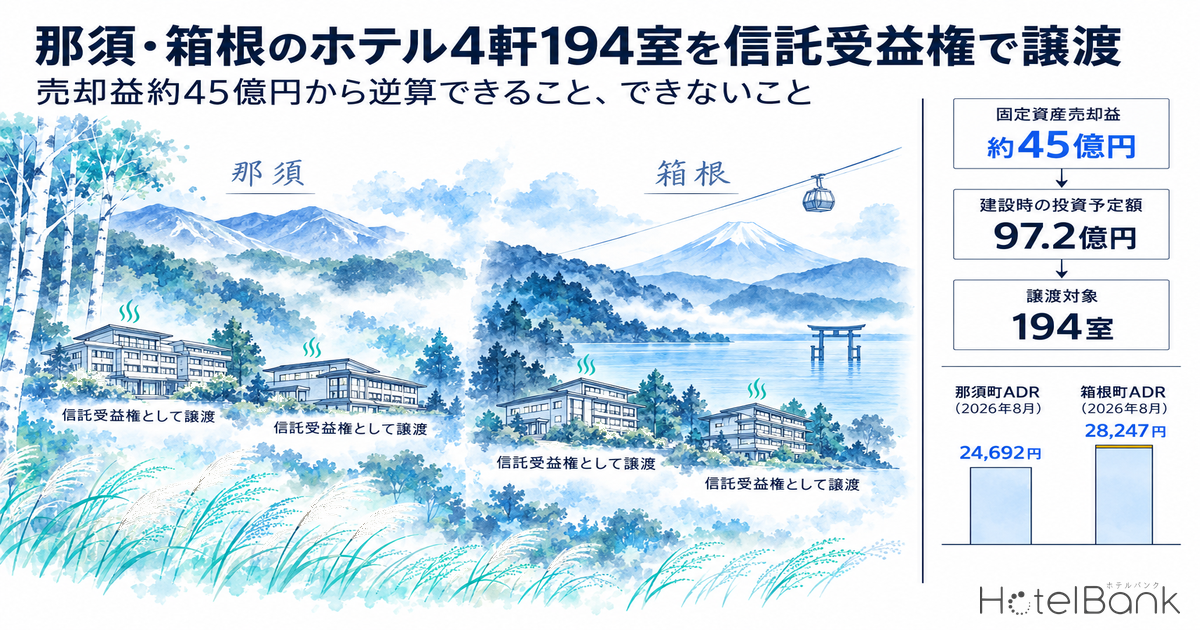
On July 30, 2026, Nihon House Holdings (日本ハウスホールディングス; TSE Prime: 1873) signed a contract to transfer four hotels totalling 194 rooms in Nasu Town, Tochigi, and Hakone Town, Kanagawa, by placing them in trust and selling the trust beneficiary interests. On October 1, the scheduled delivery date, Iconia Hospitality (アイコニア・ホスピタリティ) announced that it had begun operating the four hotels. The only figure disclosed was a single line: “gain on sale of fixed assets of approx. ¥4.5bn.” Neither the sale price, the book value nor the buyer’s name has been made public.
Even so, tracing the planned investment amounts and book values recorded in the company’s annual securities reports makes it possible to put a rough range on the price. This article separates what can and cannot be back-calculated from the deal, measures rates in Nasu Town and Hakone Town, the surrounding room stock and the site conditions of the 194 rooms, and then estimates the break-even ADR from the buyer’s side (the ADR at which the investment meets its target yield) under three scenarios.
Metric Definitions Used in This Article
- ADR (average daily rate): An estimated settled rate (tax-exclusive equivalent) calculated by applying category-specific adjustment factors to the lowest-plan rate level each property publishes on OTAs and similar channels (two guests per room, per-room rate, tax included). Checked against property-level actuals disclosed by listed hotel REITs (91 properties, most recent three months), the median error is about 7%. These are estimates and differ from each property’s actual transacted rates and accounting figures. Area-level ADR is the median across covered properties (the level of a typical property in the area). Property-level annual figures are the monthly average for September 2025–August 2026 (properties with at least six months of estimates).
- Room stock: Total rooms at properties whose selling rates could be observed on major booking sites in the latest three months (July–September 2026). Properties with the same name were consolidated into one. Room counts for the four transferred hotels are the operator’s published figures; all others come from MetroEngines Research property data. Properties not listed on booking sites are excluded.
- Occupancy: This article uses only actuals disclosed per property by listed REITs and assumed values within the estimates. It does not use any in-house estimate of individual properties’ occupancy.
- RevPAR and NOI: RevPAR is room revenue per available room (ADR × occupancy). NOI (net operating income) is total revenue less operating expenses, before depreciation; NOI yield in this article means NOI as a ratio of the investment amount.
- Sale price range and break-even ADR: Both are estimates that layer assumptions on public documents, not figures published by the parties. The assumptions are stated in each section.
- Data sources: MetroEngines Research & Consulting; company disclosures; MLIT Real Estate Information Library (as of October 2, 2026)
Source: Nihon House Holdings disclosures; MetroEngines Research & Consulting
- — 4 hotels, 194 rooms, approx. ¥4.5bn gain: Nihon House Holdings transferred 120 rooms in Nasu and 74 in Hakone as trust beneficiary interests. The sale price, book value and buyer are all undisclosed.
- — Indicative sale price of ¥11.5–12.6bn (approx. ¥59.3–64.9M per room): an estimate that assumes 3–5% annual depreciation on the ¥9.72bn planned construction investment, not a figure published by the parties.
- — Estimated settled ADR in August 2026 was ¥24,692 in Nasu Town (N=53 properties) and ¥28,247 in Hakone Town (N=186 properties). The four hotels’ annual ADR is ¥28,758 on a room-weighted basis, and all four sit above their town’s median.
- — Surrounding room stock is 268 properties and 4,051 rooms across three catchments; the 194 rooms are 4.8% of that. Seven properties with 30 or more rooms have opened since 2018, four of them the transferred hotels. The two Hakone sites lie in a national park Special Zone.
- — Break-even ADR is ¥28,300–37,000 across three scenarios (assuming a ¥12.0bn acquisition price and a 5.0% target NOI yield). The numbers work at 80% full-year occupancy even at current rates; the key is occupancy rather than rate.
Deal Overview — Delivery Two Months After Signing, and a New Operator the Same Day
Start with the disclosed facts. According to Nihon House Holdings’ timely disclosure (July 30, 2026) and extraordinary report (filed August 6), the board resolution and the contract signing both took place on July 30, with delivery scheduled for October 1. The company describes the reason for the sale as “optimization of the hotel portfolio” and says the proceeds will go to growth investment in the housing business, capital expenditure at hotels it continues to own, and repayment of borrowings tied to the transferred properties. The gain of approx. ¥4.5bn is expected to be booked as an extraordinary gain in the fiscal year ending April 2027, and the company raised its full-year consolidated net profit forecast from ¥1.37bn to ¥3.61bn.
| Property | Location | Rooms | In-room bath | Planned construction completion |
|---|---|---|---|---|
| Hotel Morinokaze Nasu (ホテル森の風 那須) | Takaku-hei, Nasu Town, Tochigi | 90 | Unit bath, etc. | October 2018 |
| Hotel Shikinoyakata Nasu (ホテル四季の館 那須) | Takaku-hei, Nasu Town, Tochigi (adjacent) | 30 | Natural hot-spring bath in every room | October 2018 |
| Hotel Shikinoyakata Hakone Ashinoko (ホテル四季の館 箱根芦ノ湖) | Moto-Hakone, Hakone Town, Kanagawa | 30 | Natural hot-spring open-air bath in every room | February 2022 |
| Hotel Morinokaze Hakone Sengokuhara (ホテル森の風 箱根仙石原) | Sengokuhara, Hakone Town, Kanagawa | 44 | 14 rooms with open-air bath | December 2022 |
| Total | Nasu 120 · Hakone 74 | 194 | — | — |
Source: Compiled by MetroEngines Research & Consulting from Nihon House Holdings’ timely disclosure (July 30, 2026) and annual securities reports, and Iconia Hospitality’s press release (October 1, 2026)
All four are young assets, four to eight years on from opening, and two of them have hot-spring baths in every room. On the October 1 delivery date, Iconia Hospitality announced that it had begun operating the four hotels. This is the company’s first property in the Hakone area and brings its portfolio to 10 properties in Tochigi, 9 in Kanagawa and 188 properties with 25,879 rooms across Japan (as of October 1, 2026, per the company). The buyer of the beneficiary interests, by contrast, is described only as “a domestic general business corporation,” and nothing further has been disclosed, including whether it shares capital ties with the operator.
As for the repayment of borrowings, the securities report gives a sense of scale. The 2018 syndicated loan secured on the land and buildings of the two Nasu hotels (originally ¥3.0bn) had a balance of ¥1.837bn at the end of April 2026, and the 2021 facility secured on Hakone Ashinoko (originally ¥2.5bn) stood at ¥2.0bn, for a combined ¥3.837bn. The same disclosure also sets out a plan to demolish part of the building at Hotel Morinokaze Oshuku (ホテル森の風鶯宿) in Shizukuishi Town, Iwate, which the company will keep, and to book a loss on retirement of approx. ¥0.8bn.
Why Trust Beneficiary Interests Rather Than Direct Title — Transfer Taxes and the “Next Buyer”
The disclosure states that “for each of the fixed assets, a trust will be established and the trust beneficiary interests based on that trust will be transferred.” In other words, an operating company puts real estate it has held directly into a trust just before the sale and hands over the beneficiary interests. This extra step serves two broad purposes.
The first is transfer taxes. In a direct sale of real estate, the buyer pays real estate acquisition tax and registration and license tax on the transfer of ownership, which by our estimate come to about 3.0% of the acquisition price. If this deal’s price is provisionally placed in the range discussed below (¥11.5–12.6bn), that is equivalent to roughly ¥345–378M. In a transfer of beneficiary interests, the registered title stays with the trustee, so real estate acquisition tax is not levied, and the buyer’s registration cost is only ¥1,000 per property for the change of beneficiary. Registration and license tax on establishing the trust and trust fees do arise, but the net saving is large.
The second is a wider pool of buyers. The trust bank acting as trustee checks legal compliance, building condition, boundaries and similar matters in its acceptance review. Assets that pass that review are more readily regarded as ready for institutional investors, SPCs and REITs to handle. The buyer this time is a general business corporation, but with the asset already in beneficiary-interest form there is no need to rebuild the vehicle when moving it to a fund or REIT in future. For the seller this increases the number of counterparties in price negotiations; for the buyer it preserves exit options.
What a ¥4.5bn Gain Does and Doesn’t Let Us Back-Calculate
The sale price is undisclosed, but the accounting relationship is simple. A gain on sale of fixed assets is what remains after deducting book value and selling costs from the sale price. So if book value can be approximated, a range can also be placed on the price. The company’s securities reports leave three clues.
The first is a ceiling on book value. The 58th-term securities report (as of April 30, 2026) records the book value of resort facilities (Hotel Morinokaze Oshuku and others) at ¥9.905bn in total. That figure includes facilities the company is keeping, so the book value of the four transferred hotels is smaller. It follows that the sale price, selling costs aside, does not exceed roughly ¥14.4bn.
The second is the investment at the time of construction. The “plans for new facilities” section of past securities reports lists the total planned investment for the three construction projects. The total is ¥9.72bn, or about ¥50.1M per room across 194 rooms.
| Construction project | Rooms | Total planned investment | Per room | Planned completion | Securities report |
|---|---|---|---|---|---|
| Nasu (Morinokaze and Shikinoyakata) | 120 | ¥4,593M | approx. ¥38.3M | October 2018 | 49th term (FY ended October 2017) |
| Shikinoyakata Hakone Ashinoko | 30 | ¥2,652M | approx. ¥88.4M | February 2022 | 53rd term (FY ended October 2021) |
| Morinokaze Hakone Sengokuhara | 44 | ¥2,475M | approx. ¥56.3M | December 2022 | 54th term (FY ended October 2022) |
| Total | 194 | ¥9,720M | approx. ¥50.1M | — | — |
Source: Compiled by MetroEngines Research & Consulting from “Plans for new construction, retirement, etc. of facilities” in Nihon House Holdings’ securities reports (49th, 53rd and 54th terms). Nasu is listed as the plan for “Hotel Morinokaze Nasu” and is recorded as construction of both buildings in the supplementary schedules of the 50th term
This planned investment also matches the amounts actually booked. The increases in buildings, structures and fixtures shown in each term’s supplementary schedules were ¥4.301bn for the two Nasu buildings, ¥2.222bn for Ashinoko and ¥2.571bn for Sengokuhara, a total of ¥9.094bn. Adding the disclosed acquisition cost of new hotel sites in Nasu Town and Hakone Town (¥624M in total) gives ¥9.718bn, almost identical to the total planned investment.
The third is whether any impairment was booked. As far as we could confirm from the impairment notes in securities reports from the 50th term onward, the four Nasu and Hakone hotels do not appear. If so, their book value should be close to the investment less depreciation.
From here we make assumptions. If buildings, structures and fixtures are depreciated straight-line at a blended 3–5% a year over the years since opening (about 8 years for Nasu, 4.6 for Ashinoko and 3.8 for Sengokuhara) and land stays at acquisition cost, book value comes to roughly ¥7.0–8.1bn. Adding the ¥4.5bn gain gives ¥11.5–12.6bn as one indication of the sale price excluding selling costs, equivalent to about ¥59.3–64.9M per room. We stress that this range depends on the depreciation assumption and is not a figure given by the parties.
Source: MetroEngines Research & Consulting estimates based on Nihon House Holdings disclosures. Book value is shown for three cases assuming 3–5% annual straight-line depreciation on buildings, structures and fixtures (land at acquisition cost); selling costs are not included
If this range is right, assets four to eight years old changed hands at 1.18–1.30 times the planned investment at construction. A likely backdrop is the rise in replacement cost. Hotel construction costs based on MLIT’s Building Starts Statistics rose from ¥1.38M per tsubo (about 3.3㎡) in 2022 to ¥1.95M per tsubo in 2024, an increase of about 41% in two years. Because building the same property today would cost more than it did then, young hot-spring hotels that are already standing tend to be valued above a price based on construction cost.
On the other hand, there is much that cannot be back-calculated from public documents. The table below sets this out.
| Issue | What can be back-calculated | What public documents do not show |
|---|---|---|
| Price level | From the book-value ceiling (¥9.905bn) and the gain, the price does not exceed roughly ¥14.4bn. With a depreciation assumption, ¥11.5–12.6bn | The actual sale price, its allocation among the four hotels, selling costs |
| Price per room | Approx. ¥59.3–64.9M in the assumed range (194-room average) | How the per-room price differs between Nasu and Hakone |
| Yield | — | The four hotels’ operating profit (NOI) is undisclosed, so a cap rate cannot be calculated |
| Buyer and operator | Iconia Hospitality operates the hotels from October 1 | The acquirer of the beneficiary interests, the contract form (lease or management contract), additional investment plans |
| Borrowings | The balance of the two facilities secured on Nasu and Ashinoko was ¥3.837bn (end of April 2026) | The amount repaid and net proceeds after repayment |
Source: Compiled by MetroEngines Research & Consulting from Nihon House Holdings disclosures and Iconia Hospitality’s press release
Against Listed REIT Acquisitions — About ¥67.8M per Room in the Same Nasu Town
To see where the assumed range sits, we set it beside properties held by listed hotel REITs. To the three properties located in Nasu Town and Hakone Town, we added the two most recent acquisitions of hot-spring hotels run by the same operator as in this deal.
| Property | REIT | Location | Rooms | Acquisition price | Per room | Acquired |
|---|---|---|---|---|---|---|
| Hotel Epinard Nasu (ホテルエピナール那須) | Invincible Investment Corporation (インヴィンシブル投資法人) | Nasu Town, Tochigi | 310 | ¥21,002M | approx. ¥67.8M | March 2016 |
| Hakone Gora Onsen Tokinoyu Setsugetsuka (箱根強羅温泉 季の湯 雪月花) | Japan Hotel REIT Investment Corporation (ジャパン・ホテル・リート投資法人) | Hakone Town, Kanagawa | 158 | ¥4,070M | approx. ¥25.8M | Not disclosed (built October 2006) |
| KAI Hakone (界 箱根) | Hoshino Resorts REIT (星野リゾート・リート投資法人) | Hakone Town, Kanagawa | 34 | ¥950M | approx. ¥27.9M | July 2013 |
| Kamenoi Hotel Kusatsu Yubatake (亀の井ホテル 草津湯畑) | Invincible Investment Corporation | Kusatsu Town, Gunma | 80 | ¥4,682M | approx. ¥58.5M | August 2025 |
| Kamenoi Hotel Izu Kogen (亀の井ホテル 伊豆高原) | Invincible Investment Corporation | Ito City, Shizuoka | 55 | ¥5,563M | approx. ¥101.2M | July 2024 |
| This deal (assumed range) | Not disclosed | Nasu Town and Hakone Town | 194 | ¥11.5–12.6bn | approx. ¥59.3–64.9M | October 2026 |
Source: Compiled by MetroEngines Research & Consulting from each REIT’s portfolio list (J-REIT holdings data covering 7 REITs and 302 properties, including 2 overseas, as of October 2, 2026). Japan Hotel REIT Investment Corporation does not publish property-level acquisition dates in its portfolio list. The figures for this deal are not published values but the estimate from the previous section
The assumed range of about ¥59.3–64.9M falls between Kusatsu Yubatake, acquired in August 2025 (approx. ¥58.5M), and Hotel Epinard Nasu in the same Nasu Town (approx. ¥67.8M). The two properties in Hakone Town are in the ¥20M range, but they were acquired in 2013 or earlier and are hard to compare directly with today’s levels. The two most recent deals came in at about ¥58.5M and about ¥101.2M per room, and this deal’s assumed range is close to the Kusatsu Yubatake level.
Operating results are worth checking too. According to Invincible Investment Corporation’s property-level disclosure, Hotel Epinard Nasu recorded room occupancy of 80.1%, ADR of ¥27,233 and RevPAR of ¥21,818 for January–June 2026. In the peak month of August, occupancy rises to 99.7% and ADR to ¥62,678. Kusatsu Yubatake recorded 95.4% occupancy and ADR of ¥25,689 for January–June, and Izu Kogen 88.8% and ¥34,039. The figures show that operations sustaining high occupancy year-round are what support the price per room.
* The J-REIT holdings data covers seven REITs: Ichigo Hotel REIT Investment Corporation (3463), Invincible Investment Corporation (8963), Nippon Hotel & Residential Investment Corporation (3472), Japan Hotel REIT Investment Corporation (8985), Hoshino Resorts REIT, Inc. (3287), MORI TRUST REIT, Inc. (8961) and Kasumigaseki Hotel REIT Investment Corporation (401A). Settled ADR disclosed by REITs is stated excluding consumption tax, and the estimated settled ADR in this article is likewise at a tax-exclusive-equivalent level. ADR in this article is an estimate (median error of about 7% against REIT-disclosed actuals).
The Market the 194 Rooms Belong To — August ADR of ¥25,000 in Nasu Town, ¥28,000 in Hakone Town
Next, the rate levels in the two towns where the four hotels stand. In MetroEngines Research’s data, estimated settled ADR for August 2026 was ¥24,700 in Nasu Town (N=53 properties) and ¥28,200 in Hakone Town (N=186 properties). Year on year, Nasu Town was down 13.8% and Hakone Town down 3.4%. However, Nasu Town’s figure for August of the previous year stood out at ¥28,600 (N=48 properties), and compared with August 2024 two years earlier (¥22,300) the latest level is up 10.5%.
Source: MetroEngines Research & Consulting (Nasu Town, all categories, N=45–54 properties per month)
Source: MetroEngines Research & Consulting (Hakone Town, all categories, N=170–193 properties per month)
Averaged over the year, the picture changes. The 12-month average for September 2025–August 2026 was ¥19,900 in Nasu Town (+0.3% YoY) and ¥26,400 in Hakone Town (+3.4% YoY), both level with or above the previous year. The seasonal swing differs as well. Nasu Town is a summer-driven market in which the highest month (August) reaches 1.42 times the lowest (June), whereas in Hakone Town the highest month (November, ¥28,900) is only 1.28 times the lowest (June, ¥22,700), with further peaks in the autumn-foliage season and in spring. Hakone Town is the easier market to sell year-round; Nasu Town is where rates jump in summer.
Where do the four hotels sit within that? Ranked by property-level annual figures (the monthly average for September 2025–August 2026), all four were above their town’s median. The two Shikinoyakata hotels, which have hot-spring baths in every room, are each in the top 22% of their town.
| Property | Rooms | Annual ADR (estimated) | Position within town | Town median |
|---|---|---|---|---|
| Hotel Shikinoyakata Nasu | 30 | ¥35,314 | Top 22% of 51 properties in Nasu Town | ¥19,242 |
| Hotel Morinokaze Nasu | 90 | ¥22,148 | Top 43% of 51 properties in Nasu Town | ¥19,242 |
| Hotel Shikinoyakata Hakone Ashinoko | 30 | ¥44,566 | Top 22% of 187 properties in Hakone Town | ¥26,102 |
| Hotel Morinokaze Hakone Sengokuhara | 44 | ¥27,032 | Top 48% of 187 properties in Hakone Town | ¥26,102 |
| Room-weighted average of the four hotels | 194 | ¥28,758 | — | — |
Source: MetroEngines Research & Consulting (monthly average of estimated settled ADR for September 2025–August 2026; properties with at least six months of estimates: Nasu Town N=51, Hakone Town N=187)
Source: MetroEngines Research & Consulting (Nasu Town N=51 properties, Hakone Town N=187 properties; horizontal axis on a logarithmic scale)
The scatter plot shows that few properties fall in the 30–99 room band. In Hakone Town, 38 properties are of this size, with a median annual ADR of ¥27,700 and an upper-quartile threshold of ¥37,100. In Nasu Town there are only 15, with a median of ¥16,400 and an upper-quartile threshold of ¥35,300. At 30–90 rooms, the four hotels fall into one of the few size bands, in two towns where small lodgings make up the great majority, in which an operator can readily consolidate staffing and sales.
Surrounding Room Stock — 268 Properties and 4,051 Rooms in Three Catchments; the 194 Rooms Are 4.8%
Next we counted how many rooms surround the sites. Within a 5km radius of the Nasu site and a 2km radius of each of the Sengokuhara and Moto-Hakone sites, the properties whose selling rates could be observed in the latest three months total 268, with 4,051 rooms. The 194 transferred rooms are 4.8% of that.
| Catchment | Properties | Rooms | Of which transferred | Properties with 30+ rooms | Properties with under 10 rooms | Opened since 2018 |
|---|---|---|---|---|---|---|
| Nasu (Takaku-hei), 5km | 142 | 2,281 | 120 rooms (5.3%) | 12 properties, 1,407 rooms | 100 | 48 properties, 385 rooms |
| Hakone (Sengokuhara), 2km | 95 | 1,369 | 44 rooms (3.2%) | 11 properties, 771 rooms | 56 | 44 properties, 412 rooms |
| Hakone (Moto-Hakone), 2km | 31 | 401 | 30 rooms (7.5%) | 3 properties, 178 rooms | 18 | 12 properties, 106 rooms |
| Total of the three catchments | 268 | 4,051 | 194 rooms (4.8%) | 26 properties, 2,356 rooms | 174 | 104 properties, 903 rooms |
Source: MetroEngines Research & Consulting (properties whose selling rates could be observed on major booking sites in July–September 2026. Openings since 2018 include rebrand openings and the four transferred hotels)
In every catchment, pensions and rental villas with under 10 rooms make up the majority by number of properties. In the Nasu 5km catchment, 100 of the 142 properties have under 10 rooms and only 12 have 30 or more. Those 12 hold just over 60% of the rooms (1,407), and the two transferred hotels with 120 rooms are among them. The Moto-Hakone 2km catchment is smaller still, with only three properties of 30 or more rooms. The 30 rooms on the shore of Lake Ashi account for 7.5% of the rooms in that catchment.
Sengokuhara is a different story. Of the 1,369 rooms within 2km, 412 (30.1%) opened in 2018 or later, making it a district where new lodgings have kept arriving. Most of the new lodgings are small, however. Openings since 2018 total 104 properties and 903 rooms across the three catchments, yet they average only 8.7 rooms each. Limited to properties with 30 or more rooms there are just seven, and four of those are the hotels transferred in this deal. Widened to the whole towns, room stock on the same definition is 263 properties and 3,746 rooms in Nasu Town and 392 properties and 7,137 rooms in Hakone Town, of which the 194 rooms represent 3.2% (120 rooms) and 1.0% (74 rooms) respectively.
Nasu (Takaku-hei), 5km catchment (142 properties, 2,281 rooms)
Hakone: Sengokuhara and Moto-Hakone, 2km catchments (95 and 31 properties)
Source: MetroEngines Research & Consulting (circle size = number of rooms; navy outline = transferred hotels. Dashed lines show the 5km and 2km radii)
Site Assessment — Both Hakone Sites Are in a National Park Special Zone; Nasu Is Outside
What about the conditions of the sites themselves? Using MLIT’s Real Estate Information Library, we checked zoning, natural park areas, land prices and disaster risk at a representative point for each of the three sites (the two Nasu hotels are adjacent and are treated as one point).
| Item | Nasu (Takaku-hei) | Hakone (Sengokuhara) | Hakone (Moto-Hakone) |
|---|---|---|---|
| City planning | City planning area without area division | City planning area without area division | City planning area without area division |
| Zoning | None designated | Category 2 Low-rise Exclusive Residential Zone | Category 2 Low-rise Exclusive Residential Zone |
| Building coverage ratio / floor-area ratio | 60% / 200% at the nearby benchmark site | 40% / 80% | 40% / 80% |
| Natural park area | Outside (approx. 2km to the nearest boundary) | Special Zone of Fuji-Hakone-Izu National Park | Special Zone of Fuji-Hakone-Izu National Park |
| Nearest prefectural benchmark land price (July 1, 2026) | ¥7,330/㎡ (−0.7% YoY) Nasu-4, approx. 1.5km | ¥23,800/㎡ (+10.2% YoY) Hakone-2, approx. 1.5km | ¥16,800/㎡ (+3.1% YoY) Hakone-4, approx. 0.7km |
| Same, versus 2018 | −8.7% | +22.7% | +8.4% |
| Sediment disaster hazard area | Outside (nearest approx. 620m) | Outside (nearest approx. 180m) | Outside but very close (steep slope failure) |
| Flood inundation area (maximum assumed scale) | Outside (nearest approx. 390m) | Outside but very close (Haya River) | Outside (nearest approx. 580m) |
| Liquefaction tendency | Volcanic foothills; unlikely to liquefy | Volcanic foothills; unlikely to liquefy | Volcanic foothills; unlikely to liquefy |
| Nearest station (per the benchmark site record) | Takaku Station, approx. 11km | Gora Station, approx. 7.5km | Kowakidani Station, approx. 7.9km |
Source: Compiled by MetroEngines Research & Consulting from the MLIT Real Estate Information Library (zoning, natural park areas, prefectural land price survey, sediment disaster hazard areas, flood inundation areas, liquefaction tendency). Distances are approximations from each property’s representative point. The sub-classification of natural park areas is provided for reference only in the National Land Numerical Information
Both Hakone sites fall within the Special Zone of Fuji-Hakone-Izu National Park and are zoned Category 2 Low-rise Exclusive Residential, with a building coverage ratio of 40% and a floor-area ratio of 80%. In a Special Zone, permission under the Natural Parks Act is required to build, extend or alter a building or to change its exterior. Hakone Town also applies a building ordinance for its special use district (tourism district) and a landscape ordinance, and a property description published by the Kanto Local Finance Bureau for state-owned land in the town lists standards for a Class 2 Special Zone (Area B) such as a building coverage ratio of 20% or less, a floor-area ratio of 40% or less, a height of 10m or less and a green coverage ratio of 70% or more. Which classification applies to the transferred sites needs to be confirmed case by case, but it seems certain that this is land with limited scope for building a new property of the same scale. In fact, apart from the two transferred hotels, only two properties with 30 or more rooms have opened within 2km of Sengokuhara and Moto-Hakone since 2018. Existing buildings with a substantial number of rooms carry scarcity value in themselves.
By contrast, the Nasu site has no zoning designation and lies outside the natural park areas, including Nikko National Park. It is easy to build on, which also makes it a location where new lodgings can readily be added nearby. In fact, 48 properties (including the two transferred hotels) have opened within the 5km catchment since 2018, 36 of them small lodgings with under 10 rooms.
Source: Compiled by MetroEngines Research & Consulting from the MLIT Real Estate Information Library (prefectural land price survey, as of July 1 each year). Nasu-4 = Takaku-hei, Nasu Town; Hakone-2 = Sengokuhara, Hakone Town; Hakone-4 = Oshiba, Moto-Hakone, Hakone Town
Land prices have also moved in different directions. The benchmark site in Sengokuhara’s villa district (Hakone-2) rose 22.7% from ¥19,400/㎡ in 2018 to ¥23,800/㎡ in 2026, and the gain accelerated to +10.2% in the latest year. The Moto-Hakone benchmark site (Hakone-4) rose 8.4% over the same period, while the Nasu benchmark site (Nasu-4) fell 8.7%. In Nasu too, the rate of decline narrowed from −1.7% in 2018 to −0.7% in 2026. In the official land price publication as of January 1, a commercial site in Moto-Hakone (Hakone 5-1) stood at ¥148,000/㎡, up 5.7% YoY.
That said, this is not an asset whose price is determined by the land value itself. According to the securities report, land accounts for ¥1.673bn of the ¥9.905bn book value of the company’s resort facilities as a whole, a share of just 16.9%. Most of the value lies in the buildings, the hot springs and the income that operations generate. As for disaster risk, a sediment disaster hazard area in Moto-Hakone and the Haya River flood inundation area in Sengokuhara lie very close to the representative points, and these are items to verify through engineering reports and insurance terms when acquiring the beneficiary interests.
Break-Even ADR from the Buyer’s Side — ¥28,300–37,000 Across Three Scenarios
Using the material so far, we take the buyer’s position and estimate “at what rate the rooms need to sell for the investment to work.” We set the acquisition price at ¥12.0bn (¥61.86M per room), the midpoint of the assumed range, and compared three scenarios that differ in the amount of additional investment and in occupancy.
· Target NOI yield: 5.0% on the sum of the acquisition price and additional investment
· Total revenue: 1.9× room revenue (total revenue ÷ room revenue for January–June 2026, calculated from Invincible Investment Corporation’s property-level disclosure, was 1.87× at Kusatsu Yubatake, 1.95× at Izu Kogen and 2.56× at Hotel Epinard Nasu)
· NOI margin: 20% of total revenue (a provisional level taken from the 20–40% rule-of-thumb GOP margin for resort hotels, less property tax, insurance, replacement capex and management fees)
· Break-even RevPAR = investment per room × 5.0% ÷ (365 days × 1.9 × 20%); break-even ADR = break-even RevPAR ÷ occupancy
| Item | A. Operational takeover | B. Room renovation | C. High value-add |
|---|---|---|---|
| Additional investment (per room) | ¥1M | ¥5M | ¥10M |
| Nature of additional investment (assumed) | Integration of reservation and sales platforms, renewal of fixtures | Renewal of room interiors and furniture | Addition of in-room open-air baths, etc. |
| Total investment | ¥12.19bn | ¥12.97bn | ¥13.94bn |
| Investment per room | ¥62.86M | ¥66.86M | ¥71.86M |
| Required NOI (per room, per year) | ¥3.14M | ¥3.34M | ¥3.59M |
| Break-even RevPAR | ¥22,660 | ¥24,102 | ¥25,905 |
| Assumed occupancy (full-year) | 80% | 75% | 70% |
| Break-even ADR | ¥28,326 | ¥32,137 | ¥37,007 |
| Versus the market | Roughly equal to the four hotels’ current level (¥28,758) | Between the median and the upper quartile of Hakone Town’s 30–99 room band | On a par with the upper quartile of Hakone Town’s 30–99 room band (¥37,079) |
Source: MetroEngines Research & Consulting estimates. This is a simplified estimate; actual investment decisions require a detailed feasibility study
Source: MetroEngines Research & Consulting estimates (assuming a 5.0% target NOI yield and a ¥12.0bn acquisition price)
The results put the break-even ADR for Scenario A at ¥28,300, almost overlapping the four hotels’ current level (¥28,800 on a room-weighted basis). In other words, the investment works without raising rates as long as occupancy reaches 80%. The required RevPAR of ¥22,700–25,900 also falls within the range of actual results at REIT-held properties run by the same operator (¥21,800–30,200 for January–June 2026). Applying the same formula to the disclosed figures gives an NOI yield on acquisition price of about 5.7% for Kusatsu Yubatake, about 4.3% for Izu Kogen and about 6.0% for Hotel Epinard Nasu, which places the 5.0% target around the middle (these are estimates using each property’s total-revenue multiple and a 20% NOI margin, not figures published by the REIT).
Occupancy is what holds the key. According to the seller’s results briefing materials (June 2026), room occupancy across the company’s resort hotels as a whole was 24.6% in the fiscal year ended April 2026 (+1.0 point YoY, including facilities outside this transfer). Rates are already above the town medians, and combining that with a nationwide membership base and sales network means the room for occupancy to grow becomes the buyer’s upside as it stands.
Scenarios B and C, which go after rate, raise the break-even ADR by the amount of the additional investment. Scenario C, which assumes the addition of in-room open-air baths, requires ¥37,000, a level in the upper quartile of Hakone Town’s 30–99 room band. Our earlier comparison of the premium for rooms with open-air baths across 792 properties found a median listed-price premium of about ¥10,000 at the same property on the same date. There is scope to consider additions in the 120 rooms without an in-room open-air bath, but the Hakone sites are in a national park Special Zone, and it should be factored in that work involving an extension presupposes permission.
We also check the yield when the assumptions move. The table below takes Scenario B as the base and varies ADR, occupancy and the NOI margin.
| Item | Base case | ADR −10% | Occupancy −5pt | Both |
|---|---|---|---|---|
| ADR / occupancy | ¥32,137 / 75% | ¥28,923 / 75% | ¥32,137 / 70% | ¥28,923 / 70% |
| Total revenue (194 rooms, per year) | ¥3.24bn | ¥2.92bn | ¥3.03bn | ¥2.72bn |
| NOI (20% NOI margin) | ¥649M | ¥584M | ¥605M | ¥545M |
| NOI yield | 5.00% | 4.50% | 4.67% | 4.20% |
Source: MetroEngines Research & Consulting estimates (Scenario B, total investment of ¥12.97bn). With an NOI margin of 15% the base-case yield is 3.75%; at 25% it is 6.25%
We also look at the case where ADR and occupancy move together. The next table shows the NOI yield under Scenario B (investment of ¥66.86M per room) when ADR is varied by ±20% from the base and full-year occupancy across a 65–85% range.
| ADR \ Occupancy (full-year) | 65% | 70% | 75% | 80% | 85% |
|---|---|---|---|---|---|
| ¥25,710 (−20%) | 3.47% | 3.73% | 4.00% | 4.27% | 4.53% |
| ¥28,923 (−10%) | 3.90% | 4.20% | 4.50% | 4.80% | 5.10% |
| ¥32,137 (base) | 4.33% | 4.67% | 5.00% | 5.33% | 5.67% |
| ¥35,351 (+10%) | 4.77% | 5.13% | 5.50% | 5.87% | 6.23% |
| ¥38,564 (+20%) | 5.20% | 5.60% | 6.00% | 6.40% | 6.80% |
Source: MetroEngines Research & Consulting estimates (Scenario B, total investment of ¥12.97bn, total revenue = room revenue × 1.9, NOI margin fixed at 20%). Green = at or above the 5.0% target; yellow = 4.5% to under 5.0%; red = under 4.5%
The combinations that hold the 5.0% target require full-year occupancy of 75% or more at the base ADR, and close to 85% if ADR falls by 10%. Conversely, if ADR can be raised by 10%, a yield of 5.1% is secured even at full-year occupancy of 70%.
A 5-point fall in occupancy affects the yield less than a 10% fall in ADR. However, this table holds the NOI margin fixed, and in practice the share of fixed costs rises as revenue falls, so the swing can be larger than shown. Lowering the target yield to 4.5% gives a break-even ADR of ¥25,500–33,300 across Scenarios A–C, and raising it to 5.5% gives ¥31,200–40,700. Depending on the loan-to-value ratio and interest-rate terms, the required rate should be expected to move by around 10%.
Points the Acquiring Side Will Want to Verify
| Category | What the measurements show | Points to verify |
|---|---|---|
| Market | Nasu Town is summer-driven, with rates 1.42 times apart between August and June. August 2026 was −13.8% YoY and +10.5% versus two years earlier | Whether weekday and off-season occupancy can be filled with member and corporate demand |
| Supply | In the Sengokuhara 2km catchment, 30.1% of rooms opened in 2018 or later. The Nasu 5km catchment also added 48 properties | The effect on rates if new openings of 30 or more rooms continue |
| Regulation | The two Hakone sites are in a national park Special Zone and a low-rise exclusive residential zone | Permit procedures and construction periods for renovations involving extensions or exterior changes |
| Disaster | A sediment disaster hazard area lies very close in Moto-Hakone, and a flood inundation area in Sengokuhara | Engineering reports, insurance terms, evacuation plans |
| Construction cost | Hotel construction costs rose about 41% between 2022 and 2024 | The break-even ADR if additional investment swells |
| Interest rates | The break-even ADR moves by about 10% across target yields of 4.5–5.5% | The yield floor after factoring in the loan-to-value ratio and repayment terms |
Source: Compiled by MetroEngines Research & Consulting
Conclusion — Priced Above Construction Cost; the Condition for Success Is Occupancy
To sum up, three things can be read from this deal. First, combining the disclosed ¥4.5bn gain with the ¥9.72bn planned investment in the securities reports points to a sale price range of ¥11.5–12.6bn, or about ¥59.3–64.9M per room. It is highly likely that hot-spring hotels four to eight years old changed hands at a level above the investment made at construction, which is consistent with rising construction costs pushing up the valuation of existing young assets.
Second, the four hotels sit in a rate band above their town medians, and their scale of 30–90 rooms was scarce in two towns where small lodgings make up the great majority. Seven properties with 30 or more rooms have opened in the three catchments since 2018, and four of them are the subject of this deal. The two Hakone sites are in a national park Special Zone, and land prices in Sengokuhara rose 10.2% in the latest year.
Third, for the buyer the condition for success lies in occupancy more than in raising rates. Even at the current rate level, the estimate reaches the 5.0% target yield at full-year occupancy of 80%. Young hot-spring hotels developed by an operating company are taken over by an operator with a nationwide sales network. This combination is likely to serve as a case that shows an exit option to operating companies holding resort assets, and a yardstick for valuation to funds and financial institutions considering acquisitions. The sale price and the contract form remain undisclosed, and we intend to keep verifying them through future earnings disclosures and announcements by the operator.
About the Methodology
Estimated settled ADR is compiled monthly by MetroEngines Research across all categories in Nasu Town and Hakone Town, and figures through August 2026 are used as final. Room stock counts the properties within a 5km radius (Nasu) and a 2km radius (Sengokuhara and Moto-Hakone) of each property’s representative point whose selling rates could be observed on major booking sites in July–September 2026. The sale price range was obtained by assuming 3–5% annual straight-line depreciation on the increases in buildings, structures and fixtures recorded in the supplementary schedules of the securities reports, adding the acquisition cost of the sites to estimate book value, and then adding the disclosed gain. Selling costs, fixtures owned by the operator and depreciation from May 2026 onward are not taken into account. Site conditions are judged at a single representative point per property and may differ from the designations across the whole site.
References and Sources
■ Data sources
Estimated settled ADR and room stock are compiled by MetroEngines Research & Consulting (all categories in Nasu Town and Hakone Town; ADR is monthly through August 2026, and room stock covers properties whose selling rates could be observed on major booking sites in July–September 2026). Details of the deal are based on Nihon House Holdings’ timely disclosure, extraordinary report and securities reports; the operational handover on Iconia Hospitality’s announcement; REIT property acquisition prices and operating results on each REIT’s disclosures; and site conditions on the MLIT Real Estate Information Library (as of October 2, 2026).
■ Estimate assumptions
The sale price range was obtained by assuming 3–5% annual straight-line depreciation on the increases in buildings, structures and fixtures recorded in the securities reports, leaving land at acquisition cost to estimate book value, and then adding the disclosed gain of approx. ¥4.5bn. The break-even ADR assumes a ¥12.0bn acquisition price, a 5.0% target NOI yield, total revenue = room revenue × 1.9, a 20% NOI margin and assumed full-year occupancy of 70–80%.
■ Limitations and caveats
The sale price, book value, buyer and contract form have not been disclosed, and the price range and break-even ADR in this article are not figures published by the parties. Estimated settled ADR is an estimate and differs from each property’s actual transacted rates. Selling costs, depreciation from May 2026 onward and borrowing terms are not taken into account. Site conditions are judged at a single representative point per property and may differ from the designations across the whole site. Actual investment decisions require a detailed feasibility study.
■ Primary documents on the deal
- Nihon House Holdings timely disclosure, “Notice of extraordinary gain from the transfer of fixed assets … and revision of earnings forecast” (July 30, 2026)
- Nihon House Holdings extraordinary report (filed August 6, 2026, EDINET)
- Nihon House Holdings 58th-term annual securities report (July 2026); securities reports for the 48th, 49th, 50th, 51st, 53rd, 54th and 55th terms
- Nihon House Holdings 58th-term results briefing handout (June 25, 2026)
- Iconia Hospitality, “Operations to begin at hot-spring hotels in Hakone and Nasu from Thursday, October 1” (October 1, 2026)
■ Market data
- MetroEngines Research & Consulting — estimated settled ADR (Nasu Town N=45–54 properties, Hakone Town N=170–193 properties), room stock (268 properties and 4,051 rooms in three catchments), J-REIT holdings data (7 REITs, 302 properties, as of October 2, 2026)
■ Government statistics and public data
- MLIT Real Estate Information Library — zoning, natural park areas, official land prices, prefectural land price survey, disaster risk
- MLIT National Land Numerical Information, “Natural Park Area Data”
- Ministry of the Environment, “Special provisions on permit standards for activities in Special Zones and Special Protection Zones of Fuji-Hakone-Izu National Park”
- Kanto Local Finance Bureau, state-owned property description (Hakone Town; standards for a Class 2 Special Zone of Fuji-Hakone-Izu National Park)
- MLIT, “Building Starts Statistics Survey”
■ REIT and industry materials