

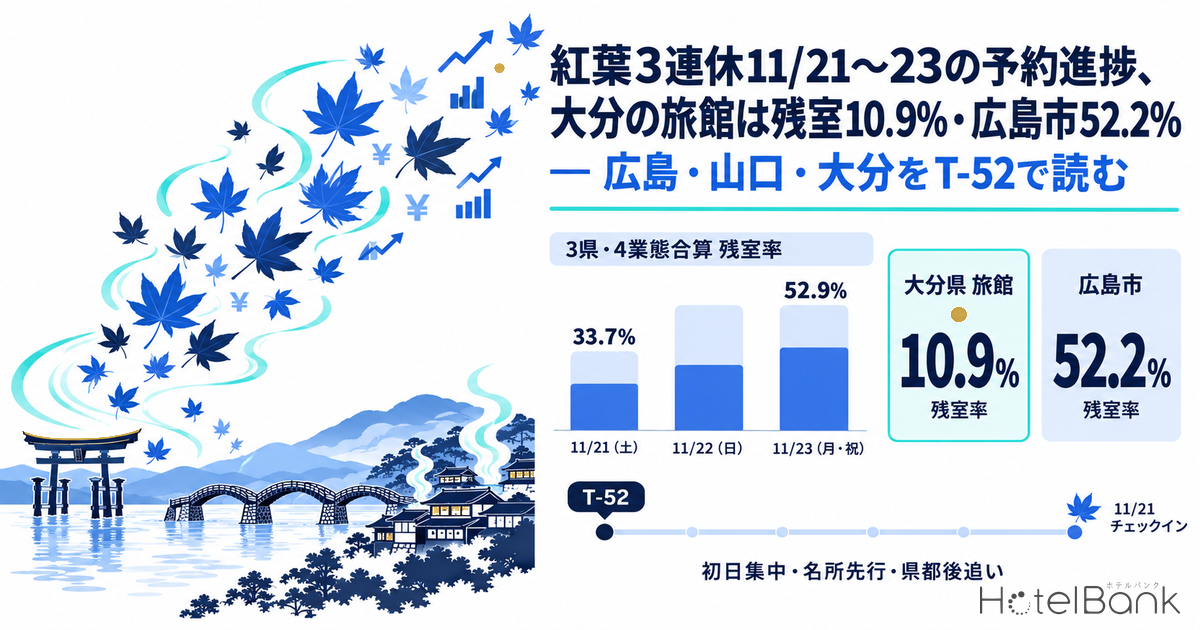
In Hiroshima, Yamaguchi and Oita, the three-day weekend of Saturday, November 21 to Monday, November 23 (Labor Thanksgiving Day) coincides with peak autumn foliage. Miyajima (Hatsukaichi) is forecast to reach peak colour from around November 19 and Shin-Yabakei (Nakatsu) from around November 15, while Momijidani Park in Iwakuni typically peaks from mid- to late November. This article reads the long weekend through inventory data captured 52 days before the stay date (as of September 30, 2026; “T-52” below). The sample is limited to properties that list at least 30% of their total rooms on major booking sites, and the remaining-room rate is compared across four segments: ryokan, resort, business and city hotels. With more than seven weeks still to go, this is a reading of booking progress to date, not a sell-out verdict. We look in turn at whether demand is concentrated on the first night or the middle night, the gap between foliage destinations and prefectural capitals, how early bookings built compared with the October long weekend, and the year-on-year change in estimated settled ADR for November, before closing with tactics for filling the inventory that remains.
Metric Definitions Used in This Article
- ADR (Average Daily Rate) = an estimated settled room rate (tax-exclusive equivalent), calculated by applying segment-specific adjustment factors to the lowest-priced plan each property publishes on OTAs (per room, two adults, tax-inclusive). Checked against property-level results disclosed by listed hotel REITs (184 property-months, April–May 2026), the median error is about 7%. These are estimates and differ from each property’s actual settled rates and accounting figures. Area-level ADR is the median of the properties in the sample (the level of a typical property in the area). November 2026 values are estimates based on rates listed at the time of the survey and will change as the stay date approaches.
- OCC (Occupancy) = rooms sold as a share of total rooms in the area (an estimate based on OTA sales inventory).
- Remaining-room rate = rooms still available on OTAs and similar channels at the time of observation, as a share of the sample properties’ total rooms. This is the main metric in this article; the lower the value, the further bookings have progressed.
- LT (Lead Time) = days until check-in. LT0 = the day of arrival. The observation point in this article is LT52 relative to November 21.
- Sample = only properties listing at least 30% of their total rooms on major booking sites (determined separately for each date, so the property count N varies by date). Properties not listed on OTAs, or that restrict their OTA allocation, are not included.
- Data source: MetroEngines Research (analysis covers approximately 27,000 properties tracked by MetroEngines Research with confirmed operating activity)
- — First night leads: Across all three prefectures and four segments, the remaining-room rate was 33.7% for Sat Nov 21, 39.2% for Sun Nov 22 and 52.9% for Mon Nov 23 (holiday) (as of September 30, 2026; 52 days before the stay).
- — Ryokan out in front: Oita ryokan had a first-night remaining-room rate of 10.9% (127 properties), with 78 showing zero rooms left. Business hotels have far more headroom, at 48.4% in Hiroshima.
- — Scenic spots first, capitals later: Hatsukaichi is at 7.8%, Yufu 12.8% and Beppu 15.2%, while Hiroshima City still has 52.2% left.
- — Versus the October long weekend: At LT60, Oita and Yamaguchi ryokan were around 15pt ahead. Hiroshima ryokan, by contrast, had 6.4pt more left.
- — Rates: On 2025 final figures, ryokan ADR in November was +9.7% to +27.9% above October. For November 2026, only Yamaguchi ryokan are listing below last year (−14.3% YoY).
The Big Picture — Saturday Fills First, Monday Night Still Has Room
First, progress across all three prefectures and four segments combined. As of September 30, Saturday, November 21 had 4,412 rooms left out of 13,111 at 307 properties, a remaining-room rate of 33.7%; Sunday the 22nd stood at 39.2% (377 properties, 18,036 rooms); and Monday the 23rd (holiday) at 52.9% (459 properties, 21,430 rooms). The shape across the three nights is clearly front-loaded: Saturday is furthest along, Sunday follows, and more than half of Monday night — followed by a working day — is still unsold. This is the reverse of a Fri–Sat–Sun weekend, where the middle night leads; the general tendency for demand to gather on the first night of a Sat–Sun–Mon long weekend shows up in these three prefectures during foliage season as well. November 21–23 is the only three-day weekend in November 2026, and it overlaps with peak foliage in many parts of Japan.
By prefecture, the November 21 remaining-room rate runs from Oita at 19.5% (164 properties, 3,967 rooms) to Yamaguchi at 34.2% (68 properties, 4,342 rooms) and Hiroshima at 44.9% (75 properties, 4,802 rooms). Oita, home to the ryokan clusters of Yufuin and Beppu, has a high share of ryokan, whereas business-hotel rooms make up most of Hiroshima’s sample. That difference in segment mix carries straight through to the prefectural ranking, so the comparison has to be broken down by segment. Observations taken more than 45 days before the stay date can include inventory that hotels have not yet fully loaded, and may not reflect true booking progress (307 properties; observation coverage 43%).
Remaining-room rate by prefecture and segment (as of September 30, 2026; check-in November 21–23). Only properties listing at least 30% of total rooms on major booking sites are included. 307–459 properties / 13,111–21,430 rooms (based on major booking site listings). City hotels are excluded from the chart because N=1–5 per prefecture; they appear in the table for reference only. Observations taken more than 45 days before the stay date can include inventory that hotels have not yet fully loaded, and may not reflect true booking progress (307 properties; observation coverage 43%).
Source: compiled by the HotelBank Editorial Team from MetroEngines Research
| Prefecture | Segment | Nov 21 (Sat) remaining | Nov 22 (Sun) remaining | Nov 23 (Mon) remaining | Share of properties with ≤10% left (Nov 21) |
|---|---|---|---|---|---|
| Hiroshima | Ryokan | 24.3% N=18 · 284 rooms | 23.7% N=30 · 596 rooms | 47.0% N=33 · 758 rooms | 38.9% |
| Hiroshima | Resort | 1.5%* N=3 · 132 rooms | 12.7%* N=4 · 379 rooms | 13.8%* N=6 · 195 rooms | 66.7% |
| Hiroshima | Business | 48.4% N=50 · 4,272 rooms | 49.9% N=68 · 6,588 rooms | 60.3% N=74 · 7,607 rooms | 32.0% |
| Hiroshima | City | 13.2%* N=4 · 114 rooms | 10.8%* N=4 · 590 rooms | 41.7%* N=5 · 199 rooms | 75.0% |
| Yamaguchi | Ryokan | 14.2% N=22 · 527 rooms | 33.0% N=24 · 554 rooms | 45.0% N=37 · 883 rooms | 54.5% |
| Yamaguchi | Resort | 23.4%* N=8 · 497 rooms | 21.5%* N=8 · 446 rooms | 45.3%* N=7 · 362 rooms | 0.0% |
| Yamaguchi | Business | 38.9% N=37 · 3,260 rooms | 45.5% N=44 · 3,809 rooms | 57.2% N=41 · 4,123 rooms | 8.1% |
| Yamaguchi | City | 41.4%* N=1 · 58 rooms | 55.9%* N=1 · 34 rooms | 50.8%* N=2 · 118 rooms | 0.0% |
| Oita | Ryokan | 10.9% N=127 · 1,674 rooms | 19.2% N=144 · 1,951 rooms | 42.5% N=188 · 2,492 rooms | 66.1% |
| Oita | Resort | 25.2% N=13 · 242 rooms | 17.9% N=20 · 508 rooms | 33.3% N=26 · 987 rooms | 53.8% |
| Oita | Business | 25.8% N=23 · 2,045 rooms | 40.1% N=29 · 2,575 rooms | 50.3% N=36 · 3,266 rooms | 26.1% |
| Oita | City | 0.0%* N=1 · 6 rooms | 50.0%* N=1 · 6 rooms | 61.4%* N=4 · 440 rooms | 100.0% |
* = reference value, N under 10. “Share of properties with ≤10% left” is the share of properties whose remaining rooms for November 21 were 10% or less of their total rooms. 307–459 properties / 13,111–21,430 rooms (based on major booking site listings). Observations taken more than 45 days before the stay date can include inventory that hotels have not yet fully loaded, and may not reflect true booking progress (307 properties; observation coverage 43%).
Source: compiled by the HotelBank Editorial Team from MetroEngines Research
By segment, ryokan stand out. The November 21 remaining-room rate is 10.9% for Oita ryokan (127 properties, 1,674 rooms), 14.2% for Yamaguchi ryokan (22 properties, 527 rooms) and 24.3% for Hiroshima ryokan (18 properties, 284 rooms). Among Oita ryokan, 66.1% of properties are down to 10% or less of their total rooms, meaning two-thirds of the sample has all but used up its first-night allocation. Business hotels, by contrast, have 15–25pt more left than ryokan: 25.8% in Oita (23 properties, 2,045 rooms), 38.9% in Yamaguchi (37 properties, 3,260 rooms) and 48.4% in Hiroshima (50 properties, 4,272 rooms). On peak foliage dates, demand goes first to ryokan, where the stay itself is the purpose of the trip, and flows into business hotels closer to the stay date; business-hotel headroom serves as the buffer for last-minute demand. Observations taken more than 45 days before the stay date can include inventory that hotels have not yet fully loaded, and may not reflect true booking progress (307 properties; observation coverage 43%).
For the final night, Monday, November 23 (holiday), close to half of inventory remains even at ryokan: 42.5% in Oita (188 properties), 45.0% in Yamaguchi (37 properties) and 47.0% in Hiroshima (33 properties). The next day is a working day, so Monday night fills only as the third night of a multi-night stay or as a stop on the way home for long-distance travellers. How this night is handled is the swing factor for RevPAR over the long weekend (tactics are discussed below). Observations taken more than 45 days before the stay date can include inventory that hotels have not yet fully loaded, and may not reflect true booking progress (459 properties; observation coverage 43%).
Foliage Destinations vs. Prefectural Capitals — Hatsukaichi, Yufu and Beppu Lead; Hiroshima City and Oita City Have Room
Next, we separate the areas around well-known foliage spots from the prefectural capitals. The six foliage destinations are Hatsukaichi (Miyajima, Momijidani Park), Iwakuni (Kintaikyo Bridge, Momijidani Park), Nakatsu (Yabakei, Shin-Yabakei), Kusu and Kokonoe (Kuju, Kyusuikei Gorge), Yufu and Beppu. The capitals are Hiroshima City (all eight wards combined), Yamaguchi City and Oita City. All four segments are combined.
Remaining-room rate by area (as of September 30, 2026; check-in November 21–23; four segments combined). Only properties listing at least 30% of total rooms on major booking sites are included. 307–459 properties / 13,111–21,430 rooms (based on major booking site listings; drawn from the prefecture × segment sample). Observations taken more than 45 days before the stay date can include inventory that hotels have not yet fully loaded, and may not reflect true booking progress (307 properties; observation coverage 43%).
Source: compiled by the HotelBank Editorial Team from MetroEngines Research
| Group | Area | Nov 21 (Sat) remaining | Nov 22 (Sun) remaining | Nov 23 (Mon) remaining | Share of properties with ≤10% left (Nov 21) |
|---|---|---|---|---|---|
| Foliage destination | Hatsukaichi | 7.8% N=6 · 102 rooms | 17.8% N=10 · 370 rooms | 38.3% N=14 · 311 rooms | 33.3% |
| Foliage destination | Iwakuni | 40.9% N=7 · 538 rooms | 52.1% N=8 · 607 rooms | 64.1% N=8 · 654 rooms | 14.3% |
| Foliage destination | Nakatsu | 10.9% N=3 · 460 rooms | 41.3% N=4 · 472 rooms | 49.8% N=6 · 488 rooms | 66.7% |
| Foliage destination | Kusu / Kokonoe | 24.5% N=13 · 167 rooms | 33.3% N=14 · 186 rooms | 49.5% N=22 · 277 rooms | 69.2% |
| Foliage destination | Yufu | 12.8% N=58 · 531 rooms | 16.1% N=64 · 633 rooms | 35.0% N=87 · 1,008 rooms | 58.6% |
| Foliage destination | Beppu | 15.2% N=44 · 1,059 rooms | 19.3% N=57 · 1,487 rooms | 39.8% N=72 · 2,247 rooms | 79.5% |
| Prefectural capital | Hiroshima City | 52.2% N=19 · 2,430 rooms | 45.9% N=31 · 4,612 rooms | 59.7% N=38 · 5,159 rooms | 36.8% |
| Prefectural capital | Yamaguchi City | 25.6% N=12 · 1,011 rooms | 44.4% N=12 · 859 rooms | 51.2% N=13 · 1,265 rooms | 41.7% |
| Prefectural capital | Oita City | 27.0% N=11 · 937 rooms | 42.9% N=13 · 1,304 rooms | 61.2% N=15 · 1,514 rooms | 0.0% |
Nakatsu (N=3–6), Hatsukaichi (N=6–14) and Iwakuni (N=7–8) have few properties, so the movement of a single large hotel can swing the figures. 307–459 properties / 13,111–21,430 rooms (based on major booking site listings). Observations taken more than 45 days before the stay date can include inventory that hotels have not yet fully loaded, and may not reflect true booking progress (307 properties; observation coverage 43%).
Source: compiled by the HotelBank Editorial Team from MetroEngines Research
For the first night (November 21), most foliage destinations are down to around 20% or less: Hatsukaichi 7.8% (6 properties, 102 rooms), Nakatsu 10.9% (3 properties, 460 rooms), Yufu 12.8% (58 properties, 531 rooms), Beppu 15.2% (44 properties, 1,059 rooms) and Kusu/Kokonoe 24.5% (13 properties, 167 rooms). The capitals, by contrast, stand at 52.2% for Hiroshima City (19 properties, 2,430 rooms), 27.0% for Oita City (11 properties, 937 rooms) and 25.6% for Yamaguchi City (12 properties, 1,011 rooms); Hiroshima City still has half its rooms left even on the first night. The foliage long weekend fills in two stages: first the areas right at the scenic spots, then the capitals, which act as gateways to them. Observations taken more than 45 days before the stay date can include inventory that hotels have not yet fully loaded, and may not reflect true booking progress (307 properties; observation coverage 43%).
There are differences within the foliage destinations, too. Iwakuni is at 40.9% (7 properties, 538 rooms), on a par with the capitals, and still has 64.1% left for November 23. Iwakuni’s sample is mostly business hotels, which suggests that foliage visitors to Kintaikyo tend to stay on the Hiroshima City or Miyajima side and visit as a day trip. Nakatsu is well advanced at 10.9% for November 21 but widens to 41.3% for the 22nd, so its demand is concentrated on Saturday night (station-front business hotels account for 90% of the rooms in Nakatsu’s sample; see the next paragraph). Kusu/Kokonoe has many small properties: nine show zero rooms left while others still have availability, so the spread between properties is wide.
At the property level, a few hotels had very little left at the time of observation. In front of Nakatsu Station, Toyoko Inn Oita Nakatsu Ekimae (東横INN大分中津駅前; 215 rooms) showed 6 rooms left for November 21 in listings captured in the 4 p.m. hour on September 30, and Hotel Route-Inn Nakatsu Ekimae (ホテルルートイン中津駅前; 207 rooms) showed 9 rooms left at the same time. These two station-front properties account for 422 of the 460 rooms in Nakatsu’s three-property sample, so Nakatsu’s 10.9% in the area table is effectively the progress of these two hotels and should be read as including station-front demand, not just Yabakei foliage demand. In Hatsukaichi, Livemax Resort Miyahama Onsen Ocean (リブマックスリゾート宮浜温泉 Ocean; 50 rooms) showed 1 room left for November 22 in data from the 6 p.m. hour on September 29, and in Beppu, Sanso Kanwaen (山荘 神和苑; 30 rooms) showed 1 room left for November 22 in the 5 p.m. hour on September 30. These are remaining-room counts at the time of observation and may change with cancellations or additional allocation.
| Area | Property | Total rooms | Stay date | Rooms left at observation | Last observed |
|---|---|---|---|---|---|
| Nakatsu | Toyoko Inn Oita Nakatsu Ekimae (東横INN大分中津駅前) | 215 rooms | Nov 21 (Sat) | 6 rooms | Sep 30, 4 p.m. hour |
| Nakatsu | Hotel Route-Inn Nakatsu Ekimae (ホテルルートイン中津駅前) | 207 rooms | Nov 21 (Sat) | 9 rooms | Sep 30, 4 p.m. hour |
| Hatsukaichi | Livemax Resort Miyahama Onsen Ocean (リブマックスリゾート宮浜温泉 Ocean) | 50 rooms | Nov 22 (Sun) | 1 rooms | Sep 29, 6 p.m. hour |
| Beppu | Sanso Kanwaen (山荘 神和苑) | 30 rooms | Nov 22 (Sun) | 1 rooms | Sep 30, 5 p.m. hour |
Remaining rooms based on OTA and similar listings at the time of observation. Because these counts change with cancellations and additional allocation, they are shown as an interim snapshot rather than a sell-out verdict. Observations taken more than 45 days before the stay date can include inventory that hotels have not yet fully loaded, and may not reflect true booking progress (307 properties; observation coverage 43%).
Source: compiled by the HotelBank Editorial Team from MetroEngines Research
Versus the October Long Weekend — Oita and Yamaguchi Ryokan Are 15pt Ahead at the Same Lead Time
To gauge when bookings in the foliage destinations start to build, we compare with the most recent long weekend, Saturday, October 10 to Monday, October 12 (Sports Day). At the time of writing, October 10 had reached LT10, so its booking curve from LT45 to date is complete. In eastern Japan, this October weekend marks the start of the foliage season in Nikko (Tochigi) and Shinshu (Nagano), so the ryokan curves for Tochigi and Nagano are overlaid as an eastern Japan reference.
Remaining-room rate for ryokan, Saturday, October 10 check-in (LT45→LT10, all observed properties at the prefecture level). Sample: Hiroshima 42 properties / 1,111 rooms; Yamaguchi 47 / 1,513; Oita 227 / 3,626; Tochigi 147 / 5,832; Nagano 272 / 6,490 (based on major booking site listings). This chart uses prefecture-level curves without the 30% allocation condition, so its sample differs from the tables above.
Source: compiled by the HotelBank Editorial Team from MetroEngines Research
The October 10 ryokan curves have the same shape in all five prefectures. At LT45 the remaining-room rate was 10.4% in Hiroshima, 14.5% in Yamaguchi, 22.7% in Oita, 21.0% in Tochigi and 16.6% in Nagano; by LT30 it had fallen to 5.8%, 9.9%, 12.7%, 15.9% and 10.3%, and by LT14 to 3.7%, 5.4%, 3.8%, 10.2% and 6.4% respectively. Comparing the drop over the 15 days from LT45 to LT30 with the 16 days from LT30 to LT14, Oita (−10.0pt / −8.9pt), Nagano (−6.3pt / −3.9pt) and Hiroshima (−4.6pt / −2.1pt) fell more in the first half, while Yamaguchi (−4.6pt / −4.5pt) and Tochigi (−5.1pt / −5.7pt) moved at about the same pace; in all five, remaining rooms declined steadily from LT45 to LT14. There was no major difference in the timing of pickup for the October long weekend between Tochigi and Nagano, where the foliage season was starting, and Hiroshima, Yamaguchi and Oita, where it had not yet begun. The October long weekend is driven by the holiday itself rather than by foliage, and fills on the same timeline regardless of region.
What about November 21, which coincides with peak foliage? To keep the samples comparable, the next table sets out remaining-room rates at LT90 and LT60 for October 10 and November 21, for property groups drawn with the same 30% allocation condition.
| Prefecture / segment | Nov 21 (Sat) check-in | Oct 10 (Sat) check-in (reference) | |||||
|---|---|---|---|---|---|---|---|
| LT90 | LT60 | Now (LT52) | LT90 | LT60 | LT30 | LT14 | |
| Hiroshima ryokan | 52.5% | 35.2% | 24.3% N=18 · 284 rooms | 43.2% | 28.8% | 17.2% | 11.1% N=26 · 413 rooms |
| Hiroshima business | 80.1% | 57.9% | 48.4% N=50 · 4,272 rooms | 69.2% | 52.5% | 29.9% | 18.2% N=63 · 6,875 rooms |
| Yamaguchi ryokan | 43.8% | 22.2% | 14.2% N=22 · 527 rooms | 52.2% | 38.5% | 16.2% | 10.9% N=29 · 682 rooms |
| Yamaguchi business | 55.4% | 46.5% | 38.9% N=37 · 3,260 rooms | 57.5% | 46.4% | 24.0% | 16.5% N=44 · 4,386 rooms |
| Oita ryokan | 48.5% | 26.8% | 10.9% N=127 · 1,674 rooms | 56.1% | 41.3% | 20.2% | 7.5% N=167 · 2,294 rooms |
| Oita business | 62.9% | 36.7% | 25.8% N=23 · 2,045 rooms | 44.8% | 39.7% | 32.9% | 16.1% N=27 · 2,300 rooms |
Remaining-room rate for property groups drawn on the same conditions (properties listing at least 30% of total rooms on major booking sites). LT90 and LT60 are observations taken more than 45 days before the stay date. Observations taken more than 45 days before the stay date can include inventory that hotels have not yet fully loaded, and may not reflect true booking progress (307 properties; observation coverage 43%).October 10: 408 properties / 20,478 rooms (based on major booking site listings; observation coverage 44%).
Source: compiled by the HotelBank Editorial Team from MetroEngines Research
Oita ryokan had a remaining-room rate of 41.3% at LT60 for October 10 (167 properties), versus 26.8% at the same LT60 for November 21 (127 properties) — roughly 15pt ahead. Yamaguchi ryokan were 38.5% at LT60 for October 10 and 22.2% for November 21, 16pt ahead. Hiroshima ryokan, however, had 28.8% left for October 10 against 35.2% for November 21, i.e. 6.4pt more remaining in November (43.2% vs. 52.5% at LT90 as well), so the lead is not shared by all three prefectures. For Oita ryokan, the October 10 curve stood at 20.2% at LT30 and 7.5% at LT14, while November 21 has already reached 10.9% at LT52. On the October 10 curve, that corresponds to roughly LT18, meaning this level was reached about five weeks earlier (a rough guide based on linear interpolation between LT30 and LT14). Observations taken more than 45 days before the stay date can include inventory that hotels have not yet fully loaded, and may not reflect true booking progress (167 properties), so the gap should be read with a margin of error. Even so, for Oita and Yamaguchi ryokan, the peak foliage weekend was already ahead of the October long weekend at LT90 and LT60, with bookings coming in early. Hiroshima ryokan (18 properties, 284 rooms) form a small sample and do not follow this pattern.
Reference Scenarios — What Would Remain at LT14 at October’s Pickup Rate?
The remaining-room rates above are interim figures; how far they fill by the stay date is not yet known. As a yardstick, we took the share of remaining rooms that the Saturday, October 10 check-in property groups (drawn on the same 30% allocation condition) absorbed between LT60 and LT14 (pickup rate = 1 − LT14 remaining-room rate ÷ LT60 remaining-room rate) and applied it to the current remaining-room rate for Saturday, November 21. Because the actual October 10 pickup rate ranged from 59.4% (Oita business hotels) to 81.8% (Oita ryokan) depending on prefecture and segment, we calculated each cell using its own pickup rate and also at four fixed levels — 60%, 65%, 70% and 80% — and present the result as a two-axis sensitivity table.
| Prefecture / segment | Now (LT52) remaining | Oct 10 pickup rate (LT60→LT14) | At own pickup rate | Pickup 60% | 65% | 70% | 80% |
|---|---|---|---|---|---|---|---|
| Hiroshima ryokan | 24.3% | 61.5% | 9.4% approx. 27 rooms | 9.7% | 8.5% | 7.3% | 4.9% |
| Hiroshima business | 48.4% | 65.3% | 16.8% approx. 717 rooms | 19.4% | 16.9% | 14.5% | 9.7% |
| Yamaguchi ryokan | 14.2% | 71.7% | 4.0% approx. 21 rooms | 5.7% | 5.0% | 4.3% | 2.8% |
| Yamaguchi business | 38.9% | 64.4% | 13.8% approx. 451 rooms | 15.6% | 13.6% | 11.7% | 7.8% |
| Oita ryokan | 10.9% | 81.8% | 2.0% approx. 33 rooms | 4.4% | 3.8% | 3.3% | 2.2% |
| Oita business | 25.8% | 59.4% | 10.5% approx. 214 rooms | 10.3% | 9.0% | 7.7% | 5.2% |
LT14 remaining-room rate = current remaining-room rate (September 30, 2026; LT52) × (1 − pickup rate). Pickup rates are derived from the LT60 and LT14 remaining-room rates in the table above (October 10 check-in property groups drawn on the same conditions). “Approx. N rooms” is a rough guide obtained by applying the rate to the current sample room count. These are not forecasts but reference values assuming remaining rooms are absorbed at the same pace as over the October long weekend. The remaining window, LT52→LT14, is 38 days — shorter than the 46-day reference interval (LT60→LT14) — so these values err on the side of overstating pickup. Observations taken more than 45 days before the stay date can include inventory that hotels have not yet fully loaded, and may not reflect true booking progress (307 properties; observation coverage 43%).
Source: compiled by the HotelBank Editorial Team from MetroEngines Research
There are two takeaways. First, ryokan have little headroom. Applying their own pickup rate (81.8%), Oita ryokan would be at 2.0% remaining at LT14, and even at a 60% pickup rate they would stay at 4.4%. Unless there are cancellations or additional allocation, ryokan will have almost no inventory left to work with on the first night. Second, the headroom sits with Hiroshima business hotels: 16.8% (approx. 717 rooms) at their own pickup rate (65.3%), and 9.7% even at the fastest 80%. Together with Yamaguchi business hotels (13.8% at their own rate), the picture holds whichever pickup rate is assumed: the properties holding inventory longest across the three prefectures are business hotels in and around the prefectural capitals. That is also where the capital-city business-hotel tactics discussed below — plans that put access to the scenic spots front and centre — will work best.
November Estimated Settled ADR — The Foliage-Month Premium for Ryokan Shows Up in Final Figures
Now to pricing. Looking first at final 2025 results to see how much higher November was than October, estimated settled ADR for ryokan rose from ¥15,000 in October to ¥18,100 in November in Hiroshima (+21.0%), from ¥14,900 to ¥19,100 in Yamaguchi (+27.9%) and from ¥18,100 to ¥19,800 in Oita (+9.7%). In all three prefectures, November is a higher-rate month than October for ryokan, and in Hiroshima and Yamaguchi a “foliage-month premium” of more than 20% appears in the final figures.
Estimated settled ADR (tax-exclusive equivalent; area median). November 2025 is a final figure; November 2026 is an estimate based on rates listed at the time of the survey (September 30, 2026) and will change as the stay date approaches. See the table below for N (properties per cell).
Source: compiled by the HotelBank Editorial Team from MetroEngines Research
| Prefecture | Segment | Nov 2025 est. settled ADR (final) | Nov 2026 est. settled ADR (estimate from rates listed at survey) | YoY | Ref: 2025 Nov ÷ Oct |
|---|---|---|---|---|---|
| Hiroshima | All | ¥9,822 N=295 | ¥12,415 N=278 | +26.4% | +7.5% |
| Hiroshima | Ryokan | ¥18,142 N=72 | ¥18,590 N=66 | +2.5% | +21.0% |
| Hiroshima | Resort | ¥22,817 N=10 | ¥26,848 N=10 | +17.7% | +5.7% |
| Hiroshima | Business | ¥7,946 N=184 | ¥10,933 N=169 | +37.6% | +0.4% |
| Hiroshima | City | ¥12,695 N=29 | ¥15,633 N=31 | +23.1% | +10.5% |
| Yamaguchi | All | ¥8,070 N=192 | ¥10,611 N=193 | +31.5% | +12.0% |
| Yamaguchi | Ryokan | ¥19,104 N=71 | ¥16,379 N=71 | -14.3% | +27.9% |
| Yamaguchi | Resort | ¥11,290 N=14 | ¥13,187 N=15 | +16.8% | -2.5% |
| Yamaguchi | Business | ¥6,302 N=97 | ¥8,973 N=97 | +42.4% | +0.2% |
| Yamaguchi | City | ¥7,532 N=10 | ¥10,778 N=10 | +43.1% | +5.3% |
| Oita | All | ¥16,436 N=436 | ¥16,340 N=457 | -0.6% | +12.5% |
| Oita | Ryokan | ¥19,842 N=296 | ¥20,930 N=315 | +5.5% | +9.7% |
| Oita | Resort | ¥17,295 N=36 | ¥19,278 N=43 | +11.5% | -13.9% |
| Oita | Business | ¥6,407 N=91 | ¥9,331 N=84 | +45.6% | +2.5% |
| Oita | City | ¥11,847 N=13 | ¥13,158 N=15 | +11.1% | +13.6% |
Estimated settled ADR is an estimate (tax-exclusive equivalent) obtained by applying segment-specific adjustment factors to each property’s lowest-priced plan. The November 2026 column is an estimate based on rates listed at the time of the survey. “2025 Nov ÷ Oct” compares final figures.
Source: compiled by the HotelBank Editorial Team from MetroEngines Research
Setting the November 2026 estimates (based on rates listed at the time of the survey) against the same month last year, ryokan are flat to slightly up in Oita at ¥20,900 (+5.5%, N=315) and Hiroshima at ¥18,600 (+2.5%, N=66), while in Yamaguchi, at ¥16,400 (−14.3%, N=71), current listed rates are below last year’s final figure. Yamaguchi’s property count is unchanged at 71, so turnover in the sample is small; the reading is that the price band of the remaining allocation has not reached last year’s settled level. Put the other way round, Yamaguchi ryokan — well advanced at a 14.2% remaining-room rate — have room to move the price of their remaining allocation up toward foliage-month levels.
For business hotels, November 2026 is showing levels roughly 40–45% above last year in all three prefectures (+37.6% to +45.6%). However, this tends to reflect listed rates at a point when the cheaper plans have sold out first, and it is likely to come down as more inventory is added closer to the stay date. Treat it as an interim figure, not a final one. By municipality, the foliage destinations are flat year on year — Hatsukaichi at ¥29,100 (¥28,400 in November last year), Yufu at ¥25,600 (¥25,800) and Beppu at ¥16,500 (¥16,600) — while Kokonoe is trending up at ¥19,300 (¥17,600).
| Group | Municipality | Nov 2025 (final) | Nov 2026 (estimate from rates listed at survey) | YoY |
|---|---|---|---|---|
| Foliage destination | Hatsukaichi | ¥28,394 N=35 | ¥29,130 N=34 | +2.6% |
| Foliage destination | Iwakuni | ¥6,734 N=15 | ¥8,801 N=15 | +30.7% |
| Foliage destination | Nakatsu | ¥6,264 N=12 | ¥8,080 N=12 | +29.0% |
| Foliage destination | Kokonoe | ¥17,559 N=37 | ¥19,278 N=43 | +9.8% |
| Foliage destination | Yufu | ¥25,766 N=131 | ¥25,608 N=140 | -0.6% |
| Foliage destination | Beppu | ¥16,640 N=113 | ¥16,546 N=123 | -0.6% |
| Prefectural capital (Hiroshima City) | Naka Ward | ¥12,550 N=56 | ¥14,012 N=59 | +11.6% |
| Prefectural capital | Yamaguchi City | ¥8,353 N=29 | ¥11,018 N=29 | +31.9% |
| Prefectural capital | Oita City | ¥7,254 N=43 | ¥9,884 N=38 | +36.3% |
Estimated settled ADR by municipality (area median; tax-exclusive equivalent). Kusu is omitted because N=1–2. For Hiroshima City, Naka Ward, which has the most properties, is shown as representative.
Source: compiled by the HotelBank Editorial Team from MetroEngines Research
Tactics for Filling Remaining Inventory — Multi-Night Stays, Meal Plans and Reselling Cancellations
The T-52 figures point to a clear layout: ryokan are nearly full on the first night, while Monday night and business and city hotels in the capitals still have room. Three tactics fit this layout.
The first is multi-night stay design. Close to half of ryokan inventory is still open for Monday, November 23 (holiday), and that night is hard to sell on its own. Putting two- and three-night plans front and centre that attach Monday night to the already-filled Saturday and Sunday nights, and pricing the Monday night below the single-night rate, raises the guest’s total spend across the stay and fills Monday’s inventory. The same pattern was observed on the final night of the October long weekend at Yufuin ryokan, where the last night sold at weekday-like levels, and it applies directly to the November long weekend.
The second is a deeper range of meal-inclusive plans. Guests in foliage destinations spend the day at the scenic spots until late afternoon and the evening at their accommodation. Plans with dinner and breakfast, or dinners featuring local ingredients, not only carry a higher rate than room-only plans but are also the most natural way to apply the ryokan “November premium” to the remaining allocation. In areas like Yamaguchi, where ryokan bookings are well advanced yet current listed rates are below last year’s final figure, there is room to rework the remaining allocation from room-only into higher-tier meal-inclusive plans and move it toward foliage-month rate levels.
The third is reselling cancellations. For November 21, 78 ryokan in Oita and 9 in Yamaguchi show zero rooms left, but a certain number of cancellations will come back from LT30 onward. Rather than relisting returned rooms at the same price the moment they appear, the approach that tends to work on a peak foliage weekend is to resell them as higher-tier plans, using the most recent curve for the same segment as a guide (the October 10 curves in this article show 3–11% remaining at LT14), and to adjust price only on whatever is still left from LT7 onward. The T-45 / T-30 / T-14 decision windows used in our analysis of ryokan and resorts in Fukushima over the October long weekend can be applied on the same timeline in these three prefectures.
Business and city hotels in the prefectural capitals are positioned to catch the demand that spills over once ryokan near the scenic spots fill up. Hiroshima City’s 52.2% and Oita City’s 27.0% remaining for November 21 are natural levels at T-52, and given that Hiroshima business hotels went from 28.3% remaining at LT45 to 8.9% at LT10 for October 10, there is considerable upside from LT30 onward. Plan names that highlight access to Miyajima and Kintaikyo, and plans that include breakfast and are built around an early-morning start to the scenic spots, are effective ways to capture this demand.
Frequently Asked Questions
Q. Which night of the foliage long weekend (November 21–23) is filling first?
A. As observed on September 30 (52 days before the stay), the first night, Saturday, November 21, is furthest along, with a remaining-room rate of 33.7% across all three prefectures and four segments (307 properties, 13,111 rooms). Sunday is at 39.2% and the final Monday night at 52.9% — a front-loaded pattern in which headroom widens with each night.
Q. Do bookings progress differently near foliage spots than in prefectural capitals?
A. Yes. Foliage destinations are ahead, with first-night remaining-room rates of 7.8% in Hatsukaichi (Miyajima), 12.8% in Yufu and 15.2% in Beppu, while the capitals still have room: 52.2% in Hiroshima City, 27.0% in Oita City and 25.6% in Yamaguchi City. Iwakuni (Kintaikyo), however, is at 40.9%, so there are differences among the foliage destinations as well.
Q. How do November 2026 room rates compare with November last year?
A. Based on estimated settled ADR derived from rates listed at the time of the survey, Oita ryokan are at ¥20,900 (+5.5% vs. November last year) and Hiroshima ryokan at ¥18,600 (+2.5%). Yamaguchi ryokan are at ¥16,400 (−14.3%), with current listed rates below last year. All are estimates that will change as the stay date approaches.
Q. How much inventory is left for the final night, Monday, November 23 (holiday)?
A. As of September 30, the remaining-room rate across all three prefectures and four segments was 52.9% (459 properties, 21,430 rooms). Even for ryokan, close to half remains: 42.5% in Oita, 45.0% in Yamaguchi and 47.0% in Hiroshima. Because the next day is a working day, the night is hard to sell on its own, making it the night where multi-night plans attaching Monday to the weekend work best.
Q. Is the November foliage long weekend booking up faster than the October long weekend?
A. For Oita and Yamaguchi ryokan, yes. Comparing property groups drawn on the same conditions, the LT60 remaining-room rate for Oita ryokan was 26.8% for November 21 versus 41.3% for October 10, and for Yamaguchi ryokan 22.2% versus 38.5% — around 15pt ahead. Hiroshima ryokan, however, had more left in November (35.2% vs. 28.8%), so the trend is not shared by all three prefectures.
Q. Which properties do the remaining-room rates in this article cover?
A. Only properties listing at least 30% of their total rooms on major booking sites (determined for each check-in date, so the number of properties varies by date). Properties not listed on OTAs, or that restrict their OTA allocation, are not included. November figures were observed more than 45 days before the stay date and are interim figures that will change with cancellations and additional allocation.
Summary
At T-52, the foliage long weekend (November 21–23) in Hiroshima, Yamaguchi and Oita shows three features: demand is concentrated on the first night, scenic destinations lead, and prefectural capitals follow. Across all three prefectures and four segments, the remaining-room rate is 33.7% for Saturday, 39.2% for Sunday and 52.9% for Monday night; ryokan are down to 10.9% in Oita and 14.2% in Yamaguchi; the foliage destinations of Hatsukaichi, Yufu and Beppu are at around 20% or less; and the capital Hiroshima City is at 52.2%. At the same LT60, Oita and Yamaguchi ryokan had around 15pt less remaining than for the October long weekend (October 10), so the peak foliage weekend has been moving from an early stage (Hiroshima ryokan, conversely, had 6.4pt more left). In the reference scenarios applying October 10 pickup rates, Hiroshima business hotels are again the segment with the most headroom at LT14. On 2025 final figures, estimated settled ADR for ryokan shows a foliage-month premium, with November roughly 10–28% above October; November 2026 listed rates are, for now, flat year on year in Oita and Hiroshima and below last year in Yamaguchi. The tactics that fit this layout are multi-night plans that attach Monday night, higher-tier meal-inclusive plans, and reselling cancelled rooms. All figures in this article were observed more than 45 days before the stay date and will change as further inventory is added and cancellations come back.
⚠ Note on ADR and remaining-room rates for future dates: The November 2026 ADR figures in this article are estimates derived from rates published on OTAs and similar channels at the time of the survey, and will change as check-in approaches. Remaining-room rates are likewise based on listed inventory at the time of observation and will change with cancellations and additional allocation. Please bear in mind both that rates currently set high may fall with last-minute adjustments, and that properties with few rooms left may add more inventory.
Methodology and Sources
The remaining-room rate was calculated by dividing each property’s remaining rooms by its total rooms, using listed inventory on major booking sites continuously aggregated by MetroEngines Research. The sample is limited to properties listing at least 30% of their total rooms on major booking sites, determined separately for each check-in date. Area figures are the sum of the sample properties located in each area. The October 10 booking curves use all observed properties at the prefecture level, without the 30% allocation condition. Estimated settled ADR is an estimate (tax-exclusive equivalent) obtained by applying segment-specific adjustment factors to each property’s lowest-priced plan; area values are the median of the sample properties. Observation date: September 30, 2026.
References and Sources
■ Data sources
Listed inventory on major booking sites continuously aggregated by MetroEngines Research (remaining rooms and total rooms by property, observed September 30, 2026); prefecture-level booking curves (October 10 check-in, LT45–LT10); estimated settled ADR (October–November 2025 final figures; November 2026 estimates based on rates listed at the time of the survey). Peak foliage timing is from Weathernews and information published by local governments.
■ Calculation assumptions
Remaining-room rate = total remaining rooms ÷ total rooms across sample properties (latest observation for each property). For each check-in date, the sample consists of properties whose maximum observed listed inventory was at least 30% of total rooms. The reference scenarios in Table 5 use LT14 remaining-room rate = current remaining-room rate × (1 − pickup rate), with pickup rates taken from the actual LT60→LT14 results for October 10 check-in property groups drawn on the same conditions (59.4–81.8%) and from fixed values of 60%, 65%, 70% and 80%. Area ADR is the median of the sample properties; year-on-year change is against the November 2025 final figure.
■ Limitations
November figures were observed more than 45 days before the stay date and include inventory that hotels have not yet fully loaded (observation coverage 43%). They are interim figures that will change with cancellations and additional allocation, not sell-out verdicts. The reference scenarios are not forecasts; because the remaining window (38 days) is shorter than the reference interval (46 days), they err on the side of overstating pickup. Properties not listed on OTAs, or that restrict their OTA allocation, are not included. Cells with N under 10 are reference values. Peak foliage dates are forecasts and may shift with the weather.
- MetroEngines Research — remaining-room rates and booking curves based on listed inventory on major booking sites; estimated settled ADR (as of September 30, 2026)
- Weathernews, “Miyajima Autumn Leaves 2026” (宮島の紅葉情報【2026】) (peak from around Nov 19; leaves begin falling from around Dec 1)
- Weathernews, “Shin-Yabakei Autumn Leaves 2026” (深耶馬溪の紅葉情報【2026】) (peak from around Nov 15; leaves begin falling from around Nov 27)
- Weathernews, “Momijidani Park (Iwakuni) Autumn Leaves” (紅葉谷公園(岩国)の紅葉情報) (typical peak mid- to late November)
- Iwakuni City Tourism Promotion Division, “Recommended Autumn Spots” (秋のおすすめスポット)
- Oita Prefecture, “When Is Peak Foliage at Yabakei? Five of Oita’s Best Autumn Leaf Spots” (耶馬渓紅葉の見頃はいつ?大分屈指の紅葉名所・スポット5選)
- Japan Tourism Agency, “Overnight Travel Statistics Survey (November 2025, second preliminary)” (宿泊旅行統計調査) — national room occupancy 65.7%; total guest nights 55.99 million (−3.7% YoY)