

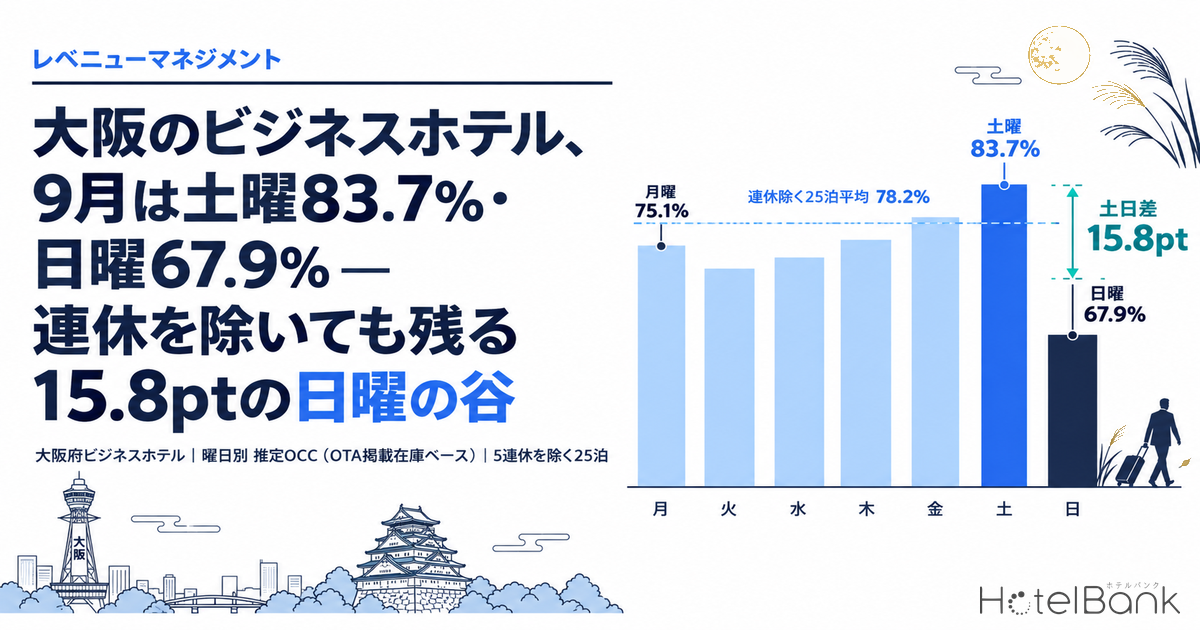
For business hotels in Osaka Prefecture, we averaged September 2026 daily results by day of week, excluding the five-day Silver Week holiday (September 19–23). Estimated OCC (based on OTA-listed inventory) was 83.7% on Saturdays but only 67.9% on Sundays, a gap of 15.8pt. The monthly average including the holiday was 80.0%; the average for the remaining 25 nights was 78.2%, and Sundays sat roughly 10pt below even that. This article shows with data that the “Sunday trough” persists after removing the holiday effect, and that much of the gap already exists 45 days before the stay date. It then sets out, from an operator’s perspective, how to fill the early part of the week, Mondays included.
Scope: business hotels in Osaka Prefecture, N=285–300 properties (mode 298 properties; 47,820–49,130 rooms; based on listings on major booking sites). The price metric in this article is the estimated settled ADR (the settled price level estimated from OTA and other sales data, tax-exclusive equivalent); occupancy is an estimate based on OTA-listed inventory. Both are defined at the end of the article. Data as of October 6, 2026.
• OCC (occupancy) = rooms sold as a share of total rooms in the area (an estimate based on OTA sales inventory). This article covers properties that list at least 30% of their total rooms on OTAs (the number of properties varies slightly by stay date).
• ADR (average daily rate) = the settled price level estimated from OTA and other sales data (estimated settled ADR, tax-exclusive equivalent). It is an estimate and differs from each property’s actual settled prices and accounting figures.
• See “About the Data” at the end of the article for detailed definitions. Source: MetroEngines Research
- — Saturday 83.7%, Sunday 67.9%: day-of-week averages of estimated OCC (based on OTA-listed inventory) for Osaka Prefecture business hotels in September 2026 (25 nights excluding the five-day holiday, N=285–300 properties); the gap is 15.8pt.
- — The trough is not unique to September: the Saturday–Sunday gap was 13.3pt in August 2026 and 12.1pt for Osaka city hotels in the same September, so it is deeper for business hotels.
- — A 6.6–11.3pt gap at 45 days out: 40–70% of the gap seen the day before arrival (15.3pt and 16.4pt) was already in place 45 days before the stay date.
- — Sundays still add +9.6 to +10.9pt in the final 7 days: whether a hotel has reached about 59%, the market level at 7 days out, is a basis for deciding whether to act or to wait.
- — The night before returning to work behaves like a Sunday: the last day of the holiday, September 23, 2026 (Wednesday, public holiday), was 66.2%, almost the same as the Sunday average.
September by Day of Week — Sunday at 67.9%, the Weekly Low Comes the Night After Saturday
Let us start with the overall day-of-week picture. In September 2026, the 19th (Saturday) through the 23rd (Wednesday, Autumnal Equinox Day) formed a five-day holiday, and those five nights fall outside the normal weekly pattern. This article therefore takes the remaining 25 nights and computes a simple average for each day of week. Sunday, Monday and Saturday are each averages of 3 nights; Tuesday through Friday are averages of 4 nights each.
Source: MetroEngines Research; compiled by HotelBank Editorial Team
| Day of week (stay date) | Nights | Average estimated OCC | Breakdown (stay date: estimated OCC) |
|---|---|---|---|
| Monday | 3 nights | 75.1% | 9/7: 71.8%, 9/14: 77.3%, 9/28: 76.1% |
| Tuesday | 4 nights | 78.3% | 9/1: 72.5%, 9/8: 79.8%, 9/15: 80.2%, 9/29: 80.8% |
| Wednesday | 4 nights | 81.2% | 9/2: 77.0%, 9/9: 83.7%, 9/16: 82.1%, 9/30: 81.9% |
| Thursday | 4 nights | 80.6% | 9/3: 78.5%, 9/10: 86.8%, 9/17: 83.4%, 9/24: 73.8% |
| Friday | 4 nights | 78.3% | 9/4: 76.3%, 9/11: 81.4%, 9/18: 75.7%, 9/25: 79.9% |
| Saturday | 3 nights | 83.7% | 9/5: 81.1%, 9/12: 85.1%, 9/26: 85.0% |
| Sunday | 3 nights | 67.9% | 9/6: 65.4%, 9/13: 69.8%, 9/27: 68.6% |
Osaka Prefecture business hotels, N=285–300 properties (varies by date). 25 nights excluding the five nights of September 19–23, 2026. Source: MetroEngines Research; compiled by HotelBank Editorial Team
The weekly shape is clear. Saturday is the highest at 83.7%; the following Sunday drops to 67.9%; occupancy recovers to 75.1% on Monday and 78.3% on Tuesday, then forms a weekday peak at 81.2% on Wednesday and 80.6% on Thursday. The three Sundays came in at 65.4%, 69.8% and 68.6%, all in the high 60s, so this was not a case of one weak week. The lowest night among the 25 non-holiday nights was also a Sunday, September 6, at 65.4%.
It is also worth noting that Friday, at 78.3%, sits below Wednesday and Thursday. This reads as a typical business-hotel pattern: business-travel demand is heaviest midweek, and many guests head home on Friday. In other words, a week at an Osaka business hotel has two peaks, Wednesday–Thursday and Saturday, with Friday forming a shallow saddle between them and the Sunday right after Saturday forming a deep trough.
Incidentally, estimated OCC on September 23 (Wednesday, public holiday), the last day of the excluded holiday, was 66.2% (N=297 properties), almost the same as the regular Sunday average of 67.9%. A night followed by a working day falls off like a Sunday even when it is a Wednesday. The trough appears to be driven not by the calendar label “Sunday” but by the nature of demand on “the night before returning to work,” and this point is a useful clue when considering the measures discussed later. For how demand was skewed within the five-day holiday itself, our analysis of pre-holiday booking pace, Osaka Sep 2026 Holiday: Demand Peaks First 2 Nights, Sep 23 at 58.0%, is also a useful reference.
Compared with August and City Hotels — The Trough Recurs Across Months and Is Deeper for Business Hotels
Next, we check whether this shape is specific to September. Averaging the same Osaka Prefecture business hotels by day of week for August 2026 (N=282–288 properties, mode 287; all 31 nights included), Saturday was 85.8% against 72.5% on Sunday, a gap of 13.3pt. The August figures still include Obon and Mountain Day (August 11), yet Sunday is the weekly low just as in September. Monday was also weak at 73.7%, so a soft start to the week, across those two nights, is common to both months.
Source: MetroEngines Research; compiled by HotelBank Editorial Team
| Segment | Mon | Tue | Wed | Thu | Fri | Sat | Sun | Sat − Sun |
|---|---|---|---|---|---|---|---|---|
| Business, Sep (25 nights excl. holiday, N=285–300) | 75.1% | 78.3% | 81.2% | 80.6% | 78.3% | 83.7% | 67.9% | 15.8pt |
| Business, Aug (31 nights, N=282–288) | 73.7% | 81.6% | 82.5% | 84.2% | 82.5% | 85.8% | 72.5% | 13.3pt |
| City, Sep (25 nights excl. holiday, N=34–40) | 78.0% | 77.0% | 79.7% | 80.5% | 83.0% | 87.1% | 75.0% | 12.1pt |
All figures are estimated OCC for Osaka Prefecture (based on OTA-listed inventory). In August, Monday, Saturday and Sunday each cover 5 nights; Tuesday through Friday cover 4 nights each. Source: MetroEngines Research; compiled by HotelBank Editorial Team
What happens with a different hotel type? Osaka Prefecture city hotels in September (N=34–40 properties, mode 35; 7,905–9,042 rooms; likewise 25 nights excluding the holiday) posted 87.1% on Saturday and 75.0% on Sunday, a gap of 12.1pt. Sunday is the low point here too, but the business-hotel Sunday of 67.9% is 7.1pt below city hotels, so the trough is deeper for business hotels.
The other difference shows up on Friday. City hotels reach 83.0% on Friday, second only to Saturday, climbing step by step toward the weekend, whereas business hotels stand at 78.3% on Friday, 4.7pt below city hotels. This can be read as the difference in character between city hotels, which capture leisure guests arriving the night before the weekend, and business hotels, which thin out as business travelers head home, concentrated in just two nights: Friday and Sunday. For business hotels, Friday, Sunday and Monday are the nights with the most room to add leisure demand.
Saturday vs Sunday on the Booking Curve — The Gap Exists 45 Days Out and Widens Close In
So when is Sunday’s weakness determined? For two weekend pairs either side of the holiday (September 12–13 and September 26–27), we overlaid the booking curves from 45 days before the stay date through the day before.
Source: MetroEngines Research; compiled by HotelBank Editorial Team
| Stay date | Scope | 45 days out | 30 days out | 7 days out | Final (day before) | Gain from 45 days out | Of which, final 7 days |
|---|---|---|---|---|---|---|---|
| 9/12 (Sat) | N=296 properties / 48,736 rooms | 48.7% | 54.4% | 70.8% | 85.1% | +36.4pt | +14.3pt |
| 9/13 (Sun) | N=297 properties / 48,805 rooms | 42.1% | 46.6% | 58.9% | 69.8% | +27.7pt | +10.9pt |
| 9/26 (Sat) | N=299 properties / 49,050 rooms | 54.0% | 59.9% | 73.5% | 85.0% | +31.0pt | +11.5pt |
| 9/27 (Sun) | N=297 properties / 48,779 rooms | 42.7% | 47.8% | 59.0% | 68.6% | +25.9pt | +9.6pt |
Osaka Prefecture business hotels, estimated OCC (based on OTA-listed inventory, based on listings on major booking sites). Source: MetroEngines Research; compiled by HotelBank Editorial Team
Two facts stand out. First, the Saturday–Sunday gap was already open 45 days out. The September 12–13 pair showed a gap of 6.6pt at 45 days out and the September 26–27 pair 11.3pt, meaning 40% to 70% of the day-before gap (15.3pt and 16.4pt) had already formed at that stage. Sunday does not collapse at the last minute; it runs below Saturday from early on.
Second, Sunday also moves substantially in the final week. From 7 days out to the day before, Saturdays gained +14.3pt and +11.5pt, while Sundays gained +10.9pt and +9.6pt. That means just under 40% of Sunday’s total gain from 45 days out (+27.7pt and +25.9pt) came in the final 7 days. Sunday nights keep taking bookings right up to arrival, which suggests there is still room to act if a hotel reviews its measures one week before the stay date.
October Weekend Pace — Levels Rise, but the Saturday–Sunday Gap Does Not Narrow
To check whether this pattern holds for upcoming weekends, we look at two October pairs. The table below is a snapshot based on observations as of October 5; all figures are from 45 days before the stay date onward.
| Stay date | Scope | 45 days out | 30 days out | 21 days out | 14 days out | Latest observation (as of 10/5) |
|---|---|---|---|---|---|---|
| 10/17 (Sat) | N=294 properties / 48,399 rooms | 60.5% | 70.1% | 75.6% | 80.3% | 82.0% (12 days out) |
| 10/18 (Sun) | N=295 properties / 48,434 rooms | 53.1% | 60.5% | 64.4% | 68.0% | 68.4% (13 days out) |
| 10/24 (Sat) | N=292 properties / 48,177 rooms | 68.4% | 78.2% | 84.4% | — | 85.8% (19 days out) |
| 10/25 (Sun) | N=293 properties / 48,212 rooms | 57.3% | 64.2% | 69.6% | — | 70.3% (20 days out) |
Osaka Prefecture business hotels, estimated OCC (based on OTA-listed inventory). Figures for stay dates not yet passed are snapshots based on current sales and may change. Source: MetroEngines Research; compiled by HotelBank Editorial Team
October weekends are tracking higher than September. At 14 days out, October 18 (Sunday) stood at 68.0%, more than 10pt above September 13 (Sunday) at 54.5% and September 27 (Sunday) at 56.1% at the same point, and already level with where September Sundays finished. The gap to Saturday, however, has not narrowed. Comparing at 14 days out, the October 17–18 gap was 12.3pt; comparing at 21 days out, the October 24–25 gap was 14.8pt. These are similar to, or slightly larger than, the gaps the two September pairs showed at 14 days out (10.3pt and 13.6pt). Even in a month when the whole market is lifted, Sunday appears to stay a notch below Saturday.
Monthly Estimated Settled ADR — Discuss Days of Week in Occupancy, Track Price by Month
On price, this article does not examine day-of-week levels; it only checks the current position using monthly estimated settled ADR. For Osaka Prefecture business hotels, estimated settled ADR was about ¥8,800 in August 2026 (N=503 properties, final) and about ¥8,900 in September (N=504 properties, final). A year earlier it was about ¥13,200 in August (N=499 properties) and about ¥13,500 in September (N=498 properties), giving YoY changes of −33.6% and −34.0% respectively. Last year’s August and September overlapped with the Expo 2025 Osaka, Kansai period (April 13 to October 13, 2025), so the current phase still reflects the post-Expo reversal. Year-over-year comparisons in the year after the Expo therefore need to be read with that base effect in mind.
| Stay month | Estimated settled ADR | N (properties) | Status | YoY |
|---|---|---|---|---|
| Aug 2025 | ¥13,211 | 499 | Final | — |
| Sep 2025 | ¥13,450 | 498 | Final | — |
| Aug 2026 | ¥8,772 | 503 | Final | −33.6% |
| Sep 2026 | ¥8,872 | 504 | Final | −34.0% |
| Oct 2026 | ¥10,876 | 497 | Estimate based on current sales | — |
| Nov 2026 | ¥10,951 | 490 | Estimate based on current sales | — |
| Dec 2026 | ¥10,167 | 487 | Estimate based on current sales | — |
Osaka Prefecture business hotels, estimated settled ADR (tax-exclusive equivalent). October onward are estimates based on current sales and may change; simple comparison with final figures should wait until each month closes. Source: MetroEngines Research; compiled by HotelBank Editorial Team
October through December currently line up above ¥10,000 on an estimated basis. The more the rate holds above ¥10,000, the more it means to fill one more room on a night whose occupancy is 10pt or more lower. Before debating day-of-week price moves, the practical order is first to use occupancy to identify which nights have empty rooms.
For Revenue Managers at Osaka Business Hotels — Implications and Action Plan
1. Review your hotel by day of week, not by monthly average. The September market averaged 80.0% for the month, but the breakdown ranged 15.8pt, from 83.7% on Saturday to 67.9% on Sunday. Even if your monthly occupancy matches the market, Sunday and Monday (market 75.1%) taken on their own may be sinking deeper than the market, or conversely outperforming it. It is worth laying out your own September results in the same seven buckets and overlaying them on the market shape.
2. The Sunday gap forms early. The Saturday–Sunday gap was already 6.6–11.3pt at 45 days out. Sunday-oriented products (multi-night stays that include Sunday, extended-stay plans with Sunday check-in, and so on) are more likely to reach demand before the gap opens if they are on sale 45 days out, rather than released at the last minute.
3. The final week still moves. Sundays gained +9.6 to +10.9pt from 7 days out to the day before. If your Sunday booking pace at 7 days out has not reached around 59%, the market level, there is room to review last-minute exposure and selling conditions. If it has, you have grounds to hold your conditions and wait.
4. The same idea applies to Fridays and the night before returning to work. On Fridays business hotels reached only 78.3% against 83.0% for city hotels, and September 23, the last day of the holiday, was Sunday-like at 66.2%. Designing for guests arriving the night before a leisure weekend, or extending their stay on the final day of a holiday, can be considered within the same framework as Sunday measures.
| Timing | Measure | Decision trigger (figures in this article) | Aim |
|---|---|---|---|
| This week | Tabulate your September results in seven day-of-week buckets (excluding the five holiday nights) | Whether your Sunday is below the market’s 67.9% and your Monday below 75.1% | Isolate weak nights from the monthly average |
| This week | Check your booking pace for October 18 and 25 (Sundays) | Whether there is a gap against the market’s latest observations of 68.4% (13 days out) and 70.3% (20 days out) | Narrow down which upcoming Sundays to act on first |
| Within 2 weeks | Put Saturday-start multi-night stays and Sunday check-in products on sale for November weekends | Given that the weekend gap was already 6.6–11.3pt at 45 days out, prepare before the 45-day mark | Capture Sunday bookings before the gap opens |
| Within 2 weeks | Review Friday selling design and consider presentation aimed at guests arriving ahead of a leisure weekend | If your Friday stays near the market’s 78.3% and the gap to Saturday is large | Lift Friday out of its shallow saddle |
| Toward next month | Set up a routine to check booking pace at a fixed point, 7 days before each Sunday | Whether you have reached the market’s 58.9–59.0% at 7 days out | Decide whether to go after the final-7-day gain (+9.6 to +10.9pt) or wait |
| Toward next month | Mark the final day of public holidays and long weekends on your calendar and treat it like a Sunday | September 23 (Wednesday, public holiday) was 66.2%, on par with the Sunday average of 67.9% | Build the trough before return-to-work days into plans in advance |
Source: MetroEngines Research; compiled by HotelBank Editorial Team
Summary — Three Yardsticks for Measuring the Sunday Trough
To sum up, there are three yardsticks for thinking about the early part of the week at Osaka business hotels. The first is depth: September Sundays excluding the holiday were 67.9%, 15.8pt below Saturday. Even compared with August (13.3pt) and city hotels (12.1pt), the September business-hotel trough is on the deep side. The second is timing: the gap was already 6.6–11.3pt at 45 days out, indicating room for early product design to make a difference. The third is late pickup: Sundays also add about 10pt in the final 7 days, so a fixed-point check one week out is meaningful.
In October, the overall market level is higher, and estimated settled ADR is currently estimated above ¥10,000. Even so, the relative Saturday–Sunday gap remained as wide as in September. Especially in the busy autumn season, the question that decides how the month lands is likely to be not the near-full Saturday but how to sell the two nights that follow it.
Frequently Asked Questions
Q. Which day of the week has the lowest occupancy at Osaka business hotels?
A. In September 2026 results (25 nights excluding the five-day holiday), Sunday nights were the lowest, with average estimated OCC (based on OTA-listed inventory) of 67.9%. Monday came next at 75.1%, so the first two nights of the week are the weak ones.
Q. How large is the gap between Saturday and Sunday?
A. In September, Saturday was 83.7% against 67.9% for Sunday, a gap of 15.8pt. The same calculation for August gave 13.3pt, and Osaka city hotels in September showed 12.1pt, so the gap is larger for business hotels.
Q. When do Sunday-night bookings come in?
A. For the Sundays of September 13 and 27, estimated OCC rose by 25.9–27.7pt between 45 days out and the day before, of which 9.6–10.9pt came in the final 7 days. Bookings move both early and at the last minute.
About the Data
| Item | Details |
|---|---|
| Definition of estimated OCC | Occupancy based on OTA-listed inventory = 100 − 100 × OTA-listed remaining rooms ÷ total rooms. Covers properties that list at least 30% of their total rooms on OTAs (the number of properties varies slightly by stay date and is shown in the tables). It is an estimate based on how inventory sold on OTAs is being absorbed and is defined differently from actual room occupancy (rooms not listed are counted on the sold side, so it reads higher). |
| Booking curves | Based on observations from 45 days before the stay date to the latest point. |
| Definition of estimated settled ADR | The settled price level (tax-exclusive equivalent) estimated from OTA and other sales data (lowest-plan level × hotel-type coefficient, an ensemble across multiple channels). Past months are final; current and future months are estimates based on current sales. Median error of 6.6% when checked against published operating results. |
| Scope N (estimated OCC) | Osaka Prefecture business hotels, September 2026: 285–300 properties (mode 298), 47,820–49,130 rooms / August 2026: 282–288 properties (mode 287), 47,378–48,247 rooms / Osaka Prefecture city hotels, September 2026: 34–40 properties (mode 35), 7,905–9,042 rooms. The number of properties varies by stay date. |
| Scope N (estimated settled ADR) | Osaka Prefecture business hotels, 487–504 properties (varies by month; N for each month is shown in the table). The property set differs from that used for estimated OCC. |
| Day-of-week averages | Simple average of daily estimated OCC by stay date for each day of week. September excludes the five nights of the 19th–23rd (Monday, Saturday, Sunday 3 nights each; Tuesday–Friday 4 nights each). August has no exclusions (Monday, Saturday, Sunday 5 nights each; Tuesday–Friday 4 nights each). |
| Data as of | Data as of October 6, 2026. Sales and inventory change daily, so the figures in this article are snapshots at the time of retrieval. |
References and Sources
■ Data sources
Sales inventory and price data from major booking sites collected by MetroEngines Research, aggregated by HotelBank Editorial Team. Estimated OCC covers Osaka Prefecture business hotels (September 2026 N=285–300 properties, 47,820–49,130 rooms; August 2026 N=282–288 properties) and Osaka Prefecture city hotels (September 2026 N=34–40 properties); estimated settled ADR covers Osaka Prefecture business hotels, N=487–504 properties (varies by month). Data as of October 6, 2026 (October booking pace observed as of October 5).
■ Calculation assumptions
Day-of-week averages are simple averages of daily estimated OCC by stay date. September 2026 covers 25 nights excluding the five-day holiday of the 19th–23rd (5 nights); August covers all 31 nights. Booking curves use only observations from 45 days before the stay date onward, and “final” is the value as of the day before. YoY is calculated between final months of estimated settled ADR.
■ Limitations and caveats
Estimated OCC is an estimate based on how OTA-listed inventory is being absorbed and is defined differently from actual room occupancy (rooms not listed are counted on the sold side, so it reads higher). Day-of-week averages are averages of 3–5 nights per day and include the effects of individual events and weather. Estimated OCC and estimated settled ADR use different property sets, and figures for stay dates and months not yet passed may change. These figures do not represent the results of any individual property.