

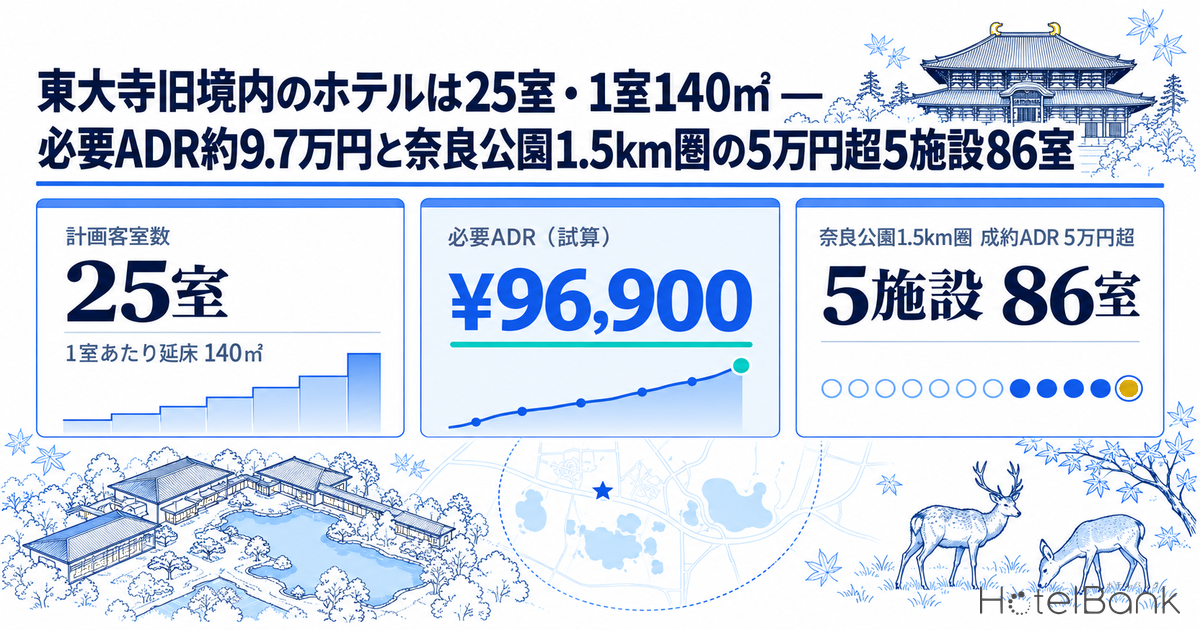
In February 2026, Todaiji — head temple of the Kegon school of Buddhism — and Kintetsu Miyako Hotels announced plans for a lodging facility of about 25 rooms, on a site of about 12,000 m² with a gross floor area of about 3,500 m², near the site of the former West Great Gate (Nishi-Daimon) within the historic site “Former Precinct of Todaiji” (1-1 Suimon-cho and others, Nara City). Low-rise buildings will be spread around a garden, with a restaurant and a tea house, and construction is scheduled to start in January 2027 for an opening in autumn 2028. Per room, that works out to about 140 m² of floor area and about 480 m² of site — a plan that gives each room four to eight times the floor of a limited-service hotel (17–33 m² per room). This article back-calculates from construction costs the ADR this low-density model needs to work, and tests its economics against Nara City’s estimated settled ADR, the price-band distribution within 1.5 km of Nara Park, and the permitting layers that govern development inside a historic site.
Metric Definitions Used in This Article
- ADR (average daily rate): an estimated settled unit price (tax-excluded equivalent), calculated by applying a category-specific adjustment factor to the lowest-plan price level each property publishes on major booking sites (two guests sharing one room, per-room rate, tax included). Checked against property-level results disclosed by listed hotel REITs (184 property-months, April–May 2026), the median error is about 7.5%, and about 16% for the ryokan category (34 property-months). These are estimates and differ from each property’s actual settled prices and accounting figures. Area-level ADR is the median of covered properties (the level of a typical property in the area). Property-level ADR is the median of monthly estimates from October 2025 to August 2026.
- Listed price: the average of all plans listed on major booking sites (two guests sharing one room, per room, tax included). Its level differs from ADR, so the two are not compared directly.
- Required ADR: in this article’s development scenario, the room rate needed to justify the total investment (excluding land) under the assumed yield, occupancy, GOP margin and rooms-revenue share. All assumptions are stated in the text; this is a simplified estimate.
- Data sources: MetroEngines Research & Consulting (estimated settled ADR, supply time series); MLIT “Building Dynamics Statistics Survey” (building plans); MLIT Real Estate Information Library (city planning, land prices); Japan Tourism Agency “Overnight Travel Statistics Survey”
- — 25 rooms, floor area approx. 3,500 m²: 140 m² of floor area and 480 m² of site per room. A low-density plan giving each room four to eight times the floor of a limited-service hotel (17–33 m² per room), scheduled to open in autumn 2028.
- — Required ADR ¥96,900: estimated on a total investment excluding land of ¥4.10bn (¥164M per room), a 6% yield and an assumed 65% occupancy. Factoring in inflation over the construction period gives ¥106,200.
- — 5 properties, 86 rooms above ¥50,000: out of the 41 properties within 1.5 km of Nara Park for which estimated settled ADR can be calculated. Among properties with 20 or more rooms, only two qualify: Fufu Nara (¥88,800) and Shisui (¥61,300).
- — Nara City ADR peaked at ¥17,200: in November 2025 (N=61 properties). June–August 2026 ran −12% to −16% year on year, including a hangover from the Expo period.
- — Permitting doubles as a barrier to entry: Articles 125 and 93 of the Act on Protection of Cultural Properties, development permission in an Urbanization Control Area and Scenic District standards overlap — a schedule risk that also restrains new top-tier supply.
The Plan’s Framework — 140 m² of Floor and 480 m² of Site per Room
According to the announcement (Todaiji religious corporation and Kintetsu Miyako Hotels Co., Ltd., February 4, 2026), the land is owned by the religious corporation Todaiji, while Kintetsu Miyako Hotels will build and operate the facility. The site, at 1-1 Suimon-cho and others, Nara City, is about a 10-minute walk from Kintetsu Nara Station, adjoins Nara Park, and lies in a corner of the historic site “Former Precinct of Todaiji,” where Todaiji’s West Great Gate once stood. The lodging will be split into several low-rise buildings spread around a newly landscaped garden, with a restaurant and a tea house as ancillary facilities. According to Kanko Keizai Shimbun (February 22, 2026), it will be the company’s third property in Nara City, after Nara Manyo Wakakusa no Yado Mikasa and Nara Kasugaokuyama Tsukihitei.
What sets the plan apart is its density. Dividing the roughly 3,500 m² of floor area by 25 rooms gives about 140 m² per room; dividing the roughly 12,000 m² site gives about 480 m² per room. The implied floor area ratio is about 29% — the opposite of a station-front limited-service hotel, which stacks around four times its site area in floor space. Lining up the same metric for building plans in Nara City, based on MLIT’s “Building Dynamics Statistics Survey,” makes its position clear.
| Property (planned / existing) | Rooms | Floor area m² | Site m² | Floor/room | Site/room | Storeys |
|---|---|---|---|---|---|---|
| Todaiji Former Precinct hotel (planned, autumn 2028) | 25 | 3,500 | 12,000 | 140.0 | 480.0 | Low-rise, multiple buildings |
| Fufu Nara (ふふ 奈良, opened 2020) | 30 | 4,500 | 13,000 | 150.0 | 433.3 | 2 |
| Shisui, a Luxury Collection Hotel, Nara (紫翠, opened 2023) | 43 | 4,442 | 30,505 | 103.3 | 709.4 | 2 |
| HOSHINOYA Nara Prison (星のや奈良監獄, opened 2026, conversion) | 48 | 10,343 | 100,479 | 215.5 | 2,093.3 | 2 |
| Henn na Hotel Premier Nara (変なホテルプレミア 奈良, opened 2020) | 104 | 3,388 | 891 | 32.6 | 8.6 | 6 |
| Iroha Grand Hotel Kintetsu Nara Ekimae (いろはグランホテル近鉄奈良駅前, opened 2022) | 143 | 4,400 | 1,000 | 30.8 | 7.0 | 6 |
| Hiyori Hotel Kintetsu Nara Ekimae (日和ホテル近鉄奈良駅前, planned April 2027) | 177 | 5,442 | — | 30.7 | — | 6 |
| APA Hotel Kintetsu Nara Ekimae (アパホテル〈近鉄奈良駅前〉, opened 2021) | 163 | 2,800 | 658 | 17.2 | 4.0 | 6 |
The Todaiji Former Precinct plan shares almost exactly the same design philosophy, in both scale and density, as Fufu Nara (30 rooms, 4,500 m² floor area, 13,000 m² site), which opened near Nara Park in 2020. Looked at purely as 3,500 m² of floor, it is about the same floor area from which Henn na Hotel Premier Nara (3,388 m², 104 rooms) gets 104 rooms — and cutting the room count to a quarter on the same floor is the starting point that defines this plan’s economics. Where station-front limited-service hotels compete on floor efficiency at 17–33 m² per room, the historic-site plan gives up floor efficiency and trades it for experiential value per room. Both are “hotels in Nara City,” but they run on entirely different P&L structures.
Nara City’s Estimated Settled ADR — a November Peak of ¥17,000 and a Year-on-Year Dip in Summer 2026
MetroEngines Research & Consulting’s estimated settled ADR for Nara City (median across all categories) peaked over the past year at ¥17,200 in November 2025 (N=61 properties), up 13.8% year on year. The autumn-foliage months of October and November are the year’s high point, and October 2025 came in at ¥15,900 (+18.6% YoY), two consecutive months of double-digit growth. In 2026 the trend turned: April was nearly flat at ¥14,800 (+1.1% YoY), then June ¥9,300 (−13.8%), July ¥10,000 (−15.5%) and August ¥12,200 (−12.3%) — three straight summer months of double-digit year-on-year declines. April–October 2025 coincided with Expo 2025 Osaka, Kansai, which lifted lodging demand across the wider Kansai region, so the summer 2026 declines appear to include a post-Expo hangover.
This ¥10,000–17,000 level is an order of magnitude away from the price band the 25-room historic-site plan is aiming for. Broken down by category, Nara City’s estimated settled ADR in August 2026 was ¥22,200 for ryokan (N=27 properties), ¥16,700 for city hotels (N=6) and ¥9,500 for business hotels (N=23) — even the ryokan category stays in the low ¥20,000s. By municipality across Nara Prefecture, Nara City sits at about ¥13,000 against about ¥20,000 for Yoshino Town. On estimates based on listed levels at the time of the survey, Nara City’s November 2026 ADR is listed at ¥19,300 (N=56 properties), 12.4% above the same month a year earlier, so foliage-season prices are still coming through firm.
The macro backdrop is worth checking too. According to the Japan Tourism Agency’s “Overnight Travel Statistics Survey” (final figures for 2025), Nara Prefecture recorded 3.177 million guest nights, up 12.1% year on year, of which foreign guests accounted for 520,000, up 30.1%. Overall room occupancy was 50.9% (+4.7 points year on year); by property type, resort hotels ran at 65.7% (5th in Japan), city hotels at 69.0%, business hotels at 69.3% and ryokan at 33.4%. Guest numbers in Nara Prefecture keep growing, while ryokan occupancy still has plenty of room to grow.
Positioning Within 1.5 km of Nara Park — 5 Properties, 86 Rooms Settle Above ¥50,000
Within a 1.5 km radius of the site, 139 properties with 3,297 rooms (as of 2026) are in operation, as far as MetroEngines Research & Consulting tracks. For the 41 properties (2,018 rooms) whose estimated settled ADR can be calculated in a validated category, splitting them into price bands by the median of monthly estimates from October 2025 to August 2026 gives a median of ¥12,800, with 17 properties (348 rooms) at ¥20,000 or more, 10 (193 rooms) at ¥30,000 or more, 5 (86 rooms) at ¥50,000 or more, 2 (31 rooms) at ¥85,000 or more, and none at ¥100,000 or more.
| # | Property | Rooms | Est. settled ADR | Listed price (all-plan avg.) | Opened |
|---|---|---|---|---|---|
| 1 | Suimontei (翠門亭) | 1 | ¥95,625 | ¥115,514 | 2022 |
| 2 | Fufu Nara (ふふ 奈良) | 30 | ¥88,838 | ¥171,110 | 2020 |
| 3 | Kasugaokuyama Tsukihitei (春日奥山 月日亭) | 3 | ¥75,096 | ¥145,338 | 1903 |
| 4 | Shisui, a Luxury Collection Hotel, Nara (紫翠) | 43 | ¥61,278 | ¥134,197 | 2023 |
| 5 | Shikitei (四季亭) | 9 | ¥50,018 | ¥96,734 | 1899 |
| 6 | Koto no Yado Musashino (古都の宿 むさし野) | 12 | ¥48,658 | ¥86,524 | 1990 |
| 7 | ANDO HOTEL Nara Wakakusayama | 21 | ¥46,372 | ¥100,590 | 2020 |
| 8 | Nara Manyo Wakakusa no Yado Mikasa (奈良 万葉若草の宿 三笠) | 34 | ¥37,384 | ¥72,756 | 1959 |
| 9 | SETRE Naramachi (セトレ ならまち) | 32 | ¥32,270 | ¥70,180 | 2018 |
| 10 | Ryori Ryokan Edosan (料理旅館 江戸三) | 8 | ¥31,322 | ¥59,327 | 1907 |
Among the top 10, only two properties with 20 or more rooms settle above ¥50,000: Fufu Nara (30 rooms, ¥88,800) and Shisui (43 rooms, ¥61,300). The other properties above ¥50,000 are small ryotei-style ryokan and detached-villa inns with 1, 3 and 9 rooms, so the above-¥50,000 zone in the 20–60-room size band is almost empty. Kasugaokuyama Tsukihitei (3 rooms, ¥75,100), already operated by Kintetsu Miyako Hotels, has the third-highest settled rate in the radius, and Nara Manyo Wakakusa no Yado Mikasa (34 rooms, ¥37,400) ranks eighth. The company already has a track record of operating at the top end in Nara City, and the 25-room plan can be read as an extension of that, filling the gap in the size band.
Even at the very top of the radius, however, settled rates top out at about ¥96,000 (Suimontei, 1 room), and at about ¥89,000 (Fufu Nara) for properties with 20 or more rooms; within the range of these estimates, no property consistently settles above ¥100,000. The estimated required ADR discussed below (about ¥97,000–106,000) sits at or above the current top level in the radius. Rather than a price band with no precedent in the market, it is a challenge to reproduce, at a 25-room scale, the top tier Fufu Nara has opened up since 2020 — and to push it one step higher.
| Takabatake-cho 163-7 (residential, nearest point) | ¥103,000/m² (+1.98%) |
| Nara City residential average | ¥106,020/m² (+1.28%) |
| Nara City commercial average | ¥362,750/m² (+4.81%) |
| Higashimuki-Nakamachi 4 (city’s highest, commercial) | ¥1,270,000/m² (+10.43%) |
Location and Permitting Layers — a Site Where an Urbanization Control Area, a Historic Site and a Scenic District Overlap
Querying the site’s coordinates against the city-planning data in MLIT’s Real Estate Information Library shows that it lies within an Urbanization Control Area with no use-zone designation. The nearest use zone, about 100 m to the west, is a Category 1 Residential Zone (floor area ratio 200%, building coverage ratio 60%), and no district-plan designation is returned. The area including Nara Park and Todaiji falls within Nara City’s Kasugayama Scenic District (about 2,801.8 ha). Under the permit standards of Nara City’s Scenic District Ordinance, depending on the class, buildings must be no taller than 8–15 m, with a building coverage ratio of no more than 20–40% and a green-space ratio of at least 20–40%. The plan’s implied floor area ratio is about 29%; if the layout is mainly two storeys with a building footprint of about half the floor area, coverage would be around 15%, leaving room to fit even the strictest Class 1 standard (coverage of 20% or less, height of 8 m or less, green space of 40% or more).
The heaviest layer for development inside a historic site is the Act on Protection of Cultural Properties. Any act that alters the existing state of land within the designated area of the historic site “Former Precinct of Todaiji” requires permission from the Commissioner for Cultural Affairs under Article 125 of the Act. In addition, the area is a known buried-cultural-property site registered on the Nara Prefecture archaeological site map, so Article 93 requires notification of civil-engineering works (60 days before starting) and, where necessary, an excavation survey. The Nara National Research Institute for Cultural Properties’ archaeological report database lists numerous excavation records for the “Former Precinct of Todaiji,” and the area around the West Great Gate site is no exception. The low-rise, dispersed building layout can be read as a design solution that localises impacts on archaeological remains and keeps the scope of alteration to a minimum.
| Layer | Legal basis / system | Procedures and standards (within published information) | Implications for the plan |
|---|---|---|---|
| Alteration of a historic site | Act on Protection of Cultural Properties, Art. 125 | Permission for alteration from the Commissioner for Cultural Affairs (via Nara City Cultural Properties Division) | Building layout, excavation scope and construction methods are reviewed. A low-rise, dispersed layout narrows the area affected |
| Buried cultural properties | Act on Protection of Cultural Properties, Art. 93 | Notification of civil-engineering works (60 days before starting); excavation survey instructions | Survey time and cost are added to the schedule. The planned January 2027 start appears to build in the survey process |
| City-planning area classification | City Planning Act (Urbanization Control Area) | Development permission (Arts. 29 and 34) | With no use-zone designation, permit requirements must be worked out first |
| Scenic District | City Planning Act; Nara City Scenic District Ordinance | Height 8–15 m or less, coverage 20–40% or less, wall setbacks, green space 20–40% or more | A 29% FAR and low-rise layout leave ample room to stay within the standards |
| Historic landscape | Ancient Capitals Preservation Act (Historic Landscape Preservation Area / Special Preservation District) | Permit application to Nara City City Planning Division (if within the area) | Whether the site falls within the area must be checked on the designation map |
| Townscape | Landscape Act; Nara City Landscape Plan | Nara Park and Naramachi surroundings are priority areas, with standards for exterior, colour and roof form | Design responses such as tiled roofs and timber cladding. Facade costs under landscape regulations range from ¥60,000 to ¥510,000 per room |
| World Heritage | World Heritage Convention (Historic Monuments of Ancient Nara) | Buffer zone of the component property Todaiji | An explanation of landscape impact may be required |
These layers are a barrier to new entrants and, at the same time, a form of entry regulation that protects existing top-tier properties. Around Nara Park, the top tier has been formed by low-density buildings on public or historic land: Shisui (in the Yoshikien area including the former governor’s residence, site 30,505 m²) and Fufu Nara (Takabatake-cho, site 13,000 m²). In towns such as Yufuin and Karuizawa, where ordinances restrict supply, ADR stays high — in Yufuin new openings are capped at 45 rooms — and the permitting layers inside the historic site work in the same direction.
Development Scenario — Two Construction-Cost Stages and the Back-Calculated Required ADR
We estimate the economics of the low-density model by working back from construction costs to the required ADR, with the assumptions stated. For the construction unit cost, we started from MLIT’s “Building Starts Statistics” 2025 hotel construction costs (steel frame ¥2.405M per tsubo, RC ¥2.026M per tsubo, all-structure average ¥1.952M per tsubo; 1 tsubo ≈ 3.3 m²) and category benchmarks (luxury ¥2.5M–3.5M per tsubo, ryokan ¥1.6M–2.5M per tsubo), and adopted ¥3.0M per tsubo on the assumption of a low-rise, dispersed layout with tiled roofs and timber finishes within a Scenic District. The 3,500 m² of floor area is about 1,059 tsubo, so building works come to ¥3.18bn. Adding the garden and exterior works (¥300M for a garden covering most of the site), FF&E (¥15M per room × 25 rooms = ¥375M) and design, supervision, excavation surveys and the like (8% of building works = ¥250M) gives a total investment excluding land of ¥4.10bn, or ¥164M per room. The land is owned by Todaiji, and the developer’s announcement gives no land terms, so no land acquisition cost is included.
For comparison, a limited-service hotel on the same unit costs — 30 m² per room × RC at ¥2.026M per tsubo — comes to ¥18.39M per room in building works, or about ¥21M including FF&E, so the historic-site low-density model needs about eight times the investment per room. Against the Henn na Hotel Premier Nara model, which gets 104 rooms from the same floor area, each room carries more than four times the construction cost. The question is how the room rate needed to recover that investment lines up against the top tier in the radius.
| Item | Stage 1: based on 2025 actuals | Stage 2: with construction-period inflation |
|---|---|---|
| Gross floor area | 3,500 m² (approx. 1,059 tsubo) | Same |
| Cost per tsubo (assumed) | ¥3.0M | ¥3.317M (2026 +5.3% and 2027 +5.0%, compounded) |
| Building works | ¥3.18bn | ¥3.51bn |
| Garden and exterior | ¥300M | ¥330M |
| FF&E (¥15M/room) | ¥375M | ¥375M |
| Design, supervision, excavation surveys, etc. (8% of building) | ¥250M | ¥280M |
| Total investment (excl. land) | ¥4.10bn | ¥4.50bn |
| Investment per room | ¥164M | ¥180M |
| Required GOP (6% yield) | ¥246M | ¥270M |
| Required total revenue (30% GOP margin) | ¥820M | ¥900M |
| Required rooms revenue (70% rooms share) | ¥570M | ¥630M |
| Required ADR (assumed occupancy 65%, 5,931 room nights/yr) | ¥96,900 | ¥106,200 |
For the 30% GOP margin, we noted that the 38.9% GOP disclosed by Invincible Investment Corporation for its 91 operated properties (fiscal period ended December 2024) reflects a mainly limited-service portfolio, and adopted the top of the 10–30% benchmark for full-service hotels with a restaurant and tea house. A 70% rooms-revenue share is typical for small luxury hotels with a restaurant. The assumed 65% occupancy matches Nara Prefecture’s resort-hotel occupancy of 65.7% (annual figure for January–December 2025, final). On these assumptions the required ADR is ¥96,900 at 2025 prices, or ¥106,200 with construction-period inflation.
| Required ADR | Occupancy (assumed) 60% | Occupancy (assumed) 65% | Occupancy (assumed) 70% |
|---|---|---|---|
| Yield 5% (2025 prices) | ¥87,500 | ¥80,800 | ¥75,000 |
| Yield 6% (2025 prices) | ¥105,000 | ¥96,900 | ¥90,000 |
| Yield 7% (2025 prices) | ¥122,500 | ¥113,100 | ¥105,000 |
| Yield 6% (with inflation) | ¥115,100 | ¥106,200 | ¥98,600 |
The implications are clear. Accept a 5% yield and, at an assumed 65% occupancy, the required ADR is ¥80,800 — inside Fufu Nara’s actual ¥88,800. At 6% it is ¥96,900, roughly level with the top of the radius, Suimontei (1 room, ¥95,600); at 7% it is ¥113,100, above anything currently achieved in the radius. In other words, the most consistent reading is that the plan is designed for a 5–6% yield range on the premise of reproducing the top tier Fufu Nara established, with upside coming from lower construction costs (at ¥2.5M per tsubo the required ADR falls to about ¥83,000), higher occupancy and deeper non-rooms revenue from the restaurant and tea house. Rising construction costs also restrain new supply, an upside factor that softens competition with the existing top tier. Carrying costs before opening also matter: hotel land costs about 5.9% a year to hold, which over three pre-opening years amounts to about ¥2.42M per room.
Supply Environment — 139 Properties and 3,297 Rooms Within 1.5 km, and the Top-Tier Pipeline
Room supply within a 1.5 km radius of the site grew 2.2-fold in 14 years, from 64 properties and 1,501 rooms in 2012 to 139 properties and 3,297 rooms in 2026. A cluster of limited-service openings in 2017–2018 lifted it in steps to 2,385 and then 2,540 rooms, and the additions of Fufu Nara, Henn na Hotel, APA, MIROKU Nara and others in 2020–2021 took it past 3,000 rooms. The three years from 2023 (126 properties, 3,257 rooms) to 2026 (139 properties, 3,297 rooms) saw a modest +13 properties and +40 rooms, and the new 25 rooms equal 0.8% of existing supply. The impact on the total is small; what matters is the mix of price bands.
| Project | Location | Rooms | Scale / layout | Timing |
|---|---|---|---|---|
| Hiyori Hotel Kintetsu Nara Ekimae | Takama-cho | 177 | 6 storeys, floor area 5,442 m² | Planned April 2027 |
| Todaiji Former Precinct hotel (Kintetsu Miyako Hotels) | Suimon-cho | 25 | Low-rise, multiple buildings; floor area 3,500 m²; site 12,000 m² | Planned autumn 2028 |
| Hotel NEI Nara (The Unbound Collection by Hyatt) | Noborioji-cho | Approx. 100 | 4 storeys above ground, floor area approx. 8,630 m² | Planned FY2030 |
| (Tentative) Nara City Sanjo-cho hotel project | Sanjo-cho | Not disclosed | 8 storeys, floor area 4,667 m² | Not disclosed |
| (Tentative) Royal Hotel Nara | Nara City | Not disclosed | 5 storeys | Planned May 2029 |
The pipeline shows station-front limited-service hotels (Hiyori Hotel, 177 rooms) and top-tier projects (the 25-room Todaiji Former Precinct plan and Hotel NEI Nara) moving forward in parallel. According to Hyatt Japan’s press materials (April 2026), Hotel NEI Nara is one of ten new hotels the company plans to open, under The Unbound Collection by Hyatt brand, in Noborioji-cho. The developer, the JR Central group, announced (April 2025) about 100 rooms and about 8,630 m² of floor area, with an opening targeted for FY2030. The top tier around Nara Park has been thickening with one low-density property roughly every three years — Fufu Nara in 2020, Shisui in 2023 and HOSHINOYA Nara Prison in 2026 — and the Todaiji Former Precinct hotel in autumn 2028 and Hotel NEI Nara in FY2030 will follow. Across the prefecture, only one property with 60 or more rooms achieves an ADR above ¥20,000, leaving the upper size bands largely empty.
A Temple Owns the Land, a Hotel Company Builds and Operates — Within Published Information
The division of roles in the announcement is a two-party structure: the religious corporation Todaiji as landowner, and Kintetsu Miyako Hotels as builder and operator. The form of land lease (ordinary leasehold, fixed-term leasehold, fixed-term leasehold for business use, etc.), ground rent, contract term and ownership of the building have not been published, and this article does not speculate on them. What can be confirmed is that a lodging business is being created on land inside a designated historic site — land that rarely comes to the sales market — while ownership stays with the temple. Around Nara Park, operators have already been using public assets on long terms, such as the prefecture-owned Yoshikien area (Shisui) and the former Nara Prison (HOSHINOYA Nara Prison), and this plan on temple-owned land falls in that lineage.
For the temple, this form offers a way to earn a stable income while preserving the historic setting of its precincts; for the operator, a chance to enter prime land that is otherwise hard to acquire. The Japan Tourism Agency has supported castle stays and temple stays as projects that use historic resources since 2020, and in the reuse of existing castles an ultra-high-price market has already taken shape. Against that background, the Todaiji Former Precinct model — new low-density construction on a designated historic site rather than reuse of an existing building — has few precedents, and will serve as a reference case, for both permitting and economics, for future development on temple and shrine land.
Investment Summary — Whitespace and Risk Assessment
Crowded Occupied space
¥7,000–16,000 × 90–220 rooms
Limited-service and city-hotel band in front of Kintetsu Nara and JR Nara stations. Accounts for most of the 3,297 rooms in the radius; 177 rooms are added in 2027.
WS1 20–60 rooms × above ¥50,000
Currently 2 properties, 73 rooms (Fufu Nara 30, Shisui 43)
The size band the 25-room plan targets. The other 3 properties above ¥50,000 are 1–9-room ryotei-style ryokan, so the gap in this size band is large.
WS2 Consistent settlement above ¥100,000
Currently 0 properties
The estimated required ADR (about ¥97,000–106,000) falls here. It is a challenge to raise the market ceiling a step above Fufu Nara’s ¥89,000, with headroom in non-rooms revenue and occupancy.
| Risk factor | Rating | Detail and view |
|---|---|---|
| Permitting and schedule | High | Article 125 alteration permission and Article 93 excavation surveys under the Act on Protection of Cultural Properties are sources of schedule and cost variance. The January 2027 start and autumn 2028 opening appear to allow for them, but the layout could change depending on survey results |
| Construction cost | Medium | Assumes construction costs, which rose 41% over 2022–2024, keep rising by around 5% a year in 2025–2027. Going from ¥3.0M to ¥3.32M per tsubo raises the required ADR by about ¥9,300. It also restrains new supply |
| Achieving the price band | Medium | Within the radius, only one property with 20+ rooms settles above ¥80,000: Fufu Nara. Kintetsu Miyako Hotels has a top-tier operating track record with Tsukihitei (¥75,000) and Mikasa (¥37,000) |
| Demand | Low | Nara Prefecture guest nights rose 12.1% year on year in 2025, foreign guests 30.1%. Resort-hotel occupancy of 65.7% (annual figure for January–December 2025) ranks 5th in Japan. The summer 2026 year-on-year ADR decline is largely a post-Expo effect |
| Supply | Low | 25 rooms is 0.8% of existing supply in the radius. Additional top-tier supply is limited to Hotel NEI Nara (about 100 rooms, planned FY2030), and the permitting layers of the historic site and Scenic District act as entry regulation |
Summary
The 25-room Todaiji Former Precinct plan is a low-density model that gives each room 140 m² of floor and 480 m² of site, targeting a top-tier market detached from Nara City’s estimated settled ADR (peak ¥17,200; ¥12,200 in August 2026). Assuming construction costs of ¥3.0M per tsubo, total investment excluding land is ¥4.10bn (¥164M per room); at a 6% yield and an assumed 65% occupancy the required ADR is ¥96,900, or ¥106,200 with construction-period inflation. Within 1.5 km of Nara Park, 5 properties with 86 rooms settle above ¥50,000, and among those with 20 or more rooms only Fufu Nara (¥88,800) and Shisui (¥61,300) do; the plan sits where it fills the gap in that size band while raising the market ceiling a step.
Development on a designated historic site layers Article 125 alteration permission and Article 93 excavation surveys under the Act on Protection of Cultural Properties, development permission in an Urbanization Control Area, and Scenic District and Landscape Plan standards. These are sources of schedule and cost variance and, at the same time, entry regulation that protects the existing top tier. In the model where a temple owns the land and a hotel company builds and operates, published information shows only the division of roles; contract terms await future disclosure. With design and permitting advancing toward an autumn 2028 opening, the overlap between the required ADR and actual rates in the radius will be the first yardstick of this plan’s economics.
Frequently Asked Questions
Q. When will the hotel in the Former Precinct of Todaiji open, and how many rooms will it have?
According to the announcement by Kintetsu Miyako Hotels and Todaiji (February 4, 2026), it will have about 25 rooms on a site of about 12,000 m² with a floor area of about 3,500 m²; construction is to start in January 2027, with an opening planned for autumn 2028. It will include a restaurant and a tea house, with low-rise buildings spread around a garden.
Q. What room rate does a 25-room, 3,500 m² low-density hotel need to work?
This article estimates a required ADR of about ¥96,900, assuming construction costs of ¥3.0M per tsubo, a total investment excluding land of ¥4.10bn, a 6% yield, an assumed 65% occupancy, a 30% GOP margin and a 70% rooms-revenue share. Factoring in construction-period inflation gives about ¥106,200. Among properties with 20 or more rooms within 1.5 km of Nara Park, the current top is Fufu Nara at ¥88,800 (estimated settled ADR).
Q. What permits are needed to build a hotel inside a historic site?
Altering the existing state of land within a designated historic site requires permission from the Commissioner for Cultural Affairs under Article 125 of the Act on Protection of Cultural Properties, and in a buried-cultural-property site, notification of works and an excavation survey are required under Article 93. Because the site lies in an Urbanization Control Area, development permission under the City Planning Act, Nara City’s Scenic District Ordinance (height 8–15 m or less, building coverage 20–40% or less) and Landscape Plan standards also apply.
⚠ Note on ADR for future dates: Estimated settled ADR from September 2026 onward in this article is estimated from selling prices published on major booking sites at the time of the survey (September 30, 2026) and will change as check-in dates approach. Prices currently set high may fall with last-minute adjustments, and year-on-year comparisons with the Expo period (April–October 2025) are prone to swings. Property-level estimated settled ADR is the median of monthly estimates from October 2025 to August 2026 and differs from each property’s actual settled prices and accounting figures. The development scenario is a simplified estimate with stated assumptions; actual investment decisions require a detailed feasibility study.
References and Sources
■ Data sources
Estimated settled ADR is an estimate (tax-excluded equivalent) obtained by applying a category-specific adjustment factor to the lowest published plan level on major booking sites (two guests per room, tax included): N=55–64 properties/month for Nara City, and N=41 properties, 2,018 rooms within 1.5 km of Nara Park (monthly median, October 2025 to August 2026). Room supply is based on property opening and closing dates (1.5 km radius, as of September 30, 2026). Plan details come from the developer’s announcement, city planning and land prices from MLIT’s Real Estate Information Library, and occupancy and guest numbers from the Japan Tourism Agency’s “Overnight Travel Statistics Survey” (final 2025 figures).
■ Scenario assumptions
Construction cost ¥3.0M per tsubo (Stage 2 compounds 2026 +5.3% and 2027 +5.0%), garden and exterior ¥300M, FF&E ¥15M per room, design, supervision, excavation surveys, etc. at 8% of building works. Yield 6% (sensitivity 5–7%), assumed occupancy 65% (sensitivity 60–70%), GOP margin 30%, rooms-revenue share 70%. Excludes land acquisition and ground rent.
■ Limitations
Estimated settled ADR is an estimate with a median error of about 7.5% (about 16% for ryokan) against property-level results of listed hotel REITs; the deluxe category (Nara Hotel, Noborioji Hotel Nara) is outside its scope. Land-lease terms, ground rent and project financials have not been published; the required ADR is a simplified estimate with stated assumptions, not the developer’s plan figure. ADR from September 2026 onward is estimated from listed levels at the time of the survey and will change.
■ Market data
- MetroEngines Research & Consulting — Estimated settled ADR (Nara City N=55–64 properties/month; within 1.5 km N=41 properties, 2,018 rooms), room-supply time series (1.5 km radius, 139 properties, 3,297 rooms)
■ Government statistics and public data
- Japan Tourism Agency, “Overnight Travel Statistics Survey,” 2025 annual (final figures) — Nara Prefecture guest nights and room occupancy
- MLIT Real Estate Information Library — City-planning area classification, use zones, published land prices
- MLIT “Building Dynamics Statistics Survey” — hotel building plans in Nara City (floor area, site area, rooms)
- MLIT “Building Starts Statistics” — Hotel construction cost per tsubo by structure (2025)
- Published land prices in Nara City (2026) — Takabatake-cho 163-7, city averages, Higashimuki-Nakamachi 4
- Nara City, “Permit Standards for Activities in Scenic Districts”
- Nara City Cultural Properties Division, “Guide to Notifications and Applications Concerning Cultural Properties”
- Nara Prefecture, “When Carrying Out Civil-Engineering Works in Historic Sites, Places of Scenic Beauty, Natural Monuments and Buried-Cultural-Property Sites”
- Nara National Research Institute for Cultural Properties, archaeological report database, “Former Precinct of Todaiji”
- Nara Prefecture, “About Nara Park”
■ REIT and industry reports
- Invincible Investment Corporation, operating results of hotels — GOP margin 38.9% (fiscal period ended December 2024, 91 properties)
- Relo Hotel Solutions, “Hotel GOP” — GOP-margin benchmarks by category
- archi-book, 2025 edition — Cost per tsubo by structure
- HOTELISM, hotel construction cost benchmarks by category
■ News and press releases
- Todaiji religious corporation and Kintetsu Miyako Hotels Co., Ltd., “[Kegon School Head Temple Todaiji × Kintetsu Miyako Hotels] Plan for a Lodging Facility in the Historic Site ‘Former Precinct of Todaiji’” (PR TIMES, February 4, 2026; in Japanese)
- Kanko Keizai Shimbun, “Luxury Hotel in Former Precinct to Open in Autumn 2028: Todaiji and Miyako Hotels” (February 22, 2026; in Japanese)
- Kyodo News, “Lodging Facility in Former Precinct of Todaiji in Autumn 2028: Kintetsu Miyako Hotels” (in Japanese)
- Hyatt Japan, “Press Materials, April 2026” — Hotel NEI Nara (The Unbound Collection by Hyatt)
- Central Japan Railway Company, “Hotel NEI Nara Expands in Scale, Targeting an Opening in FY2030” (April 2025; in Japanese) — Approx. 100 rooms, floor area approx. 8,630 m²
Source: Hyatt Japan, “Press Materials, April 2026”