

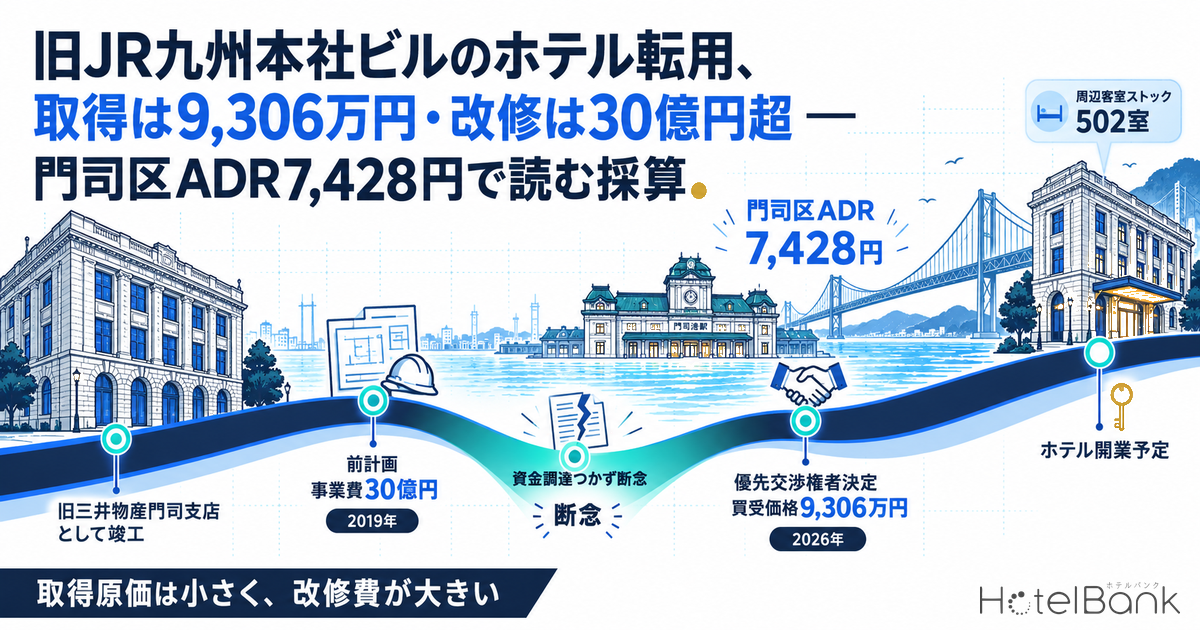
The former JR Kyushu headquarters building (旧JR九州本社ビル) in front of Mojiko Station, owned by the City of Kitakyushu (completed in 1937 as the Moji branch of Mitsui & Co.), will be converted into a hotel. In a public proposal competition in March 2026, the Mojichikko joint venture led by Nippon Steel Kowa Real Estate was named preferred negotiating partner. The purchase price is ¥93,065,263 (tax included) — identical, down to the last yen, to the minimum sale price the city set. A prime station-front site with 1,323 m² of land and 5,635 m² of floor area is changing hands for under ¥100 million, yet the previous 2019 plan to turn the same building into a 90–100-room hotel had budgeted ¥3.0 billion. This article sets that “small acquisition cost, large renovation cost” structure against Moji Ward’s estimated settled ADR (12-month average ¥7,428, 7 properties), the officially assessed land prices around the station, and the 502-room stock (12 properties) within a 2 km radius, and estimates where the break-even lies from the perspective of developers, municipal PRE (public real estate) teams and regional lenders.
Metric Definitions Used in This Article
- ADR (average daily rate): an estimated settled rate (tax-excluded equivalent), calculated by applying a category-specific adjustment factor to the lowest-plan price each property publishes on OTAs (per room, two guests sharing, tax included). Checked against the property-level results disclosed by listed hotel REITs (91 properties, most recent 3 months), the median error is about 7%. These are estimates and differ from each property’s actual achieved rates and accounting figures. Area-level ADR is the median of the covered properties (the level of a typical property in the area). Moji Ward has only 7 covered properties, so note that a single property’s price change can move the monthly figure.
- OCC (occupancy rate): rooms sold as a share of total rooms in the area (an estimate based on OTA sales inventory; consistency checks against monthly REIT disclosures confirm accuracy to within a few points).
- Listed rates, where mentioned, are per-room prices for two guests sharing one room (tax included).
- Data sources: MetroEngines Research & Consulting (as of September 30, 2026), City of Kitakyushu published materials, MLIT Real Estate Information Library.
- — The ¥93.06M purchase price equals the minimum sale price. Scoring weighted the proposal at 85 points and price at 15, so the City of Kitakyushu had bidders compete on use, not price.
- — The effective land price is about ¥61,000/m², about 49% of the average officially assessed land price at three points around Mojiko Station (about ¥127,000/m²). The conditions that the building may not be demolished and its exterior design may not be altered are priced in.
- — Even with the building lent free of charge, the 2019 plan could not finance its ¥3.0bn budget and was abandoned. Factoring in construction cost inflation, a renovation of the same scale could reach ¥4.2–4.9bn.
- — Moji Ward’s estimated settled ADR is ¥7,428 (12-month average, Sep 2025–Aug 2026, 7 properties) — 63% of the Fukuoka Prefecture average, but up 16.5% year on year.
- — Across three scenarios, GOP yields are 2.0–3.7%. Moving the renovation cost by ¥1bn shifts the yield by 0.8–1.5 pt, more than ADR ±10% (0.3–0.5 pt). Feasibility is decided by renovation cost, not by the purchase price.
Sold at exactly the minimum price — how an 85:15 scoring split told bidders not to compete on price
The tender guidelines the City of Kitakyushu published on September 26, 2025 set the minimum sale price at ¥93,065,263 (tax included), broken down as land ¥81,347,368, building ¥10,652,632 and consumption tax on the building ¥1,065,263. The purchase price offered by the preferred negotiating partner, announced on March 18, 2026, matches this minimum exactly. Two consortia applied, and the evaluation committee’s overall scores were 72.8 points for the Mojichikko joint venture and 64.5 points for the other bidder (out of 100).
Scoring was weighted “proposal 85 : purchase price 15”. In other words, price could account for only 15% of the total, so from the bidder’s side, bidding the minimum price is the rational move. The city, for its part, chose a design that prioritized a “facility that helps create tourism vitality in the Mojiko Retro district” over a higher price. The property is sold as-is: renovation work needed for the structure and other core elements is at the buyer’s expense, demolition is in principle not permitted, and changes to the design elements that form its distinctive exterior are not allowed either.
| Item | Details (City of Kitakyushu published materials) |
|---|---|
| Property | Former JR Kyushu HQ Building (1-6-2 Nishikaigan, Moji Ward, Kitakyushu) |
| Building | Completed 1937 (Showa 12); steel-reinforced concrete; 1 basement floor and 6 floors above ground; total floor area 5,635.45 m²; building footprint 806.67 m² |
| Site | 1,323.33 m² |
| History | Mitsui & Co. Moji branch → JNR Kyushu General Bureau, Moji Railway Management Bureau → JR Kyushu Kitakyushu head office → acquired by the city in December 2005 in an equal-value exchange for city-owned land → designated a component cultural property of a Japan Heritage story in April 2017 |
| Sale conditions | Sold as-is; structural and other renovation at the buyer’s expense; demolition not permitted in principle; no changes to exterior design |
| Minimum sale price | ¥93,065,263 (tax incl.) = land ¥81,347,368 + building ¥10,652,632 + consumption tax ¥1,065,263 |
| Scoring | Proposal 85 points, purchase price 15 points |
| Result | Preferred negotiating partner: Mojichikko joint venture (Nippon Steel Kowa Real Estate, Staple, Matsuda Hirata Design, YMFG ZONE Planning); proposed use: hotel; purchase price ¥93,065,263; score 72.8 points (runner-up 64.5); 2 consortia applied |
| Next steps | Basic agreement in May 2026, sale contract in September 2026, opening 2–3 years later (Nikkei report, March 18, 2026) |
The make-up of the consortium is worth noting too. Alongside lead member Nippon Steel Kowa Real Estate are Staple, which has turned historic buildings in Hakodate’s Seibu district and in Setoda into lodging; Matsuda Hirata Design, which descends from the building’s original architect, Gunpei Matsuda; and YMFG ZONE Planning, part of Yamaguchi Financial Group. Having design, operation and regional finance in one entity shows the bidders priced in from the start that “renovation cost and financing”, discussed below, is the central issue.
Land at ¥61k/m² is half the station-front official land price — the preservation obligation is priced in
Working out the land unit price from the minimum-price breakdown gives ¥81,347,368 ÷ 1,323.33 m² = about ¥61,500/m². The building comes to ¥10,652,632 ÷ 5,635.45 m² = about ¥1,900/m², effectively close to a scrap valuation. Meanwhile, MLIT’s 2026 official land price survey (as of January 1, 2026) shows the following commercial points around Mojiko Station: Sakaemachi 5 (350 m from the station) at ¥143,000/m² (+1.4% YoY), Hamamachi 40 and others (750 m) at ¥119,000/m² (+1.7%), and Sakaemachi 248 (670 m) at ¥118,000/m² (+1.7%) — a three-point average of about ¥126,700/m². The sale land’s unit price is about 49% of that average, and about 43% of the closest point, Sakaemachi 5.
The gap is not simply a bargain. Land that comes with no-demolition and no-exterior-change conditions is a different product from an adjacent plot that can be freely developed as vacant land, and appraisals normally reflect a discount for the preservation obligation. Floor-area economics also make rebuilding unattractive. Every official land price point around the station is in a commercial zone (designated floor-area ratio 400%, building coverage ratio 80%), and dividing the existing building’s 5,635 m² of floor area by the 1,323 m² site gives about 426%. It is a simple calculation that ignores the relaxations allowed in calculating the floor-area ratio, but even if rebuilding were permitted, it could not in principle yield more floor space than exists now. This is a property where every option other than “preserve it and use it fully” is effectively closed, on both regulatory and economic grounds. For bringing historic buildings up to current standards while keeping their design and framing, the Building Standards Act’s Article 3(1)(iii) exemption route — available through local exemption ordinances — is the main regulatory path.
The implication for municipal PRE teams is clear. In selling publicly owned historic buildings, a process designed to maximize sale proceeds drives bidders away, while one that puts use first sees prices stick to the floor. The City of Kitakyushu chose the latter, giving 85% of the score to the proposal rather than the price. Whether that choice was right will be judged after opening, by visitor numbers in the district, property tax and lodging spending.
Why the 2019 plan stalled — a ¥3.0bn renovation did not move even with the building lent free
This is not the first attempt to turn the building into a hotel. In November 2019 the city selected the Hong Kong investment firm Odyssey Asset Management as operator. The plan then was a 90–100-room boutique hotel with a ¥3.0bn budget, opening in summer 2021 and run by a Hong Kong hotel operator, with the city providing the building under a free loan-for-use arrangement. A basic agreement was signed in February 2020, and a loan-for-use contract and memorandum with the special-purpose company in March 2021, but for about three years afterwards there was no progress on renovation contracts and the like, and the city sent formal reminders in August and September 2023. In October 2023 the company notified the city that it was giving up because “project costs have risen sharply due to inflation and other factors, and there is no prospect of raising the funds”, and the agreement was terminated by mutual consent on December 5 of that year.
| Date | Event | Scheme |
|---|---|---|
| Nov 2019 | Odyssey (Hong Kong) selected as operator; ¥3.0bn budget, 90–100 rooms, opening planned for summer 2021 | Building lent free of charge |
| Feb 2020–Mar 2021 | Basic agreement; loan-for-use contract and memorandum signed with the SPC | Same as above |
| Oct 2023 | Project abandoned: inflation drove costs up sharply and financing was out of reach | — |
| Dec 2023 | Loan-for-use contract terminated. City proposes re-tender with “building leased or sold (with buy-back option), land on a fixed-term lease” | Lease + fixed-term land lease |
| Sep 2025 | Tender opens. Land and building sold as-is; minimum price ¥93.06M | Sale of land and building |
| Mar 2026 | Mojichikko joint venture named preferred negotiating partner (2 consortia applied) | Same as above |
| May / Sep 2026 | Basic agreement / sale contract (planned). Opening assumed 2–3 years later | Same as above |
The key fact is that the earlier project failed even though the consideration for the public property was zero (a free loan). Whether the acquisition cost is zero or ¥100 million, a historic-building hotel conversion does not move unless a renovation of around ¥3bn — and its financing — moves. According to MLIT’s Building Construction Starts statistics, the all-structure average construction cost for hotels rose 41% in two years, from ¥1.38M per tsubo in 2022 to ¥1.95M per tsubo in 2024, and stayed high in 2025 at ¥1.952M (steel frame ¥2.405M, reinforced concrete ¥2.026M). Rescaling the ¥3.0bn renovation cost of 2019 by the same ratio gives about ¥4.2bn, and factoring in Turner & Townsend’s construction cost inflation for Japan (+5.6% in 2025, +5.3% in 2026, +5.0% in 2027) over the works period brings it to about ¥4.9bn for construction in 2027–28. The city’s completion of seismic retrofitting in 2010 lightens the buyer’s load, but it does not change the fact that renovation cost defines the whole project. For new-build hotels, construction costs by hotel category run from roughly ¥8.7M to ¥71.4M per room.
Moji Ward’s estimated settled ADR is ¥7,428 — 63% of the Fukuoka Prefecture average, but on the way up
Next, consider what price band the hotel can sell at once it opens. MetroEngines Research & Consulting’s estimated settled ADR for Moji Ward (7 properties) averaged ¥7,428 over the 12 months from September 2025 to August 2026. That is up 16.5% from ¥6,400 in the prior-year period (September 2024–August 2025), but still only 63% of the Fukuoka Prefecture average of ¥11,800 over the same period (about 460 properties). Against wards within Fukuoka City — Hakata Ward at ¥14,300 (142–150 properties) and Chuo Ward at ¥16,100 (79–83 properties) — the gap is close to 2x, and Moji Ward also trails Kokurakita Ward, in the same city of Kitakyushu, at ¥8,200 (29–30 properties). Kitakyushu’s price band, Kokurakita included, sits at about 61% of Hakata’s, while its land prices are only about 16% of Hakata’s — an asymmetry that leaves a price band open for investment.
Month by month, Moji Ward’s ADR has clearly stepped up in 2026. August 2026 was ¥9,700, up 54.7% from the same month a year earlier (¥6,300), and January–February 2026 were also in the ¥8,500 range, well above the ¥5,400–6,000 range a year earlier. Because this is the median of only 7 properties, however, the monthly figure can move by several thousand yen when one property changes its prices or rotates seasonal plans, and should be read with that discount. Values from September 2026 onward are estimates based on listed levels at the time of the survey and will change as check-in dates approach.
This price band weighs heavily on any business plan. Bringing a hotel with a renovation bill above ¥3bn into a market where a typical property sells at ¥7,000–9,000-something means creating a separate price band built on the experiential value of “staying in Mojiko Retro”, not on the existing going rate. In Kitakyushu’s tourism statistics, of the city’s 9.96 million visitors in 2023, the Mojiko area drew 2.124 million (Retro district 1.844 million, 12.3% of the city total), making it the second-largest draw after central Kokura. On the other hand, about 70% (1.33 million) of the city’s 1.85 million overnight guests are business travelers, and foreign visitors numbered 370,000 in 2024 (150,000 of them staying overnight) — still small next to Kyushu’s inbound demand, which is concentrated in Fukuoka City (about 80% of the roughly 5 million people who entered Kyushu in 2024 came through Fukuoka City). The real issue for this project is a structural shift that lifts room rates at a destination dominated by day-trippers.
Room stock within 2 km is 502 rooms — +119 in summer 2026, and +19% more at the previous plan’s scale
Now the supply side. Within a 2 km radius of the former JR Kyushu HQ Building, there are 12 properties with 502 rooms that recorded sales (price observations) in July–September 2026 (within the scope tracked by MetroEngines Research & Consulting). They comprise the 162-room Premier Hotel Mojiko, the 140-room Hotel Route-Inn Mojiko and the 42-room Hotel Port Moji, joined by the 119-room BEB5 Mojiko by Hoshino Resorts, which opened on July 24, 2026. Stock in the same radius before that opening was 383 rooms, meaning supply jumped 31% in one go in summer 2026. The rest are small townhouse and whole-house rentals: 8 properties with 1–8 rooms each.
| Property | Rooms | Type | Est. settled ADR, Aug 2026 | YoY |
|---|---|---|---|---|
| Premier Hotel Mojiko (プレミアホテル門司港) | 162 | City hotel | ¥17,926 | -1.9% |
| Hotel Route-Inn Mojiko (ホテルルートイン門司港) | 140 | Business hotel | ¥9,971 | +17.6% |
| BEB5 Mojiko by Hoshino Resorts (BEB5門司港 by 星野リゾート) | 119 | City hotel (opened July 2026) | — | — |
| Hotel Port Moji (ホテルポート門司) | 42 | Business hotel | ¥6,490 | +3.3% |
| 8 townhouse / whole-house rentals, etc. | 39 | Small properties with 1–8 rooms | — | — |
| Total | 502 | |||
If the hotel opens at the previous plan’s 90–100 rooms, stock within the radius rises to about 600 rooms — a further 19% increase on today. The Mojiko Retro district draws a solid 1.84 million visitors a year, but as long as nearly all of them are day-trippers, filling 600 rooms, weekdays included, depends on the district shifting toward stay-based tourism. The fact that the existing large properties have raised their rates in 2026, and that new supply opened in July 2026 is being absorbed in front of the same station, are signs that this shift has begun. A hotel in the former JR Kyushu HQ Building would take on the “upper price band” within that trend.
Feasibility estimate — with ¥93M to acquire and ¥3–5bn to renovate, what decides the yield?
What follows is a simplified estimate. The ¥93.06M purchase price is fixed, but renovation cost, room count and ADR have not been published, so assumptions were set from the previous plan (¥3.0bn, 90–100 rooms), the rise in construction costs, and the price bands in Moji Ward and its surroundings. The purchase price is only 3.0% of total investment with a ¥3.0bn renovation, 2.2% at ¥4.2bn and 1.9% at ¥4.9bn. The project’s feasibility is decided almost entirely by how far renovation costs can be held down and what price band the hotel sells in, not by how hard the purchase price is negotiated.
Three scenarios are set by positioning. A is a mid-market hotel of 100 rooms, close to the previous plan (ADR ¥14,000); B is an upper-midscale hotel of 60 rooms (ADR ¥24,000); and C is a small luxury hotel of 35 rooms (ADR ¥45,000). ADRs are set not from Moji Ward’s typical property (¥7,428) but from the levels the top properties in the radius are achieving in 2026 (the ¥15,000–20,000-plus range) and the price bands historic-building hotels achieve in other cities. GOP margins use the 38.9% achieved by the 91 operating properties disclosed by Invincible Investment Corporation (fiscal period ended December 2024) as an upper guide, and are lowered as full-service elements increase. Renovation costs are set at ¥3.5bn, ¥4.0bn and ¥4.5bn by scenario.
| Item | A. Mid-market, 100 rooms | B. Upper-midscale, 60 rooms Close to the previous plan’s scale | C. Small luxury, 35 rooms |
|---|---|---|---|
| Rooms | 100 | 60 | 35 |
| ADR assumption | ¥14,000 | ¥24,000 | ¥45,000 |
| OCC assumption | 75% | 70% | 65% |
| Room revenue (annual) | ¥380M | ¥370M | ¥370M |
| GOP margin | 35% | 30% | 25% |
| GOP (annual) | ¥134M | ¥110M | ¥93M |
| Renovation cost assumption | ¥3.5bn | ¥4.0bn | ¥4.5bn |
| Total investment (incl. ¥93M acquisition) | ¥3.59bn | ¥4.09bn | ¥4.59bn |
| Investment per room | ¥35.9M | ¥68.2M | ¥131M |
| GOP yield | 3.7% | 2.7% | 2.0% |
| Simple payback period | 27 years | 37 years | 49 years |
Across all three scenarios room revenue is nearly level at ¥370–380M a year, while GOP yields stay at 2.0–3.7%. Cutting room count and raising rates actually lowers the yield unless renovation cost falls as fast as room count does. The numbers show that a historic-building conversion is not a “yield product” but a project that only works once brand, local value and combined revenue (F&B, retail, exclusive-use bookings) are included. A sensitivity analysis confirms this structure.
| Scenario A GOP yield | ADR -10% (¥12,600) | ADR base (¥14,000) | ADR +10% (¥15,400) |
|---|---|---|---|
| Renovation ¥2.5bn | 4.7% | 5.2% | 5.7% |
| Renovation ¥3.5bn (base) | 3.4% | 3.7% | 4.1% |
| Renovation ¥4.5bn | 2.6% | 2.9% | 3.2% |
Moving ADR by ±10% changes the yield by only 0.3–0.5 pt, but moving the renovation cost by ¥1bn changes it by 0.8–1.5 pt. The ¥93.06M purchase price is too small to affect any cell in this table. The buyer’s priorities therefore run in this order: (1) narrowing the scope of renovation (separating guest-room floors from common areas, phasing equipment upgrades), (2) tapping public support, and (3) designing revenue sources beyond lodging. On (2), the Japan Tourism Agency’s program to promote tourism-led community development using historic resources supports renovation of historic buildings and improvement of their surroundings at a subsidy rate of 1/2, up to ¥200M (FY2025 call); if the full ¥200M were obtained, the yield in the ¥3.5bn renovation case would improve from 3.7% to 4.0%. The building’s status as a component cultural property of a Japan Heritage story fits well with this kind of support.
On (3), it is telling that the previous plan envisaged an attached restaurant and café. Most of the 1.84 million visitors to the Mojiko Retro district are day-trippers, so capturing their spending with commercial uses on the ground and basement floors is a more natural way for the building to earn than relying on hotel guests alone. A design that limits guest rooms to 55–60% of the 5,635 m² floor area and turns the rest into revenue-generating space helps both lift the yield and preserve the exterior.
How municipalities, regional lenders and developers should read this
Municipal PRE teams
Design on the assumption that proceeds from selling a historic building will stick to the minimum price. The City of Kitakyushu’s 85:15 scoring and its as-is, exterior-preservation conditions are a typical example. The lesson from the stalled previous plan is that a project stops if renovation costs do not move, even with a free loan, so “public involvement that lowers renovation cost” — such as carrying out seismic retrofitting in advance (2010) or pointing bidders to subsidy programs — is what actually supports a project.
Regional lenders
Collateral value is largely explained by the land (valued at around half the official land price) and the building (scrap value), so real estate collateral is thin against a ¥3–5bn renovation. Credit assessment rests on cash flow from GOP and combined revenue, and on the sponsors’ creditworthiness. YMFG ZONE Planning’s place in the consortium is one example of a regional lender getting involved from the planning stage in this type of deal.
Developers
There is effectively no room to negotiate the purchase price; the source of value lies in the renovation design. Moji Ward’s typical ADR is in the ¥7,000 range, but the existing top properties achieve ¥15,000–20,000-plus, and 2026 is an upswing. The 2 km radius has just absorbed a 31% supply increase in summer 2026, and how far the market shifts toward stay-based tourism in the 2–3 years before opening will shape the choice of price band.
Summary
Looked at only as a ¥93.06M purchase price, the sale of the former JR Kyushu HQ Building looks like a steal. Broken down, however, the land is valued at half the station-front official land price and the building at scrap value, and the no-demolition and exterior-preservation conditions — together with the fact that the existing floor area already exceeds the permitted floor-area ratio — make the price reasonable. Feasibility is decided by renovation cost: the 2019 plan stalled before a ¥3.0bn renovation bill and inflation, even with the building lent for free. At 2026 construction cost levels a renovation of the same scale could reach ¥4.2–4.9bn, and even a 100-room mid-market hotel yields a GOP return in the 3% range, with yields falling the further room count is cut. Moji Ward’s estimated settled ADR averages ¥7,428 over 12 months, 63% of the Fukuoka Prefecture average, but it is up 16.5% year on year, and the top properties in the radius achieve ¥15,000–20,000-plus. How far the Mojiko Retro district, which absorbed +119 rooms of new supply in summer 2026, shifts toward stay-based tourism in the 2–3 years before opening will decide whether this 1937 building works not as a “yield product” but as “a device that raises the value of the district”.
⚠ Note on ADR for future dates: ADR from September 2026 onward in this article is estimated from the sale prices published on OTAs at the time of the survey and will change as check-in dates approach. The room counts, ADRs and renovation costs in the feasibility estimate are assumptions set where nothing has been published, and do not represent the buyer’s plans.
Frequently Asked Questions
Q. When will the hotel in the former JR Kyushu HQ Building open?
Under the City of Kitakyushu’s published schedule, a basic agreement was to be signed in May 2026 and a sale contract in September 2026; the city’s materials do not give an opening date. Nikkei (March 18, 2026) reported “in 2–3 years”. The room count and brand have not been announced yet.
Q. Isn’t ¥93.06M far too cheap?
The purchase price equals the minimum sale price set by the city. The effective land price is about ¥61,000/m², around half the official land price of commercial land around Mojiko Station (¥118,000–143,000/m²), but the sale comes with no-demolition and no-exterior-change conditions, and the scoring (proposal 85 points, price 15 points) did not assume price competition.
Q. What are hotel rates like in Moji Ward?
MetroEngines Research & Consulting’s estimated settled ADR averaged ¥7,428 over the 12 months from September 2025 to August 2026 (7 properties). That is 63% of the Fukuoka Prefecture average of ¥11,800, but up 16.5% on the prior-year period, and the large properties in the radius were trading at around ¥10,000–18,000 in August 2026.
References and Sources
■ Data sources
Estimated settled ADR (7 properties in Moji Ward, about 460 in Fukuoka Prefecture, and each ward of Fukuoka City and Kitakyushu; 12-month average for September 2025–August 2026, with September 2024–August 2025 as the prior-year period) and room stock within 2 km (12 properties with price observations in July–September 2026) were compiled by MetroEngines Research & Consulting (as of September 30, 2026). Sale conditions, the price breakdown and the history of the previous plan come from City of Kitakyushu published materials; land prices from MLIT’s official land price survey (as of January 1, 2026); construction costs from MLIT’s Building Construction Starts statistics.
■ Estimate assumptions
The only fixed figure is the ¥93.06M purchase price; everything else is an assumption. Three scenarios: 100 / 60 / 35 rooms, ADR ¥14,000 / ¥24,000 / ¥45,000, occupancy (assumed) 75 / 70 / 65%, GOP margin 35 / 30 / 25%, and renovation cost ¥3.5bn / ¥4.0bn / ¥4.5bn. The renovation cost range applies the rise in hotel construction costs from the Building Construction Starts statistics (+41% from 2022 to 2024) and Turner & Townsend’s forecast increases (2025–2027) to the 2019 plan’s ¥3.0bn budget. Room revenue only; F&B, retail and exclusive-use revenue are not included. The sensitivity analysis holds Scenario A’s room count, occupancy and GOP margin fixed and varies only ADR and renovation cost.
■ Limitations
Moji Ward has only 7 covered properties, so a single property’s price change can move the monthly figure substantially. ADR from September 2026 onward is estimated from listed levels at the time of the survey and will change as check-in dates approach. The buyer has not published renovation cost, room count or brand, and the estimate does not represent its plans. GOP yield is a simplified measure before property taxes, insurance, FF&E reserves and cost of capital; an investment decision requires a detailed feasibility study.
■ Primary sources (City of Kitakyushu)
- City of Kitakyushu, “Former JR Kyushu HQ Building Utilization Project (Public Proposal)” (preferred negotiating partner decision, updated March 18, 2026) (in Japanese)
- City of Kitakyushu press release, “Preferred negotiating partner decided for the Former JR Kyushu HQ Building Utilization Project” (March 18, 2026) (in Japanese)
- City of Kitakyushu, City Brand Creation and Education Committee material, “Report on the decision of the preferred negotiating partner” (March 23, 2026) (in Japanese)
- City of Kitakyushu press release, “Public proposal competition to begin” (September 26, 2025; minimum sale price breakdown and scoring) (in Japanese)
- City of Kitakyushu, “On the Use of the Former JR Kyushu HQ Building” (December 14, 2023; building outline and history of the previous plan) (in Japanese)
- City of Kitakyushu City Brand Creation Bureau, “Current State of Tourism” (August 2025; 2023 visitor numbers and breakdown by area) (in Japanese)
■ Market data and government statistics
- MetroEngines Research & Consulting — estimated settled ADR (7 properties in Moji Ward, about 460 in Fukuoka Prefecture, each ward of Fukuoka City) and room stock within 2 km (12 properties), as of September 30, 2026
- MLIT Real Estate Information Library — official land prices (2026) and zoning (in Japanese)
- MLIT, “Building Construction Starts Statistics” (hotel construction cost per tsubo) (in Japanese)
- Japan Tourism Agency, program to promote tourism-led community development using historic resources (subsidy rate 1/2, up to ¥200M) (in Japanese)
- Invincible Investment Corporation, hotel operating results (GOP margin)
■ News and industry sources
- Nikkei, “Nippon Steel Kowa Real Estate named preferred partner for hotel use of Mojiko’s Japan Heritage building” (March 18, 2026) (in Japanese)
- Kensetsu Tsushin Shimbun, “Former JR Kyushu HQ Building to be preserved and renovated into a hotel; Nippon Steel Kowa and partners” (March 20, 2026) (in Japanese)
- kitaq.media, “Preferred partner decided for the Former JR Kyushu HQ Building, symbol of Mojiko Retro” (April 2026) (in Japanese)
- Nikkei BP, “Hong Kong’s Odyssey selected to use the Former JR Kyushu HQ Building” (November 2019) (in Japanese)
- Norimono News, “What next for the ‘gateway to Kyushu’? Redevelopment in turmoil” (in Japanese)
- Travel Watch, opening of “BEB5 Mojiko by Hoshino Resorts” (119 rooms, opened July 24, 2026) (in Japanese)
- Staple press release, “‘Editing the town’ in Hakodate’s Seibu district” (in Japanese)
- Business Insider Japan, “Three reasons local governments convert former monasteries and consulates into hotels” (in Japanese)
- Turner & Townsend, “Trends shaping Japan’s construction market in 2026” (construction cost inflation forecast: 5.6% in 2025, 5.3% in 2026, 5.0% in 2027)