

Under the periodic reporting system in Article 12 of Japan’s Building Standards Act, exterior walls finished in tile or mortar must be checked across their full surface — by tapping or an equivalent method — at the first inspection after 10 years have passed since completion (or since the last exterior wall renovation), wherever falling material could injure pedestrians. Business hotels and city hotels that opened in 2016–20 number 1,694 properties and 218,519 rooms within the range MetroEngines Research can confirm as still on sale, and they reach year 10 one after another between 2026 and 2030. This article converts the survey and repair costs of this “year-10 full-surface tapping inspection” to a per-room basis, compares the cost of tapping from scaffolding with an infrared survey, and uses estimated OCC to show which days of the week and which months allow work to proceed without halting operations.
The annual cost of statutory inspections — Article 12 reports, fire-safety inspections and inspections under the Building Management Act — comes to roughly ¥3,400–12,600 per room a year by our earlier estimate. This article deals with the one item among them that jumps sharply just once every 10 years, the full-surface exterior wall survey, and narrows the scope to the opening cohort of 2016–20, which is about to reach year 10 for the first time. Neither the system nor the affected properties overlap with equipment and hazardous-material replacement costs such as LED conversion of fluorescent lighting, asbestos or PCBs.
Metric Definitions Used in This Article
- Full-surface tapping inspection, etc.: The full-surface survey of exterior wall areas where falling material could injure pedestrians, as required by Ministry of Land, Infrastructure, Transport and Tourism (MLIT) Notification No. 282 of 2008. In addition to tapping with a test hammer, the 2022 revision of the notification explicitly recognized “infrared surveys by unmanned aircraft with accuracy equal to or better than tapping.”
- ADR (average daily rate): An estimated settled rate (tax-exclusive equivalent) calculated by applying a segment-specific adjustment factor to the lowest-plan price level each property publishes on OTAs (two guests in one room, price per room, tax included). Checked against the property-level results disclosed by listed hotel REITs (91 properties, most recent three months), the median error is about 7%. It is an estimate and differs from each property’s actual settled rates and accounting figures. Area-level ADR is the median of the properties covered (the level of a typical property in the area).
- OCC (occupancy rate): The share of rooms sold relative to total rooms in the area (an estimate based on OTA inventory on sale). Because it is estimated from how inventory sold on OTAs is consumed, it differs from the actual occupancy of the whole property. (This article also uses the room occupancy rate in the Japan Tourism Agency’s Overnight Travel Statistics Survey as the official statistic.)
- LT (lead time): The number of days until the stay date. The booking curves in this article run from 45 days before the stay date to the day before (LT45→1).
- Opening-year cohort: Business hotels and city hotels whose opening date as tracked by MetroEngines Research (based on confirmed OTA listings) falls in 2016–20, limited to properties with observed selling prices in June–August 2026.
- Data sources: Published materials of MLIT and local building authorities, the Japan Tourism Agency’s Overnight Travel Statistics Survey, and MetroEngines Research
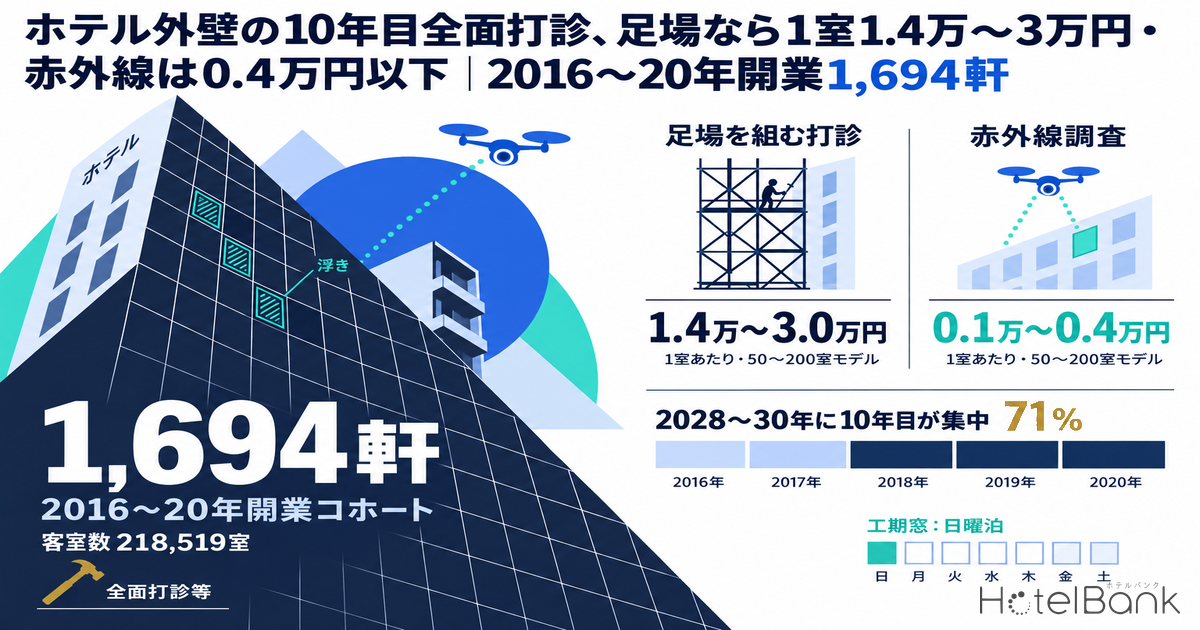
- — Target cohort: Business and city hotels that opened in 2016–20 total 1,694 properties and 218,519 rooms. The arrival of year 10 is concentrated in the three years 2028–30, with 1,202 properties (71%).
- — Survey cost: For models of 50–200 rooms, tapping from scaffolding costs ¥14,000–¥30,000 per room, while an infrared survey costs ¥1,000–¥4,000 per room. Most of the gap is the cost of temporary scaffolding.
- — Repair cost: ¥6,000–¥17,000 per room assuming a 3% delamination rate. If scaffolding can be shared with major repair work, the standalone year-10 outlay can be compressed to the infrared survey alone.
- — Work windows: Estimated OCC for business hotels is lowest on Sunday nights; in Osaka it is 72.5% on Sundays versus 83.1% on Thursdays. Even if 25 rooms on the working side of a 110-room hotel are taken off sale, the calculation shows no bookings displaced on Sunday nights in Osaka and Aichi.
- — How to proceed: Report at year 10 with an infrared survey and fold repairs that need scaffolding into the major repair work around years 12–15, and a Type M property (110 rooms) avoids paying ¥13,000–¥20,000 per room in scaffolding costs twice.
Full-Surface Tapping at the First Report After 10 Years — Drone Infrared Treated as Equivalent Since 2022
Article 12, Paragraph 1 of the Building Standards Act requires the owner (or manager) of specified buildings such as hotels and inns to have them inspected periodically by a qualified person such as a first-class architect, and to report the results to the local building authority (特定行政庁). One of the inspection items is deterioration of exterior finishing materials. MLIT Notification No. 282 of 2008, which sets out the method, requires checking the areas within reach by tapping or similar means roughly every six months to three years, and in addition, roughly once every 10 years, checking the full surface of the areas where falling material could injure pedestrians by tapping or similar means.
The starting point is completion (issue of the certificate of completion inspection), a full renovation of the exterior walls, or the date the previous full-surface tapping inspection was completed. The full-surface inspection must be finished by the first report after more than 10 years have passed from that point. In other words, the cost does not arise all at once exactly 10 years after opening; depending on each property’s reporting cycle, it slips to “the first reporting year after year 10.” This is the first issue for funding plans.
As for the survey method, the revision of the notification dated January 18, 2022 clarified that methods other than tapping with a test hammer include “infrared surveys by unmanned aircraft that have accuracy equal to or better than tapping with a test hammer.” Accuracy is judged with reference to the “Guidelines for Exterior Wall Surveys by Infrared Survey (Including Infrared Surveys by Unmanned Aircraft) under the Periodic Reporting System,” compiled by a committee of the Japan Building Disaster Prevention Association (日本建築防災協会). Now that the system clearly provides a route to completing a full-surface survey without erecting scaffolding or gondolas, the year-10 outlay varies widely depending on the choice made.
| Item | Details |
|---|---|
| Legal basis | Building Standards Act, Article 12, Paragraph 1 / MLIT Notification No. 282 of 2008 (partially revised January 18, 2022) |
| Finishes covered | Tile, stone cladding and similar (excluding dry-fixed methods), mortar and similar. In some jurisdictions, finishes other than dry-fixed ones whose fixing method is unknown are also covered in principle |
| Scope of full-surface survey | Areas where falling material could injure pedestrians. In practice, areas where a public road or a passage used by the general public lies in front of the wall within a horizontal distance of roughly half the wall height |
| Timing | By the first report after more than 10 years have passed since completion, exterior wall renovation or the previous full-surface tapping inspection |
| Survey method | Tapping with a test hammer, or an infrared survey with accuracy equal to or better than tapping (including surveys by unmanned aircraft) |
| Main exceptions | Where exterior wall renovation or similar work is certain to be carried out within three years (timing made clear in a maintenance plan, etc.), or where pedestrian safety is separately secured by protective netting, etc. |
| Reporting cycle and size thresholds | Differ by local building authority (see table below) |
The reporting cycle and the size thresholds are set by each local building authority. In Tokyo, for example, inns and hotels with three or more storeys and floor area over 2,000㎡ report every year (November 1 to January 31 of the following year), while others that meet conditions such as having three or more storeys report every three years (May 1 to October 31, on a cycle of 2019, 2022 and so on). In Chiba, by contrast, the system covers buildings that use a basement floor or the third floor or above as a hotel or inn, among others, and buildings report every two years. Even for properties that opened in the same year, the year of the full-surface tapping inspection shifts by one to three years depending on location and size, so the reporting year for each of your own properties should be confirmed individually in the rules of the authority with jurisdiction.
| Local building authority (example) | Size threshold for hotels and inns | Reporting cycle for buildings |
|---|---|---|
| Tokyo | Three or more storeys and floor area over 2,000㎡ | Every year (November 1 to January 31 of the following year) |
| Tokyo | Other buildings that meet prescribed conditions such as a basement floor or three or more storeys | Every three years (May 1 to October 31) |
| Chiba | Buildings using a basement floor or the third floor or above as a hotel or inn, buildings with 300㎡ or more on the second floor, etc. | Every two years (May 1 to May 31 in 2026) |
1,694 Business and City Hotels with 219,000 Rooms Opened in 2016–20 — 2019 Is the Largest Year at 412
Counting business hotels and city hotels that opened in 2016–20 on the basis of opening dates tracked by MetroEngines Research, 2,006 properties with 239,478 rooms were confirmed as listed on OTAs and similar channels. Of these, the properties with observed selling prices in June–August 2026 — that is, those judged to be still operating — number 1,694 (1,596 business hotels and 98 city hotels), and their property-level room counts sum to 218,519 rooms. This article treats these 1,694 properties as the “year-10 cohort.”
By opening year, the count rose from 200 properties and 22,213 rooms in 2016 to 412 properties and 56,808 rooms in 2019, and remained high in 2020 at 397 properties and 54,053 rooms. The rush of limited-service hotel openings driven by expanding inbound demand turns directly into a peak of exterior wall surveys 10 years later. The three years of openings from 2018 to 2020 account for 1,202 properties, or 71% of the total, and 163,085 rooms, or 75%.
| Opening year | Year 10 | Properties confirmed on sale | Rooms (same) | Properties excl. January 1 openings | Rooms (same) | Properties confirmed listed (reference) | Rooms (same) |
|---|---|---|---|---|---|---|---|
| 2016 | 2026 | 200 | 22,213 | 192 | 21,840 | 267 | 26,314 |
| 2017 | 2027 | 292 | 33,221 | 279 | 32,914 | 370 | 37,156 |
| 2018 | 2028 | 393 | 52,224 | 388 | 52,133 | 464 | 57,164 |
| 2019 | 2029 | 412 | 56,808 | 400 | 56,120 | 468 | 61,199 |
| 2020 | 2030 | 397 | 54,053 | 389 | 53,432 | 437 | 57,645 |
| Total | 2026–30 | 1,694 | 218,519 | 1,648 | 216,439 | 2,006 | 239,478 |
There are 46 properties with 2,080 rooms whose opening date is January 1, and provisional registration dates may be mixed in. Excluding them still leaves 1,648 properties and 216,439 rooms, and the conclusion does not change. Note that the opening date here is the date the property began operating as a hotel and does not coincide with the building’s completion date (the date the certificate of completion inspection was issued). For properties converted from existing buildings or rebranded, completion is older still, and the deadline for the full-surface tapping inspection may already have arrived.
Looking at the size distribution, the median is 111 rooms, and properties with 100 rooms or more number 953 with 185,782 rooms, accounting for 85% of rooms. There are also 460 small properties with fewer than 50 rooms, but they amount to only 11,564 rooms (5%). The cohort is centered on mid- and high-rise buildings of three or more storeys, and most are thought to fall within the size thresholds for periodic reporting. However, the full-surface tapping inspection is required only for wet-applied finishes such as tile and mortar, and the area covered is smaller for properties whose exteriors are mainly dry-fixed, such as extruded cement panels or metal panels. Because our data cannot distinguish the type of finish, the estimates below assume “properties with wet-applied exterior wall finishes.”
70% Reach Year 10 in 2028–30 — Tokyo, Osaka, Aichi, Kyoto, Fukuoka and Hokkaido Hold 60% of Rooms
By prefecture, Tokyo with 311 properties and 45,723 rooms and Osaka with 229 properties and 35,067 rooms stand out, followed by Aichi (86 properties, 15,156 rooms), Kyoto (150 properties, 14,158 rooms), Fukuoka (87 properties, 11,455 rooms) and Hokkaido (79 properties, 10,349 rooms). These six prefectures account for 942 properties and 131,908 rooms, or 60% of the cohort’s rooms. Kyoto has few rooms relative to its number of properties, averaging 94 rooms per property, with a high share of small and mid-sized hotels.
The peak arrival year differs by region. The largest number falls in 2028 (79 properties opened in 2018) and 2029 (77 properties) in Tokyo, in 2029 (49 properties) in Kyoto, and in 2030 (25 properties) in Fukuoka. Because busy periods for survey firms and scaffolding contractors arise region by region, in Tokyo, Osaka and Kyoto — where full-surface surveys of dozens of buildings overlap in the same city in the same year — bringing orders forward to secure contractor capacity is a practical option.
| Prefecture | Properties | Rooms | Year 10 in 2026–27 | Year 10 in 2028–30 |
|---|---|---|---|---|
| Tokyo | 311 | 45,723 | 86 | 225 |
| Osaka | 229 | 35,067 | 72 | 157 |
| Aichi | 86 | 15,156 | 25 | 61 |
| Kyoto | 150 | 14,158 | 28 | 122 |
| Fukuoka | 87 | 11,455 | 19 | 68 |
| Hokkaido | 79 | 10,349 | 17 | 62 |
| Chiba | 50 | 8,080 | 12 | 38 |
| Kanagawa | 48 | 6,182 | 13 | 35 |
| Hyogo | 40 | 5,831 | 7 | 33 |
| Shizuoka | 32 | 4,863 | 10 | 22 |
Survey Cost: ¥14,000–¥30,000 per Room for Scaffold Tapping, ¥1,000–¥4,000 for an Infrared Survey
The cost of a full-surface tapping inspection splits into “the unit price of the survey itself” and “the temporary works needed to get close to the wall.” Tapping requires workers to get within arm’s reach of the wall surface, using scaffolding, a gondola, rope access or an aerial work platform. An infrared survey is shot from the ground or from an unmanned aircraft, so no temporary works are needed. Most of the cost gap is explained by these temporary works.
■ Estimation Assumptions
- Models: Type S with 50 rooms and 7 storeys, Type M with 110 rooms and 10 storeys (equivalent to the cohort median of 111 rooms), and Type L with 200 rooms and 14 storeys. Gross floor area is set at 30㎡ per room, storey height at 3.1m, and the typical floor as a rectangle with a long-to-short side ratio of 2:1.
- Exterior wall area: perimeter × height. Of this, 85% is assumed to be finished surface (net of openings), and 55% of that (equivalent to the two faces fronting roads and passages) is assumed to be subject to the full-surface tapping inspection. For Type M, about 2,390㎡ of exterior wall and about 1,120㎡ subject to survey.
- Scaffolded area: area subject to survey × 1.15. About 1,290㎡ for Type M.
- Unit prices: frame scaffolding ¥1,000–1,500/㎡ plus mesh sheeting ¥100–200/㎡, tapping ¥250–450/㎡, tapping by rope access ¥240–450/㎡ (1,000㎡ or more), infrared survey ¥120–350/㎡ (including partial tapping, visual inspection and the report).
- Tapping from a gondola is not quantified because its cost varies widely with installation conditions. Consumption tax, overheads and administrative procedure costs are not included.
| Model | Area subject to survey | Scaffolding + tapping total | Scaffolding + tapping per room | Rope-access tapping per room | Infrared survey total | Infrared survey per room |
|---|---|---|---|---|---|---|
| Type S, 50 rooms | 630㎡ | ¥950,000–¥1,508,000 | ¥19,000–¥30,200 | ¥3,000–¥5,700 | ¥76,000–¥221,000 | ¥1,500–¥4,400 |
| Type M, 110 rooms | 1,120㎡ | ¥1,699,000–¥2,697,000 | ¥15,400–¥24,500 | ¥2,400–¥4,600 | ¥134,000–¥392,000 | ¥1,200–¥3,600 |
| Type L, 200 rooms | 1,780㎡ | ¥2,700,000–¥4,286,000 | ¥13,500–¥21,400 | ¥2,100–¥4,000 | ¥214,000–¥623,000 | ¥1,100–¥3,100 |
For Type M (110 rooms), the survey cost when tapping from scaffolding is about ¥1.7 million–¥2.7 million, or ¥15,000–¥25,000 per room. Of this, scaffolding and mesh sheeting cost about ¥1.42 million–¥2.19 million, which is four to five times the tapping work itself (about ¥280,000–¥500,000). Tapping the same area by rope access comes to about ¥270,000–¥500,000 (¥2,400–¥4,600 per room), and an infrared survey to about ¥130,000–¥390,000 (¥1,200–¥3,600 per room). Across Types S to L, scaffold tapping ranges from ¥14,000 to ¥30,000 per room and an infrared survey from ¥1,000 to ¥4,000 per room. The smaller the property, the larger the exterior wall area per room and the higher the per-room cost.
That said, an infrared survey is not a cure-all. Shooting depends on weather conditions such as solar radiation and outside temperature, and depending on the orientation of the wall and the distance to neighboring buildings, some areas will not produce a sufficient temperature difference. Those areas have to be supplemented by tapping. Flying an unmanned aircraft in a densely inhabited district or near the airspace above third parties also requires permission and approval under the Civil Aeronautics Act and a flight plan that takes account of the movement of guests and pedestrians. It is also worth bearing in mind that locations where the infrared survey finds suspected delamination ultimately need to be confirmed by tapping and treated at the repair stage.
To give a sense of scale for the whole cohort, applying the per-room unit cost for Type M directly to 218,519 rooms gives a rough guide of about ¥3.4 billion–¥5.4 billion for scaffold tapping and about ¥0.3 billion–¥0.8 billion for infrared surveys. This is an approximation that ignores differences in shape and finish between properties, but it does convey that the choice of survey method makes a difference measured in billions of yen across the cohort.
Repair Cost: ¥6,000–¥17,000 per Room at a 3% Delamination Rate — The Total Depends on Sharing Scaffolding with Major Repair Work
If the full-surface survey finds delamination, repairs follow. For delaminated tile walls, methods such as anchor pinning with partial epoxy resin injection and anchor pinning with injection-port pins are commonly used. Published prices in construction cost references put anchor pinning at around ¥1,900–2,800 per hole, and delamination repair with nine pins per ㎡ and full epoxy resin injection at ¥22,660 per ㎡ (for work of 100㎡ or more). This article estimates on the basis of ¥23,000–¥45,000 per ㎡ of delaminated area (excluding temporary works).
| Delamination rate (share of area surveyed) | Type S, 50 rooms | Type M, 110 rooms | Type L, 200 rooms |
|---|---|---|---|
| Delamination rate 1% | ¥145,000–¥284,000 ¥2,900–¥5,700 per room | ¥258,000–¥504,000 ¥2,300–¥4,600 per room | ¥409,000–¥801,000 ¥2,000–¥4,000 per room |
| Delamination rate 3% | ¥435,000–¥850,000 ¥8,700–¥17,000 per room | ¥773,000–¥1,512,000 ¥7,000–¥13,700 per room | ¥1,228,000–¥2,403,000 ¥6,100–¥12,000 per room |
| Delamination rate 5% | ¥725,000–¥1,418,000 ¥14,500–¥28,300 per room | ¥1,288,000–¥2,520,000 ¥11,700–¥22,900 per room | ¥2,047,000–¥4,005,000 ¥10,200–¥20,000 per room |
With the delamination rate set at 3%, the repair cost for Type M is about ¥770,000–¥1.51 million, or ¥7,000–¥14,000 per room. Across the models as a whole the range is ¥6,000–¥17,000 per room. The delamination rate varies widely with the workmanship of the finish, the substrate and the weather conditions at the site, so it is not known until the year-10 survey results are in. For funding plans, it is realistic to allow for a range at three levels: 1%, 3% and 5%.
What determines the total is who bears the cost of the scaffolding for repairs. Erecting scaffolding on a standalone basis at year 10 and carrying out tapping and repair at the same time comes to about ¥2.47 million–¥4.21 million for Type M (¥23,000–¥38,000 per room). By contrast, if the year-10 report is completed with an infrared survey, emergency measures such as partial removal or protective netting are taken at locations at risk of falling, and full-scale repair is timed with the major exterior wall repair work planned around years 12–15 (work that needs scaffolding, such as sealant replacement), scaffolding only has to be erected once. For Type M, the calculation is that about ¥1.42 million–¥2.19 million in scaffolding costs (¥13,000–¥20,000 per room) can be removed from the standalone year-10 outlay. For reference, the major repair spending disclosed by listed hotel REITs puts hotel capital expenditure at roughly ¥130,000–¥620,000 per room a year.
The notification also provides an exception where exterior wall renovation or similar work is certain to be carried out within three years. If the timing of exterior wall renovation is made clear in a maintenance plan or similar document and the work is expected to be carried out as planned, the full-surface tapping inspection can be aligned with that renovation. Deciding first where in years 10–13 to erect scaffolding, and bundling the full-surface survey, repairs and sealant renewal into a single program of work, can be called the most cost-efficient way to approach this system.
The standalone total of ¥23,000–¥38,000 per room is equivalent to 1.6–2.7 room nights at the estimated settled ADR of business hotels in Tokyo (¥14,200 average over the most recent 12 months, N=894–924 properties) and 2.2–3.8 room nights in Osaka (¥10,000 on the same basis, N=487–503 properties). Spread over 10 years it is ¥2,300–3,800 per room a year, so it can be thought of as a burden of the same order as the annual statutory inspection cost we estimated previously (¥3,400–12,600 per room a year) arriving all at once in year 10.
Work Windows Are Sunday and Monday Nights and January — A Schedule That Keeps the Hotel Running, Seen Through Estimated OCC
Exterior wall surveys and repairs are mainly daytime work, and much of it can proceed without taking rooms off sale if it is kept within the hours between check-out and check-in. Even so, for rooms facing the working side there are situations where it is realistic to take the nights of working days off sale, out of consideration for guests on consecutive-night stays being in their rooms, sightlines and noise. In that case, the volume of bookings displaced changes with the days of the week and months on which work is concentrated. By our separate estimate, the revenue lost when rooms are closed for hotel renovation work is equivalent to 32.6% of the construction cost.
First, by month. According to the Japan Tourism Agency’s Overnight Travel Statistics Survey, the room occupancy rate of business hotels in 2025 was 75.3% nationwide for the year, and by month it was lowest in January at 66.6%, followed by June (72.8%). Many regions have a trough in the winter months of January and February: Kyoto at 63.3% in January and 68.0% in February, and Osaka at 73.8% in January. In Hokkaido, on the other hand, April is lowest at 62.6%, and in Tokyo the troughs are January and July (both 77.1%).
In winter, however, the curing conditions for resin injection and the application conditions for sealants become more demanding, and in cold regions outdoor work itself is constrained. Infrared surveys are also affected by solar radiation and outside temperature. Because the choice of month is decided by the overlap between “the demand trough” and “working conditions,” the approach becomes one of splitting the work — the survey in January–February and repairs from March onward as temperatures rise — in Kyoto and Osaka, where the demand trough comes in winter, or using the spring trough (April) in Hokkaido.
Next, by day of the week. In MetroEngines Research’s estimated OCC (business hotels, as of the day before the stay date = LT1, for stays from June 1 to September 27, 2026), Sunday nights were lowest in all six prefectures, followed by Monday nights. Osaka (286 properties / 47,984 rooms covered, based on listings on major booking sites) stood at 72.5% on Sundays and 74.2% on Mondays against 83.1% on Thursdays, and Aichi (174 properties / 25,924 rooms covered) at 76.1% on Sundays and 88.0% on Thursdays, a gap of 10–12 points between Sunday and Thursday. Tokyo (535 properties / 78,086 rooms covered) was at 87.1% on Sundays and 92.6% on Thursdays, with a shallower day-of-week trough.
| Prefecture | Coverage (median) | Mon | Tue | Wed | Thu | Fri | Sat | Sun |
|---|---|---|---|---|---|---|---|---|
| Tokyo | 535 properties / 78,086 rooms | 87.6% | 90.7% | 91.4% | 92.6% | 90.7% | 92.5% | 87.1% |
| Osaka | 286 properties / 47,984 rooms | 74.2% | 79.3% | 80.9% | 83.1% | 80.6% | 86.7% | 72.5% |
| Aichi | 174 properties / 25,924 rooms | 79.6% | 84.9% | 86.5% | 88.0% | 83.9% | 86.1% | 76.1% |
| Kyoto | 192 properties / 19,718 rooms | 78.1% | 80.2% | 82.0% | 85.6% | 85.2% | 87.7% | 77.9% |
| Fukuoka | 177 properties / 22,772 rooms | 87.1% | 91.0% | 90.7% | 91.8% | 90.2% | 92.8% | 85.2% |
| Hokkaido | 219 properties / 25,666 rooms | 88.7% | 92.5% | 93.2% | 94.8% | 90.7% | 93.6% | 85.5% |
Overlaying the booking curves, estimated OCC at 45 days before the stay date is at roughly the same level, about 45%, for both Sunday and Thursday nights. The gap opens up in the final days before the stay: Thursday nights build to 83.1% as of the day before, whereas Sunday nights stop at 72.5%. In other words, the vacant rooms on Sunday nights are not rooms where “bookings have not come in yet” but structural slack that never fully fills even at the last minute, which makes those nights easy to use in a planned way as the days on which rooms are taken off sale for works.
| Prefecture | Estimated OCC Sun / Thu | Vacant rooms of 110 Sun / Thu | Bookings displaced by closing 25 rooms, Sun / Thu | Estimated settled ADR latest 12-month average | Sales opportunity per night, Sun / Thu |
|---|---|---|---|---|---|
| Tokyo | 87.1% / 92.6% | 14.2 / 8.1 rooms | 10.8 / 16.9 rooms | ¥14,178 | ¥153,300 / ¥239,000 |
| Osaka | 72.5% / 83.1% | 30.3 / 18.6 rooms | 0.0 / 6.4 rooms | ¥10,016 | ¥0 / ¥64,200 |
| Aichi | 76.1% / 88.0% | 26.3 / 13.2 rooms | 0.0 / 11.8 rooms | ¥7,820 | ¥0 / ¥92,300 |
| Kyoto | 77.9% / 85.6% | 24.3 / 15.8 rooms | 0.7 / 9.2 rooms | ¥13,892 | ¥9,600 / ¥127,300 |
| Fukuoka | 85.2% / 91.8% | 16.3 / 9.0 rooms | 8.7 / 16.0 rooms | ¥10,900 | ¥95,000 / ¥174,200 |
| Hokkaido | 85.5% / 94.8% | 16.0 / 5.7 rooms | 9.0 / 19.3 rooms | ¥8,881 | ¥80,400 / ¥171,200 |
Assuming 25 rooms on the working side of a Type M property (110 rooms) are closed for one night, in Osaka and Aichi the vacant rooms on Sunday nights (about 26–30 rooms) exceed the number of rooms closed, so the bookings displaced come to zero in the calculation. Closing the same 25 rooms on a Thursday night affects sales opportunities of about 6 rooms and about ¥64,200 per night in Osaka, and about 12 rooms and about ¥92,300 in Aichi. In Tokyo, an impact of about 11 rooms and about ¥153,300 remains even on Sunday nights, so there is considerable value in reducing the number of rooms closed (dividing the working face into smaller sections) or choosing a method with little impact on guest rooms, such as an infrared survey.
Framing the Investment Decision — Do Not Make Year 10 “the Scaffolding Year”
A. Standalone scaffolding + tapping + repair at year 10
¥23,000–¥38,000 per room (Type M, 3% delamination rate)
Survey and repair are completed in one go. Scaffolding accounts for more than half of the outlay, and if scaffolding is erected again for major repair work in years 12–15, the temporary works are paid for twice.
Recommended B. Report by infrared survey and fold repairs into major repair work
Year-10 outlay of ¥1,000–¥4,000 per room
Hazardous locations are dealt with first by emergency measures. Scaffolding is erected just once for the repair work, and a Type M property avoids paying ¥13,000–¥20,000 per room in temporary works twice.
C. Bring major repair work forward to years 10–13 and integrate
Full-surface survey, repairs and sealant renewal with a single scaffold
If exterior wall renovation within three years is certain, the full-surface tapping inspection can be aligned with the renovation. The condition is that the timing is made clear in a maintenance plan.
The cohort that opened in 2016–20 is dominated by limited-service properties that are mid- or high-rise with 100 rooms or more, and the exterior wall area subject to full-surface survey is also large. The key to minimizing the year-10 outlay lies less in the survey method itself than in when “the scaffolding year” is placed. With an approach that completes the report by infrared survey and bundles repairs that need scaffolding and sealant renewal into major repair work, the standalone year-10 outlay is kept to a few thousand yen per room.
When considering holding or acquiring a property, confirming five points for each property makes it possible to estimate capex around year 10 on a per-room basis: (1) the completion date (date of issue of the certificate of completion inspection) and the history of exterior wall renovation; (2) the reporting cycle of the local building authority with jurisdiction and the next reporting year; (3) whether the exterior finish is wet-applied or dry-fixed; (4) the position relative to the fronting road and passages (the scope of the full-surface survey); and (5) the timing of major repair work in the maintenance plan. If working days are concentrated on Sunday and Monday nights and months are chosen where the demand trough and working conditions overlap, the work can proceed without a large drop in occupancy. In Tokyo, Osaka, Kyoto and other areas where 1,202 properties reach year 10 in 2028–30, securing survey firms and scaffolding early is likely to offer upside in both cost and schedule.
Methodology and Notes
- For the opening-year cohort, all business hotels and city hotels whose opening date as tracked by MetroEngines Research (based on confirmed OTA listings) falls in 2016–20 were retrieved by prefecture and narrowed to properties with observed selling prices in June–August 2026. Room counts are the sum of property-level values.
- The opening date is the date operations began and differs from the building’s completion date. For converted or rebranded properties the building may be older. The actual year of the full-surface tapping inspection is determined by the completion date, the history of exterior wall renovation and the reporting cycle.
- Survey and repair costs are model estimates based on published unit prices, and actual amounts vary with building shape, finish, the condition of the fronting road and the contractor. Actual investment decisions require individual survey quotations.
- Estimated OCC is an estimate based on how inventory sold on OTAs is consumed and differs from the actual occupancy of the whole property. Booking curves use only the period from 45 days before the stay date to the day before (LT45→1).
References and Sources
■ Data Sources
The opening-year cohort and room counts are from the property data of MetroEngines Research & Consulting (opening date based on confirmed OTA listings; of 2,006 business hotels and city hotels opened in 2016–20, the 1,694 properties and 218,519 rooms with observed selling prices in June–August 2026). Estimated OCC and booking curves are estimates based on business hotel inventory listed on major booking sites (stays from June 1 to September 27, 2026, as of the day before the stay date), and estimated settled ADR is the monthly average on the same basis from September 2025 to August 2026. Monthly room occupancy rates are the final 2025 figures of the Japan Tourism Agency’s Overnight Travel Statistics Survey. The description of the system is based on published materials of MLIT and local building authorities.
■ Estimation Assumptions
Models of Type S with 50 rooms and 7 storeys, Type M with 110 rooms and 10 storeys, and Type L with 200 rooms and 14 storeys (gross floor area 30㎡ per room, storey height 3.1m, typical floor with a long-to-short side ratio of 2:1). The area subject to the full-surface tapping inspection is 55% of the finished surface (equivalent to the two faces fronting roads and passages), and the scaffolded area is the area subject to survey × 1.15. Unit prices are frame scaffolding ¥1,000–1,500/㎡ plus mesh sheeting ¥100–200/㎡, tapping ¥250–450/㎡, rope-access tapping ¥240–450/㎡, infrared survey ¥120–350/㎡, and delamination repair ¥23,000–¥45,000/㎡ (excluding temporary works). Delamination rates of 1%, 3% and 5% are assumed values. Room closure for works is set at 25 of 110 rooms for one night. Consumption tax, overheads and administrative procedure costs are not included.
■ Limitations and Caveats
The opening date is the date operations began and does not coincide with the building’s completion date (the date of issue of the certificate of completion inspection). Because it is not possible to tell whether the exterior finish is wet-applied or dry-fixed, the estimates assume properties with wet-applied exterior wall finishes. Reporting cycles and size thresholds differ by local building authority, and the year of the full-surface tapping inspection is pushed later property by property. Costs are model estimates based on published unit prices, and actual amounts vary with building shape, the condition of the fronting road and the contractor. Estimated OCC is an estimate based on how OTA inventory on sale is consumed and differs from the actual occupancy of the whole property.
■ Laws and Published Materials of MLIT and Local Building Authorities
- MLIT, “Survey of Exterior Wall Tiles, etc. under the Periodic Reporting System”
- Japan Building Disaster Prevention Association (日本建築防災協会), “Guidelines for Exterior Wall Surveys by Infrared Survey (Including Infrared Surveys by Unmanned Aircraft) under the Periodic Reporting System” (published by MLIT)
- MLIT Notification No. 282 of 2008 (partially revised January 18, 2022); Building Standards Act, Article 12, Paragraph 1
- Itabashi City, “Full-Surface Tapping and Other Surveys of Exterior Walls of Specified Buildings under the Building Standards Act”
- Tokyo Metropolitan Government Bureau of Urban Development, “List of Buildings, Building Equipment, etc. Subject to Periodic Reporting and Reporting Periods”
- Chiba Prefecture, “Size of Specified Buildings and Building Equipment Subject to Periodic Reporting”
■ Government Statistics
■ Survey and Construction Unit Prices
- Japan Seismic Diagnosis Association (日本耐震診断協会), “Exterior Wall Survey Costs: Infrared Surveys and Tapping Surveys”
- Dronemate Inc., “How Much Does an Exterior Wall Survey Cost? Market Rates, Unit Prices and How to Read Quotations”
- Sakura Jimusho Inc., “Scaffolding Costs for Condominium Major Repairs Explained: Unit Prices, Formulas and Five Points to Note”
- Machi no Yaneyasan Osaka Minami, “How Much Does Scaffolding Cost for Roofing Work and Exterior Painting? Market Rates for Scaffolding”
- Kensetsu Plaza, “Prices and Unit Prices for Exterior Wall Renovation Work (Sekisan Shiryo Published Price Edition)”
■ Market Data
- MetroEngines Research & Consulting — Opening-year cohort (based on confirmed OTA listings, N=1,694 properties), estimated OCC and booking curves (business hotels, based on listings on major booking sites), estimated settled ADR