

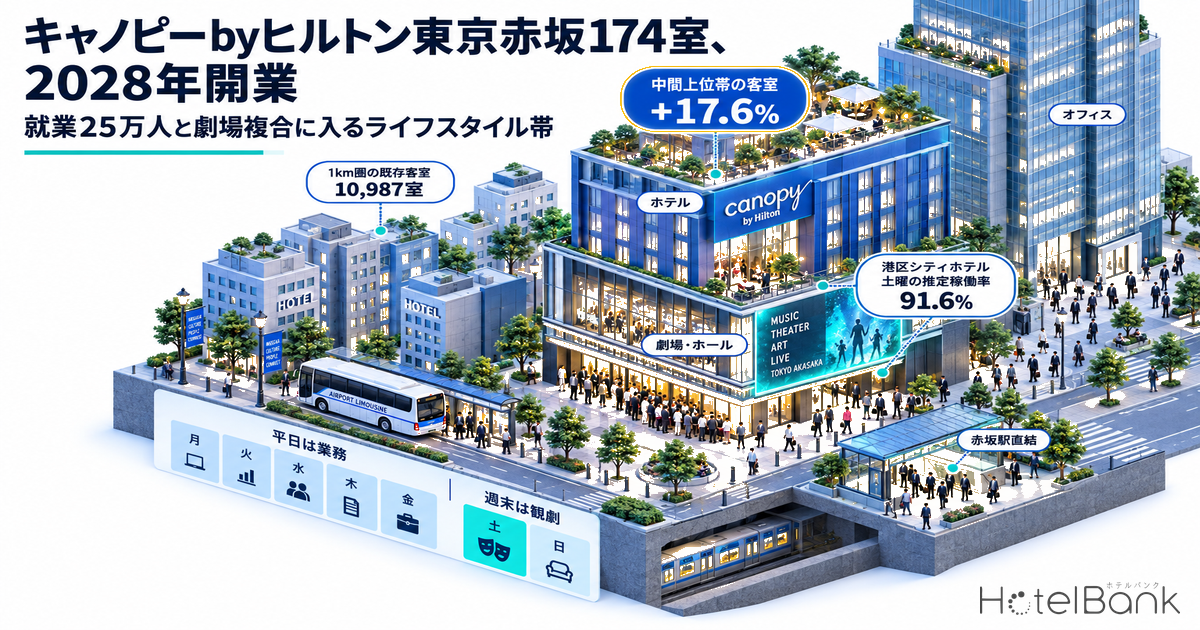
On April 25, 2025, Hilton announced that it will open Canopy by Hilton Tokyo Akasaka (キャノピーbyヒルトン東京赤坂), a 174-room hotel including 24 suites, in Tokyo’s Akasaka district. The hotel will occupy floors 7–18 of an 18-story building housing a theater, a hall and retail in the West Block of the Akasaka 2- and 6-chome District Development Project (赤坂二・六丁目地区開発計画), which Mitsubishi Estate and TBS Holdings are developing, with direct access to Akasaka Station on the Tokyo Metro Chiyoda Line. Hilton’s Japan “Company Overview” (updated August 25, 2026) lists the property as “opening in 2028.” Raffles Tokyo (130 rooms) in Hamamatsucho, which our editorial team covers separately, is a case of the very top price tier entering a business district. This article looks at a different case: an upper-midscale lifestyle hotel built into the same development as a theater, a hall and offices. Using data on nearby employment and residents, the price bands of existing rooms, occupancy by day of week and land prices, we examine the demand mix of a hotel inside a mixed-use development.
Metric Definitions Used in This Article
- ADR (Average Daily Rate): An estimated settled rate (tax-exclusive equivalent) calculated by applying category-specific adjustment factors to the lowest-plan price level each property publishes on OTAs (double occupancy, per room, tax included). In a comparison against property-level results disclosed by listed hotel REITs (91 properties, most recent three months), the median error was about 7%. This is an estimate and differs from each property’s actual settled rates and accounting figures. Area-level ADR is the median of the properties covered (the level of a typical property in the area).
- OCC (Occupancy): The share of rooms sold out of total rooms in the area (an estimate based on OTA inventory on sale). It reflects how inventory sold on OTAs is absorbed and differs from the actual occupancy of the entire property.
- Booking curve: The trajectory of remaining OTA inventory toward the check-in date. LT (lead time) = days until check-in. This article uses LT45 to LT1 only.
- Data source: MetroEngines Research
The conclusion first. The area around Akasaka Station is a business district where about 250,000 people work within a 1 km radius, and at the same time a theater district anchored by TBS Akasaka ACT Theater. Hotel supply within 1 km is deep, at 55 hotels and 10,987 rooms, but it is concentrated in business and limited-service hotels with an estimated settled ADR of ¥15,000–25,000; the upper-middle band of ¥25,000–50,000 has only 7 hotels and 990 rooms. Estimated occupancy at city hotels in Minato Ward was highest on Saturdays in June–August 2026 (91.6% on average), a peak that falls on different days from business hotels, which are strong on weekdays (94.0% on Thursdays). Sitting in the same building as a theater and hall, Canopy is positioned to absorb weekday business demand and weekend theater and entertainment demand with a single room inventory.
- — 174 rooms in the same building as a theater: In the West Block (total floor area about 38,150㎡), the theater and hall (about 11,000㎡) and the hotel (about 12,000㎡) are nearly the same size. The hotel occupies floors 7–18, with rooms mainly around 31㎡.
- — 249,000 workers within 1 km: Office-type industries account for 50.4%. The residential population within 1.5 km is about 53,000 and is projected to grow to about 58,000 by 2040.
- — A thin upper-middle band: The median for the 39 hotels and 7,646 rooms within 1 km for which ADR could be estimated is about ¥18,300. The ¥25,000–50,000 band has 990 rooms; adding 174 rooms lifts that band by 17.6%.
- — A weekend peak: Estimated occupancy at Minato Ward city hotels (June–August 2026) was 91.6% on Saturdays and 78.4% on Mondays. Business hotels peak on Thursdays at 94.0%, so demand by day of week is complementary.
- — Room revenue estimated at about ¥2 billion: The base case of ADR ¥40,000 and OCC 80% (full year) gives about ¥2.03 billion a year, or about ¥170,000 per ㎡ of hotel floor area.
174 Rooms in the Same Development as a Theater, Hall and Offices — How the Akasaka 2- and 6-chome Project Is Laid Out
The Akasaka 2- and 6-chome District Development Project broke ground in March 2024 under Mitsubishi Estate and TBS Holdings, having been certified as a Private Urban Renewal Project Plan in February of that year. Two buildings will stand on either side of Akasaka-dori. The East Block is an office-led high-rise of 40 floors above ground, about 207 m tall, with a total floor area of about 167,650㎡, and will also house an incubation facility (about 1,000㎡) for entertainment start-ups and creators. The West Block has 18 floors above ground, stands about 100 m tall, has a total floor area of about 38,150㎡, and will house the theater and hall (about 11,000㎡), the hotel (about 12,000㎡) and retail. A plaza of about 4,900㎡ running from basement to ground level and a boarding area for airport limousine and sightseeing buses will also be built.
The character of the project shows in the fact that hotel floor space takes up about 30% of the building’s total floor area and is nearly the same size as the theater and hall. Unlike the typical central Tokyo mixed-use scheme that places a luxury hotel on the upper floors of an office tower, the hotel here is paired with the theater as one of the facilities driving an “entertainment district” vision. The plan for Canopy includes a terrace café overlooking Akasaka, a restaurant and bar, a meeting lounge of about 77㎡ and a 24-hour fitness center, with rooms mainly around 31㎡.
| Item | East Block (Akasaka 2-chome) | West Block (Akasaka 6-chome) |
|---|---|---|
| Scale | 40 floors above ground, 4 below; about 207 m | 18 floors above ground, 3 below; about 100 m |
| Total floor area | About 167,650㎡ | About 38,150㎡ |
| Main uses | Offices, retail, incubation facility (about 1,000㎡) | Theater and hall (about 11,000㎡), hotel (about 12,000㎡), retail |
| Hotel | — | Canopy by Hilton Tokyo Akasaka, 174 rooms (floors 7–18) |
| Scheduled completion | End of March 2028 (overall completion end of October 2028) | End of March 2028 |
| Common | Direct access to Akasaka Station; plaza of about 4,900㎡; shelter for about 650 stranded commuters; developers: Mitsubishi Estate and TBS Holdings | |
Japan’s Third Canopy and Tokyo’s First — Its Place Among Hilton’s 37 Hotels and 13 in the Pipeline
According to Hilton’s “Company Overview” (updated August 25, 2026), Hilton operates 37 hotels under 9 brands in Japan and has announced a further 13 planned openings. Canopy by Hilton is described as a “high-end boutique hotel brand” with 49 hotels in 15 countries; in Japan it operates two: Canopy by Hilton Osaka Umeda (キャノピーbyヒルトン大阪梅田, 308 rooms), opened in 2024, and Canopy by Hilton Okinawa Miyako Island Resort (キャノピーbyヒルトン沖縄宮古島リゾート, 306 rooms), opened in 2026. Tokyo Akasaka will be the third in Japan and the first Canopy in Tokyo.
Three openings are planned in Tokyo: Waldorf Astoria Tokyo Nihonbashi (ウォルドーフ・アストリア東京日本橋, 197 rooms) and its residences (71 units), both scheduled for 2027, and Canopy by Hilton Tokyo Akasaka in 2028. Nihonbashi is top-tier luxury, whereas Akasaka is a lifestyle boutique, so even within central Tokyo their roles are split by price band and guest profile. At 174 rooms, it is smaller than Japan’s two existing Canopy hotels (both over 300 rooms), a scale that fits the constraints of a mixed-use building sharing floor space with a theater and hall.
| Hotel | Rooms | Banquet rooms | Opening | Status |
|---|---|---|---|---|
| Canopy by Hilton Osaka Umeda | 308 | 3 | 2024 | Operating |
| Canopy by Hilton Okinawa Miyako Island Resort | 306 | 0 | 2026 | Operating |
| Canopy by Hilton Tokyo Akasaka | 174 | — | Opening in 2028 | Planned |
| Waldorf Astoria Tokyo Nihonbashi | 197 | — | Scheduled for 2027 | Planned |
| Waldorf Astoria Residences Tokyo Nihonbashi | 71 units | — | Scheduled for 2027 | Planned |
249,000 People Work Within 1 km and 53,000 Live Within 1.5 km — The Catchment of a Business District
Aggregating the Economic Census for Business Activity (2021) by radius, 76,251 people work within 500 m of the site (3,542 establishments), 249,253 within 1 km (8,110) and 480,634 within 1.5 km (16,952). Within 1 km, workers in office-type industries account for 50.4%, and the figures reflect the depth of Akasaka as a business district that brings together a broadcaster’s headquarters and a wide range of other companies. This is the foundation of weekday lodging demand from business trips, meetings and corporate entertaining, and it is consistent with Canopy’s plan to include a meeting lounge.
Residential population, meanwhile, is 53,064 within 1.5 km (2025) according to the Ministry of Land, Infrastructure, Transport and Tourism’s 250 m mesh projections, and is projected to rise to 58,142 by 2040. The working-age share is high at 70.2%, and the share aged 65 and over is only 17.2%. Population growth is expected in the residential areas of Akasaka, Roppongi and Azabu, and nearby city dwellers who visit theaters and restaurants at weekends are also a promising customer base for the hotel’s food and beverage outlets. Note that this is census-based residential population, not daytime visitors or pass-through traffic.
55 Hotels and 10,987 Rooms Within 1 km of the Station — Room Supply by Price Band
As far as MetroEngines Research tracks, there are 55 hotels (business, city, luxury and capsule) with 10,987 rooms within a 1 km radius of the site. Adding Canopy’s 174 rooms increases rooms in the area by only 1.6%. Broken down by price band, however, the mix is heavily skewed. Of the 39 hotels and 7,646 rooms for which estimated settled ADR (monthly average, September 2025–August 2026) could be calculated, 10 hotels with 2,677 rooms are under ¥15,000 and 20 hotels with 3,090 rooms are at ¥15,000–25,000; together they account for about 75% of the rooms covered by the estimate. The ¥25,000–50,000 band has 7 hotels and 990 rooms, and ¥50,000 and above has 2 hotels and 889 rooms.
The 16 hotels and 3,341 rooms outside the estimate include large luxury hotels and capsule-type properties for which a settled rate cannot be estimated from the lowest-plan price level on OTAs. International-class luxury hotels line the stretch from Akasaka to Tameike-Sanno and Toranomon, while the price band below them is dominated by business and limited-service hotels around the stations; “lifestyle upper-midscale” rooms between the two are relatively scarce. With Canopy’s 174 rooms, rooms in the ¥25,000–50,000 band would rise 17.6%, from 990 to 1,164. For the scale of new supply at ward level, see Tokyo 23 Wards Supply Pressure 2026, which sets it against existing stock.
Room Count × Estimated ADR — Only 4 Hotels of 100–300 Rooms in the Upper-Middle Band
Plotting the 39 hotels within 1 km by room count and estimated settled ADR, limited-service hotels at ¥10,000–25,000 cluster around the 200-room scale, and few properties exceed ¥25,000. Of the 7 hotels in the ¥25,000–50,000 band, 4 (809 rooms in total) have 100–300 rooms. With 174 rooms, mainly around 31㎡, plus a restaurant and bar and a lounge, Canopy enters this gap in terms of both scale and price. Positioned between large international-class hotels and limited-service hotels that concentrate on rooms, it is designed to carry the price band, within the mixed-use development, where guests can “stay after the theater” and “also use it for business trips.”
Minato Ward’s Estimated Settled ADR Is Up 7.1% Over the Latest 12 Months — City Hotel Median About ¥36,000
We next check the area’s price level for Minato Ward as a whole. Minato Ward’s estimated settled ADR (median across all hotel categories, N=121–133 hotels) averaged about ¥17,700 over the 12 months from September 2025 to August 2026, up 7.1% from the same period a year earlier (about ¥16,500). By month, January–May 2026 ran 5–10% above the same months a year earlier, and April reached ¥22,100, reflecting cherry blossom season demand. June–August came in 4–8% below the year-earlier months, but the listed level for October (an estimate as of the survey date) stands at ¥23,800, above the ¥19,600 of October 2025. Behind this is growing inbound demand: according to the Japan National Tourism Organization (JNTO), international visitor arrivals to Japan reached a record 42,683,600 in 2025.
The price band closest to where Canopy will be positioned is the median for Minato Ward city hotels (N=21–24 hotels). The average over the same 12 months was about ¥36,000, virtually unchanged from a year earlier (about ¥36,100). By month, October’s ¥48,000 is the annual peak, rising when autumn tourism and business demand overlap. It is natural to assume that the price band for a 174-room lifestyle hotel with rooms mainly around 31㎡ will be around the Minato Ward city hotel median.
Business on Weekdays, Theater at Weekends — Minato Ward Occupancy by Day of Week and How Bookings Come In
The value of building a hotel into a mixed-use development shows most clearly in occupancy by day of week. Averaging the estimated occupancy of Minato Ward city hotels (11 hotels, 6,525 rooms, based on listings on major booking sites) by day of week for June 10–August 31, 2026, Saturday is highest at 91.6%, while Monday (78.4%) and Sunday (79.1%) are low. By contrast, Minato Ward business hotels (66 hotels, 10,866 rooms) peak on Thursday (94.0%) and Wednesday (92.8%), with Sunday (84.4%) the trough. Even within the same ward, limited-service hotels centered on business demand peak on weekdays, while city hotels that capture leisure and events peak at weekends.
There is also a difference in how bookings come in. Comparing stays on Wednesday, September 9 and Saturday, September 12, 2026 at Minato Ward city hotels (11 hotels, 6,525 rooms), the Saturday had already reached an estimated occupancy of 64.6% at 45 days before check-in (LT45) and filled to 84.6% by LT14. The Wednesday started more slowly, at 49.2% at LT45 and 72.7% at LT14, then built up rapidly in the final week (91.9% at LT1). Weekends are booked early to fit theater, concert and sightseeing plans, while weekday bookings cluster just before the date, once business travel schedules are fixed. A hotel in the same building as a theater and hall is suited to combining early weekend demand linked to performance schedules with the last-minute weekday demand of an office district, selling out its inventory in stages.
The drawing power of the theater side is also worth confirming. The stage production “Harry Potter and the Cursed Child,” in a long run at TBS Akasaka ACT Theater, has passed 1.3 million total audience members and 1,300 performances since opening in 2022 (announced November 2025) and will close on December 27, 2026. The record of a single production drawing audiences from far away, mainly at weekends, for several years shows that Akasaka can become “a district where people stay overnight to see a show.” If the new theater and hall in the West Block host the next major productions and events, their audiences will be the closest customer base for the Canopy in the same building.
What Canopy Osaka Umeda Shows About the Brand’s Draw — A Leisure Majority, Rated on Station Access and Service
The track record of Canopy by Hilton Osaka Umeda (308 rooms), the brand’s first property in Japan, is a useful reference for thinking about Akasaka’s demand mix. Its estimated settled ADR averaged about ¥42,200 from September 2025 to August 2026, establishing a price band about 3.7 times the median for Osaka’s Kita Ward as a whole (about ¥11,500, N=71–74 hotels). Although it sits in the Umeda office district, its guests travel mainly for leisure.
| Rating factor | Mention rate | Mentions |
|---|---|---|
| Proximity to the station | 25.6% | 237 |
| Friendly, smiling staff | 24.6% | 228 |
| Room cleanliness | 18.7% | 173 |
| Room size | 16.6% | 154 |
| View from the room | 13.2% | 122 |
| Nearby shopping | 10.5% | 97 |
Of the 1,009 reviews that state a travel purpose, as tallied by the HotelBank Editorial Team, 545 (54.0%) were leisure and 62 (6.1%) were business, and ratings for both were high, in the 4.5 range out of 5. In review mentions, “proximity to the station” and “friendly staff” rank at the top, and all 228 mentions of friendliness were positive. Combining a station-connected location in a business district with casual, warm service to attract leisure guests — this brand strength should carry over readily to Tokyo Akasaka, which is directly connected to Akasaka Station and shares a building with a theater.
Commercial Land at Akasaka Station Is Up 38.8% in Four Years — Land Prices and the Value of Hotel Assets
Tracking the standard sites around the project in MLIT’s Published Land Prices, commercial land 90 m from Akasaka Station (Minato 5-7, Akasaka 2-chome) rose 38.8% in four years, from ¥4.84 million/㎡ in 2022 to ¥6.72 million/㎡ in 2026. The 2026 year-on-year increase was 16.9%, widening from 10.2% in 2025. Residential land in Akasaka 6-chome near the site (Minato-1) also rose sharply, by 20.4% in 2026. Zoning in the area is mainly commercial (floor area ratio 500–700%), and commercial land right next to Tameike-Sanno Station (Minato 5-35) has reached ¥11.1 million/㎡.
There are also J-REIT-owned hotels within 1 km. Hoshino Resorts REIT (星野リゾート・リート投資法人, 3287) acquired the b akasaka (the b 赤坂, 160 rooms) for ¥4,860 million in November 2017, and Invincible Investment Corporation (インヴィンシブル投資法人, 8963) acquired Hotel MyStays Premier Akasaka (ホテルマイステイズプレミア赤坂, 327 rooms) for ¥20,691 million in August 2018. The acquisition prices per room are about ¥30.4 million and about ¥63.3 million, respectively. Surrounding land prices have risen substantially in the roughly eight years since acquisition, and hotel assets in Akasaka have been valued as holdings underpinned by land value. A hotel inside a mixed-use development has the major advantage that, because the land does not need to be acquired on its own, floor space can be secured more easily even at these land prices.
| Property | Owning REIT | Rooms | Acquired | Acquisition price | Per room |
|---|---|---|---|---|---|
| the b akasaka | Hoshino Resorts REIT | 160 | November 2017 | ¥4,860 million | About ¥30.4 million |
| Hotel MyStays Premier Akasaka | Invincible | 327 | August 2018 | ¥20,691 million | About ¥63.3 million |
Estimating Room Revenue for 174 Rooms — About ¥2 Billion a Year in the Base Case
From public information and surrounding data, we make a simple estimate of room revenue for the 174 rooms. ADR is set at ¥40,000 (estimated settled basis, tax-exclusive equivalent), between the Minato Ward city hotel median (about ¥36,000) and Canopy Osaka Umeda’s result (about ¥42,200); OCC is set at 80% (full year), allowing for a post-opening ramp-up from the estimated occupancy of Minato Ward city hotels in June–August 2026 (84.1% on average). On these assumptions, annual room revenue is about ¥2.03 billion and RevPAR is ¥32,000. Divided by hotel floor area (about 12,000㎡), that is about ¥170,000 of annual room revenue per ㎡.
| ADR \ OCC | OCC (full year) 75% | OCC (full year) 80% | OCC (full year) 85% |
|---|---|---|---|
| ADR ¥35,000 | ¥1.67 billion | ¥1.78 billion | ¥1.89 billion |
| ADR ¥40,000 | ¥1.91 billion | ¥2.03 billion | ¥2.16 billion |
| ADR ¥45,000 | ¥2.14 billion | ¥2.29 billion | ¥2.43 billion |
Even in a conservative case where ADR stays at ¥35,000 and OCC at 75%, room revenue comes to about ¥1.67 billion, and in the upside case of ADR ¥45,000 and OCC 85% (full year) it reaches about ¥2.43 billion. The estimate covers the rooms department only and excludes food and beverage and meeting revenue from the terrace café, restaurant and bar, and meeting lounge. If the hotel can capture dining before and after performances at the theater and hall, and meeting use by nearby offices, non-room revenue opportunities come on top. Because construction cost and acquisition price per unit of floor area have not been disclosed, this article does not calculate an investment yield.
Three Conditions for Building a Lifestyle Hotel into a Mixed-Use Development
1. Demand sources differ between weekdays and weekends
Weekday demand from 249,000 workers within 1 km, and weekend demand generated by the theater and hall. In Minato Ward the peaks fall on different days: city hotels at 91.6% on Saturdays and business hotels at 94.0% on Thursdays (June–August 2026).
2. A price-band gap in surrounding supply
Of the 10,987 rooms within 1 km, the estimated ADR ¥25,000–50,000 band has 7 hotels and 990 rooms. Adding 174 rooms raises rooms in the area by only 1.6% while deepening that band.
3. Floor space can be secured even as land prices rise
Commercial land at Akasaka Station is up 38.8% in four years. Even where acquiring a site outright is difficult, a hotel built in as floor space within a mixed-use development can share circulation with the theater and offices.
The case of Canopy by Hilton Tokyo Akasaka shows how the role of hotels in central-city mixed-use developments is broadening. Beyond the model of placing luxury on the upper floors of an office tower, a lifestyle hotel that shares floor space with a theater and hall absorbs weekday business demand and weekend entertainment demand with a single inventory. When broadcasting and entertainment companies redevelop the real estate they own, a hotel is also easy to build in as a device that converts the theater’s audience into room nights and dining. After the 2028 opening, trends in occupancy by day of week and pricing at Minato Ward city hotels will remain worth watching as indicators of whether this demand mix works.
Frequently Asked Questions
Q. When will Canopy by Hilton Tokyo Akasaka open?
A. Hilton’s “Company Overview” (updated August 25, 2026) states “opening in 2028.” According to Hilton’s announcement of April 25, 2025, the building is scheduled for completion in March 2028.
Q. Where will it be built?
A. In Akasaka 6-chome, Minato Ward, Tokyo, on floors 7–18 of the West Block (18 floors above ground, 3 below) of the Akasaka 2- and 6-chome District Development Project being developed by Mitsubishi Estate and TBS Holdings. It will be directly connected to Akasaka Station on the Tokyo Metro Chiyoda Line.
Q. How many Canopy by Hilton hotels will there be in Japan?
A. It will be the third in Japan, after Osaka Umeda (308 rooms, opened 2024) and Okinawa Miyako Island Resort (306 rooms, opened 2026), and the first Canopy in Tokyo.
Q. What are the price bands of nearby hotels?
A. There are 55 hotels with 10,987 rooms within 1 km of the site, and the median for the 39 hotels with an estimated settled ADR is about ¥18,300. The ¥25,000–50,000 band is relatively thin at 7 hotels and 990 rooms; adding 174 rooms would increase rooms in that band by 17.6%.
⚠ Note on ADR for future dates: Estimated settled ADR for September–December 2026 is an estimate based on selling prices published on OTAs as of the survey date (late September 2026) and will change as check-in dates approach. Estimated occupancy is based on how inventory sold on OTAs is absorbed and differs from the actual occupancy of the entire property. Specifications and timing of planned hotels and development projects are plans as of their announcement and may change.
Related Articles
- Dual-Growth Hotel Site Screening: 18 Japan Nodes With Rising Residents & Jobs
- Tokyo 23 Wards Supply Pressure 2026: Arakawa 16.0%, Minato Just 4.5%
References and Sources
■ Data sources
OTA published price and inventory data tracked continuously by MetroEngines Research (estimated settled ADR: N=39 hotels / 7,646 rooms within 1 km of the site, Minato Ward N=121–133 hotels, Minato Ward city hotels N=21–24 hotels, Osaka Kita Ward N=71–74 hotels; estimated occupancy: Minato Ward city hotels N=11 hotels / 6,525 rooms, business hotels N=66 hotels / 10,866 rooms), combined with MLIT Published Land Prices and 250 m mesh population projections, the Economic Census for Business Activity (2021), aggregated guest reviews (HotelBank Editorial Team research) and materials published by each company.
■ Estimate assumptions
The base case is 174 rooms, ADR ¥40,000 (estimated settled basis, tax-exclusive equivalent) and OCC 80% (full year); annual room revenue was estimated across ADR ¥35,000–45,000 and OCC 75–85%. Rooms department only. Investment yield is not calculated because construction cost and acquisition price have not been disclosed.
■ Limitations and caveats
Estimated settled ADR is an estimate that applies category-specific adjustment factors to the lowest-plan price level published on OTAs; the median error against results disclosed by listed hotel REITs is about 7%. Estimated occupancy is based on the absorption of OTA inventory on sale. Hotel and room counts within 1 km are those tracked by MetroEngines Research and are not exhaustive. Properties for which a lowest-plan price level cannot be calculated (16 hotels, 3,341 rooms) are excluded from the price-band tally.
■ Market data
- MetroEngines Research & Consulting — estimated settled ADR, estimated occupancy, booking curves, room supply
- HotelBank Editorial Team research — NLP analysis of 926 guest reviews (September 2024–September 2026)
■ Government statistics and public data
- MLIT Real Estate Information Library — Published Land Prices (2022–2026) and zoning
- MLIT National Land Numerical Information (future population projections by 250 m mesh, FY2024 National Spatial Planning and Regional Policy Bureau estimates)
- Ministry of Internal Affairs and Communications / Ministry of Economy, Trade and Industry “Economic Census for Business Activity” (2021)
- JNTO “Visitor Arrivals to Japan (December 2025 estimates)”
■ Company and industry materials
- Hilton “Company Overview” (updated August 25, 2026)
- Hilton announcement of the opening of Canopy by Hilton Tokyo Akasaka (PR TIMES, April 25, 2025)
- Mitsubishi Estate “Akasaka 2- and 6-chome District Development Project: Construction Starts / Certified as Private Urban Renewal Project Plan” (March 13, 2024)
- Hoshino Resorts REIT portfolio page for the b akasaka
- HoriPro Stage: closing date set for the stage production “Harry Potter and the Cursed Child” (November 19, 2025)
■ News
- Construction starts on Tokyo’s Akasaka 2- and 6-chome development, including a 167,000㎡ complex (Kensetsu Tsushin Shimbun)
- Two buildings directly connected to Akasaka Station, a 40-story office tower and an 18-story building with a theater, to open in 2028 (BUILT)
- New 40-story landmark in front of TBS in Akasaka; theater and hall to create an entertainment city (Impress Watch)
Source: Hilton “Company Overview” (updated August 25, 2026)