

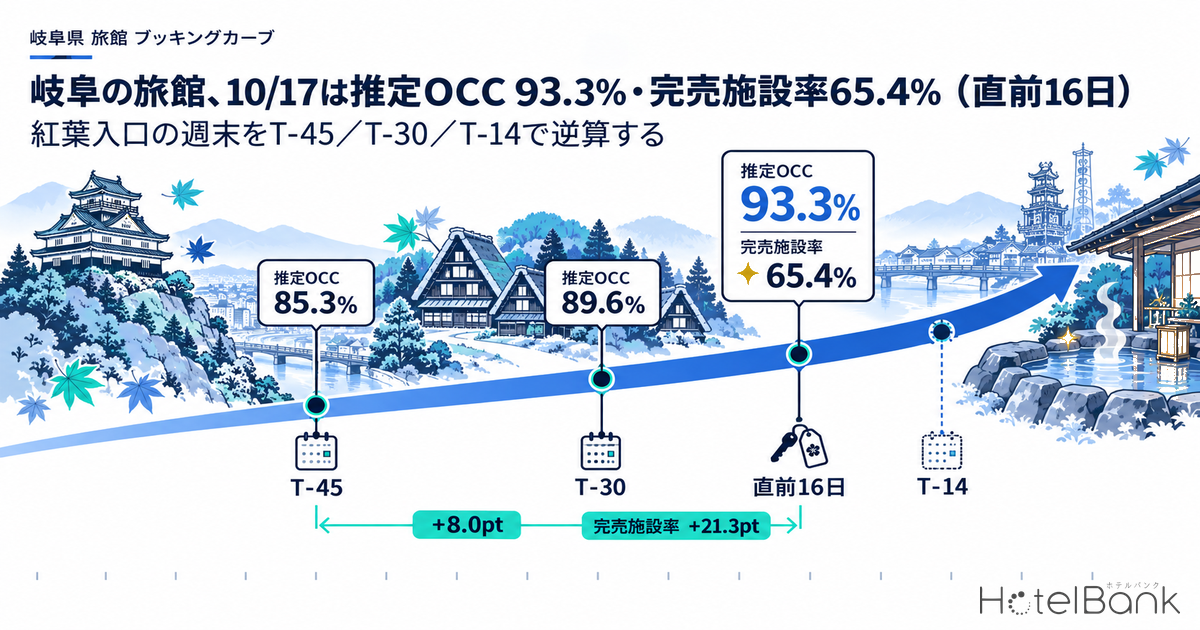
Ryokan in Gifu Prefecture have built bookings for Saturday, October 17 — the start of the autumn foliage season — to an estimated OCC of 93.3% and a sold-out property rate of 65.4% at 16 days out (observed October 1, 2026). At 45 days out the figures were 85.3% and 44.1%, so in about a month (29 days) occupancy added +8.0pt and the sold-out property rate added +21.3pt. The following day, Sunday, October 18, rose +8.4pt over the same period, from 81.4% to 89.8%, but its sold-out property rate stopped at 47.7%, leaving a 17.7pt gap to Saturday. Sunday, October 11 — the middle day of a three-day weekend — reached 92.9% with a 67.7% sold-out property rate at 10 days out, tightening ahead of the foliage weekends. This article tracks the booking curve of 127–128 ryokan in Gifu (about 3,400 rooms) from 45 days out and works backward, using pace alone (OCC and sold-out property rate), to show how to prepare the remaining foliage-season weekends in three stages: T-45, T-30 and T-14.
Scope: Gifu Prefecture ryokan, N=127–128 properties (about 3,400 rooms; a fixed cohort based on listings on major booking sites), with business hotels, N=62–63 properties (about 5,870 rooms), as a control. This article does not address price levels. Occupancy is an estimate based on OTA-listed inventory, and the sold-out property rate is the estimated share of properties with no listed inventory visible on OTAs and similar channels. Both are defined at the end of the article. Data as of: October 2, 2026 (latest observation date October 1).
- — Sat Oct 17: 93.3% estimated OCC and 65.4% sold-out property rate at 16 days out (observed October 1, 2026; ryokan N=127). Up +8.0pt and +21.3pt in about a month from 85.3% and 44.1% at 45 days out.
- — Under 4pt apart in occupancy, about 20pt apart in sold-out property rate. Occupancy for Oct 16–18 sits within 89.6–93.3%, while sold-out property rates are 44.5%, 65.4% and 47.7% — Saturday alone stands out.
- — For Saturday, the two weeks from 30 days out are the acceleration window. The sold-out property rate jumped +16.2pt from 49.2% to 65.4% — the point where stay-extension and multi-night offers do the most work.
- — Gifu’s Sundays are actually strong compared with its eight neighboring prefectures. At 17 days out its Saturday–Sunday gap is 3.6pt, the smallest of the nine. The slack lies not in the area average but in the 53 properties (of 101) with no sell-out observed for Oct 18.
- — Peak-foliage Saturdays Oct 24 and Oct 31 stand at 93.4% and 92.1% at 30 days out, starting higher than Oct 17. Their Sundays (Oct 25, Nov 1) run 4–5pt lower, so the same backward planning applies.
Oct 17 at 93.3% with 16 days to go — where three stay dates stand, viewed from 45 days out
First, let us check where the three stay dates stand today using the same yardstick. Figure 1 overlays the booking curves of estimated OCC (based on OTA-listed inventory) for the Gifu ryokan cohort, from 45 days before each stay date to the latest observation. Saturday, October 17 moved from 85.3% at 45 days out to 89.6% at 30 days out and 93.3% at the latest observation (16 days out), adding bookings at an almost constant slope. Sunday the 18th went from 81.4% at 45 days out to 87.1% at 30 days out and 89.8% at the latest observation (17 days out); its curve runs parallel to Saturday’s but stays 2–4pt lower throughout.
Sunday, October 11, by contrast, comes with a condition: it is the middle day of a three-day weekend. It rose from 84.1% at 45 days out to 88.7% at 30 days out and 92.9% at the latest observation (10 days out), reaching almost the same height as Saturday the 17th — evidence that a mid-holiday Sunday behaves not like an ordinary Sunday but like a quasi-Saturday. Saturday, October 10, shown for reference, is the second day of the Autumn Takayama Festival (Hachiman Matsuri); it already stood at 92.3% with a 64.6% sold-out property rate at 45 days out, starting from a level the other dates reach only close to arrival. For the Oct 10 stay date, the outcome was essentially settled by T-45.
Source: MetroEngines Research; compiled by the HotelBank Editorial Team
In short, the start-of-foliage weekend takes the shape of “Saturday fills first, Sunday catches up a month later.” Table 1 lists the fixed-point values. Across the three days from Friday, Oct 16 to Sunday, Oct 18, Friday stands at 89.6% with a 44.5% sold-out property rate at 15 days out, Saturday at 93.3% and 65.4%, and Sunday at 89.8% and 47.7%. Occupancy differs by under 4pt, yet the sold-out property rate differs by about 20pt. Similar occupancy with a different share of sold-out properties means that on Sunday and Friday more properties than on Saturday are “still releasing rooms” — which suggests room to steer demand there with multi-night and pre/post-night stays.
| Stay date | Est. OCC at 45 days out | Sold-out rate at 45 days out | Est. OCC at 30 days out | Sold-out rate at 30 days out | Latest observation | Latest est. OCC | Latest sold-out rate | OCC gain | Sold-out rate gain | N (properties) |
|---|---|---|---|---|---|---|---|---|---|---|
| Oct 10 (Sat) Autumn Takayama Festival | 92.3% | 64.6% | 94.2% | 74.2% | 9 days out | 96.1% | 77.3% | +3.8pt | +12.7pt | 128 |
| Oct 11 (Sun) Mid three-day weekend | 84.1% | 50.0% | 88.7% | 55.2% | 10 days out | 92.9% | 67.7% | +8.8pt | +17.7pt | 127 |
| Oct 12 (Mon) Sports Day | 74.7% | 30.7% | 79.9% | 33.6% | 11 days out | 83.5% | 37.5% | +8.8pt | +6.8pt | 128 |
| Oct 16 (Fri) | 81.9% | 37.8% | 85.7% | 40.0% | 15 days out | 89.6% | 44.5% | +7.7pt | +6.7pt | 128 |
| Oct 17 (Sat) | 85.3% | 44.1% | 89.6% | 49.2% | 16 days out | 93.3% | 65.4% | +8.0pt | +21.3pt | 127 |
| Oct 18 (Sun) | 81.4% | 34.1% | 87.1% | 37.6% | 17 days out | 89.8% | 47.7% | +8.4pt | +13.6pt | 128 |
| Oct 24 (Sat) | 88.0% | 53.6% | 93.4% | 64.8% | 23 days out | 92.8% | 65.1% | +4.8pt | +11.5pt | 126 |
| Oct 25 (Sun) | 83.9% | 36.0% | 88.3% | 42.4% | 24 days out | 88.4% | 45.2% | +4.5pt | +9.2pt | 126 |
| Oct 31 (Sat) | 88.6% | 53.5% | 92.1% | 65.2% | 30 days out | 92.1% | 65.2% | +3.5pt | +11.7pt | 132 |
| Nov 1 (Sun) | 85.3% | 44.9% | 87.9% | 45.8% | 31 days out | 87.9% | 45.8% | +2.6pt | +0.9pt | 131 |
Source: MetroEngines Research; compiled by the HotelBank Editorial Team
Note that within Gifu Prefecture, resort hotels and city hotels have only 8 and 5 properties respectively meeting the fixed-cohort criteria (properties listing at least 30% of total rooms on major booking sites, with at least 10 such properties required), so no area values are produced for them. This article therefore centers on ryokan, with business hotels (N=62–63) as a category control.
Demand that leans toward Saturday and slack on Sunday — the weekend’s shape through the sold-out property rate
Next, let us follow the sold-out property rate, a more sensitive indicator than occupancy. Figure 2 lines up the sold-out property rate at three points — 45 days out, 30 days out and the latest observation — for Friday Oct 16, Saturday Oct 17 and Sunday Oct 18. Saturday went 44.1% → 49.2% → 65.4%, jumping 16.2pt in the two weeks from 30 days out to the latest observation, while Sunday went 34.1% → 37.6% → 47.7% and Friday 37.8% → 40.0% → 44.5% — growth, but without Saturday’s acceleration. Saturday’s “two weeks from 30 days out” is the window in which sold-out properties surge, and that is where stay-extension and multi-night offers work best.
Source: MetroEngines Research; compiled by the HotelBank Editorial Team
Behind this is a demand structure in which Gifu ryokan lean heavily toward Saturdays even in normal times. Daily results for September 2026, the most recent completed month (same cohort, each observed the day before the stay date), show a monthly average estimated OCC of 89.7%, with the four Saturdays averaging 95.7% and the four Thursdays 85.4% — a 10pt gap. During Silver Week (the five-day holiday from September 19 to 23), the four nights from Saturday the 19th to Tuesday the 22nd reached 99.4–100%; when a holiday is involved, Sundays and Mondays fill like Saturdays. Sunday Oct 11 building up to Saturday levels repeats this holiday pattern, while Sunday Oct 18 falling 3.5pt short of Saturday is the natural state of a “non-holiday Sunday.” Earlier in September, the same Gifu ryokan market split night by night into peaks and troughs across the five-day holiday.
The category difference is also worth checking. For business hotels (N=62–63, about 5,870 rooms), Saturday Oct 17 went 75.4% at 45 days out → 82.2% at 30 days out → 87.8% at the latest observation (16 days out), with the sold-out property rate at 17.5% → 24.2% → 36.5% — rising at the same slope as ryokan from roughly 10pt lower. Sunday Oct 18, by contrast, went 67.9% → 69.3% → 73.7%, and its sold-out property rate barely moved at 11.1% → 12.9% → 11.1%; Sunday’s gain of +5.8pt is smaller than the ryokan’s +8.4pt. Ryokan follow a “both weekend days fill, Saturday first” pattern, whereas business hotels follow a “Saturday fills, Sunday stays loose” pattern — even within the same prefecture, the shape of the weekend differs by category.
Sell-through types at the property level — 47 properties with zero inventory left for Oct 17
Area values show only the average picture, so let us also look at what mix of sell-through types exists at the property level. Table 2 and Figure 3 show, for Gifu ryokan whose sellable allocation is at least 30% of total rooms (N=102 for Oct 17), the distribution of the lead time at which a sell-out was first observed. For Saturday Oct 17, 37 properties had been sold out since 45 or more days out, 11 sold out at 31–45 days out and 15 at 15–30 days out — 63 properties in all already have an observed sell-out. The median remaining allocation is 5.5%, and 47 properties — nearly half — have zero allocation left.
Source: MetroEngines Research; compiled by the HotelBank Editorial Team
Applying the same lens to Sunday Oct 18, the number of properties sold out since 45 or more days out drops to 25, and 53 properties — more than half — have no observed sell-out. The median remaining allocation is 14.3%, meaning about 2.6 times as much allocation as Saturday (5.5%) remains on the market. Sunday Oct 11, the middle day of the three-day weekend, had 36 properties sold out since 45 or more days out and a median remaining allocation of 8.9%, placing it between Saturday Oct 17 and Sunday Oct 18. Keep in mind too that many of these ryokan are small, with a median of around 10 rooms, so a single property can sell out with just a few bookings — a structure in which the area’s sold-out property rate readily jumps in the final two weeks.
| Stay date | N (properties) | Sold out since 45+ days out | Sold out at 31–45 days out | Sold out at 15–30 days out | Sold out within last 14 days | No sell-out observed | Median remaining allocation | Zero allocation left |
|---|---|---|---|---|---|---|---|---|
| Oct 11 (Sun) | 98 | 36 | 8 | 16 | 4 | 34 | 8.9% | 40 |
| Oct 17 (Sat) | 102 | 37 | 11 | 15 | 0 | 39 | 5.5% | 47 |
| Oct 18 (Sun) | 101 | 25 | 11 | 12 | 0 | 53 | 14.3% | 26 |
Source: MetroEngines Research; compiled by the HotelBank Editorial Team
What this shows is a contrast: on Saturday, polarization is advancing between “properties that fill early” and “properties that keep rooms open until the end,” while on Sunday half of the properties are still releasing rooms. Which type your property belongs to changes what you should do from T-14 onward.
Comparing with eight neighboring prefectures at the same lead time — how much “Sunday slack” do Gifu ryokan really have?
To check whether the pattern so far — “Saturday fills first, slack remains on Sunday” — is specific to Gifu or common to foliage-season weekends, we lined up the ryokan cohorts of eight neighboring prefectures (Nagano, Toyama, Ishikawa, Fukui, Aichi, Mie, Shiga and Shizuoka) for the same stay dates at the same lead times (Table 3). Because the latest observation differs by stay date (16 and 17 days out), both dates are aligned here at 17 days out.
| Prefecture | N (properties) | Oct 17 at 45 days out | Oct 17 at 30 days out | Oct 17 at 17 days out | Oct 17 sold-out rate (17 days out) | Oct 18 at 45 days out | Oct 18 at 30 days out | Oct 18 at 17 days out | Oct 18 sold-out rate (17 days out) | Sat–Sun gap (17 days out) |
|---|---|---|---|---|---|---|---|---|---|---|
| Gifu | 127 | 85.3% | 89.6% | 93.4% | 62.7% | 81.4% | 87.1% | 89.8% | 47.7% | 3.6pt |
| Shiga | 31 | 76.4% | 87.1% | 90.6% | 45.2% | 79.2% | 85.0% | 86.2% | 32.3% | 4.4pt |
| Toyama | 42 | 78.8% | 84.0% | 88.3% | 23.8% | 77.9% | 80.9% | 83.9% | 31.0% | 4.4pt |
| Nagano | 276 | 78.1% | 82.6% | 86.1% | 46.9% | 67.5% | 72.2% | 77.4% | 32.9% | 8.7pt |
| Mie | 119 | 71.1% | 77.9% | 83.5% | 24.4% | 64.2% | 69.9% | 74.8% | 20.2% | 8.7pt |
| Shizuoka | 305 | 66.9% | 73.7% | 79.4% | 21.3% | 62.4% | 69.2% | 74.4% | 17.7% | 5.0pt |
| Ishikawa | 88 | 71.6% | 77.0% | 78.9% | 27.3% | 63.5% | 66.9% | 69.7% | 12.5% | 9.2pt |
| Fukui | 79 | 66.8% | 70.6% | 74.7% | 35.4% | 59.3% | 58.2% | 67.0% | 20.0% | 7.7pt |
| Aichi | 87 | 64.3% | 68.5% | 72.3% | 17.2% | 57.6% | 61.6% | 67.0% | 17.2% | 5.3pt |
Source: MetroEngines Research; compiled by the HotelBank Editorial Team
Gifu ryokan rank highest of the nine prefectures for both Oct 17 and Oct 18 at every point — 45 days, 30 days and 17 days out. At 17 days out, Oct 17 stands at 93.4%, 2.8pt above second-placed Shiga (90.6%, N=31) and 7.3pt above Nagano (86.1%). On the sold-out property rate, too, Gifu’s 62.7% for Oct 17 leads Nagano (46.9%) and Shiga (45.2%) by more than 15pt.
The figure to watch is the Saturday–Sunday gap. At 17 days out, the difference between Oct 17 and Oct 18 is 3.6pt in Gifu, the smallest of the nine, while the other prefectures range from 4.4 to 9.2pt — Nagano 8.7pt, Mie 8.7pt, Ishikawa 9.2pt and so on. In other words, Gifu’s Sundays are actually filling strongly relative to its neighbors. The “Sunday slack” discussed in this article is relative to Saturday within the prefecture; measured by area-wide OCC, the headroom is smaller than in neighboring prefectures. The slack lies not in the area average but at the property level: as Table 2 shows, 53 of the 101 properties with at least 30% sellable allocation still have no observed sell-out for Oct 18. It is closer to reality to treat Sunday strategy not as “raising the area” but as a question of how properties that still hold rooms can fill them. Note that the Shiga (31 properties) and Toyama (42 properties) cohorts are small, so a single property’s movement can swing their values by several points.
For revenue managers running ryokan in Gifu — implications and action plan
Operational insights
1. Check your own booking pace against the market curve at three points: 45 days out, 30 days out and close-in.Gifu ryokan moved 85.3% → 89.6% → 93.3% for Saturday Oct 17 (45 days out → 30 days out → close-in) and 81.4% → 87.1% → 89.8% for Sunday Oct 18, a steady gain of about 8pt from 45 days out to close-in. By seeing at which of these three points your property’s pace for the same date diverges from the market, you can tell whether a shortfall comes from a low starting point or from weak close-in growth.
2. The sold-out property rate reveals the “quality of fill” on weekends earlier than occupancy does.Even with Friday–Sunday occupancy differing by under 4pt, sold-out property rates of 44.5%, 65.4% and 47.7% are about 20pt apart. If your Saturday is on the market’s sold-out side (63 properties for Oct 17), the remaining job is to steer demand to Sunday and Friday; if you are on the side still holding rooms (39 properties), the focus is how to capture demand in the window where the sold-out property rate jumped 16.2pt in the final two weeks.
3. Holidays turn Sundays into Saturdays.Oct 11 (the Sunday in the middle of a three-day weekend) matched Saturday Oct 17 at 92.9% with 10 days to go, and during September’s Silver Week the four nights from the 19th to the 22nd of the five-day holiday ran 99.4–100%. When preparing for November, treat Sundays and Mondays according to “where they fall within the holiday” rather than by calendar day of week. Conversely, the last day of a holiday (Oct 12 at 83.5% latest) tends to slacken, leaving room to fill it with multi-night conditions.
4. Peak-foliage weekends have already started moving in the same shape as mid-October.At 30 days out, Saturday Oct 24 stands at 93.4% with a 64.8% sold-out property rate and Saturday Oct 31 at 92.1% and 65.2%, both starting above Oct 17 at 30 days out (89.6% and 49.2%). On the Sunday side, Oct 25 (88.3%) and Nov 1 (87.9%) each trail their Saturdays by 4–5pt, so the same “Sunday slack” as mid-October remains. The evidence for starting Sunday multi-night offers at the T-30 stage is already in hand.
Action plan (with timeline)In line with the article’s timeline, we split the plan into three stages: T-45 to T-30, T-30 to T-14, and T-14 to close-in. Every decision trigger is tied to a figure presented in this article.
| Timeline | Action | Decision trigger (figure from the article) | Aim |
|---|---|---|---|
| T-45 to T-30 (for weekends next month onward) | Check the “quality” of remaining inventory — take stock of the room types, occupancy capacities and plans still open, and confirm unsold rooms are not concentrated in particular types | Your pace for the relevant weekend is below the market’s 45-days-out level (85.3% for Oct 17, 81.4% for Oct 18) | Assuming the market’s build-up (about 8pt from 45 days out to close-in) also reaches your property, choose deliberately which rooms to hold back |
| T-45 to T-30 | Build multi-night and pre/post-night stays that shift Saturday-heavy demand to Sunday and Friday | Against Saturday’s sold-out property rate (65.4% latest for Oct 17), Sunday (47.7% for Oct 18) and Friday (44.5% for Oct 16) have slack | Capture Saturday-only demand that would otherwise be lost on Friday and Sunday, smoothing occupancy across the whole weekend |
| T-30 to T-14 (within two weeks) | Target stay-extension and multi-night offers — properties whose Saturday inventory is gone should lead with Sunday as the overflow option; properties with Saturday rooms left should lead with two-night packages | Whether your property is riding the window in which Oct 17’s sold-out property rate rose from 49.2% at 30 days out to 65.4% latest | Capture demand in the window where the sold-out property rate grew most from 30 days out to close-in (+16.2pt for Oct 17) |
| T-30 to T-14 | Reinterpret the Oct 11 pattern (mid three-day weekend) — demand concentrates on the first and middle days of a holiday while the last day (Oct 12 at 83.5% latest) slackens; apply this to your November holidays | Your pace for the last day of a holiday is 10pt or more below the first and middle days | Fill last-day rooms with multi-night conditions or night-before offers |
| T-14 to close-in (today to this week) | How to release close-in rooms — with 47 properties (nearly half) already at zero allocation for Oct 17, release remaining rooms, including cancellation returns, in small increments, and decide when to close based on the sold-out property rate two weeks before the stay date | Your remaining allocation is above the market median (5.5% for Oct 17) | Capture close-in demand without closing out too early |
| T-14 to close-in | Review early November (Oct 31, Nov 1) this week — at 30 days out they have already reached 92.1% for Saturday and 87.9% for Sunday, so peak-foliage weekends are moving in the same shape as mid-October | Your pace for Nov 1 (Sun) is below the market’s 30-days-out level of 87.9% | Put the Sunday slack heading into peak foliage toward multi-night offers at the T-30 stage |
None of these measures guarantees results; they should be selected in light of your property’s market, guest mix and room composition. We left price levels out because we judge that, for the start-of-foliage weekends, the difference now comes from managing pace alone — which rooms to release, when, and on what conditions.
Summary — three yardsticks for reading foliage-season weekends
The first is the three points of 45 days out, 30 days out and close-in. Gifu ryokan have built about 8pt over 45 days for the start-of-foliage weekend, and simply seeing at which of these three points your pace diverges from the market sets the timeline for your actions. The second is the gap between occupancy and the sold-out property rate. For Oct 16–18, occupancy differs by under 4pt while the sold-out property rate differs by about 20pt, and the sold-out property rate tells you first on which days properties “still releasing rooms” remain. The third is holiday position and category shape. A Sunday in the middle of a holiday turns into a Saturday (92.9% for Oct 11), and business hotels’ Sundays are looser than ryokan’s (73.7% vs 89.8% for Oct 18). With these three at hand, you can prepare the peak-foliage weekends of Oct 24, Oct 31 and Nov 1 using the same backward planning — keeping in mind that any gap between peak foliage timing and the holiday calendar can also shift booking pace.
Frequently Asked Questions
Q. How far along are bookings for Gifu ryokan for Saturday, October 17?
A. As observed on October 1, 2026 (16 days before the stay date), the estimated OCC (based on OTA-listed inventory) of the 127-property Gifu ryokan cohort is 93.3%, and the sold-out property rate is 65.4%. From 85.3% and 44.1% at 45 days out, occupancy added +8.0pt and the sold-out property rate +21.3pt in about a month.
Q. How different is the following day, Sunday, October 18, from Saturday?
A. At 17 days out, estimated OCC is 89.8%, 3.5pt short of Saturday, and the sold-out property rate is 47.7%, 17.7pt below Saturday. Of the 101 properties whose sellable allocation is at least 30% of total rooms, 53 have not yet had a sell-out observed.
Q. How should estimated OCC and the sold-out property rate be used differently?
A. Estimated OCC shows how much listed inventory has been absorbed across the area, while the sold-out property rate shows the share of properties “no longer releasing rooms.” For Oct 16–18, occupancy differs by under 4pt but the sold-out property rate differs by about 20pt; the sold-out property rate shows earlier on which days properties that keep releasing rooms remain.
Q. How does the pace of Gifu ryokan compare with neighboring prefectures?
A. Compared at the same 17 days out with eight neighboring prefectures (Nagano, Toyama, Ishikawa, Fukui, Aichi, Mie, Shiga and Shizuoka), Gifu ranked highest at every point for both Oct 17 and Oct 18, and its Saturday–Sunday gap of 3.6pt was the smallest. Sunday slack is concentrated less in the area average than in individual properties that still hold rooms.
Q. What should I watch for the peak-foliage weekends of Oct 24 and Oct 31?
A. At 30 days out, Saturday Oct 24 is at 93.4% and Saturday Oct 31 at 92.1%, both starting above Oct 17 at 30 days out (89.6%). On the Sunday side, Oct 25 and Nov 1 each trail their Saturdays by 4–5pt — the same “Saturday first, Sunday later” shape as mid-October. This supports starting Sunday multi-night offers at the T-30 stage.
About the Data
| Definition of estimated OCC (based on OTA-listed inventory) | Occupancy based on OTA-listed inventory = 100 − 100 × OTA-listed rooms remaining ÷ total rooms. Coverage is a fixed cohort of properties listing at least 30% of total rooms on OTAs (the same set of properties for each stay date; the N column in Table 1 gives the count). It is an estimate based on the absorption of inventory sold on OTAs and is defined differently from actual room occupancy (it runs high because unlisted rooms are counted as absorbed). |
| Booking curve | Based on observations from 45 days before the stay date to the latest. The fixed points are 45 days out, 30 days out and close-in (latest observation). Latest observation date: October 1, 2026. |
| Sold-out property rate | The estimated share of properties with no listed inventory visible on OTAs and similar channels. The property-level distribution (Table 2, Figure 3) covers properties whose sellable allocation is at least 30% of total rooms, and shows anonymized aggregates only. |
| Breakdown of N | Gifu ryokan cohort N=127–128 properties, about 3,400 rooms (122–132 properties and 3,350–3,468 rooms depending on stay date). Business hotels N=62–63 properties, 5,819–5,871 rooms. Daily results for September 2026 use the same cohort, N=102–149 properties (146–148 on most days). Property-level distribution: Oct 11 N=98, Oct 17 N=102, Oct 18 N=101 (all properties whose sellable allocation is at least 30% of total rooms). |
| Price metrics | This article does not address price levels. Occupancy and the sold-out property rate are both estimates, not actual results. |
| Data as of | Data as of: October 2, 2026. Sales status and inventory change daily, so the figures in this article are a snapshot at the time of retrieval. |
References and Sources
■ Data sources
Data from MetroEngines Research’s daily observation of listed inventory on major booking sites: the fixed Gifu ryokan cohort (126–132 properties depending on stay date, about 3,400 rooms), business hotels as a control (62–63 properties), ryokan cohorts in eight neighboring prefectures (31–305 properties), and the property-level distribution of sell-out timing (98–102 properties whose sellable allocation is at least 30% of total rooms). Events, public holidays and foliage timing are based on information published by the Gifu Prefecture Tourism Federation, the Cabinet Office and tenki.jp.
■ Calculation assumptions
Estimated OCC = 100 − 100 × OTA-listed rooms remaining ÷ total rooms (fixed cohort). The sold-out property rate is the share of properties with no listed inventory visible. Fixed points are 45 days out, 30 days out and the latest observation (October 1, 2026) before each stay date. Comparisons with neighboring prefectures are aligned at 17 days out for all prefectures. The property-level distribution is grouped by the lead time at which a sell-out was first observed.
■ Limitations and caveats
Because rooms not listed on OTAs are counted as absorbed, the estimates run higher than actual room occupancy. Close-in increases may include sales stops (withdrawn listings). Inventory changes daily, and the figures in this article are a snapshot as observed on October 1–2, 2026. Small cohorts (Shiga, 31 properties; Toyama, 42 properties) can swing with a single property’s movement. Price levels are not addressed.
| Autumn Takayama Festival (Hachiman Matsuri) 2026 overview (October 9 and 10) | Gifu Prefecture Tourism Federation (Gifu travel guide) |
| About National Holidays (Sports Day = second Monday of October) | Cabinet Office |
| Typical peak foliage at autumn-leaf spots in Gifu Prefecture (Shirakawa-go mid-October to mid-November, Shin-Hotaka Onsen mid-October to early November, etc.) | tenki.jp autumn foliage information (Gifu Prefecture) |
| Internal data (estimated OCC, sold-out property rate, property-level distribution) | Source: MetroEngines Research; compiled by the HotelBank Editorial Team |