

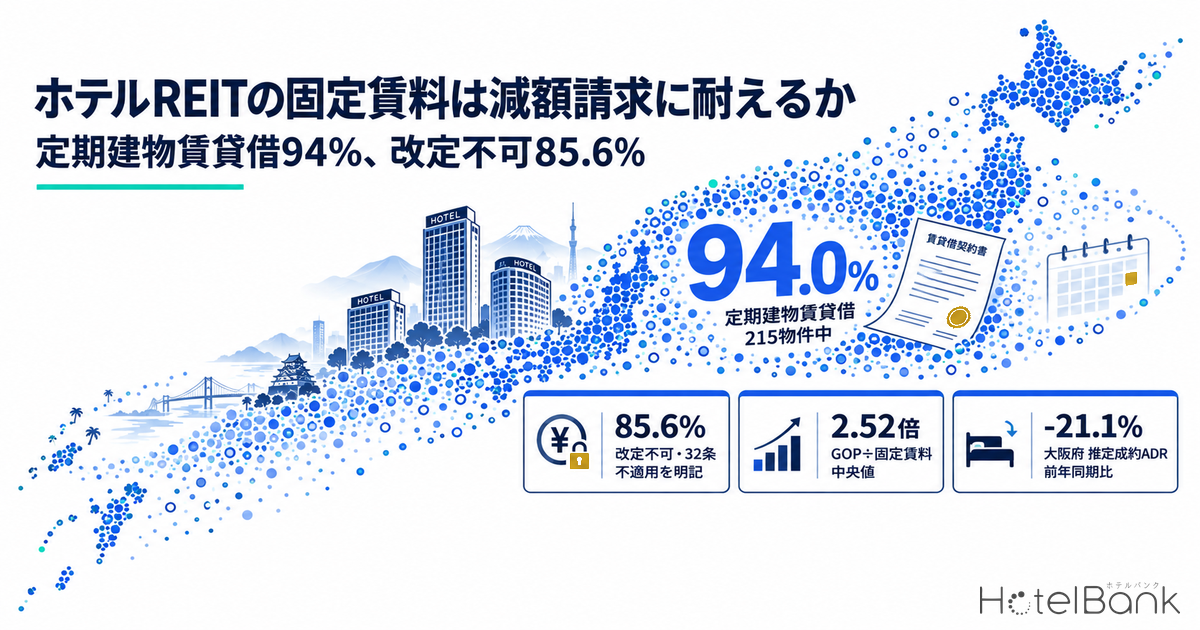
The distribution stability of hotel REITs is usually explained by “a high share of fixed rent.” Yet the right to request rent increases or decreases under Article 32(1) of Japan’s Act on Land and Building Leases (借地借家法) is asymmetric: a special agreement can rule out increases, but as a rule it cannot rule out decreases. In this article we read the lease agreements disclosed by seven hotel-focused J-REITs property by property and quantify how far their fixed rents are legally protected. The bottom line: of the 215 properties whose lease type could be confirmed from disclosures, 202 (94.0%) are on fixed-term building leases, and of the 181 properties whose rent-revision clauses are disclosed, 155 (85.6%) explicitly state that rent “cannot be revised during the lease term” or that “Article 32 of the Act on Land and Building Leases does not apply.”
Metric Definitions Used in This Article
- ADR (Average Daily Rate): An estimated settled rate (tax-exclusive equivalent), calculated by applying segment-specific adjustment factors to the lowest-priced plan level each property publishes on OTAs (per room, based on two guests per room, tax-inclusive). Checked against property-level results disclosed by listed hotel REITs (91 properties, most recent three months), the median error is about 7%. These are estimates and differ from each property’s actual transaction prices and accounting figures. Area-level ADR is the median of the properties covered (the level of a typical property in the area). This article uses only finalized months (through August 2026).
- GOP (Gross Operating Profit): Hotel revenue minus operating expenses. Follows each REIT’s disclosed definition (GOP, AGOP, etc.).
- Rent coverage: Hotel GOP ÷ fixed rent for the same period. Below 1.0x means GOP for that period cannot cover the fixed rent (an analytical metric specific to this article).
- Fixed-term building lease (teiki shakuya): A building lease under Article 38 of the Act on Land and Building Leases that is not renewed and ends on expiry. A regular building lease (futsu shakuya) is any other building lease.
- Data sources: Each REIT’s annual securities reports, earnings presentations and portfolio lists; MetroEngines Research
- — 94.0%: Of 215 properties across five REITs whose lease type could be confirmed from disclosures, 202 are on fixed-term building leases. Most fixed rent sits inside a “vessel” that can exclude Article 32.
- — 85.6%: 155 of the 181 properties with disclosed revision clauses explicitly state “no revision during the term” or “Article 32 does not apply.” 18 properties have negotiation-type clauses, whose legal fixedness may be one notch lower.
- — 68 contracts (42.8%): Of 159 contracts with disclosed terms, these expire in 2026–2029. For no-revision leases, re-contracting at expiry is where rent gets reset to market levels.
- — -21.1%: Osaka’s estimated settled ADR fell 21.1% YoY in January–August 2026 (after +28.8% in the same period a year earlier). Gaps between market reality and fixed rent of around 20% a year can arise.
- — 9 properties: Across Invincible’s 92 properties, median GOP ÷ fixed rent was 2.52x (July–December 2025). A 30% drop in GOP pushes 9 properties below 1.0x; a 50% drop pushes 26 below.
Articles 32 and 38(9) — How Fixed Rent Is Protected Depends on the Lease “Type”
Article 32(1) of the Act on Land and Building Leases provides that when building rent “has become unreasonable” because of increases or decreases in tax burdens, rises or falls in land and building prices or other changes in economic conditions, or in comparison with rents for similar nearby buildings, either party may request a prospective increase or decrease in rent regardless of the terms of the contract. The proviso to that paragraph states that if there is “a special agreement not to increase building rent for a certain period,” that agreement prevails — so only the upward direction can be excluded by agreement. No comparable exception exists for agreements not to reduce rent.
Japan’s Supreme Court has treated this provision as mandatory law. A Third Petty Bench ruling of October 21, 2003 (Minshu Vol. 57, No. 9, p. 1213) held that the article applies even to sublease contracts in which an entire commercial building is master-leased for subletting, and that an automatic rent-escalation clause does not prevent a request for rent reduction. The same ruling added, however, that when judging whether a reduction request is justified and what the appropriate rent is, the circumstances under which the initial rent and the escalation clause were agreed must be given full weight as important factors. On automatic rent-revision clauses, a First Petty Bench ruling of June 12, 2003 (Minshu Vol. 57, No. 6, p. 595) held that an automatic ground-rent revision clause cannot exclude the right to request increases or decreases under Article 11(1) of the Act. A hotel lease in which an operator sits on top of a master lease is, in legal form, a building lease. “Fixed rent,” therefore, may be fixed by contract yet still become subject to legal review if economic conditions change significantly.
The mechanism that switches off this asymmetry is Article 38(9), which states that “the provisions of Article 32 do not apply to a building lease under paragraph (1) if there is a special agreement concerning the revision of rent.” In other words, only where the lease is a fixed-term building lease and it contains a special agreement on rent revision are Article 32 requests excluded in both directions. Note that the exclusion covers increases as well as decreases. Nippon Hotel & Residential Investment Corporation (日本ホテル&レジデンシャル投資法人, 3472) states in its annual securities report that including such an exclusion clause also removes its ability to request an increase under Article 32, so it may receive below-market rent if unforeseen circumstances arise after signing. The exclusion also presupposes that the fixed-term lease has been validly formed (a written contract, prior delivery of a written explanation and the other requirements set out in Article 38).
Regular building lease
Article 32 applies in full.Reduction request: cannot be excluded by agreement
Increase request: only a “no increase” agreement is valid
Typical clause: “revised upon mutual consultation”
Fixed-term building lease (negotiation-type revision clause)
Whether the clause counts as a “special agreement concerning the revision of rent” under Article 38(9) depends on its wording, and interpretations may differ.Typical clause: “may be revised upon consultation every X years”
Fixed-term building lease + revision clause
Article 32 does not apply by virtue of Article 38(9).Reduction and increase requests: both excluded
Typical clauses: “no revision during the lease term,” “Article 32 of the Act on Land and Building Leases does not apply to this agreement”
Source: Prepared by MetroEngines Research & Consulting from e-Gov Law Search, “Act on Land and Building Leases” (Act No. 90 of 1991, checked September 25, 2026) and Supreme Court precedents (Minshu Vol. 57, No. 9, p. 1213; Minshu Vol. 57, No. 6, p. 595). This is not a legal opinion.
* On paragraph numbering in Article 38: under the Act on the Arrangement of Related Acts for the Formation of a Digital Society (Act No. 37 of 2021), from May 18, 2022 fixed-term building leases may be concluded by electronic record (current paragraph 2) and the advance explanatory document may be provided electronically (current paragraph 4). The paragraphs were renumbered as a result, so pre-amendment materials may refer to the same provision as “Article 38(7)” (Ministry of Justice, “Amendments to the Act on Land and Building Leases, etc. (Fixed-Term Land Leaseholds and Fixed-Term Building Leases)”).
| Lease type | Reduction request (tenant) | Increase request (landlord) | How fixed rent looks |
|---|---|---|---|
| Regular building lease | Possible (cannot be excluded by agreement) | Possible (not if a no-increase agreement exists) | Fixed by contract, but open to legal review |
| Fixed-term lease, negotiation-type revision clause | Depends on clause wording and interpretation | Same as left | May be revised within the negotiation framework |
| Fixed-term lease, no revision / Art. 32 excluded | Excluded (Art. 38(9)) | Excluded (Art. 38(9)) | Fixed during the term; re-contracting at expiry is where revision happens |
Source: Prepared by MetroEngines Research & Consulting from Articles 32 and 38 of the Act on Land and Building Leases
Lease Structures at Seven REITs — 94.0% of 215 Disclosed Properties Are on Fixed-Term Leases
Next we apply these “types” to actual portfolios. The scope is the domestic hotels held by seven REITs — Ichigo Hotel REIT (いちごホテルリート投資法人, 3463), Invincible Investment Corporation (インヴィンシブル投資法人, 8963), Nippon Hotel & Residential Investment Corporation (日本ホテル&レジデンシャル投資法人, 3472), Japan Hotel REIT (ジャパン・ホテル・リート投資法人, 8985), Hoshino Resorts REIT (星野リゾート・リート投資法人, 3287), Mori Trust REIT (森トラストリート投資法人, 8961) and Kasumigaseki Hotel REIT (霞ヶ関ホテルリート投資法人, 401A) — totaling 301 properties and 52,265 rooms (as of each REIT’s disclosure reference date). From each REIT’s annual securities report, earnings presentation and portfolio list, we tallied lease type (fixed-term / regular) and rent structure (fixed, fixed + variable, variable) property by property. The table below is a structural comparison, not a ranking; no meaning is attached to the order of the REITs.
| REIT | Basis (document, date) | Properties | Rooms | Fixed-term | Regular | Mgmt. contract | Undisclosed / not tallied | Rent structure breakdown |
|---|---|---|---|---|---|---|---|---|
| Japan Hotel REIT | Earnings presentation (as of end-June 2026), portfolio list | 52 | 15,058 | 42 | 6 | 4 | 0 | Fixed + variable 32 / fixed + revenue share 4 / fixed 7 / variable 5 / management contract 4 |
| Invincible | Annual securities report (as of end-December 2025) | 111 | 19,260 | 111 | 0 | 0 | 0 | Fixed + variable 103 / fixed 8 |
| Hoshino Resorts REIT | Earnings presentation (as of November 4, 2025) | 71 | 8,667 | Property-level lease type not tallied in this article | Fixed 8 / fixed + variable (revenue-linked) 5 / fixed + variable (profit-linked) 57 / variable 1 | |||
| Mori Trust REIT | Annual securities report (as of end-February 2026) | 6 | 1,937 | 6 | 0 | 0 | 0 | Variable + minimum guarantee 3 / variable 1 / fixed 2 |
| Ichigo Hotel REIT | Annual securities report, asset management report (as of end-January 2026) | 30 | 4,626 | 28 | 1 | 0 | 1 | Fixed + variable 23 / fixed 6 / variable 1 |
| Kasumigaseki Hotel REIT | Portfolio list, “Features of the REIT” | 15 | 726 | Property-level lease type not tallied in this article | GOP-linked variable rent 11 / fixed rent at acquisition 4 | |||
| Nippon Hotel & Residential | Annual securities report (as of end-May 2026) | 16 | 1,991 | 15 | 0 | 0 | 1 | Fixed + variable (all disclosed hotels) |
| Total | — | 301 | 52,265 | 202 | 7 | 4 | 2 | Lease types checked for 5 REITs / 215 properties |
Source: Prepared by MetroEngines Research & Consulting from each REIT’s annual securities reports, earnings presentations and portfolio lists (room counts for Invincible and Hoshino Resorts REIT from the ownership master as of September 21, 2026). N=301 properties.
Source: Prepared by MetroEngines Research & Consulting from each REIT’s disclosures (N=215 properties)
Of the 215 properties at five REITs whose lease type could be confirmed property by property, 202 (94.0%) are on fixed-term building leases, 7 on regular building leases, 4 under management contracts and 2 undisclosed. All 111 of Invincible’s domestic hotels and all 6 of Mori Trust REIT’s hotels are on fixed-term leases. At Nippon Hotel & Residential, 100% of annual rent from the 15 properties with disclosed terms comes from fixed-term leases, each with more than 10 years remaining. At least as a contractual “vessel,” most hotel REIT fixed rent sits on fixed-term building leases that can exclude Article 32.
The seven properties on regular leases range from limited-service to full-service hotels, with rent structures that vary across fixed, fixed + revenue share and variable, and disclosed revision clauses such as “revisable upon mutual consultation” or “no provision.” Article 32 applies to these as-is — but that also leaves room for the landlord to request increases. It is more realistic to read them as contracts open in both directions, downside and upside. For Hoshino Resorts REIT and Kasumigaseki Hotel REIT, this article tallied only the rent-structure breakdown. Both rely mainly on profit-linked variable rent; properties with predominantly fixed rent number just 8 at the former (3.1% by acquisition price) and the 4 properties in their initial post-acquisition period at the latter.
Reading the Revision Clauses — 155 of 181 Properties State “No Revision” or “Article 32 Does Not Apply”
Exclusion under Article 38(9) requires more than a fixed-term lease; it also needs “a special agreement concerning the revision of rent.” We therefore classified the wording of revision clauses for the 181 properties whose clauses are disclosed property by property: Japan Hotel REIT (42 fixed-term properties), Invincible (111) and Ichigo Hotel REIT (28).
Source: Prepared by MetroEngines Research & Consulting from each REIT’s annual securities reports and earnings presentations (N=181 properties, fixed-term leases only)
Clauses that explicitly rule out revision — “no revision during the lease term,” “rent revision not permitted in principle,” “Article 32 of the Act on Land and Building Leases shall not apply to this agreement” — covered 155 properties (85.6%). In Ichigo Hotel REIT’s annual securities report, the lease summaries for 14 properties state that “Article 32 of the Act on Land and Building Leases shall not apply to this agreement,” or that the right to request rent changes under that article is waived. This is a textbook example of writing the intent of Article 38(9) directly into the contract, and the easiest kind of disclosure for readers to assess.
The remainder comprises 18 properties with negotiation-type or conditional clauses such as “may be revised upon mutual consultation every X years” or “the parties will consult if rent becomes unreasonable due to renovation, etc.”; 2 properties on fully GOP-linked variable rent with no fixed component; and 6 undisclosed or other. Whether a negotiation-type clause qualifies as a “special agreement concerning the revision of rent” under Article 38(9) and thus excludes Article 32 may depend on how specific the clause is. We do not offer a definitive legal view here; we present it only as a reading guide: “properties with negotiation clauses may be one notch less legally fixed.” The two fully variable properties have no fixed rent, so the Article 32 issue is unlikely to arise.
Remaining Lease Terms and Revision Timing — 68 of 159 Contracts Expire by 2029
A fixed-term lease with no revision locks rent during the term, but renegotiation is inevitable at expiry. The expiry year thus becomes “the year rent is reset to market levels.” Below is the distribution of expiry years for the 159 contracts whose terms are disclosed property by property: Invincible (111) and Japan Hotel REIT (48, excluding management contracts).
Source: Prepared by MetroEngines Research & Consulting from Invincible Investment Corporation’s annual securities report (lease terms as of end-December 2025) and Japan Hotel REIT’s earnings presentation (as of end-June 2026) (N=159 contracts)
68 contracts (42.8%) expire in 2026–2029, of which Invincible accounts for 49. Invincible discloses that since May 2024 it has signed new contracts for 32 properties as fixed-term lease-cum-management-services agreements with operators expired. The new contracts kept the combination of fixed and variable rent and left the fixed-rent amounts unchanged, but lengthened the variable-rent calculation period from three months to six so that operators’ rent burden does not become excessive in a downturn. Expiries cluster again in 2034–2035 (53 at Invincible, 9 at Japan Hotel REIT).
In its interim earnings presentation for fiscal 2026, Japan Hotel REIT discloses several cases in which it revised rent terms on the expiry of fixed-term leases — by introducing variable rent, raising variable-rent rates or changing tenants. A no-revision fixed-term lease legally locks in the downside during the term, while expiry becomes an opportunity to capture upside. For investors, the expiry-year distribution is both a timetable of downside exposure and a schedule of opportunities to reset rent.
The Market Reality Behind Rent — Estimated Settled ADR Moved 20–30% in Two Years
Even while fixed rent stays put contractually, the hotel earnings behind it keep moving. Looking at Osaka with MetroEngines Research’s estimated settled ADR, monthly ADR in 2025 rose sharply year on year, centered on the Expo 2025 Osaka, Kansai period, reaching about ¥13,500 in August 2025. By contrast, August 2026 came in at about ¥9,100 (-32.7% YoY), and the January–August 2026 average was down 21.1% from the prior-year period. Since January–August 2025 had been up 28.8% YoY, ADR moved 20–30% in both directions within two years.
Source: Prepared by MetroEngines Research and the HotelBank Editorial Team (estimated settled ADR, median of covered properties in Osaka; 2026 coverage N=640–653 properties)
Source: Prepared by MetroEngines Research and the HotelBank Editorial Team (estimated settled ADR; simple average of monthly medians of covered properties in each prefecture. January–August 2026 coverage: Tokyo 1,111+ properties, Osaka 640+, Kyoto 580+, Hokkaido 885+, Fukuoka 463+, Okinawa 485+)
By prefecture, January–August 2026 YoY changes were Okinawa +13.8%, Fukuoka +8.6%, Hokkaido +5.2%, Tokyo +1.7%, Kyoto -1.3% and Osaka -21.1% — varying in both direction and magnitude. How far courts would recognize rent as having become unreasonable due to “changes in economic conditions” or “comparison with rents for similar nearby buildings” under Article 32(1) depends on the specific facts, but the data confirm that gaps of around 20% a year can open up between market reality and fixed rent. For properties on regular leases or with negotiation-type revision clauses, such a gap could be put on the table in rent-revision talks. Under a no-revision fixed-term lease, the same gap would instead be reflected in the terms of re-contracting at expiry.
Sensitivity Analysis — A 30% Drop in GOP Pushes 9 of 92 Properties Below 1.0x Coverage
How resilient, then, is fixed rent economically? Invincible Investment Corporation discloses fixed rent and hotel GOP for each property in its annual securities report. For the 92 domestic properties with both figures disclosed, we calculated the GOP ÷ fixed rent coverage ratio from July–December 2025 results. Individual properties are anonymized; only the distribution is shown.
Source: Prepared by MetroEngines Research & Consulting from property-level disclosures in Invincible Investment Corporation’s annual securities report (45th fiscal period) (N=92 properties, July–December 2025 results)
Median coverage was 2.52x, and 2.64x for the 92 properties combined (GOP of about ¥21.9 billion ÷ fixed rent of about ¥8.3 billion). Even the lowest property stood at 1.13x, so at present GOP exceeds fixed rent at every property. We then applied scenarios in which GOP falls uniformly by 10%, 30% and 50%.
| Scenario | Assumed situation | Median coverage | Below 1.2x | Below 1.0x |
|---|---|---|---|---|
| Current | July–December 2025 results | 2.52x | 2 properties | 0 properties |
| GOP -10% | Gradual softening of ADR | 2.27x | 6 properties | 0 properties |
| GOP -30% | ADR falls ~20%, e.g. a post-mega-event hangover (operating leverage makes the GOP drop larger) | 1.77x | 11 properties | 9 properties |
| GOP -50% | Nationwide demand shock | 1.26x | 43 properties | 26 properties |
Source: Same as above. N=92 properties. A simple estimate applying a uniform GOP decline; differences in each property’s cost structure are not reflected.
Source: Same as above (N=92 properties)
With a softening of around 10% in GOP, no property falls below 1.0x. At -30% GOP, 9 properties — and at -50%, 26 — would see operators unable to pay fixed rent out of that period’s GOP. The key point is that legal resilience and economic resilience are separate axes. Even where Article 38(9) excludes Article 32, if the tenant’s GOP persistently falls short of fixed rent, the parties may choose to change terms by agreement. Indeed, Invincible’s annual securities report discloses that in 2020 it signed amendment memoranda with its operator that temporarily changed fixed-rent payment terms, and that the original terms were restored from January 2023. This is a route of flexible adjustment by agreement, distinct from a unilateral reduction request under Article 32, and it is disclosed as a decision that prioritized keeping the hotels operating.
Invincible’s contracts are designed so that fixed and variable rent together pass almost all hotel GOP to the REIT (variable rent equals GOP minus fixed rent). The coverage ratio above can therefore also be read as “how many times fixed rent the variable rent provides as a cushion.” Nine properties are currently below 1.5x coverage; this is the group whose capacity to pay fixed rent will be tested first in a downturn. Identifying this group in normal times is the starting point for refining distribution forecasts. Pairing this rent-side view with an analysis of how rising interest rates affect distributions through REIT debt and LTV gives a fuller picture of the downside.
On the Map — Distribution of Lease Types
Source: Prepared by MetroEngines Research & Consulting by matching location data from the ownership master (as of September 21, 2026) with lease types disclosed by each REIT (N=299 properties)
On the map, blue marks fixed-term building leases, navy regular building leases, light blue management contracts, and gray properties that are undisclosed or whose property-level lease type was not tallied in this article. Circle size is proportional to room count. Fixed-term leases are spread across regions, from urban limited-service hotels to resorts, indicating that lease type is determined less by location than by each REIT’s operating scheme and acquisition timing.
Five Items Investors Should Check in Disclosures
Given the above, when assessing hotel REIT fixed rent, looking beyond the single figure of “fixed-rent ratio” to the following five items sharpens the view of downside risk. All can be read from the “lease summary” in annual securities reports or the contract lists in earnings presentations.
| Item | Where to look in disclosures | How to read it |
|---|---|---|
| 1. Lease type | “Contract type” / “lease type” fields (fixed-term / regular), “renewal at expiry” | A fixed-term lease is the precondition for Article 38(9). Under a regular lease, Article 32 works in both directions |
| 2. Revision clause | “Rent revision” / “summary of rent revision” fields | Explicit “no revision” or “Article 32 does not apply” is the most fixed. “Revised upon consultation” leaves room for interpretation |
| 3. Coverage | Property-level GOP and fixed rent (where disclosed), base amount in the variable-rent formula | Identify the group with GOP ÷ fixed rent below 1.5x. Also check how the AGOP base amount relates to fixed rent |
| 4. Deposits / parent guarantees | “Security deposits” field, tenant attributes (e.g., sponsor subsidiary) | Deposits indicate the depth of security for rent payment. Also check which corporate group the tenant belongs to |
| 5. Termination clause | “Mid-term cancellation” field | Whether the lease is “non-cancellable during the term” or cancellable on notice after a set period changes the effective lease term |
Source: Prepared by MetroEngines Research & Consulting from items disclosed in each REIT’s annual securities report
For item 5, Mori Trust REIT’s annual securities report is a good example. All six of its hotels are on fixed-term leases that in principle cannot be cancelled mid-term, yet some contracts state individually that “after 10 years from the start of the lease term, the tenant may cancel with 12 months’ written notice.” When disclosures go down to this level, readers can see the gap between the nominal lease term and the effective commitment period.
Summary
Article 32(1) of the Act on Land and Building Leases is interpreted as mandatory law, and as a rule a “no reduction” clause cannot block a tenant’s request for rent reduction. The only thing that removes this asymmetry is the combination under Article 38(9): “fixed-term building lease + special agreement on rent revision.” Reading the disclosures of seven hotel REITs property by property, 94.0% of the 215 properties with confirmed lease types are on fixed-term leases, and 85.6% of the 181 properties with disclosed revision clauses explicitly state no revision or exclusion of Article 32. In terms of the legal framework, hotel REIT fixed rent sits in a sturdier vessel than one might expect.
Being legally solid, however, is not the same as being economically payable. Estimated settled ADR in Osaka swung 20–30% up and down within two years, and a 30% fall in GOP would push 9 of 92 properties below 1.0x coverage. The practical takeaway for investors is to read five items together — lease type, revision clause, coverage, deposits and termination clauses — in addition to the fixed-rent ratio. The expiry-year distribution is both a timetable of downside exposure and a schedule of opportunities to reset rent to market levels.
* Statements in this article on legal interpretation are general explanations of statutory provisions and published Supreme Court precedents and do not represent our legal opinion on the validity of any individual contract. Individual judgments require confirmation by qualified professionals. Each REIT’s contract terms are as of the respective disclosure dates and may not reflect subsequent re-contracting or changes in terms.
References and Sources
■ Data sources
Lease type, rent structure, revision clauses, lease terms, and property-level GOP and fixed rent were collected property by property from the annual securities reports, earnings presentations and portfolio lists of seven REITs (8985, 8963, 3287, 8961, 3463, 401A, 3472) (301 properties, 52,265 rooms in total). Market comparisons use MetroEngines Research’s estimated settled ADR (by prefecture, monthly, finalized months from January 2024 to August 2026). Statutory text is from the Act on Land and Building Leases on e-Gov Law Search (checked September 25, 2026).
■ Calculation assumptions
Rent coverage = hotel GOP ÷ fixed rent (Invincible Investment Corporation’s 92 domestic properties, July–December 2025 results). The sensitivity analysis is a simple estimate that reduces GOP uniformly across all properties by 10%, 30% and 50% while holding fixed rent constant. Prefecture-level ADR YoY compares simple averages, over January–August, of each month’s median for covered properties.
■ Limitations and caveats
The lease-type tally is limited to 215 properties at five REITs that could be confirmed property by property from disclosures; for Hoshino Resorts REIT and Kasumigaseki Hotel REIT only the rent-structure breakdown was tallied. Contract terms are as of each disclosure date and may not reflect subsequent re-contracting or changes in terms. The classification of revision clauses (no revision / negotiation-type) is an editorial organization based on disclosed wording and is not a legal opinion on the applicability of Article 38(9). The sensitivity analysis does not reflect differences in each property’s cost structure or variable-rent formula. Estimated settled ADR is an estimate and differs from each property’s actual transaction prices.
■ Statutes and case law
- e-Gov Law Search, “Act on Land and Building Leases” (Act No. 90 of 1991), Articles 32 and 38 (checked September 25, 2026) (Japanese)
- Ministry of Justice, “Amendments to the Act on Land and Building Leases, etc. (Fixed-Term Land Leaseholds and Fixed-Term Building Leases)” (Japanese)
- Supreme Court Third Petty Bench, October 21, 2003 (2000 (Ju) Nos. 573 and 574, Minshu Vol. 57, No. 9, p. 1213), commentary (Yuhikaku) (Japanese)
- Supreme Court First Petty Bench, June 12, 2003 (2002 (Ju) No. 689, Minshu Vol. 57, No. 6, p. 595) (Real Estate Transaction Improvement Organization, Supreme Court case list) (Japanese)
■ REIT disclosures
- Japan Hotel REIT Investment Corporation, “Interim Earnings Presentation for the Fiscal Year Ending December 2026” (lease summary, as of end-June 2026) (Japanese)
- Japan Hotel REIT Investment Corporation, “Portfolio List” (Japanese)
- Invincible Investment Corporation, “Annual Securities Report (45th Fiscal Period, December 2025)” (Japanese)
- Hoshino Resorts REIT, “Earnings Presentation for the Fiscal Period Ended October 2025” (rent structures) (Japanese)
- Mori Trust REIT, “Annual Securities Report (48th Fiscal Period, February 2026)” (Japanese)
- Ichigo Hotel REIT Investment Corporation, “Annual Securities Report (21st Fiscal Period, January 2026)” (Japanese)
- Ichigo Hotel REIT Investment Corporation, “Report on Results and Operations (21st Fiscal Period)” (Japanese)
- Kasumigaseki Hotel REIT, “Features of the REIT” / “Portfolio List” (Japanese)
- Nippon Hotel & Residential Investment Corporation, “Annual Securities Report (20th Fiscal Period, May 2026)” (Japanese)
■ Market data
- MetroEngines Research & Consulting — estimated settled ADR (by prefecture, monthly, January 2024–August 2026); ownership master (as of September 21, 2026)