

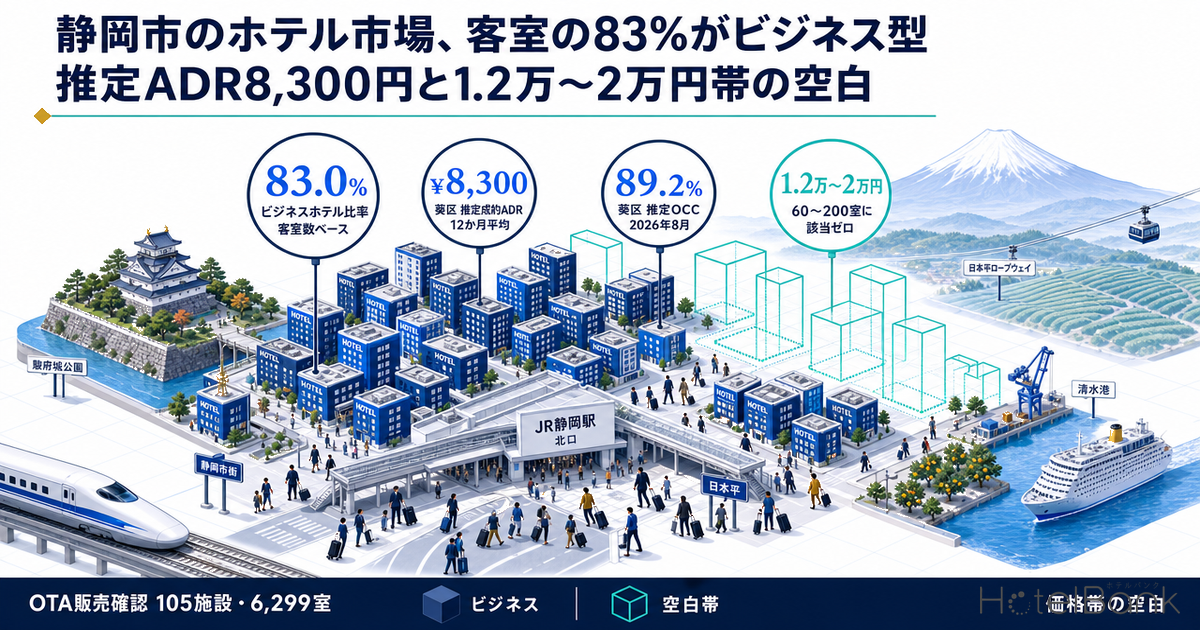
Shizuoka City’s hotel market (Aoi, Suruga and Shimizu wards) is dominated by business hotels: of the 105 properties and 6,299 rooms confirmed as selling on OTAs, business hotels account for 5,226 rooms (83.0%). Estimated settled ADR averaged ¥8,300 in Aoi Ward, ¥7,400 in Suruga Ward and ¥7,500 in Shimizu Ward over the latest 12 months (September 2025 to August 2026), on a par with Numazu (¥8,600) elsewhere in the prefecture. This article quantifies where the price gaps lie in Shizuoka City, and under what conditions an investment to fill them would work, across five lenses: supply and demand, land prices, the age of existing stock, price-band positioning and development economics.
Metric Definitions Used in This Article
- ADR (Average Daily Rate): An estimated settled rate (tax-excluded equivalent), calculated by applying segment-specific adjustment factors to each property’s lowest publicly listed OTA plan (price per room for 2 guests, tax included). Benchmarked against property-level results disclosed by listed hotel REITs (91 properties, latest 3 months), the median error is about 7%. These are estimates and differ from each property’s actual settled rates and accounting figures. Area-level ADR is the median of the properties covered (the level of a typical property in the area).
- OCC (Occupancy): The share of rooms sold relative to total rooms in the area (an estimate based on OTA sales inventory; consistency checks against REIT monthly disclosures confirm accuracy within a few points). This differs from actual property-wide occupancy. Occupancy is not calculated for individual properties.
- Listed price: Price per room for 2 guests (tax included), averaged across all plans. This is a separate metric from ADR.
- LT (Lead Time): Days until check-in. This article uses only observations from LT45 to LT1.
- Data source: MetroEngines Research & Consulting
- — Of the 105 properties and 6,299 rooms confirmed as selling on OTAs across Shizuoka City’s three wards, business hotels number 45 properties with 5,226 rooms (83.0%). City hotels account for only 5 properties and 553 rooms (8.8%).
- — The 12-month average estimated settled ADR (September 2025 to August 2026) was about ¥8,300 in Aoi Ward (+5.4% YoY), about ¥7,400 in Suruga Ward (+5.5%) and about ¥7,500 in Shimizu Ward (-0.1%).
- — Of the 46 properties with 30+ rooms (5,713 rooms), 77.0% of rooms sit below ¥10,000, and no property falls in the “¥12,000-20,000 x 60-200 rooms” band. Only one property is priced at ¥20,000+ with 30-120 rooms.
- — On the first day of the 2026 Silver Week five-day holiday (September 19), OTA-inventory-based occupancy across 22 Shizuoka City business hotels (2,436 rooms) reached 98.0% at LT1.
- — In a model of a new 3,600㎡ building on commercial land north of the station (official land price ¥743,000/㎡), the GOP yield is 5.8% for a business hotel vs 4.1% for an upper-midscale hotel. To match the business hotel, the latter would need an estimated settled ADR of about ¥23,000 (at 75% annual occupancy).
Executive Summary — Shizuoka Is a “Station Business-Hotel City” With a Gap in the Upper Price Bands
In short, Shizuoka City’s hotel market combines high demand density with a single-layer price structure. OTA-inventory-based occupancy in Aoi Ward was 89.3% in July 2026 and 89.2% in August, above Shizuoka Prefecture as a whole for the same months (82.5% and 87.4%). Yet most rooms in properties with 30+ rooms sit below an estimated settled ADR of ¥10,000, leaving the ¥12,000-20,000 mid-size band and the ¥20,000+ urban high-grade band almost empty.
Should this gap be filled with new development? In our development model, elevated construction costs leave a new upper-midscale hotel with a yield 1.7 points lower than a business hotel. The gap is therefore best read not as “no demand” but as “a price band that new construction struggles to make pay”, which points to renovating and repositioning existing stock as the realistic entry point. The evidence follows.
Market Trends — Prefectural Foreign Guest Nights +18.2%; Aoi and Suruga ADR Up 5%+
We start with the macro environment. According to the Japan Tourism Agency’s Accommodation Survey (2025 annual figures, final, published July 6, 2026), Shizuoka Prefecture’s room occupancy was 56.0% overall, 72.6% for business hotels and 68.3% for city hotels. Total guest nights fell to 22.407 million (-2.6% YoY), while foreign guest nights rose 18.2% to 2.229 million. Inbound growth is offsetting a pause in domestic demand.
A factor specific to Shizuoka City is cruise demand at Shimizu Port. According to press reports, Shimizu Port recorded a record 105 cruise ship calls in 2025, more than 90% of them by foreign vessels. Calls are mostly day visits, but turnaround cruises with embarkation and disembarkation, and pre- and post-cruise stays, can underpin lodging demand in Shimizu Ward. For call counts at major ports and the room capacity around them, see also our analysis of cruise calls and hotel capacity at Japan’s top 10 ports.
On a 12-month average basis, Aoi Ward’s estimated settled ADR was about ¥8,300, up 5.4% from the prior-year period (about ¥7,900), and Suruga Ward’s was about ¥7,400 (prior year about ¥7,000), up 5.5%. Both grew faster than the Shizuoka Prefecture business-hotel average (about ¥7,000, +1.3% YoY, N=216-222 properties). Shimizu Ward was flat at about ¥7,500 (-0.1%). Against Numazu (about ¥8,600, +1.3%) and Mishima (about ¥8,000, +0.4%) in the east of the prefecture, the growth in Aoi and Suruga stands out. Numazu’s rates are best read by splitting the station-front business segment from the leisure segment.
Monthly, Aoi Ward reached about ¥9,100 in August 2026, up 7.5% from the same month a year earlier (about ¥8,500) and the highest August level in the past two years (the monthly peak was about ¥9,500 in May 2026). May (Golden Week) and August (Obon) form two annual peaks and June is the trough, a seasonal pattern unchanged over two years. The troughs are rising too, however: January 2026 came in at about ¥8,300, up 9.6% YoY. Higher rates in the off-peak months suggest that weekday business demand is supporting prices.
Supply and Demand — Aoi Ward’s Estimated OCC Hit 89.2% in August 2026, 1.8 pt Above the Prefecture
We compare estimated occupancy based on OTA sales inventory by month. Our inventory-tracking data has a sufficient observation window for check-in dates from May 7, 2026 onward, so this section covers May to August 2026. We show Aoi Ward, where the ward-level sample is large enough, alongside Shizuoka Prefecture as a whole and Numazu for comparison.
| Area / Segment | May | Jun | Jul | Aug | Properties / Rooms (Aug) |
|---|---|---|---|---|---|
| Shizuoka Pref., all properties | 82.2% | 77.6% | 82.5% | 87.4% | 711 / 29,451 rooms |
| Shizuoka Pref., business hotels | 84.9% | 80.1% | 84.7% | 86.8% | 109 / 11,700 rooms |
| Aoi Ward, all properties | — | 85.4% | 89.3% | 89.2% | 28 / 2,315 rooms |
| Aoi Ward, business hotels | — | 86.0% | 89.5% | 89.8% | 15 / 2,015 rooms |
| Suruga Ward, all properties | — | 75.2% | 81.8% | 80.0% | 11 / 596 rooms |
| Numazu, all properties | — | 74.4% | 83.1% | 85.0% | 20 / 1,288 rooms |
Aoi Ward’s estimated OCC in August 2026 was 89.2% (28 properties / 2,315 rooms), 1.8 points above Shizuoka Prefecture as a whole (87.4%, 711 properties / 29,451 rooms). The gap was wider in July: 89.3% in Aoi Ward vs 82.5% for the prefecture, a difference of 6.8 points. While the prefecture, with its many leisure destinations, catches up in August on summer-holiday demand, Aoi Ward was already near 90% in July, pointing to deep weekday demand that is less sensitive to season. Suruga Ward (80.0% in August 2026) covers only 11 properties, so it should be treated as indicative only.
2026 Silver Week Results — First Day of the 5-Day Holiday Hit 98.0% at LT1; Listed Prices About 1.8x a Normal Saturday
In 2026, September 19 (Sat) to September 23 (Wed, Autumnal Equinox Day) formed a five-day holiday. September 19 also coincided with the opening day of the 20th Asian Games (Aichi-Nagoya, September 19 to October 4). We look at how Shizuoka City business hotels sold down their inventory, comparing against recent Saturdays and Wednesdays whose results are final now that the check-in dates have passed.
Across 16 Aoi Ward business hotels (2,122 rooms), September 19, 2026, the first day of the holiday, already showed an estimated OCC of 72.0% at LT45, 8.3 points ahead of the previous Saturday (September 12, 63.7%). By LT14 it reached 92.0%, 15.6 points above September 12 at the same point (76.4%). It then reached 96.2% at LT7 and 98.5% at LT1, effectively sold out. Weekday September 16 (Wed) started slowly at 58.3% at LT45 but climbed to 95.7% by LT1, showing a heavy layer of last-minute business-travel bookings.
On price, the listed prices of the same 16 properties (all-plan average, tax included) at LT7 were about ¥30,000 for September 19, about ¥16,600 for September 12 and about ¥10,000 for September 16. The listed price on the first day of the holiday was set at about 1.8 times a normal Saturday, confirming that hotels are increasingly reflecting early demand in their pricing.
| Check-in date | Properties | Rooms | LT14 | LT7 | LT1 |
|---|---|---|---|---|---|
| Sep 5 (Sat) | 24 | 3,043 | 65.7% | 69.6% | 78.0% |
| Sep 9 (Wed) | 25 | 2,715 | 60.0% | 67.5% | 81.8% |
| Sep 12 (Sat) | 24 | 2,845 | 70.8% | 76.4% | 89.2% |
| Sep 16 (Wed) | 22 | 2,392 | 65.3% | 74.3% | 92.6% |
| Sep 19 (Sat), first day of holiday | 22 | 2,436 | 86.5% | 94.0% | 98.0% |
| Sep 20 (Sun) | 22 | 2,594 | 90.9% | 99.4% | 92.7% |
| Sep 21 (Mon, Respect for the Aged Day) | 25 | 3,057 | 86.9% | 96.8% | 92.6% |
| Sep 22 (Tue, national holiday) | 25 | 3,074 | 73.3% | 78.5% | 87.1% |
Across all three wards of Shizuoka City, the first three days of the holiday (September 19-21) reached 94.0-99.4% at LT7. On September 20 and 21, estimated OCC fell 4-7 points between LT7 and LT1, suggesting that inventory came back late through cancellations and similar. Meanwhile, September 22, the fourth day of the holiday, reached only 87.1% at LT1, below weekday September 16 (92.6%). Late-holiday nights attract little business travel while leisure guests are heading home, so filling end-of-holiday inventory is one of the revenue opportunities for Shizuoka City hotels. Ryokan and resort hotels elsewhere in the prefecture showed a similar front-loaded pattern over the same holiday, selling out in the first three days.
Area Analysis and Location — Commercial Land North of the Station Accelerates: Takajo +11.4%, Tenmacho +9.9%
By location, Shizuoka’s two hubs, Shizuoka Station and Shimizu Station, differ sharply in character. According to the Economic Census for Business Activity (2021) by the Ministry of Internal Affairs and Communications and the Ministry of Economy, Trade and Industry, the 1km radius around Shizuoka Station holds 6,075 establishments and 69,069 employees, with an office share of 24.4%. The 1km radius around Shimizu Station has 1,470 establishments and 10,248 employees (office share 14.7%), about one-seventh of the Shizuoka Station area’s employment. Behind the high weekday occupancy of Shizuoka Station business hotels lies the concentration of administrative, financial and commercial functions that comes with being the prefectural capital.
| Aoi Ward (20 sites) | ¥387,000/㎡, +2.26% |
| Suruga Ward (8 sites) | ¥292,000/㎡, +1.30% |
| Shimizu Ward (9 sites) | ¥105,000/㎡, +0.16% |
Land prices also show clear gains in the center. In the 2026 official land prices (reference date January 1, 2026), Shizuoka City’s commercial land rose 1.54% YoY on a simple average of 37 standard sites. By ward, Aoi rose 2.26% and Suruga 1.30%, while Shimizu was nearly flat at +0.16%. Among individual sites, Gofukucho 2-chome kept the top price at ¥1.5 million/㎡ (+2.0%), while Tenmacho near the north exit of Shizuoka Station reached ¥743,000/㎡ (+9.9%) and Takajo 2-chome ¥490,000/㎡ (+11.4%), with the largest gains on the periphery north of the station. Minamicho, south of the station, was ¥765,000/㎡ (+2.0%).
From a hotel development perspective, rising land prices push up acquisition costs, but rising property values in the center also support the valuation of existing hotel assets. That the fastest-rising sites north of the station overlap with the hotel cluster (around Tenmacho and Takajo) is a tailwind when considering renovation investment in existing stock.
Competition and Supply Structure — 83% of 105 Properties and 6,299 Rooms Are Business Hotels; 58% of Rooms in 30+ Room Properties Opened in 2009 or Earlier
| Ward | Properties | Rooms | Business | City | Ryokan | Business share (rooms) |
|---|---|---|---|---|---|---|
| Aoi | 48 | 3,097 | 23 / 2,718 rooms | 2 / 214 rooms | 14 / 130 rooms | 87.8% |
| Suruga | 31 | 1,602 | 11 / 1,079 rooms | 2 / 259 rooms | 4 / 44 rooms | 67.4% |
| Shimizu | 26 | 1,600 | 11 / 1,429 rooms | 1 / 80 rooms | 4 / 45 rooms | 89.3% |
| 3-ward total | 105 | 6,299 | 45 / 5,226 rooms | 5 / 553 rooms | 22 / 219 rooms | 83.0% |
Business hotels account for 45 properties and 5,226 rooms, or 83.0% of rooms, in Shizuoka City’s three wards. City hotels (5 properties, 553 rooms) and ryokan (22 properties, 219 rooms) are both small. The ryokan are mainly small properties scattered across mountain areas of Aoi Ward such as the Umegashima and Aburayama hot springs, forming a market separate from urban lodging demand.
By opening period, of the 47 properties with 30+ rooms (5,795 rooms), those opened in 2009 or earlier account for 32 properties and 3,341 rooms (57.7%). Only 4 properties and 609 rooms opened in 2010-2017, and 9 properties with 1,687 rooms (29.1%) have been added since 2018. Recent new supply has all been limited-service hotels of 150-300 rooms right next to Shizuoka or Shimizu Station, with national chains driving up station-front room supply.
| Opened | Property | Ward | Rooms |
|---|---|---|---|
| Nov 2018 | Toyoko Inn Shizuoka-eki Minamiguchi | Suruga | 232 |
| Mar 2019 | APA Hotel Shizuoka-eki Kita | Aoi | 269 |
| Mar 2019 | Toyoko Inn Shizuoka Shimizu Ekimae | Shimizu | 246 |
| Sep 2019 | Hotel Capsule Inn Shizuoka | Suruga | 62 |
| Feb 2020 | Toyoko Inn Shizuoka-eki Kitaguchi | Aoi | 155 |
| Jul 2020 | Hotel Orein | Aoi | 305 |
| Nov 2021 | Kuretake Inn Premium Shizuoka Annex | Aoi | 196 |
| Mar 2023 | HOTEL New Masterchi | Aoi | 36 |
| Aug 2023 | KOKO HOTEL Shizuoka | Aoi | 186 |
Existing stock is moving too. Shizutetsu Hotel Prezio Shizuoka Ekikita (107 rooms), a 3-minute walk from the north exit of Shizuoka Station, began a full renovation on May 18, 2026; it plans to close entirely from December 10, 2026 to March 4, 2027 and reopen on March 5, 2027 with new, fully non-smoking rooms. It is a notable example of an aging station-front property upgrading its product through renovation.
Among listed REIT holdings, Invincible Investment Corporation (8963) owns Hotel MyStays Shimizu in front of Shimizu Station (152 rooms, acquired July 2015 for ¥2,198 million). According to the REIT’s disclosures, the hotel posted OCC of 84.1%, ADR of about ¥8,100 and RevPAR of about ¥6,800 in July 2026. Our estimated settled ADR for the same month (about ¥7,500) differs by about 7%, providing a reference point that supports the level of our estimates.
Positioning Analysis — Zero Properties in the “¥12,000-20,000 x 60-200 Rooms” Band
Of the properties confirmed as selling on OTAs, we plotted the 71 for which a 12-month estimated settled ADR could be calculated on two axes: room count and rate. Individual property names are not shown; points are colored by segment.
Splitting the 46 properties with 30+ rooms (5,713 rooms) by price band, those with an estimated settled ADR below ¥8,000 account for 31 properties and 3,163 rooms (55.4%), and ¥8,000-10,000 for 9 properties and 1,237 rooms (21.7%), so 77.0% of rooms are concentrated below ¥10,000. The ¥10,000-12,000 band has 3 properties and 678 rooms, ¥12,000-20,000 has 2 properties and 555 rooms (both large properties of 200+ rooms), and ¥20,000+ has just 1 property with 80 rooms. In other words, no property exists in the mid-size upper-midscale band of “¥12,000-20,000 x 60-200 rooms”. Apart from one property on the Nihondaira hills, the ¥20,000+ band is limited to small ryokan in mountain areas such as Umegashima and in Miho.
CrowdedOccupied territory
Below ¥10,000 x 30-310 rooms
40 station-front limited-service properties with 4,400 rooms cluster here. New entrants need differentiation by location and product.
WS1Mid-size upper-midscale
¥12,000-20,000 x 60-200 rooms
Zero properties. An urban hotel near the station that raises stay value with a lounge, large public bath and breakfast.
WS2Urban high-grade
¥20,000+ x 30-120 rooms
No property in the city center. A small, high-rate format combined with business dining, MICE and Mt. Fuji views.
A gap, however, does not automatically mean demand. Shizuoka City’s high occupancy rests mainly on weekday business travel and weekend regional leisure demand, and the depth of guests willing to pay ¥12,000+ per night is limited by the fact that Tokyo and Nagoya are only about an hour away by Shinkansen, which makes day trips easy. The next section therefore models the economics of filling this gap with new construction.
Development Scenarios — Four Formats on a 3,600㎡ Site North of the Station
Assuming commercial land north of Shizuoka Station, we compared four formats on a 600㎡ site with 3,600㎡ of floor area (assuming a 600% floor-area ratio). The land price references the Tenmacho standard site in the 2026 official land prices (¥743,000/㎡), giving ¥446 million. Construction costs start from the 2025 steel-frame cost of ¥2.405 million per tsubo based on MLIT’s Building Construction Statistics, adjusted for the specification differences of each format.
| Item | A. Standard business | B. Upper business | C. Upper-midscale (WS1) | D. High-end (WS2) |
|---|---|---|---|---|
| Room size / guestroom area ratio | 18㎡ / 68% | 20㎡ / 62% | 28㎡ / 60% | 40㎡ / 55% |
| Rooms | 136 | 111 | 77 | 49 |
| Est. settled ADR assumption | ¥8,800 | ¥10,500 | ¥16,000 | ¥28,000 |
| OCC assumption | 82% | 82% | 75% | 65% |
| RevPAR | ¥7,216 | ¥8,610 | ¥12,000 | ¥18,200 |
| Total revenue (incl. F&B etc.) | ¥358M | ¥366M | ¥405M | ¥472M |
| GOP margin / GOP | 50% / ¥179M | 45% / ¥165M | 35% / ¥142M | 25% / ¥118M |
| Construction cost per tsubo | ¥2.405M | ¥2.50M | ¥2.80M | ¥3.30M |
| Construction cost | ¥2.62B | ¥2.72B | ¥3.05B | ¥3.59B |
| Total investment (incl. land) | ¥3.06B | ¥3.17B | ¥3.49B | ¥4.04B |
| GOP yield (2025 cost basis) | 5.8% | 5.2% | 4.1% | 2.9% |
| Simple payback | 17.1 yrs | 19.2 yrs | 24.7 yrs | 34.2 yrs |
| Construction cost (inflation-adjusted) | ¥3.03B | ¥3.15B | ¥3.52B | ¥4.15B |
| Total investment (inflation-adjusted) | ¥3.47B | ¥3.59B | ¥3.97B | ¥4.60B |
| GOP yield (inflation-adjusted) | 5.2% | 4.6% | 3.6% | 2.6% |
| Simple payback (inflation-adjusted) | 19.4 yrs | 21.8 yrs | 28.0 yrs | 39.0 yrs |
The ADR assumptions are drawn from the actual price bands identified in the positioning analysis. A uses the upper end of station-front limited-service hotels opened since 2019 (estimated settled ADR around ¥8,600-8,800), B the actual range of existing properties in the ¥10,000-13,000 band, and C and D the midpoints of the respective gap bands. For GOP margins, we took the conservative side for each format between the GOP margin of MHM-operated hotels disclosed by Invincible Investment Corporation (38.9%, fiscal period ended December 2024) and industry benchmarks of 50-60% for limited-service and 10-30% for full-service hotels.
The inflation-adjusted rows assume a 2029 opening, with construction costs rising about 5% a year to the midpoint of the construction period (Turner & Townsend forecasts: +5.3% in 2026 and +5.0% in 2027; +4.5% assumed for 2028). Rising construction costs depress the economics of new entry, but by the same token they restrain new supply, which is an upside for existing hotels as it keeps competition moderate.
Sensitivity and Break-Even — Upper-Midscale Needs an Estimated Settled ADR of About ¥23,000 to Match a Business Hotel
For the middle option, B (upper business), we check the GOP yield if ADR and occupancy come in below plan.
| Item | Base case | ADR -10% | OCC -5 pt | Both |
|---|---|---|---|---|
| Total revenue | ¥366M | ¥330M | ¥344M | ¥310M |
| GOP | ¥165M | ¥148M | ¥155M | ¥139M |
| GOP yield (2025 cost basis) | 5.2% | 4.7% | 4.9% | 4.4% |
| GOP yield (inflation-adjusted) | 4.6% | 4.1% | 4.3% | 3.9% |
Working backwards, for C (upper-midscale; modeled at 77 rooms, 75% annual occupancy and a 35% GOP margin) to reach the same 5.8% GOP yield as A (standard business), it would need an estimated settled ADR of about ¥23,100. That is about 2.8 times Aoi Ward’s 12-month average (about ¥8,300) and above even the highest-priced large station-front hotel today (an estimated ¥17,000 or so). The gap is thus both a gap on the demand side and a gap in the economics of new construction.
We also check the effect of moving ADR and OCC together. The table below models C’s GOP yield (2025 cost basis; upper-midscale, 77 rooms, with total investment of ¥3.49 billion and a 35% GOP margin held fixed) across six estimated settled ADR levels and five annual occupancy levels. Total revenue including F&B is assumed to be proportional to RevPAR.
| Est. settled ADR \ Annual OCC | 65% | 70% | 75% | 80% | 85% |
|---|---|---|---|---|---|
| ¥12,000 | 2.6% | 2.8% | 3.0% | 3.2% | 3.4% |
| ¥14,000 | 3.1% | 3.3% | 3.5% | 3.8% | 4.0% |
| ¥16,000 | 3.5% | 3.8% | 4.1% | 4.3% | 4.6% |
| ¥18,000 | 4.0% | 4.3% | 4.6% | 4.9% | 5.2% |
| ¥20,000 | 4.4% | 4.7% | 5.1% | 5.4% | 5.7% |
| ¥23,100 | 5.1% | 5.5% | 5.9% | 6.2% | 6.6% |
As the table shows, for C to match the business hotel’s 5.8%, it needs either about 87%+ annual occupancy at an estimated settled ADR of ¥20,000, or 75% occupancy at ¥23,100. Either way, it requires a rate near the top of the gap band, or sustaining year-round occupancy close to the August 2026 estimated OCC for all Aoi Ward properties (89.2%).
The realistic entry point to WS1 is therefore likely to be acquiring and renovating existing stock. Reusing the existing land and structure keeps total investment to a fraction of new construction, making the economics easier to build even at rates of ¥12,000-16,000. With 57.7% of rooms in properties of 30+ rooms opened in 2009 or earlier, there is plenty of room, as in the full renovation north of the station noted above, to reshape aging station-front stock into products with higher stay value.
Investment Summary and Risk Assessment
In summary, hotel investment in Shizuoka City is most coherently approached on two tracks: holding or acquiring business hotels in a phase of high occupancy and rising rates, and moving existing stock into higher price bands through renovation. Targeting the gap with new construction presupposes evidence of demand that can support an estimated settled ADR above ¥20,000 (MICE, business dining and high-spending inbound guests).
| Category | Description | Assessment |
|---|---|---|
| Demand | High-rate lodging demand tends to leak to day trips from Tokyo and Nagoya | Medium. Upper price bands are hard to sustain on weekday business travel alone; capturing regional weekend and holiday demand is key |
| Supply | Additional station-front limited-service supply; rooms returning after renovation closure (March 2027) | Low to medium. Elevated construction costs are likely to limit large new supply |
| Construction | Scenario of construction costs continuing to rise about 5% a year | High. Lowers new-build yields by 0.3-0.6 pt (in our model) |
| Regulation | Shizuoka Prefecture is considering ways to secure tourism funding, including an accommodation tax (aiming to set a direction during FY2026) | Medium. If introduced, the higher tax-inclusive price must be built into pricing |
| Land prices | Commercial sites north of the station rising around 10% | Medium. Raises acquisition costs, but also supports the valuation of existing assets |
Frequently Asked Questions
Q. What is the average daily rate (ADR) of hotels in Shizuoka City?
A. Our estimated settled ADR, as a 12-month average from September 2025 to August 2026, was about ¥8,300 in Aoi Ward (N=36-38 properties), about ¥7,400 in Suruga Ward (N=19-20) and about ¥7,500 in Shimizu Ward (N=17-18). Year on year, Aoi Ward rose 5.4%, Suruga Ward 5.5% and Shimizu Ward -0.1%.
Q. Which hotel segment has the most rooms in Shizuoka City?
A. Of the 105 properties and 6,299 rooms confirmed as selling on OTAs in August 2026, business hotels account for 45 properties and 5,226 rooms (83.0%). City hotels number 5 properties with 553 rooms.
Q. Which price band is undersupplied in Shizuoka City?
A. No property falls in the mid-size upper-midscale band of ¥12,000-20,000 estimated settled ADR with 60-200 rooms, and only one property is in the urban high-grade band of ¥20,000+ with 30-120 rooms.
Q. What yield can a new hotel near Shizuoka Station expect?
A. In our model of a 3,600㎡ building north of the station, GOP yields are 5.8% for a business hotel, 5.2% for an upper business hotel, 4.1% for an upper-midscale hotel and 2.9% for a high-end hotel (2025 construction cost basis). Factoring in rising construction costs lowers each by 0.3-0.6 pt.
Q. How full were Shizuoka City hotels during the 2026 Silver Week?
A. On September 19, the first day of the five-day holiday, the OTA-inventory-based estimated OCC of 22 business hotels (2,436 rooms) across Shizuoka City’s three wards was 94.0% at LT7 and 98.0% at LT1.
Methodology and Sources
■ Data sources
Hotel supply, estimated settled ADR, estimated OCC and booking curves were compiled by extracting properties in Aoi, Suruga and Shimizu wards from the public price and inventory data of the roughly 27,000 operating properties tracked by MetroEngines Research. Supply covers properties with sales confirmed on 10+ check-in dates in August 2026. Estimated OCC and booking curves are based on major booking-site listings, and daily property-level aggregation is limited to properties whose OTA public allotments are 30%+ of total rooms. We cross-checked the holdings of seven listed hotel REITs (Ichigo Hotel REIT Investment Corporation (3463), Invincible Investment Corporation (8963), Nippon Hotel & Residential Investment Corporation (3472), Japan Hotel REIT Investment Corporation (8985), Hoshino Resorts REIT, Inc. (3287), Mori Trust Reit, Inc. (8961) and Kasumigaseki Hotel REIT Investment Corporation (401A)); the only holding in Shizuoka City is one property owned by Invincible Investment Corporation.
■ Modeling assumptions
The development scenarios are a simplified model assuming a 600㎡ site, 3,600㎡ of floor area and a land price of ¥743,000/㎡ (2026 official land price, Tenmacho standard site). Construction costs start from a steel-frame cost of ¥2.405 million per tsubo (2025) with format-specific premiums; the inflation-adjusted case assumes a 2029 opening and multiplies construction costs by 1.155. GOP yield is GOP divided by total investment, before rent, insurance, fixed asset tax, FF&E reserves and similar deductions. In the two-way ADR x OCC sensitivity, the GOP margin and total investment are held fixed and total revenue including F&B is assumed to be proportional to RevPAR.
■ Limitations
Estimated settled ADR and estimated OCC are estimates based on public OTA information and differ from each property’s actual settled rates and occupancy. Ward-level estimated OCC is not shown for months with few properties in the sample. All check-in dates covered in this article had passed by the survey date (September 23, 2026); no future-dated prices were used. The development model is a simplified estimate; actual investment decisions require a detailed feasibility study based on site-specific regulations and a business plan.
Related Articles
References and Sources
■ Market data
- MetroEngines Research & Consulting — Public price data (105 properties in Shizuoka City’s 3 wards), estimated settled ADR, estimated OCC, booking curve analysis
■ Government statistics and public data
- Japan Tourism Agency, Accommodation Survey (2025 annual figures, final), published July 6, 2026 (Japanese)
- Shizuoka City, Land Price Information (Official Land Prices and Prefectural Land Price Survey): 2026 official land prices in the city (Japanese)
- Shizuoka Prefecture, 2026 Official Land Price Results (Japanese)
- MIC and METI, Economic Census for Business Activity (2021)
- MLIT, Building Construction Statistics (Japanese)
■ REIT and industry reports
- Invincible Investment Corporation, Monthly Operating Results for July 2026
- Invincible Investment Corporation, Portfolio List
- JLL, Japan Hotel Investment Market 2025
■ News and press releases
- Shizutetsu Hotel Prezio Shizuoka Ekikita official website (notice of renovation and closure) (Japanese)
- Editorial: “More Cruise Ships at Shimizu Port: Mechanisms Needed to Benefit the Region” (Shizuoka Shimbun, Japanese)
- Shimizu Port Cruise Ship Promotion Committee, FY2025 scheduled calls (Japanese)
- Shizuoka Prefecture to consider funding options including an accommodation tax to strengthen the tourism industry (NHK News, Japanese)
- Shizuoka governor to set up accommodation tax study committee in FY2026, calling it a “strong option” for funding (Chunichi BIZ Navi, Japanese)
- Japanese Olympic Committee, Aichi-Nagoya Asian Games (Japanese)