

Joining a global hotel brand’s loyalty programme and booking network does not require a full-brand conversion that replaces both the signage and the interiors. There is another route: the soft brand, where a hotel keeps its own name and the character of its building and joins as a member of a “collection”. Hilton’s corporate fact sheet, updated on August 25, 2026, lists “Kyoto Brighton Hotel, Curio Collection by Hilton (working name)” (about 160 rooms, opening 2028) among its 13 pipeline hotels in Japan. This article counts how many such hotels operate in Japan using Hilton’s and Hyatt’s published materials, overlays estimated settled ADR and the stock of existing hotels in central Kyoto’s three wards and Nara City, and then estimates the rate growth an affiliation needs for each combination of fee rate and renovation cost.
Scope relative to earlier articles
Earlier HotelBank analyses covered the cost structure of franchise affiliation and breakeven by fee rate, the ADR gap that brands command within the same trade area, and measured ADR after the conversion of 14 former Unizo hotels. This article does not examine rate changes before and after affiliation. It addresses two questions: why the soft-brand format, which keeps a hotel’s own name, is still rare in Japan, and whether existing hotels in Kyoto and Nara can take this option. The breakeven estimate adds a renovation-cost axis alongside fees.
Metric Definitions Used in This Article
- ADR (average daily rate) = estimated settled rate (tax-exclusive equivalent), calculated by applying a property-type correction factor to the lowest-plan rate each property publishes on OTAs and other channels (two guests per room, per-room rate, tax-inclusive). Checked against property-level results disclosed by listed hotel REITs (91 properties, latest three months), the median error is about 7%. These are estimates and differ from each property’s actual settled prices and accounting figures. Area-level ADR is the median of the properties covered (the level of a typical property in the area). The “12-month average” in this article is the simple average of monthly medians from September 2025 to August 2026.
- OCC (occupancy) = rooms sold as a share of total rooms in the area (estimated from OTA sales inventory). The occupancy used in this article’s estimates is the final January–December 2025 figure by property type from the Japan Tourism Agency’s Overnight Travel Statistics Survey. OCC is not calculated for individual properties.
- Soft brand = a format in which an existing hotel joins a global chain’s “collection” brand while keeping its own name and character. This article counts three brands: Hilton’s Curio Collection by Hilton and Tapestry Collection by Hilton, and Hyatt’s The Unbound Collection by Hyatt.
- Breakeven ADR lift = the ADR increase needed for the incremental room revenue from higher rates to cover ongoing post-affiliation fees plus renovation cost recovered evenly over 10 years (see “■ Estimation Assumptions” for the formula).
- Data sources = MetroEngines Research. Brand and property information is from Hilton, “Corporate Fact Sheet” (updated Aug 25, 2026) and Hyatt Japan, “Press Kit, April 2026”. REIT-disclosed settled ADR is shown excluding consumption tax, and this article’s estimated settled ADR is likewise at a tax-exclusive equivalent level.
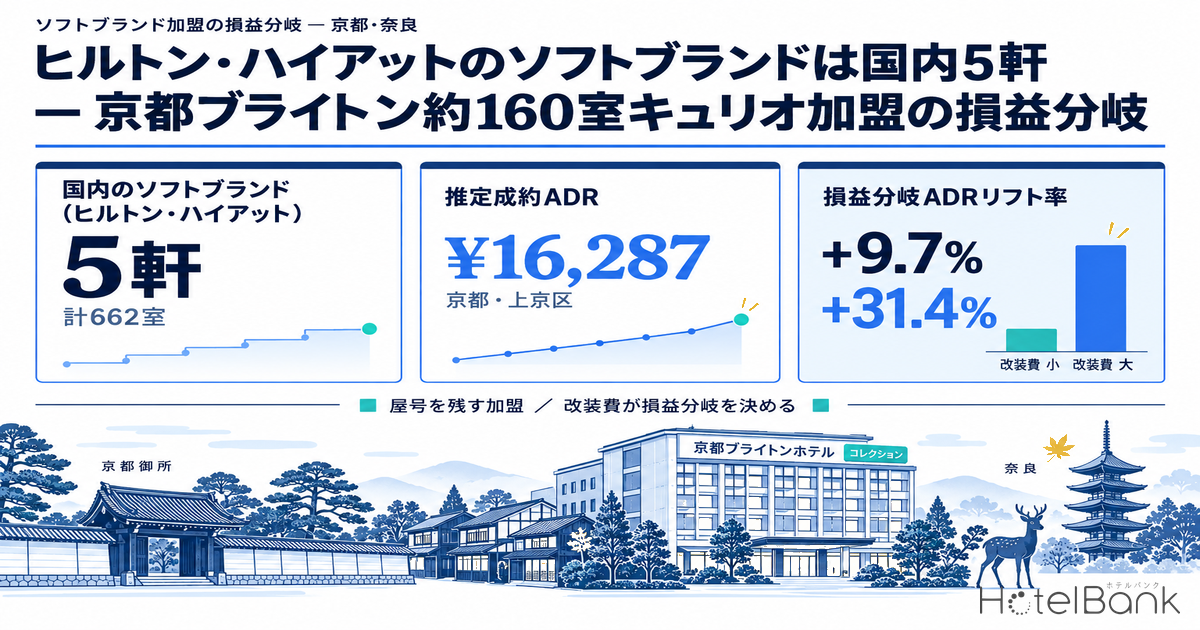
- — 5 hotels, 662 rooms — Soft-brand hotels that Hilton and Hyatt operate in Japan: 8.5% of the two companies’ 59 hotels in Japan, and just 3.8% by rooms.
- — About 160 rooms, opening planned for 2028 — Kyoto Brighton Hotel will operate until November 30, 2026, then undergo a full renovation, and join Curio Collection under a franchise while keeping its own operations.
- — 189 hotels, 29,081 rooms — Hotels with 50+ rooms in central Kyoto’s three wards. The median estimated settled ADR of the 35 opened in 1999 or earlier, ¥14,800, is 9.7% below the ¥16,200 of the group opened in 2015 or later.
- — +9.7% — Breakeven ADR lift at a 5% fee and renovation of about ¥1.5M per room. At ¥10M per room it rises to +31.4%; renovation cost matters more than the fee rate.
- — Nara City at about 70% — Annual room revenue per room is about ¥3.24M, about 70% of Kyoto’s Kamigyo Ward (about ¥4.61M). The same renovation cost therefore implies a higher breakeven than in Kyoto.
Conclusion — Only 5 hotels in Japan have joined while keeping their names; for existing Kyoto hotels, breakeven hinges on how far renovation cost is contained
Counted from Hilton’s and Hyatt’s published materials, soft-brand hotels operating in Japan number just 5, with 662 rooms: two Curio and one Tapestry hotel at Hilton, and two Unbound Collection hotels at Hyatt. That is 8.5% of the two companies’ 59 hotels in Japan. Meanwhile, 13 of Hilton’s 37 hotels in Japan are explicitly recorded in the fact sheet’s history as having opened through a “rebrand”. Converting existing buildings to global brands is no longer unusual. What remains rare is the kind of conversion that keeps the hotel’s name.
Kyoto has a concentrated pool of existing hotels that could take this route. In the three central wards of Kamigyo, Nakagyo and Shimogyo, 189 hotels with 50 or more rooms (29,081 rooms) recorded sales in the last 12 months. Of these, 35 hotels with 6,375 rooms opened in 1999 or earlier according to our data. Median estimated settled ADR is ¥14,800 for the group opened in 1999 or earlier and ¥16,200 for the group opened in 2015 or later, a gap of +9.7%.
The economics of affiliation are decided more by the size of the renovation than by the fee rate. We modelled a 160-room hotel at 77.5% occupancy (the final full-year 2025 figure for city hotels in Kyoto Prefecture) and an ADR of ¥16,300 (estimated settled ADR in Kamigyo Ward). With fees at 5% of room revenue and renovation of about ¥1.5M per room, the breakeven ADR lift is +9.7%, the same as the gap between the two groups above. At the same fee rate, renovation of ¥10M per room requires +31.4%. Time the affiliation to coincide with a major refurbishment that has to happen anyway, and put only the extra renovation spent for the brand into the affiliation decision. That distinction is the starting point for existing hotels in Kyoto and Nara.
What is a soft brand? — Keep the name and building, join the loyalty programme and booking network
Affiliation with a global hotel chain falls broadly into two forms. One is a full-brand conversion: rooms, public areas and F&B are rebuilt to brand standards and the name is replaced with the brand name. The other is a soft brand, in which the hotel keeps its own name and design and joins the chain’s membership programme, official booking channels and sales network as a member of a “… Collection”. In its fact sheet, Hilton describes Curio Collection by Hilton as a global collection of handpicked luxury and resort hotels offering authentic experiences beyond expectations, and Tapestry Collection by Hilton as upscale, original hotels offering a unique style to guests seeking an authentic connection with the destination.
Seen from the owner’s side, the two differ in three ways. The first is the scope of renovation requirements: because a soft brand treats the building’s character as part of the brand’s value, demands to standardise room sizes and interiors are generally smaller. The second is how the hotel appears to customers: a name known to long-standing regulars and to local banquet and wedding demand can stay in use. The third is the fee structure, which is the same as for full brands: royalties, marketing contributions, reservation-system fees and loyalty-programme charges are combined and levied on room revenue. Rates are set contract by contract; within what is publicly known they fall at roughly 4–11% of room revenue (per an earlier HotelBank analysis).
| Item | Full-brand conversion | Soft-brand affiliation |
|---|---|---|
| Name | Replaced with the brand name | Keeps its own name, adding “… Collection” |
| Renovation requirements | Room specs, public areas and F&B all conform to brand standards | Centred on safety, quality and systems; design respects the property’s character |
| Distribution | Loyalty programme, official channels, corporate sales | Same as left (members book and stay under the same points programme) |
| Operation | Management contract or franchise | Mostly franchise (owner continues to operate) |
| Ongoing fees | A combination of rates on room revenue | Same as left (rates set case by case) |
Current state in Japan — 3 Hilton and 2 Hyatt hotels; 3.8% of the two companies’ rooms in Japan
According to Hilton’s fact sheet (updated August 25, 2026), it operates 37 hotels under 9 brands in Japan; summing the room counts in the 37-hotel table gives 12,206 rooms by our count (the fact sheet gives no total). Three are soft brands: Kyu Karuizawa KIKYO, Curio Collection by Hilton (50 rooms), opened in 2018; The Green Leaf Niseko Village, Tapestry Collection by Hilton (200 rooms); and Hinode Hills Niseko Village, Curio Collection by Hilton (87 rooms). The history section notes that the 2018 opening was Curio Collection by Hilton’s first entry into Japan and that it opened through a rebrand. The two Niseko hotels also opened through rebrands according to the history.
According to Hyatt Japan, “Press Kit, April 2026”, Hyatt operates 22 hotels under 9 brands in Japan, with 5,066 rooms in total. The Unbound Collection by Hyatt has two: Hotel Toranomon Hills (205 rooms, opened December 2023) and Fuji Speedway Hotel (120 rooms, opened October 2022). Its 10 pipeline hotels include “Hotel NEI Nara (The Unbound Collection by Hyatt)”, with both opening date and room count listed as “TBD”.
Combined, the two companies have 5 soft-brand hotels in Japan with 662 rooms: 8.5% of their 59 hotels in Japan by count, and 3.8% of their combined 17,272 rooms. Because many of these properties are small, the share by rooms is less than half the share by hotel count.
| Hotel | Brand | Rooms | Opening (as stated in source) |
|---|---|---|---|
| Kyu Karuizawa KIKYO, Curio Collection by Hilton | Curio | 50 | 2018 (rebrand) |
| The Green Leaf Niseko Village, Tapestry Collection by Hilton (winter season) | Tapestry | 200 | 2025 (rebrand) |
| Hinode Hills Niseko Village, Curio Collection by Hilton | Curio | 87 | Rebranded 2025 / opened as Curio 2026 |
| Hotel Toranomon Hills (The Unbound Collection by Hyatt) | Unbound | 205 | Dec 2023 |
| Fuji Speedway Hotel (The Unbound Collection by Hyatt) | Unbound | 120 | Oct 2022 |
| Kyoto Brighton Hotel, Curio Collection by Hilton (working name) | Curio | About 160 | 2028 (planned) |
| Hotel NEI Nara (ホテル 寧 奈良) (The Unbound Collection by Hyatt) | Unbound | TBD | TBD (planned) |
Set against global figures, the domestic count looks different. According to Hilton’s materials, Curio has 208 hotels in 48 countries and territories and Tapestry 206 hotels in 25. Together the two brands total 414 hotels, about 4% of Hilton’s more than 9,400 hotels. Their share of Hilton’s Japan portfolio (3 of 37) is not low by global standards. The scarcity of soft brands in Japan is therefore not because Japan alone is lagging in adoption. A better reading is that existing hotels of the scale and grade that could raise rates by plugging into a global loyalty programme have not yet encountered this option.
The “keep the name, join the distribution network” approach is also spreading beyond collection brands. In 2024 Hilton formed an exclusive strategic partnership with Small Luxury Hotels of the World (SLH), making SLH member hotels, including 13 in Japan, bookable through Hilton’s official channels. In 2026 it also introduced a new brand-partnership model, Select by Hilton, which lets independent and third-party-branded hotels use Hilton Honors and Hilton’s official channels while keeping their own brand identity and operations. Hilton Honors has more than 260 million members, and Hyatt’s loyalty programme World of Hyatt more than 63 million.
Kyoto Brighton, about 160 rooms — an existing hotel west of the Imperial Palace joins Curio under its own name
Two of Hilton’s 13 pipeline hotels in Japan are in Kyoto: “Kyoto Brighton Hotel, Curio Collection by Hilton (working name)” (about 160 rooms, opening 2028) and “Motto by Hilton Kyoto Shijo Karasuma” (108 rooms; listed as opening in 2029 / FY2029). According to the joint announcement by Brighton Corporation and Hilton on October 6, 2025, Kyoto Brighton Hotel is an existing hotel that opened in 1988. The current hotel will operate until November 30, 2026, after which the whole building will be renovated. Brighton Corporation will continue to operate it, partnering with Hilton under a franchise agreement. The opening is given as “winter 2028” in the announcement and “opening 2028” in the fact sheet; both are planned dates.
This project illustrates the features of a soft brand directly. First, the name “Kyoto Brighton Hotel” remains. Second, operation stays in-house, taking the form of a franchise that borrows the brand and its booking network. Third, a full renovation of an ageing building and the brand affiliation happen at the same time. The renovation would eventually be needed anyway as part of the building’s renewal cycle. What the affiliation decision has to answer for is not the total renovation cost, but only the portion added to meet the brand. This idea feeds directly into the breakeven estimate later in the article.
Rates in central Kyoto’s three wards and Nara City — Kamigyo ¥16,300, Nakagyo ¥16,900, Shimogyo ¥15,600, Nara City ¥12,900
MetroEngines Research’s estimated settled ADR (12-month average, September 2025–August 2026) is ¥16,300 in Kamigyo Ward (N=8–10 properties), ¥16,900 in Nakagyo Ward (N=102–112), ¥15,600 in Shimogyo Ward (N=157–168) and ¥12,900 in Nara City (N=58–62). Against the previous 12 months (September 2024–August 2025), all four areas rose: Kamigyo +19.5%, Nakagyo +1.8%, Shimogyo +5.5% and Nara City +1.4%. Kamigyo covers only about 10 properties, so its median moves easily depending on which properties enter the count. The +19.5% is better read as an upper bound than as the rise of the market as a whole.
On occupancy, the Japan Tourism Agency’s Overnight Travel Statistics Survey (final full-year 2025 figures, January–December) puts room occupancy in Kyoto Prefecture at 77.5% for city hotels and 77.4% for business hotels. Nara Prefecture is at 69.0% for city hotels and 69.3% for business hotels. Against the national averages from the same final 2025 figures (city hotels 74.1%, business hotels 75.3%), Kyoto is 2–3 points higher and Nara 5–6 points lower. Kyoto’s occupancy is stable at a high level, making it a market where any uplift from affiliation is more likely to appear in rate than in room turnover. Nara City is lower than Kyoto on both rate and occupancy, but that leaves more headroom if a distribution network can capture weekday and off-season demand.
| Area | Estimated settled ADR, 12-month avg. | Previous 12 months | YoY | N (properties) | Room occupancy (prefecture, city hotels, 2025) |
|---|---|---|---|---|---|
| Kamigyo Ward | ¥16,287 | ¥13,626 | +19.5% | 8–10 | Kyoto Pref. 77.5% |
| Nakagyo Ward | ¥16,943 | ¥16,642 | +1.8% | 102–112 | |
| Shimogyo Ward | ¥15,606 | ¥14,790 | +5.5% | 157–168 | |
| Nara City | ¥12,875 | ¥12,699 | +1.4% | 58–62 | Nara Pref. 69.0% |
Hotels with the option — 189 hotels with 50+ rooms in central Kyoto’s 3 wards, 35 opened in 1999 or earlier
Soft-brand examples in Japan range from 50 rooms (Kyu Karuizawa KIKYO) to 205 rooms (Hotel Toranomon Hills), and the Kyoto Brighton plan is about 160 rooms. The format suits mid-sized properties chosen for their character, a size smaller than large full-service hotels. We therefore counted hotels with 50 or more rooms in central Kyoto’s three wards and Nara City that recorded sales in the last 12 months (September 2025–August 2026).
| Area / opening period | Hotels | Rooms | Median rooms | Median estimated settled ADR | ADR N |
|---|---|---|---|---|---|
| Central Kyoto, 3 wards, total | 189 | 29,081 | — | — | 155 |
| Opened 1999 or earlier | 35 | 6,375 | 144 | ¥14,782 | 30 |
| Opened 2000–2014 | 26 | 4,652 | 159 | ¥13,475 | 22 |
| Opened 2015 or later | 128 | 18,054 | 122 | ¥16,215 | 103 |
| Nara City, total | 27 | 3,839 | — | — | 23 |
| Opened 1999 or earlier | 6 | 805 | 104.5 | ¥11,048 | 4 |
| Opened 2000–2014 | 7 | 932 | 131 | ¥8,029 | 6 |
| Opened 2015 or later | 14 | 2,102 | 145.5 | ¥12,628 | 13 |
Of the 189 hotels in central Kyoto’s three wards, 150 fall in the 50–205-room band, and 24 of those opened in 1999 or earlier. Median estimated settled ADR was ¥14,800 for the group opened in 1999 or earlier and ¥16,200 for the group opened in 2015 or later, a gap of +9.7% measured from the older group. This gap, however, also mixes in location, room size, the presence of F&B outlets and other factors. It is neither the effect of building age alone nor a brand effect. It should be read no further than this: “within the market for 50+ room hotels in central Kyoto, the median of older properties sits about 10% below that of newer ones, and depending on how renovation and brand are combined, that gap is headroom.”
Nara City has only 27 hotels with 50+ rooms (3,839 rooms), and just 6 opened in 1999 or earlier (estimated settled ADR was available for 4). An earlier HotelBank analysis of Nara highlighted the shortage of mid-sized hotels serving the high-rate band. Hyatt naming Nara as a pipeline location for The Unbound Collection points to room in such markets for putting distinctive properties onto a global loyalty programme.
The map shows hotels with 50+ rooms in central Kyoto’s three wards that opened in 1999 or earlier (other than Kyoto Brighton Hotel, the 34 properties are unnamed). They line up from west of the Imperial Palace along the north–south axis of Karasuma, Shijo and Kyoto Station, all locations where both leisure and business demand can be expected.
Location and regulation — Commercial land within 1 km west of the Imperial Palace up 8–13% YoY; using existing buildings beats rebuilding
In the official land prices (as of January 1, 2026) from the Ministry of Land, Infrastructure, Transport and Tourism’s Real Estate Information Library, the three commercial benchmark sites within 1 km of Kyoto Brighton Hotel rose +8.4–13.2% year on year. Within 1 km of Kintetsu-Nara Station in Nara City, four commercial-zone benchmark sites also rose +3.8–7.9%. When land values are rising, raising the earning power of an existing building tends to keep investment efficiency higher than acquiring and rebuilding.
| Location (benchmark site) | Zoning / floor-area ratio | Distance | 2025 | 2026 | YoY |
|---|---|---|---|---|---|
| Kamigyo Ward, Kyoto (下立売通黒門西入橋西二町目) | Neighbourhood commercial 200% | About 730 m from Kyoto Brighton | ¥359,000/m² | ¥389,000/m² | +8.4% |
| Nakagyo Ward, Kyoto (丸太町通室町東入常真横町) | Commercial 500% | Same, about 810 m | ¥1,290,000/m² | ¥1,460,000/m² | +13.2% |
| Kamigyo Ward, Kyoto (堀川通上立売上る竹屋町) | Commercial 600% | Same, about 980 m | ¥500,000/m² | ¥560,000/m² | +12.0% |
| Hanashiba-cho, Nara City | Commercial 400% | About 230 m from Kintetsu-Nara Station | ¥224,000/m² | ¥233,000/m² | +4.0% |
| Mochiido-cho, Nara City | Commercial 400% | Same, about 400 m | ¥312,000/m² | ¥334,000/m² | +7.1% |
| Aburasaka Jikata-cho, Nara City | Commercial 400% | Same, about 630 m | ¥570,000/m² | ¥615,000/m² | +7.9% |
| Aburasaka-cho, Nara City | Commercial 400% | Same, about 650 m | ¥344,000/m² | ¥357,000/m² | +3.8% |
In Kyoto, regulation also works in favour of existing buildings. Kyoto City’s New Landscape Policy, in force since September 2007, revised the height districts in the urban area and lowered the height limit along major roads in the centre from 45 m to 31 m. As a result, existing buildings with more volume than current rules allow became non-conforming (Japanese Journal of Human Geography, Vol. 65, No. 5). Rebuilding such a building may not secure the same number of rooms, so renovating and continuing to use it helps preserve asset value. The New Landscape Policy also tightened outdoor-advertising rules, banning rooftop signs and flashing lights. Keeping the existing name and adding a “Collection” label blends into the streetscape more easily than a full-brand conversion that puts up large new signage.
Zoning around Kyoto Brighton Hotel is a mix of neighbourhood commercial (300% floor-area ratio), commercial (400–600%), residential and quasi-industrial districts. Mid-sized hotels dotted through quiet blocks next to residential areas provide just the setting for the “stay that could only happen here” that soft brands do best.
Breakeven — even at a 5% fee, renovation of ¥10M per room requires a +31% rate increase
We estimated the economics of affiliation with a 160-room model priced at Kamigyo Ward’s market level. The room count is set close to the scale of the Kyoto Brighton plan as an assumption; it is not that hotel’s actual or planned figures. ADR is Kamigyo Ward’s estimated settled ADR (12-month average) of about ¥16,300, and occupancy is the Japan Tourism Agency’s final 2025 figure for city hotels in Kyoto Prefecture, 77.5%. On this basis, pre-affiliation room revenue is about ¥4.61M per room per year, or about ¥737M a year for 160 rooms.
Let f be the rate of ongoing fees charged on room revenue after affiliation, c the renovation cost per room, and assume 90% of incremental room revenue from higher rates is retained as profit (contribution margin). If renovation cost is recovered evenly over 10 years, the breakeven ADR lift is “(f + c ÷ (10 × pre-affiliation annual room revenue per room)) ÷ (0.9 − f)”. Occupancy is assumed unchanged before and after affiliation; no occupancy uplift from the distribution network is assumed here.
| Assumptions | Fee rate | Renovation ¥0 | ¥1M | ¥2M | ¥5M | ¥10M | ¥15M |
|---|---|---|---|---|---|---|---|
| Kamigyo Ward ADR ¥16,287 · OCC 77.5% (full-year 2025) | 5% | +5.9% | +8.4% | +11.0% | +18.7% | +31.4% | +44.2% |
| 8% | +9.8% | +12.4% | +15.1% | +23.0% | +36.2% | +49.5% | |
| 11% | +13.9% | +16.7% | +19.4% | +27.7% | +41.4% | +55.1% | |
| Nara City ADR ¥12,875 · OCC 69.0% (full-year 2025) | 5% | +5.9% | +9.5% | +13.1% | +24.0% | +42.2% | +60.3% |
| 8% | +9.8% | +13.5% | +17.3% | +28.6% | +47.4% | +66.2% | |
| 11% | +13.9% | +17.8% | +21.7% | +33.4% | +53.0% | +72.5% |
Three points stand out from the table. First, even with zero renovation, a 5% fee requires a +5.9% rate increase and an 8% fee +9.8%. Because the fee applies to all room revenue, it weighs more heavily than the increase in the numerator alone. Second, renovation cost has a far larger effect than the fee rate. In Kamigyo, raising the fee from 5% to 11% moves breakeven by only 8–11 points, whereas raising renovation from ¥2M to ¥10M per room moves it by more than 20 points. Third, because room revenue per room is smaller in Nara City, the same renovation cost produces a higher breakeven. For existing hotels in Nara, keeping the renovation cost attributed to the affiliation small matters even more than in Kyoto.
Take as one yardstick the +9.7% gap between the groups opened in 1999 or earlier and in 2015 or later in central Kyoto’s three wards. At a 5% fee, breakeven is reached as long as the renovation attributed to the affiliation stays at about ¥1.5M per room or less. Kyoto Brighton’s approach, planning the full renovation as building renewal and timing the affiliation to it, is consistent with this logic. Soft brands are characterised by small brand-specific renovation, which brings breakeven closer to a realistic level for existing hotels with an established name.
Expressed in absolute terms for the 160-room model, a 10% rise in ADR adds about ¥74M a year in room revenue. After deducting the 5% fee, the increase in profit is about ¥26M a year (before recovering renovation cost). On top of this, there may be lower commission costs as direct bookings from the loyalty programme grow, and occupancy uplift on weekdays and in the off-season. These are upside factors not included in this estimate.
Assumptions and Limitations
(1) The gap between the two groups in Table 4 (+9.7%) is an observed value that mixes location, room size, the presence of F&B outlets and other factors; it does not show the effect of brand affiliation and is used only as a yardstick for the estimate. (2) Kamigyo Ward’s estimated settled ADR covers only 8–10 properties, so its value moves easily with the mix of properties counted. (3) Fee rates are individual terms for each brand and contract; this article sets three levels, 5%, 8% and 11%, from the range of public information (roughly 4–11% of room revenue). One-off payments such as joining fees and deposits can be read as part of the renovation-cost axis. (4) Occupancy is assumed to be the same before and after affiliation; occupancy uplift from distribution and lower sales commissions are not included. (5) Opening year is the value in our data; for some properties the founding year differs from the completion year of the current building.
Summary — Joining while keeping the name is an option for existing Kyoto and Nara hotels at renewal time
Hilton’s and Hyatt’s soft brands in Japan number 5 hotels with 662 rooms, to which Kyoto Brighton’s roughly 160 rooms and Hotel NEI in Nara are set to be added as pipeline openings. With 13 of Hilton’s 37 hotels in Japan having opened through rebrands, the pairing of existing hotels with global brands is becoming established in Japan. The name-keeping format is at the stage where it has begun to spread as the next option within that trend.
Central Kyoto’s three wards have 189 existing hotels with 50 or more rooms, of which 35, with 6,375 rooms, opened in 1999 or earlier. In Kyoto, where landscape regulation makes it hard to secure the same volume when rebuilding, renovating existing buildings to raise their value matters a great deal. Being able to keep a long-established name is another strength of the format. What decides the economics of affiliation is less the fee rate than the size of the renovation cost attributed to it. If the affiliation is considered in step with the building’s renewal cycle and the extra spent for the brand is held to the ¥1M range per room, breakeven at a 5% fee stays at around +8–11%. For Kyoto’s and Nara’s long-established hotels, this is a realistic path to combining a global loyalty programme with their own name.
Frequently Asked Questions
Q. What is the difference between a soft brand and a full brand?
A. A soft brand lets a hotel join a global chain’s loyalty programme and booking network as a member of its “collection” while keeping its own name and design. A full-brand conversion replaces the name with the brand name and brings rooms and public areas into line with brand standards. In both cases ongoing fees are charged on room revenue.
Q. How many soft-brand hotels are there in Japan?
A. Counted from Hilton’s and Hyatt’s published materials, 5 hotels with 662 rooms are operating in Japan: 2 Curio Collection by Hilton, 1 Tapestry Collection by Hilton and 2 The Unbound Collection by Hyatt (other companies’ collection brands are not included in this count).
Q. When will Kyoto Brighton Hotel become a Curio Collection hotel?
A. Hilton’s fact sheet (updated August 25, 2026) lists “Kyoto Brighton Hotel, Curio Collection by Hilton (working name)” with about 160 rooms, opening in 2028. The October 6, 2025 announcement states that the current hotel will operate until November 30, 2026, followed by a full renovation. The opening is planned and not a confirmed date.
Q. What determines the economics of joining a soft brand?
A. In this article’s estimate (Kamigyo Ward, 160-room model), changing the fee rate from 5% to 11% moves the breakeven ADR lift by only 8–11 points, while raising the renovation cost attributed to the affiliation from ¥2M to ¥10M per room moves it by more than 20 points. The size of the renovation cost matters most.
Q. Is a soft brand an option in Nara as well?
A. Hyatt lists “Hotel NEI Nara (The Unbound Collection by Hyatt)” among its pipeline hotels (opening date and room count TBD). Nara City has 27 hotels with 50 or more rooms (3,839 rooms), with a 12-month average estimated settled ADR of about ¥12,900. Because revenue per room is lower than in Kyoto, keeping the renovation cost attributed to the affiliation down matters even more.
References & Sources
■ Data Sources
Estimated settled ADR is the monthly ward/city-level value (September 2024–August 2026) from MetroEngines Research & Consulting. The stock of existing hotels comprises properties in our data with addresses in Kamigyo, Nakagyo or Shimogyo Ward or Nara City, 50 or more rooms, and at least one month of sales recorded between September 2025 and August 2026 (189 in central Kyoto’s three wards, 27 in Nara City). Occupancy is from the Japan Tourism Agency’s Overnight Travel Statistics Survey (final 2025 figures) and land prices are official land prices from the MLIT Real Estate Information Library. Brand and property information is from Hilton, “Corporate Fact Sheet” (updated Aug 25, 2026) and Hyatt Japan, “Press Kit, April 2026”.
■ Estimation Assumptions
Breakeven ADR lift L = (f + c ÷ (10 × r)) ÷ (m − f). f = ongoing fee rate (share of room revenue: 5%, 8%, 11%); c = renovation cost per room attributed to the affiliation (¥0–15M); r = pre-affiliation annual room revenue per room; m = contribution margin (90%). r is ¥16,287 × 77.5% × 365 days = about ¥4.61M in Kamigyo Ward and ¥12,875 × 69.0% × 365 days = about ¥3.24M in Nara City. Renovation is recovered evenly over 10 years, undiscounted. Occupancy is held constant before and after affiliation; occupancy gains from distribution and lower sales commissions are excluded. The 160 rooms is a model room count set close to the scale of the Kyoto Brighton plan, not that hotel’s actual or planned figures.
■ Limitations & Notes
Estimated settled ADR is an estimate obtained by applying property-type corrections to the lowest-plan rates published on OTAs and other channels, and differs from each property’s actual settled prices and accounting figures. Rate differences by opening period are observed values, not causal effects. Kamigyo Ward has a small N of 8–10 properties. The soft-brand count is based on the published materials of two companies, Hilton and Hyatt, and excludes other companies’ collection brands. Fee rates are assumptions from the range of public information and differ from the terms of individual contracts.
■ References
- Hilton, “Corporate Fact Sheet” (updated Aug 25, 2026; Japan, Korea & Micronesia) (in Japanese)
- Kyoto Brighton Hotel announces rebrand as Curio Collection by Hilton (Brighton Corporation and Hilton, Oct 6, 2025) (in Japanese)
- Hyatt Japan, “Press Kit, April 2026”
- Japan Tourism Agency, Overnight Travel Statistics Survey, 2025 final figures (in Japanese)
- MLIT Real Estate Information Library (official land prices, zoning) (in Japanese)
- “Existing non-conforming buildings in Kyoto City after the New Landscape Policy: focusing on central districts with tightened height limits” (Japanese Journal of Human Geography, Vol. 65, No. 5) (in Japanese)
- Kyoto City, Mayor’s press conference (Jan 30, 2007, New Landscape Policy) (in Japanese)