

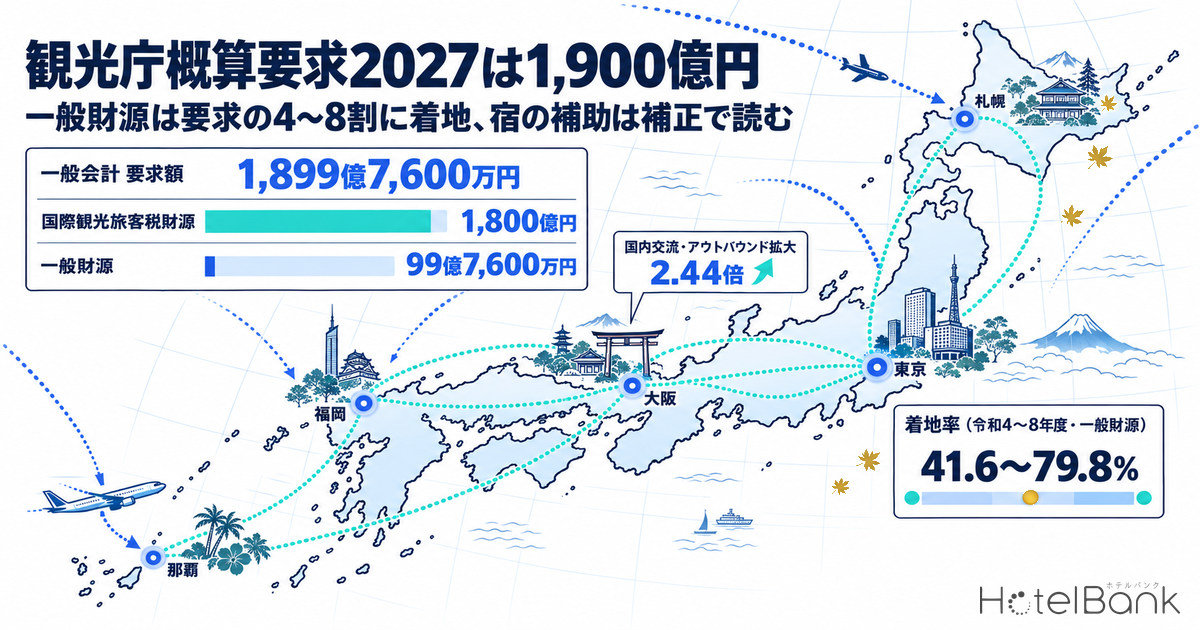
On August 28, 2026, the Japan Tourism Agency (JTA, 観光庁) released its budget request for FY2027 (Reiwa 9, April 2027–March 2028). The general-account request totals ¥189.976 billion, of which ¥180 billion is funded by the International Tourist Tax (国際観光旅客税, the departure tax) and ¥9.976 billion by general revenue. Adding ¥566 million from the Special Account for Reconstruction from the Great East Japan Earthquake brings the total to ¥190.542 billion — the largest request since the agency was founded. A budget request, however, is only a request: both the amounts and the contents will shift during year-end budget compilation. In this article we verify the figures against the JTA’s published documents (PDF), calculate for each funding source how the final budget “landed” relative to the request over the five years from FY2022 to FY2026, and lay out how much accommodation operators should discount the FY2027 numbers. We also look at which budgets have actually funded facility subsidies for hotels and ryokan, and how the 2.44x increase in the domestic-exchange and outbound pillar lines up with the trend in Japanese guest nights.
Metric Definitions Used in This Article
- Budget request (概算要求): The amount each ministry submits to the Ministry of Finance at the end of August for the following fiscal year. It is finalized after Cabinet approval of the government budget draft in late December and passage by the Diet in March. Every “requested amount” in this article is a figure at this stage, not a final amount.
- Approved amount (initial budget): The JTA-related budget set in the December government budget draft (as published in the JTA’s “Budget Decision Overview”). Supplementary budgets are excluded.
- Landing rate: Approved amount ÷ requested amount. This ratio is calculated independently by HotelBank. For departure-tax-funded programs, we compare the JTA’s own allocation and exclude the portion booked by the Imperial Household Agency (development of the Museum of the Imperial Collections, Sannomaru Shozokan, and the Otemon rest area in the East Gardens of the Imperial Palace).
- Guest nights: Annual figures (final) from the JTA’s Overnight Travel Statistics Survey (宿泊旅行統計調査). Number of guests × nights stayed.
- Units: Government documents report in millions of yen; in this article we convert to billions of yen. Because of rounding, line items may not sum exactly to totals.
- — ¥189.976 billion FY2027 general-account request (¥180 billion from the departure tax + ¥9.976 billion from general revenue). Including the reconstruction special account, the total is ¥190.542 billion.
- — 41.6–79.8% The range within which approved general-revenue budgets landed relative to requests over FY2022–FY2026 (median 62.0%). Applying this range to ¥9.976 billion gives roughly ¥4.1–8.0 billion.
- — 1.77x In FY2026, departure-tax funding overshot the ¥70 billion request, reaching ¥124.2 billion on the JTA’s own allocation. This happened because the tax-rate hike was decided midway through budget compilation; with the hike already built into the FY2027 figure of ¥180 billion, a similar overshoot is unlikely.
- — ¥7.75 billion Combined total of the three tourism DX, barrier-free, and labor-saving programs funded in the FY2025 supplementary budget. Facility subsidies for accommodations have been funded more heavily through supplementary budgets than through initial budgets.
- — 72.8% Share of Japanese guests in total guest nights in 2025 (481.18 million guest nights). The 2.44x increase in the domestic-exchange and outbound pillar can be read as a signal that policy support is starting to extend to this largest market.
Breakdown of the FY2027 Request — ¥180 Billion from the Departure Tax, ¥9.976 Billion from General Revenue
The JTA budget consists of three components: programs funded by the International Tourist Tax, programs funded by ordinary general revenue, and the Special Account for Reconstruction from the Great East Japan Earthquake. Checking the summary table in the JTA’s “Overview of the FY2027 JTA-Related Budget Request” (August 2026), we confirmed that every amount reported in the press matches the PDF. The breakdown of general-revenue programs has been reorganized along the three pillars of the 5th Basic Plan for Promoting Japan as a Tourism-Oriented Country, approved by the Cabinet on March 27, 2026.
| Category | FY2027 request | FY2026 budget | Ratio |
|---|---|---|---|
| Departure-tax-funded programs | ¥180.0bn | ¥130.0bn | 1.38x |
| General-revenue programs, total | ¥9.976bn | ¥8.345bn | 1.20x |
| (1) Strategic inbound attraction balanced with residents’ quality of life | ¥6.671bn | ¥6.317bn | 1.06x |
| (2) Expanding domestic exchange and outbound travel | ¥1.220bn | ¥0.500bn | 2.44x |
| (3) Strengthening the resilience of destinations and the tourism industry | ¥1.187bn | ¥0.727bn | 1.63x |
| (4) Other (routine administrative costs, etc.) | ¥0.898bn | ¥0.800bn | 1.12x |
| General account, total | ¥189.976bn | ¥138.345bn | 1.37x |
| Special Account for Reconstruction (Great East Japan Earthquake) | ¥0.566bn | ¥0.665bn | 0.85x |
| Grand total | ¥190.542bn | ¥139.010bn | 1.37x |
Source: Compiled by the HotelBank Editorial Team from the JTA’s “Overview of the FY2027 JTA-Related Budget Request” (August 2026). The FY2026 departure-tax figure of ¥130 billion follows the JTA document and includes the Imperial Household Agency allocation.
There are two points to keep in mind when reading these numbers. First, the ¥180 billion in departure-tax funding — 94.5% of the total — is shown at the request stage only as an overall envelope. The JTA document itself states that “at the budget request stage only the requested amount is shown; specific programs will be considered (…) during the budget compilation process,” so how much goes to which program will not be known until December. Second, within the ¥9.976 billion of general revenue whose contents are visible, the fastest-growing pillars are expanding domestic exchange and outbound travel (2.44x) and strengthening the resilience of destinations and the tourism industry (1.63x). How the departure-tax funds are split across ministries, and which programs actually reach hotels and ryokan, will become clear only when the December budget draft sets the program-by-program allocation.
Why It Swelled to ¥180 Billion — The Departure Tax Rose from ¥1,000 to ¥3,000
The direct reason departure-tax funding reached ¥180 billion is that the revenue source itself grew. The FY2026 tax reform outline of December 2025 decided to raise the International Tourist Tax (commonly called the departure tax) from ¥1,000 to ¥3,000 per departure, effective for departures from July 1, 2026 (with a transitional measure applying the old rate to air and ship tickets purchased by June 30, 2026). The JTA’s budget-trend chart also carries the note “International Tourist Tax increase (July 2026)” at the FY2026 position.
In the FY2026 initial budget, departure-tax funding expanded from ¥49 billion in the previous year (including the Imperial Household Agency allocation) to ¥130 billion. The FY2027 request of ¥180 billion can be read as the first figure that assumes the higher rate applies for a full fiscal year. Counting from the creation of the tax in January 2019, the FY2027 request of ¥180 billion is 30 times the FY2018 initial budget (¥6 billion). How the higher tax could shift outbound travel demand among Japanese travelers toward domestic resorts is a separate question worth watching as the post-hike departure data come in.
Source: Compiled by the HotelBank Editorial Team from the “JTA Budget Trend” chart in the JTA’s “Overview of the FY2027 JTA-Related Budget Request” (in units of ¥100 million, rounded). FY2027 is the requested amount; supplementary budgets etc. are shown through FY2025.
The chart shows that the center of gravity of the JTA budget has shifted substantially. The general-revenue initial budget peaked at ¥21.6 billion in FY2018 and has declined steadily since, reaching ¥8.3 billion in FY2026. Departure-tax funding, by contrast, bottomed out in FY2022 (¥9 billion), when tax revenue shrank during the COVID-19 pandemic, then recovered; by FY2026 it was more than 15 times the size of general revenue. In other words, an ever-larger share of the JTA’s programs is financed by the departure tax. This structural shift also bears directly on how to discount the requested amounts, which we look at next.
A Budget Request Is Not a Final Amount — From the August Request to Passage in March
It is too early to treat the request figures as “next year’s budget.” Japan’s national budget is finalized in three stages: the budget request at the end of August, Cabinet approval of the government budget draft in late December, and passage by the Diet the following March. In the roughly four months between the request and the government draft, negotiations with the Ministry of Finance lead to cuts, reallocations, and the addition of new programs. In tourism, moreover, supplementary budgets are often compiled alongside the autumn economic package, funding programs from a source separate from the initial budget.
| Timing | Stage | What accommodation operators should watch |
|---|---|---|
| End of August 2026 | Budget request (published) | Growth by pillar in general revenue. Departure-tax funding is shown only as an envelope |
| November–December 2026 | Economic package and supplementary budget | Facility-related subsidies such as labor saving, barrier-free upgrades, and DX tend to be funded here |
| Late December 2026 | Cabinet approval of the government budget draft | The program-by-program allocation of departure-tax funding becomes clear |
| March 2027 | Budget passed by the Diet | Application guidelines for each program begin to be published |
| Spring–summer 2027 | Calls for applications and grant decisions | Many programs exclude orders and construction started before the grant decision |
Source: Compiled by the HotelBank Editorial Team from the publication timing of documents on the JTA’s “Budget and Tax” pages. Schedules for individual programs must be confirmed in each program’s application guidelines.
Rather than looking only at the most recent year, this article uses five years of actual results to see where requests tend to land.
What Share of the Request Actually Lands? — Five Years, FY2022–FY2026, by Funding Source
Using the summary tables in the JTA’s annual “Budget Request Overview” and “Budget Decision Overview,” we lined up the requested and approved amounts by funding source for the five years from FY2022 to FY2026. General revenue and departure-tax funding land in completely different ways.
| Fiscal year | General revenue: request | General revenue: approved | Landing rate | Departure tax: request | Departure tax: approved | Landing rate |
|---|---|---|---|---|---|---|
| FY2022 | 17.735 | 14.158 | 79.8% | 24.000 | 8.095 | 33.7% |
| FY2023 | 17.688 | 10.972 | 62.0% | 27.000 | 19.731 | 73.1% |
| FY2024 | 24.112 | 10.025 | 41.6% | 42.000 | 40.293 | 95.9% |
| FY2025 | 14.997 | 8.930 | 59.5% | 47.000 | 44.103 | 93.8% |
| FY2026 | 10.694 | 8.345 | 78.0% | 70.000 | 124.225 | 177.5% |
| FY2027 | 9.976 | Known in December | — | 180.000 | Known in December | — |
Source: Compiled by the HotelBank Editorial Team from the summary tables of the JTA’s “Budget Request Overview” (FY2022–FY2027) and “Budget Decision Overview” (FY2022–FY2026). Approved departure-tax amounts are the JTA’s own allocation (excluding the Imperial Household Agency portion). Landing rates calculated by the editorial team.
Source: Compiled by the HotelBank Editorial Team from the JTA’s “Budget Request Overview” and “Budget Decision Overview.”
General revenue landed below the request in every one of the five years. Landing rates ranged from 41.6% (FY2024) to 79.8% (FY2022), with a median of 62.0% and a simple average of 64.2%. The most recent year, FY2026, came in at 78.0%, toward the high end of the five-year range. Applied to the FY2027 request of ¥9.976 billion, this gives a range of about ¥4.1 billion at the low end (41.6%), about ¥6.2 billion at the median (62.0%), and about ¥7.8 billion at the latest year’s rate (78.0%). Viewed from another angle, the approved general-revenue amount has fallen year after year, from ¥14.158 billion in FY2022 to ¥8.345 billion in FY2026, at year-on-year ratios of 0.78–0.93x. Applying those ratios to the previous year’s ¥8.345 billion yields about ¥6.5–7.8 billion, so the results of the two methods broadly overlap.
Note, however, that shrinking general revenue does not mean programs themselves are shrinking. Many programs once funded from general revenue, such as inbound promotion and support for destination management organizations (DMOs), have been shifted to departure-tax funding. What matters to an accommodation operator is not which pot the money comes from, but how much is allocated to the programs its property can use. In that sense, the practical way to use the general-revenue landing rate is as a rough discount factor when reading program-level requested amounts.
Departure-tax funding, unlike general revenue, has landed close to — or even above — the requested amount. Excluding FY2022 (33.7%), when outbound travelers collapsed during the pandemic, FY2024 and FY2025 came in at 94–96%, in line with projected tax revenue. The 177.5% overshoot in FY2026 was a one-off, caused by the decision in December, after the request, to triple the tax rate. Because the FY2027 figure of ¥180 billion already assumes the higher rate, an overshoot of similar size is unlikely. Since departure-tax funding is set by revenue projections tied to the number of outbound travelers, it is better seen as an envelope that could move either up or down depending on departure trends.
How Accommodation Operators Should Read It — The 1.63x Resilience Pillar and Facility Subsidies Funded Through Supplementary Budgets
The item most relevant to accommodation operators is the general-revenue pillar “strengthening the resilience of destinations and the tourism industry” (request ¥1.187 billion, 1.63x). In the program list of the request overview, this pillar includes “promoting tourism DX and regional transport DX,” “strengthening the management capabilities of the tourism industry (promoting the upgrading of accommodation facilities, and supporting town development in regional hot-spring areas through removal and regeneration of derelict buildings),” “securing tourism human resources (securing workers for destinations and the tourism industry),” and “improving reception environments for diverse needs (promoting universal tourism).” Trade-press coverage also describes securing and training staff, tourism DX and labor-saving investment, and promoting facility upgrades as falling under this pillar.
Source: Compiled by the HotelBank Editorial Team from the JTA’s “Overview of the FY2027 JTA-Related Budget Request” (three pillars, excluding routine administrative costs etc.).
Judging the scale of facility subsidies that hotels and ryokan can use directly from the initial budget alone, however, badly misjudges the actual level of support. Past decision overviews show that facility-related subsidies — renovation, labor saving, and barrier-free upgrades of accommodations — have been funded more heavily through supplementary budgets than through initial budgets.
| Supplementary budget | Main program | Supplementary amount | General revenue in next year’s initial budget |
|---|---|---|---|
| FY2023 supplementary | Region-wide revitalization and value enhancement of destinations and the tourism industry | ¥20.0bn | ¥10.025bn (FY2024) |
| FY2024 supplementary | Region-wide revitalization and value enhancement of destinations and the tourism industry | ¥30.0bn | ¥8.930bn (FY2025) |
| FY2025 supplementary | Improving environments to promote universal tourism (barrier-free upgrades of accommodations, etc.) | ¥4.0bn | ¥8.345bn (FY2026) |
| Program promoting labor saving and staffing efficiency at destinations and in the tourism industry | ¥2.55bn | ||
| Program promoting tourism DX at destinations and in the tourism industry nationwide | ¥1.2bn |
Source: Compiled by the HotelBank Editorial Team from the supplementary-budget lists in the JTA’s “Budget Decision Overview” for FY2024, FY2025, and FY2026.
In the FY2023 and FY2024 supplementary budgets, the value-enhancement program alone — which includes accommodation renovation — received ¥20–30 billion, 2.0–3.4 times the total general-revenue initial budget of the following year. In the FY2025 supplementary budget, too, three programs for barrier-free upgrades, labor saving, and tourism DX at accommodations totaled ¥7.75 billion, approaching the FY2026 general-revenue initial budget of ¥8.345 billion. For the FY2025 supplementary labor-saving program, automated check-in kiosks and central kitchens were given as illustrative uses.
The lesson from this track record is that accommodation operators should watch the autumn economic package and supplementary budget as closely as the August budget request. Subsidy funding usable for capex in FY2027 may come not only from the FY2027 initial budget but also from the FY2026 supplementary budget to be compiled in autumn 2026. Neither is confirmed at this point, but if a supplementary-budget call for applications opens, properties that already have plans and quotes in hand can apply without worrying about the short application window. Preparing in advance is the biggest upside.
The 2.44x Domestic Exchange and Outbound Pillar Signals a Broadening Policy Focus — Set Against 481.18 Million Japanese Guest Nights
Within general revenue, the pillar with the highest growth rate is “expanding domestic exchange and outbound travel,” at 2.44x (from ¥500 million to ¥1.22 billion). Its program list includes smoothing domestic travel demand through initiatives such as “La-cation” (family trips combining learning and vacation during school days), creating workplaces where it is easier to take leave, building “related populations” through workations and dual-region living, promoting universal tourism, and encouraging outbound travel through overseas school trips and working holidays. While the amounts are not large, they show that tourism policy, long concentrated on attracting inbound visitors, has begun to extend its support to domestic exchange and to smoothing travel demand among Japanese residents.
The significance of this shift becomes clear when set against guest-night data from the JTA’s Overnight Travel Statistics Survey. Of the 661.11 million total guest nights in 2025 (final figures), Japanese guests accounted for 481.18 million, or 72.8%. Although their share has fallen as inbound travel has grown, more than 70% of the accommodation market is still Japanese demand.
Source: Compiled by the HotelBank Editorial Team from the JTA’s “Overnight Travel Statistics Survey (2025 annual, final)” (published July 6, 2026).
Japanese guest nights peaked at 499.70 million in 2023, then fell to 494.60 million in 2024 and 481.18 million in 2025 (-2.7% YoY, +0.2% vs. 2019) — essentially flat at the 2019 level. Foreign guest nights, meanwhile, rose to 179.92 million in 2025 (+55.6% vs. 2019). In 2026 so far, Japanese guest nights were 33.6 million in June (-6.3% YoY, second preliminary estimate) and 41.1 million in July (-3.1% YoY, first preliminary estimate). Note that from January 2026 the survey changed its stratification criterion from “number of employees” to “number of guest rooms,” so year-on-year comparisons may include effects of this revision.
Against this backdrop, thicker funding for smoothing domestic travel demand and building related populations is an upside for properties whose main customers are Japanese. If measures that lift weekday and off-season demand take hold, the peaks and troughs in occupancy by day of week and season will flatten, giving operators more options for selling rooms throughout the year. For a sense of scale, dividing the ¥1.22 billion general-revenue domestic-exchange and outbound pillar by 2025 Japanese guest nights gives only about ¥2.5 per guest night. Precisely because the envelope is still small, there is plenty of room for it to grow.
What to Prepare Now for FY2027
With subsidies, starting a plan only after the call for applications opens is often too late. Application windows are frequently limited to a few weeks, while obtaining quotes and drafting a business plan takes one to two months. Based on the programs funded in past budgets, we have organized the preparations accommodation operators can make now into five areas.
| Area | Position in past budgets | What to prepare now |
|---|---|---|
| Labor saving | FY2025 supplementary “labor saving and staffing efficiency program” (automated check-in kiosks, central kitchens, etc.) | An inventory of time spent per operational process; candidate equipment and quotes from at least two vendors |
| Tourism DX | FY2025 supplementary “tourism DX promotion program” (introduction of digital tools such as reservation and inventory management, planning and hands-on support) | A diagram of current systems, data-integration requirements, and draft post-implementation KPIs |
| Barrier-free | FY2025 supplementary “improving environments to promote universal tourism” (removing level differences in guest rooms, etc.) | Identify the rooms and circulation routes to be renovated; drawings and renovation quotes |
| Multilingual / reception environment | Program promoting improvement of reception environments (subsidy rates of 1/2, 1/3, etc.; private businesses also eligible); multilingual interpretation | A list of current signage and in-house information; confirm coordination with the local DMO and municipality |
| Energy saving / facility renewal | Renovation support under the value-enhancement program (FY2023 and FY2024 supplementary). Programs from other ministries are also candidates for energy-saving equipment | Monthly records of energy use; priorities and rough costs for equipment renewal |
Source: Compiled by the HotelBank Editorial Team from program summaries in the JTA’s “Budget Decision Overview” (FY2025 and FY2026). Whether programs of the same name and content will be funded in FY2027 is undecided.
One point common to many programs is that “orders placed or construction started before the grant decision are not eligible.” Assuming calls open at the start of the fiscal year and grant decisions come in summer, equipment orders and construction tend to be concentrated from summer onward. The more a property wants to avoid construction during its peak season, the more it benefits from moving its plans forward. For a list of DX-related programs, see our FY2026 Tourism DX Subsidy Guide for Hotels.
Frequently Asked Questions
Q. How much is the Japan Tourism Agency’s budget request for FY2027 (Reiwa 9)?
¥189.976 billion in the general account. Of this, ¥180 billion is funded by the International Tourist Tax and ¥9.976 billion by general revenue; adding ¥566 million from the Special Account for Reconstruction from the Great East Japan Earthquake brings the total to ¥190.542 billion (JTA, “Overview of the FY2027 JTA-Related Budget Request”).
Q. Does the requested amount become the budget as is?
No. It is finalized through the government budget draft in late December and Diet deliberations the following March. Over FY2022–FY2026, approved general-revenue amounts landed at 41.6–79.8% of the request (median 62.0%). Departure-tax funding tracks projected tax revenue; in FY2026, when the tax-rate hike was decided, it came in at 1.77 times the request (JTA allocation).
Q. Which budget should I look at for facility subsidies for accommodations?
Be sure to check the supplementary budget compiled in autumn in addition to the initial budget. The FY2023 and FY2024 supplementary budgets provided ¥20–30 billion for the value-enhancement program, and the FY2025 supplementary budget provided a total of ¥7.75 billion for three programs covering barrier-free upgrades, labor saving, and tourism DX — in each case on a scale equal to or larger than the general-revenue initial budget.
Summary
The JTA’s FY2027 budget request is a record ¥189.976 billion in the general account (¥190.542 billion including the reconstruction special account). The main driver is the increase in the International Tourist Tax from ¥1,000 to ¥3,000 in July 2026, which raised departure-tax funding to ¥180 billion. These are request-stage figures, however, not final amounts. Based on the past five years, general-revenue requests have landed at 40–80% of the requested level, so it is prudent to pencil in the ¥9.976 billion at roughly ¥4.1–8.0 billion. Because departure-tax funding already assumes the higher rate, a large overshoot like FY2026’s is unlikely.
There are three practical implications for accommodation operators. First, because facility subsidies have been funded heavily through supplementary budgets, track the autumn economic package and supplementary budget with the same weight as the budget request. Second, before calls for applications open, have plans and quotes ready in each area: labor saving, DX, barrier-free, multilingual support, and energy saving. Third, build the policy broadening reflected in the 2.44x domestic-exchange and outbound pillar into your sales plans as an opportunity to capture weekday and off-season demand from Japanese guests. We will update the figures once the late-December government budget draft reveals the allocation of departure-tax funding.
Note: This article is based on documents published by the JTA as of September 26, 2026, the date of our research. Budget requests are request-stage amounts and are subject to cuts, reallocations, and the creation of new programs during budget compilation. Estimates based on landing rates are rough guides derived from past results and do not represent a forecast of the FY2027 budget.
Further Reading
- JTA’s ¥138.3B FY2026 Budget: Regional Dispersion Ideal vs. 2.5x ADR Gap Reality
- FY2026 Tourism DX Subsidy Guide for Hotels: 7 Programs for PMS & Smart Check-In
References and Sources
■ Data sources
Summary tables of the JTA’s “Overview of the JTA-Related Budget Request” (FY2022–FY2027) and “Overview of the JTA-Related Budget Decision” (FY2022–FY2026); the JTA’s Overnight Travel Statistics Survey (2025 annual, final; June 2026, second preliminary; July 2026, first preliminary). Background on departure-tax funding and the tax-rate hike was supplemented with press reports (Travel Voice, Yamatogokoro.jp, Nikkei).
■ Calculation assumptions
The landing rate is the approved initial-budget amount divided by the requested amount, calculated separately for general revenue and for International Tourist Tax funding (JTA allocation). The indicative FY2027 general-revenue landing range (about ¥4.1–8.0 billion) is the requested ¥9.976 billion multiplied by the minimum (41.6%) and maximum (79.8%) landing rates for FY2022–FY2026; it is not a forecast. Supplementary budgets are tallied separately from initial budgets.
■ Limitations
Approved amounts are on an initial-budget basis and exclude supplementary budgets compiled during the year. Departure-tax funding in FY2026 (landing rate 177.5%) was an unusual year in which the tax-rate hike was decided midway through budget compilation; a similar overshoot is unlikely in FY2027. Because program pillars are reorganized each year, pillar-level ratios rely on the previous-year comparison in the budget request overview. Overnight Travel Statistics Survey data from January 2026 onward may include effects of the change in stratification criteria.
■ JTA budget documents (Japanese)
- JTA, “Budget and Tax — JTA Budget”
- JTA, “Overview of the FY2027 JTA-Related Budget Request” (August 2026)
- JTA, “Overview of the FY2026 JTA-Related Budget Decision” (December 2025)
- JTA, “Overview of the FY2026 JTA-Related Budget Request” (August 2025)
- JTA, “Overview of the FY2025 JTA-Related Budget Decision” (December 2024)
- JTA, “Overview of the FY2025 JTA-Related Budget Request” (August 2024)
- JTA, “Overview of the FY2024 JTA-Related Budget Decision” (December 2023)
- JTA, “Overview of the FY2024 JTA-Related Budget Request” (August 2023)
- JTA, “Overview of the FY2023 JTA-Related Budget Decision” (December 2022)
- JTA, “Overview of the FY2023 JTA-Related Budget Request” (August 2022)
- JTA, “Overview of the FY2022 JTA-Related Budget Decision”
- JTA, “Overview of the FY2022 JTA-Related Budget Request”
■ Government statistics (Japanese)
- JTA, “Overnight Travel Statistics Survey (2025 annual, final)” (published July 6, 2026)
- JTA, “Overnight Travel Statistics Survey (July 2026 first preliminary, June 2026 second preliminary)” (published August 31, 2026)
■ News (Japanese)
- JTA’s 2027 budget request hits a record of about ¥190 billion; domestic and outbound up 2.44x (Travel Voice, August 28, 2026)
- JTA’s FY2027 budget request of ¥190.5 billion: ¥180 billion from the departure tax, domestic exchange and outbound up 2.44x (Yamatogokoro.jp)
- Government and ruling parties set policy to raise the departure tax to ¥3,000 in the FY2026 tax reform outline (Travel Voice, December 22, 2025)
- Departure tax to rise from ¥1,000 to ¥3,000 in July 2026, per government and ruling-party policy (Nikkei)