

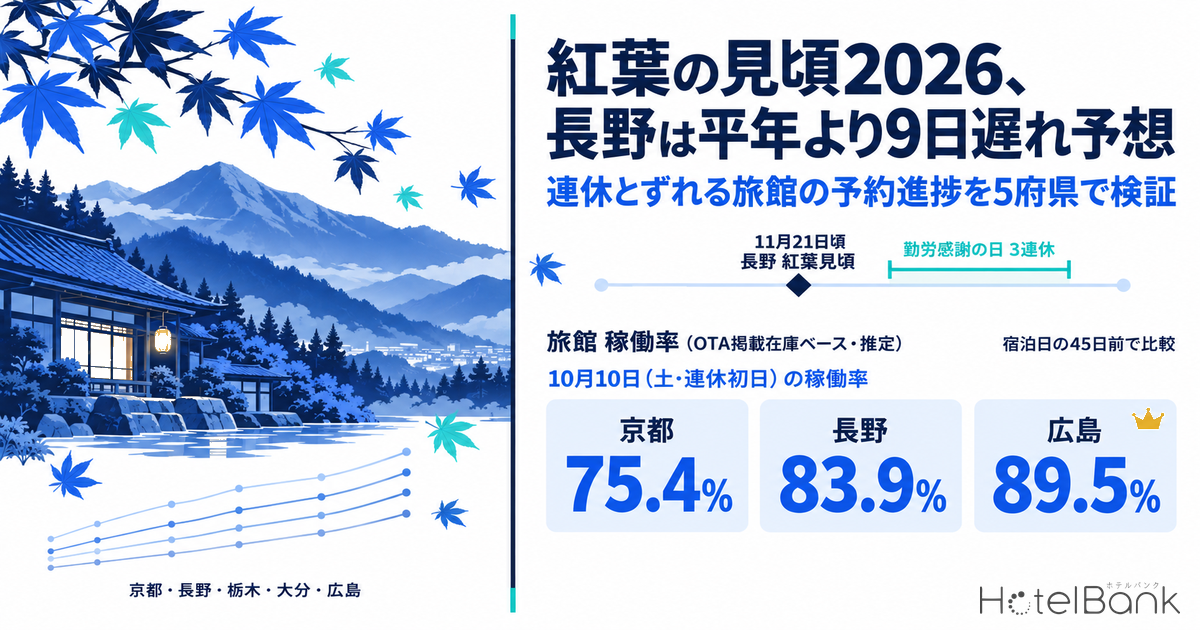
Japan’s 2026 fall foliage is forecast to peak around November 21 in Nagano, nine days later than normal, and around November 7 in Sapporo, ten days later (Japan Meteorological Corporation (日本気象株式会社), released September 2). Kyoto, Hiroshima and Tokyo are forecast to be near normal, but in each case the heart of the peak falls between late November and early December and does not necessarily line up with the calendar’s three-day weekends (October 10–12 and November 21–23). This article lines up ryokan in five prefectures — Kyoto, Nagano, Tochigi, Oita and Hiroshima — at the same point of 45 days before the stay date, using occupancy (estimated, based on OTA-listed inventory), and sets out, as an interim reading as of September 25, whether it is the long weekends or the foliage peak that is moving bookings.
- — Nagano’s red leaves are forecast to peak around November 21, nine days later than normal, coinciding with the Labor Thanksgiving Day three-day weekend. Kyoto (red leaves around December 11), Hiroshima and Tokyo are near normal, with the peak centered on late November to early December (Japan Meteorological Corporation, released September 2, 2026).
- — Aligned at the same point of 45 days before the stay date (LT45), Saturday, October 10 (first night of the Sports Day three-day weekend) is the highest level of the first half of October in all five prefectures (from 75.4% in Kyoto to 89.5% in Hiroshima).
- — Holiday nights followed by a working day form a trough. On the nights of October 12 and November 3, all five prefectures stayed at 55.5–62.5%, and November 3 was lower than the ordinary weekday that follows it.
- — LT45 occupancy for Saturday, November 7 was 80.5% in Tochigi and 79.9% in Oita: a weekend that is not a long weekend has already overtaken the first night of the long weekend.
- — The effect of the November three-day weekend coinciding with the peak can be tested on the same scale from October 7, when the November 21 stay date reaches LT45 (figures are an interim reading as of September 25, 2026, estimated from OTA-listed inventory).
Metric Definitions Used in This Article
- OCC (occupancy): Rooms sold as a share of total rooms in the area (an estimate based on inventory sold through OTAs). In the text it is written as “occupancy (estimated, based on OTA-listed inventory)”. It is an estimate based on how inventory offered on OTAs is being consumed and differs from a property’s actual overall occupancy. Only prefecture-level aggregates are shown; occupancy is not calculated for individual properties.
- LT (lead time): Number of days until the stay date. LT45 = 45 days before the stay date. This article uses only observations within LT45.
- Same-LT comparison: Comparing occupancy for different stay dates at the same number of days before each stay date. It is used to remove the “time gap” effect whereby stay dates further in the future naturally have more rooms left.
- Current remaining-room rate: OTA rooms remaining as a share of total rooms (per property). Early sell-out: the further from the stay date remaining rooms first hit zero, the earlier the sell-out.
- Listed price: Rate per room for two guests in one room (tax included), averaged across all plans.
- Scope: The ryokan category. Property-level tallies cover only properties offering 30% or more of their total rooms on OTAs.
- Data source: MetroEngines Research
2026 Fall Foliage Forecast — Nagano Nine Days Late, Kyoto and Hiroshima Near Normal
On September 2, 2026, Japan Meteorological Corporation (日本気象株式会社) released its “First 2026 Red- and Yellow-Leaf Peak Forecast”. Because autumn temperatures are expected to run above normal nationwide, it says the peak for red leaves (maples) and yellow leaves (ginkgo) will be “near normal” or “late” in many places. By region, red leaves in northern Japan are expected to be near normal, both red and yellow leaves in eastern Japan near normal or late, and both in western Japan near normal.
Looking across the main forecast points, the largest delays are in northern Japan and inland eastern Japan. Nagano’s red leaves are forecast for around November 21, nine days later than normal, and Sapporo’s for around November 7, ten days later. Kyoto, by contrast, is forecast at around December 11 for red leaves and November 27 for yellow leaves, and Hiroshima at around November 28 for red leaves and November 20 for yellow leaves — all near normal. Note that these are forecasts for representative urban points: high-altitude spots such as Nikko and Kamikochi peak earlier, and timing also differs for individual famous sites such as Yabakei and Miyajima.
| Location | Red-leaf peak forecast | vs. normal | Yellow-leaf peak forecast | vs. normal |
|---|---|---|---|---|
| Sapporo | Around Nov 7 | 10 days late | Around Nov 6 | Near normal |
| Nagano | Around Nov 21 | 9 days late | Around Nov 14 | Near normal |
| Tokyo | Around Nov 29 | Near normal | Around Nov 26 | Near normal |
| Kyoto | Around Dec 11 | Near normal | Around Nov 27 | Near normal |
| Osaka | Around Dec 4 | Near normal | Around Nov 24 | Near normal |
| Hiroshima | Around Nov 28 | Near normal | Around Nov 20 | Near normal |
Source: Compiled by HotelBank Editorial Team from Japan Meteorological Corporation, “First 2026 Red- and Yellow-Leaf Peak Forecast Released” (September 2, 2026)
Leaves in the lowlands have not yet started to turn. According to the Japan Weather Association’s tenki.jp foliage information, as of the 3 p.m. update on September 25, parts of Hokkaido were shown as “at peak” or “starting to turn” and mountain spots such as Sounkyo and Oze had reached their peak, but every prefecture from Honshu southward was still shown as “green”. Peak forecasts are updated as temperatures unfold, so sales plans need to be adjusted while checking the second and subsequent forecasts.
The Gap Between Calendar Long Weekends and the Peak Forecast
In autumn 2026, the holiday calendar and the forecast peak are out of step. Sports Day in October falls on Monday, October 12, creating a three-day weekend from Saturday the 10th. Lowland foliage will still be green at that point, however, so what supports demand is less the foliage itself than the pull of the calendar — an autumn long weekend. Culture Day on Tuesday, November 3 is an isolated holiday with working days on either side and does not form a long weekend.
In November, Labor Thanksgiving Day on November 23 falls on a Monday, creating a three-day weekend from Saturday the 21st. Nagano’s forecast red-leaf date (around November 21) coincides exactly with this weekend. By contrast, Kyoto’s yellow leaves (around November 27), Hiroshima’s red leaves (around November 28) and Tokyo’s red leaves (around November 29) cluster on the weekend after it, and Kyoto’s red leaves, at around December 11, fall nearly three weeks after the long weekend.
| Date | Position in the calendar | Relation to the 2026 peak forecast |
|---|---|---|
| Oct 10 (Sat) – Oct 12 (Mon) | Sports Day three-day weekend | Lowland foliage still green. Outside high-altitude areas, a long weekend “before the leaves” |
| Nov 3 (Tue) | Culture Day (isolated holiday; working days on both sides) | Before Nagano’s yellow-leaf forecast (around Nov 14) |
| Nov 14 (Sat) | Ordinary weekend | Nagano’s forecast yellow-leaf date (near normal) |
| Nov 21 (Sat) – Nov 23 (Mon) | Labor Thanksgiving Day three-day weekend | Coincides with Nagano’s forecast red-leaf date (around Nov 21, nine days later than normal). Immediately after Hiroshima’s yellow-leaf forecast (around Nov 20) |
| Nov 27 (Fri) – Nov 29 (Sun) | Ordinary weekend | Forecast dates cluster here: Kyoto’s yellow leaves (around Nov 27), Hiroshima’s red leaves (around Nov 28) and Tokyo’s red leaves (around Nov 29) |
| Dec 4 (Fri) and Dec 11 (Fri) | Ordinary weekdays (Fridays) | Forecast dates for Osaka’s red leaves (around Dec 4) and Kyoto’s red leaves (around Dec 11) |
Source: Compiled by HotelBank Editorial Team from Japan Meteorological Corporation, “First 2026 Red- and Yellow-Leaf Peak Forecast” (released September 2, 2026) and Cabinet Office, “National Holidays”
This gap matters for ryokan sales in two ways. First, long-weekend nights tend to fill regardless of the peak, while peak weekends tend to fill even when they are not long weekends, so several demand peaks form over the course of autumn. Second, demand troughs tend to form on the last night of a long weekend and on the weekdays just after the peak. The next section checks these peaks and troughs against actual booking pace.
Ground Rules for Comparison — Correcting for “Later Dates Have More Rooms Left”
Simply lining up inventory data easily leads to the wrong conclusion. Viewed on September 25, the October 10 stay date is 15 days out, while November 28 is 64 days out. The further ahead the stay date, the more time remains for bookings to come in, so more remaining rooms is only to be expected. Reading “November 28 has many rooms left, so demand is weak” is merely observing a difference in the length of the booking window.
This article therefore compares on the following basis.
Step 1: Align every stay date at the same point — 45 days before the stay date (LT45) — using occupancy (estimated, based on OTA-listed inventory).
Step 2: Treat only the differences that appear at the same LT45 as a “skew in demand”. Comparing Saturdays with Saturdays and weekdays with weekdays also separates out the day-of-week effect.
Step 3: Stay dates that had not reached LT45 as of September 25 (November 14 onward) are not used in numerical comparisons. Observations more than 45 days before the stay date include periods before allotments are loaded and may not represent booking pace.
Step 4: Comparison with the same-LT value for the same period last year would also be useful, but property-level remaining-room observation began in March 2026 and no same-LT values exist for autumn 2025. This article is therefore limited to same-LT comparisons within the same year.
The dates on which the main November Saturdays reach LT45 are as follows. Saturday, November 21 reaches LT45 on October 7, and Saturday, November 28 on October 14. The effect of the peak coinciding with the long weekend can be tested on the same scale from early October.
| Stay date | LT as of Sep 25 | Date LT45 is reached | Treatment in this article |
|---|---|---|---|
| Oct 10 (Sat) | 15 | Aug 26 (reached) | Same-LT comparison + interim reading at 15 days out |
| Nov 7 (Sat) | 43 | Sep 23 (reached) | Same-LT comparison (LT45) |
| Nov 14 (Sat) | 50 | Sep 30 | Excluded from numerical comparison (LT45 not yet reached) |
| Nov 21 (Sat) | 57 | Oct 7 | Same as above |
| Nov 28 (Sat) | 64 | Oct 14 | Same as above |
Source: Compiled by HotelBank Editorial Team
Compared at the Same 45 Days Out — Ryokan Occupancy in Five Prefectures
The table and chart below line up ryokan occupancy (estimated, based on OTA-listed inventory) at LT45 for the main stay dates from October 3 to November 7. Coverage is 121–126 properties / 2,208–2,341 rooms in Kyoto, 281–286 properties / 6,654–6,758 rooms in Nagano, 149–150 properties / 5,831–5,849 rooms in Tochigi, 235–239 properties / 3,675–3,737 rooms in Oita, and 42–45 properties / 1,101–1,133 rooms in Hiroshima (all on a major-booking-site listing basis).
Source: MetroEngines Research; compiled by HotelBank Editorial Team (ryokan; occupancy at LT45, estimated from OTA-listed inventory)
| Stay date | Kyoto | Nagano | Tochigi | Oita | Hiroshima |
|---|---|---|---|---|---|
| 10/3 (Sat) | 57.1% | 71.3% | 72.0% | 62.9% | 69.6% |
| 10/7 (Wed) | 66.6% | 66.4% | 62.5% | 58.8% | 69.5% |
| 10/10 (Sat, long-weekend first night) | 75.4% | 83.9% | 79.1% | 77.0% | 89.5% |
| 10/11 (Sun, long-weekend middle night) | 66.7% | 74.4% | 73.8% | 69.1% | 83.1% |
| 10/12 (Mon, Sports Day) | 56.9% | 60.2% | 55.5% | 58.4% | 60.1% |
| 10/17 (Sat) | 64.7% | 79.5% | 69.9% | 74.2% | 80.9% |
| 10/21 (Wed) | 75.2% | 68.3% | 62.8% | 68.2% | 73.6% |
| 10/24 (Sat) | 72.1% | 78.8% | 75.4% | 73.0% | 87.4% |
| 10/31 (Sat) | 70.6% | 79.9% | 75.8% | 78.1% | 87.4% |
| 11/3 (Tue, Culture Day) | 60.3% | 59.5% | 62.3% | 62.5% | 59.3% |
| 11/4 (Wed) | 69.9% | 64.8% | 66.7% | 69.9% | 66.1% |
| 11/7 (Sat) | 72.2% | 77.1% | 80.5% | 79.9% | 80.1% |
| Properties / rooms covered | 121–126 properties 2,208–2,341 rooms | 281–286 properties 6,654–6,758 rooms | 149–150 properties 5,831–5,849 rooms | 235–239 properties 3,675–3,737 rooms | 42–45 properties 1,101–1,133 rooms |
Note: Ryokan category; occupancy (estimated, based on OTA-listed inventory) at 45 days before the stay date (LT45). The LT45 observation dates run from August 19 (Oct 3 stay) to September 23 (Nov 7 stay). The number of properties (N) and rooms (M) covered is on a major-booking-site listing basis and varies slightly by stay date, so ranges are shown.
Source: MetroEngines Research; compiled by HotelBank Editorial Team
Aligned at the same LT45, three patterns emerge. First, Saturday, October 10 — the first night of the Sports Day three-day weekend — is the highest of the first half of October in all five prefectures: 75.4% in Kyoto, 83.9% in Nagano, 79.1% in Tochigi, 77.0% in Oita and 89.5% in Hiroshima. Compared with October 3, an ordinary Saturday in the same month, it was 18.3pt higher in Kyoto and 12.6pt higher in Nagano. Even before the leaves turn, the first night of a long weekend is a strong demand date.
Second, a holiday night does not automatically become a demand date. On the night of Monday, October 12 (Sports Day), all five prefectures stayed at 55.5–60.2%, and the night of Tuesday, November 3 (Culture Day) came in at 59.3–62.5%. November 3 in particular was lower in all five prefectures than Wednesday, November 4, an ordinary weekday (a 9.6pt gap in Kyoto and 7.4pt in Oita). A holiday night followed by a working day evidently does not function well as a “day off” in terms of lodging demand.
Third, in some prefectures Saturdays in early November have already reached the level of a long-weekend first night. LT45 occupancy for Saturday, November 7 was 80.5% in Tochigi and 79.9% in Oita, both above the October 10 first night (79.1% in Tochigi, 77.0% in Oita). Kyoto was at 72.2%, 3.2pt below the long-weekend first night, and Nagano at 77.1%, 6.8pt below. That weekend is when foliage spots in Nikko and Kyushu come into season, which suggests autumn weekend demand is building even without a long weekend.
Kyoto shows another feature. LT45 occupancy for Wednesday, October 21 was 75.2%, almost level with the October 10 long-weekend first night (75.4%). Kyoto was the only one of the five prefectures where a weekday stay date came this close to the long-weekend first night, pointing to the depth of the demand that supports weekdays, such as group demand in the school-trip season and inbound demand. On price, the listed price of Kyoto ryokan (all-plan average, tax included) at LT45 was about ¥69,700 for the November 7 stay, above about ¥61,900 for October 10. Occupancy falls just short of the long-weekend first night, but prices have already switched to autumn high-season levels. Nationally, school trips are heavily concentrated in October to December, which is one reason weekday demand in Kyoto holds up through this period.
October 10, First Night of the Long Weekend — Interim Reading at 15 Days Out
As of September 25, the October 10 stay date is 15 days out and bookings are in their final stretch. Prefecture-level occupancy (estimated, based on OTA-listed inventory) rose over the roughly one month from LT45 to LT16 (observed September 24) by 14.0pt in Kyoto, from 75.4% to 89.4%, and by 17.2pt in Oita, from 77.0% to 94.2%. Nagano was already high at 83.9% at LT45 and had reached 92.8% at LT16.
Source: MetroEngines Research; compiled by HotelBank Editorial Team (ryokan; October 10 stay)
| Prefecture (ryokan) | LT45 (8/26) | LT16 (9/24) | Change | Properties (N) / rooms (M) |
|---|---|---|---|---|
| Kyoto | 75.4% | 89.4% | +14.0pt | 121–122 properties / 2,232 rooms |
| Nagano | 83.9% | 92.8% | +8.9pt | 282–283 properties / 6,654 rooms |
| Tochigi | 79.1% | 89.0% | +9.9pt | 150 properties / 5,843 rooms |
| Oita | 77.0% | 94.2% | +17.2pt | 239 properties / 3,737 rooms |
| Hiroshima | 89.5% | 95.4% | +5.9pt | 44 properties / 1,129 rooms |
Note: Stay on Saturday, October 10. Occupancy (estimated, based on OTA-listed inventory). Properties (N) and rooms (M) covered are on a major-booking-site listing basis.
Source: MetroEngines Research; compiled by HotelBank Editorial Team
Even for the same long weekend, the speed at which rooms fill differs by prefecture. The next chart overlays the booking curves for the Saturdays of October 10, 17 and 24 in Kyoto and Nagano. In Kyoto, at the same LT45, October 10 stood at 75.4% and October 17 at 64.7%, a gap of 10.7pt, and a gap of 9.3pt remained at LT23 (86.9% versus 77.6%). In Nagano, the gap between October 10 and October 17 was 4.4pt at LT45 and 6.3pt at LT23 — smaller, but widening slightly toward arrival.
Note: Ryokan category. Kyoto: 121–123 properties / 2,232–2,241 rooms; Nagano: 283–286 properties / 6,654–6,742 rooms (major-booking-site listing basis). Observations through September 24.
Source: MetroEngines Research; compiled by HotelBank Editorial Team
At the property level, inventory for the October 10 stay is thinner still. Tallying the position as of September 25 for ryokan that offer 30% or more of their total rooms on OTAs, about half of the properties tallied in Nagano, Oita and Hiroshima had zero rooms remaining, and the median current remaining-room rate was 1.1% in Nagano, 0.0% in Oita and 1.3% in Hiroshima. In Kyoto and Tochigi the medians were 11.5% and 12.5% respectively, with 36 properties at zero rooms in Kyoto (36% of those tallied) and 29 in Tochigi (27%). Properties observed as sold out from 45 or more days before the stay date numbered 57 in Nagano, 45 in Oita and 26 in Kyoto.
| Prefecture | Ryokan universe | Remaining rooms tracked | Tallied (30%+ of rooms on OTAs) | Current remaining-room rate (median) | Properties with zero rooms now | Observed sold out 45+ days before stay |
|---|---|---|---|---|---|---|
| Kyoto | 475 | 169 | 100 | 11.5% | 36 properties (36%) | 26 properties |
| Nagano | 800 | 335 | 164 | 1.1% | 78 properties (50%) | 57 properties |
| Tochigi | 461 | 194 | 107 | 12.5% | 29 properties (27%) | 21 properties |
| Oita | 609 | 287 | 163 | 0.0% | 81 properties (51%) | 45 properties |
| Hiroshima | 185 | 62 | 26 | 1.3% | 13 properties (50%) | 8 properties |
Note: Stay on Saturday, October 10; two guests per room. Observed as of September 25 (15 days before the stay date). Only properties offering 30% or more of their total rooms on OTAs are tallied (those below 30% are excluded). For Nagano, the remaining-room rate and property counts are calculated on 156 of the 164 tallied properties, and for Oita on 158 of 163. Current remaining-room rate = OTA rooms remaining as a share of total rooms. Zero rooms remaining is a reversible state that includes stop-sells; inventory can return through cancellations or additional releases.
Source: MetroEngines Research; compiled by HotelBank Editorial Team
Zero rooms remaining here is a reversible state that includes stop-sells, and inventory can return as the stay date approaches through cancellations or additional releases by the property. The final two weeks before the long-weekend first night are a phase where the ability to resell returned inventory without letting it slip tends to make the difference in revenue.
The November Long Weekend Is Still Ahead — Early October Is the First Checkpoint
For Nagano, where the forecast peak coincides with the Labor Thanksgiving Day three-day weekend, Saturday, November 21 and Sunday, November 22 could be the biggest peak of the autumn. As of September 25, however, the November 21 stay date is still 57 days out and, in line with Step 3, has been left out of numerical comparison. The large number of rooms remaining at this stage simply reflects the booking window still left.
The checkpoint is October 7, when the November 21 stay date reaches LT45. From that date, setting LT45 occupancy for November 21 alongside LT45 for October 10 (long-weekend first night) and Saturday, November 7 will measure the uplift from “long weekend × peak” on the same scale. For Kyoto, the first checkpoint is October 14, when the November 28 stay date — close to the forecast peak (yellow leaves around November 27, red leaves around December 11) — reaches LT45.
One point to keep in mind is the pattern confirmed for October 12 and November 3: holiday nights followed by a working day are weak. The night of Monday, November 23 (Labor Thanksgiving Day) is also followed by a working day and is likely to show the same pattern. In other words, even for the November three-day weekend, it is realistic to assume that demand centers on the two nights of Saturday the 21st and Sunday the 22nd, and that the night of the 23rd tends to be a trough. Measures for the final night of a long weekend should be planned with that dip as the starting assumption.
Practical Implications — Three Designs for Turning the Peak Gap into Revenue
1. Design inventory for late-November weekdays and the final night of the long weekend first. In Kyoto and Hiroshima, where the peak centers on late November to early December, demand gathers on the peak weekends while the weekdays around them and the night of November 23 are relatively likely to stay open. Weekday demand in Kyoto is deep — LT45 for October 21 was on a par with the long-weekend first night — and weekdays still have room to grow. By putting forward the value of “enjoying the peak while avoiding the crowds”, such as weekday-only multi-night plans, early-morning foliage walks and a choice of dinner times, inventory on weekdays and the final night can be turned into a revenue opportunity.
2. Use forecast updates as the cue to switch plans. If the second and later forecasts confirm the delay, it is natural for plans that lead with “fall foliage” for late October to early November to switch their appeal to “leaves starting to turn”, “autumn flavors” and “hot springs”, and to concentrate the foliage message on late November to early December. In the plan-name tally below, too, the top elements of ryokan plans carrying the foliage label are cuisine — kaiseki, half board, seafood and wagyu — showing that selling autumn inventory on value that does not depend on peak timing is already mainstream. On price, one approach is to raise peak weekends in stages while holding the level on pre-peak weekends through the value of cuisine and hot springs.
3. Absorb weather risk by reselling returned inventory. Foliage shifts earlier or later with temperatures and typhoons, and when the peak shifts, last-minute cancellations become more likely. As the interim reading for October 10 showed, in the main prefectures almost no inventory was left for the long-weekend first night at 15 days out. Being set up to keep adjusting prices and plans within 14 days of the stay date, so that rooms returned through cancellations can be resold at the last minute, is a realistic way to turn weather risk into a revenue opportunity. Another option is to offer plans that accept date changes to match the peak, converting cancellations into “date changes”.
For properties: plan-name hints for this theme
Appeal elements common in publicly listed ryokan plan names carrying “fall foliage / autumn” (N=424) —
Kaiseki course 42%Half board (two meals) 22%Seafood 21%Wagyu / branded beef 18%Open-air hot spring 14%Seasonal events 9%
Examples of actual names (anonymized; translated from Japanese):
- [Early Bird 30] ¥1,100 off per person [Spiny lobster / five-mushroom Shinshu miso-sesame hot pot / Shinshu beef] Autumn top-grade kaiseki plan
- [Early Bird 30] ¥1,100 off per person [Whole abalone sashimi / five-mushroom Shinshu miso-sesame hot pot / grilled Shinshu beef shabu] Autumn upgraded kaiseki
Note: This is a tendency based on a tally of publicly listed plan names and does not indicate that naming causes sales. The fact that “autumn flavors” and “hot springs” — appeals that do not depend on peak timing — rank high fits well with a design that sells inventory before and after the peak.
Frequently Asked Questions
Q. Will the 2026 fall foliage peak be later than normal?
A. According to the first forecast released by Japan Meteorological Corporation on September 2, 2026, autumn temperatures are expected to run above normal, so the peak is forecast to be “near normal” or “late” in most of the country. Red leaves in Nagano are forecast to peak around November 21, nine days later than normal, and in Sapporo around November 7, ten days later. Kyoto (red leaves around December 11), Hiroshima (around November 28) and Tokyo (around November 29) are forecast to be near normal.
Q. Which stay dates fill up fastest at ryokan during the foliage season?
A. Compared at the same point of 45 days before the stay date, ryokan in Kyoto, Nagano, Tochigi, Oita and Hiroshima showed high occupancy (estimated, based on OTA-listed inventory) for Saturday, October 10 (the first night of the Sports Day three-day weekend) and for Saturdays from late October to early November such as November 7. By contrast, on holiday nights followed by a working day, such as Monday, October 12 and Tuesday, November 3, occupancy in all five prefectures stayed below that of the weekday immediately after.
Q. How are ryokan bookings shaping up for the November three-day weekend (November 21-23)?
A. As of September 25, the November 21 stay date had not yet reached 45 days before arrival (it does so on October 7). Observations earlier than 45 days out include periods before OTA allotments are fully loaded, so this article excludes them from numerical comparison. From early October, comparing the same 45-day cross-section against Saturdays in October and early November will show the effect of the long weekend coinciding with the peak.
Summary
The 2026 fall foliage peak is forecast for around November 21 in Nagano, nine days later than normal, and near normal in Kyoto, Hiroshima and Tokyo, though centered on late November to early December. Comparing ryokan in five prefectures at the same point of 45 days before the stay date, the first night of the Sports Day three-day weekend (October 10) is the peak of October, while holiday nights followed by a working day — October 12 and November 3 — formed troughs. Occupancy for Saturday, November 7 has already overtaken the long-weekend first night in Tochigi and Oita, showing that autumn weekend demand builds even without a long weekend.
The effect of the November three-day weekend coinciding with the peak can be tested on the same scale from October 7, when the November 21 stay date reaches LT45. The gap in peak timing multiplies the peaks and troughs in demand, but by combining inventory design for weekdays and final nights, plan switching in step with forecast updates, and a setup for last-minute resale, it can become an autumn revenue opportunity in its own right.
⚠ Note on data for future dates: The occupancy, remaining-room and listed-price figures in this article for stay dates from October onward are estimates based on the inventory and selling prices published on OTAs at the time of the survey (September 25, 2026) and will change as the stay date approaches. Figures for stay dates 30 or more days ahead are shown as an interim reading and do not establish sell-outs or the strength of demand. Peak forecasts will be updated as temperatures unfold.
References and Sources
■ Data sources
Ryokan occupancy, booking curves, property-level remaining rooms and listed prices are tallies by MetroEngines Research (based on OTA-listed inventory; ryokan category in Kyoto, Nagano, Tochigi, Oita and Hiroshima; as of September 25, 2026). Red- and yellow-leaf peak forecasts are from Japan Meteorological Corporation’s first forecast (released September 2, 2026), leaf-color status from the Japan Weather Association’s tenki.jp, and holidays from the Cabinet Office.
■ Assumptions
Comparisons across prefectures and stay dates are same-LT comparisons aligned on occupancy (estimated, based on OTA-listed inventory) at 45 days before the stay date (LT45). The numbers of properties and rooms covered are on a per-stay-date listing basis and shown as ranges. Property-level tallies are limited to ryokan offering 30% or more of their total rooms on OTAs, and the listed price is the rate per room for two guests in one room (tax included, all-plan average).
■ Limitations and caveats
Occupancy is an estimate based on how inventory sold through OTAs is being consumed and differs from a property’s actual overall occupancy. Because property-level remaining-room observation began in March 2026, same-LT comparison with the same period last year is not possible. Stay dates that had not reached LT45 as of September 25 (November 14 onward) were excluded from numerical comparison. Zero rooms remaining is a reversible state that includes stop-sells, and peak forecasts will also be updated as temperatures unfold.
- Japan Meteorological Corporation, “First 2026 Red- and Yellow-Leaf Peak Forecast Released: Lingering Summer Heat May Delay This Autumn’s Peak in Some Areas Nationwide” (PR TIMES, September 2, 2026)
- Japan Meteorological Corporation, “2026 Red- and Yellow-Leaf Peak Forecast (First Release)”
- Japan Weather Association tenki.jp, “Fall Foliage Peak Timing and Weather 2026” (accessed September 25, 2026)
- Cabinet Office, “National Holidays”
- MetroEngines Research — tallies of ryokan occupancy (estimated, based on OTA-listed inventory), booking curves and property-level remaining rooms (Kyoto, Nagano, Tochigi, Oita, Hiroshima; as of September 25, 2026)