

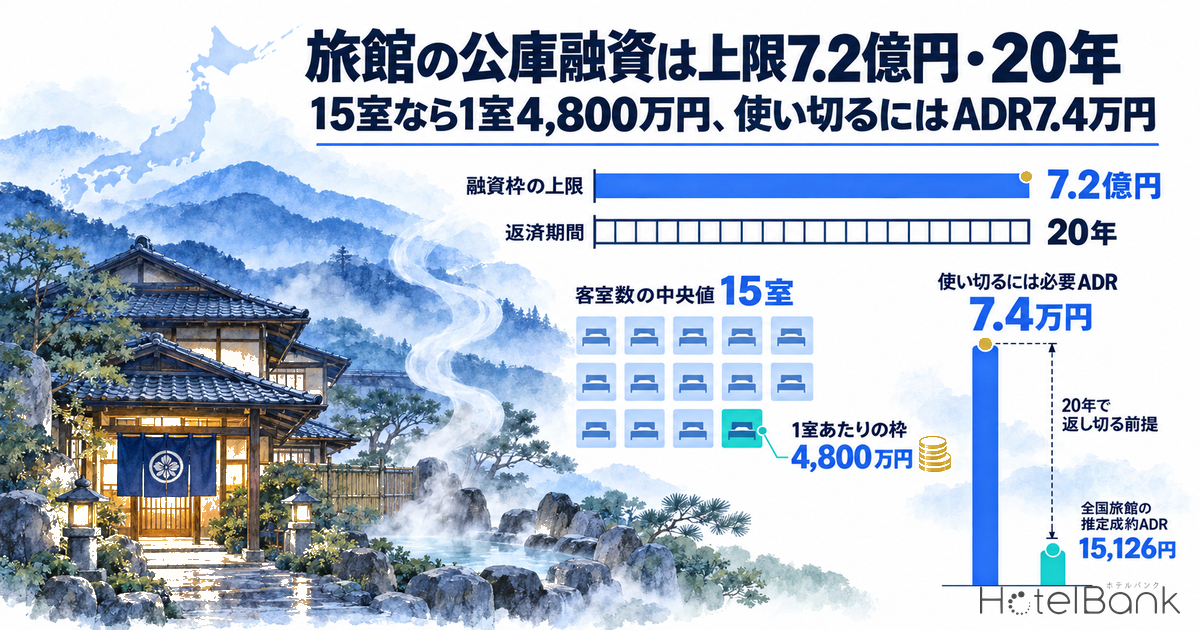
Japan Finance Corporation’s (JFC) environmental health business loans (生活衛生貸付) set a loan limit for ryokan-business equipment funds of ¥400M under the General Loan and ¥720M under the Promotion Program Loan (振興事業貸付). Equipment funds under the Promotion Program Loan can be repaid over up to 20 years. The median ryokan nationwide has 15 rooms, so ¥720M divided by 15 rooms comes to ¥48M per room. That is almost the same as the median per-room price at which listed hotel REITs have acquired ryokan (¥49.6M), so the institutional limit is large enough to reach the succession or acquisition of a small ryokan. Whether it can be repaid within 20 years, however, depends on ADR and occupancy. This article sets two ceilings side by side — “the size of the limit” and “the amount that can be repaid” — using the room-count distribution and estimated settled ADR of 7,753 ryokan nationwide.
Where This Article Fits (and How It Differs from Earlier Pieces)
HotelBank’s earlier financing coverage has dealt with private-loan tenors and transaction prices, private-sector LTV for mid-sized and larger hotels, outstanding lending to the sector in Bank of Japan statistics, and capital structure. To avoid overlap, this article focuses on a single question: how far the size of the public loan limits available to small ryokan determines the scale that can be acquired or renovated. Whether a loan is approved, and its amount and rate, are decided by JFC’s individual credit review; this article sets out the institutional limits and models scenarios on the assumption that those limits apply.
Metric Definitions Used in This Article
- ADR (average daily rate): An estimated settled rate (tax-exclusive equivalent), calculated by applying a category-specific adjustment factor to the lowest-plan rate each property publishes on OTAs (two guests per room, per-room price, tax-inclusive). Checked against property-level results disclosed by listed hotel REITs (91 properties, latest three months), the median error is about 7%. These are estimates and differ from each property’s actual transaction prices and accounting figures. Area-level ADR is the median of the properties covered (the level of a typical property in the area). The national and prefectural ryokan ADRs in this article cover the 12 finalised months from September 2025 to August 2026, with prefectural monthly values weighted by the number of properties tallied (N).
- OCC (occupancy rate): The ratio of rooms sold to total rooms in the area (an estimate based on OTA sales inventory; verified against REIT monthly disclosures to be accurate to within roughly a few points). The 40%, 50% and 60% occupancy rates used in this article’s models are assumed full-year averages, not estimates or actuals. As an actual reference value, the ryokan guest-room occupancy rate from the Japan Tourism Agency’s Overnight Travel Statistics Survey is used.
- Annual debt service: The annual repayment calculated as level principal-and-interest repayment with no grace period (at 3.0% interest unless stated otherwise).
- Required ADR = annual debt service × DSCR 1.25 ÷ (NOI margin 30% × rooms × 365 days × occupancy).NOI margin is net operating income as a share of room revenue, and DSCR is NOI ÷ annual debt service. Both are assumptions set for this article.
- Data sources: Japan Finance Corporation, “Guide to Environmental Health Business Loans” FY2026 edition (scheme details as of April 8, 2026) and interest-rate information (as of September 1, 2026); MetroEngines Research (property master database, estimated settled ADR); Japan Tourism Agency, “Overnight Travel Statistics Survey”
- — The ryokan equipment-fund limit is ¥400M under the General Loan and ¥720M under the Promotion Program Loan. Using the Promotion Program Loan requires a “Promotion Program Funding Certificate” as a member of an environmental health trade association. There are also top-ups of ¥15M for business-succession funds and ¥30M for disaster-prevention and environmental measures.
- — At ¥49.6M per room (the REIT ryokan median acquisition price), the ¥720M limit covers up to 14 rooms. 50.0% of ryokan nationwide have 14 rooms or fewer, and 79.6% have 30 or fewer.
- — Using up the full limit at 15 rooms requires an ADR of ¥73,700 at 50% occupancy (assumed full-year average), about 4.9 times the national ryokan estimated settled ADR (¥15,100).
- — At the national ADR and 50% occupancy (assumed full-year average), the amount repayable over 20 years is about ¥9.9M per room. Under these conditions only ryokan with 73 or more rooms can use the full ¥720M; for the 95.3% of ryokan with fewer than 73 rooms, repayment capacity becomes the ceiling before the loan limit does.
- — Inbound-related additions and renovations qualify for repayment periods of up to 30 years. Compared with 20 years, annual repayment is 24.1% lighter, and the required ADR for the ¥25M-per-room renovation model drops from ¥30,700 to ¥23,300.
Ryokan Limits Are ¥400M General and ¥720M Promotion — The Scheme on One Page
Environmental health business loans are JFC’s lending scheme for environmental-health-related businesses such as restaurants, barbers and beauty salons, and ryokan. The two main schemes open to the ryokan business are the “General Loan”, which anyone can apply for, and the “Promotion Program Loan”, available to members of environmental health trade associations (生活衛生同業組合). The equipment-fund limit for the ryokan business is ¥400M under the General Loan versus ¥720M under the Promotion Program Loan, a 1.8-fold gap. The repayment period is also longer: up to 13 years for the General Loan versus up to 20 years for the Promotion Program Loan.
Eligible properties are those holding a business licence under the Inns and Hotels Act, including simple lodging (kan’i shukusho). Private lodging (minpaku) under the Private Lodging Business Act and special-zone minpaku in National Strategic Special Zones, on the other hand, are not covered by environmental health business loans.
For the ryokan business, the size requirement is met by either “capital of ¥50M or less” or “200 employees or fewer”. The scope therefore covers not only small ryokan but also mid-sized operating companies that take over businesses in successions.
| Item | General Loan | Promotion Program Loan | Special top-ups |
|---|---|---|---|
| Eligible borrowers | Anyone operating an environmental-health-related business | Members of environmental health trade associations with an approved promotion plan | Users of the General or Promotion Program Loan |
| Equipment-fund limit for ryokan | ¥400M | ¥720M | Business Succession, Consolidation and Revitalisation Support Fund +¥15M / Disaster Prevention and Environmental Measures Fund +¥30M / New Business Development Fund +¥15M |
| Working-capital limit | — | ¥57M (all industries) | Succession and new-business development also add +¥15M to working capital |
| Repayment period (of which grace period) | Up to 13 yrs (up to 1 yr; up to 2 yrs if over 7 yrs) | Equipment up to 20 yrs (up to 2 yrs) / working capital up to 10 yrs (up to 2 yrs) | Succession and new-business equipment funds up to 20 yrs (up to 5 yrs) / disaster prevention up to 20 yrs (up to 2 yrs) |
| Required documents | Letter of recommendation from the prefectural governor (not required for equipment funds of ¥5M or less) | “Promotion Program Funding Certificate” issued by the head of the association | Depends on each scheme’s requirements |
| 30-year repayment special provision | — | Equipment funds for inbound-visitor readiness covering the construction, extension or renovation of lodging facilities | — |
The key point here is that the entry point to the Promotion Program Loan is association membership. The All Japan Ryokan Hotel Association (Zenryoren) is the national body of the ryokan-hotel associations in all 47 prefectures, and membership is handled by the association of the prefecture where the property operates. When taking over a ryokan through succession or acquisition, it speeds things up to confirm, in parallel with the loan discussions, whether the previous operator was a member and what the new operating entity must do to join. Note that a borrower using the Promotion Program Loan at a special rate may be moved to the standard rate on leaving the association.
Secured Base Rates of 2.80–5.00% — Special Rates Lower Them Depending on Use
JFC loans carry fixed rates, and the rate applied varies with the use of funds, the repayment period and whether collateral is provided. As of September 1, 2026, the secured base rate for the Micro Business and Individual Unit is 2.80–5.00% a year, with special rates starting in the 2% range. Under the Promotion Program Loan, Special Rate A applies to operators registered under the Standard Terms of Business (標準営業約款), and Special Rate J to equipment funds for inbound readiness. On top of that, the “Promotion Program Support Lending Scheme”, which cuts the applicable rate by 0.15% (0.30% for plans that raise productivity) once the association has reviewed the borrower’s accounts and business plan, can be used in combination.
| Rate (secured) | Annual rate (%) | Main uses under the Promotion Program Loan |
|---|---|---|
| Base rate | 2.80–5.00 | Standard application |
| Special Rate A | 2.40–4.60 | Registrants under the Standard Terms of Business; tourism businesses with productivity-improvement plans, etc. |
| Special Rate B | 2.20–4.35 | Working capital for inbound readiness; tourism business plans in depopulated areas supported by certified support organisations, etc. |
| Special Rate C | 2.15–4.10 | Equipment funds that qualify as designated promotion-program facilities |
| Special Rate J | 2.00–3.95 | Equipment funds for inbound readiness |
This article’s models use 3.0% a year, roughly the middle of this range, as the base case, with 2.0% and 4.5% shown as sensitivities. Rates are revised as financial conditions change, so anyone actually considering a loan should re-run the figures with the rates published at the time of application.
80% of Ryokan Have 30 Rooms or Fewer — Room-Count Profile of 7,753 Properties
Of the 138,203 domestic properties tracked by MetroEngines Research, 7,753 properties with 179,915 rooms are classified as ryokan and flagged as operating. Among the 7,741 with a known room count, the median is 15 rooms. 2,683 properties (34.7%) have 10 rooms or fewer and 2,485 (32.1%) have 11–20, so properties with 20 rooms or fewer alone make up 66.8% of the total. 6,159 properties (79.6%) have 30 rooms or fewer, and 7,031 (90.8%) have 50 or fewer.
In other words, most of the deals where the JFC limit is relevant are projects of up to a few hundred million yen per property. Only 170 ryokan have more than 100 rooms, and that tier tends to be a matter for private co-financing or syndication. For the 90% of ryokan with 50 rooms or fewer, ¥720M is a limit of a size where “can we reach it?” is the real question.
Rooms Covered by ¥720M — 14 at the REIT Median, 29 at City-Tier Construction Cost
Next, we look at the “limit per room”, dividing the limit by the number of rooms. ¥720M comes to ¥48M per room at 15 rooms, ¥24M at 30 rooms and ¥14.4M at 50 rooms. The ¥400M General Loan works out to ¥26.67M per room even at 15 rooms. We compare these with two per-room figures tallied in earlier HotelBank articles.
One is the per-room acquisition price of the 26 ryokan held by listed hotel REITs, from our earlier tally of REIT acquisition prices by asset type: a median of ¥49.6M, a first quartile of ¥28.04M and a third quartile of ¥65.42M. The other is the per-room construction cost of new builds from our earlier analysis of hotel construction costs: about ¥24.8M for the city/upper-midscale tier and about ¥71.4M for the resort/upscale tier.
| Per-room investment cost (reference) | Rooms covered by ¥720M | Share of ryokan at or below that size | Rooms covered by ¥400M | Share of ryokan at or below that size |
|---|---|---|---|---|
| Construction cost, city/upper-midscale ¥24.8M | 29 rooms | 78.2% | 16 rooms | 57.3% |
| REIT ryokan, first quartile ¥28.04M | 25 rooms | 74.1% | 14 rooms | 50.0% |
| REIT ryokan, median ¥49.6M | 14 rooms | 50.0% | 8 rooms | 22.0% |
| REIT ryokan, third quartile ¥65.42M | 11 rooms | 38.3% | 6 rooms | 11.0% |
| Construction cost, resort/upscale ¥71.4M | 10 rooms | 34.7% | 5 rooms | 6.5% |
Applying the REIT ryokan median of ¥49.6M, ¥720M covers up to 14 rooms, and ryokan with 14 rooms or fewer make up exactly half of the total (50.0%). A ryokan of the median 15 rooms acquired at a median-level price would therefore sit right at the edge of the limit. Applying the same price to the ¥400M General Loan reaches only 8 rooms, and coverage shrinks to 22.0%. In terms of the limit alone, whether the Promotion Program Loan can be used changes the size that can be acquired by a factor of 1.8.
Note, however, that this table shows “the number of rooms that borrowing alone can fully fund”; in practice, deals usually combine equity and loans from other lenders. Assuming 20% equity, the same ¥720M limit supports a total project cost of up to ¥900M. For equipment funds used for succession, the ¥15M top-up raises the limit to ¥735M.
Using Up the Limit at 15 Rooms Requires a ¥73,700 ADR — Working Back from Debt Service
Reaching the limit and repaying it within 20 years are two different things. Here we work back to the ADR needed to earn enough NOI to cover annual debt service at a DSCR of 1.25. The NOI margin is set at 30% of room revenue, and repayment at level principal and interest over 20 years at 3.0% with no grace period.
Borrowing ¥720M over 20 years at 3.0% means annual debt service of about ¥48.4M. Servicing that with 15 rooms requires an ADR of ¥73,700 at 50% occupancy, or ¥92,100 at 40%. At 30 rooms the burden halves, to ¥36,800 at 50% occupancy. The national ryokan estimated settled ADR is ¥15,100 (September 2025–August 2026, monthly average N=6,671 properties), so a plan to use the full limit at a median-sized ryokan amounts to assuming ADR rises to four to five times its current level.
What happens if we work the other way, from the national average ADR to the “amount that can be repaid”? At an ADR of ¥15,100 and 50% occupancy (assumed full-year average), annual NOI per room is about ¥830k, and the amount that can be borrowed and repaid over 20 years at 3.0% is about ¥9.9M per room (¥9.86M). Under these conditions, about ¥150M for 15 rooms and about ¥300M for 30 rooms falls within a repayable range. Only ryokan with 73 or more rooms can use the full ¥720M, and those with fewer than 73 rooms account for 95.3% of the total. For most ryokan, the ceiling is set by repayment capacity rather than by the limit itself, and the practical reading is that the unused remainder of the limit is headroom available if a renovation that lifts ADR is carried out.
According to the Japan Tourism Agency’s Overnight Travel Statistics Survey, the ryokan guest-room occupancy rate for 2025 was 38.2% on a finalised basis (preliminary: 38.4%). This article’s 40% occupancy case (assumed full-year average) is closest to that actual figure. At 40% occupancy, the amount repayable at the national average ADR is about ¥7.9M per room, and the size needed to use the full limit rises to 91 rooms or more.
Two-Way Sensitivity to ADR and Occupancy — Repayable Amount per Room
The repayable amount moves almost in proportion to ADR multiplied by occupancy. Keeping the assumptions of 3.0% interest, 20 years, 30% NOI margin and DSCR 1.25, the table below shows the repayable amount per room as ADR and occupancy (assumed full-year averages) each move across five steps. The national-average ADR row matches the figures in the text: ¥7.89M at 40% occupancy and ¥9.86M at 50%.
| ADR \ Occupancy | 30% | 40% | 50% | 60% | 70% |
|---|---|---|---|---|---|
| ¥10,000 | ¥3.91M | ¥5.21M | ¥6.52M | ¥7.82M | ¥9.12M |
| ¥15,126 (national) | ¥5.91M | ¥7.89M | ¥9.86M | ¥11.83M | ¥13.8M |
| ¥20,000 | ¥7.82M | ¥10.43M | ¥13.03M | ¥15.64M | ¥18.25M |
| ¥25,000 | ¥9.77M | ¥13.03M | ¥16.29M | ¥19.55M | ¥22.81M |
| ¥30,000 | ¥11.73M | ¥15.64M | ¥19.55M | ¥23.46M | ¥27.37M |
Even at an ADR of ¥30,000 and 70% occupancy (assumed full-year average), the repayable amount is about ¥27.4M per room, so 27 rooms are needed to use the full ¥720M. No combination in this table lets a 15-room ryokan use the limit in full (¥48M per room). For a ryokan of about 15 rooms, an ADR band of ¥20,000–¥30,000 with 50–70% occupancy gives ¥13M–¥27M per room, or roughly ¥200M–¥410M for 15 rooms, as the repayable range — broadly overlapping the ¥400M limit of the General Loan.
Three Investment Scenarios — Required ADR at ¥10M, ¥25M and ¥49.6M per Room
We set three scenarios for the succession or acquisition of a median 15-room ryokan and compared the required ADR by occupancy when 80% of the total project cost is borrowed under the Promotion Program Loan. A is a succession with partial renovation (¥10M per room), B an acquisition with full renovation (¥25M per room, the same level as the ryokan model in our earlier mezzanine-finance article), and C a plan in line with the REIT ryokan median acquisition price (¥49.6M per room).
| Item | A Succession + partial renovation | B Acquisition + full renovation | C REIT-median level |
|---|---|---|---|
| Total project cost per room | ¥10M | ¥25M | ¥49.6M |
| Total project cost (15 rooms) | ¥150M | ¥375M | ¥744M |
| Borrowing (80%) | ¥120M | ¥300M | ¥595M |
| Applicable limit | Within both General and Promotion limits | Within both General and Promotion limits | Within Promotion limit only |
| Annual debt service (3.0%, 20 yrs) | ¥8.07M | ¥20.16M | ¥40.01M |
| Required ADR, 40% occupancy (full-year) | ¥15,346 | ¥38,365 | ¥76,116 |
| Required ADR, 50% occupancy (full-year) | ¥12,277 | ¥30,692 | ¥60,893 |
| Required ADR, 60% occupancy (full-year) | ¥10,231 | ¥25,577 | ¥50,744 |
| NOI yield (national ADR ¥15,126, 50% occupancy, full-year) | 8.3% | 3.3% | 1.7% |
A, the succession with partial renovation, needs an ADR of only ¥15,300 even at 40% occupancy (assumed full-year average) — about the national average — and its NOI yield is 8.3% at 50% occupancy. A succession that takes over the existing business base as-is tends to be completed at a scale that uses only 10–20% of the JFC limit. B, the full renovation, needs an ADR of ¥30,700 at 50% occupancy (assumed full-year average), about twice the national average. Even Kyoto, the highest prefecture, is at ¥24,400, so the plan presupposes that the renovation moves the property into the top rate band of its area. C needs an ADR in the ¥50,000–¥70,000 range, a scale that exceeds the General Loan limit but fits within the Promotion Program Loan limit.
Our earlier analysis of converting ryokan washitsu rooms to Japanese-Western (wayoshitsu) rooms found the rate gap ranging from +10.8% to −33.9% depending on the town’s price band; in other words, how much a renovation lifts rates depends heavily on the price band of the location. For a deal like B, setting post-renovation ADR against what the top properties nearby actually achieve is the quickest way to judge how much of the limit can be used.
The Effect of the Repayment Period — 30 Years Brings B’s Required ADR to ¥23,300
The repayment period is a more effective lever for lowering required ADR than the interest rate. Comparing scenario B (¥300M borrowed, 15 rooms, 50% occupancy), the required ADR is ¥42,900 with the General Loan’s 13 years and ¥30,700 with the Promotion Program Loan’s 20 years. Annual repayment per ¥100M is ¥9.4M over 13 years and ¥6.72M over 20 years — 28.5% lighter simply from the longer term. Using the 2-year grace period and repaying over the remaining 18 years makes post-grace repayments 8.2% heavier than 20-year level repayment, and the required ADR becomes ¥33,200.
The Promotion Program Loan has a special provision allowing repayment periods of up to 30 years for equipment funds needed to accommodate international (inbound) visitors, where they cover the construction, extension or renovation of lodging facilities. Repaying over 30 years makes annual repayment 24.1% lighter than over 20 years, and B’s required ADR falls to ¥23,300. Because Special Rate J applies to equipment funds for inbound readiness, the actual interest rate may also be lower than 3.0%. Renovations involving conversion to Japanese-Western rooms or multilingual support make it easier to design financing on both term and rate.
Let us also check interest-rate sensitivity. B’s annual repayment is ¥18.35M at 2.0%, ¥20.16M at 3.0% and ¥23.06M at 4.5%, moving the required ADR (50% occupancy) to ¥27,900, ¥30,700 and ¥35,100. The gap between 2.0% and 4.5% is about ¥7,200, smaller than the gap between 13 and 20 years (about ¥12,200). Being able to take a long term is the biggest advantage of using public financing.
| Scenario B (¥300M borrowed, 15 rooms) | Annual debt service | Required ADR, 40% occupancy (full-year) | 50% occupancy | 60% occupancy |
|---|---|---|---|---|
| General Loan, 13 yrs, 3.0% | ¥28.21M | ¥53,670 | ¥42,936 | ¥35,780 |
| Promotion, 20 yrs with 2-yr grace (18 yrs after grace), 3.0% | ¥21.81M | ¥41,500 | ¥33,200 | ¥27,667 |
| Promotion, 20 yrs, 3.0% | ¥20.16M | ¥38,365 | ¥30,692 | ¥25,577 |
| Inbound upgrade, 30 yrs, 3.0% | ¥15.31M | ¥29,121 | ¥23,296 | ¥19,414 |
| Promotion, 20 yrs, 2.0% | ¥18.35M | — | ¥27,925 | — |
| Promotion, 20 yrs, 4.5% | ¥23.06M | — | ¥35,103 | — |
By Prefecture — Repayable ¥4M–¥12.7M per Room, 57–180 Rooms to Use the Full Limit
The repayable amount varies widely with local rates. Using each prefecture’s ryokan estimated settled ADR, we calculated the repayable amount per room at 40% occupancy (assumed full-year average; the Japan Tourism Agency’s actual ryokan figure for full-year 2025 was 38.2%), 3.0% interest and 20 years. Kyoto, the highest, has an ADR of ¥24,400 and ¥12.7M per room, followed by Hyogo at ¥11.6M and Kanagawa at ¥11.14M. The size needed to use the full ¥720M limit is 57 rooms in Kyoto and 62 in Hyogo.
| Prefecture | Ryokan properties | Est. settled ADR | Monthly avg N for ADR | Repayable per room | Rooms to use full ¥720M |
|---|---|---|---|---|---|
| Kyoto | 229 | ¥24,355 | 194 | ¥12.7M | 56.7 rooms |
| Hyogo | 300 | ¥22,243 | 257 | ¥11.6M | 62.1 rooms |
| Kanagawa | 296 | ¥21,361 | 265 | ¥11.14M | 64.7 rooms |
| Saga | 86 | ¥20,376 | 88 | ¥10.62M | 67.8 rooms |
| Shizuoka | 524 | ¥18,807 | 443 | ¥9.8M | 73.4 rooms |
| Oita | 330 | ¥18,333 | 312 | ¥9.56M | 75.3 rooms |
| Ishikawa | 172 | ¥18,299 | 111 | ¥9.54M | 75.5 rooms |
| Tochigi | 210 | ¥16,954 | 206 | ¥8.84M | 81.5 rooms |
| Kumamoto | 237 | ¥16,932 | 230 | ¥8.83M | 81.6 rooms |
| Hiroshima | 86 | ¥16,920 | 72 | ¥8.82M | 81.6 rooms |
| (Rows omitted; all 47 prefectures are shown on the map) | |||||
| Iwate | 145 | ¥9,027 | 139 | ¥4.71M | 153.0 rooms |
| Okinawa | 47 | ¥8,316 | 17 | ¥4.34M | 166.1 rooms |
| Ibaraki | 96 | ¥8,061 | 95 | ¥4.2M | 171.3 rooms |
| Tokushima | 54 | ¥7,686 | 51 | ¥4.01M | 179.7 rooms |
| Miyazaki | 55 | ¥7,677 | 45 | ¥4M | 179.9 rooms |
The top prefectures — Kyoto, Hyogo, Kanagawa, Saga, Shizuoka, Oita and Ishikawa — are all areas where ryokan cluster in hot-spring resorts or tourist cities, and their repayable amounts exceed ¥9.5M per room. By contrast, prefectures with ADRs around ¥8,000 stay in the ¥4M range per room. These levels, however, are based on prefecture-wide figures; within the same prefecture, rates differ greatly in the centres of hot-spring resorts and tourist areas. For a deal in a location with ADR above the prefectural average, the repayable amount and the usable limit widen in proportion.
Three Checkpoints for Structuring Succession and Acquisition Finance
1. Line up association membership
The ¥720M, 20-year Promotion Program Loan is a scheme for association members. In a succession, check the previous operator’s membership status and run the new operating entity’s membership procedures alongside the loan consultation. For business-succession funds, a ¥15M top-up with a grace period of up to 5 years is also available.
2. Decide the repayment period first
Moving from 13 to 20 years lightens annual repayment by 28.5%, and from 20 to 30 years by a further 24.1%. Whether works that qualify as inbound-related additions and renovations can be carved out moves the required ADR by several thousand yen per room.
3. How to set post-renovation ADR
At the national ADR, the repayable amount is about ¥7.9M–¥11.8M per room (40–60% occupancy). Using the limit beyond that is only realistic where there is a plan for the renovation to move the property into the top rate band of its area.
In the business-succession context, the deadline for executing gifts and inheritances under the special measures of the business succession tax scheme falls in December 2027. Many ryokan will consider arranging renovation funding at the same time as transferring shares, so whether the JFC limit can be counted on in full bears directly on the size of the post-succession investment plan. Acquisitions through court auctions or voluntary sales, and buildings that lack an inspection certificate (kensa-zumisho), raise separate pricing and due-diligence questions.
Summary
JFC’s environmental health business loans give the ryokan business equipment-fund limits of ¥400M under the General Loan and ¥720M under the Promotion Program Loan. For a median 15-room ryokan, ¥720M equals ¥48M per room, on a par with the REIT ryokan median acquisition price of ¥49.6M. Measured by the size of the limit alone, half of all ryokan nationwide fall within the range that borrowing can fund even at a median-level acquisition price.
On the other hand, the amount that can be repaid within 20 years is about ¥7.9M–¥9.9M per room at the national average ADR (40–50% occupancy), and for more than 95% of ryokan repayment capacity becomes the ceiling before the limit does. That is exactly why the unused remainder of the limit can be seen as headroom for renovations that raise ADR. In succession and turnaround deals, combining three elements — using the Promotion Program Loan through association membership, choosing a 20- or 30-year repayment period, and grounding post-renovation ADR in evidence — makes it possible to design an investment scale that makes the most of public financing.
Notes:This article sets out the institutional limits based on Japan Finance Corporation’s published materials and models scenarios using assumed values. Whether a loan is approved, and its amount, rate and repayment period, are decided by JFC’s individual credit review, and the figures in this article are not guaranteed. Scheme details are as of April 8, 2026 and rates are as published on September 1, 2026; both may be revised.
Frequently Asked Questions
Q. What is the maximum a ryokan can borrow under JFC’s environmental health business loans?
A. For ryokan-business equipment funds, ¥400M under the General Loan and ¥720M under the Promotion Program Loan (FY2026 edition, as of April 8, 2026). The Promotion Program Loan also has a ¥57M working-capital limit. There are top-ups of ¥15M for business-succession funds and ¥30M for disaster-prevention and environmental-measures funds.
Q. What are the conditions for using the Promotion Program Loan?
A. You must be a member of an environmental health trade association with an approved promotion plan, and you need a “Promotion Program Funding Certificate” issued by the head of the association. For the ryokan business, membership is handled by the ryokan-hotel association of the prefecture where the property operates.
Q. Are minpaku and simple lodging (kan’i shukusho) eligible?
A. Simple lodging licensed under the Inns and Hotels Act is eligible. Minpaku under the Private Lodging Business Act and special-zone minpaku in National Strategic Special Zones are not.
Q. What is the longest repayment period?
A. Up to 13 years for the General Loan and up to 20 years (with up to 2 years’ grace) for Promotion Program Loan equipment funds. Equipment funds needed for inbound readiness that cover the construction, extension or renovation of lodging facilities can be repaid over up to 30 years.
References and Sources
■ Data sources
Loan scheme details are from Japan Finance Corporation’s published materials (scheme details as of April 8, 2026; rates as of September 1, 2026). Ryokan property and room counts are from the MetroEngines Research property master database (ryokan flagged as operating, as of September 2026; N=7,741 properties with a known room count). ADR is estimated settled ADR (the 12 finalised months from September 2025 to August 2026, prefectural monthly values weighted by number of properties N; monthly average N=6,671 properties). The actual occupancy reference is the 2025 finalised figure from the Japan Tourism Agency’s Overnight Travel Statistics Survey. Per-room acquisition prices and construction costs are figures tallied in earlier HotelBank articles (REIT-held ryokan N=26 properties, among others).
■ Model assumptions
Level principal-and-interest repayment, no grace period, 3.0% a year (sensitivities at 2.0% and 4.5%), 20-year repayment (13 years, 30 years and 2-year grace + 18 years for comparison). NOI margin 30% of room revenue; DSCR 1.25. Occupancy of 40%, 50% and 60% are assumed full-year averages. Scenarios assume 15 rooms with borrowing = 80% of total project cost. Required ADR = annual debt service × 1.25 ÷ (0.30 × rooms × 365 × occupancy).
■ Limitations and caveats
Whether a loan is approved, and its amount, rate and repayment period, are decided by JFC’s individual credit review; this article models scenarios assuming the institutional limits. The NOI margin uses room revenue as its denominator, so actual repayment capacity differs for ryokan with a high share of food, beverage and ancillary revenue. Estimated settled ADR is estimated from OTA published prices, with a median error of about 7% against REIT-disclosed results. Prefectural values reflect prefecture-wide levels and can differ greatly from the centres of hot-spring resorts and tourist areas in the same prefecture. Values for prefectures with a small monthly average N (e.g. Okinawa, N=17) fluctuate more.
■ Loan schemes (primary sources)
- Japan Finance Corporation, “Guide to Environmental Health Business Loans” FY2026 edition (scheme details as of April 8, 2026)
- Japan Finance Corporation, “Promotion Program Loan”
- Japan Finance Corporation, “Interest Rate Information: Micro and Small Businesses / Sole Proprietors (Micro Business and Individual Unit)” (as of September 1, 2026)
- All Japan Ryokan Hotel Association (Zenryoren), “Membership Information”
■ Government statistics
■ Market data
- MetroEngines Research & Consulting — property master database (7,753 ryokan flagged as operating), estimated settled ADR (ryokan, 47 prefectures, September 2025–August 2026, monthly average N=6,671 properties), REIT ownership master (as of August 31, 2026)