

When investors look at an onsen ryokan’s business plan, hot-spring water tends to be treated as a binary: the property either “has” it or it doesn’t. But for a property without its own spring source, hot-spring water is a purchased input — metered every month and billed like any other utility, a variable cost line item just like electricity or gas. And its unit price is an order of magnitude above water-utility rates.
This article uses Atami’s municipal hot-spring supply — whose tariffs are published by ordinance — to break down the running cost for a property that buys its onsen water, all the way to an annual figure per guest room. The aim is to let “piped hot-spring water” sit as a line item in a business plan at the same granularity as our cost-item series (water and sewer, waste disposal, fire insurance, property tax, statutory inspections). Up-front investment and water-rights structures were covered in our earlier piece “27,899 Hot Springs, 40% Unused: Drill, Pipe or Buy — Onsen Cost Math”, and the bathing tax in “Onsen Bathing Tax Rises: ¥350 Aizuwakamatsu, ¥300 Izu“. Where that earlier work stopped at the entry point — the base charge — this article goes further: into the escalating charges that kick in above the base volume, and the supply-side cost structure that sets them.
Metric Definitions Used in This Article
- ADR (average daily rate): an estimated settled rate (tax-excluded equivalent) calculated by applying a segment-specific adjustment coefficient to the lowest publicly listed plan level each property posts on OTA sites (double occupancy, per-room rate, tax-included). Cross-checked against property-level results disclosed by listed hotel REITs (91 properties, most recent three months), the median error is approximately 7%. These are estimates and differ from each property’s actual transacted prices and accounting figures. Area-level ADR is the median across the properties covered (the level of a typical property in that area).
- Hot-spring charges: the published amounts in the hot-spring tariff set under the Atami City Hot Spring Ordinance (revised April 1, 2024), shown including consumption tax. It is a two-part tariff of a base charge and excess charges: the base charge includes a base volume, and usage above that volume is billed per cubic meter at two escalating tiers.
- Volume conversion: this article converts between liters per minute (L/min) and cubic meters per month (m³/month). Assuming continuous supply, 1 L/min ≈ 43.8 m³/month (60 minutes × 24 hours × 365 days ÷ 12 months ÷ 1,000).
- Annual cost per room: the annual hot-spring charge calculated from an assumed volume, divided by an assumed room count. These are not the billed amounts of any specific existing property.
- Data sources: Atami City, “Hot Spring Charges”, “Atami City Hot Spring Business Management Strategy” and “Overview of the Atami City Hot Spring Business”; Yugawara Town Hot Spring Business Ordinance; Kusatsu Town Hot Spring Use Ordinance; Ministry of Health, Labour and Welfare, “Guidelines on Hygiene Management in Public Bathhouses”; Shizuoka Prefecture Hot Spring Protection Guidelines; Japan Tourism Agency, “Overnight Travel Statistics Survey”; MetroEngines Research & Consulting
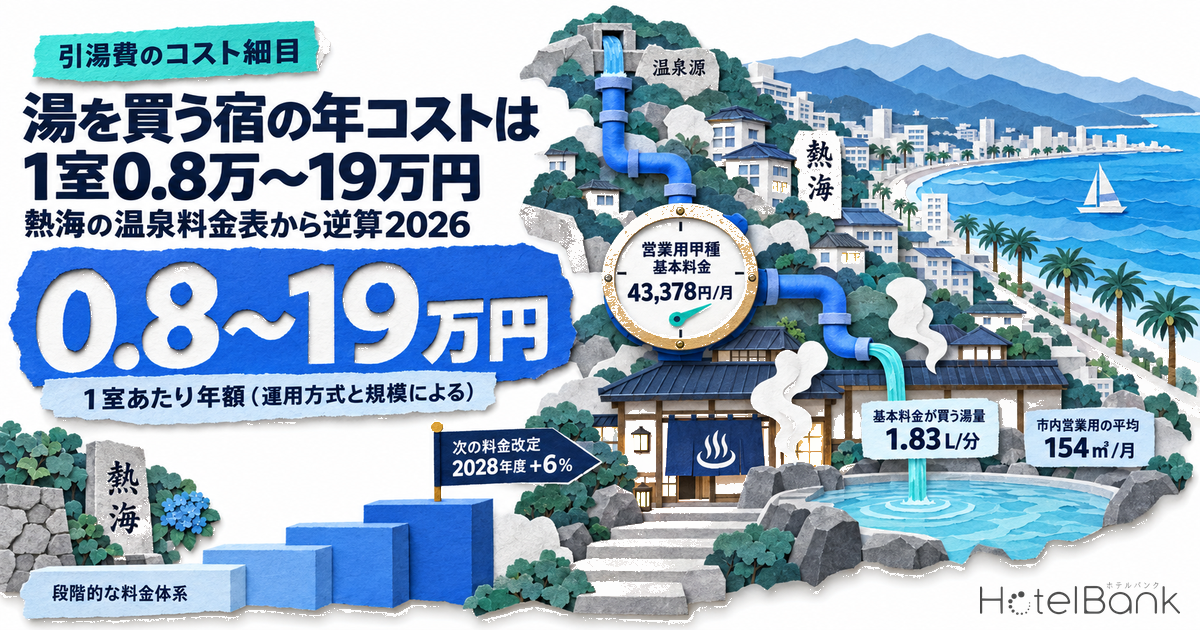
- — The ¥43,378 base charge covers only 1.83 liters per minute. That is the 80 m³ base volume converted to continuous supply — short even of the 6.9 L/min needed to refill a 10 m³ bath once a day. A business plan that books only the base charge understates the piped-water cost by a multiple.
- — Atami’s 172 municipal commercial accounts used 318,412 m³ a year — an average of 154 m³ a month each. Annualized, that is about ¥1.14 million, 2.2 times the ¥524,000 a year of the base charge alone (Atami City, “Overview of the Hot Spring Business”, FY2024 edition).
- — Fully replacing the large baths every day converges on ¥130,000–190,000 per room a year regardless of scale. A 10 m³ bath with 15 rooms costs about ¥2.89 million a year; a 55 m³ bath with 150 rooms about ¥19.25 million. As long as bath capacity scales with room count, the per-room figure stays roughly flat.
- — Atami’s revenue-water ratio is 40.08%, and 54.3% of costs go to pumping at the source. Six-tenths of the water pumped never turns into billed revenue, and the pumping itself is the largest expense — together they produce a supply cost of ¥823 per cubic meter (FY2021).
- — The next revisions are already planned: +6% in FY2028 and a further +9% in FY2032. These figures are stated in the Atami City Hot Spring Business Management Strategy; combined with the +19% in FY2024, charges in FY2032 would be 1.37 times the FY2023 level. They need to be built into the business plan at acquisition.
- — Even when closed, 80% of the base charge keeps running. The suspension charge for Commercial Class A is ¥34,702 a month, 79% of the annual cost when staying within the base volume under a normal contract. Plans that include renovation closures or seasonal shutdowns should treat it as a fixed cost.
What the ¥43,378 base charge buys: 1.83 liters per minute
Atami City runs a municipal hot-spring supply business. Supply is provided under the Atami City Hot Spring Ordinance (in force since April 1, 1973); as of March 2025 the city had 59 municipal spring sources (41 in use, 18 suspended or otherwise idle) and 1,203 supply accounts. Few municipalities anywhere in Japan supply hot-spring water directly and publish the charges by ordinance, which makes Atami a rare case in which the cost of piped onsen water can be verified from the outside.
The tariff is two-part — a base charge plus excess charges — with the excess charges escalating over two tiers. For the “Commercial” Class A category that covers hotels and ryokan, the base charge is ¥43,378 a month (tax included), which includes a base volume of 80 cubic meters. Usage above 80 m³ and up to 560 m³ is charged at ¥693 per cubic meter, and anything above 560 m³ at ¥849. A meter management fee of ¥324 a month is added on top.
| Use / class | Base charge (monthly) | Base volume | Excess tier 1 | Excess tier 2 | Suspension charge (monthly) |
|---|---|---|---|---|---|
| Commercial Class A | ¥43,378 | 80 m³ | ¥693 (to 560 m³) | ¥849 (over 560 m³) | ¥34,702 |
| Commercial Class B | ¥66,384 | 120 m³ | ¥712 (to 840 m³) | ¥873 (over 840 m³) | ¥53,107 |
| Private Class A (reference) | ¥18,932 | 30 m³ | ¥664 (to 70 m³) | ¥700 (over 70 m³) | ¥15,145 |
| Group Class A (reference) | ¥24,781 | 100 m³ | ¥293 (to 1,000 m³) | ¥342 (over 1,000 m³) | ¥19,823 |
| Temporary supply (reference) | ¥74,974 | 100 m³ | ¥867 (to 600 m³) | ¥985 (over 600 m³) | — |
Table 1: Atami City hot-spring charges (revised April 1, 2024; tax included. A meter management fee of ¥324/month applies separately for regular supply) / Source: Compiled by MetroEngines Research & Consulting from Atami City, “Hot Spring Charges”
The point to grasp here is not the size of the ¥43,378 figure but how many cubic meters it includes. Converted to a volume delivered continuously over a month, the 80 m³ base volume works out to just 1.83 liters per minute — roughly a kitchen tap opened to a thin stream.
Whether that is enough to run a large communal bath can be judged against the Ministry of Health, Labour and Welfare’s “Guidelines on Hygiene Management in Public Bathhouses”. The guidelines set as a principle that bath water be completely replaced and the tub cleaned every day, and even where that is difficult, require complete replacement with cleaning and disinfection at least once a week. In other words, bath capacity itself sets the floor on water demand.
Refilling indoor baths with a combined capacity of 10 m³ (men’s and women’s together) once a day takes 10 m³ a day, or 6.9 liters per minute. Allowing 20% for overflow and carry-out during operating hours brings it to 8.3 L/min — four to five times the 1.83 L/min the base volume covers. A 28 m³ bath needs 23.3 L/min, and a 55 m³ bath 45.8 L/min.
Figure 1: Hot-spring charges by monthly usage (Commercial Class A, tax included) and average unit price per cubic meter. Above the 80 m³ base volume the charge climbs linearly, and the slope steepens again at 560 m³ / Source: Compiled by MetroEngines Research & Consulting from Atami City, “Hot Spring Charges”
As Figure 1 shows, the substance of this tariff lies not in the base charge but in the excess charges. Within the base volume the average unit price is ¥546 per cubic meter, but as usage rises it is pulled toward the marginal rate, approaching ¥799 at 2,000 m³ a month. This is the opposite of water tariffs, which often use declining block rates that get cheaper for large users: hot-spring water is designed so that the more you use, the higher the unit price. The escalating structure exists to protect a finite resource and is rational as a price signal — but it cuts hard against properties that use a lot of water.
Translating water volume into annual cost per room — a 20x gap by bath operation
With the tariff and the bath capacity in hand, the piped-water cost can be reduced to an annual figure per guest room. Here we model three levels of bath operation: first, staying within the base volume; second, the average usage of commercial accounts in the city; and third, fully replacing the bath water every day.
| Operating scenario | Flow per minute | Monthly usage | Monthly | Annual | 15 rooms | 30 rooms | 50 rooms | 150 rooms |
|---|---|---|---|---|---|---|---|---|
| Stay within base volume | 1.83 L/min | 80 m³ | ¥43,702 | ¥524k | ¥35k | ¥17k | ¥10k | ¥3k |
| Average of 172 commercial accounts | 3.5 L/min | 154 m³ | ¥94,984 | ¥1.140M | ¥76k | ¥38k | ¥23k | ¥8k |
| 10 m³ bath, full daily replacement | 8.3 L/min | 364 m³ | ¥240,514 | ¥2.886M | ¥192k | ¥96k | ¥58k | ¥19k |
| 28 m³ bath, full daily replacement | 23.3 L/min | 1,021 m³ | ¥767,731 | ¥9.213M | ¥614k | ¥307k | ¥184k | ¥61k |
| 55 m³ bath, full daily replacement | 45.8 L/min | 2,006 m³ | ¥1,603,996 | ¥19.248M | ¥1.283M | ¥642k | ¥385k | ¥128k |
Table 2: Piped-water cost by operating scenario and annual cost per guest room (Commercial Class A, tax included, meter management fee included). Bold marks combinations where bath capacity and room count are in proportion / Source: Estimated by MetroEngines Research & Consulting from Atami City, “Hot Spring Charges” and “Overview of the Hot Spring Business”
Figure 2: Annual piped-water cost per room by flow per minute and room count (log scale) / Source: Estimated by MetroEngines Research & Consulting from Atami City, “Hot Spring Charges”
Look at the bold figures in Table 2. Line up the combinations where bath capacity is roughly in proportion to room count — a 10 m³ bath with 15 rooms, 28 m³ with 50 rooms, 55 m³ with 150 rooms — and the annual cost per room is ¥192,000, ¥184,000 and ¥128,000, converging on a narrow band of ¥130,000 to ¥190,000. A bigger bath needs more water, but it also serves more rooms, so the two offset each other on a per-room basis. The slight economy of scale comes from the fact that larger properties tend to be designed with less bath capacity per room, even as a larger share of their usage falls into the second excess tier.
On the other hand, the same property can bring its per-room cost down to between ¥8,000 and ¥76,000 by installing circulation filtration and replacing the water less often. The choice of bath operation moves the piped-water cost by a factor of 20. For a property that buys its water, the decision to invest in filtration equipment should be framed not as a “hygiene management choice” but as “an investment that cuts variable costs”. The renewal cost of the circulation filtration equipment itself, and the ordinance standards that govern it, need to be modeled alongside — as a per-room annual capex line that sits next to this piped-water cost.
What the city’s 172 accounts reveal about how Atami properties operate
So far these are estimates from the tariff table, but Atami City also publishes actual usage. According to the FY2024 edition of the “Overview of the Atami City Hot Spring Business”, there were 1,203 supply accounts in FY2024 with annual usage of 435,007 cubic meters. Broken down by use, the shape of the market becomes clear.
| Use | Accounts | Annual usage | Share of volume | Average per account (monthly) | Ratio to base volume |
|---|---|---|---|---|---|
| Private (households, second homes, etc.) | 1,025 | 110,346 m³ | 25.4% | 9.0 m³ | 0.30x |
| Commercial (hotels, ryokan, etc.) | 172 | 318,412 m³ | 73.2% | 154.3 m³ | 1.93x |
| Shared | 4 | 4,190 m³ | 1.0% | 87.3 m³ | 0.87x |
| Group | 2 | 2,059 m³ | 0.5% | 85.8 m³ | 0.86x |
| Total | 1,203 | 435,007 m³ | 100% | 30.1 m³ | — |
Table 3: Atami municipal hot-spring supply by use (FY2024; account counts as of fiscal year-end). Ratio to base volume is average usage per account divided by that category’s base volume / Source: Compiled by MetroEngines Research & Consulting from Atami City, “Overview of the Hot Spring Business”, FY2024 edition
Commercial users account for only 14.3% of accounts but 73.2% of volume. At 154.3 m³ per account per month, they use almost twice the 80 m³ base volume. Applied to Table 2, that is ¥94,984 a month, or about ¥1.14 million a year — 2.2 times the ¥524,000 a year implied by the base charge alone.
Note, however, that 154.3 m³ is a mean, not a representative value of the distribution. The city’s own documents explain that most supply accounts are households, second homes, and company dormitories or recreation facilities, and that hotels and ryokan are few in number but large in volume. Since the 172 commercial accounts also include small users such as dormitories and recreation facilities, the natural reading is that the distribution is dominated by many small accounts, with a handful of large users pulling the average up.
That average also says something about how Atami’s properties run their baths. If all 172 commercial accounts fully replaced a 10 m³ bath every day, each would need 364 m³ a month — 750,000 m³ a year across the city, 2.4 times the actual 318,412 m³ and equivalent to 96% of the municipal supply’s total annual pumped volume of 783,692 m³. In other words, only a small minority of properties in the city fully replace their large baths every day using purchased water alone. Most either combine circulation filtration to reduce the replacement frequency, or have a private spring source of their own.
This inference becomes a practical due-diligence tool. The monthly usage shown on a property’s hot-spring meter-reading slip can be read as an indicator of how its baths are actually run. If monthly usage is small relative to bath capacity, the property is mainly on circulation filtration; if it is around 30 times the bath capacity, operation is close to full daily replacement. If a buyer wants to market the property as “free-flowing source water” (gensen kakenagashi) after acquisition, that difference is the incremental variable cost.
Figure 3: Atami municipal hot-spring usage by category and commercial share of volume (FY2020–FY2024). Private usage fell while commercial usage rose, lifting the commercial share from 65.6% to 73.2% / Source: Compiled by MetroEngines Research & Consulting from Atami City, “Overview of the Hot Spring Business”, FY2024 edition
The five-year trend shows a structural shift under way. Private accounts fell by 88, from 1,113 to 1,025, and their usage dropped 16.0%, from 131,406 m³ to 110,346 m³ — likely reflecting cancellations as second homes are sold or inherited. Commercial accounts, by contrast, held roughly flat at 172, while their usage rose 12.9%, from 281,931 m³ to 318,412 m³, as occupancy recovered with tourism demand.
As a result, the commercial share of volume rose from 65.6% in FY2020 to 73.2% in FY2024. The business’s revenue base is concentrating on accommodation operators — which also means the burden of the tariff revisions discussed below is shifting onto properties.
Figure 4: The three supply districts of Atami’s municipal hot-spring service and the distribution of commercial supply (FY2024; circle size = annual commercial usage). Marker positions are representative points for each district and do not show exact supply boundaries / Source: Compiled by MetroEngines Research & Consulting from Atami City, “Overview of the Hot Spring Business”, FY2024 edition
The supply area is divided into three districts: Atami, Minami-Atami and Izumi. In FY2024, commercial supply was 125 accounts and 236,869 m³ in the Atami district, 31 accounts and 55,418 m³ in Minami-Atami, and 16 accounts and 26,125 m³ in Izumi. Per account per month, that is 158 m³ in Atami, 149 m³ in Minami-Atami and 136 m³ in Izumi — not a large difference between districts. The Izumi district’s sources, however, run cool, and the city heats the water at the Izumi heating station before distributing it. City documents note that because Izumi Source No. 1 is very low in temperature, heating costs are high. Regional differences in supply cost could be reflected in future tariff structures.
Why ¥823 per cubic meter — a 40% revenue-water ratio and 54% pumping costs
The reason hot-spring charges sit an order of magnitude above water tariffs becomes clear once you open up the supply side’s cost structure. The Atami City Hot Spring Business Management Strategy (adopted March 2023) publishes the supply cost and revenue-water ratio by fiscal year.
Figure 5: Average tariff revenue per cubic meter, supply cost and revenue-water ratio of Atami’s hot-spring business (FY2017–FY2021). The revenue-water ratio fell from 44.36% to 40.08% / Source: Compiled by MetroEngines Research & Consulting from Atami City, “Atami City Hot Spring Business Management Strategy”
In FY2021, the supply cost was ¥823.19 per cubic meter, average tariff revenue ¥910.37, and the cost-recovery ratio 110.59%. Charges exceed cost, and the business is profitable (net income of ¥86,732,403 in FY2021). What sets the level of the charges is the sheer height of the cost itself.
Two factors push the cost up. The first is the low revenue-water ratio. In FY2021 it was 40.08%: only 40% of the water distributed turned into billed revenue. The city attributes this not only to leakage but to the fact that “when hot-spring water stops flowing its temperature drops, so a constant distribution volume must always be maintained to prevent the temperature from falling.” In other words, keeping unsold water flowing is a physical precondition of hot-spring supply — a constraint that does not exist for tap water.
The second is the power cost of pumping. In the FY2021 breakdown of operating expenses, pumping at the source came to ¥189,669,767, or 54.3% of the total, followed by transmission and distribution at ¥60,226,056 (17.2%). By nature of expense, power costs were ¥41,848,388 (12.0%), outsourcing fees ¥77,525,178 (22.2%), and materials and flow meters ¥52,263,114 (15.0%). Atami’s municipal sources are mainly pumped rather than naturally flowing, and as of FY2024 the air-lift method accounted for about 66%. The city itself notes that with air-lift pumping, mineral scale (yu-no-hana) readily builds up on the pumping pipes, making it inefficient and power-hungry, and says it is switching to submersible pumps.
Put differently, the unit price of Atami’s water is set by “the cost of lifting it out of the ground”. Measured across 38 wells, source temperatures peak at 94.0°C, with 32 wells (84.2%) at 50°C or above, and an average flow of 67.6 liters per minute — a generous resource. But because the water is pumped rather than flowing naturally, power and equipment-renewal costs keep riding on the unit price. The supply cost rose 5.4% from ¥781.01 in FY2017 to ¥823.19 in FY2021, pushed up by the falling revenue-water ratio.
75 years of tariff history — and a FY2028 revision already decided
For putting the piped-water cost into a business plan, what matters most is not today’s figure but tomorrow’s. Atami City publishes its history of tariff revisions since 1950 in the “Overview of the Hot Spring Business”, which makes it possible to trace the long-run trend of the Commercial Class A base charge.
Figure 6: Atami municipal hot spring, Commercial Class A base charge (FY1950–FY2032). The base volume was changed from 60 m³ to 80 m³ in 1971. The dashed line is an estimate based on the planned revision rates in the Atami City Hot Spring Business Management Strategy (+6% in FY2028, +9% in FY2032) / Source: Compiled by MetroEngines Research & Consulting from Atami City, “Overview of the Hot Spring Business” and “Atami City Hot Spring Business Management Strategy”
Taking ¥4,160 in 1971 — when the base volume was standardized at 80 m³ — as the starting point, the 2024 figure of ¥43,378 is 10.4 times higher, an average annual increase of 4.5% over 53 years. The pace has not been even, though. In the 1970s, spanning the oil crises, the charge jumped 4.8-fold in six years from ¥4,160 to ¥20,160; it then rose only 20.7% over 25 years, from ¥25,730 in 1983 to ¥31,068 in 2008. In the 16 years since 2008, however, it has risen 39.6%. Even excluding consumption-tax pass-through, the recent increases stand out.
What matters most is that the next revisions are already set out in a plan. In its investment and financial plan, the Atami City Hot Spring Business Management Strategy states that “tariff revisions of 19% in FY2024, 6% in FY2028 and 9% in FY2032 are expected to be necessary.” The 19% for FY2024 has already been implemented, and the current ¥43,378 is its result. Applying the remaining two, the Commercial Class A base charge would be ¥45,981 in FY2028 and ¥50,119 in FY2032. From the FY2023 base of ¥36,452, that makes FY2032 1.37 times higher.
| Operating scenario | Current (FY2024–) | FY2028 (+6% planned) | FY2032 (+9% planned) | Annual increase |
|---|---|---|---|---|
| Within base volume (80 m³/month) | ¥524k | ¥556k | ¥605k | +¥81k |
| City commercial average (154 m³/month) | ¥1.140M | ¥1.208M | ¥1.316M | +¥176k |
| 10 m³ bath, full daily replacement (364 m³/month) | ¥2.886M | ¥3.057M | ¥3.332M | +¥446k |
| 28 m³ bath, full daily replacement (1,021 m³/month) | ¥9.213M | ¥9.764M | ¥10.643M | +¥1.430M |
| 55 m³ bath, full daily replacement (2,006 m³/month) | ¥19.248M | ¥20.403M | ¥22.239M | +¥2.991M |
Table 4: Outlook for piped-water costs reflecting the planned revision rates (Commercial Class A, tax included). FY2028 and FY2032 are estimates that apply the planned revision rates in the Atami City Hot Spring Business Management Strategy uniformly to the current tariff; actual rates and timing will be set by future demand forecasts and financial simulations / Source: Estimated by MetroEngines Research & Consulting from Atami City, “Atami City Hot Spring Business Management Strategy”
The city itself cautions that “when tariffs are actually revised, demand forecasts will be reviewed and financial simulations conducted to determine an appropriate revision rate”, so +6% and +9% are not locked in. But the city’s demand forecast assumes a decline in billed volume, with tariff revenue projected to fall from ¥381.692 million in FY2021 to ¥333.551 million in FY2032. Redemptions of enterprise bonds are also set to rise from FY2028, with the outstanding bond balance entering an upward trend. Since these revisions exist to keep the recurring balance out of the red as revenue shrinks and debt service grows, the conservative assumption is that charges will move in the planned direction. A business plan built on a ten-year hold should model the piped-water cost as rising, not flat.
Buy, drill or suspend — limited options in a semi-protected zone
If piped water is expensive, the natural response is to drill your own well. In Atami, though, that option is almost entirely closed off by regulation.
The Shizuoka Prefecture Hot Spring Protection Guidelines divide the prefecture into three zones: hot-spring protection zones, semi-protection zones and general zones. All of Atami City (except for parts designated as protection zones) is designated a hot-spring semi-protection zone, as are the whole of Ito, Shimoda, Izu and Izunokuni cities and Kamo and Tagata districts. The rules for semi-protection zones are explicit: “Drilling must be at least 200 meters in horizontal distance from existing springs. Horizontal and directional drilling are not permitted.” In the stricter protection zones, drilling, deepening and even installing pumping equipment are not permitted at all, save for exceptions such as recovery from natural disasters.
In a dense spring area with 59 municipal sources alone — plus the sources owned by members of the local hot-spring cooperative — finding a site that clears a 200-meter radius from every existing spring is no easy task. And because horizontal and directional drilling are prohibited, a well cannot be angled out beyond the site boundary either. In other words, acquiring an onsen property in Atami usually means “inheriting a contract to keep buying water”.
| Option | Up-front cost | Monthly fixed cost | Regulatory constraints |
|---|---|---|---|
| Connect to municipal supply | Supply connection fee ¥990,000–¥1,474,000 (Commercial Class A, bath volume up to 1.0 m³; ¥330,000 per additional m³) + hot-spring maintenance fee ¥66,000 | Base charge ¥43,378 + excess charges + meter management fee ¥324 | Must reside in or own property within the supply area; supply approval is subject to review |
| Drill your own well | Drilling cost (depends on depth and geology) + pumping equipment | Pumping power, scale removal, pipeline maintenance | Semi-protection zone: at least 200 m horizontal distance from existing springs; no horizontal or directional drilling |
| Suspend supply | — | Suspension charge ¥34,702 (Commercial Class A); no meter management fee | 80.0% of the base charge continues to accrue |
Table 5: Three options for securing hot-spring water in Atami (charges as of April 1, 2024, tax included; supply connection fee as revised October 1, 2019) / Source: Compiled by MetroEngines Research & Consulting from Atami City, “Hot Spring Charges” and “Supply Connection Fee and Hot Spring Maintenance Fee”; Shizuoka Prefecture Hot Spring Protection Guidelines
The third row of Table 5 — suspension — deserves a mention too. The suspension charge for Commercial Class A is ¥34,702 a month, 80.0% of the ¥43,378 base charge, or ¥416,424 a year. Whether a property closes for a few months of renovation or scales back operations in winter, this amount does not stop. When modeling profit and loss over a renovation period, setting the piped-water cost to zero will throw the plan off.
Compared with Yugawara and Kusatsu — same “bought water”, different design philosophy
Piped hot-spring tariffs vary widely from one onsen town to the next. Setting Atami alongside Yugawara and Kusatsu — two towns that likewise publish their charges by ordinance — brings the differences in design philosophy into sharp relief.
| Item | Atami City (Shizuoka) | Yugawara Town (Kanagawa) | Kusatsu Town (Gunma) |
|---|---|---|---|
| Tariff structure | Base charge + excess charges escalating over two tiers | Base charge by allocated supply share + usage charge + excess charge | Flat unit price within the permitted volume; premium unit price for excess |
| Category for accommodation operators | Commercial (Class A / Class B) | Commercial (allocated share of at least 155 m³ per month = 3.6 L/min) | Class A / Class B (by source system) |
| Unit price per m³ | Excess ¥693 / ¥849 (tax included) | Usage charge ¥271 for rights-based supply, excess ¥450 (tax excluded) | Yubatake and Shirahata sources: base ¥30, excess ¥40 + management fee ¥5–20 (tax excluded) |
| One-time fee on joining | Supply connection fee ¥990,000–¥1,474,000 (Commercial Class A) | Rights-based water: ¥10,340 per 1.8 L/min. Guaranteed-loan water: ¥1 million deposit per 1.8 L/min | Hot-spring supply contribution = permitted volume (L/min) × ¥300,000 (Class A) or ¥900,000 (Class B) |
| Treatment during closure | Suspension charge ¥34,702/month | Base charge still payable during closure or temporary suspension | Flow-meter fee of ¥1,000/month still payable while supply is suspended |
| How volume is set | Supply connection fee banded by bath volume | Allocated supply share (in units of 1.8 L/min) | Bath surface area × coefficient ÷ temperature difference (formula annexed to the ordinance) |
Table 6: Comparison of piped hot-spring tariff structures in three onsen towns. Because tax treatment differs, per-m³ unit prices cannot be compared directly (Atami includes tax; Yugawara and Kusatsu add consumption tax separately) / Source: Compiled by MetroEngines Research & Consulting from Atami City, “Hot Spring Charges”; Yugawara Town Hot Spring Business Ordinance; Kusatsu Town Hot Spring Use Ordinance
The most striking difference is the unit price. Atami’s excess charges run ¥693 to ¥849 per cubic meter, whereas Kusatsu’s Yubatake and Shirahata source systems charge a base of ¥30 and an excess of ¥40, plus a management fee of ¥5–20. That is an order of magnitude apart.
The gap is explained by how the water comes out of the ground. Kusatsu is one of Japan’s leading onsen towns by naturally flowing volume, distributing water that wells up on its own from sources such as the Yubatake. Atami, by contrast, relies mainly on pumping, with the air-lift method accounting for about 66%. The electricity to lift the water and the renewal costs of equipment degraded by scale ride on the unit price. As shown above, 54.3% of Atami’s operating expenses go to pumping at the source. The price of piped onsen water is set not by a resort town’s brand power but by whether the water flows naturally or has to be pumped.
Kusatsu, however, front-loads the burden. The hot-spring supply contribution is the permitted volume multiplied by ¥300,000 for Class A or ¥900,000 for Class B, where the permitted volume is a liters-per-minute figure derived by formula from bath surface area and temperature difference. A Class A property permitted 20 L/min would pay a ¥6 million contribution, and one permitted 50 L/min ¥15 million (consumption tax added separately in both cases). Against Atami’s supply connection fee of ¥990,000–¥1,474,000, the entry cost is several times to more than ten times higher. It is a design that lightens running costs in exchange for payment on entry, which favors operators planning to hold for the long term. How these town-by-town differences feed back into acquisition pricing is a separate exercise — working back from each town’s ADR, occupancy and target yield to a maximum purchase price per room.
Yugawara sits in between. Supply volume is set at a minimum of 3.6 L/min (an allocated share of 155 m³ a month), and for rights-based supply the charges are a base charge of ¥107 per cubic meter of allocated share (commercial), a usage charge of ¥271 per cubic meter, and ¥450 for usage above the allocated share. Using the full minimum share of 155 m³ comes to ¥58,590 a month (tax excluded) — lighter than Atami at the same volume. But acquiring water rights carries an entry cost of ¥10,340 per 1.8 L/min, or a ¥1 million deposit per 1.8 L/min for guaranteed-loan water, and a separate secondary market in water rights exists.
Weight against revenue — applying it to the economics of an Atami ryokan
Finally, let us check how heavy the piped-water cost is relative to revenue. According to MetroEngines Research & Consulting, the estimated settled ADR for the ryokan category in Atami City averaged ¥25,750 over the latest 12 months (September 2025 – August 2026), covering 68–74 properties per month (median 70.5). According to the Japan Tourism Agency’s “Overnight Travel Statistics Survey” (preliminary annual figures for 2025), ryokan room occupancy in Shizuoka Prefecture was 42.2%, 13th in the nation.
Multiplying the two gives annual lodging revenue of roughly ¥3.97 million per guest room. Because ryokan plans are mostly priced with dinner and breakfast included, note that this figure includes food and beverage revenue.
| Operating scenario (bath capacity in proportion to room count) | Annual piped-water cost per room | Share of lodging revenue | After FY2032 planned revision |
|---|---|---|---|
| Mainly circulation filtration, city average (150 rooms) | ¥8k | 0.2% | 0.2% |
| Mainly circulation filtration, city average (50 rooms) | ¥23k | 0.6% | 0.7% |
| Mainly circulation filtration, city average (15 rooms) | ¥76k | 1.9% | 2.2% |
| Full daily replacement, 55 m³ bath (150 rooms) | ¥128k | 3.2% | 3.7% |
| Full daily replacement, 28 m³ bath (50 rooms) | ¥184k | 4.6% | 5.4% |
| Full daily replacement, 10 m³ bath (15 rooms) | ¥192k | 4.8% | 5.6% |
Table 7: Piped-water cost as a share of annual lodging revenue per room of ¥3.97 million (estimated settled ADR ¥25,750 × room occupancy 42.2% × 365 days) / Source: Compiled from MetroEngines Research & Consulting (Atami City, ryokan category, N=68–74 properties, September 2025 – August 2026); Japan Tourism Agency, “Overnight Travel Statistics Survey”, 2025 annual figures (preliminary); Atami City, “Hot Spring Charges”
Under an operation based mainly on circulation filtration, the piped-water cost stays within 0.2% to 1.9% of lodging revenue. Placed alongside the other cost items we have estimated — property tax of ¥160,000–240,000 per room a year, and statutory inspection costs of ¥3,400–12,600 per room a year — it is a line item that sits between statutory inspections and property tax. And given that the electricity for pumping and heating is ultimately passed through into the charges, it is easiest to see the whole picture of energy-linked costs by setting it next to utility costs such as electricity (around ¥96,000 per room a year in a 100-room model).
Move to full daily replacement, however, and the share jumps to 3.2%–4.8%, comparable to property tax. With the planned revisions reflected, it reaches 5.6% in FY2032. Table 7 also shows that the smaller the property, the less room it has to absorb the cost. A decision to market “free-flowing source water” as a selling point only stands up if it is paired with a judgment on whether that cost gap can be passed through into room rates.
Sensitivity to the planned tariff revisions — up to ¥220,000 per room a year by FY2032
The Atami City Hot Spring Business Management Strategy sets out planned figures of +6% for the next revision in FY2028 and +9% for the one after in FY2032. A plan with a holding period of more than five years needs to build both revisions into its annual per-room figure. Laid out along the two axes of bath operation and revision scenario, it looks like this.
| Operating scenario \ Tariff revision | Current (after FY2024 revision) | After FY2028 revision (+6%) | After FY2032 revision (cumulative +15.5%) | Share of lodging revenue, FY2032 |
|---|---|---|---|---|
| Mainly circulation filtration, city average (150 rooms) | ¥8k | ¥8k | ¥9k | 0.2% |
| Mainly circulation filtration, city average (50 rooms) | ¥23k | ¥24k | ¥26k | 0.7% |
| Mainly circulation filtration, city average (15 rooms) | ¥76k | ¥81k | ¥88k | 2.2% |
| Full daily replacement, 55 m³ bath (150 rooms) | ¥128k | ¥136k | ¥148k | 3.7% |
| Full daily replacement, 28 m³ bath (50 rooms) | ¥184k | ¥195k | ¥213k | 5.4% |
| Full daily replacement, 10 m³ bath (15 rooms) | ¥192k | ¥204k | ¥222k | 5.6% |
Table 8: Annual piped-water cost per room by tariff revision scenario (Commercial Class A, tax included). Assumes the planned revision rates in the Atami City Hot Spring Business Management Strategy are applied uniformly across the tariff. The denominator for share of lodging revenue is annual lodging revenue per room of ¥3.97 million (estimated settled ADR ¥25,750 × room occupancy 42.2% (2025 annual figure) × 365 days) / Source: Estimated from Atami City, “Hot Spring Charges” and “Atami City Hot Spring Business Management Strategy”; Japan Tourism Agency, “Overnight Travel Statistics Survey”, 2025 annual figures (preliminary); MetroEngines Research & Consulting (Atami City, ryokan category, N=68–74 properties, September 2025 – August 2026)
Under operations based mainly on circulation filtration, the cost stays at ¥9,000–88,000 per room a year even in FY2032, and its share of revenue does not exceed 2.2%. Full daily replacement, by contrast, rises to ¥148,000–222,000, reaching 5.6% of revenue at small properties. The revision rate is the same, yet the absolute increase ranges from ¥1,200 to ¥30,000 a year depending on bath operation. Book a flat piped-water cost at acquisition without checking replacement frequency, and the estimate could be off by ¥30,000 per room a year in the second half of the holding period.
Six points to check in due diligence
For anyone acquiring an onsen property — or reviewing the business plan for one — here are the items to verify on the piped-water cost.
The second item in particular is a verification axis unique to properties that buy their water. Buildings and guest rooms can be checked against drawings and on site, but how the baths are actually run cannot be seen by looking. Set the meter readings against the bath capacity — two numbers — and you know how much water the property really uses. If the plan is to raise product value by increasing water volume, the additional cubic meters multiplied by ¥693 or ¥849 become additional variable cost, one for one.
Conclusion — hot-spring water is not an asset but a monthly bill
For a property without its own spring source, onsen water is not an asset on the balance sheet but an expense that shows up on the income statement every month. For Commercial Class A at Atami’s municipal hot spring, the ¥43,378 base charge covers just 1.83 liters per minute, while running a large communal bath takes several to dozens of times that. At the city’s average commercial usage of 154 m³ a month, the cost is about ¥1.14 million a year; with full daily replacement of the baths, it comes to ¥130,000–190,000 per room a year regardless of scale.
This cost item has three characteristics. First, it moves by a factor of 20 depending on bath operation. Installing circulation filtration is a hygiene-management choice, but it is also an investment decision that cuts variable costs by millions of yen. Second, it does not stop when the property closes: for Commercial Class A, ¥34,702 a month — 80.0% of the base charge — accrues even in months when no water is used. Third, it is planned to go up. Atami implemented a +19% revision in FY2024 and has written +6% for FY2028 and +9% for FY2032 into its management strategy. As long as the cost structure — a 40.08% revenue-water ratio, with 54.3% of expenses going to pumping at the source — remains unchanged, the reasonable view is that this direction will continue.
And in Atami, there is almost no regulatory way to escape this cost. Under the Shizuoka Prefecture Hot Spring Protection Guidelines, the city is designated a hot-spring semi-protection zone: new wells must be at least 200 meters in horizontal distance from existing springs, and horizontal and directional drilling are prohibited. Buying water is, in most cases, not a choice but a given. That is exactly why a business plan should model this cost as rising rather than flat — and why due diligence should begin with the most basic document of all: the meter readings.
Related Reading
- Who Owns the Hot Spring? Water Rights and Ryokan Valuation (how own sources, piped supply and centralized management split ryokan valuations)
- Onsen Bathing Tax Rises: ¥350 Aizuwakamatsu, ¥300 Izu, 1.1–1.6% of ADR
- Hotel Water & Sewer Costs Vary 2.1x by Municipality: ¥7.85mn NOI Gap
References and Sources
■ Data sources
Primary information on charges and usage comes from Atami City’s “Hot Spring Charges” (revised April 1, 2024; tax included), the “Overview of the Atami City Hot Spring Business” (FY2024 edition) and the “Atami City Hot Spring Business Management Strategy” (March 2023). The Yugawara Town Hot Spring Business Ordinance and Kusatsu Town Hot Spring Use Ordinance used for comparison are taken from each town’s collection of ordinances. Room rates are from MetroEngines Research & Consulting (estimated settled ADR for the Atami City ryokan category, N=68–74 properties, September 2025 – August 2026); room occupancy is the Shizuoka Prefecture ryokan figure from the Japan Tourism Agency’s “Overnight Travel Statistics Survey”, 2025 annual figures (preliminary).
■ Modeling assumptions
Monthly charges were calculated by adding the ¥324 meter management fee to the Commercial Class A base charge of ¥43,378 (base volume 80 m³) and stacking excess usage at ¥693 (80–560 m³) and ¥849 (above 560 m³), then multiplied by 12 to annualize (all tax included). Full daily replacement is represented by the volume needed to refill bath capacity once a day; operation based mainly on circulation filtration is represented by the average usage of the city’s 172 commercial accounts (154 m³ a month). Tariff revisions apply the planned rates in the management strategy (+6% in FY2028, +9% in FY2032) uniformly across the whole tariff. Annual lodging revenue per room is calculated as estimated settled ADR ¥25,750 × room occupancy 42.2% (January–December 2025 annual figure for Shizuoka Prefecture ryokan) × 365 days ≈ ¥3.97 million.
■ Limitations and caveats
Usage is back-calculated from bath capacity and replacement frequency, not taken from actual meter readings at individual properties. Fuel for heating and cooling, renewal of supply piping and circulation filtration equipment, and the bathing tax are not included in the piped-water cost. The denominator for share of lodging revenue covers ryokan, whose plans mostly include two meals, so it includes food and beverage revenue and yields a lower ratio than a rooms-only view would. Room occupancy is the annual figure for Shizuoka Prefecture ryokan, not a figure for Atami City alone. Tariff revision rates are planned figures, and implementation requires a resolution of the city council.
■ Primary sources on ordinances and charges (Japanese)
- Atami City, “Hot Spring Charges” (revised April 1, 2024; tax included)
- Atami City, “Supply Connection Fee and Hot Spring Maintenance Fee” (from October 1, 2019)
- Atami City, “Revision of Hot Spring Charges” (FY2024, average 19% revision)
- Yugawara Town Hot Spring Business Ordinance
- Kusatsu Town Hot Spring Use Ordinance
■ Operating results and management plans (Japanese)
- Atami City, “Atami City Hot Spring Business Management Strategy” (March 2023, Water and Hot Spring Division, Public Enterprise Department, Atami City) — supply cost, revenue-water ratio, cost-recovery ratio, planned revision rates
- Atami City, “Overview of the Atami City Hot Spring Business”, FY2024 edition — supply by use and district, history of tariff revisions, source temperatures and flow rates
- Atami City, “Atami: A City with a Municipal Hot Spring”
■ Laws and administrative standards (Japanese)
- Shizuoka Prefecture Hot Spring Protection Guidelines — classification of protection and semi-protection zones and treatment of drilling
- Shizuoka Prefecture, “The Hot Springs Act and the Hot Spring Subcommittee of the Shizuoka Prefecture Environmental Council”
- Ministry of Health, Labour and Welfare, “On the Guidelines on Hygiene Management in Public Bathhouses” — standards for complete replacement of bath water and cleaning
- Hot Springs Act (Act No. 125 of 1948)
■ Statistics and market data
- Japan Tourism Agency, “Overnight Travel Statistics Survey”, 2025 annual figures (preliminary) (press release of February 27, 2026) — room occupancy by prefecture and accommodation type
- Japan Tourism Agency, “Overnight Travel Statistics Survey”
- MetroEngines Research & Consulting — estimated settled ADR for the Atami City ryokan category (N=68–74 properties, September 2025 – August 2026) and estimated occupancy for Atami City based on OTA-listed inventory