

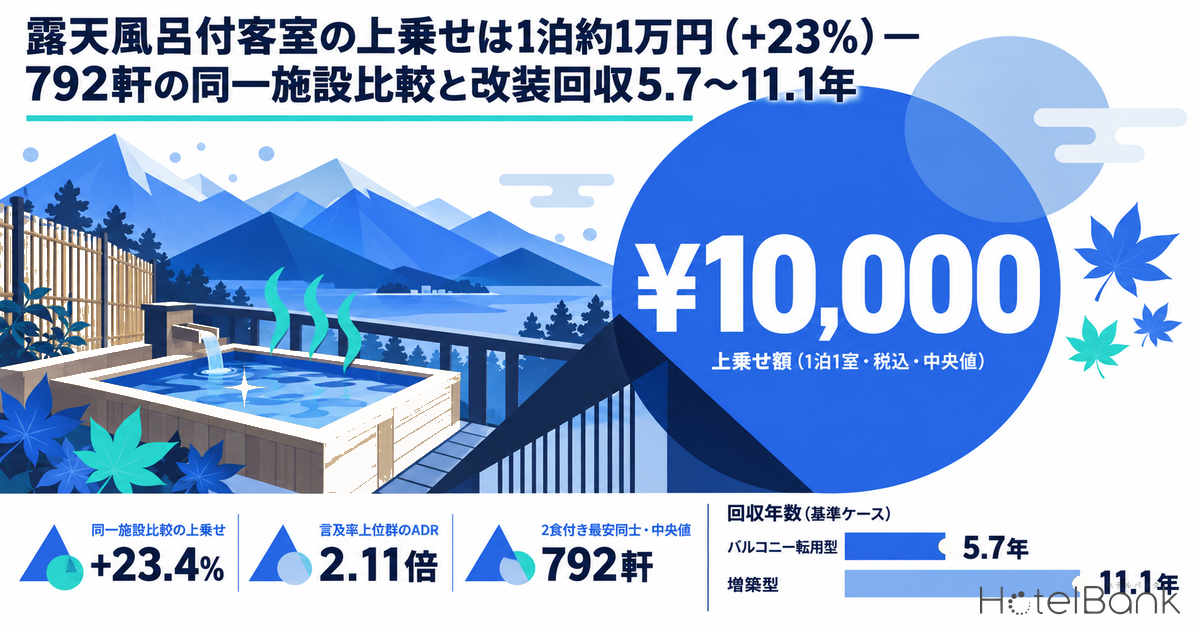
How much more can a ryokan charge per night once a guest room has its own open-air bath? MetroEngines Research compared 792 ryokan and resort hotels that list both rooms with a private open-air bath and standard rooms, pairing the cheapest plans at the same property, on the same stay date and with the same meal plan (dinner and breakfast). The listed price of the room with a private open-air bath was higher by a median of about ¥10,000, or +23.4%, per room per night.
Separately, properties where at least 10% of guest reviews speak favourably about rooms with a private open-air bath (the mention rate) sit at 2.11x the estimated settled ADR of properties of the same type in the same municipality where such mentions are almost absent (ryokan, median across 183 municipalities). That gap, however, also reflects differences in room size, cuisine and property grade. This article treats the two yardsticks separately and uses the premium attributable to the facility itself to estimate the payback period for adding private open-air baths (balcony-conversion and extension types).
Metric Definitions Used in This Article
- ADR (average daily rate): an estimated settled rate (tax-exclusive equivalent), calculated by applying a segment-specific adjustment factor to the cheapest plan each property publishes on OTAs (2 guests per room, per-room rate, tax-inclusive). Checked against property-level results disclosed by listed hotel REITs (91 properties, latest 3 months), the median error is about 7%. These are estimates and differ from each property’s actual settled prices and accounting figures. This article uses the monthly average over the 12 months from September 2025 to August 2026 (for properties with estimates for at least 9 of those months) as each property’s annual level, and medians at group level.
- Listed price: the per-room rate for 2 guests per room (tax-inclusive). The same-property comparison (Section 4) uses this listed price.
- Mention rate: the share of guest reviews posted in the latest 24 months (September 2024–September 2026) that mention rooms with a private open-air bath favourably. It measures how often the feature is mentioned, not a rating score.
- High-mention group / non-mention group: properties with a mention rate of 10% or more / below 1% (both with at least 50 reviews).
- OCC (occupancy rate): the estimates in this article use the room occupancy rate from the Japan Tourism Agency’s Overnight Travel Statistics Survey (2025 final figures, full year).
- Data source: MetroEngines Research & Consulting / HotelBank Editorial Team research (NLP analysis)
Source: MetroEngines Research & Consulting / HotelBank Editorial Team research (NLP analysis) / Japan Tourism Agency, Overnight Travel Statistics Survey
- — +23.4%, about ¥10,000 The premium for a room with a private open-air bath, comparing the same property, stay date and meal plan (cheapest half-board plans; median across 792 properties and 7,422 pairs).
- — The premium is close to a flat amount +34.0% at properties whose standard rooms cost under ¥30,000, +11.3% at ¥60,000 and above. The premium stays within ¥8,600–¥10,100, so it matters more in percentage terms the lower a property’s price band.
- — 5.7 yrs / 11.1 yrs Simple payback for a ¥5M-per-room balcony conversion and a ¥10M-per-room extension (base case, room occupancy 38.2%, full year).
- — ¥6,100 / ¥9,800 The premium per room per night (tax-exclusive equivalent) needed to pay back within 10 years. A conversion gets there at the median premium; an extension needs a design that earns somewhat above the median.
- — 2.11x Estimated settled ADR of properties with a review mention rate of 10% or more, relative to the non-mention group in the same municipality. Most of this reflects the property’s overall positioning, not the value of the facility alone.
Where guests remember the private open-air bath — 979 properties at a 10%+ mention rate, 43% of them in four prefectures
The HotelBank Editorial Team classified guest reviews posted between September 2024 and September 2026 using NLP. Across 6,331 ryokan and resort hotels with at least 50 reviews (2,198,040 reviews), 84,969 reviews spoke favourably about rooms with a private open-air bath. Split by each property’s mention rate, 979 properties (15.5%) are at 10% or more, 1,759 at 1–10% and 3,593 below 1%.
The top of the ranking by mention count is dominated by properties with many rooms and a large review base. In first place, Hotel Nanpuso (ホテル南風荘) in Hakone, Kanagawa, has 404 of its 1,351 reviews mentioning its rooms with private open-air baths, a mention rate of 29.9%. By mention rate itself, among properties with 200 or more reviews, Ryokan Koyo (旅館 紅葉) in Takayama, Gifu, stands at 49.2%, Homare no Hikari Suigetsu (ほまれの光 水月) in Ito, Shizuoka, at 43.7% and Chichibu Onsen Hananoya (ちちぶ温泉 はなのや) in Chichibu, Saitama, at 43.2%: almost one guest in two talks about the in-room open-air bath.
| Rank | Property | Location | Reviews | Mentions | Mention rate |
|---|---|---|---|---|---|
| 1 | Hotel Nanpuso (ホテル南風荘) | Hakone, Kanagawa | 1,351 | 404 | 29.9% |
| 2 | Awara Onsen Mimatsu (あわら温泉美松) | Awara, Fukui | 1,275 | 356 | 27.9% |
| 3 | Chichibu Onsen Hananoya (ちちぶ温泉 はなのや) | Chichibu, Saitama | 789 | 341 | 43.2% |
| 4 | Marumine (丸峰) | Aizuwakamatsu, Fukushima | 2,177 | 332 | 15.3% |
| 5 | Laforet Hakone Gora Yunosumika (ラフォーレ 箱根強羅 湯の棲) | Hakone, Kanagawa | 1,387 | 317 | 22.9% |
| 6 | Shionoyu Onsen Rengetsu (塩の湯温泉 蓮月) | Nasushiobara, Tochigi | 1,305 | 297 | 22.8% |
| 7 | La Vista Kusatsu Hills (ラビスタ草津ヒルズ) | Kusatsu, Gunma | 1,109 | 291 | 26.2% |
| 8 | Ogoto Onsen Biwako Ryokusuitei (おごと温泉 びわこ緑水亭) | Otsu, Shiga | 1,457 | 279 | 19.1% |
| 9 | Sengokuhara Shinanoki Ichinoyu (仙石原品の木一の湯) | Hakone, Kanagawa | 919 | 271 | 29.5% |
| 10 | Ogoto Onsen Yuzanso (雄琴温泉 雄山荘) | Otsu, Shiga | 1,164 | 269 | 23.1% |
Source: HotelBank Editorial Team research (NLP analysis). Covers reviews posted between September 2024 and September 2026. Mentions are the number of reviews mentioning rooms with a private open-air bath favourably.
Counting properties with a mention rate of 10% or more by prefecture, the four prefectures of Shizuoka (160), Kanagawa (99), Oita (97) and Kumamoto (65) account for 421 properties, or 43.0% of the national total of 979. These are the hot-spring areas — Izu and Hakone, Yufuin and Beppu, Aso and Kurokawa — where small inns have long competed on in-room open-air baths. In these prefectures one ryokan or resort in three is in the high-mention group, whereas in Nagano (7.0%) and Hokkaido (9.0%) the share is below one in ten. Penetration varies fivefold between prefectures.
| Prefecture | Properties covered | Mention rate 10%+ | Share |
|---|---|---|---|
| Shizuoka | 456 | 160 | 35.1% |
| Kanagawa | 281 | 99 | 35.2% |
| Oita | 279 | 97 | 34.8% |
| Kumamoto | 191 | 65 | 34.0% |
| Gunma | 243 | 43 | 17.7% |
| Nagano | 514 | 36 | 7.0% |
| Hokkaido | 391 | 35 | 9.0% |
| Tochigi | 222 | 34 | 15.3% |
| Gifu | 165 | 25 | 15.2% |
| Kagoshima | 102 | 24 | 23.5% |
Source: HotelBank Editorial Team research (NLP analysis) (ryokan and resort hotels with at least 50 reviews; top 10 prefectures by number of properties with a mention rate of 10% or more)
Source: HotelBank Editorial Team research (NLP analysis), MetroEngines Research & Consulting (788 ryokan and resort hotels with a mention rate of 10% or more and at least 100 reviews; circle size = mention rate)
The higher the mention rate, the higher the ADR — ryokan rise from ¥12,400 to ¥30,600 across five bands
Splitting properties into five mention-rate bands and lining up each band’s estimated settled ADR (median of the 12-month average), ryokan rise step by step from ¥12,400 below 1%, to ¥19,800 at 1–5%, ¥24,300 at 5–10% and ¥30,600 at 10–20%. The gap between the below-1% and 10–20% bands is 2.47x. Resort hotels move in the same direction, from ¥15,000 to ¥34,900.
Note also that ADR levels off slightly in the 20%-and-above band. Ryokan in this band have a median of just 13 rooms and are mostly small inns with an open-air bath in every room. Rooms with private open-air baths appear to support pricing both when used to carve out part of the inventory as a premium tier and when they define the product of the whole property.
Source: MetroEngines Research & Consulting / HotelBank Editorial Team research (NLP analysis) (ryokan N=4,337 properties, resort hotels N=1,269 properties; estimated settled ADR is the median of monthly averages from September 2025 to August 2026)
2.11x within the same municipality — the multiple peaks in June and bottoms out in August
To even out differences in location, we compared only combinations where both the high-mention group and the non-mention group exist within the same municipality and property type. For ryokan, 183 municipalities qualify (717 high-mention and 1,183 non-mention properties); the median multiple across municipalities is 2.11x and the median gap is ¥15,900. In 94.5% of municipalities, the high-mention group’s ADR exceeds the non-mention group’s. Resort hotels come out almost the same, at 2.12x across 54 municipalities.
This 2.11x cannot, however, be read directly as the value of an open-air bath. Comparing properties of similar size, the multiple is 2.34x among properties with 30 rooms or fewer (154 municipalities), 1.82x at 31–80 rooms (46 municipalities) and 1.45x at 81 rooms or more (12 municipalities): the larger the property, the smaller the multiple. The high-mention group includes many small inns positioned at the premium end through their cuisine and furnishings as well, so it is more natural to see this gap as a difference in “the market position of a property built around rooms with private open-air baths” than as the value of the facility alone.
Laid out month by month, seasonal differences appear. The multiple is largest in June at 2.29x and smallest in August at 1.97x. In June the non-mention group’s ADR drops to ¥11,000 while the high-mention group holds at ¥25,200. In August, family travel demand lifts the non-mention group’s rates and the gap narrows. In yen terms the gap is widest in December (¥17,300) and January (¥17,100). Rooms with private open-air baths work as a device that supports rates both in the rainy season, when demand troughs, and in winter, when a hot bath is worth more.
Source: MetroEngines Research & Consulting / HotelBank Editorial Team research (NLP analysis) (ryokan; 183 municipalities with both a high-mention and a non-mention group. Monthly property counts: 692–717 in the high-mention group, 1,108–1,182 in the non-mention group)
| Municipality | High-mention (properties) | Non-mention (properties) | High-mention ADR | Non-mention ADR | Multiple |
|---|---|---|---|---|---|
| Hakone, Kanagawa | 51 | 25 | ¥35,800 | ¥14,200 | 2.53x |
| Nikko, Tochigi | 10 | 48 | ¥39,600 | ¥15,200 | 2.61x |
| Yufu, Oita | 47 | 7 | ¥26,400 | ¥14,700 | 1.79x |
| Beppu, Oita | 22 | 16 | ¥23,100 | ¥13,300 | 1.74x |
| Atami, Shizuoka | 15 | 21 | ¥39,500 | ¥18,900 | 2.09x |
| Takayama, Gifu | 13 | 23 | ¥30,400 | ¥15,000 | 2.03x |
| Kusatsu, Gunma | 7 | 28 | ¥24,100 | ¥16,700 | 1.45x |
| Toba, Mie | 11 | 22 | ¥37,700 | ¥17,800 | 2.12x |
| Yamanouchi, Nagano | 6 | 25 | ¥34,100 | ¥10,900 | 3.12x |
| Nasushiobara, Tochigi | 7 | 24 | ¥31,100 | ¥15,000 | 2.07x |
Source: MetroEngines Research & Consulting / HotelBank Editorial Team research (NLP analysis) (estimated settled ADR is the median of monthly averages from September 2025 to August 2026. Note that in municipalities with few properties, a single property can sway the level.)
The facility’s own premium within the same property: +23.4%, about ¥10,000
What an investment decision on a renovation can use is not the 2.11x, which includes the property’s positioning, but the price premium earned by adding an open-air bath within the same property. We therefore took properties that list both rooms with a private open-air bath and standard rooms (966 properties where rooms with a private open-air bath account for 5–60% of listed plans) and compared the cheapest plans with the same stay date and meal plan across 16 Wednesdays and Saturdays in October–November 2026.
With dinner and breakfast, 792 properties and 7,422 pairs could be compared, and the premium for a room with a private open-air bath came to a median of +23.4%, ¥10,000 (per room per night, tax-inclusive). The middle half falls between ¥4,000 and ¥20,400, and at 87.4% of properties the room with the open-air bath is the more expensive. With breakfast only (+26.6%, ¥8,800) and room only (+28.8%, ¥8,800), the premium in yen barely changes, showing that the price difference attaches to the room itself, not the meals.
| Comparison condition | Properties | Pairs | Premium (%) | Premium (¥) | Middle 50% of premium | Share where open-air bath room costs more |
|---|---|---|---|---|---|---|
| Dinner & breakfast (all) | 792 | 7,422 | +23.4% | ¥10,000 | ¥4,000–¥20,400 | 87.4% |
| Breakfast only | 426 | 3,357 | +26.6% | ¥8,800 | ¥2,200–¥16,400 | 83.1% |
| Room only | 356 | 2,889 | +28.8% | ¥8,800 | ¥2,200–¥16,000 | 83.4% |
| Dinner & breakfast, Wednesday | 733 | 4,291 | +24.1% | ¥9,900 | ¥4,400–¥20,600 | 87.7% |
| Dinner & breakfast, Saturday | 669 | 3,131 | +19.1% | ¥10,000 | ¥3,300–¥20,500 | 85.1% |
| Dinner & breakfast, ryokan | 691 | 6,233 | +24.4% | ¥10,900 | ¥4,400–¥22,000 | 88.3% |
| Dinner & breakfast, resort hotels | 101 | 1,189 | +13.7% | ¥6,600 | ¥1,700–¥13,400 | 81.2% |
Source: MetroEngines Research & Consulting (listed prices, 2 guests per room, tax-inclusive. 16 Wednesdays and Saturdays from October 3 to November 25, 2026, as listed on September 19, 2026. Premium % and ¥ are the median across properties of each property’s median.)
By day of week, the premium in yen is almost identical — ¥9,900 on Wednesdays and ¥10,000 on Saturdays — but in percentage terms it is higher on weekdays: +24.1% on Wednesdays versus +19.1% on Saturdays. Standard-room rates also rise on Saturdays, diluting the percentage. The effect is therefore larger as a way to lift weekday rates.
By price band, this “close to flat” character becomes even clearer. At properties where the cheapest half-board plan for a standard room is under ¥30,000, the premium is +34.0%; it falls to +27.7% at ¥30,000–45,000, +19.7% at ¥45,000–60,000 and +11.3% at ¥60,000 and above, yet the premium in yen stays within ¥8,600–¥10,100. An in-room open-air bath effectively carries a price tag of around ¥10,000 a night regardless of a property’s price band, so the lower the price band, the greater the room to improve rates in percentage terms.
Source: MetroEngines Research & Consulting (listed prices, dinner & breakfast. Property × stay-date pairs classified by the price band of the cheapest standard-room plan. Under ¥30,000 N=141 properties; ¥30,000–45,000 N=436; ¥45,000–60,000 N=486; ¥60,000 and above N=435)
By prefecture (where 15 or more properties could be compared), the premium is largest in the mountain hot-spring areas of northern Kanto and Koshinetsu: Tochigi +33.0% (¥16,500), Niigata +32.6% (¥13,200), Nagano +29.0% (¥17,400) and Gunma +28.6% (¥15,400). On the other hand, the rank correlation with penetration seen earlier (the share of properties with a 10%+ mention rate) is a weak −0.28, suggesting that the size of the premium is driven less by prefecture-level penetration than by each property’s price band and room mix.
| Prefecture | Properties | Premium (%) | Premium (¥) |
|---|---|---|---|
| Shizuoka | 78 | +23.3% | ¥8,800 |
| Nagano | 55 | +29.0% | ¥17,400 |
| Oita | 47 | +18.2% | ¥8,800 |
| Hokkaido | 45 | +23.8% | ¥7,700 |
| Hyogo | 35 | +16.7% | ¥8,800 |
| Gunma | 33 | +28.6% | ¥15,400 |
| Niigata | 33 | +32.6% | ¥13,200 |
| Tochigi | 30 | +33.0% | ¥16,500 |
| Kanagawa | 28 | +11.2% | ¥7,200 |
| Ishikawa | 28 | +19.3% | ¥8,900 |
Source: MetroEngines Research & Consulting (listed prices, dinner & breakfast; the 10 prefectures with the most comparable properties)
Capex for adding in-room open-air baths — balcony conversion vs extension
There are two broad ways to add an open-air bath to a guest room: the balcony conversion, which installs a tub on an existing balcony or terrace, and the extension, which adds floor area — for example on the garden side of the ground floor — to create an open-air space. Both involve more work items than an ordinary room renovation: waterproofing and subfloor, water supply and drainage with drainage falls, piping and insulation to bring hot-spring water from the source (or heating equipment), the tub itself, screening and handrails, electrical work for lighting and ventilation, and design and permit applications. Relo Hotel Solutions (リロホテルソリューションズ), which works on revitalising lodging facilities, puts the cost of renovating one guest room at ¥1M–5M and one private bath at ¥3M–10M or more, and notes that converting a room into one with a private open-air bath can cost ¥10M or more.
■ Assumptions
- Construction cost (per room): balcony conversion ¥5M (assumed range ¥3M–8M); extension ¥10M (range ¥8M–15M). Values set by the editorial team from the published ranges above, not individual quotes.
- Premium (per room-night sold, tax-exclusive equivalent): conservative ¥5,300 (the same-property premium of +23.4% applied to the ¥22,800 median estimated settled ADR of the compared properties); base ¥9,100 (the ¥10,000 median premium converted to tax-exclusive); upside ¥18,600 (likewise, the ¥20,400 upper-quartile premium converted to tax-exclusive).
- Occupancy: base case uses the 38.2% ryokan room occupancy rate from the Japan Tourism Agency’s Overnight Travel Statistics Survey (2025 final figures, full year), with 50% and 60% shown alongside.
- Additional operating cost: ¥300,000 per room per year (utilities and heating, cleaning labour, water-quality testing, equipment maintenance). An editorial assumption.
- Revenue lost during works: rolling works that take only the affected rooms out of service, for 90 days (balcony conversion) or 120 days (extension). The lost amount is estimated the same way as in HotelBank’s analysis of renovation downtime (room-nights taken out × ADR × occupancy, at a 70% contribution margin) — ¥550,000 for a balcony conversion and ¥730,000 for an extension — and added back to the construction cost.
- Payback period = (construction cost + lost revenue) ÷ (premium × 365 days × occupancy − additional operating cost). A simple payback period that ignores tax, depreciation and interest.
Where an extension is involved or an upper-floor balcony is used, regulatory checks drive both the schedule and the cost. The main issues are set out below; which renovations require a building confirmation application, and the hygiene rules and local ordinance standards for bathwater, should be confirmed with the building authority and public health centre for each project.
| Issue | Details | Main type affected |
|---|---|---|
| Building confirmation | In fire-prevention and quasi-fire-prevention districts, any extension requires a building confirmation application regardless of floor area; elsewhere, one is required if the extension exceeds 10m² (Building Standards Act, Article 6(2)). The scaling back of the “Category 4 special exemption” in April 2025 widened the scope to include renovations of two-storey timber buildings. | Extension |
| Floor-area ratio and building coverage ratio | As a rule, balconies open to the outside air are excluded from floor area up to 2m from their outer edge. Enclosing one with walls and a roof to make it an indoor space brings it into floor area, which may make the work impossible at existing ryokan with no headroom left in their floor-area ratio. | Both (depends on enclosure) |
| Setback (slant-plane) restrictions | Adding floor area on upper levels, or new roofs or screens above a tub, must stay within the road, adjacent-lot and north-side slant-plane limits. | Extension |
| Existing non-conforming buildings | Depending on the scale of an extension, current standards may also apply to the existing parts of the building. Article 86-7 of the same Act provides certain relaxations. | Extension |
| Floor loading | A tub filled to a depth of 0.5m imposes about 4,900N/m² from the water alone — roughly 2.7 times the 1,800N/m² that Article 85 of the Enforcement Order sets for bedroom floors. On upper floors, reinforcing beams and slabs, or placing the tub on the ground floor or at grade, is a prerequisite. | Balcony conversion |
| Hot-spring use | Using hot-spring water for bathing requires a permit from the prefectural governor (Hot Springs Act, Article 15). Bringing hot-spring water to guest rooms and adding tubs is typically discussed in advance with the competent public health centre as a change to the facilities using the spring. Spare flow capacity at the source also needs to be checked. | Both |
| Hygiene management | In Kawasaki City, for example, bathwater filtered continuously for 24 hours or more must be tested at least twice a year, and water fully replaced every day at least once a year. In-room tubs that are refilled for each guest and not recirculated are exempt. The choice of system drives operating costs. | Both |
Source: Compiled by the HotelBank Editorial Team from the Building Standards Act (Articles 6 and 86-7), its Enforcement Order (Article 85), the Hot Springs Act (Article 15), “On the Method of Calculating Floor Area” (Ministry of Construction Housing Guidance Notice No. 115, 1986) and Kawasaki City’s “Water Quality Testing of Bathrooms in Inns and Hotels”. Whether a given project complies must be confirmed with the competent building authority and public health centre.
Payback estimates — 5.7 years for a balcony conversion in the base case
Working through the assumptions, at the average ryokan occupancy of 38.2% (Japan Tourism Agency, Overnight Travel Statistics Survey, 2025 final figures, full year), a balcony conversion pays back in 5.7 years in the base case (premium ¥9,100) and an extension in 11.1 years. At an upper-quartile premium (¥18,600), these shorten to 2.4 and 4.7 years respectively. Rooms with private open-air baths are likely to book more easily than standard rooms; at 50% occupancy, the base case comes to 4.1 and 7.9 years.
| Type | Premium (tax-excl. equivalent) | Occupancy 38.2% (full year) | Occupancy 50% (full year) | Occupancy 60% (full year) |
|---|---|---|---|---|
| Balcony conversion | Conservative (¥5,300) | 12.6 yrs | 8.3 yrs | 6.4 yrs |
| Balcony conversion | Base (¥9,100) | 5.7 yrs | 4.1 yrs | 3.3 yrs |
| Balcony conversion | Upside (¥18,600) | 2.4 yrs | 1.8 yrs | 1.5 yrs |
| Extension | Conservative (¥5,300) | 24.4 yrs | 16.1 yrs | 12.5 yrs |
| Extension | Base (¥9,100) | 11.1 yrs | 7.9 yrs | 6.3 yrs |
| Extension | Upside (¥18,600) | 4.7 yrs | 3.5 yrs | 2.8 yrs |
Source: MetroEngines Research & Consulting (assumptions as set out under “■ Assumptions” in the text; lost revenue already added back to construction cost)
Source: MetroEngines Research & Consulting (case with 38.2% occupancy, full year, and additional operating cost of ¥300,000 per year)
Put the other way round, the premium needed to pay back within 10 years at 38.2% occupancy is ¥6,100 per room per night for a balcony conversion and ¥9,800 for an extension (both tax-exclusive equivalent). With the median premium from the same-property comparison at ¥9,100 tax-exclusive, a balcony conversion comfortably gets there at a median property, while for an extension the test is whether the product can be designed to earn somewhat above the median. If occupancy rises to 50%, the premium an extension needs falls to ¥7,500.
Implications for investment decisions — how to use a flat-rate premium
First, the lower-to-mid price bands have the most room for improvement in percentage terms. A premium that stays around ¥10,000 regardless of price band means a rate improvement of +34% at a property whose cheapest half-board standard-room plan is under ¥30,000, but +11% at one priced at ¥60,000 or more. When prioritising renovations, the lower a property’s current price band, the higher the return on investment is likely to be.
Second, a phased roll-out is easier to structure than converting every room. The same-property comparison here covers properties where rooms with a private open-air bath account for 5–60% of listed plans. Fitting out a few rooms first with the cheaper balcony conversion, confirming the premium and occupancy, and then adding more pushes back the regulatory consultations and the large construction cost of the extension type.
Third, it can be valued as a facility that supports weekday and off-season rates. The premium percentage is higher on Wednesdays than on Saturdays, and the ADR multiple is largest in June and February. Building it into the business plan as a facility that lifts rates in demand troughs, rather than one aimed at upside in peak season, makes the payback outlook easier to establish.
Fourth, for acquirers and asset managers, the share of rooms with private open-air baths and the premium they achieve are a direct indicator of upside. For investors acquiring existing ryokan and REIT managers holding them, balcony depth, space on the garden side of the ground floor, spring flow capacity and remaining floor-area ratio are “dormant options” for raising future room rates.
Summary
Properties with many reviews speaking favourably about rooms with a private open-air bath sell at 2.11x the estimated settled ADR of properties in the same municipality. Most of that, however, reflects the property’s overall positioning; the premium for the facility itself is closer to the +23.4%, about ¥10,000, found by comparing the cheapest half-board plans within the same property. This premium is close to a flat amount regardless of price band and works on weekdays and in the off-season too. A ¥5M-per-room balcony conversion pays back in 5.7 years in the base case and a ¥10M-per-room extension in 11.1 years, shrinking to a few years if occupancy runs higher or an upper-quartile premium is achieved. In-room open-air baths are an option existing ryokan can use to raise room rates — one whose numbers can be tested.
Methodology and Sources
- Mention rate: based on guest reviews classified by semantic analysis by the HotelBank Editorial Team, covering reviews posted between September 2024 and September 2026 (NLP analysis, N=6,331 properties, 2,198,040 reviews). The number of reviews mentioning rooms with a private open-air bath favourably was divided by the property’s total number of reviews. Counts for the top 10 properties were reconciled with the prefecture-level totals.
- To confirm that the difference in mention rate is not an artefact of differences in how widely reviews were classified, we compared by group the share of reviews containing any mention of the guest room. It was 70.1% for the high-mention group and 59.1% for the non-mention group, so this difference cannot explain the gap in mention rate (10% or more vs below 1%).
- Estimated settled ADR: covers properties with estimates for at least 9 of the 12 closed months from September 2025 to August 2026 (4,337 ryokan and 1,269 resort hotels). The same-municipality comparison is limited to combinations where both a high-mention and a non-mention group exist within the same municipality and property type.
- Same-property comparison: rooms whose names include terms such as 露天 (open-air bath) or 温泉付 (with hot-spring bath) were treated as rooms with a private open-air bath, and the meal plan (dinner & breakfast, breakfast only, room only) was determined from plan and room names. The cheapest plans at the same property, on the same stay date and with the same meal plan were compared, limited to listings on sale. Listed prices are as of September 19, 2026 and change as the stay date approaches. Rooms with private open-air baths are often larger or higher-tier room types than standard rooms, so the premium also includes differences in room size and furnishings.
- Prices in the text are rounded to the nearest ¥100. Values in tables and charts are based on the aggregated figures.
Note on listed prices for future dates: The same-property comparison in Section 4 is based on sale prices for stays in October–November 2026 published on OTAs and similar channels as of the survey date (September 19, 2026). Please note that these may change as new plans are added and prices adjusted in the run-up to check-in.
For properties: plan-name hints for this theme
Most common selling points in published ryokan plan names that feature a private open-air bath (N=870) —
Room with private open-air bath 38%Kaiseki course 25%Dinner & breakfast 23%Hot-spring open-air bath 23%In-room dining 15%Detached villa / cottage 12%
Examples of actual names (anonymised):
- [Standard] Sea-view detached room with private open-air bath, golden-eye snapper and seasonal kaiseki [breakfast & dinner served in room]
- [Grown-up solo getaway] Sea-view detached room with private open-air bath, golden-eye snapper and seasonal kaiseki [breakfast & dinner served in room]
- Annex [○○] suite with private hot-spring open-air bath / Dinner: standard kaiseki / Breakfast: Japanese set meal <served in room>
* These are trends based on counts of published plan names and do not show that naming causes sales.
References and Sources
■ Data sources
OTA-published listed prices and inventory data (as listed on September 19, 2026, for 16 Wednesdays and Saturdays from October 3 to November 25, 2026); semantic analysis of guest reviews (September 2024–September 2026, 6,331 ryokan and resort hotels, 2,198,040 reviews); estimated settled ADR (4,337 ryokan and 1,269 resort hotels with estimates for at least 9 months between September 2025 and August 2026); Japan Tourism Agency, Overnight Travel Statistics Survey, 2025 final figures (full year).
■ Assumptions
Construction cost per room is ¥5M for a balcony conversion and ¥10M for an extension (values set by the editorial team from published ranges, not individual quotes). The premium, tax-exclusive equivalent, is conservative ¥5,300 / base ¥9,100 / upside ¥18,600. Room occupancy uses the 38.2% ryokan rate (full year) as the base, with 50% and 60% shown alongside. Additional operating cost is ¥300,000 per room per year (an editorial assumption). Revenue lost during works (¥550,000 for a conversion, ¥730,000 for an extension) is added back to construction cost, and the payback period is calculated as (construction cost + lost revenue) ÷ (premium × 365 days × occupancy − additional operating cost). See “■ Assumptions” in the text for details.
■ Limitations
The payback period is a simple payback that ignores tax, depreciation and interest, and does not constitute an investment recommendation. Estimated settled ADR is an estimate and differs from each property’s actual settled prices and accounting figures (median error of about 7% against property-level disclosures by listed hotel REITs). The same-property premium also includes differences in room size and furnishings and does not isolate the contribution of the open-air bath alone. The 2.11x gap between the high-mention and non-mention groups includes differences in cuisine, property grade and room count. Listed prices for future dates change as the stay date approaches. Construction cost, occupancy and premium are all assumptions; for individual projects, confirmation with the competent building authority and public health centre and actual quotes are required.
■ Market data
- MetroEngines Research & Consulting — estimated settled ADR (4,337 ryokan, 1,269 resort hotels); same-property comparison of listed prices (792 properties, 7,422 pairs)
- HotelBank Editorial Team research (NLP analysis) — 2,198,040 guest reviews (September 2024–September 2026, 6,331 properties)
■ Government statistics and legislation
- Japan Tourism Agency, Overnight Travel Statistics Survey (2025, annual): room occupancy, preliminary and final figures
- Japan Tourism Agency, Overnight Travel Statistics Survey
- Building Standards Act (e-Gov law search, in Japanese)
- Enforcement Order of the Building Standards Act (e-Gov law search, in Japanese)
- Hot Springs Act (e-Gov law search, in Japanese)
- Ministry of Construction, “On the Method of Calculating Floor Area” (April 30, 1986, Housing Guidance Notice No. 115)
- Ministry of Health, Labour and Welfare, “Partial Revision of the Hygiene Management Guidelines for Inns and Hotels” (November 15, 2023)
- Kawasaki City, “Water Quality Testing of Bathrooms in Inns and Hotels”
■ Industry sources