

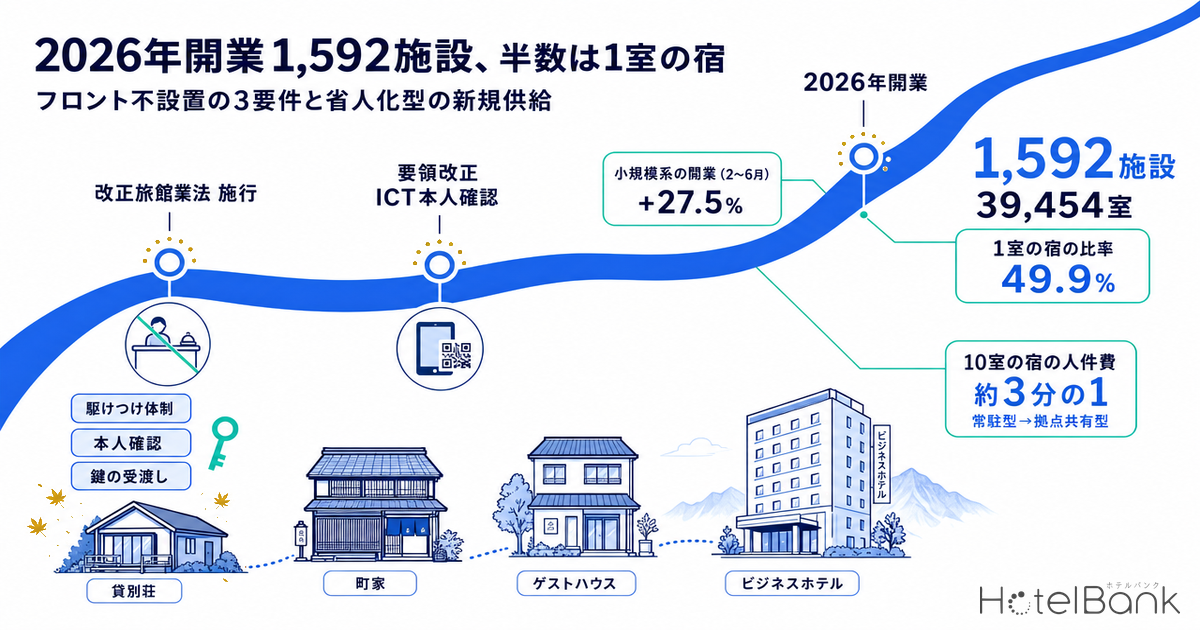
MetroEngines Research has identified 1,592 lodging properties with 39,454 rooms opening in Japan in 2026. The average property has 24.8 rooms, but the median is just 2, and 49.9% of all openings have a single room (whole-property rentals). Operating without a staffed front desk is now spelled out in the Ministry of Health, Labour and Welfare’s (MHLW) “Guidelines for Sanitation Management in the Hotel and Inn Business,” and in April 2025 a new category of ICT-based identity verification was added. This article confirms those requirements against primary sources, counts small-scale, labor-light new supply by both property count and room count, and uses check-in review sentiment and a per-room labor cost estimate to map the room for growth in locations where lodging has struggled to pencil out.
Metric Definitions Used in This Article
- Newly opened properties: the 1,592 properties tracked by MetroEngines Research with an opening date between January and December 2026 and a registered room count (as of September 22, 2026). Covers properties confirmed as listed on OTAs and other channels; not a complete census.
- Whole-property rental formats: vacation rentals, cottages and machiya (traditional townhouses). Small-scale / simple lodging formats: whole-property rentals plus hostels, guesthouses, minshuku, pensions, glamping, lodges, dormitories and similar. Hotel formats: business, city, resort, deluxe and capsule hotels, among others.
- Positive check-in mention ratio: among guest review comments that mention check-in or check-out procedures, the share of positive comments in the total of positive and negative comments (NLP analysis by the HotelBank Editorial Team).
- Data sources: MetroEngines Research & Consulting (based on confirmed OTA listings, N=1,592 properties) / review analysis by the HotelBank Editorial Team
- — 1,592 properties, 39,454 rooms: among 2026 openings (as of September 22), the median room count is 2 and 49.9% of properties have a single room. Yet hotel formats supply 84.6% of the rooms, a two-tier structure.
- — Three requirements for going without a front desk: a response system that can reach the property in roughly 10 minutes, identity and entry/exit verification (including ICT-based methods), and proper key handover. Only the response system remains a nightly operating cost.
- — +27.5%: 676 small-scale / simple lodging properties opened in February-June 2026, above the same period a year earlier. No acceleration was visible immediately after the April 2025 guideline revision, however.
- — 74.1% vs. 53.0%: the positive check-in mention ratio at 7 properties that put automated check-in front and center beats the remaining 93 properties by more than 20 points.
- — About ¥5,500 to about ¥1,700: for a 10-room property, front-desk and emergency-response labor cost per occupied room-night falls to about one-third under a shared-hub model versus on-site staffing (estimate).
Requirements for Operating Without a Front Desk — The Three Points in the MHLW Guidelines
Operating without a front desk (genkan-choba, the reception counter) has been institutionalized in stages. The revised Hotel Business Act, effective June 15, 2018, merged the “hotel business” and “ryokan business” categories into a single “ryokan/hotel business” and abolished the minimum room counts (10 rooms for hotels, 5 for ryokan). It also allowed facilities meeting standards set by MHLW ordinance (with ICT equipment in mind) to substitute for a front desk. For the simple lodging business, revisions to the guidelines in March 2016 and December 2017 had already made a front desk merely “desirable,” and one is not required if substitute equipment and an emergency response system are in place.
Following the Regulatory Reform Implementation Plan (Cabinet decision of June 21, 2024), MHLW revised the “Guidelines for Sanitation Management in the Hotel and Inn Business” by a notice dated March 11, 2025 (Kensei-hatsu 0311 No. 1), applying from April 1, 2025. The notice cites staffing challenges in the lodging industry and advances in ICT as the background for the revision. A further revision applying from January 20, 2026 (Kensei-hatsu 0120 No. 48) clarified the approach to preventing adverse effects on the living environment, but the requirements for operating without a front desk still consist of the following three points under the current guidelines.
| Requirement | Wording of the current guidelines (summary) | Operational nature |
|---|---|---|
| 1. Emergency response system | In emergencies such as accidents or unauthorized entry into guest-only areas, a system under which “staff or others can normally arrive within roughly 10 minutes” at the guest’s request | Met by people (continues overnight) |
| 2. Identity and entry/exit verification | Either (a) continuous verification with clear images from video cameras or similar equipment installed by the operator, or (b) ICT-based identity verification, with guest-only areas accessible only using a key issued to the verified person, entry and exit recorded at an angle where faces can be identified, and the footage checked when necessary | Met by equipment |
| 3. Key handover | Keys must be handed over appropriately | Met by equipment |
Source: Compiled by the HotelBank Editorial Team from MHLW, “Partial Revision of the Guidelines for Sanitation Management in the Hotel and Inn Business” (March 11, 2025, Kensei-hatsu 0311 No. 1 / January 20, 2026, Kensei-hatsu 0120 No. 48)
The “ICT-based identity verification” in 2(b) is defined in the guest register section of the guidelines. One method lets the operator clearly see the face and passport of the prospective guest and confirm that the images are being transmitted from near the property (for example, a video phone or tablet installed at the property). The other, added in April 2025, has the operator share identity information such as name, address and contact details in advance together with a QR code or PIN issued by the operator, which is then matched on an automated check-in machine at the property. In this case too, the matching must be recorded at an angle where the face can be identified, and the operator must provide “equipment or a system through which guests can make inquiries about operating the automated check-in machine.”
Note that these notices are “technical advice” under the Local Autonomy Act. Some municipalities require a front desk by ordinance, and the notices ask local governments to consider “flexible operation suited to local circumstances or revision of ordinances.” Anyone actually opening a property must first check with the local public health center and ordinances. Of the requirements, points 2 and 3 can be met with a one-time equipment investment, but the response system in point 1 remains a nightly operating cost for as long as guests are on site. That structure is the starting point for the labor cost estimate later in this article.
1,592 Openings in 2026 — Different Leaders by Property Count and by Room Count
Ranking the 1,592 properties opening in 2026 by format, vacation rentals lead with 768 properties, 48.2% of the total and 3.8 times the second-place business hotels (200 properties). Re-rank by room count, however, and the order changes sharply. Vacation rentals account for just 1,264 rooms (3.2%), placing fifth; business hotels lead with 20,276 rooms (51.4%), followed by resort hotels with 7,517 rooms (19.1%) and city hotels with 5,139 rooms (13.0%). Machiya rank 8th by property count (49 properties) but 13th by rooms (94 rooms).
Source: MetroEngines Research & Consulting (based on confirmed OTA listings, N=1,592 properties)
| Format | Properties | Rooms | Avg. rooms | Rank (properties) | Rank (rooms) |
|---|---|---|---|---|---|
| Vacation rentals | 768 | 1,264 | 1.6 | 1 | 5 |
| Business hotels | 200 | 20,276 | 101.4 | 2 | 1 |
| Hostels | 119 | 2,291 | 19.3 | 3 | 4 |
| Resort hotels | 95 | 7,517 | 79.1 | 4 | 2 |
| Guesthouses | 87 | 361 | 4.1 | 5 | 8 |
| Cottages | 73 | 671 | 9.2 | 6 | 7 |
| Ryokan | 57 | 792 | 13.9 | 7 | 6 |
| Machiya | 49 | 94 | 1.9 | 8 | 13 |
| City hotels | 47 | 5,139 | 109.3 | 9 | 3 |
| Minshuku | 24 | 119 | 5.0 | 10 | 11 |
Source: MetroEngines Research & Consulting (based on confirmed OTA listings, N=1,592 properties. Top 10 formats by property count shown; ranks are out of all 23 formats)
Grouping the formats makes the structure even clearer. Whole-property rental formats (vacation rentals, cottages and machiya) account for 890 properties, 55.9% of the count, but only 2,029 rooms, or 5.1%. Adding hostels, guesthouses, minshuku and the like, small-scale / simple lodging formats total 1,172 properties (73.6%) with 5,156 rooms (13.1%). Hotel formats, by contrast, number 357 properties (22.4%) yet supply 33,395 rooms (84.6%). By size band, single-room properties are 795 (49.9%) and 2.0% of rooms, while properties with 100 or more rooms are 131 (8.2%) and 65.1% of rooms. Widening the lens to properties with 10 rooms or fewer gives 1,149 properties (72.2%), still only 2,628 rooms (6.7%).
Source: MetroEngines Research & Consulting (based on confirmed OTA listings, N=1,592 properties)
In other words, the story that “new openings are increasing” changes depending on whether it is told in properties or in rooms. Growth in the property count is driven by lodgings with one to a few rooms, while most of the rooms entering the market are still supplied by mid-size and large hotels, as before. The requirements for operating without a front desk matter mainly for the former group, the size band where staffing each property around the clock is hard to justify financially.
Openings by Month — Property Count Peaks in January, Rooms Peak in April and July
Breaking down January-August 2026 openings by month shows that the peaks in property count and room count do not line up. The most properties opened in January, at 246, of which 197 were whole-property rentals. The most rooms, by contrast, came in April (6,321 rooms) and July (6,072 rooms), both months in which hotel openings (56 properties in April, 57 in July) pushed up the room total. Note that 173 of January’s 246 properties are registered with an opening date of the 1st, so properties for which only the opening month is known tend to cluster in January.
Source: MetroEngines Research & Consulting (based on confirmed OTA listings, openings in January-August 2026, N=1,479 properties) *Counts for August onward may rise as further listings are confirmed
By Prefecture — Hokkaido Leads in Properties, Osaka in Rooms
By prefecture too, the rankings by property count and by room count diverge. Hokkaido leads in properties with 158, followed by Tokyo (97), Okinawa (91), Shizuoka (89) and Kyoto (81). Osaka leads in rooms with 3,096 but ranks only 13th in properties (46). Osaka’s small-scale / simple lodging share is 32.6%, the only one of the top 15 prefectures below 50%, and at 67.3 rooms per property, large hotel openings are what build up its room count.
Conversely, in Yamanashi (8th in properties, 29th in rooms), Kagoshima (14th in properties, 32nd in rooms) and Oita (12th in properties, 27th in rooms), the small-scale / simple lodging share exceeds 80%. Yamanashi and Kagoshima are both around 88%, with fewer than 10 rooms per property. These are regions with tourism assets that are nevertheless hard locations for large hotels, and whole-property rentals and small lodgings are what sustain the opening count there.
Source: MetroEngines Research & Consulting (based on confirmed OTA listings, N=1,592 properties)
| Prefecture | Properties | Rank (properties) | Rooms | Rank (rooms) | Small-scale share | Avg. rooms |
|---|---|---|---|---|---|---|
| Hokkaido | 158 | 1 | 2,794 | 4 | 84.2% | 17.7 |
| Tokyo | 97 | 2 | 2,799 | 3 | 64.9% | 28.9 |
| Okinawa | 91 | 3 | 2,919 | 2 | 74.7% | 32.1 |
| Shizuoka | 89 | 4 | 1,137 | 11 | 79.8% | 12.8 |
| Kyoto | 81 | 5 | 911 | 15 | 79.0% | 11.2 |
| Nagano | 69 | 6 | 890 | 17 | 79.7% | 12.9 |
| Fukuoka | 63 | 7 | 1,570 | 6 | 79.4% | 24.9 |
| Yamanashi | 59 | 8 | 449 | 29 | 88.1% | 7.6 |
| Hyogo | 58 | 9 | 886 | 18 | 81.0% | 15.3 |
| Chiba | 56 | 10 | 1,635 | 5 | 78.6% | 29.2 |
| Kumamoto | 52 | 11 | 1,451 | 8 | 75.0% | 27.9 |
| Oita | 49 | 12 | 518 | 27 | 83.7% | 10.6 |
| Osaka | 46 | 13 | 3,096 | 1 | 32.6% | 67.3 |
| Kagoshima | 43 | 14 | 380 | 32 | 88.4% | 8.8 |
| Kanagawa | 40 | 15 | 1,469 | 7 | 67.5% | 36.7 |
Source: MetroEngines Research & Consulting (based on confirmed OTA listings, N=1,592 properties. Top 15 prefectures by property count; ranks are out of 47 prefectures. Small-scale share = share of small-scale / simple lodging formats in the property count)
Did the Pace of Openings Change After the Guideline Revision? — The Trend So Far
We checked month by month whether openings of small-scale / simple lodging formats accelerated after April 2025, when the ICT identity verification category was added. In short, there was no notable acceleration during 2025; changes began to show only in 2026. Small-scale / simple lodging openings in April-December 2025 totaled 926 properties, below the same period of 2024 (1,225). In February-June 2026, by contrast, there were 676, up 27.5% from the same period a year earlier (530). January was excluded from the comparison to avoid the effect of opening dates clustering in that month, and growth is still substantial.
Source: MetroEngines Research & Consulting (based on confirmed OTA listings, monthly openings of small-scale / simple lodging formats) *2026 data through August. Recent months may rise as further listings are confirmed
Splitting 2026 into January-June and July-August, small-scale / simple lodging openings fell from an average of 149 per month to 113, and their share of all openings dropped from 78.1% to 68.1%. Hotel openings, meanwhile, rose from an average of 35 per month to 44.5. Still, it is too early to read the July-August decline as “labor-light formats losing steam.” Overlaying quarterly shares shows that in 2025 too the share fell from 78.4% in January-March to 70.2% in July-September: there is a seasonal pattern in which more hotels open in summer and the share dips.
Source: MetroEngines Research & Consulting (based on confirmed OTA listings) *Q3 2026 covers July-August only
In addition, because opening data starts from confirmed OTA and other listings, the most recent months tend to be undercounted. Among past openings, 30-40% of properties were first confirmed as listed 91 or more days after opening. Small-scale / simple lodging openings in July-August 2026 were 226, down 5.8% from 240 a year earlier, but that gap is likely to narrow as further listings are confirmed. For now, the fairest summary is that “small-scale / simple lodging openings ran well above the prior year in the first half of 2026, and the summer is following the usual seasonal pattern.” Isolating the effect of the guideline revision quantitatively will take several more quarters of observation.
Check-in That Earns Good Reviews — Advance Information and a “Help Line”
At a property without a front desk, check-in is the linchpin of the guest experience. From guest reviews compiled by the HotelBank Editorial Team (the 24 months from September 2024 to September 2026), we extracted the 100 properties with the most comments on check-in and check-out procedures. These properties have 424,201 reviews, of which 47,719 comments mention check-in. The share of positive comments in the total of positive and negative comments was 54.3% across the 100 properties combined, with a per-property median of 57.1%. Waiting times and procedural hassle feed directly into ratings, making check-in an experience on which opinions tend to split.
Source: HotelBank Editorial Team research (NLP analysis. Top 100 properties by check-in mentions; reviews N=424,201, of which check-in mentions N=47,719; September 2024-September 2026)
Within that group, 7 properties from brands that put robot receptionists or automated check-in machines front and center had a combined positive mention ratio of 74.1%, more than 20 points above the remaining 93 properties combined (53.0%). Their median share of reviews mentioning check-in was also 23.0%, more than double the 10.8% at the 93 properties. Automated check-in itself becomes a talking point of the stay, and one that guests describe favorably. The data suggest that labor saving is not simply “the price of cutting staff” but, if designed well, can be a factor that lifts ratings.
Classifying 400 positive check-in comments from the 20 properties with the highest positive mention ratios by element, the most common were comments about speed, such as “smooth” and “no waiting” (18.0%, appearing at 19 properties), followed by the route to arrival, such as proximity to stations or airports and shuttle service (13.5%, 16 properties). Also cited were automated check-in machines and self-service procedures (6.0%, 12 properties), advance information and pre-check-in (2.8%, 6 properties), and luggage storage before and after the stay (2.2%, 5 properties).
Source: HotelBank Editorial Team research (NLP analysis. Positive check-in comments N=400 from the top 20 properties by positive mention ratio, September 2024-September 2026. A single comment may fall into multiple elements)
Looking at specific comments, those praising pre-arrival guidance and preparation stand out, such as “thanks to online pre-check-in … smooth,” “an advance information email arrived,” and “unstaffed check-in, but I could leave my luggage in advance.” Even when guests stumbled with the machine, some ratings held up because a help line was available: “when I had a problem, I called … and they responded right away.” This matches the guidelines’ requirement, when automated check-in machines are used, for “equipment or a system through which guests can make inquiries about operating the machine.”
Only 1 of the 400 comments explicitly mentioned multilingual displays. However, 48.0% of the positive comments were written in languages other than Japanese. That international visitors praise the smoothness of the procedure in their own languages can be read as a sign that multilingual support functions as a baseline expectation. The elements common to highly rated properties come down to five: (1) advance information and pre-check-in before arrival, (2) an easy-to-follow route from the station or parking lot to the entrance and terminal, (3) procedures that finish without waiting, (4) a help line that connects immediately when guests get stuck, and (5) guidance that works regardless of language.
Estimating Labor Cost per Room — “Shared Hubs” Work Best for Small Properties
We estimated the labor cost of front-desk duties and emergency response per occupied room-night. The assumptions are as follows. The hourly wage is ¥1,300, about 1.1 times ¥1,177, the national weighted average of the FY2026 regional minimum wages (announced by MHLW on September 3, 2026); the 7 hours from 10 p.m. to 5 a.m. carry a 25% late-night premium; and 15% is added for statutory welfare and similar costs. Filling one post 24 hours a day, 365 days a year comes to about ¥14.05 million in annual labor cost. Occupancy is set at 70% year-round.
| Operating model | Annual cost structure per property (estimate assumptions) | Annual cost |
|---|---|---|
| A. On-site staffing | One post staffed 24 hours at each property | About ¥14.05 million |
| B. Shared hub | One remote inquiry post shared by 10 properties + one response-hub post shared by 5 properties + substitute equipment (¥370,000 per property depreciated over 5 years, ¥6,000 per month) | About ¥4.36 million |
| C. Wide-area shared | Remote support shared by 50 properties and response hub shared by 20 properties + substitute equipment | About ¥1.13 million |
Source: Estimated by the HotelBank Editorial Team based on MHLW, “Status of Recommendations on FY2026 Regional Minimum Wages.” Substitute equipment unit cost uses assumptions from previous HotelBank analysis. Excludes cleaning, linen and similar costs
Converting to cost per occupied room-night under these assumptions, the difference by size is stark. A 100-room hotel pays about ¥550 per occupied room-night even with on-site staffing, because the fixed front-desk cost is spread thinly across many rooms. For a 10-room property that jumps to about ¥5,500, and for a 2-room property to about ¥27,500. The weight of this fixed cost is why small properties have struggled to work when each one must be staffed individually.
Source: HotelBank Editorial Team estimate (hourly wage ¥1,300, 25% late-night premium, 15% statutory welfare etc., 70% year-round occupancy. Vertical axis is logarithmic)
Switching to a shared hub brings a 10-room property down to about ¥1,700 per occupied room-night, about one-third (31%) of on-site staffing, and to about ¥440 under the wide-area shared model. Even a 2-room property comes to about ¥8,500 with a shared hub and about ¥2,200 with the wide-area model, levels that start to fit within the room rate. Because the burden per property falls as more properties cluster within the 10-minute response radius, simply adding more operated properties in the same area improves the economics. Regions such as Yamanashi, Kagoshima and Oita, where small-scale / simple lodging accounts for more than 80% of openings, are exactly where this mechanism works best. Whether the equipment investment can be recovered depends heavily on how many properties sit within one response radius, so local density is the variable to check first.
Seen another way, this opens a path to lodging in locations where properties could not be built because overnight staff could not be secured for each one: vacant houses in hot spring towns far from stations, for example, or small villages with tourism assets that cannot support a large hotel. The response system remains a “requirement met by people,” but designing it to be shared across multiple properties considerably eases the staffing constraint. Results shift substantially with the assumptions, however, so actual plans must individually confirm local ordinances, the density of properties within the response radius, and seasonal occupancy.
Summary
The 1,592 properties opening in 2026 form a two-tier structure: whole-property rentals account for more than half of the count, while hotel formats supply 84.6% of the rooms. The requirements for operating without a front desk (a response system reaching the property in roughly 10 minutes, identity and entry/exit verification including ICT-based methods, and proper key handover) matter mainly for the former, and small-scale / simple lodging openings rose 27.5% year on year in February-June 2026. However, no acceleration was visible immediately after the April 2025 guideline revision, and July-August figures include seasonality and listing-confirmation lags, so for now this should be treated as a trend rather than a conclusion.
The reviews confirm that well-designed automated check-in is described favorably. With advance information, an easy route, no waiting, a help line that connects immediately, and guidance that works in any language, labor saving becomes a strength of the guest experience in its own right. On labor cost as well, sharing emergency response and inquiry handling across multiple properties cuts the per-occupied-room-night burden of a 10-room property to about one-third. Both regulation and technology are widening the room to add lodging in places where securing staff used to be the obstacle.
Frequently Asked Questions
Q. Under what conditions can a lodging operate without a front desk?
A. MHLW’s “Guidelines for Sanitation Management in the Hotel and Inn Business” allow a property to go without a front desk if it meets all three of the following: (1) a system under which staff or others can normally arrive within roughly 10 minutes in an emergency, (2) continuous verification by video camera or similar, or ICT-based identity verification with entry and exit recorded, and (3) proper key handover. Some municipalities require a front desk by ordinance, so checking with the local public health center is a prerequisite.
Q. How many lodging properties opened in Japan in 2026?
A. Within the scope tracked by MetroEngines Research as of September 22, 2026, 1,592 properties with 39,454 rooms among those with a registered room count. The median room count is 2, and 49.9% of properties have a single room.
Q. How much does labor saving change labor cost per room?
A. Under this article’s estimate (hourly wage ¥1,300, 70% year-round occupancy, etc.), front-desk and emergency-response labor for a 10-room property costs about ¥5,500 per occupied room-night with 24-hour on-site staffing, and about ¥1,700 when remote support and a response hub are shared across multiple properties.
Methodology and notes: New-opening data are as of the survey date of September 22, 2026, and are based on opening dates registered in the MetroEngines Research property master (domestic, with registered room counts). Because OTA and other listings are confirmed before or after the actual opening, the most recent months tend to show lower counts, and counts for August 2026 onward may increase as further listings are confirmed. Properties for which only the opening month is known are registered on the first day of that month. Formats follow the MetroEngines Research property classification. The review analysis aggregates the results of NLP analysis of guest reviews, and individual reviews are quoted only in part. Labor costs are estimates based on stated assumptions; actual costs vary by region and operating structure.
References and Sources
- MHLW, “Partial Revision of the Guidelines for Sanitation Management in the Hotel and Inn Business” (March 11, 2025, Kensei-hatsu 0311 No. 1, applied from April 1, 2025) [Japanese]
- MHLW, “Partial Revision of the Guidelines for Sanitation Management in the Hotel and Inn Business” (January 20, 2026, Kensei-hatsu 0120 No. 48) [Japanese]
- MHLW Health and Environmental Sanitation Division, “Regulations on Front Desks, etc. for the Simple Lodging Business under the Hotel Business Act” (Regulatory Reform Promotion Council, Regional Industry Revitalization WG, Document 1-2, April 19, 2024) [Japanese]
- Tokyo Metropolitan Government Bureau of Social Welfare and Public Health, “Revisions to the Hotel Business Act and Related Ordinances (Main Points)” (March 28, 2018) [Japanese]
- MHLW, “History of Revisions to the Hotel Business Act” [Japanese]
- MHLW, “Revised Regional Minimum Wages Recommended in All Prefectures” (September 3, 2026) [Japanese]
- MetroEngines Research & Consulting — 2026 new openings (based on confirmed OTA listings, N=1,592 properties), by format, month and prefecture
- HotelBank Editorial Team research — NLP analysis of guest reviews (check-in related, September 2024-September 2026)