

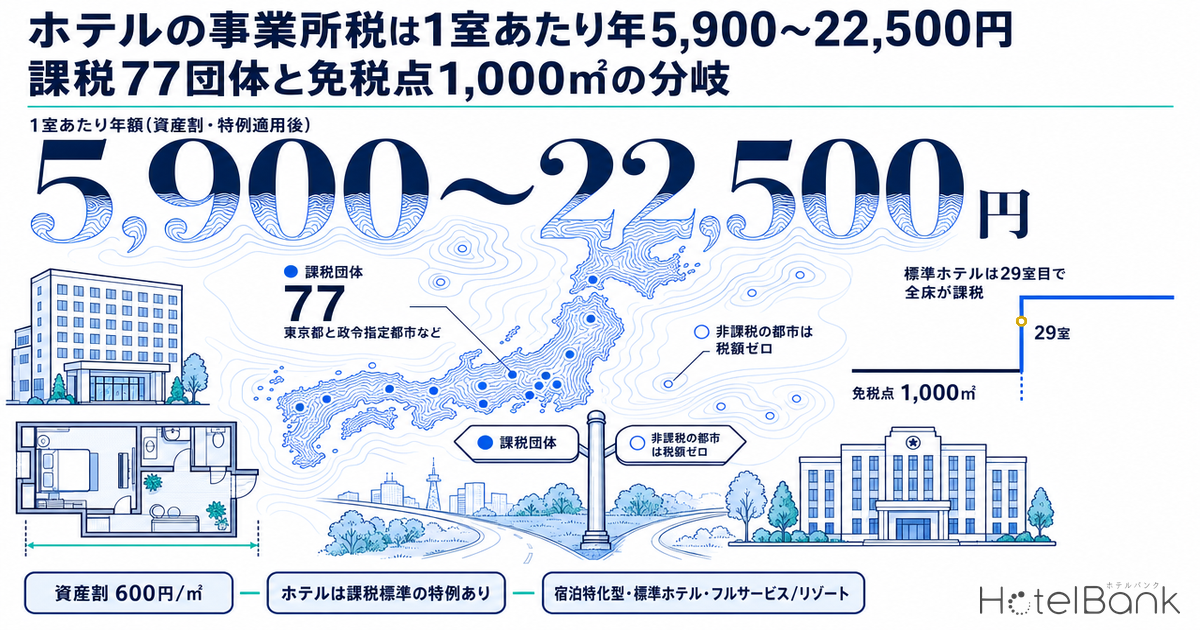
When investors tally a hotel’s holding costs, almost everyone counts property tax on land and buildings, city planning tax and depreciable asset tax. The fourth, the business office tax (jigyosho-zei), is often left out. The reason is simple: this tax is not levied nationwide. As of January 1, 2025, only 77 municipalities, mostly cities with 300,000 or more residents, levy it. Two hotels with the same design and the same room count can owe nothing or several million yen a year, depending only on which city they stand in.
This article focuses on that “location-dependent holding tax” and estimates its annual cost per room and its effect on NOI yield. Our earlier estimates put property tax at ¥160,000–240,000 per room a year and depreciable asset tax at ¥21,000–66,000 per room a year, but both apply regardless of location. The business office tax is the only one that can still be influenced at the site-selection stage.
Metric Definitions Used in This Article
- ADR (average daily rate): An estimated realized rate (tax-exclusive equivalent), calculated by applying segment-specific adjustment factors to the lowest-plan price each property publishes on OTAs and other channels (per room, 2 guests per room, tax-inclusive). Checked against property-level results disclosed by listed hotel REITs (91 properties, latest 3 months), the median error is about 7%. These are estimates and differ from each property’s actual transaction prices and accounting figures. Area-level ADR is the median of the properties covered (the level of a typical property in the area).
- OCC (occupancy rate): The share of rooms sold out of total rooms in the area (an estimate based on OTA sales inventory). The calculations in this article use a flat assumed occupancy of 75%.
- Data source: MetroEngines Research & Consulting
- — ¥5,900–22,500 per room a year. The floor-area levy comes to ¥5,940 for a limited-service hotel, ¥12,075 for a standard hotel and ¥22,500 for a full-service or resort hotel. That is an order of magnitude below property tax, but on par with the low end of depreciable asset tax.
- — Only 77 municipalities levy it. As of January 1, 2025, only Tokyo and 76 cities impose the tax. Of the four holding taxes, it is the only one whose very existence can be decided at the site-selection stage.
- — The 1,000 m² threshold is crossed at room 29 when each room carries 35 m². It is a threshold, not a deduction: one square meter over, and the entire floor area becomes taxable, creating a step of ¥350,175 a year.
- — The payroll levy only starts at roughly 180–300 rooms. Part-timers are excluded from the 100-employee threshold test, pushing it further away, so for most hotels the business office tax is in practice just the floor-area levy.
- — The effect on NOI yield is 0.015–0.225pt. Across five same-prefecture city pairs it equals 0.40–0.66% of room revenue. The lower the rates in an area, the heavier the same floor area weighs.
An Earmarked Tax on the “Benefit of Urban Infrastructure”: 77 Levying Municipalities, Two Rates
The business office tax is an earmarked tax under the Local Tax Act. According to the Ministry of Internal Affairs and Communications (MIC), it is levied by cities of 300,000 or more residents and similar municipalities “to cover the cost of projects that develop and improve the urban environment, based on the benefit relationship between urban administrative services and the business premises located there.” Its use is restricted to transport facilities such as roads, urban expressways and railways and parking, and to water supply and sewerage. It is not general revenue.
The levying municipalities fall into four groups: (1) Tokyo (the area of the 23 special wards only); (2) designated cities under Article 252-19(1) of the Local Autonomy Act (the 20 ordinance-designated cities); (3) cities containing an existing urban area under the National Capital Region Development Act or an existing urbanized area under the Kinki Region Development Act; and (4) cities of 300,000 or more residents designated by Cabinet Order. Together they total 77 municipalities.
| Category | Count | Municipalities |
|---|---|---|
| Tokyo (special-ward area) | 1 | Tokyo’s 23 wards |
| Ordinance-designated cities | 20 | Sapporo, Sendai, Niigata, Chiba, Saitama, Yokohama, Kawasaki, Sagamihara, Shizuoka, Hamamatsu, Nagoya, Kyoto, Osaka, Sakai, Kobe, Okayama, Hiroshima, Kitakyushu, Fukuoka, Kumamoto |
| Cities with an existing urban area (National Capital Region Development Act) | 3 | Kawaguchi, Musashino, Mitaka |
| Cities with an existing urbanized area (Kinki Region Development Act) | 5 | Moriguchi, Higashiosaka, Amagasaki, Nishinomiya, Ashiya |
| Cities of 300,000+ designated by Cabinet Order | 48 | Asahikawa, Akita, Koriyama, Iwaki, Utsunomiya, Maebashi, Takasaki, Kawagoe, Tokorozawa, Koshigaya, Ichikawa, Funabashi, Matsudo, Kashiwa, Hachioji, Machida, Yokosuka, Fujisawa, Toyama, Kanazawa, Nagano, Gifu, Toyohashi, Okazaki, Ichinomiya, Kasugai, Toyota, Yokkaichi, Otsu, Toyonaka, Suita, Takatsuki, Hirakata, Himeji, Akashi, Nara, Wakayama, Kurashiki, Fukuyama, Takamatsu, Matsuyama, Kochi, Kurume, Nagasaki, Oita, Miyazaki, Kagoshima, Naha |
| Total | 77 | As of January 1, 2025 |
The tax has two components. The floor-area levy (shisan-wari) is ¥600 per square meter of business floor area per year, with an exemption threshold of 1,000 m² or less. The payroll levy (jugyosha-wari) is 0.25% of total employee payroll, with an exemption threshold of 100 employees or fewer. If only one of the two exceeds its threshold, only that component is filed and paid. The filing deadline is two months after the end of the fiscal year for corporations and March 15 of the following year for individuals, with no extension.
How much of Japan’s hotel stock do these 77 municipalities cover? Within the scope tracked by MetroEngines Research & Consulting, among properties with a confirmed room count, there are 6,898 properties with 100 or more rooms nationwide, totaling 1,397,990 rooms. Of these, 3,531 properties and 736,204 rooms are located in the 77 levying municipalities, or 51.2% of properties and 52.7% of rooms. Roughly half of all hotels with more than 100 rooms fall within the reach of the business office tax.
Hotels Get a 50% Tax-Base Reduction on Guest Rooms, Lobbies and Kitchens: Effective ¥330–375/m²
This is the point most often missed in practice. Article 701-41 of the Local Tax Act (special tax-base provisions) provides that for certain facilities used for hotel or ryokan operations as defined under the Hotel Business Act, the tax base for the floor-area levy is reduced by one half. The facilities listed in the filing guides of Osaka City and Hirakata City are as follows, covering nearly all of a hotel’s floor area.
| Type | Facilities eligible for the 50% reduction |
|---|---|
| Guest rooms & dining | Guest rooms / dining rooms (used exclusively by overnight guests) / banquet halls (excluding those used mainly by people other than overnight guests) |
| Common areas & plant | Lobby / baths / kitchen / machine rooms |
| Circulation & back of house | Entrance / entrance front desk / front desk / cloakroom / pantry / service stations / restrooms / stairs / elevators / linen room / laundry room |
| Excluded | Facilities used for businesses listed in Article 2(6)(iv) of the Act on Control and Improvement of Amusement Businesses |
Conversely, floor area not on the list stays at ¥600/m². This includes offices (administration and back office), retail space leased to tenants, banquet halls and meeting rooms used mainly by non-guests, and indoor parking. Outdoor surface parking, on the other hand, is not a building and is not counted as business floor area at all.
The effective rate therefore depends on the share of floor area eligible for the reduction. For a limited-service design made up almost entirely of rooms and circulation, the eligible share reaches around 90%, giving an effective rate of 600×0.1 + 300×0.9 = ¥330/m². For a full-service hotel with banquet space and tenants, an eligible share of 75% gives ¥375/m². The models in this article are built on this logic.
How Many Rooms Is 1,000 m²? At 35 m² per Room, ¥350,000 a Year Kicks In at Room 29
The exemption threshold is a threshold, not a deduction. If total business floor area is 1,000 m² or less, no tax is due; exceed it by even one square meter, and the entire floor area, not just the excess, becomes the tax base. This creates a step at a certain room count where the tax jumps from zero to several hundred thousand yen.
So how many rooms is 1,000 m²? Taking planned hotels from the Ministry of Land, Infrastructure, Transport and Tourism (MLIT) “Statistics on Building Construction Starts” whose use is exclusively hotel or ryokan, and dividing total floor area by room count (N=27), gives a distribution with a first quartile of 18.2 m²/room, a median of 26.9 m²/room and a third quartile of 59.8 m²/room. We set three model types at 18, 35 and 60 m² per room: limited-service, standard hotel, and full-service/resort.
| Type | Floor area/room | Max rooms while exempt | Floor area at one room more | Annual tax triggered |
|---|---|---|---|---|
| Limited-service | 18 m² | 55 rooms (990 m²) | 56 rooms = 1,008 m² | ¥332,640 |
| Standard hotel | 35 m² | 28 rooms (980 m²) | 29 rooms = 1,015 m² | ¥350,175 |
| Full-service / resort | 60 m² | 16 rooms (960 m²) | 17 rooms = 1,020 m² | ¥382,500 |
For a standard design, ¥350,000 a year kicks in at room 29. For formats with larger floor area per room, such as resorts, the threshold is reached at 17 rooms. Put the other way, when planning a small boutique hotel inside a levying municipality, 1,000 m² of floor area is a level worth designing around. Within the scope tracked by MetroEngines Research & Consulting, the 77 levying municipalities contain 1,868 properties with 20–29 rooms and 1,153 with 29–40 rooms, so a sizable stock sits near this step.
Once past the threshold, the floor-area levy is strictly proportional to floor area. There is no progressive structure and no size-based relief, so the burden per room is constant regardless of room count. ¥5,900 for limited-service, ¥12,100 for a standard hotel and ¥22,500 for full-service/resort: these three numbers are the backbone of the business office tax.
| Type | 50 rooms | 100 rooms | 200 rooms | 300 rooms | Per room |
|---|---|---|---|---|---|
| Limited-service (18 m²/room) | ¥0 900 m², below threshold | ¥594,000 | ¥1,188,000 | ¥1,782,000 | ¥5,940 |
| Standard hotel (35 m²/room) | ¥603,750 | ¥1,207,500 | ¥2,415,000 | ¥3,622,500 | ¥12,075 |
| Full-service / resort (60 m²/room) | ¥1,125,000 | ¥2,250,000 | ¥4,500,000 | ¥6,750,000 | ¥22,500 |
Set alongside our earlier estimates, the position becomes clear. Property tax on land and buildings runs ¥160,000–240,000 per room a year and depreciable asset tax ¥21,000–66,000, while the floor-area levy of the business office tax is ¥5,900–22,500. In absolute terms it is the smallest of the four. Even so, it is roughly on par with the low end of depreciable asset tax, and the accurate way to see it is not “small enough to ignore” but “small, yet the only one that can be reduced to zero.”
The Payroll Levy Only Bites at About 180–300 Rooms: Excluding Part-Timers Pushes the 100-Employee Threshold Further Out
The payroll levy is 0.25% of total payroll, but the 100-employee threshold is a high bar. We need an assumption for how many people work per guest room. In the MIC/METI “Economic Census for Business Activity,” industry subgroup “751 Ryokan and hotels” shows 476,731 employees against 991,925 guest rooms (18,447 establishments), or 0.481 employees per room. That is a national average across ryokan and hotels combined; limited-service hotels run lower and ryokan and full-service hotels higher. We set three levels here: 0.20, 0.48 and 0.80 employees per room.
Assuming a 30% part-timer share, the room count at which the 100-employee threshold is reached is about 714 rooms for limited-service, about 298 rooms for a standard hotel and about 179 rooms for full-service/resort. With annual pay of ¥2.5 million per employee, the tax comes to the following.
| Type | Employees/room | Threshold reached at | 100 rooms | 200 rooms | 300 rooms |
|---|---|---|---|---|---|
| Limited-service | 0.20 | ~714 rooms | ¥0 | ¥0 | ¥0 |
| Standard hotel | 0.48 | ~298 rooms | ¥0 | ¥0 | ¥900,000 = ¥3,000/room |
| Full-service / resort | 0.80 | ~179 rooms | ¥0 | ¥1,000,000 = ¥5,000/room | ¥1,500,000 = ¥5,000/room |
The conclusion: for most hotels, the business office tax is the floor-area levy. The payroll levy only really starts at around 200 rooms for full-service hotels and around 300 rooms for standard hotels. Within the scope tracked by MetroEngines Research & Consulting, the 77 levying municipalities contain 443 properties with 300 or more rooms, totaling 207,960 rooms; this band is effectively where the payroll levy applies.
What Changes Between Levying and Non-Levying Cities: Tax as a Share of Room Revenue in Five Same-Prefecture Pairs
Consider the same 100-room, 3,500 m² standard hotel placed inside a levying municipality and outside one. On the levying side, the annual tax is ¥1,207,500, or about ¥12,100 per room. On the non-levying side, it is zero. We compare this with room revenue built up from each city’s estimated realized ADR.
| Prefecture | Levying city | Est. realized ADR | Room revenue/room/year | Tax / room revenue | Non-levying city (same prefecture) | Est. realized ADR | Tax / room revenue |
|---|---|---|---|---|---|---|---|
| Nagano | Nagano City | ¥11,058 N=75 | ¥3,027,128 | 0.40% | Matsumoto | ¥13,252 N=102 | 0% |
| Ishikawa | Kanazawa | ¥10,226 N=116 | ¥2,799,368 | 0.43% | Kaga | ¥19,827 N=45 | 0% |
| Hokkaido | Asahikawa | ¥8,605 N=38 | ¥2,355,619 | 0.51% | Hakodate | ¥8,556 N=87 | 0% |
| Okinawa | Naha | ¥10,198 N=140 | ¥2,791,702 | 0.43% | Onna Village | ¥21,408 N=39 | 0% |
| Kagoshima | Kagoshima City | ¥6,715 N=73 | ¥1,838,231 | 0.66% | Kirishima | ¥14,347 N=57 | 0% |
As a share, it is 0.40–0.66%, below 1% of room revenue. But the lower the rate, the heavier the share. Kagoshima City’s 0.66% is higher than Asahikawa’s 0.51% and Nagano City’s 0.40%, because the tax is a fixed amount set by floor area while revenue moves with rates. The lower the rates in an area, the heavier the business office tax weighs relative to the same floor area.
One more point: in four of the five pairs, the non-levying city has the higher ADR. This should be read as a difference in market character, not an effect of the tax. Kaga, Onna and Kirishima are all hot-spring or resort markets, with a fundamentally different property mix from the levying cities, which are driven by urban business demand. ADR gaps between cities strongly reflect property mix, so one cannot conclude that “the business office tax pushes rates down.” What the data does show is a supply-side fact: many high-rate resort locations lie outside the levying municipalities to begin with.
NOI Yield Impact of 0.015–0.225pt: What Matters Is Aggregation Within the Same City
Dividing the annual tax by the acquisition price gives the effect on NOI yield. A standard hotel (about ¥12,100 per room) acquired at ¥15 million per room shows 0.081pt; a full-service hotel (¥22,500 per room) acquired at ¥25 million per room shows 0.090pt. Across acquisition prices of ¥10–40 million per room, the effect stays within 0.015–0.225pt. Construction costs, which we have estimated at ¥8.7–71.4 million per room, are spread more widely, so outside this band the effect can be even smaller or larger.
| Type (annual tax per room) | Acquired at ¥10M/room | ¥15M/room | ¥25M/room | ¥40M/room |
|---|---|---|---|---|
| Limited-service (¥5,940) | 0.059pt | 0.040pt | 0.024pt | 0.015pt |
| Standard hotel (¥12,075) | 0.121pt | 0.081pt | 0.048pt | 0.030pt |
| Full-service / resort (¥22,500) | 0.225pt | 0.150pt | 0.090pt | 0.056pt |
On a single asset, this is a matter of around 0.1pt. But there is a further issue on the operating side: the exemption threshold is aggregated per business operator and per municipality. As Osaka City’s filing guide explains, the test uses the combined business floor area of all premises in the city, so an operator with several hotels in the same city may be below the threshold building by building but, once combined, exceed it and have its entire floor area taxed.
Site selection It splits at the city line
Only 77 municipalities levy the tax. Even within the same trade area, crossing into another city can take the floor-area levy to zero. For the standard 100-room model, that is ¥1,207,500 a year, or over ¥12 million over 10 years. It is worth adding a row to the site comparison sheet.
Size planning The 1,000 m² threshold
At 35 m² per room the tax kicks in at room 29, and at 60 m² per room at room 17, adding ¥330,000–380,000 a year. When planning a small boutique hotel inside a levying municipality, floor area is a level worth designing around.
Portfolio Aggregated within a city
The test is not per building. Owning several buildings in the same city can push the combined total over the threshold, making all floor area taxable. An additional acquisition in the city also changes the tax burden of existing buildings.
If the hotel is held under a lease, the operator is the direct taxpayer. The practical question for asset managers is therefore not “our own filed amount” but whether it is priced into rent negotiations as a fixed cost on the operator’s P&L. Under variable rent it flows back to the owner through GOP; under fixed rent it becomes a point for lease renewal. Given that the conduit requirements for TMK and GK-TK structures effectively force a lease structure, whose pocket this tax comes out of is determined by the structure itself.
Assumptions and Limitations
All figures in this article are model calculations. The assumptions are disclosed below.
■ Model settings
| Parameter | Value | Basis |
|---|---|---|
| Floor area per room | Limited-service 18 m² / standard 35 m² / full-service 60 m² | Quartiles of planned hotels from MLIT “Statistics on Building Construction Starts” (use exclusively hotel/ryokan, N=27): p25 18.2 / median 26.9 / p75 59.8 m² |
| Share of floor area eligible for 50% reduction | Limited-service 90% / standard 85% / full-service 75% | Assumption based on the facilities listed under Local Tax Act Article 701-41; offices, tenant space, indoor parking, etc. assumed ineligible |
| Effective floor-area levy rate | ¥330 / ¥345 / ¥375 (per m² per year) | Weighted average of ¥600/m² and ¥300/m² |
| Employees per room | 0.20 / 0.48 / 0.80 | Three levels centered on 0.481 per room = 476,731 employees ÷ 991,925 rooms in “751 Ryokan and hotels,” Economic Census for Business Activity |
| Annual pay per employee | ¥2.5 million | Economic Census for Business Activity (enterprise tabulation), “751 Ryokan and hotels”: total payroll ¥1,097,677 million ÷ 504,377 employees = about ¥2.18 million, set higher to reflect recent wage increases in the lodging industry |
| Part-timer share excluded from threshold test | 30% | Those working less than three-quarters of regular employees’ hours are excluded from the test (Osaka City guide); the share is an assumption |
| Occupancy | 75% | Flat assumption for estimation |
| Estimated realized ADR | Monthly average, September 2025–August 2026 | MetroEngines Research & Consulting |
■ Sensitivity to the eligible floor share (optimistic, base, pessimistic)
Of the limitations, the one with the largest effect is the share of floor area eligible for the 50% reduction. Below is the range when only this share is varied, for a standard 100-room hotel with 3,500 m² of floor area.
| Case | Eligible share | Effective levy rate | Annual tax (100 rooms) | Per room | Tax / room revenue | Effect on NOI yield |
|---|---|---|---|---|---|---|
| Pessimistic | 70% | ¥390 | ¥1,365,000 | ¥13,650 | 0.45% | 0.091pt |
| Base (used in this article) | 85% | ¥345 | ¥1,207,500 | ¥12,075 | 0.40% | 0.081pt |
| Optimistic | 95% | ¥315 | ¥1,102,500 | ¥11,025 | 0.36% | 0.073pt |
Lowering the share to 70% gives ¥13,650 per room and raising it to 95% gives ¥11,025, so the swing around the base of ¥12,075 stays within roughly ±10%. How much ineligible floor area a hotel carries moves the effective rate, but not enough to change the order of magnitude of the business office tax. What changes the order of magnitude is the location split: whether or not the site is in a levying municipality.
The limitations should also be stated. First, the eligible floor share is determined by the actual area schedule, so even at the same room count the effective rate rises or falls with the mix of banquet space and tenant areas. Second, the last Economic Census tabulation that reports both room counts and employee counts is the 2016 survey, so the figure of 0.481 employees per room does not reflect later labor-saving investment. Third, some cities have their own relief provisions, which this article does not incorporate. Fourth, ADR is an estimate and differs from actual transaction prices. Applying these figures in practice requires case-by-case checking against the filing guide of the relevant city and the property’s area schedule.
Summary
In absolute terms, the business office tax is the smallest of a hotel’s holding taxes. For a standard 100-room hotel it is ¥1,207,500 a year, or ¥12,100 per room — an order of magnitude below property tax at ¥160,000–240,000 per room.
The reason to put it on the table in investment decisions anyway is that this tax is the only one of the four holding taxes whose very existence can be changed by the choice of location. Only 77 municipalities levy it, and even within the same prefecture, moving to another city can take the floor-area levy to zero. For 100 rooms, that is ¥1.2 million a year and ¥12 million over 10 years; capitalized at a 5% cap rate, it equals ¥24 million in property value, all decided by a city boundary.
In addition, the 1,000 m² exemption threshold sits at a realistic 29 rooms at 35 m² per room or 17 rooms at 60 m² per room, so it affects the size design of small hotels. Because multiple buildings in the same city are tested in aggregate, an additional acquisition also changes the tax burden of existing buildings. It is worth adding this one line to the site comparison sheet and the sizing study.
References and Sources
■ Data sources
MIC, “Local Tax System | Business Office Tax” and the filing guides published by each levying municipality (system, rates, exemption thresholds and special tax-base provisions); Ichinomiya City’s published list of municipalities levying business office tax nationwide (77 municipalities); MIC/METI, “Economic Census for Business Activity” (2016 survey: number of establishments, employees and guest rooms / 2021 survey: employees and total payroll); floor area and room counts of 27 planned hotels from MLIT’s “Statistics on Building Construction Starts”; and MetroEngines Research & Consulting’s estimated realized ADR (by municipality, monthly average September 2025–August 2026, 10 municipalities, median monthly property count N=38–140) and tabulations of property and room stock by room-count band.
■ Estimation assumptions
Floor area per room was set for three types, limited-service 18 m², standard 35 m² and full-service 60 m², and the share of floor area eligible for the 50% reduction was assumed at 90%, 85% and 75%, giving effective floor-area levy rates of ¥330, ¥345 and ¥375 per m² per year. The exemption threshold is tested on floor area before the special provision, and if 1,000 m² is exceeded by even one square meter, all floor area is taxed. The payroll levy assumes 0.20, 0.48 and 0.80 employees per room, annual pay of ¥2.5 million per employee and a 30% part-timer share excluded from the threshold test, with 0.25% applied to total payroll. Room revenue = estimated realized ADR × 365 × 75% occupancy (a flat full-year assumption for this estimate, not measured occupancy); the effect on NOI yield = annual tax per room ÷ acquisition price per room. 12 models (3 types × 4 sizes); 77 levying municipalities referenced.
■ Limitations
All tax amounts in this article are model calculations; actual amounts depend on each property’s area schedule and the practice of the city where it is located. The eligible floor share varies with the mix of banquet space, tenant areas and indoor parking, so the effective rate may deviate from these assumptions (see the three-case sensitivity table in the text). The last Economic Census tabulation reporting both room and employee counts is the 2016 survey, so 0.481 employees per room does not reflect later labor-saving investment. Pay of ¥2.5 million per employee and the 30% part-timer share excluded from the threshold test are assumptions. Some cities have their own relief provisions, which are not incorporated. Estimated realized ADR is an estimate and differs from actual transaction prices. The list of levying municipalities is as of January 1, 2025 and may change as population requirements shift.
■ Legal and regulatory
- MIC, “Local Tax System | Business Office Tax” (Japanese) (categories of levying municipalities, tax base, rates, exemption thresholds, use of revenue)
- Ichinomiya City, “List of Municipalities Levying Business Office Tax Nationwide” (Japanese) (breakdown of the 77 municipalities)
- Osaka City, “Business Office Tax Filing Guide (January 2025)” (Japanese) (threshold test, scope of employees, special tax-base provisions)
- Hirakata City, “List of Facilities Eligible for Special Tax-Base Provisions (Local Tax Act Article 701-41)” (Japanese) (50% reduction for hotel and ryokan facilities)
- Yokohama City, “Business Office Tax Q&A” (Japanese) (taxpayer, lessor filing obligation, treatment of outdoor parking)
- Oita City, “Business Office Tax Exemptions, Special Deductions and Relief” (Japanese)
- Tokyo Metropolitan Government Bureau of Taxation, “Business Office Tax” (Japanese)
■ Government statistics
- MIC/METI, “Economic Census for Business Activity” (2016 survey: establishments, employees and guest rooms by ryokan, hotel and simple lodging, table ID 0003215481 / 2021 survey: employees and total payroll by enterprise industry, table ID 0004006361)
- MLIT, “Statistics on Building Construction Starts” (floor area and room counts of planned hotels)
■ Market data
- MetroEngines Research & Consulting — estimated realized ADR (by municipality, September 2025–August 2026), distribution of properties by room count, and property and room stock inside and outside levying municipalities