

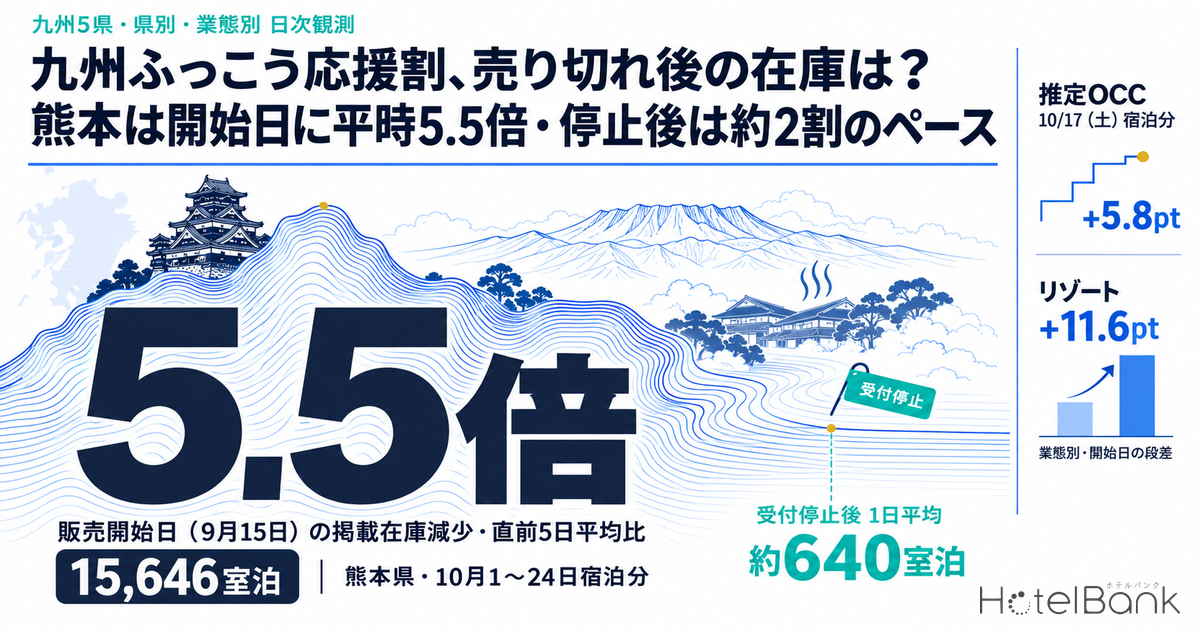
The Kyushu Fukko Ouenwari (Kyushu Recovery Support Discount) hit its budget cap on major booking sites within the launch day or the day after, prefecture by prefecture, and notices that applications had been suspended went up. Nagasaki was reported to have sold out 20 minutes after launch, and the same notice has appeared for Kumamoto, Saga, Oita and Miyazaki. This article counts, day by day, how much October listed inventory was drawn down before and after these “sell-outs,” and measures how inventory moved after applications stopped, by prefecture and by property type. The headline: in Kumamoto, listed inventory for October 1–24 stays fell by 15,646 room-nights on launch day alone — 5.5 times the average of the preceding five days. Over the nine days after applications stopped, the drawdown averaged about 640 room-nights a day, settling at roughly 20% of the pre-launch pace.
Metric Definitions Used in This Article
- OCC (occupancy rate): rooms sold as a share of total rooms in the area (an estimate based on OTA-listed inventory). Shown as “estimated OCC” in the text and charts, together with the number of properties and rooms covered (based on listings on major booking sites). It is an estimate based on how inventory sold through OTAs is being absorbed, and differs from a property’s actual overall occupancy.
- LT (lead time): days until the stay date. The trends in this article use only observations from LT45 to LT1; same-day (LT0) observations and those 46 or more days out are not used.
- Listed-inventory drawdown (room-nights): for each of the 24 stay dates from October 1 to October 24, the decrease in remaining rooms on major booking sites from the previous day’s observation to the current day’s, summed across stay dates (1 room × 1 night = 1 room-night). Besides bookings, it includes properties delisting or pulling inventory, so it is not a booking count. When remaining rooms increased from the previous day, the increase is netted off as a negative.
- Data source: MetroEngines Research (observations through September 25, 2026)
- — On launch day (September 15) alone, Kumamoto’s listed inventory for October 1–24 stays fell by 15,646 room-nights, 5.5x the average of the preceding five days. By multiple, Miyazaki led at 9.8x, followed by Saga 8.9x, Nagasaki 8.1x and Oita 7.1x.
- — In the nine days after applications stopped (September 17–25), Kumamoto’s drawdown slowed to a daily average of about 640 room-nights, around 23% of the pre-launch pace. Nagasaki averaged about 730 room-nights, around 96% of its pre-launch pace — essentially normal.
- — Estimated OCC for Kumamoto stays on Saturday, October 17 jumped from 79.9% on September 14 to 85.7% on September 15, 2026 (+5.8pt); over the nine days after the suspension it rose only +1.7pt, roughly half the earlier slope.
- — Kumamoto’s launch-day jump varied sharply by property type: resorts +11.6pt and ryokan +8.4pt versus +3.7pt for business hotels. Business hotels kept climbing after the suspension (+2.6pt).
- — Estimated OCC for Tuesday, November 3 (a national holiday) stood at 61.0% in Kumamoto and 61.6% in Nagasaki as of September 25, 2026. Reopened allocations, direct sales and steering demand to November are where demand can land after the suspension.
Timeline to Sell-Out — Five Prefectures Suspended on Launch Day or the Day After
The Kyushu Fukko Ouenwari is a travel and accommodation discount program announced by the Japan Tourism Agency on August 28, 2026, after the 2026 Kumamoto Earthquake triggered large numbers of accommodation cancellations across Kyushu. It covers stays from October 1 onward, discounts 50% of the travel or accommodation price (60% in Kumamoto and Kagoshima), and caps the discount per person per trip at ¥20,000 for accommodation only, ¥30,000 for trips of two or more nights with transport, and ¥35,000 for multi-destination tours (Japan Tourism Agency, “Kyushu Fukko Ouenwari” (Japanese), updated September 24, 2026).
Sales start dates differ by prefecture and by channel. One major booking site posted the notice “Applications have been suspended because the budget cap has been reached” for all five of Kumamoto, Nagasaki, Saga, Oita and Miyazaki, and each notice was dated either the prefecture’s launch day or the following day (confirmed by the editorial team on the notice pages on September 26, 2026). According to press reports, Nagasaki sold out 20 minutes after advance sales opened at 10:00 on September 15 (Asahi Shimbun, September 19). Saga began sales at noon on September 24, and the same notice appeared that day.
| Prefecture | Sales launch on booking sites | Suspension notice on one major booking site | Other channels (scheduled start) |
|---|---|---|---|
| Kumamoto | Tue, Sep 15, 10:00 | Updated Sep 16 | — |
| Nagasaki | Tue, Sep 15, 10:00 (advance sales on some booking sites) | Updated Sep 15 | Accommodations: Mon, Sep 28; travel agencies and booking sites: Wed, Sep 30 |
| Saga | Thu, Sep 24, 12:00 | Updated Sep 24 | Travel agencies: Fri, Oct 2; accommodations: early October |
| Oita | Fri, Sep 25, 12:00 | Updated Sep 25 | Travel agencies: Fri, Oct 9; accommodations: Fri, Oct 16 |
| Miyazaki | Fri, Sep 25, 10:00 | Updated Sep 25 | Accommodations and travel agencies: from Mon, Sep 28 |
| Fukuoka | From Thu, Sep 24, rolling out as each operator is ready | In preparation | — |
| Kagoshima | Prefecture’s own discount launched Mon, Sep 14 (for stays Sep 14 – Oct 13) | In preparation | — |
Source: Compiled by the HotelBank Editorial Team from the Japan Tourism Agency “Kyushu Fukko Ouenwari,” the Kyushu Tourism Organization “Kyushu Fukko Ouenwari Information Site,” notice pages on a major booking site (all confirmed September 26, 2026) and the Asahi Shimbun (September 19, 2026)
The key point is that “sold out” and “applications suspended” refer to the discount budget allocated to each booking site — not to a property’s rooms filling up, and not to any judgment of the property. The same booking site notes that “even in prefectures where it has ended, the discount may become available again depending on cancellations and other circumstances,” and in Nagasaki, Saga, Oita and Miyazaki, direct booking with properties and travel-agency sales have yet to begin. Even after the discount allocation stops, properties keep selling.
5.5–9.8x Normal in a Single Day — How Listed Inventory Fell in Six Prefectures
So how much did inventory move on launch day? Using MetroEngines Research observation data, we summed the listed inventory drawn down from the previous day to the current day across the 24 stay dates from October 1 to 24. The baseline is the daily average over the five days immediately before launch.
Source: Compiled by the HotelBank Editorial Team from MetroEngines Research (stays October 1–24, observations within LT45; properties and rooms covered are shown in the table below)
| Prefecture | Launch date | Launch-day drawdown | Prior 5-day daily average | Multiple | Properties / rooms covered |
|---|---|---|---|---|---|
| Kumamoto | Tue, Sep 15 | 15,646 room-nights | 2,825 room-nights | 5.5x | 383 properties / 14,362 rooms |
| Nagasaki | Tue, Sep 15 | 6,167 room-nights | 760 room-nights | 8.1x | 273 properties / 11,564 rooms |
| Saga | Thu, Sep 24 | 3,223 room-nights | 363 room-nights | 8.9x | 140 properties / 4,510 rooms |
| Oita | Fri, Sep 25 | 7,174 room-nights | 1,009 room-nights | 7.1x | 479 properties / 10,952 rooms |
| Miyazaki | Fri, Sep 25 | 6,485 room-nights | 658 room-nights | 9.8x | 161 properties / 6,914 rooms |
| Fukuoka (reference) | Thu, Sep 24 | 11,617 room-nights | 3,503 room-nights | 3.3x | 441 properties / 29,815 rooms |
Source: Compiled by the HotelBank Editorial Team from MetroEngines Research. Properties and rooms are those covered for October 17 stays (based on listings on major booking sites). Fukuoka is shown for reference only because operators launched on a rolling basis
Miyazaki posted the largest multiple at 9.8x, followed by Saga at 8.9x, Nagasaki at 8.1x and Oita at 7.1x. Kumamoto ranks low by multiple at 5.5x, but its absolute volume of 15,646 room-nights was the largest of the six — spread over 24 stay dates, about 650 room-nights per stay date moved in a single day. Inventory in Kumamoto had already been falling at around 2,800 room-nights a day before launch, as bookings recovered after the earthquake, and that high baseline makes its multiple look relatively small. By our earlier measurement, Kumamoto’s October Saturdays were at 72–80% estimated occupancy before sales began, which serves as the starting point for this analysis.
Fukuoka’s 3.3x is a different story. Fukuoka launched “in sequence, starting with operators that are ready,” and one major booking site still showed it as “in preparation” as of September 26. The five-day baseline also includes 6,133 room-nights on the Autumnal Equinox holiday (September 23), which inflates the baseline itself. The gap in multiples likely reflects the difference between the five prefectures, where launch-day demand spiked all at once, and Fukuoka, where the launch was staggered.
Nine Days After the Suspension — Kumamoto at About 20% of Its Pre-Launch Pace, Nagasaki Nearly Normal
The focus of this article is what happened after applications stopped. Kumamoto and Nagasaki, which both launched on September 15, now have nine or more days of post-suspension observations. The chart below shows the daily listed-inventory drawdown for October 1–24 stays in both prefectures.
Source: Compiled by the HotelBank Editorial Team from MetroEngines Research (Kumamoto 383 properties / 14,362 rooms; Nagasaki 273 properties / 11,564 rooms; based on listings on major booking sites. Stays October 1–24, observations within LT45)
In Kumamoto, inventory fell by 15,646 room-nights on launch day (September 15) and by another 4,719 on the 16th, but over the nine days from September 17 to 25 the total was only 5,779 room-nights — a daily average of about 640. That is roughly 23% of the pre-launch five-day daily average (2,825 room-nights). The natural reading is that demand wanting the discount was pulled forward into launch day and the day after, and a group of travelers is now waiting for the discount to reopen.
In addition, Kumamoto’s listed inventory increased from the previous day on September 19 (Saturday) and September 21 (Monday, Respect for the Aged Day). Across stay dates, a cumulative 926 room-nights came back on September 19 and 1,158 room-nights on September 21. Public data alone cannot tell whether these returns were cancellations or properties adding inventory. Either way, inventory on booking sites kept moving after the suspension, and the opening the booking site describes — the discount “may become available again depending on cancellations and other circumstances” — is actually materializing.
Nagasaki looks different. Its nine-day total from September 17 to 25 was 6,586 room-nights, a daily average of about 730 — around 96% of the pre-launch five-day average (760 room-nights), essentially back to a normal pace. Nagasaki’s launch-day drawdown of 6,167 room-nights was only about 40% of Kumamoto’s, so the pull-forward was smaller to begin with; the planned rollout of sales through accommodations, travel agencies and booking sites from September 28 onward is also likely spreading demand out.
Estimated OCC for Saturday, October 17 — The Launch-Day Jump and the Post-Suspension Slope
The same movement can be seen in estimated OCC for a specific stay date. For Saturday, October 17 stays, we overlaid the trend from LT45 (September 2) to LT22 (September 25) for four prefectures.
Source: Compiled by the HotelBank Editorial Team from MetroEngines Research. Estimated OCC, stays on Saturday, October 17. Coverage: Kumamoto 383 properties / 14,362 rooms, Nagasaki 273 properties / 11,564 rooms, Saga 140 properties / 4,510 rooms, Fukuoka 441 properties / 29,815 rooms (based on listings on major booking sites). Observations from LT45 to LT22
Kumamoto’s October 17 stays rose from 79.9% on September 14 to 85.7% on launch day, September 15 — a jump of 5.8pt. In the nine days before launch (September 5 → 14) the rate climbed from 76.6% to 79.9% (+3.3pt), whereas in the nine days after the suspension (September 16 → 25) it went from 86.9% to 88.6% (+1.7pt) — roughly half the slope. On the chart, the line flattens out after the step.
Saga showed a jump of 72.8% → 78.2% (+5.4pt) on September 24. There is only one day of post-suspension data so far: 79.0% on September 25 (+0.8pt). Nagasaki’s September 15 jump was modest at +2.8pt (75.6% → 78.4%), and it has kept rising at almost the same slope as before launch, reaching 80.9% on September 25. Fukuoka shows no clear step, rising gently through the second half of September.
For reference, for stays on Saturday, October 10 (the first day of a three-day weekend), Kumamoto went from 81.5% on September 14 to 87.5% on September 15 (+6.0pt) and 90.6% on September 25 (382 properties / 14,303 rooms), while Nagasaki went 79.5% → 82.9% → 85.9% (270 properties / 11,512 rooms). In Kumamoto, the gain over the nine days from September 16 (88.9%), when the suspension notice appeared, to September 25 was +1.7pt. Oita and Miyazaki, which launched on September 25, are beginning to show the same kind of step for October 17 stays: from September 24 to 25, Oita rose from 83.2% to 87.3% (479 properties / 10,952 rooms) and Miyazaki from 69.7% to 75.5% (161 properties / 6,914 rooms).
Jumps by Property Type — Ryokan and Resorts Jumped Most in Kumamoto; Business Hotels Kept Growing After the Suspension
The size of the jump differed by property type. Splitting Kumamoto’s October 17 stays by type, the launch-day jump was +8.4pt for ryokan, +11.6pt for resorts, +4.7pt for city hotels and +3.7pt for business hotels.
Source: Compiled by the HotelBank Editorial Team from MetroEngines Research. Change in estimated OCC for Kumamoto stays on Saturday, October 17. Properties and rooms covered are shown in the table below (based on listings on major booking sites)
| Prefecture / type | Properties / rooms | Day before launch | Launch day | Sep 25 | Launch-day jump |
|---|---|---|---|---|---|
| Kumamoto – ryokan | 170 / 3,068 rooms | 84.2% | 92.6% | 94.3% | +8.4pt |
| Kumamoto – resort | 20 / 1,145 rooms | 81.7% | 93.3% | 94.9% | +11.6pt |
| Kumamoto – city | 14 / 1,585 rooms | 89.1% | 93.8% | 95.2% | +4.7pt |
| Kumamoto – business | 62 / 7,445 rooms | 79.6% | 83.3% | 85.9% | +3.7pt |
| Nagasaki – ryokan | 51 / 1,762 rooms | 72.8% | 76.8% | 78.7% | +4.0pt |
| Nagasaki – resort | 30 / 2,199 rooms | 80.4% | 83.9% | 86.5% | +3.5pt |
| Nagasaki – business | 62 / 4,896 rooms | 73.8% | 76.3% | 80.0% | +2.5pt |
| Saga – ryokan | 77 / 1,836 rooms | 72.8% | 80.1% | 80.3% | +7.3pt |
| Saga – business | 21 / 1,968 rooms | 72.9% | 76.6% | 78.0% | +3.7pt |
Source: Compiled by the HotelBank Editorial Team from MetroEngines Research. Estimated OCC for stays on Saturday, October 17 (based on listings on major booking sites). The day before launch and launch day are September 14 and 15 for Kumamoto and Nagasaki, and September 23 and 24 for Saga. Property types with fewer than 10 properties are not shown
Kumamoto’s ryokan and resorts shot up to the 92–93% range on launch day, adding only +1.6–1.7pt afterwards. With a 60% discount rate and a ¥20,000 cap, the discount amount tends to be larger at hot-spring ryokan and resorts with higher nightly rates, which is consistent with the launch-day response concentrating in ryokan and resorts. (By our separate estimate, only about 4–10% of properties across the seven prefectures are priced high enough for the ¥20,000 cap to bind.) In Saga too, the jump for ryokan (+7.3pt) was about twice that for business hotels (+3.7pt).
By contrast, Kumamoto’s business hotels had a small launch-day jump of +3.7pt but kept rising after the suspension, gaining +2.6pt from September 15 to 25 — the most of the four property types. Under the major booking site’s terms of use, business travel is excluded from the discount, and business-hotel demand likely includes many guests who are less sensitive to whether a discount is available. Note that “business” here is a property-type classification, not a trip-purpose classification.
Late-October and November Weekends — Room Left After the Jump
To think about where demand can land after the suspension, we also checked the status of stay dates from late October onward. The table compares estimated OCC as of September 25 for three dates: Saturday, October 31; Tuesday, November 3 (Culture Day); and Saturday, November 7.
| Stay date (LT as of Sep 25) | Kumamoto | Nagasaki | Saga |
|---|---|---|---|
| Sat, Oct 31 (LT36) | 78.8% (+0.7pt vs. 7 days earlier) | 79.3% (+1.0pt) | 87.5% (+7.8pt) |
| Tue, Nov 3, holiday (LT39) | 61.0% (+0.9pt vs. 4 days earlier) | 61.6% (+0.5pt) | 74.0% (+4.0pt) |
| Sat, Nov 7 (LT43) | 78.7% | 76.2% | 76.5% |
| Properties / rooms (Nov 7 stays) | 383 properties / 14,358 rooms | 268 properties / 11,500 rooms | 142 properties / 4,515 rooms |
Source: Compiled by the HotelBank Editorial Team from MetroEngines Research. Estimated OCC (based on listings on major booking sites). Comparisons are limited to observations within LT45: October 31 stays vs. September 18, November 3 stays vs. September 21. No change is shown for November 7 stays because LT43 is the first comparable observation
For October 31 stays, Kumamoto and Nagasaki gained only +0.7–1.0pt over the last seven days — essentially flat, reflecting the same post-suspension plateau. November 3 (Tuesday, holiday) sits in the 60–70% range in all three prefectures, about 15–18pt below November 7 (Saturday) in Kumamoto and Nagasaki. Meanwhile Saga, which only launched on September 24, gained +7.8pt for October 31 stays over seven days, with the launch-day jump carried straight through.
What Properties Can Do After the Suspension — Three Places for Demand to Land
Based on the data so far, the options for properties after the suspension fall into three groups. Each starts from the premise that the discount allocation has stopped, and asks where the demand that remains can be captured.
First, keep inventory open on booking sites to catch reopened allocations (cancellation returns). The booking site says the discount “may become available again depending on cancellations and other circumstances” and that “we will announce it on this page when it reopens,” and in Kumamoto we observed two days after the suspension on which listed inventory increased from the previous day. Travelers waiting for the discount to reopen will move the moment allocation comes back. Keeping inventory listed after the suspension — especially on dates with room to spare, such as weekdays in late October and November 3 — reduces missed bookings when the discount reopens.
Second, direct booking through the property’s own channels. According to the Kyushu Tourism Organization, sales through accommodations are scheduled to begin on September 28 in Nagasaki, in early October in Saga, on October 16 in Oita and from September 28 in Miyazaki. The earlier a prefecture’s booking-site allocation closed, the larger the response is likely to be once properties can offer the discount through their own websites or by phone. In Oita, direct sales cover stays from October 16, and properties had until September 30 to register to participate. For ryokan and resorts, where the launch-day jump was largest, preparing discount-eligible plans for direct booking in advance is how to capture the next wave in-house.
Third, steer demand toward November weekends and holidays. As of September 25, estimated OCC for Saturday, October 10 stays had reached 85.9–90.6% in Kumamoto and Nagasaki. Meanwhile November 3 (Tuesday, holiday) remains in the 60% range, and October 31 has been nearly flat since the suspension. The discount runs until mid-to-late December in each prefecture, and in Kumamoto it covers stays through December 25. Offering to shift demand from well-booked October dates to November dates with room to spare is an opportunity for properties and travelers alike.
Finally, it bears repeating that “sold out” means the discount budget hit its cap — it says nothing about a property’s popularity or reputation. What the launch-day jump shows is how much demand for Kyushu accommodation was waiting in the wings, and much of that demand has yet to reach its stay dates.
Note on forward-date data: Estimated OCC and listed inventory in this article are estimates based on inventory listed on major booking sites as of the survey date (through September 25, 2026), and will change as stay dates approach. The listed-inventory drawdown includes not only bookings but also properties delisting or adjusting inventory, so it does not represent the number of bookings or of discount redemptions. Discount allocations and sales-channel status are updated from time to time by each prefecture and operator.
Methodology
Estimated OCC and listed inventory were compiled daily by aggregating remaining rooms per stay date across properties listed on major booking sites and tracked by MetroEngines Research, limited to properties with confirmed observations in each prefecture. Figures are aggregated at the prefecture level; occupancy for individual properties is not calculated. Both the booking curves and the listed-inventory drawdown are limited to observations within 45 days of the stay date (LT45 to LT1). The drawdown sums the change in remaining rooms from the previous day’s observation across the 24 stay dates from October 1 to 24. Because sales start times differ by prefecture (10:00 or 12:00), launch-day observations may include movement from before sales opened. The large drawdown in Kumamoto on the day after launch likely reflects this effect in part.
Frequently Asked Questions
Q. What do “sold out” and “applications suspended” mean for the Kyushu Fukko Ouenwari?
A. They mean the discount budget allocated to each booking site has reached its cap; they do not mean a property’s rooms are full, nor do they reflect on the property. Booking sites note that the discount “may become available again depending on cancellations and other circumstances,” and in Nagasaki, Saga, Oita and Miyazaki, direct booking with properties and travel-agency sales are yet to begin.
Q. How much listed inventory was drawn down on launch day?
A. Across October 1–24 stays, Kumamoto’s listed inventory fell by 15,646 room-nights on launch day (September 15) alone — 5.5 times the daily average of the preceding five days. By multiple, Miyazaki was 9.8x, Saga 8.9x, Nagasaki 8.1x and Oita 7.1x (MetroEngines Research, observations through September 25, 2026).
Q. How did inventory movement change after applications were suspended?
A. Over the nine days from September 17 to 25, Kumamoto settled at a daily average of about 640 room-nights, around 23% of the pre-launch five-day average (2,825 room-nights). Nagasaki averaged about 730 room-nights a day, around 96% of its pre-launch pace — essentially back to normal.
Q. Did the response differ by property type?
A. For estimated OCC on Kumamoto stays for Saturday, October 17, the launch-day (September 15, 2026) jump was +11.6pt for resorts, +8.4pt for ryokan, +4.7pt for city hotels and +3.7pt for business hotels. This is consistent with higher-priced ryokan and resorts tending to receive larger discount amounts. Business hotels had a small jump but kept rising after the suspension, gaining +2.6pt from September 15 to 25.
Q. What should properties do after applications are suspended?
A. This article identifies three places for demand to land. First, keep inventory listed on booking sites to catch reopened allocations (cancellation returns). Second, prepare discount-eligible plans for when the discount becomes available through direct and in-house booking. Third, shift demand from well-booked October dates to November weekends and holidays with room to spare.
References and Sources
■ Data sources
Daily inventory observations of properties listed on major booking sites and tracked by MetroEngines Research (through September 25, 2026). Estimated OCC and listed-inventory drawdown are aggregated at the prefecture level; coverage is Kumamoto 383 properties / 14,362 rooms, Nagasaki 273 / 11,564, Saga 140 / 4,510, Oita 479 / 10,952, Miyazaki 161 / 6,914 and Fukuoka 441 / 29,815 (October 17 stays). Program rules and sales status were confirmed with the Japan Tourism Agency, the Kyushu Tourism Organization, booking-site notices and press reports.
■ Calculation assumptions
The listed-inventory drawdown sums the change in remaining rooms from the previous day’s observation across each of the 24 stay dates from October 1 to 24 (days when remaining rooms increased are netted off as negatives). The normal-pace baseline is each prefecture’s daily average over the five days immediately before its launch. All trends are limited to observations within 45 days of the stay date (LT45 to LT1).
■ Limitations
Estimated OCC is an estimate based on inventory listed on major booking sites and differs from a property’s actual overall occupancy. The listed-inventory drawdown includes properties delisting or adjusting inventory and is not the number of bookings or of discount redemptions. Because sales start times differ by prefecture (10:00 or 12:00), launch-day observations may include movement from before sales opened. Forward-date values reflect the survey date and will change as stay dates approach.
- Japan Tourism Agency, “Kyushu Fukko Ouenwari” (disaster-related information, updated September 24, 2026; Japanese)
- Japan Tourism Agency, “2026 Kumamoto Earthquake: Related Information (including the Kyushu Fukko Ouenwari)” (Japanese)
- Japan Tourism Agency, “Kyushu Fukko Ouenwari” overview (PDF, Japanese)
- Kyushu Tourism Organization, “Kyushu Fukko Ouenwari Information Site” (confirmed September 26, 2026; Japanese)
- Asahi Shimbun, “Kyushu Fukko Ouenwari sells out in 20 minutes; phased expansion planned, ‘stay calm’” (September 19, 2026; Japanese)
- Travel Watch, “Saga Prefecture travel support ‘Kyushu Fukko Ouenwari Saga Campaign’ opens for booking September 24” (Japanese)
- TravelVoice, “Japan Tourism Agency to launch ‘Kyushu Fukko Ouenwari’ in October” (August 28, 2026; Japanese)
- Kyushu Fukko Ouenwari notice pages on a major booking site (suspension notices by prefecture, confirmed September 26, 2026)
- MetroEngines Research — daily observations of inventory listed on major booking sites (estimated OCC, booking curves, listed-inventory drawdown; Kumamoto 383 properties, Nagasaki 273, Saga 140, Oita 479, Miyazaki 161, Fukuoka 441)