

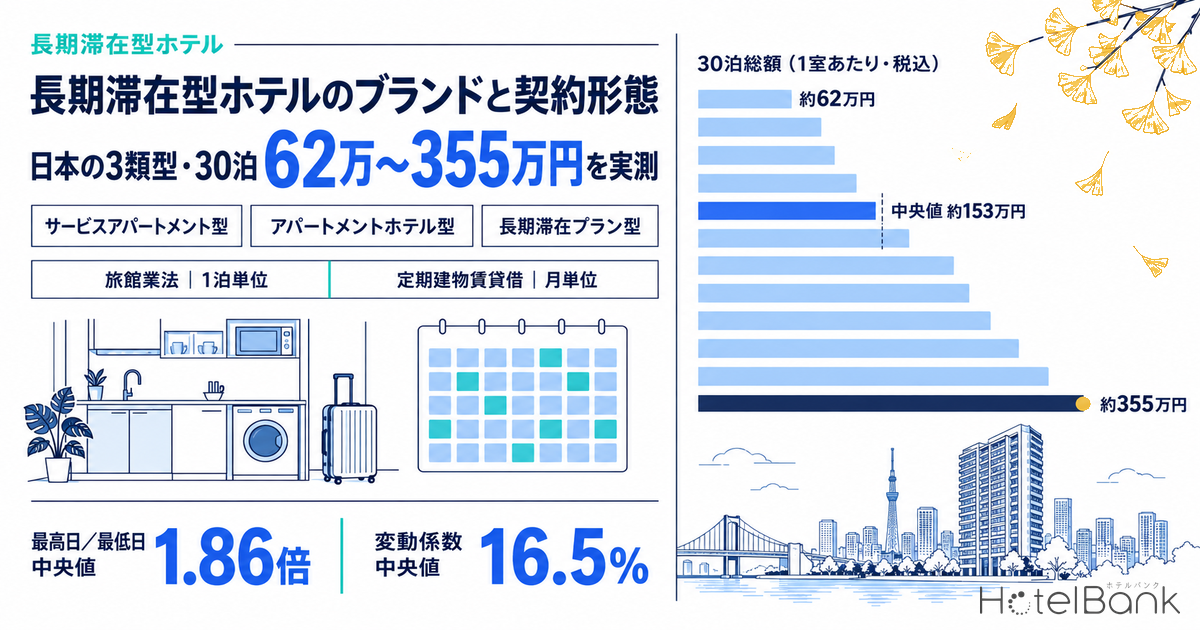
“Long-stay hotel” is now used as the name of a single business category, but underneath that label the legal basis for the contract is split in two. Properties that hold a licence under the Hotel Business Act (旅館業法) and sell by the night sit alongside properties that lease by the month under a fixed-term building lease governed by the Act on Land and Building Leases (借地借家法), and both hang out the same “long stay” sign. This difference determines how rates are set, which sales channels are used, how costs are structured, and every assumption an investment decision depends on. For investors and operators, this article sorts Japan’s long-stay hotels into three operating models and examines how contract type relates to rate structure, using both the regulatory framework and measured data.
Metric Definitions Used in This Article
- Listed price: The selling price each property publishes on major booking sites. Per-room rate for 2 guests sharing one room (tax included). This article uses the cheapest plan available on each date.
- 30-night total: For 30 consecutive nights from Sunday, November 1 to Monday, November 30, 2026, the sum of each night’s cheapest listed price (per room, tax included). It represents the cost of stacking 30 standard one-night bookings and is distinct from the monthly flat-rate products that operators sell officially. Only properties with all 30 nights observed are included.
- Coefficient of variation: The standard deviation of the 30 daily listed prices divided by their mean (%). A higher value means the amount paid moves more from day to day, even for the same room at the same property.
- Data source: MetroEngines Research (listed prices). Regulatory and brand information is based on public materials from each company and from government agencies.
This article does not use ADR (estimated settled rate). Because the question is the total paid over a multi-night stay and its day-to-day variation, figures are based on the listed prices actually shown on screen.
- — Contracts fall into three regimes / Ryokan/hotel business under the Hotel Business Act (per night), boarding-house business under the same Act (lodging fees charged in units of one month or more), and fixed-term building leases under the Act on Land and Building Leases (monthly rent). In practice, the market has converged on a choice between the first and the third.
- — Boarding-house licences down 69.6% in 25 years / Nationwide boarding-house businesses fell from 1,971 (FY1997) to 599 (FY2021). Long-stay demand is now served either by per-night licences or by lease contracts.
- — 30-night totals range from about ¥620K to ¥3.55M / Measured at 13 long-stay brand properties (November 2026, 2 guests per room, per room, tax included). The median is about ¥1.53M. Because capacity and floor area differ across formats, per-room prices cannot be compared directly.
- — A 1.86x daily spread within the same property / Across the 30 nights, the median ratio of the highest night to the lowest was 1.86x, and the median coefficient of variation was 16.5%. This is the structural difference from monthly flat-rate products.
- — Supply has concentrated since 2018 / Of the 78 properties and 9,933 rooms across the long-stay brands listed here, 51 properties opened in 2018 or later. Cumulative room count rose 107.9% in five years, from 4,511 rooms at end-2017 to 9,377 rooms at end-2022.
Start from the Governing Law, Not the Category Name
When discussing long-stay hotels, the first thing to pin down is neither the brand nor the room amenities. It is the law under which the property receives payment. Japan’s lodging and residential services offer three frameworks that can be used for long stays.
The first is the ryokan/hotel business (旅館・ホテル営業) under the Hotel Business Act. The Act defines it as “a business that provides facilities and accommodates people in return for lodging fees, other than simple lodging business and boarding-house business,” and it can be sold from a single night. Only properties holding this licence can publish daily inventory and prices on booking sites. The second is the boarding-house business (下宿営業), also under the Hotel Business Act, defined as “a business that provides facilities and accommodates people in return for lodging fees charged in units of one month or longer.” It is a lodging fee, yet charged by the month: a category designed precisely for long stays. The third is the fixed-term building lease (定期建物賃貸借契約) under the Act on Land and Building Leases. This is a lease, not lodging. The contract has no renewal and ends definitively when the term expires; it must be made in writing, and the landlord must deliver a separate written explanation in advance stating that the lease will not be renewed.
Of these three, practice is almost entirely limited to the first and the third. Tracking facility counts by business type in the Ministry of Health, Labour and Welfare’s Report on Public Health Administration and Services (衛生行政報告例) shows that boarding-house businesses fell from 1,971 in FY1997 to 599 in FY2021, a 69.6% decline over 25 years. Over the same period, simple lodging businesses (簡易宿所営業) grew 52.4%, from 25,324 to 38,593. For a quarter of a century, the category has existed in law but gone largely unused.
Source: Compiled by HotelBank Editorial Team from MHLW, Report on Public Health Administration and Services (nationwide, facility counts at fiscal year-end)
Why is the boarding-house business so little used? The reason lies on the revenue side. A licence that allows lodging fees only by the month means giving up the ability to move rates daily. The operator cannot raise prices on high-demand days, nor capture short-term bookings to fill last-minute vacancies. By contrast, choosing a fixed-term building lease means only residential development regulations apply, and front-desk and housekeeping operations can be kept lean. If the rate is going to be fixed by the month, a lease is more rational; if the operator wants to move rates daily, the ryokan/hotel licence is the way to go. The numbers show that no middle option survived.
Three Operating Models: Serviced Apartments, Apartment Hotels, and Long-Stay Plans
With the contract regime as the axis, Japan’s long-stay hotels can be sorted into three operating models. The key point is that the model is determined property by property, not brand by brand. Within a single brand, properties that sell by the night coexist with properties that accept only stays of 30 nights or more.
| Model | Contract and sales unit | Room design | Revenue and cost characteristics |
|---|---|---|---|
| 1. Serviced apartment | Monthly quotes and corporate contracts are the core. Properties using fixed-term building leases screen tenants, and some set a minimum stay of 30 nights or more. Properties that hold a hotel licence and accept stays from one night also coexist | Full kitchen, washer-dryer, and furniture and appliances as standard. Residential-scale floor areas from studios to multi-bedroom units | Revenue is mainly rent; guests pay little beyond additional cleaning fees. Fewer services than a hotel keep costs down, and gross operating profit margins tend to be higher than hotels’ |
| 2. Apartment hotel | Basically sold by the night under a Hotel Business Act licence. Many properties layer 7+ and 30+ night plans on top | Stay-ready rooms with kitchens and washer-dryers. Typically builds capacity for groups of 4–6 into the room design itself | Rates can move daily, but housekeeping and front-desk staffing follow hotel standards. OPEX is adjusted by reducing cleaning frequency during multi-night stays |
| 3. Long-stay plans at existing hotels | Fixed-term products such as 14 or 30 nights layered onto existing hotel room inventory. Flat rate for the period; no lease contract or guarantor required | Standard hotel rooms used as-is. Access to in-house facilities such as lounges, fitness centres, and parking is bundled as a benefit | Captures long-stay demand with existing inventory. Flexibility to return rooms to regular sales when short-term demand is strong |
Source: Compiled by HotelBank Editorial Team from company disclosures and public materials by Nomura Real Estate Solutions and JLL
The leading examples of model 1 are the Japanese operations of two Singapore-based operators. Ascott states in its own announcement that it operates 22 properties in major cities including Tokyo, Yokohama, Osaka, Kyoto, and Fukuoka, including Oakwood Oimachi Tracks Tokyo (オークウッド大井町トラックス東京), which opened in June 2026. Oakwood Oimachi Tracks Tokyo (78 units, approx. 27–107㎡) is designed exclusively for long stays of 30 nights or more and does not accept per-night bookings. Citadines North Shinjuku Tokyo (シタディーンノース新宿東京), which the same company opens on October 28, 2026, has 179 units split into 106 hotel rooms and 73 serviced residences, housing both regimes in a single building. It is a textbook example of how a brand name alone does not determine the model.
On the Frasers Hospitality side, Fraser Suites Akasaka Tokyo (フレイザースイート赤坂東京; 224 units, opened March 2020, 24 storeys above ground), developed by Sekisui House and operated by Frasers, is the flagship property in Japan. The model 2 apartment-hotel segment is anchored by MIMARU, run by Cosmos Initia of the Daiwa House Group; Singapore-based lyf; and WAYPOINT, a new brand launched by Mitsubishi Estate in 2026. Tokyu Stay (東急ステイ), which has long designed its rooms for extended stays, also belongs to this tier.
| Brand (operator) | Model | Published footprint and stay conditions |
|---|---|---|
| Ascott / Citadines / Oakwood (The Ascott Japan) | 1 | Reports operating 22 properties in Tokyo, Yokohama, Osaka, Kyoto, and Fukuoka. Oimachi Tracks Tokyo (78 units) is 30+ nights only; Citadines North Shinjuku Tokyo (179 units, opening October 28, 2026) combines 106 hotel rooms and 73 residences |
| Fraser Suites / Fraser Residence (Frasers Hospitality) | 1 | Akasaka Tokyo: developed by Sekisui House, 224 units, 24 storeys, opened March 2020. Every unit has a kitchen and washer-dryer; serves short to long stays |
| MIMARU / MIMARU SUITES (Cosmos Initia, Daiwa House Group) | 2 | Operates in Tokyo, Kyoto, and Osaka. Sells primarily by the night, with kitchens in every room and group stays of 4+ built into room design. Standard room size about 40㎡ |
| lyf (The Ascott Japan) | 2 | Three locations: Tenjin Fukuoka, Ginza Tokyo, and Shibuya Tokyo. Offers community-style stays built around shared social kitchens and laundries |
| WAYPOINT (Mitsubishi Estate / Mitsubishi Estate Hotels & Resorts) | 2 | First property, WAYPOINT TSUKIJI TOKYO: 52 rooms, 9 storeys, opened April 1, 2026. Up to 6 guests per room; some rooms have mini-kitchens and washer-dryers. Targets 10 properties by 2030 |
| Tokyu Stay (Tokyu Stay Service) | 2 | Operates as stay-oriented hotels with washer-dryer rooms. Offers weekly plans from 7 nights and monthly plans for 30+ nights; at locations offering flat-rate plans, the nightly rate does not change during the stay |
| Hotel New Otani Serviced Apartments | 3 | Sells existing hotel rooms as long-stay products. Minimum 30 nights (14-night option available for limited periods); includes breakfast, sports club, and parking |
Source: Compiled by HotelBank Editorial Team from company disclosures (ordered by model, not alphabetically). No ranking by property or room count is implied
Brands are grouped by operating model; the order is not a ranking by property or room count. Companies do not count their “locations” the same way (directly operated only, or including franchised and partner properties or overseas sites), so there is little value in a third party recounting and ranking them. Each company’s scale is cited from its published figures as-is.
Measured 30-Night Totals: About ¥620K to ¥3.55M Across 13 Properties, Median ¥1.53M
We now turn to measured rate structures. The sample is 13 properties from long-stay brands whose daily sales could be observed on major booking sites. For 30 consecutive nights from November 1 to November 30, 2026, we summed each night’s cheapest listed price. Figures are per room, for 2 guests sharing, tax included.
Source: Compiled by MetroEngines Research and HotelBank Editorial Team (N=13 properties, November 1–30, 2026, all 30 nights observed)
The highest, Oakwood Premier Tokyo (オークウッドプレミア東京; 123 units, adjacent to the Yaesu exit of Tokyo Station), came to about ¥3.55M, and the lowest, lyf Tenjin Fukuoka, to about ¥620K, a gap of 5.8x. The median was about ¥1.53M.
These figures, however, cannot be read side by side as “expensive” or “cheap.” The model 1 serviced residences range from one to three bedrooms with large floor areas, while model 2 apartment hotels are designed for 4–6 guests. Per-room listed prices taken under the same 2-guests-per-room condition do not form a valid unit of comparison across formats with different capacities and floor areas. Recalculated per guest or per square metre, the ranking changes. What this article shows is the distribution of total payments—how much cash changes hands if 30 nights are stacked night by night—not a ranking of price competitiveness.
| Property | 30-night total | Avg. per night | Coef. of variation | Highest / lowest night |
|---|---|---|---|---|
| Oakwood Premier Tokyo | ¥3,554,500 | ¥118,500 | 16.2% | 1.86x |
| Ascott Marunouchi Tokyo (アスコット丸の内東京) | ¥3,340,200 | ¥111,300 | 9.4% | 1.58x |
| MIMARU Tokyo Shinjuku West | ¥2,714,400 | ¥90,500 | 15.1% | 1.58x |
| MIMARU Tokyo Station East | ¥2,583,300 | ¥86,100 | 18.6% | 1.93x |
| MIMARU Tokyo Ueno North | ¥2,120,400 | ¥70,700 | 16.6% | 2.00x |
| Citadines Shinjuku Tokyo (シタディーン新宿東京) | ¥1,546,100 | ¥51,500 | 29.7% | 2.84x |
| MIMARU Kyoto Nijo CastleMedian | ¥1,531,500 | ¥51,000 | 14.7% | 1.62x |
| MIMARU Osaka Namba North | ¥1,369,500 | ¥45,700 | 7.2% | 1.23x |
| lyf Shibuya Tokyo | ¥1,364,200 | ¥45,500 | 32.4% | 3.56x |
| Oakwood Hotel Kyoto Oike (オークウッドホテル京都御池) | ¥1,011,400 | ¥33,700 | 21.6% | 1.90x |
| Citadines Namba Osaka (シタディーンなんば大阪) | ¥862,100 | ¥28,700 | 16.5% | 1.65x |
| lyf Ginza Tokyo | ¥834,200 | ¥27,800 | 15.9% | 1.83x |
| lyf Tenjin Fukuoka | ¥617,200 | ¥20,600 | 39.3% | 2.72x |
Source: Compiled by MetroEngines Research and HotelBank Editorial Team (N=13 properties, 30 nights observed each, 2 guests, per room, tax included)
Some properties fell outside this measurement. For several properties of the brands covered here, daily sales for the same period could not be observed on major booking sites. Possible reasons include a minimum stay of 30 nights or more, as with Oakwood Oimachi Tracks Tokyo mentioned above; operations centred on monthly contracts or direct corporate sales; and limited inventory allocation to booking sites. Whatever the reason, the decisive difference between this segment and other lodging segments is that “collecting booking-site prices alone does not capture the full picture of the market.”
Daily Variation or Flat-Rate Period: The Line That Divides Rate Structures
The contract regime shows most clearly in how prices move during a stay. At properties that sell by the night, the price of the same room changes every day with the day of week, events, and remaining inventory. Across the 13 measured properties, the median ratio of the highest to the lowest night over 30 nights was 1.86x, and the median coefficient of variation was 16.5%. The largest ratio, at lyf Shibuya Tokyo, was 3.56x; even the smallest, at MIMARU Osaka Namba North, was 1.23x.
Source: Compiled by MetroEngines Research and HotelBank Editorial Team (index with each property’s 30-night average = 100, November 1–30, 2026)
Products sold by the month, on the other hand, have no such variation. For its locations offering flat-rate long-stay plans, Tokyu Stay officially states that the nightly rate does not change during the stay. The guest has a fixed budget, and the property has the revenue for the whole period locked in advance. Model 3 long-stay plans share the same structure: Hotel New Otani Serviced Apartments sells 30 nights as a single product, with rates on its official website ranging from ¥2,040,000 for 30 nights in a Garden Tower Suite (74.7㎡) to ¥2,730,000 for 30 nights in a Shin-Edo Residence Suite (77.0㎡). Additional nights from the 31st onward are clearly stated at ¥68,000 to ¥91,000 per night.
From an operator’s perspective, this difference is inventory policy itself. The daily-variation model can capture the upside on peak days, but filling a 30-night block with one booking means giving up every high-demand day in that period at a flat rate. The flat-rate model forgoes demand peaks but compresses the acquisition cost, cancellation risk, and cleaning of 30 bookings into one. Even at the same revenue, the operating resources required and the predictability of cash flow differ greatly. Neither is simply correct; the optimal answer depends on how deep the peaks and troughs of the location’s demand are and on the fixed-cost level of housekeeping and front-desk operations.
Profit Structure: Why the Lease Model Earns Higher Margins
The contract regime also feeds directly into cost structure. According to Nomura Real Estate Solutions, serviced apartments of the rental-housing type earn mainly rental income, and guests pay little beyond additional cleaning fees. Development regulations are relatively light, which helps keep investment down, but these properties cannot capture demand of less than one month, and vacancies tend to arise when tenants turn over. The hotel type, by contrast, can accept guests from one night, but compliance with regulations such as fire-safety equipment raises construction costs, and larger staffing and more frequent cleaning raise operating costs. As a result, the company concludes that because serviced apartments provide fewer services than hotels, each cost line is contained, and serviced apartments’ gross operating profit margins tend to be higher than hotels’.
The difference in cleaning frequency can be confirmed in concrete terms. JLL explains that in-room cleaning at serviced apartments is done once or twice a week, a different operation from hotels, where rooms are cleaned daily. Laundry equipment installed as standard in each unit also structurally lowers linen-related operating costs. JLL describes the core user base as foreign business people seconded by multinational companies and foreign embassy staff, with domestic demand also coming from corporate training and affluent households’ second homes.
Given this cost structure, the position of model 2 apartment hotels becomes clear. They bring room amenities close to serviced apartments while selling by the night under the Hotel Business Act. In other words, they are a hybrid that captures part of the lease model’s OPEX advantage without giving up the hotel model’s price elasticity. The widespread practice of reducing cleaning during multi-night stays is an extension of this design philosophy.
Supply Trends: Concentrated Since 2018, with New Players Entering in 2026
Next, the breadth of supply. Counting domestic properties of the long-stay brands listed in this article, to the extent we track them, gives 78 properties and 9,933 rooms. Ordered by opening year, the cumulative room count rose 107.9% in five years, from 4,511 rooms at end-2017 to 9,377 rooms at end-2022. Of the 78 properties, 51—65.4% of the total—opened in 2018 or later.
Source: MetroEngines Research & Consulting (based on confirmed listings, N=78 properties / 9,933 rooms, limited to the long-stay brands listed in this article)
Two caveats apply to this count. First, the population is limited to the brands listed in this article and is not the full stock of long-stay rooms in Japan. Second, because opening dates are identified from when properties are confirmed as listed on booking sites, figures for recent and future years may rise as more listings appear. The 2026 figure reflects properties confirmed to date and is not final.
Lining up the players that moved in 2026 shows the character of this market well. In April, Mitsubishi Estate opened the first property of its new WAYPOINT brand in Tsukiji (52 rooms, 9 storeys, site area 368.46㎡, gross floor area 2,392.77㎡) and set a target of 10 properties by 2030. In June, Ascott opened a 30+-night-only serviced residence in Oimachi (78 units), and on October 28 it opens a combined hotel-and-residence property in Hyakunincho, Shinjuku. Domestic developers and international operators entered the same city in the same year under different regimes.
On the brand side, Hilton has launched “Apartment Collection” as a new lodging category. The brand table in the company’s corporate overview lists 3 properties in 1 country, and the document does not mention any operations in Japan. It is too early to discuss the impact on the Japanese market, but the formal addition of an apartment-style category to a global brand portfolio can itself be read as supporting evidence that this segment is moving beyond niche status. For more on how Mitsubishi Estate’s WAYPOINT and Hilton are entering this market, see Long-Stay Hotels Take Off in Tokyo: Mitsubishi Estate WAYPOINT and Hilton Enter the Market.
Four Points Investors and Operators Should Keep in Mind
First, start due diligence from the operating licence. Even if deals are lined up under the “long-stay hotel” label, a property with a Hotel Business Act licence and one leased under a fixed-term building lease differ in applicable regulations, expected returns, and likely buyers at exit. Since there are real cases of properties under the same brand operating under different regimes, judging by brand name does not work.
Second, move comparison metrics away from per-room price. As the measurements in this article show, lining up 40㎡-class rooms for 4–6 guests against serviced residences ranging from studios to three bedrooms on per-room listed price does not produce a meaningful ranking. Comparison becomes possible only after converting to per guest, per square metre, or annual revenue per tsubo.
Third, treat the size of daily variation as a design variable in inventory policy. With a median 1.86x price spread within 30 nights at the same property, the decision whether to lock in that period at a flat rate or turn it over night by night is not merely a sales tactic but revenue design itself. If the location’s demand curve is flat, the efficiency of the flat-rate model pays off; if its peaks and troughs are deep, the upside of the daily-variation model pays off.
Fourth, do not rely on booking-site data alone to gauge market size. Properties limited to 30+ nights and those centred on monthly contracts do not appear in daily listing data. That is why this article’s price measurement covered only 13 properties. When assessing supply and competition, booking-site data must be combined with public disclosures, IR materials, and building plans.
⚠ Note on listed prices for future dates: The 30-night totals in this article aggregate the November 2026 selling prices published on booking sites as of the survey (September 2026), and they will change as check-in dates approach. Please note that prices currently set high may fall with last-minute adjustments, and that the addition of new plans may move the averages.
Summary
Japan’s long-stay hotels are not divided by whether rooms have a kitchen and a washer-dryer. They are divided by the contractual basis: whether payment is received as a per-night lodging fee or as monthly rent. The fact that the boarding-house business—the middle option the Hotel Business Act provided—fell 69.6% in 25 years to just 599 facilities confirms this polarisation from the regulatory side.
The measurements point to the same structure. The 30-night totals at 13 per-night properties ranged from about ¥620K to ¥3.55M, and even within the same property the highest and lowest nights differed by a median of 1.86x. Monthly products, by contrast, are flat-rate for the period, locking in both the guest’s payment and the operator’s revenue in advance. On the supply side, openings have concentrated since 2018, and in 2026 domestic developers and international operators entered simultaneously under different regimes. Reading this segment through contract type rather than brand name is the most direct route to evaluating it.
Frequently Asked Questions (FAQ)
Q. What is the difference between a long-stay hotel and a serviced apartment?
A. The difference lies not in room amenities but in the contract under which payment is received. Properties that hold a ryokan/hotel business licence under the Hotel Business Act and charge lodging fees by the night stand side by side with properties that charge monthly rent under a fixed-term building lease governed by the Act on Land and Building Leases, all under the same “long stay” sign. This article sorts them into three operating models (serviced apartment, apartment hotel, and long-stay plans at existing hotels). The model is determined property by property, not brand by brand, and within a single brand, properties that sell from one night coexist with properties limited to stays of 30 nights or more.
Q. How much does a 30-night stay cost in total?
A. For 13 long-stay brand properties whose daily sales could be observed on booking sites, stacking each night’s cheapest listed price for 30 consecutive nights from November 1 to November 30, 2026 gives totals from about ¥620K (lyf Tenjin Fukuoka) to about ¥3.55M (Oakwood Premier Tokyo), with a median of about ¥1.53M (2 guests, per room, tax included). However, because room capacity and floor area differ greatly across formats, these per-room prices cannot be read side by side as “expensive” or “cheap.”
Q. Why does the room rate change from day to day at the same property?
A. Because properties that sell by the night move their prices daily according to the day of week, events, and remaining inventory. Across the 13 measured properties, the median ratio of the highest to the lowest night over 30 nights was 1.86x, and the median coefficient of variation was 16.5%. At the property with the largest ratio, it reached 3.56x. Flat-rate products sold by the month have no such variation: the guest’s budget and the property’s revenue for the period are both fixed in advance.
Q. Why is the Hotel Business Act’s “boarding-house business” category rarely used?
A. For revenue reasons. A boarding-house business can only charge lodging fees in units of one month or longer, so it gives up both the ability to move rates daily and last-minute short-term bookings. If rates are to be fixed monthly, a fixed-term building lease—with lighter development regulations and operations—is more rational; if the operator wants to move rates daily, it takes a ryokan/hotel licence. The market converged on this two-way choice. Nationwide, boarding-house businesses fell 69.6% over 25 years, from 1,971 in FY1997 to 599 in FY2021.
Q. Can booking-site price data alone measure the size of the long-stay market?
A. No. Properties with a minimum stay of 30 nights or more, properties centred on monthly contracts or direct corporate sales, and properties that limit their inventory allocation to booking sites do not appear in daily listing data. That is also why this article’s price measurement covered only 13 properties. When assessing supply and competition, the data must be combined with each company’s public disclosures, IR materials, and building plans.
Related Articles
References and Sources
■ Data Sources
Listed prices are MetroEngines Research booking-site listed prices (November 1–30, 2026, 2 guests, per room, tax included, cheapest plan on each date). Property and room counts for long-stay brands are from MetroEngines Research & Consulting, based on confirmed listings (N=78 properties / 9,933 rooms). Facility counts by business type are from MHLW’s Report on Public Health Administration and Services; business-type definitions are from Japan Tourism Agency public materials; brand and property information and rate tables are from each company’s public materials.
■ Calculation Assumptions
The 30-night total is the simple sum of each night’s cheapest listed price for 30 consecutive nights from November 1 to November 30, 2026. It represents the cost of stacking 30 standard one-night bookings and is treated as distinct from the monthly flat-rate products that operators sell officially. The coefficient of variation is the standard deviation of the 30 daily listed prices divided by their mean. The sample is limited to the 13 properties with all 30 nights observed in the same period, and no adjustment is made for differences in room capacity or floor area.
■ Limitations
Per-room listed prices do not form a valid unit of comparison between rooms for 4–6 guests and serviced residences ranging from studios to multi-bedroom units. Recalculated per guest or per square metre, the ranking changes. Properties limited to 30+ nights and those centred on monthly contracts or direct corporate sales do not appear in daily listing data, so this article’s price measurement (13 properties) does not cover the whole market. Listed prices for future dates change as check-in approaches. Because the supply count starts from confirmation of booking-site listings, figures for recent and future years may rise as more listings appear.
■ Market Data
- MetroEngines Research — Booking-site listed prices (30-night totals and daily variation, N=13 properties)
- MetroEngines Research & Consulting — Property and room counts for long-stay brands (based on confirmed listings, N=78 properties / 9,933 rooms)
■ Laws and Government Statistics
- Japan Tourism Agency, Minpaku Portal: “About the Hotel Business Act” (definitions of ryokan/hotel business, simple lodging business, and boarding-house business) (Japanese)
- MHLW, Report on Public Health Administration and Services, appended table: number of ryokan businesses by year (e-Stat table ID: 0004048085, nationwide, FY1997–FY2021)
- Real Estate Transaction Promotion Center: “Necessity of the Article 38 Document When Re-contracting a Fixed-Term Lease” (Act on Land and Building Leases, Article 38) (Japanese)
■ Industry Reports and Commentary
- Nomura Real Estate Solutions: “Serviced Apartments: Operating Models and Profit Structure” (Japanese)
- JLL: “What Is a Serviced Apartment? How It Differs from Hotels and Rental Housing” (Japanese)
■ Company Disclosures and Press Releases
- Mitsubishi Estate: “Full-Scale Entry into the Apartment Hotel Business / First Property of New Brand ‘WAYPOINT’ to Open in Tsukiji, Tokyo on April 1, 2026” (February 2, 2026) (Japanese)
- The Ascott Japan: “A Long-Stay Base (30 Nights+) Linking the City Centre and the Airport: ‘Oakwood Oimachi Tracks Tokyo’ Opens June 25, 2026” (Japanese)
- The Ascott Japan: “Citadines Opens a New Base in Shinjuku, Tokyo: ‘Citadines North Shinjuku Tokyo’ Opens October 28, 2026” (Japanese)
- Sekisui House: “Frasers’ First Entry into Japan: Luxury Serviced Apartment ‘Fraser Suites’ Project in Akasaka” (Japanese)
- Tokyu Stay: “Flat-Rate Long-Stay Plans” (official website) (Japanese)
- Hotel New Otani: “Serviced Apartments” (official website, rate table)
Source: Hilton, “Company Overview” (updated August 25, 2026)