

When a hotel’s construction cost rises after the contract is signed, who pays the difference — the owner or the contractor? In private-sector construction in Japan, the answer has long depended on “what the contract says” and on bargaining power. The law has now put a frame around that question. The revised Construction Business Act and the Public Works Bidding and Contracting Act came fully into force on December 12, 2025. Together, the changes require the method for changing the contract price in the event of material price surges and similar events to be written into the contract, require the prospective contractor to notify the owner of “risk information”, impose on owners a duty to endeavor to negotiate in good faith when a change is requested, and prohibit estimates based on unreasonably low labor costs and below-cost contracts.
Written from the perspective of hotel developers, lenders and investors considering pre-completion acquisitions, this article (1) explains what the revision changed in contracting practice, (2) sets out three contract types for allocating construction cost overruns, (3) maps the planned start and completion dates of 135 hotel projects not yet under construction obtained from Ministry of Land, Infrastructure, Transport and Tourism (MLIT) building-plan data, (4) estimates by hotel type how a +5%, +10% and +15% cost increase translates into the ADR required to recover it, and (5) compares these against postponed and cancelled projects to show where contract design shapes the business decision.
How This Article Relates to Earlier Coverage
We covered construction cost levels and project cancellations and postponements in Construction +41% & Labor Crunch Erase Japan’s 2027-2029 Hotel Supply, and construction periods in Hotel Build Times: 2.80-Year Median. This article focuses narrowly on the construction contract clause that decides “who bears the increase,” and leaves the analysis of construction periods themselves to that earlier piece.
Metric Definitions Used in This Article
- ADR (Average Daily Rate): An estimated settled room rate (tax-excluded equivalent) calculated by applying a hotel-type-specific adjustment factor to the lowest-plan rate each property publishes on OTAs (per room, two guests, tax included). Checked against property-level results disclosed by listed hotel REITs (91 properties, most recent 3 months), the median error is about 7%. These are estimates and differ from each property’s actual settled rates and accounting figures. Area-level ADR is the median of the target properties (the level of a typical property in the area). This article uses the simple average of monthly values from September 2025 to August 2026 as the reference value.
- Cost per tsubo (based on estimated construction cost): For accommodation-use buildings in MLIT’s Building Starts Statistics, the estimated construction cost divided by floor area (converted to tsubo; 1 tsubo = 3.305785 m²). Excludes land, design and supervision fees, FF&E (furniture, fixtures and equipment) and pre-opening costs.
- Floor area per room (m²/room): Total gross floor area of the building ÷ number of guest rooms. Includes common areas (lobby, corridors, communal baths, banquet halls, plant rooms, etc.).
- Required ADR uplift: The increase in room rate needed to secure an additional 6% annual operating profit on the construction cost increase (calculation method described below).
- Data sources: MetroEngines Research; MLIT “Building Dynamics Statistics” and “Building Starts Statistics”
Key Takeaways
- “No change” can no longer be written: Changes to the contract price upon price fluctuations, and the method for calculating them, are now mandatory contract items. MLIT’s guidelines state explicitly that provisions which do not presuppose negotiation — such as “the price will not be changed” or “no change will be permitted” — violate Article 19(1) of the Construction Business Act.
- The Private-Sector (Seven Associations) Joint Standard Contract was also revised on December 12, 2025: “a surge in material prices or any other event affecting the contract price” was added to the grounds for change in Article 29, and a new provision requires the party receiving a request for negotiation to endeavor to negotiate in good faith.
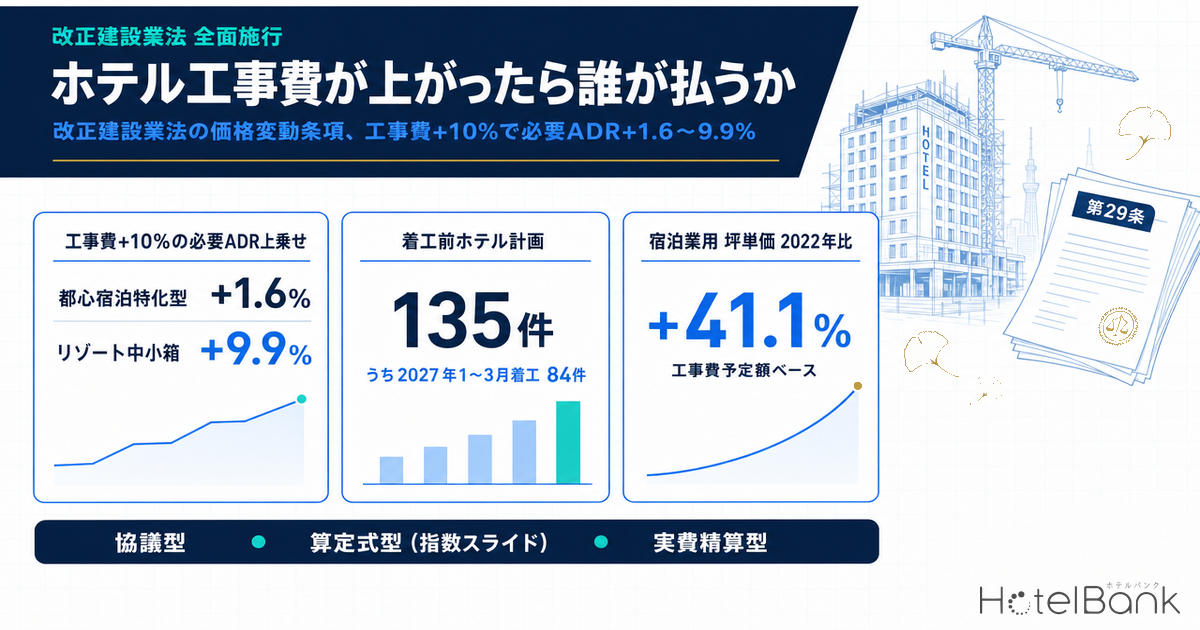
- Of 135 hotel projects not yet under construction, 84 (62%) plan to break ground in January–March 2027, with planned completions of 78 in 2028 and 44 in 2029. All 135 have more than one year between planned start and completion.
- Recovering a +10% construction cost increase requires an ADR uplift of about ¥200 (+1.6%) for a central-city limited-service hotel, but about ¥1,700 (+9.9%) for a small-to-mid-sized resort. The more floor area per room a hotel type has, the more the allocation of overruns determines project viability.
- There are three ways to allocate overruns: negotiation-based, formula-based (index escalation) and cost-reimbursable. Even with the same total overrun, the range of costs the owner can estimate in advance differs.
The Revision at a Glance — “How to Negotiate Increases” Became Law in Two Stages
The revision (Act No. 49 of 2024) came into force in stages. The parts that directly affect owners’ contracting practice are those enforced on December 13, 2024 and the full enforcement on December 12, 2025. A simple way to frame them: the former set out the procedure when an overrun occurs, while the latter set out that parties must not sign contracts at unreasonable prices or schedules in the first place.
Under the December 2024 provisions, when a prospective contractor recognizes an event that could affect the construction period or contract price — such as a marked decrease in supply or a price surge for major materials and equipment, or a decrease in labor supply or rising labor costs for specific trades — it must notify the owner, together with supporting information, before the contract is signed. If a notified event materializes after signing, the contractor may request negotiations on a change, and the owner must endeavor to respond to those negotiations in good faith.
Under full enforcement, contractors are also prohibited from signing below-cost contracts and contracts with unreasonably short construction periods, and estimates based on unreasonably low labor costs are banned. Where a client requests a revised estimate or signs a contract at such low amounts, it may become subject to recommendations and public disclosure by the Minister of Land, Infrastructure, Transport and Tourism or other authorities. By cabinet order, recommendations apply to works where the amount of costs normally deemed necessary is ¥5 million or more (¥15 million or more for general building works), a range that virtually every prime contract for a new hotel falls within. On labor costs, the Central Construction Industry Council issued its recommended “Standards for Labor Costs” on December 2, 2025, and MLIT has been releasing benchmark values by trade in stages.
| Effective date | Main provisions | What changes in practice for hotel owners |
|---|---|---|
| December 13, 2024 | Duty to notify risk information (prospective contractor → owner, by contract signing) / Changes to the contract price upon price fluctuations and the calculation method become mandatory contract items / Change negotiations when risks materialize, and the owner’s duty to endeavor to negotiate in good faith | Price outlooks for materials and labor, with supporting documents, arrive together with the estimate. The contract must include a clause on “how the price will be changed.” When a request for negotiation arrives, first come to the negotiating table |
| December 2, 2025 | Central Construction Industry Council recommends the “Standards for Labor Costs” | Owners gain a reference for reading the labor cost in an estimate against benchmark values |
| December 12, 2025 | Ban on below-cost contracts by contractors / Ban on unreasonably short construction periods (now also for contractors) / Ban on estimates based on unreasonably low labor costs / Recommendations and public disclosure for clients who sign contracts far below the estimate amount (costs of ¥5M or more; ¥15M or more for general building works) | Less room for “just cut the total” discount negotiations. Negotiations shift to the reasonableness of the breakdown, including labor costs and statutory welfare costs |
For owners, the most consequential passage is likely the following sentence in the guidelines. Regarding changes to the contract price based on price fluctuations and the method of calculating them, not only is omitting them from the contract a violation, but even if they are included, provisions that do not presuppose negotiation, such as “the price will not be changed” or “no change will be permitted,” violate Article 19(1) of the Construction Business Act. In other words, while fixing the contract price as a lump sum remains possible, a contract that shifts all risk onto the contractor by saying “no revision whatsoever, whatever happens to prices” is no longer an option. As an example of how to write the calculation method, the guidelines cite wording to the effect of “to be determined by negotiation; in negotiating, the nature of price fluctuations related to the works and other circumstances shall be taken into account.”
Article 29 of the Seven Associations Standard Contract — “Surges in Material Prices” Added as Grounds for Change
The Private-Sector (Seven Associations) Joint Standard Construction Contract, widely used for new private-sector hotel construction, was also revised effective December 12, 2025, the same day as full enforcement. Checking the provisions on changes to the contract price (Article 29) in the comparison table published by the contract committee, there are three main changes.
| Item | Before revision | After revision (December 12, 2025) |
|---|---|---|
| How to request a change (Paragraph 1, main clause) | May “request” a change in the contract price deemed necessary, stating the reasons | May “demand a change and, where necessary, request negotiations on a change in the contract price” |
| Additional grounds for change | (No corresponding item) | New Item 1(e): “when a surge in material prices as provided in Article 20-2(2) of the Construction Business Act or any other event affecting the contract price occurs” |
| Price fluctuations in long-term contracts | (f) “In a long-term contract,” when, due to the enactment or repeal of laws or fluctuations in prices, wages, etc., the contract price for the portion of works after one year from signing becomes inappropriate | (g) “In a contract where more than one year elapses between signing and delivery of the works,” when the contract price for “the portion of works not yet performed” after one year becomes inappropriate |
| Basis for the changed amount (Paragraph 2) | Decreases at the unit prices in the contract price breakdown; increases at market prices at the time of change | In addition, new item (a): “the nature of price fluctuations related to the works and other circumstances shall be taken into account so that an appropriate contract price is set through appropriate price pass-through” |
| Response to negotiations (Paragraph 3) | (No provision) | New: a party receiving a request for negotiation shall endeavor to negotiate in good faith, except where the request lacks grounds or there is other justifiable reason |
The key point is that the contract terms themselves set no threshold for the rate of change and no split of the burden between owner and contractor. The framework is that a change may be demanded and negotiated “in a contract of more than one year, when the price of the portion not yet performed after one year is deemed inappropriate” — who bears how much is decided by negotiation. Article 28 likewise added a right to demand an extension of the construction period on grounds of a marked decrease in supply of major materials or other events affecting the schedule, or prolonged negotiations, along with a good-faith negotiation provision. The contract committee has indicated that where the pre-revision form is used after the revision date, the parties should specify that the revised terms form part of the contract and bind the comparison table into the contract.
Three Ways to Allocate Cost Overruns — The Same ¥100 Million, a Different “Estimable Range”
Now that clauses presupposing negotiation are mandatory, what owners can choose is “how much of the outcome of negotiation to settle in advance.” In practice, the options fall into three types.
| Type | How the contract is written (example) | Characteristics from the owner’s view | Suited to |
|---|---|---|---|
| 1. Negotiation-based | As in Article 29 of the standard contract: “to be determined by negotiation, taking into account the nature of price fluctuations and other circumstances” | The burden is decided by negotiation after the risk materializes. The advance estimate must span “zero to the full overrun” | Limited-service hotels with short construction periods and generic material mixes whose price movements are easier to read |
| 2. Formula-based (index escalation) | A special clause defines a formula and base date, e.g., “the owner bears the portion of change in a published index exceeding X%, applied to the unperformed portion” | The burden is determined mechanically from the index, making it easier to set budget and financing limits in advance. The threshold level becomes the point of negotiation | Projects with construction periods well over one year, or project-finance deals that want a fixed contingency facility |
| 3. Cost-reimbursable (cost-plus-fee, open-book, etc.) | Construction costs are settled at actual cost, with the fee stated separately. Includes construction management (CM) arrangements with separately contracted trade packages | Price fluctuations in principle fall on the owner, but the cost content is visible. Savings also flow back to the owner | Large mixed-use and resort projects whose specifications are not fully fixed, where the owner has in-house technical management capability |
Let’s compare the three types using a model project with a contract price of ¥2.0 billion and a 24-month construction period. Assuming progress proceeds in proportion to time and that prices rise 10% on the portion not yet performed one year after the start (¥1.0 billion), the total overrun is ¥100 million. The formula-based example assumes “the owner bears the portion of change exceeding 2%.”
This difference matters a great deal to lenders and to investors considering pre-completion acquisitions. Under the negotiation-based type, the owner’s estimated overrun exposure is a range of “¥0–100 million,” so cost-overrun facilities in the loan and price-adjustment clauses in an acquisition must be set at the upper end. Under the formula-based type, a cap of ¥80 million is visible at signing. Under the cost-reimbursable type, the burden is fixed at ¥100 million, but because the cost breakdown is disclosed, the owner can itself pursue savings through specification adjustments. No type is universally better; the choice depends on “which uncertainty the owner can carry” on that particular project.
Note that the ¥100 million overrun in this model equals 5% of the ¥2.0 billion total. In terms of the sensitivity analysis below, it corresponds to “construction cost +5%”; converted to a central-city limited-service hotel (about 206 rooms at about ¥9.7 million per room), it is about ¥480,000 per room, and the required ADR uplift is only about ¥100. More than the size of the overrun itself, whether that amount can be fixed in advance is what shapes how the financing plan is structured.
How Far Have Construction Costs Risen? — Accommodation Cost per Tsubo Up 41.1% in Two Years
As background to the discussion of contract clauses, let’s confirm the level of construction costs. For accommodation-use buildings in MLIT’s Building Starts Statistics, the cost per tsubo — estimated construction cost divided by floor area — rose from ¥699,000 in 2011 to ¥1.955 million in 2024. The pace has accelerated in particular over the two years from ¥1.386 million in 2022 to 2024, a rise of 41.1%.
As for recent movement, the Construction Research Institute’s building cost index (Tokyo, 2015 average = 100) showed construction cost (koji genka) in July 2026 up 5.4% year on year for offices (steel frame) and also 5.4% for apartment buildings (reinforced concrete) (published August 10, 2026). Simply assuming this pace continues, a +5% construction cost increase corresponds to roughly one year of inflation, and +10% to two years. For hotel works taking more than a year from start to completion, the gap between the estimate at signing and market prices at the time of progress can be far from small.
135 Hotel Projects Not Yet Under Construction — 84 Break Ground in Jan–Mar 2027, Entering the Contracting Phase Now
How many hotel projects will sign construction contracts under the revised law? Aggregating the 200 records we could retrieve (the retrieval limit) from the building-plan data of MLIT’s Building Dynamics Statistics, 135 projects have a planned start date on or after September 15, 2026. By quarter of planned start, 84 projects (62%) are scheduled for January–March 2027 and 35 for October–December 2026, so most will break ground within the next six months. Since construction contracts are generally signed before the start of works, these projects are likely at exactly the stage of finalizing contract terms.
* Based on building confirmation applications as of the survey date. The tally covers only the plan data we could retrieve (200 records) and is not the national total of planned projects. Counts and room numbers are expected to increase as further applications are filed, so treat these figures as a lower bound on the confirmed pipeline at this point. Planned dates for individual projects may have been changed by the owner after publication.
Planned completions are 78 projects in 2028 and 44 in 2029, and all 135 have more than one year between planned start and completion. That means most of these works would fall under item (g) of Article 29(1) of the standard contract — “a contract where more than one year elapses between signing and delivery.” For the 133 projects with a stated gross floor area, the median is 1,971 m², and the median number of floors is 13. 101 projects list hotel as the sole principal use, while 34 are mixed-use projects that also list offices, retail and the like.
| Ward / city | Projects |
|---|---|
| Taito Ward, Tokyo | 47 |
| Shinjuku Ward, Tokyo | 22 |
| Minato Ward, Tokyo | 19 |
| Chuo Ward, Tokyo | 15 |
| Sumida Ward, Tokyo | 14 |
| Urayasu City, Chiba | 6 |
| Adachi Ward, Tokyo | 5 |
| Chiyoda Ward, Tokyo | 2 |
| Osaka, Yokohama, Utsunomiya, Sapporo | 5 |
| Total | 135 |
Within the data we could retrieve, projects not yet under construction are concentrated in Tokyo’s Taito, Shinjuku, Minato, Chuo and Sumida wards. Most are mid- to high-rise projects of around 2,000 m² gross floor area, so the construction scale per project is relatively small. By contrast, the few large mixed-use projects range from tens of thousands to hundreds of thousands of square meters and have long construction periods. As shown below, the more floor area per room a hotel type has, the larger the impact of the same overrun rate on required ADR, so the choice of contract type also varies by hotel type.
How Much Does Required ADR Rise at +5%, +10% and +15% Construction Cost? — Sensitivity Analysis by Hotel Type
We translate the impact of construction cost overruns on project viability into room rates. For floor area per room, we use the medians of the per-room floor-area bands measured from planned hotel projects (which range from 13 to 196 m² per room), and for cost per tsubo we apply the 2024 accommodation-use figure of ¥1.955 million (about ¥591,000 per m²). The construction cost per room for the three model hotel types is about ¥9.7 million for a central-city limited-service hotel (16.4 m²/room), about ¥33.5 million for a multi-function hotel (56.6 m²/room) and about ¥59.7 million for a small-to-mid-sized resort (101.0 m²/room).
The estimate works as follows. The target is to secure an additional 6% annual operating profit on the increase in construction cost, assuming that 85% of any room rate increase remains as profit after sales commissions and similar costs. Assumed occupancy is 85% for limited-service, 80% for multi-function and 70% for small-to-mid-sized resorts. Required ADR uplift = construction cost increase × 6% ÷ (365 days × assumed occupancy × 85%). The reference ADRs are MetroEngines Research estimated settled ADRs: about ¥14,200 for business hotels in Tokyo (N=894–924 properties), about ¥27,400 for city hotels in Tokyo (N=104–109 properties) and about ¥16,600 for resort hotels in Okinawa (N=258–282 properties).
| Model hotel type | Cost per room | Reference ADR | +5% | +10% | +15% | Reference: +100% |
|---|---|---|---|---|---|---|
| Central-city limited-service (16.4 m²/room, 85% occupancy) | ¥9.699M | ¥14,178 Tokyo, business | +¥110 (+0.8%) | +¥221 (+1.6%) | +¥331 (+2.3%) | +¥2,207 (+15.6%) |
| Multi-function (56.6 m²/room, 80% occupancy) | ¥33.473M | ¥27,446 Tokyo, city hotel | +¥405 (+1.5%) | +¥809 (+2.9%) | +¥1,214 (+4.4%) | +¥8,092 (+29.5%) |
| Small-to-mid-sized resort (101.0 m²/room, 70% occupancy) | ¥59.730M | ¥16,634 Okinawa, resort | +¥825 (+5.0%) | +¥1,650 (+9.9%) | +¥2,475 (+14.9%) | +¥16,502 (+99.2%) |
The results diverge sharply by hotel type. For a central-city limited-service hotel, even a +10% construction cost increase requires an ADR uplift of only about ¥200 (+1.6%) — a range that, given room rate levels at Tokyo business hotels, could be absorbed within pricing strategy. The multi-function type requires about ¥800 (+2.9%) at +10%. By contrast, a small-to-mid-sized resort requires about ¥1,700 (+9.9%) at +10%, and about ¥2,500 (+14.9%) at +15%. The more floor area allocated per room, the more the same overrun rate accumulates as a per-room amount.
Note, however, that the reference ADR for the small-to-mid-sized resort is the median for all resort hotels in Okinawa; new high-value-added projects with more than 100 m² of floor area per room are often planned for a higher rate band. The ratios change depending on the reference ADR used. Put differently, the more high-value-added the hotel, the more its design relies on room rate headroom to absorb construction cost overruns — making it a hotel type where settling the allocation of overruns in the contract in advance is especially valuable.
Changing the Assumptions — Required ADR Uplift Rate by Target Profit Rate (at +10% Construction Cost)
The estimate above rests on a single set of assumptions: a 6% target profit rate and an 85% profit retention rate. Varying the target profit rate — the assumption most likely to move with business judgment — between 4% (optimistic), 6% (base) and 8% (pessimistic) changes the required uplift as follows.
| Model hotel type | Optimistic (4% target) | Base (6% target) | Pessimistic (8% target) |
|---|---|---|---|
| Central-city limited-service (16.4 m²/room, 85% occupancy) | +¥147 (+1.0%) | +¥221 (+1.6%) | +¥294 (+2.1%) |
| Multi-function (56.6 m²/room, 80% occupancy) | +¥539 (+2.0%) | +¥809 (+2.9%) | +¥1,079 (+3.9%) |
| Small-to-mid-sized resort (101.0 m²/room, 70% occupancy) | +¥1,100 (+6.6%) | +¥1,650 (+9.9%) | +¥2,200 (+13.2%) |
Lowering the other assumption, assumed occupancy, by 5 percentage points from the base increases the required uplift by 6–8% relative to the base for every hotel type. Compared with the swing from the target profit rate (±2 points moves the uplift by ±33%), the sensitivity is small: what drives the conclusion of this estimate is not the occupancy assumption but the size of the construction cost overrun itself and the level of profit required on the investment. Conversely, if the size of the overrun can be fixed in the contract in advance, the recalculation of required ADR is also uniquely determined.
Comparing Postponed and Cancelled Projects — At “+100%,” It Becomes a Business-Plan Rethink, Not a Contract Clause
The “+100%” column at the right of the table references the level seen in publicly announced cases. On September 26, 2025, JR Kyushu announced the cancellation of the “Hakata Station Sky City Project,” a mixed-use building with offices and a hotel to be built above the tracks at Hakata Station. It was reported that construction costs, initially expected at ¥43.5 billion, had swelled to nearly double, and the company judged it difficult to secure profitability. On March 27, 2026, Imperial Hotel announced that it would start demolition of the Imperial Hotel Tokyo (帝国ホテル東京) Tower building around the end of FY2030, about six years later than originally planned. Soaring construction and energy prices were cited as the background, and in its revised medium- to long-term management plan on May 14, 2026, the company also left the timing of the Main Building’s reconstruction undecided.
Both were decisions made before construction contracts were signed and works got under way. At construction costs of roughly double, even our estimate calls for a +15.6% uplift for limited-service hotels and an uplift almost equal to the reference ADR itself for small-to-mid-sized resorts; however the contract allocates the cost, the decision becomes one of rebuilding the business plan itself. Conversely, overruns in the +5–15% range are a band where the contract type and the placement of contingency leave room to design the project so it can proceed. With many projects not yet under construction now in the contracting phase, which type is used to absorb this band is the point that determines whether postponement or cancellation can be avoided.
Practical Checkpoints for Owners, Lenders and Investors
| Stage | Owner (building owner) | Lender / investor considering a pre-completion acquisition |
|---|---|---|
| Estimate | Obtain the breakdown of material costs, labor costs, statutory welfare costs and so on, and read it against the benchmark values in the Standards for Labor Costs. Negotiate on the reasonableness of the breakdown, not on a discount to the total | Request the estimate breakdown, together with the risk information and supporting documents received at the same time, as due diligence materials |
| Before signing | Receive the risk-information notice (types of materials and equipment, price base date, sources of supporting information) in writing or by email, and keep it with the estimate | Reflect the notified events in the sizing of cost-overrun facilities and contingency |
| Contract | Choose the method for changing the price upon fluctuations from the negotiation-based, formula-based and cost-reimbursable types. For the formula-based type, specify the index, base date, threshold and scope (e.g., the unperformed portion) | Depending on the type, design the limits of additional loan facilities and of price-adjustment clauses in the acquisition |
| During construction | When a request for negotiation arrives, first come to the negotiating table and explain whether a change is accepted and why. If negotiations drag on, also consider revising the construction period | Monitor the progress of negotiations and feed it into the completion timing and a recalculation of required ADR after opening |
Conclusion
With the full enforcement of the revised Construction Business Act, hotel construction contracts now presuppose writing down “how increases will be negotiated.” Shifting all risk onto the contractor with a “no change” clause is no longer an option; what the owner chooses is which of the negotiation-based, formula-based or cost-reimbursable types will absorb overruns.
In the building-plan data we could retrieve, 84 of the 135 hotel projects not yet under construction plan to break ground in January–March 2027, and are now at the stage of finalizing contract terms. In the sensitivity analysis, the required ADR uplift for a +10% construction cost increase is only about ¥200 (+1.6%) for a central-city limited-service hotel, but reaches about ¥1,700 (+9.9%) for a small-to-mid-sized resort. The more floor area per room a high-value-added hotel has, the more worthwhile it is to consider a formula-based type that fixes the allocation of overruns in advance, or a cost-reimbursable type that makes the cost content visible. Even as construction costs keep rising, designing the contract and the ADR strategy together still leaves ample room to move projects forward.
Note on the estimates: The sensitivity analysis in this article is a simplified estimate based on the medians of floor-area-per-room bands, the 2024 cost per tsubo, assumed occupancy, an 85% profit retention rate and a 6% target profit rate, and excludes land, design and supervision fees, FF&E, pre-opening costs, interest and consumption tax. The reference ADRs are estimates (median error of about 7% against REIT-disclosed results). The descriptions of the standard contract and laws are general explanations; individual contract decisions require confirmation with lawyers or other experts and a project-specific feasibility study.
Related Articles
- Construction +41% & Labor Crunch Erase Japan’s 2027-2029 Hotel Supply
- Hotel Build Times: 2.80-Year Median, 1.96 Solo vs 4.00 Mixed-Use
References and Sources
■ Data sources
Hotel projects not yet under construction: of the 200 records (the retrieval limit) obtained from the building-plan data of MLIT’s Building Dynamics Statistics, the 135 with a planned start date on or after September 15, 2026. Cost per tsubo: estimated construction cost ÷ floor area for accommodation-use buildings in MLIT’s Building Starts Statistics (by use and by owner type, all structures, all owners; statistical table ID 0003114490). Reference ADR: MetroEngines Research estimated settled ADR, simple average of monthly values from September 2025 to August 2026 (business hotels in Tokyo N=894–924 properties, city hotels in Tokyo N=104–109 properties, resort hotels in Okinawa N=258–282 properties). Descriptions of laws and the standard contract are based on MLIT’s published materials and the comparison table of the Seven Associations Joint Standard Construction Contract Committee.
■ Estimation assumptions
Construction cost per room = floor area per room (m²/room) × 2024 accommodation-use cost per tsubo of ¥1.955 million (about ¥591,000 per m²). Required ADR uplift = construction cost increase × target profit rate ÷ (365 days × assumed occupancy × 85% profit retention). The target profit rate is based on the 6% base case, with 4% (optimistic) and 8% (pessimistic) shown in the sensitivity analysis. Assumed occupancy: 85% for central-city limited-service, 80% for multi-function and 70% for small-to-mid-sized resort. Floor area per room: 16.4 / 56.6 / 101.0 m² (medians of the measured bands from planned hotel projects). Allocation model: contract price ¥2.0 billion, 24-month construction period, progress proportional to time, +10% on the ¥1.0 billion unperformed portion one year after the start; the 2% threshold for the formula-based type is illustrative.
■ Limitations
Project counts are a tally of the data we could retrieve on a building-confirmation-application basis, not the national total of planned projects (a lower bound expected to rise as further applications are filed). Planned dates for individual projects may have been changed by the owner after publication. The estimates exclude land, design and supervision fees, FF&E, pre-opening costs, interest and consumption tax. Reference ADRs are estimates; checked against property-level results disclosed by listed hotel REITs (91 properties, most recent 3 months), the median error is about 7%, and they differ from each property’s actual settled rates and accounting figures. The cost per tsubo uses the confirmed 2024 value and does not reflect increases from 2025 onward. The descriptions of laws and the standard contract are general explanations; individual contract decisions require confirmation with lawyers or other experts and a project-specific feasibility study.
■ Market data
- MetroEngines Research & Consulting — Estimated settled ADR (business hotels in Tokyo N=894–924 properties, city hotels in Tokyo N=104–109 properties, resort hotels in Okinawa N=258–282 properties, September 2025–August 2026)
- Prepared by MetroEngines Research & Consulting from MLIT, “Building Dynamics Statistics” (building plans) — of 200 records retrieved, the 135 with planned start on or after September 15, 2026
■ Laws, standard contract and government materials (in Japanese)
- MLIT, “On the Revision of the Construction Business Act and the Public Works Bidding and Contracting Act (Act No. 49 of 2024)”
- MLIT press release, “Revised Construction Business Act Comes Fully into Force to Build a Sustainable Construction Industry” (Cabinet decision November 14, 2025; effective December 12, 2025)
- MLIT, “Guidelines for Compliance with Construction Business Laws between Owners and Contractors (8th Edition)” (January 2026)
- Private-Sector (Seven Associations) Joint Standard Construction Contract Committee, “On the Revision of the Seven Associations Standard Construction Contract”
- Same committee, “Standard Construction Contract, December 2025 (Reiwa 7) Revision: Comparison Table of Old and New Provisions”
- e-Stat, “Building Starts Statistics,” by use and by owner type (statistical table ID: 0003114490)
■ Industry data and news (in Japanese)
- July building cost index (Construction Research Institute, published August 10, 2026)
- MLIT calculates benchmark values based on “standard labor costs” (Nikkei xTECH)
- The revised Construction Business Act came fully into force on December 12, 2025 — the arrival of the “labor cost standards” era and key points for practice
- JR Hakata Station’s flagship “Sky City” project cancelled as construction costs double (Nikkei xTECH)
- JR Kyushu announces cancellation of “Hakata Station Sky City Project” (TNC News, September 26, 2025)
- Imperial Hotel Tokyo postpones Tower demolition by six years (Impress Watch)
- Imperial Hotel Tokyo Main Building reconstruction timing now undecided (Nikkei, May 2026)