

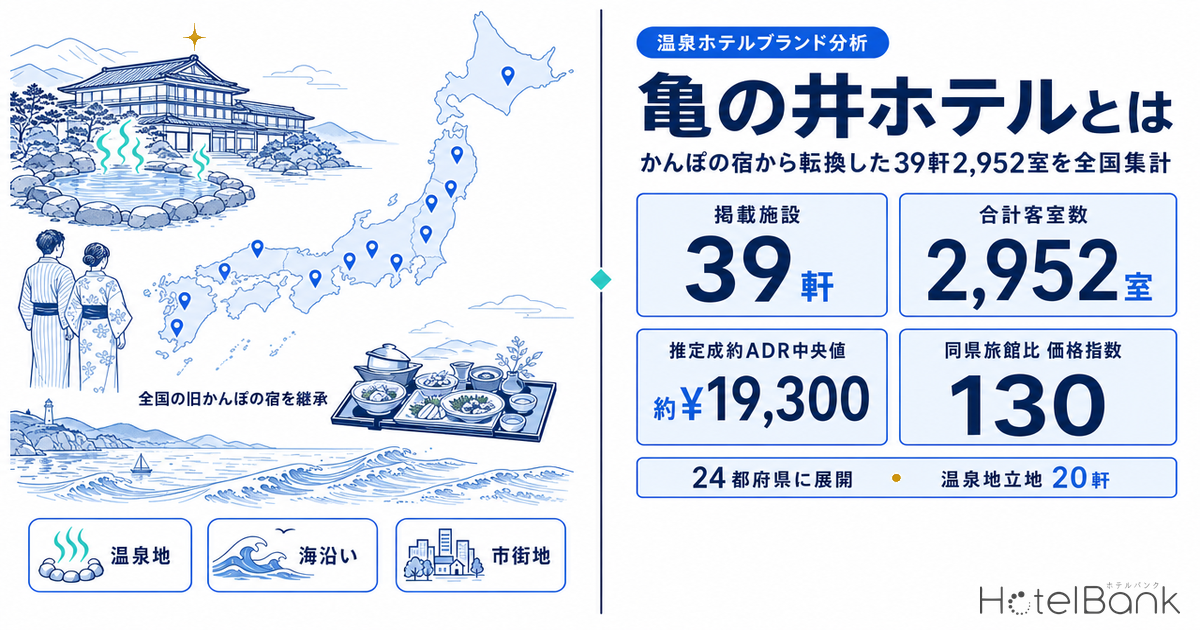
Kamenoi Hotel (亀の井ホテル) is an onsen hotel brand that took over the former Kanpo no Yado (かんぽの宿) resort inns. As of September 2026, its official website lists 39 properties across 24 prefectures, totaling 2,952 rooms. This article builds a timeline of the brand conversion from official announcements and press coverage, then breaks the 39 properties down by prefecture, room count and location type, and uses our own database of listed prices, estimated settled rates and guest reviews to map where the brand sits on price.
Metric Definitions and Sample Used in This Article
- Sample: We matched the property list on the Kamenoi Hotel official website (as of September 18, 2026) against our hotel master by property name and address, and analyzed the 39 properties that matched. Every property matched (39/39). Kamenoi Bessou (亀の井別荘) in Yufuin and a guesthouse with the same name are run by unrelated operators and are excluded. One property that converted to another brand in April 2026 is also excluded.
- ADR (Average Daily Rate): An estimated settled rate (tax-exclusive equivalent), calculated by applying a property-type adjustment factor to the lowest-plan price level each property publishes on OTAs and other channels (per room, 2 guests, tax included). Checked against property-level results disclosed by listed hotel REITs (91 properties, most recent 3 months), the median error is about 7%. These are estimates and differ from each property’s actual settled prices and accounting figures. Area-level ADR is the median across the properties in scope (the level of a typical property in that area). Wherever listed prices are mentioned, they are per-room rates for 2 guests, tax included.
- Period: The 12 months from September 2025 to August 2026 (finalized months only). Estimated settled ADR could be calculated for 36 of the 39 properties; listed prices were obtained for all 39.
- Data source: MetroEngines Research; review aggregation by the HotelBank Editorial Team
- — 39 properties and 2,952 rooms in 24 prefectures. An onsen hotel brand built on the former Kanpo no Yado inns; all 39 properties on the official list (as of September 18, 2026) matched our hotel master.
- — On October 1, 2021, Japan Post Holdings resolved to transfer the business of 32 Kanpo no Yado properties (about ¥8.8 billion in total). On July 1, 2022, they were unified under one brand together with the Kamenoi Hotel in Beppu.
- — More than half, 20 properties (1,895 rooms), are in onsen resort areas, followed by 10 seaside and 9 urban properties. The inventory is built for leisure stays, not station-front business travel.
- — Median estimated settled ADR is about ¥19,300 (September 2025–August 2026, N=36 properties). Against the ryokan-category median in each property’s prefecture, the median price index is 130, spread from 76 to 279.
- — Across 137,196 guest reviews (39 properties), dinner (4.14), staff (4.17) and breakfast (4.13) score highest. Food in general is mentioned in 34.4% of reviews, far ahead of other topics — an onsen stay with two meals is at the center of how guests judge the brand.
What Is Kamenoi Hotel? A Beppu Name Extended to 39 Properties Nationwide
The Kamenoi Hotel name traces back to Beppu in Oita. Its forerunner was the Kamenoi Ryokan, opened in October 1911 (Meiji 44) by Kumahachi Aburaya (油屋熊八), known as the “father of Beppu tourism,” and converted into a Western-style hotel in 1924 (Taisho 13). Aburaya is credited with running what is said to be Japan’s first scheduled sightseeing bus with female tour guides, and with coining the slogan “For mountains, Fuji; for sea, the Seto Inland Sea; for hot springs, Beppu.”
This historic name became a national brand in 2022. Japan Post Holdings sold its Kanpo no Yado business to MyStays Hotel Management (now Iconia Hospitality), and on July 1, 2022, the acquired properties and the Kamenoi Hotel in Beppu were brought together under the single brand “Kamenoi Hotel.” In other words, “Kamenoi Hotel” and “Kanpo no Yado” largely refer to the same buildings; what changed was the operator and the brand.
As of September 2026, the official website lists 39 properties and 2,952 rooms in 24 prefectures. The median property has 55 rooms, ranging from 33 rooms (Fukui) to 322 rooms (Beppu). We analyzed 137,196 guest reviews across the 39 properties.
From Kanpo no Yado to Kamenoi Hotel: A Timeline Since the 2021 Transfer Decision
The brand conversion began on October 1, 2021. On that day, Japan Post Holdings resolved to transfer the business of 32 of its Kanpo no Yado properties to four companies and signed the contracts. The total was about ¥8.8 billion. Of these, 29 properties went to MyStays Hotel Management and Yakushima TMK (both affiliates of Fortress Investment Group), and the remaining three went to Chateraise Holdings (Isawa), Nozawa World (Iwaki) and Hita Tansuigyo Center (Hita).
Japan Post cited profitability as the reason. The Kanpo no Yado business had posted an average recurring loss of ¥4.6 billion a year since postal privatization in 2007, and in fiscal 2020, hit by COVID-19, recorded a recurring loss of about ¥11.3 billion. Rather than wait for lodging demand to recover on its own, Japan Post chose to hand the whole business to operators whose core business is running hotels.
| Date | Event |
|---|---|
| October 1911 | Kumahachi Aburaya founds the Kamenoi Ryokan in Beppu (converted to a Western-style hotel in 1924) |
| December 1, 2015 | MyStays Hotel Management begins operating the Kamenoi Hotel in Beppu |
| October 1, 2021 | Japan Post Holdings resolves to transfer the business of 32 Kanpo no Yado properties and signs contracts (about ¥8.8 billion in total; 29 properties to the MyStays side) |
| April 2022 | MyStays Hotel Management begins operating the acquired properties; Okunikko Yumoto in Tochigi is newly added |
| July 1, 2022 | Properties unified under the “Kamenoi Hotel” brand (32 properties) |
| November 15, 2023 | Kamenoi Hotel Kusatsu Yubatake holds its grand opening |
| July 2025 | The operator changes its name to Iconia Hospitality |
| December 25, 2025 | Kusatsu Onsen Hotel Resort reopens after rebranding as “Kamenoi Hotel Kusatsu Resort” |
| April 11, 2026 | One property in Nara converts to a dog-friendly brand (excluded from this article’s sample) |
| May 30, 2026 | Evergreen Fuji in Fujiyoshida, Yamanashi, rebrands and opens as “Kamenoi Hotel Fuji” (88 rooms) |
Source: Compiled by the HotelBank Editorial Team from official announcements by Japan Post Holdings and Iconia Hospitality (formerly MyStays Hotel Management), and press reports
The timeline shows that the brand did not stop at the acquisition; it has kept growing. From 32 properties in 2022, new openings and rebrandings such as Okunikko Yumoto, Kusatsu Yubatake, Kusatsu Resort and Fuji have accumulated, bringing the official list to 39 properties as of September 2026. In Kusatsu, where several properties joined in a short span, the relationship between new supply and room rates is a question in its own right. Beyond carrying over the former Kanpo no Yado buildings, the brand is clearly working as a platform that absorbs other onsen hotels as well.
Where Are the 39 Properties? 12 in Kanto, More Than Half in Onsen Areas
By region, Kanto has the most, with 12 properties and 828 rooms, followed by Kinki (9 properties, 512 rooms) and Chubu (7 properties, 470 rooms). Kyushu has only 5 properties but includes two large ones — Beppu (322 rooms) and Aso Park Resort (209 rooms) — giving it 687 rooms, second only to Kanto. By prefecture, Shizuoka leads with 4 properties; Ibaraki, Tochigi and Hyogo have 3 each; and Gunma, Chiba, Akita, Wakayama, Fukuoka and Kumamoto have 2 each.
Source: MetroEngines Research; compiled by the HotelBank Editorial Team
By location type, 20 properties (1,895 rooms) are in onsen resort areas — more than half — with 10 seaside properties (641 rooms) and 9 urban properties (416 rooms). The legacy of Kanpo no Yado, which placed its inns in leisure destinations across Japan, remains intact. The brand’s character is defined by stay-oriented inventory built around hot springs and meals, not station-front business locations.
Source: MetroEngines Research; compiled by the HotelBank Editorial Team
Mostly 40 to 60-Something Rooms: A Portfolio of Mid-Sized Onsen Hotels
Looking at the distribution of room counts, the 50–59-room band is the largest with 14 properties, and 9 properties have fewer than 50 rooms (33–49). Together that is 23 properties — nearly 60% of the total — with fewer than 60 rooms. With a median of 55 rooms, the brand’s standard format is the “mid-sized onsen hotel,” neither a large resort nor a small ryokan.
There are also 4 large properties with 120 rooms or more: Beppu (322 rooms), Aso Park Resort (209), Atami (159) and Tazawako (121). The portfolio bundles many mid-sized properties while holding large inventory in major onsen destinations.
Source: MetroEngines Research; compiled by the HotelBank Editorial Team
Price Positioning: Index 130 Against the Prefectural Ryokan Median
Next, we check price levels using our own database. Taking each property’s monthly median estimated settled ADR over the 12 finalized months from September 2025 to August 2026, the brand-wide median is about ¥19,300 (N=36 properties). The highest is Izukogen at about ¥37,300 and the lowest is Tazawako at about ¥10,300, a 3.6x spread. The median listed price over the same period (average of all plans, 2 guests per room, tax included) is about ¥43,300. Estimated settled ADR is a tax-exclusive estimate derived from the lowest-plan level with a property-type adjustment factor, while listed price is the average of all plans, including premium ones, so the two sit at different levels.
Price levels depend on the local market. So we calculated an index by dividing each property’s estimated settled ADR by the median estimated settled ADR of the ryokan category in the same prefecture. An index of 100 means “on par with a typical ryokan in that prefecture.” The median index across the 36 properties is 130. In other words, in most markets Kamenoi Hotel is priced somewhat above the typical ryokan in its prefecture.
Source: MetroEngines Research; compiled by the HotelBank Editorial Team
The highest indexes belong to properties such as Tsukubasan (279), Izukogen (199), Kusatsu Yubatake (184) and Hikone (181), where scarce locations — views, or proximity to Kusatsu’s Yubatake hot spring field — are reflected in price. At the other end, four properties are below 100: Beppu (76), Kitsuregawa (77), Setouchi Hikari (92) and Okunikko Yumoto (99). In onsen towns like Beppu and Okunikko Yumoto, where high-priced inns are plentiful, the brand uses its large room inventory to serve as an accessible price option. That fits the concept set at the rebrand: a casual onsen inn anyone can stay at.
Source: MetroEngines Research; compiled by the HotelBank Editorial Team
Plotting room count against estimated settled ADR, properties in the 40–60-something-room range are spread widely between ¥15,000 and ¥30,000, showing that size does not determine price. By location type, median estimated settled ADR is about ¥21,000 for seaside (N=9), about ¥19,300 for onsen (N=20) and about ¥15,900 for urban (N=7): seaside and onsen are roughly on par, with urban somewhat lower.
What Reviews Reveal: Dinner, Staff and Breakfast Rank Highest
From 137,196 guest reviews across the 39 properties compiled by the HotelBank Editorial Team, the property-level medians of category scores (out of 5) are: dinner 4.14, staff 4.17, breakfast 4.13, meals 4.07, bath/onsen 4.07, location 4.06, cleanliness 4.04, rooms 3.99 and service 3.99. Food and hospitality are clearly at the center of how guests evaluate the brand.
Mention rates by tag, derived from NLP analysis of review text (property-level medians), show the same pattern. Food in general stands out at 34.4%, followed by breakfast buffet at 14.3%, open-air baths at 10.6%, hot springs at 10.3% and large communal baths at 7.9%. Mentions of value for money account for 7.8% and family stays another 7.8%, confirming in the data how the brand is used: families enjoying an affordable onsen stay with two meals included.
Source: HotelBank Editorial Team research (137,196 guest reviews across 39 properties; category scores are medians of each property’s 5-point ratings)
At the property level, the highest bath/onsen scores go to Izukogen (4.58), Okunikko Yumoto (4.52), Kumano Tanabe (4.45), Ako (4.41) and Nagatoro Yorii (4.36). For dinner, Kusatsu Yubatake (4.41), Fuji (4.40), Hikone (4.38), Izukogen (4.37) and Yaizu (4.35) lead. Some properties, like Okunikko Yumoto, earn high bathing scores despite a modest price index — price level and guest satisfaction do not always line up, which shows how broad the brand is.
All 39 Properties (Prefecture, Rooms, Location Type, Price Level)
Below are the 39 properties in this article’s sample. The price index shows each property’s level relative to the median estimated settled ADR of the ryokan category in the same prefecture (=100). The three properties for which estimated settled ADR could not be calculated are marked “—”.
| Region | Prefecture | Property | Rooms | Location type | Est. settled ADR | Price index | Reviews |
|---|---|---|---|---|---|---|---|
| Tohoku | Iwate | Kamenoi Hotel Ichinoseki | 55 | Urban | — | — | 2,365 |
| Tohoku | Akita | Kamenoi Hotel Tazawako | 121 | Onsen | ¥10,285 | 113 | 3,501 |
| Tohoku | Akita | Kamenoi Hotel Akita Yuze | 114 | Onsen | ¥10,614 | 117 | 2,863 |
| Tohoku | Aomori | Kamenoi Hotel Aomori Makado | 73 | Onsen | ¥13,367 | 127 | 2,154 |
| Kanto | Chiba | Kamenoi Hotel Kamogawa | 103 | Seaside | ¥22,024 | 160 | 3,765 |
| Kanto | Chiba | Kamenoi Hotel Kujukuri | 81 | Seaside | ¥19,349 | 141 | 3,532 |
| Kanto | Saitama | Kamenoi Hotel Nagatoro Yorii | 51 | Onsen | ¥18,582 | 136 | 2,595 |
| Kanto | Tokyo | Kamenoi Hotel Ome | 56 | Onsen | ¥18,674 | 170 | 6,363 |
| Kanto | Tochigi | Kamenoi Hotel Okunikko Yumoto | 78 | Onsen | ¥16,442 | 99 | 1,846 |
| Kanto | Tochigi | Kamenoi Hotel Nikko Yunishigawa | 54 | Onsen | ¥27,451 | 165 | 1,922 |
| Kanto | Tochigi | Kamenoi Hotel Kitsuregawa | 53 | Onsen | ¥12,802 | 77 | 2,191 |
| Kanto | Gunma | Kamenoi Hotel Kusatsu Resort | 103 | Onsen | ¥20,005 | 130 | 5,137 |
| Kanto | Gunma | Kamenoi Hotel Kusatsu Yubatake | 80 | Onsen | ¥28,265 | 184 | 1,871 |
| Kanto | Ibaraki | Kamenoi Hotel Tsukubasan | 59 | Onsen | ¥23,020 | 279 | 1,454 |
| Kanto | Ibaraki | Kamenoi Hotel Itako | 58 | Urban | ¥14,738 | 178 | 4,048 |
| Kanto | Ibaraki | Kamenoi Hotel Oarai | 52 | Seaside | — | — | 3,703 |
| Chubu | Yamanashi | Kamenoi Hotel Fuji | 80 | Onsen | ¥14,852 | 118 | 915 |
| Chubu | Aichi | Kamenoi Hotel Chita Mihama | 45 | Seaside | ¥14,983 | 107 | 1,965 |
| Chubu | Fukui | Kamenoi Hotel Fukui | 33 | Urban | ¥15,124 | 104 | 1,029 |
| Chubu | Shizuoka | Kamenoi Hotel Atami | 159 | Onsen | ¥28,947 | 155 | 6,171 |
| Chubu | Shizuoka | Kamenoi Hotel Izukogen | 55 | Onsen | ¥37,308 | 199 | 2,587 |
| Chubu | Shizuoka | Kamenoi Hotel Yaizu | 53 | Seaside | ¥22,329 | 119 | 1,926 |
| Chubu | Shizuoka | Kamenoi Hotel Atami Annex | 45 | Onsen | ¥24,269 | 130 | 3,573 |
| Kinki | Mie | Kamenoi Hotel Toba | 62 | Seaside | ¥22,078 | 130 | 2,810 |
| Kinki | Hyogo | Kamenoi Hotel Arima | 68 | Onsen | ¥34,163 | 169 | 3,800 |
| Kinki | Hyogo | Kamenoi Hotel Awajishima | 53 | Seaside | ¥26,561 | 132 | 2,022 |
| Kinki | Hyogo | Kamenoi Hotel Ako | 49 | Onsen | ¥29,256 | 145 | 2,807 |
| Kinki | Wakayama | Kamenoi Hotel Nachikatsuura | 102 | Seaside | ¥20,990 | 157 | 4,980 |
| Kinki | Wakayama | Kamenoi Hotel Kumano Tanabe | 52 | Urban | ¥15,132 | 113 | 2,808 |
| Kinki | Osaka | Kamenoi Hotel Tondabayashi | 43 | Urban | ¥19,286 | 170 | 1,235 |
| Kinki | Nara | Kamenoi Hotel Nara | 42 | Urban | ¥20,156 | 121 | 2,029 |
| Kinki | Shiga | Kamenoi Hotel Hikone | 41 | Urban | ¥24,490 | 181 | 2,535 |
| Chugoku-Shikoku | Yamaguchi | Kamenoi Hotel Setouchi Hikari | 40 | Seaside | ¥13,699 | 92 | 1,765 |
| Chugoku-Shikoku | Kochi | Kamenoi Hotel Kochi | 52 | Urban | — | — | 2,736 |
| Kyushu | Oita | Kamenoi Hotel Beppu | 322 | Onsen | ¥13,884 | 76 | 27,206 |
| Kyushu | Kumamoto | Kamenoi Hotel Aso Park Resort | 209 | Onsen | ¥18,214 | 108 | 5,324 |
| Kyushu | Kumamoto | Kamenoi Hotel Aso | 66 | Onsen | ¥27,512 | 163 | 3,305 |
| Kyushu | Fukuoka | Kamenoi Hotel Genkainada | 50 | Seaside | ¥16,062 | 123 | 2,188 |
| Kyushu | Fukuoka | Kamenoi Hotel Yanagawa | 40 | Urban | ¥15,875 | 122 | 2,170 |
Source: MetroEngines Research (estimated settled ADR is the monthly median over finalized months, September 2025–August 2026, N=36 properties); review counts by the HotelBank Editorial Team; property list based on matching the Kamenoi Hotel official website (as of September 18, 2026) against our hotel master
What It Means When Public-Sector Lodging Is Revived Under a Private Brand
The shift from Kanpo no Yado to Kamenoi Hotel is one real-world example of lodging facilities held by the public sector moving to a private brand. The model carries several implications for the industry.
The first is reuse of existing buildings. The 2,952 rooms spread across onsen towns and seaside resorts nationwide are inventory that would be hard to build again today at the same locations and scale. With construction costs rising, renovating and reopening existing properties carries growing weight as a practical answer on the supply side. The second is unified sales channels and branding. Regional mid-sized onsen hotels that struggle to gain recognition on their own can appear side by side on OTA search results under a shared brand, lifting each property’s ability to attract guests. How much a brand conversion lifts rates, and how many years it takes to recover the investment, are the key questions for owners weighing a reflag.
The third is price architecture. As this article shows, the 39 properties are distributed widely, from 76 to 279, centered around an index of about 130 against the typical ryokan in their prefecture. Rather than aligning every property to the same price band, the brand varies its level by market while keeping a unified identity — a useful reference for operating a multi-location brand. It shows there is room for one brand name to play different roles: an accessible option in crowded onsen towns, and a commensurately priced stay in scarce locations.
The question of converting public facilities to private operation is not unique to Kamenoi Hotel. Similar revival schemes are being considered for recreation facilities and tourism properties owned by local governments across Japan, and how to put existing stock to work as capacity for lodging demand will remain a major supply-side theme.
Summary
Kamenoi Hotel is an onsen hotel brand that carries the name of a long-established Beppu inn and operates 39 properties and 2,952 rooms in 24 prefectures, centered on the former Kanpo no Yado. Starting from Japan Post Holdings’ October 2021 decision to transfer the business (32 properties, about ¥8.8 billion in total) and the brand unification on July 1, 2022, it has continued to add properties through new openings and rebrandings.
Nearly 60% of the properties are mid-sized, with fewer than 60 rooms, and more than half are in onsen areas. The median estimated settled ADR is about ¥19,300, and the median price index against the prefectural ryokan-category median is 130. Guests rate dinner, staff and breakfast highly, and food is mentioned in 34.4% of reviews, well ahead of other topics. Both official information and our own data point to the same picture: a brand that offers onsen stays with two meals at price levels tuned to each market.
References and Sources
■ Data sources
The property list is from the Kamenoi Hotel official website (as of September 18, 2026); the history and transfer facts are from official announcements by Japan Post Holdings and the operator, and from press reports. Room counts, locations, listed prices, estimated settled ADR and guest reviews are from MetroEngines Research and HotelBank Editorial Team research (finalized months, September 2025–August 2026).
■ Calculation assumptions
Estimated settled ADR is a tax-exclusive estimate obtained by applying a property-type adjustment factor to each property’s lowest-plan level (2 guests, per room, tax included). We took each property’s median over 12 monthly values and then the brand-wide median. The price index is each property’s estimated settled ADR divided by the median estimated settled ADR of the ryokan category in the same prefecture, multiplied by 100 (index 100 = on par with a typical ryokan in that prefecture). Location types (onsen, seaside, urban) are an editorial classification based on address and property characteristics.
■ Limitations
Estimated settled ADR is an estimate derived from published prices and differs from each property’s actual settled prices and accounting figures (median error of about 7% against property-level disclosures by listed hotel REITs). Estimated settled ADR could be calculated for 36 of the 39 properties; the remaining 3 are outside the price analysis. The sample depends on the official website listing at the time of research, so the property count will change with later openings, rebrandings and brand conversions. Guest reviews involve self-selection by reviewers, and review volume differs across properties, so score comparisons should be read as median-based tendencies. This article describes a single brand and does not compare its scale with, or rank it against, other chains.
■ Official announcements and primary sources
- Japan Post Holdings, “On the Transfer of Kanpo no Yado” (October 13, 2021; material submitted to the Postal Privatization Committee) [Japanese]
- MyStays Hotel Group, “Kanpo no Yado to Rebrand on July 1; New Brand Name Is Kamenoi Hotel” (May 31, 2022) [Japanese]
- “Kusatsu Onsen Hotel Resort Reopens as Kamenoi Hotel Kusatsu Resort on December 25” (December 19, 2025) [Japanese]
- Iconia Hospitality press release (April 10, 2026) [Japanese]
- Kamenoi Hotel official website (property list, accessed September 18, 2026)
■ Press coverage
- Travel Voice, “Japan Post Transfers 32 Kanpo no Yado Properties to Four Companies; Total Valuation About ¥8.8 Billion” (October 1, 2021) [Japanese]
- Travel Watch, “Kanpo no Yado Rebrands as Kamenoi Hotel” (June 1, 2022) [Japanese]
- Travel Watch, “Kamenoi Hotel Fuji Opens May 30 with 88 Rooms” (2026) [Japanese]
- Tokyo Shimbun, “Kusatsu Onsen Reborn: Kamenoi Hotel Shifts to Individual Travelers with View Restaurant and Open-Air Baths” [Japanese]
- Beppu Kamenoi Hotel (reference for company history) [Japanese]
■ Proprietary data
- MetroEngines Research — listed prices and estimated settled ADR (September 2025–August 2026, N=36 properties; listed prices N=39 properties), prefectural ryokan-category medians
- HotelBank Editorial Team research — category scores and tag mention rates from 137,196 guest reviews (39 properties)