

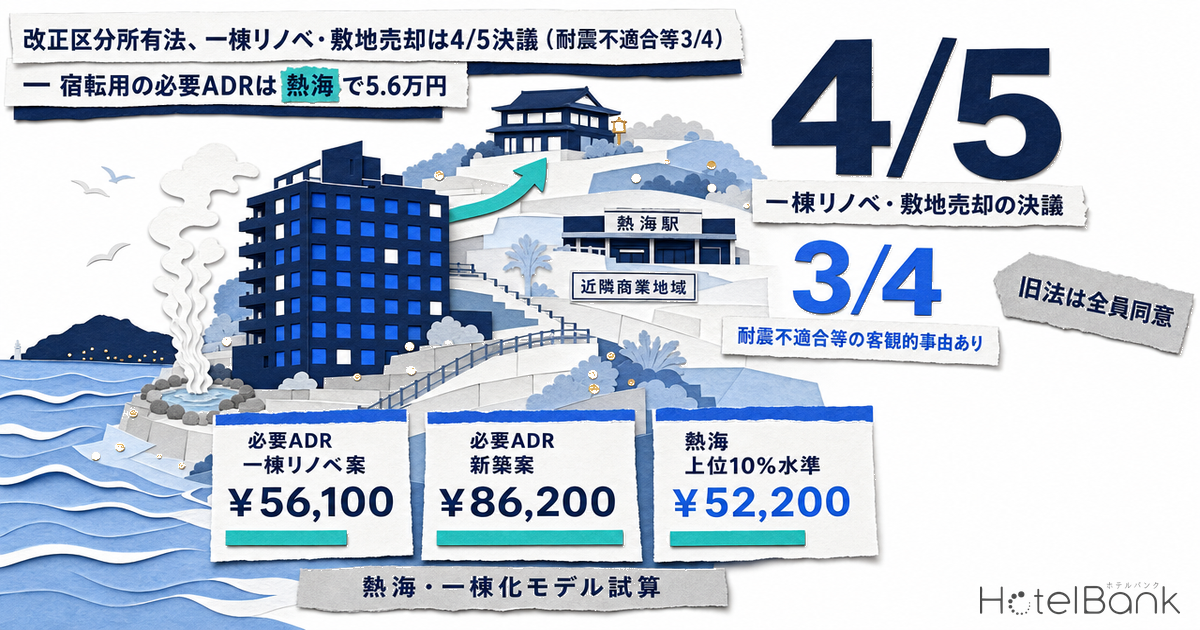
On April 1, 2026, Japan’s amended Act on Building Unit Ownership (the Condominium Unit Ownership Act; Act No. 47 of 2025) came into force. Four actions that previously required the consent of every single unit owner — a whole-building renovation, a sale of the building together with its site, demolition followed by a sale of the site, and demolition itself — can now be approved by majority vote, just like a rebuilding, with at least four-fifths of both the unit owners and the voting rights. Where statutory objective grounds exist, such as inadequate seismic safety or a hazardous exterior wall, the threshold drops to three-quarters. The law now sets out a clear path for turning a building split among many owners into a single hotel, or into a hotel development site, by resolution. This article confirms the amendments against the statutory text, lines up ADR, condo unit prices and zoning for resort areas where condominium buildings are concentrated, and uses a model of a 45-year-old, 50-unit building to estimate the required ADR and payback period for two options: converting it into a hotel through a whole-building renovation, or demolishing it and building new.
Metric Definitions Used in This Article
- ADR (average daily rate): An estimated settled rate (tax-excluded equivalent), calculated by applying a property-type correction factor to the lowest-priced plan each property publishes on OTAs (per room, two guests per room, tax included). Checked against property-level results disclosed by listed hotel REITs (91 properties, most recent three months), the median error is about 7%. These are estimates and differ from each property’s actual transaction prices and accounting figures. Area-level ADR is the median of the covered properties (the level of a typical property in the area). Figures such as the “top-10% level” in this article are percentiles of the property-level estimated ADR, taken across properties for which a 12-month average could be calculated.
- Occupancy rate: Published figures from the Japan Tourism Agency’s Overnight Travel Statistics Survey, used as the occupancy assumption in the model (our own estimated OCC is not used).
- NOI yield: As defined for this model: (GOP − FF&E reserve − property tax, insurance, etc.) ÷ total project cost. A simple pre-debt, pre-tax yield.
- Data sources: MetroEngines Research & Consulting (estimated ADR, lodging property master), MLIT Real Estate Information Library (transaction prices, zoning), and published materials from the Ministry of Justice, MLIT and the Japan Tourism Agency
- — For a 50-unit building, the consent threshold moves from 50 units (unanimous) → 40 (4/5) → 38 (3/4). If two units whose owners cannot be located are excluded from the denominator by court order, 36 units are enough to pass a resolution (Articles 62, 64-5 to 64-8 and 38-2 of the Act).
- — A resolution only settles how the unit-ownership relationship is dissolved. Operating a hotel separately requires the right zoning, a change-of-use approval under the Building Standards Act, and a permit under the Hotel Business Act. In Atami and Hakone, both dense lodging markets, about a quarter of existing hotels and inns sit in exclusively residential zones, so screening the location comes first.
- — Pre-1981 resale condo units in Atami traded at a median ¥149,600/m² (n=190). Even buying all 50 units at a 20% premium, unit acquisition is only 28% of total project cost; construction accounts for the remaining roughly 70%.
- — The ADR needed for a 6% NOI yield is ¥56,100 for the renovation option and ¥86,200 for the new build. Room design must target the top of the market rather than the area median. Across six areas, Hakone (required ¥47,400 / top-10% level ¥49,800), with low unit prices and high rates at top properties, comes closest.
- — Adding up the statutory periods alone, from the meeting notice to the termination of leases and vacating of units takes roughly 8 months to 1 year. Including voluntary buyouts, the timeline is about 3 years to groundbreaking, and about 4.4 years to opening for the renovation option and 5.7 years for the new build.
Conclusion: The Consent Bar Is Lower; Location, Structure and Room Rates Decide Success
The conclusions first. First, the amendment lowered the consent threshold for consolidating a building from “everyone” to “four-fifths,” and to “three-quarters” where objective grounds exist, such as problems with seismic resistance or the safety of exterior walls or piping. Unit owners who cannot be located can be removed from the voting denominator through a district court order. In a 50-unit building, a process that used to stall if even one owner objected or could not be reached can now go ahead while tolerating 10 to 12 non-consenting units.
Second, a resolution under the Act only reorganizes property rights. Whether the building works as a hotel depends on zoning, change-of-use approval under the Building Standards Act, a Hotel Business Act permit, and room rates. When we line up resort areas with many condominium buildings in our data, lodging supply is large, but a certain share of locations falls in exclusively residential zones. Candidates for consolidation will have to come from commercial zones, some residential zones, or areas with no zoning designation.
Third, the acquirer’s economics respond far more to construction cost and room rates than to the unit purchase price. In the Atami model of a 45-year-old, 50-unit building, moving the unit buyout premium from 0% to 100% only shifts the required ADR between ¥53,500 and ¥66,600, while changing the renovation cost or GOP margin assumptions swings it from ¥33,000 to ¥101,200. Because the amended law shortens consensus-building and reduces holdout premiums, buildings that can redirect that freed-up capacity into larger rooms, views and operating efficiency become a new source of hotel supply.
Scope — How This Article Differs from Earlier Coverage
HotelBank has covered the relationship between unit ownership and lodging from several angles. An earlier analysis of resort condominium conversion to short-term lodging looked at the economics of an individual owner renting out one unit (the annual nights sold needed to cover fixed costs). Hotel Condominium Tax Arbitrage covered the taxation of hotels sold by the unit, and other articles have covered the conversion of rights in urban redevelopment projects and transfer schemes for single-owner properties.
This article is different from all of them. It focuses on the procedure and economics of consolidating a building with many unit owners into a single hotel, or a hotel development site, by resolution of the owners’ meeting. Unit-level break-even points for Echigo-Yuzawa and Atami (79 and 48 nights a year) are only referenced from earlier work; here we newly estimate total project cost, required ADR and the timeline at whole-building scale.
What Changed — Resolution Requirements by Article
We compiled the resolutions relevant to consolidating a building from the Ministry of Justice Civil Affairs Bureau’s “On the Amendments to the Unit Ownership Act and the Act on Unit Ownership of Disaster-Damaged Buildings” (April 2026) and the text of the amended Act. “Those without voting rights” in the table include owners subject to the exclusion order for owners of unknown identity or whereabouts, discussed in the next section.
| Resolution | Description | Before | After (from April 1, 2026) | Article |
|---|---|---|---|---|
| Rebuilding resolution | Demolish the building and construct a new one on the site | 4/5 of unit owners and voting rights | 4/5 each (3/4 each with objective grounds) | Art. 62(1), (2) |
| Building renewal resolution (whole-building renovation) | Keep the structural frame and change the shape of common areas together with the shape, area and layout of all exclusive units | Unanimous | 4/5 each (3/4 each with grounds) | Art. 64-5 |
| Building-and-site sale resolution | Sell the building and site together | Unanimous (*) | 4/5 each of unit owners, voting rights and the value of site-use rights (3/4 each with grounds) | Art. 64-6 |
| Demolition-and-site-sale resolution | Demolish the building and sell the site | Unanimous (*) | Same, 4/5 each (3/4 each with grounds) | Art. 64-7 |
| Demolition resolution | Demolish the building | Unanimous | 4/5 each (3/4 each with grounds) | Art. 64-8 |
| Alteration of common areas | Works involving significant changes to shape or utility | 3/4 of unit owners and voting rights (all owners as denominator) | With a quorum (majority present), 3/4 each of those present; 2/3 each for removing defects or barrier-free work | Art. 17(1), (5) |
| Establishing, amending or abolishing bylaws | E.g., amending use-restriction clauses | 3/4 of unit owners and voting rights (all owners as denominator) | With a quorum, 3/4 each of those present | Art. 31(1) |
| Ordinary resolution | E.g., carrying out repairs | Majority of all unit owners and voting rights | Majority each of those present (including votes in writing, by proxy or electronically) | Art. 39 |
Source: Compiled by MetroEngines Research & Consulting from Ministry of Justice Civil Affairs Bureau, “On the Amendments to the Unit Ownership Act and the Act on Unit Ownership of Disaster-Damaged Buildings” (April 2026) and e-Gov Law Search, “Act on Building Unit Ownership, etc.” *Even before the amendment, condominiums certified as requiring removal due to seismic deficiency could pass a site-sale resolution (4/5 each) under the Act on Facilitation of Reconstruction of Condominiums.
From a consolidation standpoint, the biggest change is that the three shaded resolutions moved from unanimous consent to majority vote. According to MLIT, condominium site sales and similar projects under the Act on Facilitation of Reconstruction of Condominiums totaled only 17 cases (about 1,300 units) as of March 31, 2025, well below the cumulative 323 rebuildings (about 26,000 units). Because selling the building and site can now be approved by majority vote without first passing through a seismic removal-required certification, the pool of buildings with an exit other than rebuilding gets wider. The government has set a target of raising the number of “condominium regenerations, etc.” from 472 in 2024 to 1,000.
Here we set out the number of “yes” votes needed for each resolution, using a 50-unit building with one owner per unit and equal voting rights. Site-sale resolutions also require the same share of site-use-right value, but if shares are allocated in proportion to exclusive floor area and are equal, this matches the unit count.
Source: Estimated by MetroEngines Research & Consulting from Articles 38-2, 62 and 64-5 to 64-8 of the Unit Ownership Act (50 units, one owner per unit, equal voting rights)
Under the old unanimous rule, the process stopped if even one of the 50 units objected or could not be reached. Under the amended default (4/5), 40 “yes” votes are enough, or 38 with objective grounds. If an exclusion order is obtained for two owners whose whereabouts are unknown, the denominator becomes 48 and the 3/4 line falls to 36 units. For developers seeking to acquire such buildings, the structural need to pay a large premium to win every last owner (a holdout premium) has become smaller.
Objective Grounds (Conditions That Lower the Threshold to 3/4)
Article 62(2) sets the threshold at three-quarters where the building falls under any of the following. The criteria for each item are set by the Minister of Justice in consultation with the Minister of Land, Infrastructure, Transport and Tourism (Art. 62(3)), and are specified in a Ministry of Justice notice and Article 8 of the Enforcement Regulations of the Act.
| Item | Ground (summary of the provision) | Where the criteria are set |
|---|---|---|
| Item 1 | Does not meet standards equivalent to Building Standards Act provisions on seismic safety | Minister of Justice notice (same content as the removal-required certification criteria) |
| Item 2 | Does not meet standards equivalent to Building Standards Act provisions on fire safety | Minister of Justice notice |
| Item 3 | Exterior walls or cladding may peel off or fall and endanger the surroundings | Minister of Justice notice |
| Item 4 | Deterioration of water supply, drainage or other piping (where repair is extremely difficult) risks becoming seriously harmful to hygiene | Enforcement Regulations Art. 8 (e.g., piping in the ceiling space serving the unit above) and Minister of Justice notice |
| Item 5 | Does not meet standards equivalent to the building accessibility standards under the Barrier-Free Act | Minister of Justice notice |
Source: e-Gov Law Search, “Act on Building Unit Ownership, etc.” Article 62 and “Enforcement Regulations of the Act on Building Unit Ownership, etc.” Article 8; Ministry of Justice Civil Affairs Bureau, “On the Amendments to the Unit Ownership Act and the Act on Unit Ownership of Disaster-Damaged Buildings”
The text of the Act does not make certification by a designated administrative agency or other body a requirement for the resolution. Because the question is whether the building actually meets the criteria, in practice owners are expected to prepare documentation, such as surveys by architects, substantiating that it does, and present it in the meeting notice and at the briefing session. The notice convening a rebuilding resolution meeting (and the other resolutions that apply the same rules) must be sent at least two months before the meeting date. It must state the reasons the rebuilding or other action is needed, the cost of maintaining or restoring the building’s utility if it is not carried out, the repair plan and the amount of the repair reserve. A briefing session must then be held at least one month before the meeting (Art. 62(6)–(8)). Using administrative measures such as special exceptions to floor-area-ratio or height limits separately involves removal-required certification or similar under the Condominium Regeneration Act (discussed below).
Excluding Owners of Unknown Whereabouts and Majority-of-Attendees Voting
If, despite the necessary investigation, a unit owner or their whereabouts cannot be identified, the court may, at the request of another unit owner or the manager, order that resolutions may be passed by the owners other than that person (Art. 38-2(1)). An owner subject to this order has no voting rights (Art. 38-2(2)) and is removed from the denominator of every resolution, including rebuilding, renewal and sale. Jurisdiction lies with the district court where the building is located. The court publicly announces the petition and an objection period (at least one month), and rules after the period ends. The order takes effect only once it becomes final (Art. 86).
In addition, ordinary resolutions that do not involve disposing of unit ownership are now decided by a majority of those present (Art. 39), and alterations of common areas and bylaw amendments by 3/4 of those present, provided a quorum is met (Arts. 17 and 31). This makes preliminary decisions, such as revising use-restriction clauses in the bylaws or spending on surveys toward consolidation, less likely to stall because apathetic owners stay away, which also shortens consensus-building.
Transitional Measures and the Condominium Regeneration Act
In principle, the amended Act also applies to matters that arose before its effective date and extends directly to existing condominium buildings (Supplementary Provisions, Art. 2(1)). However, meetings whose convening procedure began by March 31, 2026 are governed by the pre-amendment rules, even if the meeting is held on or after April 1 (Supplementary Provisions, Art. 2(2)). From the effective date, bylaw provisions that conflict with the amended Act lose effect (Supplementary Provisions, Art. 2(3)).
On the project-law side, the Act on Facilitation of Reconstruction of Condominiums was renamed the Act on Facilitation of Condominium Regeneration, etc. (the Condominium Regeneration Act) and took effect on the same day. According to MLIT, the Act establishes condominium regeneration projects that cover building renewal (whole-building renovation) in addition to rebuilding, as well as condominium sale projects and condominium removal projects. It also provides procedures such as forming an association, rights conversion plans and distribution plans. Rights in adjacent land and leased land can now be converted into unit ownership after regeneration, and for rebuildings of buildings that fail seismic standards, a height-limit exception by permission of the designated administrative agency was added alongside the floor-area-ratio exception. The Japan Housing Finance Agency has also launched loans for condominium renewal and similar works.
The Resolution and the Permits to Operate a Hotel Are Separate Layers
A resolution under the Unit Ownership Act is a procedure for deciding how to change the unit-ownership relationship (renew, sell or demolish). To use the building as a lodging facility, each of the following layers must be satisfied separately. In business planning, checking feasibility on these points early, in parallel with the resolution outlook, reduces rework.
| Layer | What to check | Relationship to the consolidation scheme |
|---|---|---|
| Management bylaws | Whether a clause limits exclusive units to residential use. Amendment requires 3/4 each of those present (Art. 31) | Effectively resolvable once all units are acquired and held by a single owner. A bylaw amendment is needed if unit ownership remains under a renewal resolution |
| Zoning (Building Standards Act Art. 48) | Hotels and ryokan are in principle not permitted in Category 1 and 2 low-rise exclusively residential zones, Category 1 and 2 mid/high-rise exclusively residential zones, rural residential zones, industrial zones and exclusively industrial zones. Category 1 residential zones allow up to 3,000 m² | These limits also apply to a change of use. The location itself is the first screen |
| Change of use under the Building Standards Act | A building confirmation application is required when the area converted to hotel/ryokan use exceeds 200 m². Compliance with evacuation, fire-prevention, daylighting and other standards | Depending on building age, check whether a certificate of inspection completion exists and how common corridors and stairs, excluded from floor-area-ratio calculations as a residential building, are treated |
| Hotel Business Act | Permit for hotel/ryokan operation (from the prefectural governor, etc.). Structural and facility standards; procedures near schools and similar facilities | Also check additional standards imposed by local ordinances and guidelines |
| Fire Service Act | Installation of automatic fire alarms and other equipment according to the use category of the building as a hotel/ryokan | Include the cost of upgrading from residential-era equipment in construction costs |
Source: Compiled by MetroEngines Research & Consulting from e-Gov Law Search (Building Standards Act, Hotel Business Act, Unit Ownership Act). Feasibility for individual projects assumes prior consultation with the competent administrative agency
Whether the building has a certificate of inspection completion is a separate due-diligence item that should be confirmed early. For the renovation option, which reuses the existing building, the items that must meet current standards change with the scope of the works, so the model treats prior consultation with the designated administrative agency as a precondition.
Stock: 1.588 Million Condominium Units Aged 40+, Set to Grow About 3.2x in 20 Years
According to MLIT, Japan’s stock of condominium units for sale was about 7.236 million as of end-2025, of which about 1.03 million were built to the old seismic standards. Condominiums aged 40 years or more numbered about 1.588 million units at end-2025, and are projected to reach about 3.131 million (about 2.0x) by end-2035, ten years later, and about 5.036 million (about 3.2x) by end-2045, twenty years later.
Source: Compiled by MetroEngines Research & Consulting from MLIT, “Trends in the Stock of Condominiums Aged 40 Years or More (as of End-2025)”
These statistics are nationwide figures that include urban residential condominiums, not a count limited to locations with lodging demand. So we turn to lodging-side data to find areas where condominium buildings and lodging demand are likely to overlap.
In the lodging property master tracked by MetroEngines Research & Consulting, covering about 27,000 properties confirmed to be operating (N=27,248 properties, 1,266,597 rooms), properties with an opening date of May 1981 or earlier total 4,744 properties and 235,707 rooms (opening dates are known for 24,720 properties; by rooms, 18.6% of the overall 1,266,597). Opening date is not the building confirmation date and does not reflect later extensions or renovations, so we treat it as a rough indicator of lodging likely built in the old-seismic-standard era. Ranking tourist municipalities by room count, onsen towns and ski resorts dominate the top.
Source: MetroEngines Research & Consulting (lodging property master; rooms at properties opened in May 1981 or earlier; tourist destinations only, excluding prefectural capitals and wards of designated cities)
In Yuzawa (Niigata), 49.9% of lodging rooms belong to properties opened in May 1981 or earlier; the figure is 52.3% in Nikko (Tochigi) and 38.1% in Atami (Shizuoka). The fact that the renewal cycle of lodging buildings and the aging of condominiums are advancing at the same time in the same areas means sizable floor space and land will come up for reorganization in places with a proven track record as lodging locations.
Areas Likely to Have Many Condominium Buildings — ADR, Unit Prices and Zoning in 7 Areas
Our lodging data cannot tell whether a building is under unit ownership. There are 137 properties with 3,006 rooms whose names include words such as “condominium,” “residence” or “apartment,” but they are skewed toward Okinawa and urban areas and do not capture resort condominium clusters. We therefore overlaid transaction prices for resale condominiums and similar units from MLIT’s Real Estate Information Library (Q1 2021 to Q4 2025) as an indicator of tourist areas where condo units change hands. Note that the number of transactions reflects only part of the market, not the size of the stock itself.
| Area | Total lodging | Opened May 1981 or earlier | Resale condo transactions | Price per m² (median) | Estimated settled ADR | Top-10% level |
|---|---|---|---|---|---|---|
| Atami Shizuoka | 135 properties 4,839 rooms | 1,843 rooms (38.1%) | 1,445 incl. 190 built pre-1981 | ¥149,600/m² Built pre-1981, n=190; approx. ¥8.97M for 60 m² | ¥24,600 N=99–108; YoY +11.4% | ¥52,200 N=80 |
| Hakone Kanagawa | 235 properties 6,296 rooms | 2,493 rooms (39.6%) | 396 incl. 73 built pre-1981 | ¥66,700/m² Built pre-1981, n=73; approx. ¥4.00M for 60 m² | ¥26,400 N=170–187; YoY +3.4% | ¥49,800 N=120 |
| Yugawara Kanagawa | 61 properties 1,016 rooms | 657 rooms (64.7%) | 295 incl. 14 built pre-1981 | ¥159,200/m² Built pre-1981, n=14; approx. ¥9.56M for 60 m² | ¥20,600 N=50–59; YoY +7.2% | ¥47,700 N=38 |
| Ito Shizuoka | 298 properties 4,825 rooms | 1,310 rooms (27.2%) | 197 incl. 32 built pre-1981 | ¥53,200/m² Built pre-1981, n=32; approx. ¥3.19M for 60 m² | ¥20,600 N=120–128; YoY -2.5% | ¥40,000 N=87 |
| Karuizawa Nagano | 120 properties 3,104 rooms | 706 rooms (22.7%) | 335 incl. 7 built pre-1981 | —/m² Built pre-1981, n=7 (not used); 60 m² equivalent — | ¥23,500 N=49–53; YoY +5.4% | ¥35,300 N=29 |
| Beppu Oita | 118 properties 5,030 rooms | 2,107 rooms (41.9%) | 118 incl. 9 built pre-1981 | ¥75,000/m² Built pre-1981, n=9; approx. ¥4.50M for 60 m² | ¥15,700 N=113–126; YoY +6.9% | ¥32,000 N=79 |
| Yuzawa Niigata | 108 properties 3,899 rooms | 1,944 rooms (49.9%) | 15 incl. 0 built pre-1981 | ¥39,100/m² First quartile, all build years, n=15; approx. ¥2.35M for 60 m² | ¥15,100 N=34–53; YoY +7.7% | ¥28,100 N=22 |
Source: MetroEngines Research & Consulting (total lodging, opening year, estimated settled ADR); MLIT Real Estate Information Library, “Real Estate Price Information (Transaction Prices),” Q1 2021 to Q4 2025. Estimated settled ADR is the 12-month average for September 2025 to August 2026 (N shows the range of monthly property counts); YoY compares with September 2024 to August 2025. The top-10% level is the 90th percentile of property-level 12-month averages for the same period. Yuzawa has no transactions for units built before 1981, so the first quartile across all build years is shown as a reference value
All seven areas have deep lodging clusters, with estimated settled ADR ranging from ¥15,100 in Yuzawa to ¥26,400 in Hakone. Atami posted the strongest growth at +11.4% YoY, and six of the seven areas, all except Ito, were above the previous year. Unit prices are high in Atami (¥149,600/m² for pre-1981 buildings) and Yugawara (¥159,200/m²), and low in Ito (¥53,200/m²) and Hakone (¥66,700/m²). This suggests that consolidation economics are easier to make work in areas where unit buyout prices are low and top properties command high rates.
On the map, circle size shows the number of rooms at lodging properties opened in May 1981 or earlier. Candidates line up across Izu, Hakone and Yugawara near the Tokyo metropolitan area, followed by the highland resorts of Joetsu and Karuizawa and by Beppu in Kyushu.
Source: MetroEngines Research & Consulting (locations are the average coordinates of lodging properties in each municipality) (map tile attribution is shown on the map)
Zoning Screen — About a Quarter of Lodging Locations Are in Exclusively Residential Zones
To rule out locations where a consolidated building could not become a hotel, we overlaid the coordinates of our lodging properties on zoning data from MLIT’s Real Estate Information Library. The share of lodging located in exclusively residential zones (Category 1 and 2 low-rise, Category 1 and 2 mid/high-rise), where hotels and ryokan are in principle not permitted, is about a quarter in Atami and Hakone, and 14.2% in Karuizawa. These existing properties are likely there because they predate the zoning designation (existing non-conforming use), received special permission, or sit in special use districts. When converting a condominium building to lodging from now on, the same treatment is hard to count on.
| Area | Lodging (with coordinates) | Commercial / neighborhood commercial | Residential / quasi-residential / quasi-industrial | No zoning designation | Exclusively residential (generally not permitted) |
|---|---|---|---|---|---|
| Atami | 135 | 56 (41.5%) | 23 (17.0%) | 22 (16.3%) | 34 (25.2%) |
| Hakone | 235 | 69 (29.4%) | 80 (34.0%) | 28 (11.9%) | 58 (24.7%) |
| Yugawara | 61 | 37 (60.7%) | 4 (6.6%) | 20 (32.8%) | 0 (0.0%) |
| Ito | 298 | 42 (14.1%) | 14 (4.7%) | 238 (79.9%) | 4 (1.3%) |
| Karuizawa | 120 | 12 (10.0%) | 79 (65.8%) | 12 (10.0%) incl. 2 outside city planning areas | 17 (14.2%) |
| Beppu | 118 | 88 (74.6%) | 22 (18.6%) | 1 (0.8%) | 7 (5.9%) |
| Yuzawa | 108 | 26 (24.1%) | 1 (0.9%) | 81 (75.0%) incl. 51 outside city planning areas | 0 (0.0%) |
Source: MLIT Real Estate Information Library (zoning, city planning areas); MetroEngines Research & Consulting (lodging coordinates). Category 1 residential zones permit hotels and ryokan only up to 3,000 m². “No zoning designation” combines areas inside city planning areas but outside zoning districts and areas outside city planning areas
In Yuzawa, 75.0% of lodging sits in areas with no zoning designation, and 51 properties are outside city planning areas altogether. In Ito, 79.9% are outside zoning districts too, leaving a wide range of options as far as Building Standards Act use restrictions go. On the other hand, some areas carry additional rules beyond zoning, such as the Natural Parks Act or municipal landscape and development guidelines, so a realistic approach is a two-step check: narrow down candidates by zoning, then confirm against site-specific regulations.
Model — Comparing a Whole-Building Renovation and a Demolition-and-New-Build for a 45-Year-Old, 50-Unit Building
From here we assume a resort condominium in a neighborhood commercial zone in Atami, completed in 1981, with 50 units (60 m² each). Exclusive floor area is 3,000 m², and total floor area including common areas is 4,000 m². Assuming an acquirer buys up the units and turns the building into a single hotel, we set out two options.
Option 1: Whole-building renovation reusing the existing structure (36 rooms)
Acquire the whole building via a building-and-site sale resolution (Art. 64-6) and renovate it, or regenerate it via a building renewal resolution (Art. 64-5). Merge some of the 50 units, add common facilities such as a lobby and baths, and create a 36-room hotel.
Option 2: Demolition and site sale → new build (40 rooms)
Acquire a cleared site via a demolition-and-site-sale resolution (Art. 64-7) and build a new 40-room hotel with the same 4,000 m² of floor area. If there is spare floor-area-ratio capacity, adding floor area can also be considered.
Choosing the scheme
A renewal resolution regenerates the building while keeping unit ownership, and consenting owners’ units remain theirs after regeneration. If one company is to own the whole building, consolidating rights through a site-sale resolution is simpler.
All assumptions are disclosed in the table. For the unit buyout price, we used the median price per m² (about ¥149,600) of resale condo transactions in Atami for buildings built before 1981 (n=190), and set the premium for securing every owner’s consent at 20%. For occupancy, we adopted 55.0% for resort hotels in Shizuoka from the Japan Tourism Agency’s Overnight Travel Statistics Survey, 2025 annual figures (preliminary) (42.2% for ryokan in the same prefecture; 56.9% for resort hotels nationwide).
| Item | Option 1: Renovation | Option 2: New build | Basis |
|---|---|---|---|
| Building | Completed 1981; 50 units × 60 m² (3,000 m² exclusive); 4,000 m² total floor area; neighborhood commercial zone | Model setting | |
| Unit buyout price | Approx. ¥149,600/m² × 60 m² = approx. ¥9.0M per unit, plus a 20% consensus premium | Real Estate Information Library transaction prices (Atami, built pre-1981, n=190) | |
| Acquisition costs | 6% of buyout amount (brokerage, registration, real estate acquisition tax, etc.) | Model setting | |
| Resolution and vacating costs | ¥50M (lawyers, appraisal, court proceedings for owners of unknown whereabouts, compensation for tenants, etc.) | Model setting | |
| Holding costs during consensus-building | 3 years; average ownership share 50%; management fees etc. ¥30,000/unit per month | Model setting | |
| Construction cost | Renovation ¥300,000/m² (seismic retrofit, full replacement of building services, change-of-use works, incl. FF&E) | Demolition ¥40,000/m²; new build ¥591,000/m² | New build from Building Construction Starts statistics 2024, lodging-use buildings (estimated construction cost ÷ floor area). Renovation set at about 50% of new-build cost |
| Design, supervision, PM / contingency | 6% / 7% of construction cost | 6% / 5% of construction cost | Uncertainty of the existing structure reflected in Option 1’s contingency |
| Rooms | 36 rooms | 40 rooms | Model setting |
| Occupancy | 55% | Japan Tourism Agency 2025 preliminary, Shizuoka resort hotels 55.0% | |
| Revenue mix and GOP margin | Ancillary revenue = 10% of room revenue; GOP margin 35%; FF&E reserve = 4% of total revenue | Model setting (assumes typical levels for resort hotels) | |
| Property tax, insurance, etc. | 0.8% of total project cost per year | Model setting | |
Source: Compiled by MetroEngines Research & Consulting from MLIT Real Estate Information Library; MLIT, “Building Construction Starts Statistics” (e-Stat 0003114490); Japan Tourism Agency, “Overnight Travel Statistics Survey”
Total Project Cost — Unit Buyouts Are Under 30%; Construction Is the Other 70%
Source: Estimates by MetroEngines Research & Consulting (assumptions as in the table above)
Total project cost comes to ¥2.03bn for the renovation option (¥56.5M per room) and ¥3.47bn for the new build (¥86.8M per room). Unit buyouts (¥540M including the premium) and acquisition costs account for only 28.1% of total project cost in the renovation option and 16.4% in the new build, while construction, design/supervision and contingency make up 66.7% and 80.2% respectively. Estimated construction cost for lodging-use buildings rose to a national average of ¥591,000/m² in 2024 (¥417,000/m² in 2023), so whether the existing structure can be reused moves total project cost by about ¥1.4bn.
| Assumed ADR (Atami property-level distribution) | Opt. 1 NOI | Opt. 1 yield | Opt. 1 payback | Opt. 2 NOI | Opt. 2 yield | Opt. 2 payback |
|---|---|---|---|---|---|---|
| Area median (¥25,300) | ¥46.1M | 2.27% | 44.1 yrs | ¥41.6M | 1.20% | 83.5 yrs |
| Top-25% level (¥31,600) | ¥61.7M | 3.03% | 33.0 yrs | ¥58.8M | 1.69% | 59.0 yrs |
| Top-10% level (¥52,200) | ¥112.3M | 5.52% | 18.1 yrs | ¥115.1M | 3.31% | 30.2 yrs |
| Required ADR (6% NOI yield) | ¥56,100 (payback 16.7 yrs) | ¥86,200 (payback 16.7 yrs) | ||||
| Required ADR (8% NOI yield) | ¥72,600 | ¥111,600 | ||||
Source: Estimates by MetroEngines Research & Consulting. The property-level distribution covers N=80 properties in Atami for which a 12-month average estimated settled ADR for September 2025 to August 2026 could be calculated. Simple payback = total project cost ÷ NOI (pre-debt, pre-tax)
Operated at the level of a typical Atami property (property-level median ¥25,300), the renovation option’s NOI yield is only 2.27%, with a simple payback of 44.1 years. If it can achieve the top-10% level of ¥52,200, the yield rises to 5.52% and payback shrinks to 18.1 years. The ADR needed for a 6% NOI yield was ¥56,100 for the renovation option and ¥86,200 for the new build. The precondition for success is product design that turns the generous floor space unique to existing condominium buildings into top-tier room rates: large rooms that make use of units of around 60 m², sea views, and kitchen-equipped rooms for long stays.
Required ADR by Area — Hakone Reaches Its Top-10% Level
We applied each area’s unit prices to the same 50-unit, 36-room renovation option, calculated the required ADR (6% NOI yield), and compared it with the distribution of property-level estimated settled ADR in each area. All assumptions other than unit prices are the same as in the Atami model.
Source: Estimates and estimated settled ADR by MetroEngines Research & Consulting (percentiles of property-level 12-month averages for September 2025 to August 2026); MLIT Real Estate Information Library (transaction prices). Karuizawa is excluded from the model because it has only 7 transactions for units built before 1981
| Area | Unit price per m² | Total project cost | Required ADR (6%) | Top-25% level | Top-10% level | Required ADR ÷ top-10% |
|---|---|---|---|---|---|---|
| Atami | ¥149,600/m² | ¥2.03bn | ¥56,100 | ¥31,600 | ¥52,200 | 1.08x |
| Hakone | ¥66,700/m² | ¥1.72bn | ¥47,400 | ¥38,000 | ¥49,800 | 0.95x |
| Yugawara | ¥159,200/m² | ¥2.07bn | ¥57,100 | ¥30,800 | ¥47,700 | 1.20x |
| Ito | ¥53,200/m² | ¥1.67bn | ¥46,000 | ¥32,600 | ¥40,000 | 1.15x |
| Beppu | ¥75,000/m² | ¥1.75bn | ¥48,300 | ¥24,200 | ¥32,000 | 1.51x |
| Yuzawa | ¥39,100/m² | ¥1.61bn | ¥44,500 | ¥20,600 | ¥28,100 | 1.59x |
Source: Estimates by MetroEngines Research & Consulting. Yuzawa’s unit price uses the first quartile across all build years (n=15) as a reference value
Differences in unit prices create up to ¥460M of difference in total project cost, but required ADR stays within ¥44,500 to ¥57,100. Dividing required ADR by each area’s top-10% level, Hakone, at 0.95x, is the only area below 1x, followed by Atami at 1.08x, Ito at 1.15x and Yugawara at 1.20x. Beppu (1.51x) and Yuzawa (1.59x) have low unit prices but a large gap to top-property rates. Rather than applying the same 36-room renovation, these areas call for a different product to find upside, such as a high-rate concept with fewer rooms or an apartment-style format that keeps renovation costs down.
Sensitivity Analysis — Renovation Cost and GOP Margin Move Required ADR the Most
| Opt. 1 renovation: cost \ GOP margin | 25% | 35% (base) | 45% |
|---|---|---|---|
| ¥200,000/m² | ¥64,400 | ¥43,600 | ¥33,000 |
| ¥300,000/m² | ¥82,800 | ¥56,100 | ¥42,400 |
| ¥400,000/m² | ¥101,200 | ¥68,600 | ¥51,900 |
| Opt. 2 new build: cost \ GOP margin | 25% | 35% (base) | 45% |
|---|---|---|---|
| ¥500,000/m² | ¥112,500 | ¥76,200 | ¥57,600 |
| ¥591,000/m² | ¥127,300 | ¥86,200 | ¥65,200 |
| ¥700,000/m² | ¥145,000 | ¥98,200 | ¥74,300 |
| Other sensitivities (required ADR, 6% NOI yield) | Condition | Opt. 1 renovation | Opt. 2 new build |
|---|---|---|---|
| Occupancy (full-year model assumption; the 55% base is Shizuoka resort hotels from the Japan Tourism Agency’s Overnight Travel Statistics Survey, 2025 annual preliminary) | 45% / 55% / 65% | ¥68,600 / ¥56,100 / ¥47,500 | ¥105,400 / ¥86,200 / ¥73,000 |
| Unit buyout premium | 0% / 20% / 50% / 100% | ¥53,500 / ¥56,100 / ¥60,100 / ¥66,600 | — |
Source: Estimates by MetroEngines Research & Consulting (Atami model; assumptions not listed are the base case)
If the renovation option keeps renovation cost to ¥200,000/m² and secures a 45% GOP margin through, for example, kitchen-equipped apartment-style operation, the required ADR falls to ¥33,000, close to Atami’s top-25% level (¥31,600). Conversely, at ¥400,000/m² and a 25% GOP margin, ¥101,200 is needed. Widening the unit buyout premium from 0% to 100% changes required ADR by only ¥13,100, so assessing the condition of the structure and estimating renovation cost matters more to the economics than the premium paid to win consensus. The amended law’s reduced need for premiums also frees up budget and time for surveys and design.
The Acquirer’s Timeline — 8 Months to 1 Year of Statutory Periods Alone, from Meeting Notice to Vacating
Source: Compiled by MetroEngines Research & Consulting from Articles 38-2, 62, 63, 64-2 and 86 of the Unit Ownership Act. Periods for voluntary buyouts, design and construction are model settings
| Stage | Statutory procedure / period | Article | Placement in the model |
|---|---|---|---|
| Excluding owners of unknown whereabouts | Petition to the district court; public notice and an objection period of at least one month; order becomes final | Art. 38-2, Art. 86 | Months 18–24, in parallel with voluntary buyouts |
| Convening the meeting | Notice at least two months before the meeting (reasons, cost of maintaining utility, repair plan, repair reserve amount); briefing session at least one month before | Art. 62(6)–(8) (applied to each resolution) | Months 24–26 |
| Resolution | 4/5 each (3/4 with grounds). Sale-type resolutions also require the same share of site-use-right value | Arts. 64-5 to 64-8 | Month 26 |
| Demand to participate / demand to sell | Written demand to non-consenting owners, who must answer within two months (no answer is deemed non-participation). Demand to sell at market value within two months of the period ending | Art. 63(1)–(5) | Months 26–30 |
| Vacating | Leases end six months after a termination request; compensation payment and vacating are performed simultaneously. The court may grant up to one year’s grace for vacating where it would cause serious hardship to daily life | Art. 64-2, Art. 63(6) | Months 30–36 |
| Start of works | If demolition works (renewal works under a renewal resolution, or transfer of rights under a building-and-site sale resolution) do not start within two years of the resolution, owners who sold have a right to repurchase (unless there is a justifiable reason) | Art. 63(7) | Works start in month 36 |
| Works to opening | Change-of-use confirmation, Hotel Business Act permit, fire safety | Building Standards Act, Hotel Business Act, Fire Service Act | Opt. 1: 15-month renovation → opens in about 4.4 years / Opt. 2: 6-month demolition + 24-month build → opens in about 5.7 years |
Adding up the stages from the two-month advance notice through the demands to participate and sell to the termination of leases, the statutory framework around the resolution alone takes about 8 months to 1 year (12 months in the model). Adding the period for voluntary buyouts and consensus-building yields a timeline of about three years to groundbreaking. Because Article 63(7) requires works to start within two years of the resolution, design, change-of-use confirmation and financing need to proceed in parallel from before the resolution. Prolonged negotiations over the “market value” in demands to sell, and grace periods for vacating, should be conservatively built in as factors that extend the timeline.
Condominium Buildings Most Likely to Work as Hotels
Location: clears use restrictions and supports top-tier rates
Commercial, neighborhood commercial or residential zones (up to 3,000 m² in Category 1 residential), or outside zoning districts, with additional rules such as the Natural Parks Act and landscape regulations already checked. The area’s top-10% level should be close to the required ADR (in the model, Hakone and Atami come closest).
Building: reusable structure, large units
A structure where the amount of seismic retrofit can be estimated and piping can be replaced. Units of around 60 m² or more can command higher rates as large rooms without merging. Meeting an objective ground supports a 3/4 resolution, but also pushes renovation costs up, so surveys should quantify both sides.
Rights: unit count and owners’ whereabouts are known
Buildings of roughly 30–60 units where owners can be traced through the registry and owner lists. Check early for tenants and the compensation owed, and whether overseas owners have appointed a domestic administrator (Art. 6-2).
Risks and Upside — Points for Credit Review and Investment Decisions
Below are the items most likely to be debated when a regional bank or non-bank lender reviews such a deal, or when a fund takes it to an investment committee. Each is an area where the amended law has added new tools, and quantifying them early becomes leverage in price negotiations and schedule control.
| Issue | Metrics and documents to examine | Responses and upside |
|---|---|---|
| Prospects of passing the resolution | Expected number of consenting units, number of owners of unknown whereabouts, distribution of voting rights and share values | Fix the denominator via exclusion orders (Art. 38-2). Acquire units with large shares first |
| Whether objective grounds apply | Results of seismic assessments and exterior wall and piping surveys, checked against the Minister of Justice notice criteria | If they apply, a 3/4 resolution is possible. Survey results also sharpen renovation cost estimates |
| Level of market value and compensation | Nearby transactions, appraisals, presence of tenants | Present a range upfront using transaction price data to shorten negotiations |
| Construction cost | Structural surveys, estimates for renovations and new builds of similar scale, price outlook | Set different contingency levels for Options 1 and 2. Prioritize buildings where renovation fits within ¥200,000–299,000/m² |
| Rates and operations | Distribution of the area’s estimated settled ADR, rates by room size, GOP margin by operating model | Target the top tier with large rooms, views and long-stay features. Raise GOP margin with an apartment-style format |
| Schedule | Requirement to start works within two years of the resolution; time needed for permits | Run basic design, prior consultation on change of use and financing in parallel before the resolution |
With condominiums aged 40 years or more set to grow about 3.2x in 20 years, condominium buildings in tourist areas now legally have the options of “selling as a whole” and “regenerating as lodging,” in addition to “continuing repairs” and “rebuilding.” For unit owners this offers an exit through sale proceeds, and for acquirers an opportunity to secure sizable floor space and land in locations with proven lodging demand. When sizing the effective investment, it is also worth factoring in lost revenue during renovation downtime alongside the construction cost itself.
Summary
Under the amended Unit Ownership Act that took effect in April 2026, resolutions for building renewal (whole-building renovation), building-and-site sale, demolition-and-site sale, and demolition moved from the unanimous consent of all unit owners to a majority vote of four-fifths each (three-quarters each where objective grounds exist). Together with the new system for excluding owners of unknown whereabouts from the denominator by court order and majority-of-attendees voting, a 50-unit building can now proceed with consolidation with 36 to 40 votes in favor.
On the other hand, operating as a hotel requires checks on a separate layer — zoning, change of use and a Hotel Business Act permit — and in Atami and Hakone about a quarter of lodging properties are located in exclusively residential zones. In the Atami model of a 45-year-old, 50-unit building, the ADR needed for a 6% NOI yield is ¥56,100 for the renovation option and ¥86,200 for the new build, and unit buyouts account for under 30% of total project cost. What determines the economics is whether the structure can be reused and whether rooms can be created that capture top-tier rates. In the six-area comparison, Hakone reached its top-10% level, followed by Atami. Given a timeline of 8 months to 1 year from meeting notice to vacating and about three years to groundbreaking, investment opportunities in new hotel supply are likely to expand first in buildings where location, structure and rights can be quantified early.
Note on the estimates: Total project cost, required ADR and payback periods in this article are simplified estimates based on the assumptions shown in the tables and do not represent the earnings or value of any specific building. The application of laws varies with individual circumstances, so any actual project should be confirmed with lawyers, architects and other professionals and with the competent administrative agencies. The ADR in this article is an estimate (median error of about 7% against REIT-disclosed results).
Related Reading
References and Sources
■ Data sources
Lodging supply (properties, rooms, opening year) and estimated settled ADR are aggregated from 27,248 properties and 1,266,597 rooms confirmed to be operating and tracked by MetroEngines Research & Consulting. Area ADR is the 12-month average for September 2025 to August 2026, YoY compares with September 2024 to August 2025, and N shows the range of monthly property counts. The top-25% and top-10% levels are the 75th and 90th percentiles of property-level ADR for properties with a calculable 12-month average over the same period. Condo unit prices are resale condominium transaction prices from MLIT’s Real Estate Information Library (Q1 2021 to Q4 2025); zoning and city planning areas are from the same library’s area data. Resolution requirements are from the text of the Unit Ownership Act and Ministry of Justice Civil Affairs Bureau materials; condominium stock and regeneration results from MLIT published statistics; construction cost per m² from the Building Construction Starts Statistics (lodging use, 2024); and occupancy from the Japan Tourism Agency’s Overnight Travel Statistics Survey, 2025 annual figures (preliminary).
■ Model assumptions
A representative estimate for a resort condominium in a neighborhood commercial zone in Atami, completed in 1981, with 50 units (60 m² per unit, 3,000 m² exclusive, 4,000 m² total floor area). Option 1 (renovation) has 36 rooms at ¥300,000/m²; Option 2 (new build) has 40 rooms with demolition at ¥40,000/m² and construction at ¥591,000/m². The unit buyout price is the median price per m² for pre-1981 buildings in Atami (about ¥149,600, n=190) plus a 20% consensus premium; acquisition costs are 6% of the buyout amount; resolution and vacating costs are ¥50M; holding costs are 3 years at an average ownership share of 50% and ¥30,000/unit per month. Design/supervision/PM is 6% of construction cost; contingency is 7% (Option 1) and 5% (Option 2). Occupancy 55%, ancillary revenue = 10% of room revenue, GOP margin 35%, FF&E reserve = 4% of total revenue, property tax and insurance etc. 0.8% of total project cost per year. NOI yield is (GOP − FF&E reserve − property tax, insurance, etc.) ÷ total project cost, a simple pre-debt, pre-tax yield. The six areas in Table 8 are compared using the same construction cost and room count assumptions, with only the unit price per m² changed.
■ Limitations
Estimated settled ADR is an estimate derived by applying property-type correction factors to the lowest-priced plan each property publishes on OTAs; checked against property-level results disclosed by listed hotel REITs (91 properties, most recent three months), the median error is about 7%. It differs from actual transaction prices and accounting figures. Because our lodging data cannot determine whether a building is under unit ownership, the concentration of condominium buildings is proxied by resale condo transaction counts, which reflect only part of the market, not the size of the stock itself. Karuizawa is excluded as a reference because it has only n=7 transactions for pre-1981 buildings, and Yuzawa, with no such transactions, is shown using the first quartile across all build years as a reference value. Zoning is determined by a point check at each property’s representative coordinates and does not reflect sites straddling multiple zoning districts, special use districts or special permissions. The estimates do not represent the earnings or value of any specific building, and total project cost, required ADR and payback periods all depend on the assumptions in Table 6. The application of laws varies with individual circumstances, so any actual project requires confirmation with lawyers, architects and other professionals and with the competent administrative agencies.
■ Laws and government materials
- Ministry of Justice, “On the Act Partially Amending the Act on Building Unit Ownership, etc. to Facilitate the Management and Regeneration of Aging Condominiums” (Japanese)
- Ministry of Justice Civil Affairs Bureau, “On the Amendments to the Unit Ownership Act and the Act on Unit Ownership of Disaster-Damaged Buildings” (April 2026, Japanese)
- e-Gov Law Search, “Act on Building Unit Ownership, etc.” (Act No. 69 of 1962, Japanese)
- e-Gov Law Search, “Enforcement Regulations of the Act on Building Unit Ownership, etc.” (Japanese)
- MLIT, “Cabinet Approval of Related Cabinet Orders for the Enforcement of the Amended Condominium Laws” (November 2025, Japanese)
- MLIT, “Statistics and Data on Condominiums” (condominium stock, stock of condominiums aged 40+ years as of end-2025, and status of condominium rebuilding etc. as of March 31, 2025; Japanese)
■ Statistics and public data
- MLIT Real Estate Information Library — real estate price information (transaction prices), zoning, city planning areas
- Japan Tourism Agency, “Overnight Travel Statistics Survey (2025 Annual, Preliminary)” (Japanese)
- e-Stat, “Building Construction Starts Statistics,” by use and client (Statistical table ID: 0003114490)
■ Market data and industry materials
- MetroEngines Research & Consulting — estimated settled ADR (September 2024 to August 2026), lodging property master (N=27,248 properties)
- Chuo Sogo Law Office, “Overview of the Amendments to the Unit Ownership Act Effective April 2026” (May 21, 2026, Japanese)