

In Japan, “hotel leasing” means two different things. The first is leasing in the ordinary property sense: bringing tenants into the shops and office space inside a hotel building. The second is a lease structure for the hotel itself, where the building owner takes on a hotel operator as its tenant and hands the whole operation to that company. Most practitioners who search for the term want the second meaning. Their question is: “If I run my building as a hotel, should I choose a lease, a management contract, or a franchise, and who carries which risk under each?” This article uses the rent types and actual variable-rent formulas that listed hotel REITs disclose for 52 properties to lay out the revenue structure of the four operating models. It looks at each model from three angles: the owner, the operator, and the lender.
Metric Definitions Used in This Article
- GOP (Gross Operating Profit): Hotel revenue minus operating expenses such as labor and general administrative costs. Adjusted GOP is GOP minus certain additional fees and similar items. Both follow the definitions disclosed by Japan Hotel REIT Investment Corporation.
- ADR (Average Daily Rate): This article uses two sources and keeps them separate. ADR cited from REIT disclosures is the actual figure each investment corporation reports: total rooms revenue ÷ total rooms sold (excluding consumption tax). ADR cited from our own data is the estimated settled ADR. We start from the lowest plan price each property publishes on OTAs and similar channels (per room, 2 guests per room, tax included) and apply a correction factor for each hotel type. The result is an estimated settled rate on a tax-excluded basis. Checked against property-level actuals disclosed by listed hotel REITs (184 property-months, April–May 2026), the median error is about 7.5% (about 6.0% for business and city hotels). It is an estimate and differs from each property’s actual transaction prices and accounting figures. The area-level estimated settled ADR is the median of the properties covered, i.e. the level of a typical property in that area.
- Occupancy and RevPAR: All figures cited in this article are actual results disclosed by the investment corporations, not our estimates.
- Rent types: Following the investment corporation’s disclosure categories: “Fixed” = fixed-rent properties, “Variable” = variable-rent properties, “Variable/Fixed” = properties with both fixed and variable rent, and “Management contract” = properties under a hotel management agreement.
- Data sources: Japan Hotel REIT Investment Corporation, Financial Report (Tanshin) for the fiscal periods ended December 2025 and December 2024; disclosures by other investment corporations; MetroEngines Research.
Two Meanings of “Hotel Leasing”: Filling Space, or Leasing Out the Operation
In real estate, “leasing” is the work of bringing tenants into vacant space and putting lease agreements in place. In an office building that means finding corporate occupiers; in a retail property, shops and restaurants. Hotels have leasing in this sense too: letting a restaurant space inside the building, ground-floor retail, rental rooms next to the banquet hall, or ancillary areas such as the rooftop or car park. In its forecast for the fiscal year ending December 2026, Japan Hotel REIT Investment Corporation expects ¥28 million for the full year in variable rent and similar income from “office and retail tenants”, separate from the hotels themselves. In the fiscal year ended December 2025, it booked ¥150 million in parking fees. These amounts are below 1% of the total, but the idea of earning income from unused space in a building is the same in a hotel as in any other property. Separately, HotelBank has estimated that leasing out a hotel’s rooftop or idle parking can bring in roughly ¥3.34–9.74 million a year.
What the hotel industry calls the “lease model” is not about individual spaces. It is the design of the whole business structure: the owner leases the entire building to a hotel operating company, the operator runs the lodging business in its own name, and the owner receives rent. The operator employs the staff, is the party to the guest accommodation terms, and holds the contracts with OTAs and other partners. The owner stays purely a landlord. So the same word “leasing” means a sales activity (finding tenants) in the first sense and a contract design that decides where business risk sits in the second. The rest of this article focuses on the second.
How the Four Operating Models Differ: Sorting Them by Who Carries the Risk
Hotel business structures fall into four types: owner-operated, lease, management contract (MC), and franchise (FC). In the end, only one question separates them: who keeps the upside and who absorbs the downside of the business. Under a lease the operator takes the profit or loss; under a management contract the owner does. Once that point is clear, the detailed contract terms are easier to read.
| Model | Business principal | Employer of staff | Owner’s income | Who keeps upside / downside | Typical owners |
|---|---|---|---|---|---|
| Owner-operated | The owner | Owner | Operating profit itself | All with the owner | Operating companies, independent ryokan |
| Lease | Lessee = operating company | Operator | Rent (fixed / variable / hybrid) | Depends on the contract; with fixed rent, mainly the operator | REITs, private funds, individual landowners |
| Management contract (MC) | Owner | Owner (or seconded to the operator) | GOP etc. minus management fees | All with the owner | International brands, large third-party operators |
| Franchise (FC) | Owner | Owner | Operating profit minus royalties | All with the owner | Independent hotels joining a brand |
Source: Prepared by the HotelBank Editorial Team with reference to the rent-type categories in Japan Hotel REIT Investment Corporation disclosures
Owner-operation is the simplest model, but the owner handles everything in-house, from room pricing to hiring to food-cost control. For a property owner with no hotel operating experience, it is rarely a realistic option. Seen the other way, if the know-how exists in-house, it is the most profitable model, because there is no need to share the upside with anyone.
Under a lease, the owner collects rent while keeping its distance from operating risk. With fixed rent, the contracted rent is due however the hotel performs, so the owner’s cash flow is predictable. On the other hand, even if inbound demand doubles the hotel’s profit, the owner’s income stays at the fixed amount. Missing out on that upside is what has driven the recent rethink of rent structures.
Under a management contract (MC), the owner remains the principal of the hotel business and pays the operator a management fee linked to revenue and GOP. When demand grows, the owner’s share grows too. When demand falls, labor, utilities and other costs still land on the owner. International brands favor this model in Japan. In effect, the owner keeps the business risk and buys in a brand and operating quality.
A franchise (FC) moves one step further toward the owner. The owner runs the hotel itself and pays a royalty for the use of the brand, the reservation network and the loyalty program. HotelBank has analyzed royalty levels for hotel franchises in Japan separately: they run at 4–11% of rooms revenue, and recovering them requires an estimated ADR lift of 7–15%.
Source: Prepared by the HotelBank Editorial Team from Japan Hotel REIT Investment Corporation, Financial Report for the fiscal period ended December 2025 (lease terms of the asset scheduled for acquisition: annual fixed rent ¥3,600 million; variable rent = [adjusted GOP − ¥2,980 million] × 97.5%). The “variable rent only” line is an illustration using the same threshold and percentage rate with fixed rent set to zero.
Figure 1 shows the design thinking behind rent structures. Under fixed rent, the line stays flat however much the hotel’s adjusted GOP grows, and the owner’s income stays at the contracted amount. Under the fixed + variable hybrid, fixed rent supports the owner’s income up to the threshold (¥2,980 million a year in this contract). Above that, the 97.5% percentage rate applies and the line rises. A single line shows a floor for the owner plus a share of the upside. With variable rent only (fixed rent set to zero), the upside slope is the same, but when GOP does not reach the threshold, the owner’s income falls all the way to zero.
The part practitioners most often misread is the percentage rate. A “97.5% percentage rate” does not mean the owner receives 97.5% of GOP. The 97.5% applies only to the amount above the threshold. In the same investment corporation’s forecast for the fiscal year ending December 2026, variable rent is ¥19,358 million against forecast GOP of ¥33,516 million for the 29 hotels with variable rent and similar arrangements. That is 57.8% of forecast GOP, with fixed rent paid on top. Estimating how much rent a hotel can bear from the percentage rate alone leads to figures far from reality.
Actual Rent Structures in Listed REIT Disclosures: The 52-Property Breakdown
That covers the textbook classification. Next, we look at how actual contracts are distributed. Among Japan’s listed hotel REITs, Japan Hotel REIT Investment Corporation discloses the rent type of each property. The schedule of portfolio assets in its financial report for the fiscal period ended December 2025 lists 52 properties (one sold during the period, 51 held at period-end). Each is tagged “Fixed”, “Variable”, “Variable/Fixed” or “Management contract”.
Source: Prepared by the HotelBank Editorial Team from the schedule of portfolio assets in Japan Hotel REIT Investment Corporation, Financial Report for the fiscal period ended December 2025 (N=52 properties)
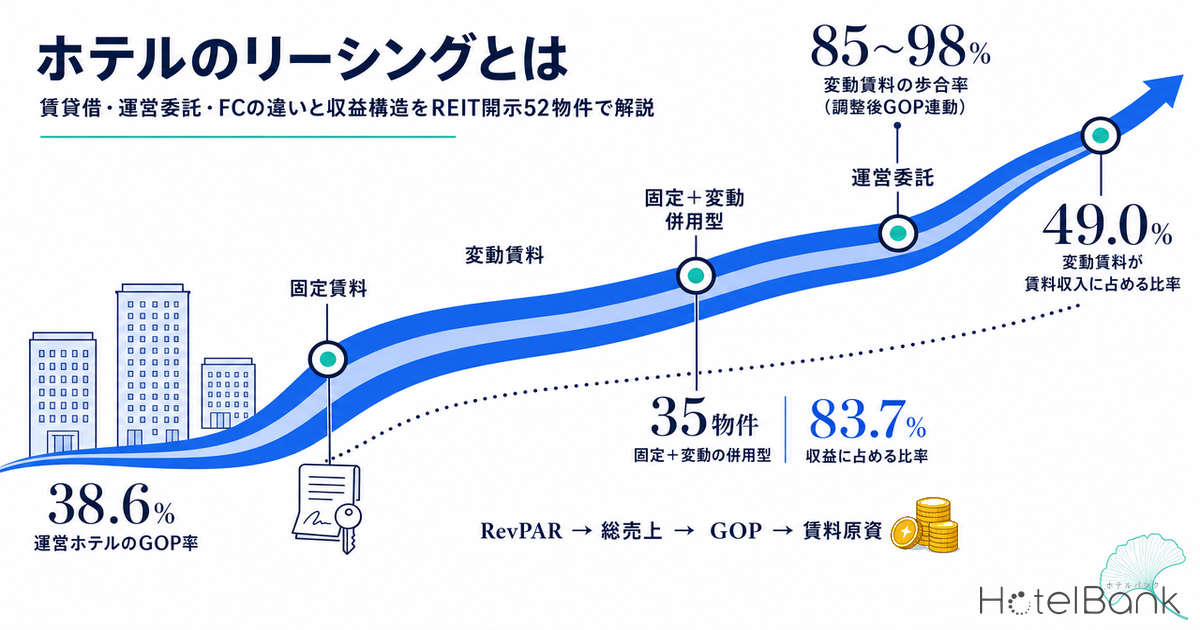
The result is clear. Of the 52 properties, 35 (67.3%) use the “Variable/Fixed” type combining fixed and variable rent. By real estate operating revenue, 83.7% comes from this type. Pure fixed-rent properties number 8 with a 3.8% revenue share; variable-rent-only properties number 5 with 6.9%; management contracts number 4 with 5.7%. So the standard form among Japan’s listed hotel REITs is not the textbook choice between fixed and variable rent. It is a hybrid that secures a fixed floor and captures the upside through a percentage rent.
This mix is not fixed; it has shifted quickly over the past few years. Comparing the investment corporation’s real estate operating revenue breakdown across three fiscal years, the share of fixed rent fell from 57.5% in the period ended December 2023 to 45.9% in the period ended December 2025, while the share of variable rent rose from 37.3% to 49.0%. In yen terms, variable rent grew 2.2 times, from ¥9,516 million to ¥20,632 million.
Source: Prepared by the HotelBank Editorial Team from the notes to the income statement in Japan Hotel REIT Investment Corporation, Financial Reports for the fiscal periods ended December 2025 and December 2024
Leased portfolios are moving toward variable rent together because, while lodging demand recovers, fixed rent leaves the upside on the table. The flip side is that the move also widens the room for the owner’s cash flow to swing when demand turns down. Choosing a rent structure is also a statement of one’s market outlook.
Only some of the seven listed hotel REITs disclose rent type property by property. Mori Trust REIT, for example, holds six hotels: three on variable rent and three on fixed rent, and it discloses monthly operating results only for the variable-rent properties. REITs also differ in the number of hotels they hold and in acquisition price per room; HotelBank has examined those differences in a separate re-tabulation of 285 properties by hotel type.
Inside Variable Rent: Thresholds Range from ¥128 Million to ¥4,120 Million a Year
Nearly every variable-rent term can be written as one formula: “(adjusted GOP − threshold) × percentage rate”. The design has two levers, the threshold (hurdle) and the percentage rate, and their combination sets the risk split. A higher threshold gives the lessee a thicker floor of retained profit; a higher percentage rate sends most of the amount above the hurdle to the owner.
Source: Prepared by the HotelBank Editorial Team from the rent structure of hotels with variable rent etc. and the assumptions for the FY Dec 2026 forecast in Japan Hotel REIT Investment Corporation, Financial Report for the fiscal period ended December 2025 (N=18). Properties whose rent is calculated on GOP or rooms revenue, and properties whose calculation method is not disclosed, were excluded to keep the basis consistent.
For the 18 leases based on adjusted GOP, percentage rates range from 85.0% to 98.0%, with a median of 95.0%. Thresholds range 32-fold, from ¥128 million to ¥4,120 million a year. The spread in thresholds is far wider than the 13-point spread in percentage rates. So the actual rent level depends mostly on where the threshold is set, not on the percentage rate, and in practice that is where negotiations focus.
| Property | Threshold (annual) | Percentage rate | Calculation basis |
|---|---|---|---|
| Hilton Tokyo Odaiba (ヒルトン東京お台場) | ¥1,660M | 98.0% | Adjusted GOP |
| Oriental Hotel Fukuoka Hakata Station (オリエンタルホテル福岡 博多ステーション) | ¥442M | 98.0% | Adjusted GOP |
| International Garden Hotel Narita (インターナショナルガーデンホテル成田) | ¥360M | 98.0% | Adjusted GOP |
| Hyatt Regency Tokyo (ハイアット リージェンシー 東京) (scheduled for acquisition in 2026) | ¥2,980M | 97.5% | Adjusted GOP |
| Holiday Inn Osaka Namba (ホリデイ・イン大阪難波) | ¥580M | 97.0% | Adjusted GOP |
| Hotel Oriental Express Fukuoka Tenjin (ホテル オリエンタル エクスプレス 福岡天神) | ¥165M | 97.0% | Adjusted GOP |
| Hilton Fukuoka Sea Hawk (ヒルトン福岡シーホーク) | ¥2,100M | 95.0% | Adjusted GOP |
| Oriental Hotel Okinawa Resort & Spa (オリエンタルホテル 沖縄リゾート&スパ) | ¥655M | 95.0% | Adjusted GOP |
| Hotel Nikko Nara (ホテル日航奈良) | ¥440M | 95.0% | Adjusted GOP |
| Oriental Hotel Universal City (オリエンタルホテル ユニバーサル・シティ) | ¥370M | 95.0% | Adjusted GOP |
| Hotel JAL City Kannai Yokohama (ホテルJALシティ関内 横浜) | ¥150M | 95.0% | Adjusted GOP |
| Oriental Hotel Kyoto Rokujo (オリエンタルホテル京都 六条) | ¥183M | 93.5% | Adjusted GOP |
| Hilton Narita (ヒルトン成田) | ¥450M | 93.0% | Adjusted GOP |
| Southern Beach Hotel & Resort Okinawa (サザンビーチホテル&リゾート沖縄) | ¥650M | 93.0% | Adjusted GOP |
| Hotel Oriental Express Fukuoka Nakasukawabata (ホテル オリエンタル エクスプレス 福岡中洲川端) | ¥189M | 92.0% | Adjusted GOP |
| Hotel Oriental Express Osaka Shinsaibashi (ホテル オリエンタル エクスプレス 大阪心斎橋) | ¥128M | 91.0% | Adjusted GOP |
| Sheraton Grand Hiroshima Hotel (シェラトングランドホテル広島) | ¥360M | 90.0% | Adjusted GOP |
| Five hotels combined (Kobe Meriken Park Oriental Hotel and others) | ¥4,120M | 85.0% | Combined adjusted GOP |
Source: Prepared by the HotelBank Editorial Team from Japan Hotel REIT Investment Corporation, Financial Report for the fiscal period ended December 2025 (N=18)
The last row stands out. Five hotels (Kobe Meriken Park Oriental Hotel, Oriental Hotel Tokyo Bay, Namba Oriental Hotel, Hotel Nikko Alivila and Oriental Hotel Hiroshima) do not have individual terms. Instead, a single ¥4,120 million threshold applies to the combined adjusted GOP of all five. A weak year at one hotel can be offset by strong results at the others, so the lessee’s cash flow swings less than if percentage rent were calculated hotel by hotel. It is a useful model for structuring leases when several hotels go to the same operator.
The calculation basis also matters. Adjusted GOP is GOP minus certain fees and similar items, so it is smaller than GOP itself. At the same percentage rate, rent differs depending on whether the base is GOP or adjusted GOP. Stating in the draft contract exactly what is deducted before the percentage applies helps prevent disputes later.
Case Study: An Operator Running 27 Hotels as Lessee
Here we check, using public documents, how a lease is actually structured. Hotel Management Japan Co., Ltd. (HMJ, 株式会社ホテルマネージメントジャパン) is a hotel operator that runs 27 hotels with 9,051 rooms in Japan under the Oriental Hotels & Resorts brand (figures published on its official website). We matched our own master data on listed-REIT ownership against HMJ’s list of operated hotels. Japan Hotel REIT Investment Corporation owns 24 of the 27 hotels, about 96% of HMJ’s rooms.
According to the investment corporation’s disclosure dated June 7, 2021, HMJ group companies were at the time the lessees of all 16 hotels the investment corporation owned, and HMJ was named as a specified related corporation. In other words, the relationship is a lease, not a management contract: HMJ is the business principal as lessee and employs the staff, and the investment corporation collects rent. The “five hotels combined, ¥4,120 million threshold, 85.0% percentage rate” terms from the previous section apply to five hotels leased to HMJ.
This structure shows that, in practice, hotel leasing is put together at the portfolio level, not as a set of one-off leases. By grouping several hotels under one lessee, the owner reduces management and negotiation costs, and the lessee can share staff across hotels and even out results. On the other hand, concentrating on one lessee means that one company’s credit decides the cash flow of the whole portfolio. Tenant diversification is standard in office leasing, but hotels often accept concentration in exchange for consistent operations.
The same investment corporation also has management contracts. It uses them for four properties (ibis Styles Kyoto Station, ibis Styles Sapporo, Mercure Sapporo and Mercure Okinawa Naha), and describes the model as follows: “For the hotel real estate it owns, it entrusts hotel operations to the operator and takes in the business results as real estate operating revenue.” Each hotel’s GOP is booked directly in operating revenue as management contract income. Leases and management contracts sit side by side in the same portfolio, which shows that the choice of model depends on each property’s circumstances.
| Metric | FY Dec 2025 actual | FY Dec 2026 forecast | Change |
|---|---|---|---|
| Occupancy | 83.6% | 84.8% | +1.3pt |
| ADR | ¥20,746 | ¥21,533 | +3.8% |
| RevPAR | ¥17,336 | ¥18,270 | +5.4% |
| Revenue | ¥81,890M | ¥85,375M | +4.3% |
| of which rooms | ¥55,549M | ¥58,542M | +5.4% |
| of which F&B | ¥23,220M | ¥23,620M | +1.7% |
| GOP | ¥31,583M | ¥33,516M | +6.1% |
| GOP margin (our calculation) | 38.6% | 39.3% | +0.7pt |
Table: Operating metrics of the 29 hotels with variable rent etc. Source: Prepared by the HotelBank Editorial Team from Japan Hotel REIT Investment Corporation, Financial Report for the fiscal period ended December 2025. GOP margin is our calculation as disclosed GOP ÷ revenue. The disclosure notes that the figures were provided by lessees and others and have not been audited.
This table gives a realistic benchmark for lease negotiations. Across a group of 29 hotels that includes full-service properties, GOP margin is 38–39% of revenue. That level caps the pool that can be paid out as rent. If a lease in a location or segment where GOP margins stay in the 20% range promises rent that assumes a 40% margin, the contract will need to be renegotiated within a few years.
Owner, Operator, Lender: Three Parties See the Same Contract Differently
The same contract means very different things depending on where you sit. Go into a negotiation with these views confused, and the agreement will not last.
| Perspective | Lease (fixed rent) | Lease (fixed + variable) | Management contract (MC) | Franchise (FC) |
|---|---|---|---|---|
| Owner | Predictable income. Insulated from how well the hotel is run. Cannot capture upside | Secures a floor while capturing upside. The mainstream among the 52 disclosed properties | Captures all upside in a demand recovery. Can bring in a brand | Gets a brand and reservation network at minimal cost. Can build its own operating skills |
| Operator | Keeps the rewards of its own effort. Greatest business freedom | Keeps profit up to the threshold, shares the excess with the owner | Grows operating scale without investing capital. Fees linked to revenue and GOP | Gains a brand name and booking flow as a franchisee. Keeps operating discretion |
| Lender | Repayment source is identifiable as contracted rent; easier credit decision | Fixed portion supports DSCR. Variable portion is viewed conservatively | Repayment source is the hotel’s operating result itself. Operator’s track record is underwritten | Operating result is the repayment source. Downside from brand termination is priced in |
Source: Prepared by the HotelBank Editorial Team with reference to the rent-type categories in Japan Hotel REIT Investment Corporation disclosures
The lender’s view often ends up as the constraint that outlasts the owner–operator discussion. Whether the repayment source is “fixed rent specified in a contract” or “the hotel’s operating result” changes how deep the credit review goes and what collateral and covenants are required. One reason the fixed + variable hybrid is popular in practice is that the fixed portion can be shown to lenders as a floor for debt service. HotelBank has also quantified separately how much loan tenor itself moves achievable acquisition prices. The choice between a lease and a management contract is also tied to the design of the acquisition vehicle (direct ownership, trust beneficiary interest or SPC), and transfer taxes differ considerably by vehicle.
Leasing in Practice: Use Restrictions, and Working Backward to the Rent Level
The key difference from office or retail leasing is that, for a hotel, you cannot simply lease the space once you have found a tenant. A lodging business needs a license under the Hotel Business Act. Before that, the building must sit in a zoning district where hotels and ryokan are allowed, and it must meet Fire Service Act and Building Standards Act requirements. When an existing office or retail building is being leased for hotel conversion, the owner needs a view on whether a change of use is possible, and on the scope of works, before a lessee is chosen. Otherwise negotiations go nowhere. Seen the other way, a property where these questions are already settled has a competitive edge in itself.
The approach to rent is also the reverse of ordinary real estate, where you start from rent per tsubo (floor area). Hotel rent can only be paid out of the GOP the hotel earns. So the standard practice is to work backward in this order: RevPAR → total revenue → GOP → funds available for rent.
Take the FY Dec 2025 actuals of the 29 hotels with variable rent etc. covered earlier (RevPAR ¥17,336, rooms at 67.8% of revenue, GOP margin 38.6%) and convert them to a per-room basis. Annual rooms revenue comes to ¥6.33 million, total revenue including F&B and other departments to ¥9.33 million, and GOP to ¥3.60 million. That ¥3.60 million is the entire pool that could be paid out as rent. Meanwhile, the real estate operating revenue the investment corporation actually received was ¥3.07 million per room per year (our tabulation for 50 properties and 13,910 rooms with matched room counts). The two figures cover different property sets and periods, so they cannot be divided directly. Still, the order of magnitude shows that the structure sends most of GOP to the owner.
For a sense of individual property levels, the terms for Hyatt Regency Tokyo (ハイアット リージェンシー 東京), scheduled for acquisition in 2026, are a useful reference. Its annual fixed rent is ¥3,600 million. Divided by its 746 rooms (figure from Hyatt Japan’s April 2026 press materials), that is ¥4.83 million per room per year. On top of that comes 97.5% of adjusted GOP above the ¥2,980 million threshold. As a benchmark for fixed rent at a large full-service hotel in central Tokyo, ¥4.83 million per room is a figure worth remembering.
RevPAR, the starting point of this calculation, varies widely by location. Looking at our estimated settled ADR by prefecture, the median over the latest 12 months (July 2025 – June 2026) was highest in Kyoto at ¥15,652 and lowest in Aichi at ¥8,896, a 1.76-fold gap. For two 100-room buildings with the same occupancy, rooms revenue differs by that same ratio. This is why hotel rent is discussed as “per room per year” or “a percentage of GOP” rather than “per tsubo”.
Source: Prepared by MetroEngines Research and the HotelBank Editorial Team. Properties covered per month (median): Tokyo 1,122, Hokkaido 921, Osaka 644, Kyoto 588, Kanagawa 572, Aichi 506, Okinawa 492, Fukuoka 464. Estimated settled ADR is on a tax-excluded basis.
Put together, the negotiating sequence for a hotel lease runs as follows. First, confirm the permitted use and whether licenses can be obtained. Second, estimate the RevPAR and GOP margin achievable at the location from actual results nearby. Third, decide how much of the resulting GOP to lock in as fixed rent and where percentage rent begins. Fourth, confirm how much of that the lender will accept as a repayment source. Skip this sequence and set terms first (“in line with nearby office rents”), and the contract will not survive the first time occupancy falls short of plan.
Summary: The Real Choice Is How to Split the Upside and Downside, Not the Model
The hybrid is the standard form
Of 52 disclosed properties, 35 (67.3%), and 83.7% by real estate operating revenue, use fixed + variable hybrid rent. Thinking in terms of a fixed-or-variable choice is already outdated.
The threshold matters more than the rate
Percentage rates for the 18 adjusted-GOP leases fall between 85.0% and 98.0% (median 95.0%), while thresholds range 32-fold from ¥128 million to ¥4,120 million a year. Negotiations center on the threshold.
Rent can only come from GOP
Work backward: RevPAR → total revenue → GOP → funds for rent. GOP margin for the 29 mainly full-service hotels is 38–39%. No lease can promise rent above that ceiling.
Hotel leasing carries both the ordinary property meaning of bringing tenants into space inside the building and the business-structure meaning of handing the operation itself to a lessee. When choosing the latter, what the owner is really deciding is not the name of the model, lease or management contract. It is how the upside and downside of the GOP the hotel earns are split among the owner, the operator and the lender. The lease terms disclosed by listed REITs are one of the few public sources that show what that split looks like in actual numbers.
References and Sources
■ Listed REIT disclosures
- Japan Hotel REIT Investment Corporation, Financial Report (REIT) for the Fiscal Period Ended December 2025 (February 25, 2026) (Japanese): schedule of portfolio assets by rent type, rent structure of hotels with variable rent etc., assumptions for the FY Dec 2026 forecast
- Japan Hotel REIT Investment Corporation, Financial Report (REIT) for the Fiscal Period Ended December 2024 (February 25, 2025) (Japanese): breakdown of real estate operating revenue for FY Dec 2023 and FY Dec 2024
- Japan Hotel REIT Investment Corporation, Notice Concerning Changes in Major Shareholders, Parent Company and Specified Related Corporations of the Asset Management Company (June 7, 2021) (Japanese): states that the HMJ group was the lessee of all 16 hotels owned
- Japan Hotel REIT Investment Corporation, Investor Relations
- Mori Trust REIT, Inc.: mix of variable-rent and fixed-rent properties and scope of monthly disclosure
■ Operator and brand publications
- Hotel Management Japan Co., Ltd., Company Information (Oriental Hotels & Resorts)
- Hyatt Japan (日本ハイアット株式会社), press materials, April 2026: Hyatt Regency Tokyo has 746 rooms and opened in September 1980
- Hilton, Company Overview (updated August 25, 2026): Hilton Tokyo Odaiba 453 rooms, Hilton Narita 548 rooms, Hilton Fukuoka Sea Hawk 1,052 rooms; 37 hotels under 9 brands in Japan
■ Market data
- MetroEngines Research: estimated settled ADR by prefecture (July 2025 – June 2026); listed-REIT ownership master data (as of September 14, 2026)
Source: Hyatt Japan, press materials, April 2026
Source: Hilton, Company Overview (updated August 25, 2026)