

When a resort property comes up for acquisition, you sometimes hear that “no large lodging can be built in this town anymore.” These are towns where the municipality layers its own procedures and standards on top of Japan’s Building Standards Act and City Planning Act. This article takes up two of them — the Nature Conservation Guidelines of Karuizawa Town (Nagano) and the Ordinance for Comfortable Town Development of Yufu City (Oita) — and lines up two sets of numbers. The first is how supply has stalled (openings, net room additions, and the size of each new property). The second is the price level and occupancy of the existing stock in those markets, measured against the prefecture average and the neighbouring city.
How this differs from our earlier coverage
We have already covered how national city-planning rules push up land cost per room (scenic district hotel sites, where a 20% building coverage cap multiplies land cost per room fivefold; Kyoto hotel sites, where the 20m height limit adds 25% to land cost per room), how long the procedures take (the notice-board and explanation duties of mid- and high-rise ordinances before a building confirmation application), and the instruments that loosen regulation (the Building Standards Act exemption ordinances now adopted by 31 municipalities). What this article addresses is the guidelines and ordinances municipalities layer on by their own initiative. What we calculate here is not land cost per room. It is how fast new rooms are being added, and the price level of the stock that already exists.
Metric Definitions Used in This Article
- ADR (average daily rate): an estimated settled rate (tax-excluded equivalent) derived by applying a property-type correction factor to the lowest published plan level each property lists on OTAs (double occupancy, per-room rate, tax included). Cross-checked against property-level disclosures by listed hotel REITs (91 properties, most recent 3 months), the median error is approximately 7%. These are estimates and differ from each property’s actual transacted rates and accounting figures. Area-level ADR is the median of the properties covered (the level of a typical property in that area).
- OCC (occupancy): the share of rooms sold against the total room count in the area (an estimate based on OTA sales inventory; consistency checks against monthly REIT disclosures confirm accuracy within roughly a few percentage points). It is an estimate based on how listed OTA inventory is taken up, and differs from each property’s full operational occupancy.
- Reference RevPAR: a reference figure obtained as estimated ADR × estimated OCC above.
- Opening year: the opening date of each property within the scope MetroEngines Research tracks (based on confirmed OTA listings).
- Data source: MetroEngines Research & Consulting
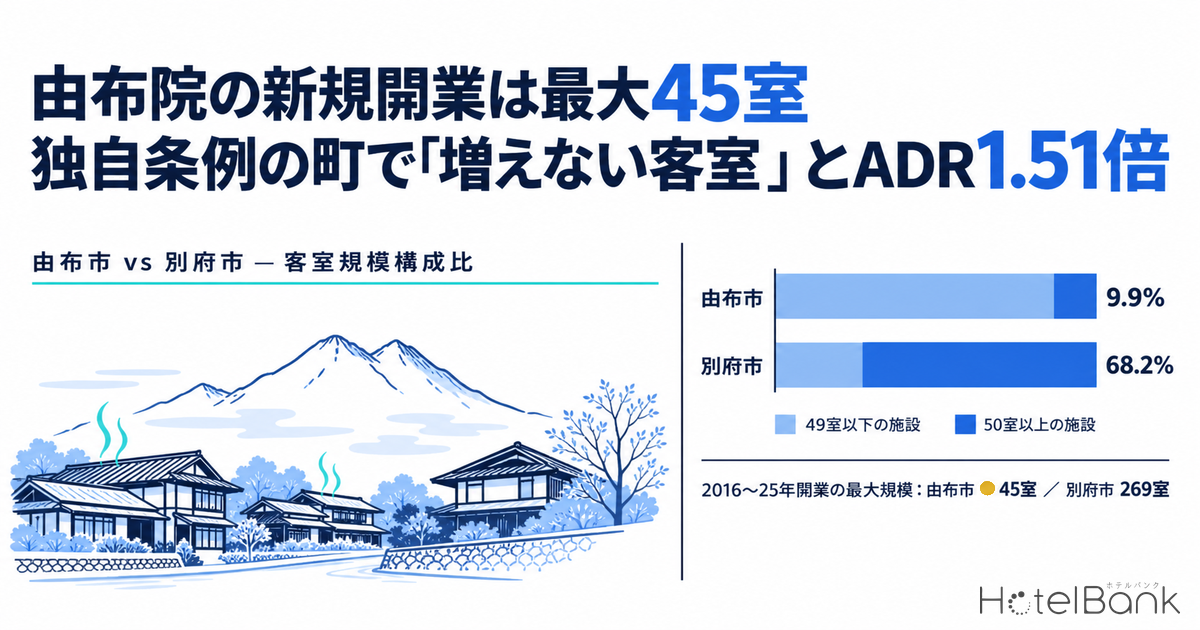
- — 45 rooms at most: the largest property opened in Yufu City between 2016 and 2025. In neighbouring Beppu City the figure is 269 rooms, and the share of existing rooms sitting in properties of 50+ rooms differs just as sharply — 9.9% against 68.2%.
- — 8.0 rooms per property: rooms per new property in Karuizawa Town over 2021–25, down from 20.9 rooms in 2016–20. New rooms fell 64%, from 1,294 to 466.
- — The slowdown in net additions is not confined to regulated towns: over the same period new rooms also fell in Hakone (-46%), Hakuba (-49%) and Yugawara (-66%). What distinguishes towns with their own rules shows up in scale rather than in volume.
- — ADR 1.51x and 1.94x: on the estimated ADR average for September 2025 – August 2026, Yufu City sits above Beppu City and Karuizawa Town above the Nagano Prefecture level. Estimated OCC for August 2026 was 94.3% in Karuizawa Town, 1.8pt above Nagano Prefecture.
- — The valuation question is reproducibility: Karuizawa Town’s storey cap and on-site staffing duty take effect on 1 October 2026. Whether an existing property’s scale could be rebuilt becomes the due-diligence issue at acquisition.
The two local rule sets in scope
Separately from national legislation, Karuizawa Town and Yufu City each maintain their own procedures and standards. Karuizawa Town’s Nature Conservation Guidelines (自然保護対策要綱) were enacted in 1972. The town sets building standards by zone classification and runs the procedure through consultation under the Ordinance on Procedures for Land-Use Activities for Nature Conservation in Karuizawa Town. The amendment promulgated on 28 August 2025 runs to 18 items. Building height is capped at three storeys in commercial zones and two storeys in resort and similar zones, and the operator or an employee is required to be on site at the property while guests are staying. Both of these take effect on 1 October 2026. The site area per unit for multi-unit housing and similar buildings is to be raised from 600 m² to 1,000 m² in resort zones (10 units or more), with the effective date to be set separately by the mayor.
Yufu City’s Ordinance for Comfortable Town Development (潤いのある町づくり条例, Ordinance No. 19 of 1990) is a rule carried over from the era of the former town of Yufuin. For developments of 1,000 m² or more, the procedure runs in sequence through a preliminary consultation document, a development application and a notice of consent. The range of neighbouring parties whose understanding must be obtained in advance widens with the development area: within 4m of the site boundary for 1,000–3,000 m², and within 16m once the area exceeds 5,000 m². The development standards are set numerically as well — in low-rise residential districts inside city planning areas, for instance, height must be 10m or less, open-space ratio 60% or more, and wall setback 1.5m or more. Manazuru Town in Kanagawa and its Town Development Ordinance (the “Design Code of Beauty”) belongs to the same lineage, but the operating stock we track there amounts to only 18 properties and 138 rooms. That is too small for a statistical comparison, so we excluded it from the quantitative analysis.
| Municipality | Rule | Enacted | Main provisions affecting lodging and development |
|---|---|---|---|
| Karuizawa Town, Nagano | Nature Conservation Guidelines / Ordinance on Procedures for Land-Use Activities | 1972 (guidelines) | Building standards and consultation by zone classification. The August 2025 amendment adds a storey cap (three storeys in commercial zones, two in resort and similar zones) and an on-site staffing duty for lodging facilities (effective 1 October 2026) |
| Yufu City, Oita | Ordinance for Comfortable Town Development | 1990 (Ordinance No. 19 of 1990) | Preliminary consultation, development application, notice of consent and neighbour consultation for developments of 1,000 m² or more. District-level standards for height, open-space ratio and wall setback |
| Manazuru Town, Kanagawa | Town Development Ordinance (Design Code of Beauty) | Early 1990s | Guides landscape and architecture through 8 principles and 69 keywords (qualitative reference only in this article) |
Source: Karuizawa Town official website, Karuizawa Shimbun (August 2025), Yufu City regulations database “Enforcement Rules of the Ordinance for Comfortable Town Development”, and the National Association of Towns and Villages; compiled by MetroEngines Research & Consulting
How supply stalled, part 1: the slowdown in net room additions is not unique to Karuizawa
The first thing to check is whether rooms really have stopped increasing in towns with their own rules. We counted the properties MetroEngines Research tracks by opening year and compared two five-year blocks, 2016–2020 and 2021–2025. In Karuizawa Town the number of openings was roughly flat, from 62 to 58. The rooms added, however, fell 64%, from 1,294 to 466.
Yet over the same period new rooms also dropped sharply in Hakone (1,304 → 707), Hakuba (819 → 419) and Yugawara (366 → 123). Each of these towns has its own regulatory circumstances, but at minimum they differ from the two rule sets covered here. Common factors such as construction cost inflation and site constraints are plausible as well. In other words, a slowdown in net room additions alone does not establish an effect of local rules. What distinguishes towns with their own rules shows up clearly in the next measure — scale. Note also that the swings are large even at five-year granularity: Yugawara’s 2016–20 block includes a single large property of 187 rooms that opened in 2017.
Source: MetroEngines Research & Consulting (based on confirmed OTA listings, properties with an identifiable opening year. Karuizawa Town N=117, Yufu City N=183, Beppu City N=117, Hakone N=226, Hakuba N=316, Atami N=121, Ito N=246, Yugawara N=59)
| Municipality | Openings 2016–20 | New rooms 2016–20 | Openings 2021–25 | New rooms 2021–25 | Change in new rooms | Rooms per property 2021–25 |
|---|---|---|---|---|---|---|
| Karuizawa Town | 62 | 1,294 rooms | 58 | 466 rooms | -64% | 8.0 |
| Yufu City | 77 | 342 rooms | 75 | 286 rooms | -16% | 3.8 |
| Beppu City | 53 | 1,045 rooms | 60 | 1,394 rooms | +33% | 23.2 |
| Hakone Town | 72 | 1,304 rooms | 92 | 707 rooms | -46% | 7.7 |
| Hakuba Village | 141 | 819 rooms | 118 | 419 rooms | -49% | 3.6 |
| Atami City | 43 | 473 rooms | 103 | 755 rooms | +60% | 7.3 |
| Ito City | 72 | 593 rooms | 163 | 656 rooms | +11% | 4.0 |
| Yugawara Town | 16 | 366 rooms | 20 | 123 rooms | -66% | 6.2 |
Source: MetroEngines Research & Consulting (based on confirmed OTA listings). Note: some properties appear on OTAs only some time after opening, so counts for the most recent years may rise as further listings appear
How supply stalled, part 2: a ceiling on scale in Yufu City, a shift to small formats in Karuizawa
The influence of local rules is easier to see in the size of individual properties than in the number of openings. Of the 184 operating properties and 1,910 rooms in Yufu City, 124 properties have 10 rooms or fewer — two-thirds of the total. Not a single property has 100 rooms or more, and the rooms held by properties of 50+ rooms come to just 190, or 9.9% of the total. Among properties that opened between 2016 and 2025, only two had 30 rooms or more, and the largest had 45.
Neighbouring Beppu City has 118 operating properties and 5,030 rooms, with properties of 50+ rooms accounting for 68.2% of the rooms. Over the same ten years, 18 properties of 30+ rooms opened there, totalling 1,758 rooms, the largest with 269. The two cities adjoin one another and are both onsen destinations in Oita Prefecture. Even so, the shape of the room stock differs this much. Rather than halting the total volume of rooms, Yufu City’s ordinance appears to place a ceiling on the size of any single property.
In Karuizawa Town, 54.3% of the existing stock sits in properties of 50+ rooms, and large properties already exist (six with 100 rooms or more). What has changed is the size of newly opening properties: rooms per new property shrank from 20.9 in 2016–20 to 8.0 in 2021–25. With a storey cap added from October 2026, reproducing the scale of today’s mid- and large-sized properties in a new build looks set to become harder still.
Source: MetroEngines Research & Consulting (room mix of operating properties by property size band. Yufu City 184 properties, Beppu City 118, Karuizawa Town 120, Hakone 235, Atami 135, Ito 298, Hakuba 319, Yugawara 61)
Price level of the existing stock: Yufu City at 1.51x Beppu, Karuizawa at 1.94x Nagano
How do “rooms that do not increase” show up in the price of the stock that exists today? Averaged over the twelve months from September 2025 to August 2026, ADR was about ¥23,700 in Yufu City and about ¥15,700 in Beppu City — Yufu at 1.51x. Karuizawa Town came in at about ¥23,500, or 1.94x the roughly ¥12,100 for Nagano Prefecture as a whole. What about estimated occupancy over the last two months? Yufu City recorded 76.1% in July and 78.7% in August, against 73.6% and 79.5% in Beppu City — no large gap. Karuizawa Town posted 90.1% in July and 94.3% in August, 3.2pt and 1.8pt above Nagano Prefecture’s 86.9% and 92.5%.
What this supports is that in these two markets with their own rules, a higher rate than the neighbouring benchmark holds without giving up occupancy. It is not, however, an isolation of the regulation’s effect. Yufu City has a preponderance of small ryokan and Karuizawa Town a deep high-end resort segment, and those differences in property type and brand strength feed straight through into price. To use this in an acquisition decision, the comparison has to be made within the same property type and the same size band. It is also worth noting that the August year-on-year changes do not point the same way: +3.1% in Karuizawa Town, -0.3% in Nagano Prefecture, -6.5% in Yufu City and +5.2% in Beppu City.
Source: MetroEngines Research & Consulting (simple average of monthly estimated ADR from September 2025 to August 2026. Property counts by month: Karuizawa Town 49–53, Nagano Prefecture 773–845, Yufu City 131–142, Beppu City 113–126)
| Area | ADR 12-month average | ADR August 2026 | YoY | OCC July (est.) | OCC August (est.) | Reference RevPAR August |
|---|---|---|---|---|---|---|
| Karuizawa Town | ¥23,472 | ¥38,124 | +3.1% | 90.1% | 94.3% | ¥35,951 |
| Nagano Prefecture | ¥12,078 | ¥13,678 | -0.3% | 86.9% | 92.5% | ¥12,652 |
| Yufu City | ¥23,692 | ¥22,386 | -6.5% | 76.1% | 78.7% | ¥17,618 |
| Beppu City | ¥15,660 | ¥16,998 | +5.2% | 73.6% | 79.5% | ¥13,513 |
Source: MetroEngines Research & Consulting. Estimated OCC coverage: Karuizawa Town 59 properties / 2,483 rooms in July and 61 / 2,530 in August; Nagano Prefecture 495 / 18,485 in July and 557 / 19,508 in August; Yufu City 102 / 1,187 in July and 136 / 1,556 in August; Beppu City 115 / 3,547 in July and 128 / 3,785 in August (based on listings on major booking sites)
Location and land prices: Yufuin and Beppu stations lie about 10km apart in a straight line
The map below plots operating properties in Yufu City (blue) and Beppu City (navy) as circles scaled to room count. In Beppu City the large circles cluster in the seafront urban area. In the Yufuin basin, by contrast, small circles are scattered across the plain — the difference in the shape of supply between the two cities is visible directly. Looking at the 2026 official land price survey at points near the stations, commercial land around Yufuin Station stood at ¥141,000 per m² (+5.2% year on year) and ¥221,000 (+4.7%), while both residential points were flat. Around Beppu Station, commercial points varied widely, from +1.7% to +18.8%. Around Karuizawa Station, all three points rose by double digits: residential +14.6% and +12.7%, commercial +11.7%. In a town with a ceiling on new supply, land can appreciate without the number of buildable rooms rising with it. That puts the weight of valuation on whether an already-operating property can keep being used without being rebuilt.
Circle size = room count ● Yufu City (N=184) ● Beppu City (N=118)
Source: MetroEngines Research & Consulting
| Land price survey point near station (2026) | Use | Price (JPY/m²) | YoY |
|---|---|---|---|
| Karuizawa-1 | Residential | 118,000 | +14.6% |
| Karuizawa-4 | Residential | 42,500 | +12.7% |
| Karuizawa 5-2 | Commercial | 89,800 | +11.7% |
| Yufu-3 | Residential | 33,100 | 0.0% |
| Yufu-4 | Residential | 37,400 | 0.0% |
| Yufu 5-2 | Commercial | 141,000 | +5.2% |
| Yufu 5-3 | Commercial | 221,000 | +4.7% |
| Beppu 5-1 | Commercial | 171,000 | +18.8% |
| Beppu 5-3 | Commercial | 102,000 | +10.7% |
| Beppu 5-15 | Commercial | 54,900 | +1.7% |
Source: Ministry of Land, Infrastructure, Transport and Tourism, Real Estate Information Library (official land price survey); compiled by MetroEngines Research & Consulting. Points were extracted from the map tiles containing each station (not the full set of points)
Reading it from the buyer’s side: three angles for pricing “cannot be built”
First, what is hard to substitute is scale. Yufu City has only three properties in the 50–99 room band and none at 100 rooms or above. A property able to absorb demand that requires a certain room count — groups, MICE, larger leisure bookings — has few substitutes in that market. Alongside a conventional comparison of rate per room, there is room in valuation to weigh whether a property of the same size could be built again.
Second, whether that value can be preserved is decided by the terms of a rebuild. Karuizawa Town adds a storey cap from October 2026. An existing building that does not meet the current standards may be unable to keep its present scale if rebuilt. In due diligence, the realistic approach is to confirm — against the town’s actual consultation practice — whether the current storey count, floor area and room count could be reproduced under today’s standards, and to value a “hold and refurbish” scenario separately from a rebuild scenario. Because the on-site staffing duty takes effect at the same time, small properties premised on unstaffed operation will need to build the cost of that staffing into the business plan.
Third, break the rate premium down by driver. The 1.51x in Yufu City and 1.94x in Karuizawa Town embed property-type mix and brand strength. To see how much of it is scarcity created by the local rules, the check has to be multi-sided: compare within the same category and size band, and compare against other destinations where net room additions have also slowed, such as Hakone and Hakuba. Listed hotel REITs, for their part, hold three properties in Karuizawa Town and two in Beppu City (MetroEngines Research & Consulting, as of 7 September 2026), so these markets do come into scope for listed REIT acquisitions.
Conclusion
Municipal guidelines and ordinances did not uniformly stop the total number of rooms. In Yufu City they work by placing a ceiling on the size of a single property; in Karuizawa Town, by making newly opening properties smaller — and from October 2026 a storey cap is added on top. In those markets, existing properties run 1.5x to 1.9x above the neighbouring benchmark on ADR while holding occupancy at the same level or better. That gap, however, is an observed figure that includes differences in property-type mix, not a number that isolates the effect of regulation. What matters for a buyer is not the reputation that “you cannot build here.” It is confirming one thing — whether that property’s scale could be reproduced under today’s rules — and translating the answer into a value differential in the underwriting.
Methodology and caveats: ADR figures are estimates for months closed through August 2026, aggregated as at the time of research (September 2026). Opening years are based on confirmed OTA listings, limited to the scope MetroEngines Research tracks, and are not a complete census. Room counts are the room counts MetroEngines Research holds for each property. Regulatory content is based on each municipality’s published materials and does not determine whether any individual development or rebuild is permissible; actual consideration requires prior consultation with the municipality.
References and Sources
■ Data sources
Estimated ADR (closed months, September 2025 – August 2026), estimated OCC (July and August 2026, based on OTA sales inventory) and the room counts and opening years of operating properties (based on confirmed OTA listings) come from MetroEngines Research & Consulting. Regulatory content is drawn from the published materials and regulations databases of Karuizawa Town and Yufu City; land prices are from the Ministry of Land, Infrastructure, Transport and Tourism’s official land price survey (2026).
■ Calculation assumptions
Supply is compared as five-year totals for 2016–2020 and 2021–2025 across properties with an identifiable opening year, and the size mix splits the rooms of operating properties into 49 rooms or fewer and 50 rooms or more. The ADR multiples are ratios of 12-month averages (Yufu City ÷ Beppu City, Karuizawa Town ÷ Nagano Prefecture), and reference RevPAR is estimated ADR × estimated OCC for August 2026.
■ Limitations
The gaps shown are observed values that include differences in property-type mix, brand and location, and do not isolate the effect of regulation alone. Because some properties appear on OTAs only after opening, opening counts for the most recent years may still rise. Manazuru Town was excluded from the quantitative comparison because its property count is too small. Whether an individual property may be rebuilt must be confirmed through prior consultation with the municipality.
■ Market data
- MetroEngines Research & Consulting — estimated ADR, estimated OCC, property and room counts, opening years (based on confirmed OTA listings)
■ Municipal and public materials
- Karuizawa Town, “Overview of the Karuizawa Town Nature Conservation Guidelines”
- Karuizawa Town, “Ordinance on Procedures for Land-Use Activities for Nature Conservation in Karuizawa Town”
- Karuizawa Town, “On the Amendment of the Nature Conservation Guidelines” (reference material)
- Yufu City regulations database, “Enforcement Rules of the Ordinance for Comfortable Town Development”
- Yufu City, “Ordinances on Development”
- MLIT Policy Research Institute, “Research Study on Sustainable Tourism Policy (Interim Report)” (2019)
- MLIT Real Estate Information Library (official land price survey, 2026)
- National Association of Towns and Villages, “Manazuru Town and the Design Code of Beauty”
■ News