

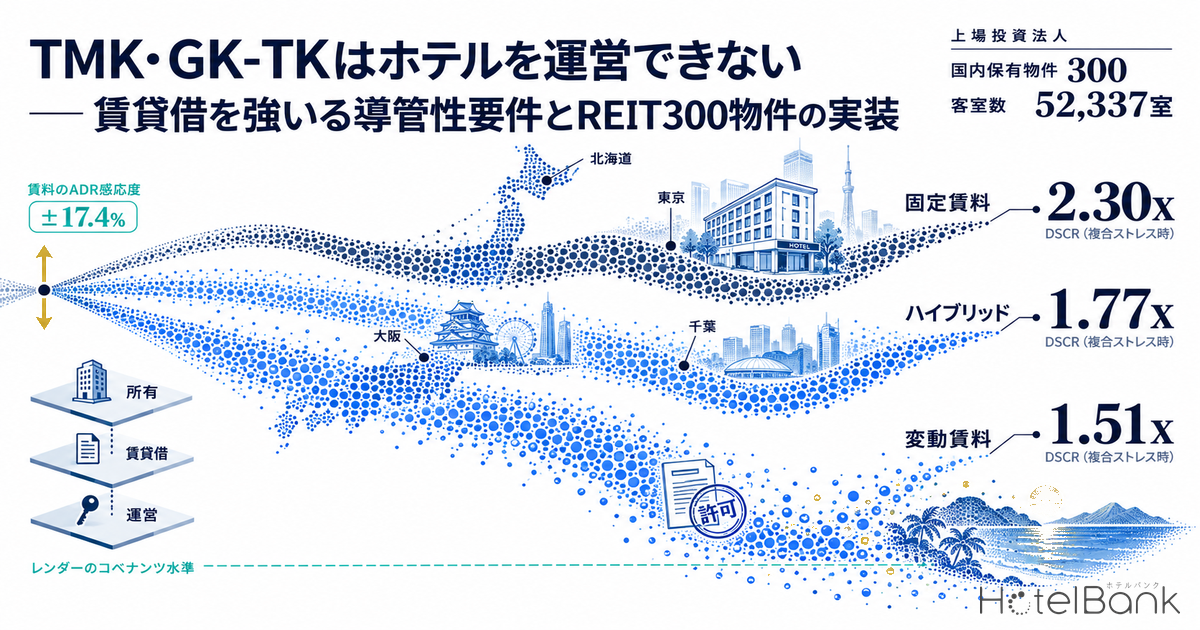
When structuring a hotel acquisition, the choice of vehicle is usually discussed as a question of tax and transfer costs. But where that choice bites most directly is in what comes next: rent design. A Tokutei Mokuteki Kaisha (TMK, specified purpose company), a Godo Kaisha paired with a Tokumei Kumiai (GK-TK, a limited liability company plus silent partnership), and a listed investment corporation (J-REIT) are none of them designed, under their governing laws, to run a lodging business themselves. The hotel is therefore handed to an operator through either a lease or a management contract, and because the vehicle cannot be the operating entity of a lodging business, in practice it gravitates toward the lease. This article traces that upstream institutional driver—why hotels are effectively forced into leases—back to the statutes, confirms how it is implemented across the 300 properties held by the seven listed hotel investment corporations, and then runs a 100-room model to test the sensitivity of the three rent types.
How This Article Differs from Our Earlier Coverage
HotelBank has previously covered how assets are held and the transfer taxes involved (the three vehicles: direct ownership, trust beneficiary interests, and SPCs), the legal resilience of rent after signing (rent reduction claims under Article 32 of the Act on Land and Building Leases), the resulting distribution of contracts (rent contract types at hotel REITs), and fractional products (single-asset funds under the Real Estate Specified Joint Enterprise Act). This article addresses the layer upstream of all of these: the institutional requirement that the vehicle itself cannot run a lodging business. Rent levels and contract resilience are dealt with only in the last two sections, as conclusions.
Metric Definitions Used in This Article
- ADR (average daily rate / estimated settled ADR): An estimated settled rate (tax-excluded equivalent), calculated by applying a segment-specific adjustment factor to the lowest published plan rate each property lists on OTAs and similar channels (per room, 2 guests per room, tax-included). Checked against property-level results disclosed by listed hotel REITs (91 properties, most recent 3 months), the median error is about 7%. These are estimates and differ from each property’s actual settled prices and accounting figures. Area-level ADR is the median of the properties covered (the level of a typical property in the area).
- OCC (occupancy rate): The share of rooms sold relative to total rooms in the area (an estimate based on OTA sales inventory). Because it reflects how OTA-listed inventory is absorbed, it differs from the actual occupancy of each property as a whole.
- GOP: Gross operating profit—total hotel revenue less each department’s direct costs and undistributed operating expenses (administrative, sales and marketing, utilities, and repairs and maintenance).
- NOI yield: Net income—the rent received by the vehicle less ownership-side costs such as fixed asset tax, city planning tax, insurance, and trust fees—divided by the acquisition price.
- Data sources: MetroEngines Research & Consulting; investor relations disclosures of each investment corporation
- — The reason vehicles cannot operate hotels rests on three statutory provisions: Article 63 of the Investment Trust Act (no employees), Article 195 of the Asset Liquidation Act (prohibition on other businesses), and Article 3 of the Hotel Business Act (the license is issued in the operator’s name). Together they make the lease the default structure for hotels.
- — The TMK pass-through requirements call for distributing more than 90% of distributable profit. A vehicle that can hardly retain earnings prefers rent that does not swing from one fiscal period to the next.
- — The seven listed investment corporations hold 300 domestic properties, 52,337 rooms, with a total acquisition price of ¥1,804.2 billion (as of September 7, 2026). The scope of their monthly operating disclosures tracks their rent types.
- — In a 100-room model, a ±10% change in ADR moves GOP and variable rent by ±17.4%. Hybrid rent moves ±11.6%; fixed rent stays at ±0%.
- — Under a combined stress of ADR -10% and occupancy -5pt, DSCR diverges to 1.51x for variable, 1.77x for hybrid, and 2.30x for fixed. In the two-axis sensitivity grid, 1 of 25 cells for variable rent falls below 1.30x.
Three Statutory Provisions Explain Why Vehicles Cannot Operate Hotels
Start with the statutes. A hotel’s “ownership,” “management,” and “operation” are separate layers, and a securitization vehicle occupies only the ownership layer. This separation is not a matter of market custom; it follows from the fact that the laws governing each vehicle prohibit it from engaging in other businesses.
For listed investment corporations, Article 63 of the Act on Investment Trusts and Investment Corporations (the Investment Trust Act) provides that an investment corporation may not conduct any business other than asset management, may not establish business offices other than its head office, and may not employ workers. An investment corporation cannot itself hire the general manager who runs the property, the front desk staff, or the housekeepers. In other words, the investment corporation is designed from the outset as a “company without employees,” and it is given no room to bring labor-intensive hotel operations in-house.
For TMKs, Article 195 of the Act on the Securitization of Assets (the Asset Liquidation Act) prohibits other businesses: a TMK may not engage in any business other than the asset securitization business conducted in accordance with its asset securitization plan and business incidental to it. The asset securitization plan is filed in advance, and the TMK is not expected to operate beyond the scope written into it. Running a lodging business does not fit within the “business relating to asset securitization.”
Finally, Article 3 of the Hotel Business Act requires anyone who intends to operate a hotel business to obtain a license from the prefectural governor (or, in cities with public health centers and in Tokyo’s special wards, from the mayor or ward head). The license is issued per facility, in the name of the party that actually operates it. Since the vehicle cannot be the operating entity, the license is held on the operator’s side. Putting this all on one page gives the following.
| Dimension | TMK (specified purpose company) | GK-TK (LLC + silent partnership) | Investment corporation (J-REIT) |
|---|---|---|---|
| Governing law | Act on the Securitization of Assets | Companies Act + Commercial Code (silent partnership) | Act on Investment Trusts and Investment Corporations |
| Other businesses | Prohibited (Art. 195) | In practice, purpose restricted by articles of incorporation and TK agreement | No business other than asset management (Art. 63) |
| Employees | None in practice (employee-less SPC) | None in practice (employee-less SPC) | May not employ (Art. 63) |
| Typical holdings | Can hold real property directly | Generally trust beneficiary interests | Either real property or trust beneficiary interests |
| Pass-through mechanism | Dividends deductible (Act on Special Measures Concerning Taxation, Art. 67-14) | Silent partnership distributions deductible | Dividends deductible (Act on Special Measures Concerning Taxation, Art. 67-15) |
| Hotel business license | None of the vehicles obtains it — it is held on the operator’s side | ||
| Resulting contract structure | Lease (master lease) is the default. A management contract makes the owner the operating entity, which is hard to accommodate within these vehicles | ||
The last two rows of this table are the core of this article. Under a management contract (MC), the owner is the entity running the hotel business: it books revenue and costs itself and pays the operator a management fee. In other words, the owner becomes the licensed operator under the Hotel Business Act. A vehicle cannot take this on, so the remaining option is a lease. The vehicle leases the entire building to an operator, receives rent in return, and the profit and loss of the lodging business sits on the operator’s books. For owners that are able to choose a management contract, the evaluation of management fees should be done on the basis of NOI after fees, comparing proposals by the GOP margin at which each breaks even.
TMK Pass-Through Requirements: A 90%+ Payout Demands Stable Rent
For a vehicle to avoid corporate income tax, it must meet the pass-through requirements (deductibility of dividends paid). For a TMK, Article 67-14 of the Act on Special Measures Concerning Taxation sets the conditions for deducting profit distributions on preferred equity. They include: a statement that more than 50% of the offering and allotment of preferred equity and specified capital is made in Japan; an expectation that all specified bonds issued will be held by institutional investors or similar parties; a fiscal period not exceeding one year; and a distribution for the fiscal year that exceeds 90% of the distributable profit amount specified by Cabinet Order.
In practice, it is the last requirement—the 90%+ payout—that shapes rent design. Being unable to retain earnings means the vehicle has little room to absorb repairs or unexpected costs from retained profit. The vehicle therefore prefers a structure in which rental income does not swing sharply from one fiscal period to the next. And because it stacks debt in the form of specified bonds and specified borrowings, it needs a structure in which rent comes in ahead of principal and interest payments. Although the pass-through requirements are a tax matter, they feed directly into the design philosophy of how much rent stability to demand.
On transfer taxes, when a TMK acquires specified real property under its asset securitization plan, the registration and license tax on the ownership transfer is reduced to 1.3% under Article 83-2-2 of the Act on Special Measures Concerning Taxation, and for real estate acquisition tax, three-fifths of the property value is deducted from the tax base under Article 11, Paragraph 3 of the Supplementary Provisions of the Local Tax Act. The choice of vehicle can move acquisition costs by hundreds of millions of yen. Note that the tax discussion in this article is a general summary based on published materials; tax judgments on individual transactions, including confirmation that requirements are met, should rely on qualified professionals.
Why GK-TKs Use Trust Beneficiary Interests — The Specified Joint Enterprise Act and the FIEA
In a GK-TK, investors contribute capital through a silent partnership (tokumei kumiai) agreement with a godo kaisha (LLC) as the operator, and that LLC holds a trust beneficiary interest in a trust whose trust property is the real estate. Because profit distributions to silent partners are treated as deductible expenses, corporate taxation at the vehicle level is avoided. Why, then, does it go to the trouble of converting to a trust beneficiary interest rather than holding real property directly as a TMK can?
The answer lies in the Real Estate Specified Joint Enterprise Act. If an SPC accepts silent partnership investment backed by income from real property, it falls within the definition of a real estate specified joint enterprise and requires a license. If, instead, the property is converted into a trust beneficiary interest under a trust agreement with a trust bank, the act does not apply. Being subject to the act adds compliance obligations and reduces operational flexibility, so conversion to trust beneficiary interests has become standard practice. Special business provisions introduced by the 2013 amendment (the so-called SPC exception) now allow schemes to be formed by notification under certain conditions, but trust beneficiary interests remain the default structure.
In addition, silent partnership interests are deemed securities (Paragraph 2 securities) under the Financial Instruments and Exchange Act (FIEA). Soliciting their acquisition as a business raises the question of Type II Financial Instruments Business registration, and making investment decisions raises the question of Investment Management Business registration. The lighter the vehicle is built, the thicker the surrounding layer of licenses and delegation becomes—that is the hallmark of the GK-TK.
Moreover, converting to a trust beneficiary interest does not enable the vehicle to run a lodging business: a holder of a trust beneficiary interest cannot obtain a hotel business license. A GK-TK therefore also requires a master lease with the operator, with the trustee as lessor. Whatever form the vehicle takes, the conclusion that a lease must sit between it and the operator does not change.
Confirming the Implementation Across 300 Properties Held by 7 Listed Investment Corporations
To see how these institutional consequences appear in actual portfolios, we examined REIT ownership data based on each investment corporation’s IR disclosures. The seven listed investment corporations hold 302 properties; excluding 2 overseas assets, they hold 300 domestic properties with 52,337 rooms, a total acquisition price of ¥1,804.2 billion, and an average of ¥34.47 million per room (REIT ownership master, snapshot as of September 7, 2026).
| Investment corporation | Domestic properties | Rooms | Total acquisition price | Per room |
|---|---|---|---|---|
| Invincible Investment Corporation (インヴィンシブル投資法人) | 110 | 19,260 | ¥603,134mn | ¥31.32mn |
| Japan Hotel REIT Investment Corporation (ジャパン・ホテル・リート投資法人) | 53 | 15,338 | ¥655,708mn | ¥42.75mn |
| Hoshino Resorts REIT (星野リゾート・リート投資法人) | 71 | 8,667 | ¥233,906mn | ¥26.99mn |
| Ichigo Hotel REIT (いちごホテルリート投資法人) | 29 | 4,418 | ¥71,903mn | ¥16.28mn |
| Nippon Hotel & Residential Investment Corporation (日本ホテル&レジデンシャル投資法人) | 16 | 1,991 | ¥48,083mn | ¥24.15mn |
| Mori Trust REIT (森トラストリート投資法人) | 6 | 1,937 | ¥142,217mn | ¥73.42mn |
| Kasumigaseki Hotel REIT (霞ヶ関ホテルリート投資法人) | 15 | 726 | ¥49,210mn | ¥67.78mn |
| Total (domestic) | 300 | 52,337 | ¥1,804,161mn | ¥34.47mn |
The more than threefold spread in acquisition price per room reflects differences in hotel type and location. An investment corporation that accumulates many properties centered on limited-service hotels and one that holds a few high-priced properties in central Tokyo are both “hotel REITs,” yet the rent that flows to the vehicle differs in character. That difference in character leads directly to the choice of rent type examined in the next section.
Looking at location, the 229 properties whose location is disclosed at the prefecture level are spread across 39 prefectures, and 75.8% of their rooms are concentrated in the top 10 prefectures. Tokyo is the largest with 53 properties and 8,743 rooms, followed by Chiba (4,676 rooms), Osaka (3,929), and Hokkaido (3,787). Acquisition price per room is highest in Tokyo (¥57.85 million) and Okinawa (¥51.13 million) and lowest in Chiba (¥23.19 million) and Kanagawa (¥20.56 million). Hoshino Resorts REIT’s 71 properties are disclosed only by regional block, so they are excluded from the prefecture-level tally.
Rent Type Determines How Much of the Operation the Vehicle Sees
Once a lease is chosen, the design variable left is the rent type. There are three: fixed rent, variable rent, and a hybrid of the two, with variable rent typically calculated on GOP. What is easily overlooked is that rent type does more than set the range of income volatility; it also determines how far the vehicle tracks—and discloses—the hotel’s operating figures.
The trace shows up in the scope of monthly disclosures. Japan Hotel REIT’s monthly operating results for July 2026 cover the “29 hotels with variable rent, etc.,” reporting OCC of 83.1%, ADR of ¥21,806, and RevPAR of ¥18,119, with year-over-year changes of OCC +4.0pt, ADR +0.1%, and RevPAR +5.1%. Of its 53 domestic properties, only the 29 hotels with variable rent or similar arrangements have operating metrics disclosed monthly. Invincible Investment Corporation also disclosed monthly results for the same month covering “101 domestic hotels,” with OCC of 86.3% (July 2026 actual), ADR of ¥15,100, and RevPAR of ¥13,039, and year-over-year changes of OCC +1.9pt, ADR -1.0%, and RevPAR +1.2%.
According to our ownership data, Mori Trust REIT’s 6 properties consist of 3 on fixed rent and 3 on variable rent, and it is the variable-rent properties for which OCC, ADR, and RevPAR are disclosed monthly. For fixed-rent properties, the amount the vehicle receives does not depend on operating performance, so investors have relatively little need to track monthly operating metrics. Rent type sets the very resolution at which the vehicle sees the hotel.
| Investment corporation | Monthly disclosure scope | OCC | ADR | RevPAR |
|---|---|---|---|---|
| Invincible Investment Corporation | 101 domestic hotels | 86.3% | ¥15,100 | ¥13,039 |
| Japan Hotel REIT Investment Corporation | 29 hotels with variable rent, etc. | 83.1% | ¥21,806 | ¥18,119 |
| Hoshino Resorts REIT | Entire portfolio | 78.8% | ¥21,214 | ¥16,719 |
| Ichigo Hotel REIT | All portfolio | 84.4% | ¥9,684 | ¥8,175 |
Kasumigaseki Hotel REIT, listed in August 2025, is an example of this structure being designed explicitly within a single vehicle. At listing its portfolio comprised 15 domestic properties with assets of ¥49.2 billion; its flagship is “seven x seven Ishigaki” on Ishigaki Island, Okinawa (acquisition price ¥18.7 billion). The average building age was about 2 years and the appraisal NOI yield was reported at 5.8%. Operations are run by the group company fav hospitality group under master leases, and variable rent linked to hotel revenue is reportedly applied in principle. The three layers—the vehicle (investment corporation), the vehicle as lessor, and the operator as lessee and operator—were laid out from the time of listing.
A 100-Room Model: When ADR Moves ±10%, How Does the Vehicle’s Rent Move?
We now look at the numbers to see how rent type affects the vehicle’s income. We set up a 100-room model based on actual conditions for business hotels in Tokyo. For July 2026, the estimated settled ADR for Tokyo business hotels was ¥12,306 (913 properties), and occupancy estimated from OTA-listed inventory was 91.7% (535 properties, 77,917 rooms). The model, however, uses 87%, close to the 86.3% that Invincible Investment Corporation disclosed for its 101 domestic hotels in the same month. Because OTA-inventory-based estimates differ from a property’s actual occupancy, we used the more conservative figure for an investment model.
Rooms revenue is assumed to be 88% of total revenue (a limited-service hotel), with a GOP margin of 38%. The GOP margin refers to the 38.9% GOP result (fiscal period ended December 2024) that Invincible Investment Corporation disclosed for 91 properties under operator agreements. Of operating expenses, 25% of total revenue is treated as variable cost and the remainder as fixed cost, held constant as revenue changes.
The three rent types were calibrated so that the rent flowing to the vehicle in the base case is identical (¥126.6 million per year = 75% of base GOP). This isolates differences in structure rather than differences in level. Fixed rent is always ¥126.6 million. Variable rent is 75% of GOP (equal to ¥126.6 million in the base case). Hybrid rent has a fixed portion equal to 50% of base GOP, plus a variable portion of 50% of GOP above that level. The acquisition price is set at ¥2,150 million (¥21.5 million per room), which gives a base-case NOI yield of 4.5%, with LTV at 65% and annual debt service at 3.0% of the principal balance (2.0% interest + 1.0% principal repayment).
| Scenario | Total revenue | GOP | Fixed rent | Variable rent | Hybrid |
|---|---|---|---|---|---|
| ADR +10% | 483.1 | 198.1 (+17.4%) | 126.6 (±0%) | 148.5 (+17.4%) | 141.2 (+11.6%) |
| Base | 444.1 | 168.7 (38.0%) | 126.6 | 126.6 | 126.6 |
| ADR -10% | 405.0 | 139.4 (-17.4%) | 126.6 (±0%) | 104.6 (-17.4%) | 111.9 (-11.6%) |
| ADR -10%, OCC -5pt | 384.8 | 124.3 (-26.4%) | 126.6 (±0%) | 93.2 (-26.4%) | 104.3 (-17.6%) |
The first thing to note is that GOP swings more than ADR. A 10% move in ADR moves rooms revenue by 10%, but because fixed costs do not move, GOP moves by 17.4%. Operating leverage means hotel profit amplifies price changes. Variable rent is designed to pass this amplified figure straight through to the vehicle; hybrid rent passes on only 50% of the excess, cutting the swing to 11.6%; fixed rent reduces it to zero.
Second, applying a combined stress with OCC rather than ADR alone sharpens the asymmetry. At ADR -10% and OCC -5pt, GOP falls by 26.4% and variable rent shrinks to ¥93.2 million. Fixed rent, meanwhile, stays at ¥126.6 million—above the GOP of ¥124.3 million. At that level the operator is loss-making on a GOP basis after paying rent, and this is the zone in which a rent reduction claim under Article 32 of the Act on Land and Building Leases becomes realistic. Fixed rent has zero sensitivity for the vehicle contractually, but not necessarily economically. We leave that issue to our earlier coverage.
Rent Volatility Directly Affects LTV and DSCR Headroom
When the vehicle has taken out a non-recourse loan, rent volatility becomes volatility in debt service capacity. Calculating DSCR with the model above (acquisition price ¥2,150 million, LTV 65% = ¥1,398 million of borrowing, annual debt service at 3.0% of principal = ¥41.9 million), the base case comes to 2.30x for every rent type. Under stress, however, they diverge sharply.
| Scenario | Fixed NOI yield | Fixed DSCR | Variable NOI yield | Variable DSCR | Hybrid NOI yield | Hybrid DSCR |
|---|---|---|---|---|---|---|
| ADR +10% | 4.49% | 2.30x | 5.51% | 2.83x | 5.17% | 2.65x |
| Base | 4.49% | 2.30x | 4.49% | 2.30x | 4.49% | 2.30x |
| ADR -10% | 4.49% | 2.30x | 3.47% | 1.78x | 3.81% | 1.95x |
| ADR -10%, OCC -5pt | 4.49% | 2.30x | 2.94% | 1.51x | 3.46% | 1.77x |
Table 5 moves ADR and OCC one direction at a time, but real downturns hit both at once. Using the same 100-room model, we therefore varied ADR from -10% to +10% and occupancy from 77% to 92% (base 87%) in a 5×5 grid and set DSCR for variable and hybrid rent side by side (fixed rent is 2.30x in every cell). In the harshest cell—ADR -10% and occupancy 77% (the model’s lower bound, -10pt from the July 2026 base)—variable rent comes to 1.24x and hybrid to 1.59x.
| ADR \ Occupancy | 77% (-10pt) | 82% (-5pt) | 87% (base) | 90% (+3pt) | 92% (+5pt) |
|---|---|---|---|---|---|
| ADR -10% | 1.24x / 1.59x | 1.51x / 1.77x | 1.78x / 1.95x | 1.94x / 2.06x | 2.05x / 2.13x |
| ADR -5% | 1.47x / 1.75x | 1.75x / 1.94x | 2.04x / 2.13x | 2.21x / 2.24x | 2.33x / 2.32x |
| Base | 1.70x / 1.90x | 2.00x / 2.10x | 2.30x / 2.30x | 2.48x / 2.42x | 2.60x / 2.50x |
| ADR +5% | 1.93x / 2.06x | 2.25x / 2.27x | 2.57x / 2.48x | 2.76x / 2.60x | 2.88x / 2.69x |
| ADR +10% | 2.16x / 2.21x | 2.50x / 2.43x | 2.83x / 2.65x | 3.03x / 2.79x | 3.16x / 2.87x |
Variable rent moves DSCR by roughly 0.53x up or down from the base and loses 0.79x under the combined stress. The hybrid’s downside stays at 0.53x. When interest rates rise and debt service grows heavier, this gap translates directly into the distance to covenant breach—which is why the interest-rate sensitivity of the capital stack (corporate bonds, non-recourse loans, and other funding sources) deserves to be assessed alongside the rent type.
To sum up, variable rent is designed to capture GOP upside for the vehicle, at the cost of taking on income volatility. Fixed rent shifts volatility to the operator in exchange for giving up the gains in upswings. For a vehicle that can hardly retain earnings because of the pass-through requirements, this choice amounts to deciding whether to promise investors stable distributions or growth.
In Development Projects, Deciding the Vehicle or the Operator First Changes Your Flexibility
Finally, a word on sequencing in practice. In new development, sponsors either fix the vehicle first and then choose an operator, or choose the operator first and then build the vehicle. Which comes first changes how much freedom there is in rent design.
If the vehicle is decided first, its constraints—the distribution policy that comes with the pass-through requirements, the rent stability lenders demand, and the scope of business written into the asset securitization plan—are set first. Choosing an operator in that state narrows the pool of operators that fit the conditions and tends to push the deal toward fixed rent or a hybrid with a large fixed portion. Conversely, if the operator is decided first, that brand’s standard contract (primarily variable rent, or a management contract as a premise) becomes the constraint. If the brand requires a management contract, the vehicle cannot accept it, and a separate intermediate entity must be set up to take the master lease.
Working backward from the development stage, there are three points to lock in. First, confirm early whether the prospective operator’s contract form is a lease or a management contract. If it presupposes a management contract, the structure needs an operating company placed between the vehicle and the operator as lessee. Second, design the DSCR level lenders require at the same time as the rent type. As the model above shows, even with the same base rent, a different rent type opens a 0.79x gap in DSCR under stress. Third, build the name and timing of the hotel business license into the schedule. Because the license is issued per facility in the operator’s name, the application cannot proceed until the lessee is confirmed. If the vehicle’s formation gets too far ahead, the opening schedule is where things jam.
Conclusion
Hotels end up under leases not because of market custom or tax optimization, but because the laws governing the vehicles remove the operation of a lodging business from the vehicles’ permitted scope of business. Three provisions—Article 63 of the Investment Trust Act, Article 195 of the Asset Liquidation Act, and Article 3 of the Hotel Business Act—institutionally require the separation of ownership and management. The pass-through requirements then add the character of a “vehicle that can hardly retain earnings,” creating a preference for stable rent.
As a result, the only design variable left to the vehicle is the rent type. Looking at its implementation across the 300 domestic properties and 52,337 rooms of the seven listed investment corporations, the difference in rent type shows up even in the scope of monthly disclosures, determining how far the vehicle sees a hotel’s operating figures. In the 100-room model, even with rent designed to be identical in the base case, DSCR under the combined stress of ADR -10% and OCC -5pt diverged to 1.51x for variable rent, 1.77x for hybrid, and 2.30x for fixed. The choice of vehicle sets the rent type, and the rent type sets the headroom in the capital structure. Building the design in that order is the practical starting point for structuring a hotel acquisition.
About this article: The discussion of institutional and tax matters in this article is a general summary based on statutes and published practitioner commentary, and does not constitute tax or legal advice on any individual transaction. Whether the pass-through requirements are met, whether licenses are required, and whether a rent design is lawful must be confirmed by professionals for each transaction. The 100-room model is a simplified estimate based on our own estimates and general benchmarks; actual investment decisions require a detailed feasibility study.
Related Articles
References and Sources
■ Data Sources
Properties held by the seven listed investment corporations are from MetroEngines Research & Consulting’s REIT ownership data (302 properties, of which 300 domestic with 52,337 rooms; snapshot as of September 7, 2026; reconciled with each investment corporation’s IR disclosures). The prefecture-level tally covers the 229 properties whose location is disclosed by prefecture (excluding 71 properties disclosed only by regional block). Estimated settled ADR is for Tokyo business hotels in July 2026 (N=913 properties); estimated OCC is the same month’s estimate based on OTA-listed inventory (N=535 properties, 77,917 rooms). Monthly operating results are quoted as-is from each investment corporation’s July 2026 releases. Institutional requirements are based on the text of the Asset Liquidation Act, the Investment Trust Act, the Hotel Business Act, and the Act on Special Measures Concerning Taxation, together with published practitioner commentary.
■ Model Assumptions
A 100-room business hotel in Tokyo is assumed, with ADR of ¥12,306, occupancy of 87% (a conservative value close to the 86.3% that Invincible Investment Corporation disclosed for its 101 domestic hotels in July 2026), rooms revenue at 88% of total, a GOP margin of 38%, and variable costs at 25% of total revenue, with the remainder fixed. Base-case rent is set at ¥126.6 million per year (75% of base GOP) for all three types; variable rent is 75% of GOP, and hybrid rent has a fixed portion of 50% of base GOP plus 50% of GOP above that level. Acquisition price ¥2,150 million, ownership-side costs ¥30 million/year, LTV 65%, and debt service at 3.0% of the principal balance (2.0% interest + 1.0% principal repayment).
■ Limitations
Estimated settled ADR and estimated OCC are estimates based on public OTA information and differ from each property’s actual settled prices and occupancy. The 100-room model is a simplified single-year estimate that holds non-rooms revenue constant and fixed costs unchanged with revenue; it does not reflect rent revision clauses, rent reduction claims under the Act on Land and Building Leases, FF&E reserves, or the determination of whether pass-through requirements are met. Because each investment corporation’s monthly operating results have a different disclosure scope, the figures cannot be compared side by side to rank performance. The discussion of institutional and tax matters is a general summary and not advice on individual transactions.
■ Market Data
- MetroEngines Research & Consulting — Estimated settled ADR (Tokyo business hotels, N=913 properties), estimated OCC (N=535 properties, 77,917 rooms), REIT ownership master (N=300 domestic properties, snapshot as of September 7, 2026)
■ Statutes and Regulations
- Act on the Securitization of Assets (Japanese Law Translation Database System)
- Act on Investment Trusts and Investment Corporations (Japanese Law Translation Database System)
- Hotel Business Act (statutory text, Japanese)
- Ordinance for Enforcement of the Act on Special Measures Concerning Taxation, Article 31-5 (reduced registration tax rate when a TMK acquires specified real property under an asset securitization plan; Japanese)
■ Practitioner Commentary
- TMI Associates, “Practice of Asset Securitization Using a Specified Purpose Company (TMK), Part 2” (Japanese)
- The Association for Real Estate Securitization (ARES), Real Estate Securitization Glossary: “GK-TK Structure” (Japanese)
- Ministry of Land, Infrastructure, Transport and Tourism, “Basic Knowledge of Real Estate Securitization” (Japanese)
- Clifford Chance, “Amendment to the Real Estate Joint Enterprise Act — Possible Expanded Application of the TK-GK Scheme” (Japanese version)
■ Investment Corporation IR and Industry Reports
- Invincible Investment Corporation, “Monthly Operating Status for July 2026” (Japanese)
- Japan Hotel REIT Investment Corporation, Portfolio List and Monthly Operating Results (Japanese)
- Hoshino Resorts REIT, IR Library (Japanese)
- Ichigo Hotel REIT, “Monthly Operating Results for July 2026” (Japanese)
- Kasumigaseki Hotel REIT, official website
- Sogo Unicom, Monthly Property Management, October 2025 — “First New REIT Listing in Four Years Specializes in Hotels for Groups” (Japanese)