

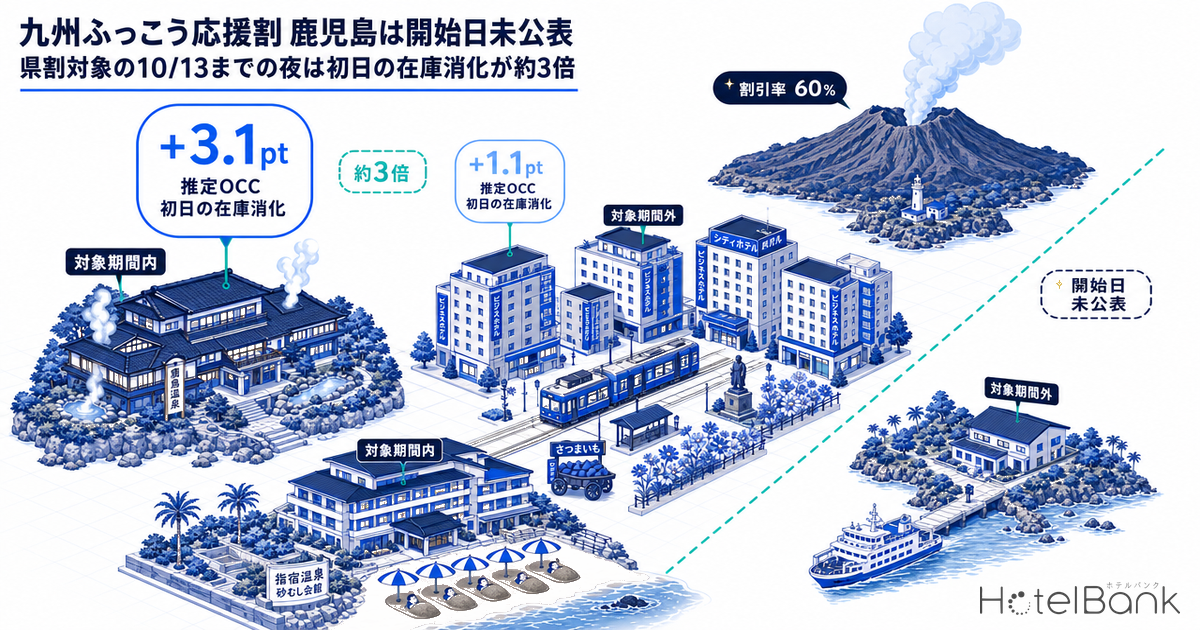
For the Kagoshima portion of the Kyushu Fukko Ouenwari (Kyushu Recovery Travel Support), the reservation start date is still listed as “not yet announced” on the Japan Tourism Agency’s information page (updated September 15). Ahead of it, Kagoshima Prefecture launched its own “Kagoshima Kanko Ouenwari” (かごしま観光応援割) on September 14. That discount covers only stays from September 14 to October 13, and bookings made on or before September 13 are not eligible. In other words, a policy line runs between the night of October 13 and the night of October 14. This article lines up the October nights on both sides of that line and checks, property by property, whether inventory moved differently on the single day sales opened (9/14). The conclusion first: the 13 nights inside the eligible period saw estimated OCC rise by an average of +3.1pt on 9/14 alone, while the 15 nights outside it rose only +1.1pt. The same nights in Okinawa rose +0.6–0.7pt on both sides of the line, with almost no difference.
Metric Definitions Used in This Article
- OCC (occupancy rate): The share of sold rooms in the total room count of an area (an estimate based on OTA sales inventory). In this article it is calculated by summing remaining rooms property by property for Kagoshima properties that list at least 30% of their total rooms on OTAs and similar channels. It is an estimate based on how OTA-listed inventory is consumed and differs in definition from a property’s actual occupancy.
- First-day inventory pickup: For each stay date, the difference (pt) between estimated OCC as of September 13 (Sun) and as of September 14 (Mon). It shows how much of that night’s inventory was taken on the single day the prefectural discount opened for bookings.
- LT (lead time): Days until the stay date. All observation points used in this article fall within LT45 to LT1 (LT0 is not used).
- Listed price (lowest plan): The per-room rate (tax included) for two guests in one room, taking each property’s cheapest listed plan. It is not the transacted price.
- Data source: MetroEngines Research
- — +3.1pt vs +1.1pt on average: On 9/14, the single day the prefectural discount opened for bookings, the 13 nights inside the eligible period (10/1–13) gained an average of +3.1pt in estimated OCC, versus +1.1pt for the 15 nights outside it (10/14–28). The same nights in Okinawa gained +0.6pt / +0.7pt, with no step between them.
- — The gap survives removing the top property: 174 of 411 properties saw inventory fall on 9/14. Around 80% of properties left listed prices unchanged, and at the Saturday lowest-plan median (¥14,700–¥15,400) the ¥20,000 cap is never reached, so the full 60% applies.
- — From 10/14, waiting on a start date: The reservation start date for the Kagoshima portion of the Kyushu Fukko Ouenwari is unannounced (as of the Japan Tourism Agency page updated September 15), and the supplementary budget bill has not yet passed. Hotels should mark both the announcement date and the start date as days to revisit inventory and guest messaging.
Two Lodging Discounts in Kagoshima — What Is Confirmed and What Is Not
Kagoshima’s lodging discounts consist of two similarly named programs that overlap with staggered timing. The first is the “Kagoshima Kanko Ouenwari,” which the prefecture launched early through its September supplementary budget. The prefectural assembly’s regular September session opened on September 11 and passed the bill, with a program budget of ¥452 million, the same day (as reported by the Minami-Nippon Shimbun). According to the prefecture’s dedicated website, the discount covers stays from September 14 (Mon) to October 13 (Tue) (with check-out by October 14), at a 60% discount rate and a cap of ¥20,000 per person per trip; bookings made before the start of the reservation/sales period are not eligible. Direct bookings, travel agencies, and OTAs are all eligible channels.
The second is the Kagoshima portion of the “Kyushu Fukko Ouenwari,” funded by a national grant. The Japan Tourism Agency lists a 60% discount rate for Kumamoto and Kagoshima (50% for the other five prefectures), with a cap of ¥20,000 per night for accommodation-only stays. However, Kagoshima’s reservation start date remains “not yet announced” even on the page updated September 15. NHK reported on September 16 that the prefecture would add a supplementary budget bill for the program to the ongoing assembly session. The reported implementation period of “starting mid-October through February 28, 2027 (excluding the year-end and New Year holidays)” can so far only be confirmed through news reports, not through prefectural releases or the bill itself. The supplementary budget is still a “proposal” awaiting deliberation.
| Item | Kagoshima Kanko Ouenwari (prefecture’s own) | Kyushu Fukko Ouenwari (Kagoshima portion) |
|---|---|---|
| Eligible stay period | Stays 9/14–10/13 (confirmed) | Expected “mid-October to 2027/2/28, excluding year-end/New Year” (per news reports, unconfirmed) |
| Reservations/sales open | 9/14 (confirmed) | Not announced (as of Japan Tourism Agency page updated 9/15) |
| Discount rate | 60% | 60% (Kumamoto and Kagoshima; 50% in the other 5 prefectures) |
| Cap (accommodation only) | ¥20,000 per person per trip | ¥20,000 per night (¥30,000 etc. for 2+ nights with transport) |
| Ineligible bookings | Bookings made before sales opened (on or before 9/13), day trips, publicly funded business trips | Awaiting prefectural announcement |
| Budget | Program budget ¥452 million (passed 9/11) | Supplementary budget bill to be added (not yet passed) |
Source: Compiled by HotelBank Editorial Team from Kagoshima Prefecture’s “Kagoshima Kanko Ouenwari” website and prefectural homepage, Japan Tourism Agency “Kyushu Fukko Ouenwari,” NHK (September 16, 2026), and Minami-Nippon Shimbun (September 11, 2026)
Only the prefectural discount is confirmed; for nights from October 14 onward, “which program applies, and from when” has not yet been decided. Because of this asymmetry, splitting October’s nights into those inside and outside the eligible period produces two groups that share the same prefecture and season and differ only in whether a discount applies. The conditions are in place to compare the response to a program launched on a single day across both sides of the line.
Saturdays Inside the Period Jumped 4pt+ on 9/14; 10/17, Outside It, Rose +0.6pt
Start with four Saturdays. October 3 and October 10 fall inside the prefectural discount period; October 17 and October 24 fall outside it. Over the four days up to September 13, all four rose gently at about 0.5–0.8pt per day, with no noticeable difference between the two sides of the line. Then, on September 14 alone, 10/3 moved from 64.9% to 69.2% (+4.3pt) and 10/10 from 65.9% to 70.5% (+4.6pt). On the same day, 10/17, outside the period, moved only from 65.3% to 65.9% (+0.6pt).
10/24 moved +2.3pt despite being outside the period. The day before, 10/23 (Fri), also saw a sizable block of rooms move at one business hotel in Kagoshima City, so weekend-specific demand may have overlapped. Even so, the gap with 10/10 remains over 2pt. Note also that 10/10 is the first day of a three-day weekend (10/12 is Sports Day), so it includes extra holiday demand compared with 10/3.
Coverage: 10/3 = 263 properties / 8,923 rooms, 10/10 = 240 properties / 8,445 rooms, 10/17 = 287 properties / 8,103 rooms, 10/24 = 269 properties / 7,946 rooms (based on listings on major booking sites; properties listing at least 30% of total rooms). An estimate based on OTA-listed inventory, which differs in definition from actual occupancy. All observation points are within LT45.
Source: MetroEngines Research; compiled by HotelBank Editorial Team
After September 14, the gap between the two sides stopped widening. Over the three days from 9/14 to 9/17, the 13 nights inside the period rose by an average of +2.1pt and the 15 nights outside it by +1.9pt — nearly the same pace. The prefecture’s website announced on September 16 that newly participating businesses had started selling, but judging by inventory movement, the response was concentrated on “the first day of reservations.”
Across 28 October Nights: +3.1pt Inside the Period, +1.1pt Outside
Since four Saturdays alone could be coincidence, we compared first-day inventory pickup across all 28 nights from October 1 to 28 (nights from 10/29 were excluded because the 9/13 observation falls beyond LT45). The 13 nights inside the period averaged +3.1pt (median +2.8pt) and the 15 nights outside averaged +1.1pt (median +0.9pt), a gap of roughly 3x. Even the smallest of the 13, 10/5 (Mon), gained +2.0pt, while only two nights outside the period exceeded +2pt: 10/23 (Fri) and 10/24 (Sat).
As a control, running the same calculation for Okinawa, which is not covered by the Kyushu program, gives an average of +0.6pt for 10/1–10/13 and +0.7pt for 10/14–10/28. Okinawa shows no step between October 13 and 14, so the gap seen in Kagoshima is hard to explain by season or day-of-week patterns.
Coverage: Kagoshima 240–295 properties / 7,460–9,488 rooms; Okinawa 490–598 properties / 15,847–22,348 rooms (aggregated per stay date; based on listings on major booking sites). Only stay dates where both 9/13 and 9/14 are within LT45. An estimate based on OTA-listed inventory, which differs in definition from actual occupancy.
Source: MetroEngines Research; compiled by HotelBank Editorial Team
Another pattern is the “wait” before launch. Over the three days from September 10 to 13, nights inside the period rose by an average of +0.7pt, while nights outside it rose +1.3pt. Because bookings made on or before September 13 had been announced as ineligible, some demand for nights inside the period appears to have held off applying until the start date. From the hotel’s perspective, the booking pace for eligible nights slowed temporarily between the announcement and the start date, then caught up on the start date. Also, “rebooking” — cancelling an existing reservation and booking it again after the start date — nets out on the same remaining rooms (a cancellation and a new booking cancel each other), so the +3.1pt is best read as a net increase after rebookings are accounted for.
Breaking It Down by Property — The Gap Remains Without the Top Contributor
Prefecture-wide aggregates swing sharply when a few large properties add or pull inventory in bulk. Indeed, the prefecture-level curve for 10/3 stays shows a large step on 9/14 and a “pullback” on 9/16, but when broken down by property, most of that swing was explained by listed inventory being added and withdrawn at a single limited-service hotel in Kirishima City. All figures in this article are therefore rebuilt by summing remaining rooms property by property. In this aggregation, the 9/16 pullback for 10/3 disappears; it was flat, from 70.3% to 70.6%.
Next, we checked how much of the +3.1pt was concentrated in particular properties. Inventory pickup on 9/14 across the 13 eligible nights totaled 3,600 rooms, of which 17% came from one large hot-spring ryokan in Kirishima City. The next-largest contributors were mainly business hotels in Kagoshima City, with no single property contributing more than 8.2%. 174 of 411 properties saw inventory fall on 9/14 for at least one eligible night. Even after removing the single largest contributor in each property type, the eligible period stays at more than twice the level of the non-eligible period in every group except Amami City, as shown below. This cannot be explained by inventory moves at a handful of properties; it is best read as a response spread widely across the prefecture.
| Group | Properties | Inside period (10/1–13) | Outside period (10/14–28) | Inside, excl. top property | Outside, excl. top property |
|---|---|---|---|---|---|
| Business hotels | 99 | +2.7pt | +1.2pt | +2.4pt | +1.2pt |
| Ryokan | 63 | +9.2pt | +1.3pt | +2.5pt | +1.1pt |
| Resort hotels | 31 | +4.2pt | +1.2pt | +3.7pt | +1.3pt |
| City hotels | 18 | +2.5pt | +0.4pt | +2.3pt | +0.4pt |
| Minshuku, guesthouses, whole-house rentals, etc. | 200 | +0.5pt | +0.2pt | — | — |
| Kagoshima City | 69 | +3.2pt | +1.3pt | +2.9pt | +1.3pt |
| Kirishima City | 61 | +6.8pt | +1.0pt | +3.6pt | +0.8pt |
| Ibusuki City | 22 | +2.8pt | +0.7pt | +1.5pt | +0.7pt |
| Amami City | 30 | +1.5pt | +1.0pt | +1.0pt | +1.3pt |
Rooms picked up from 9/13 to 9/14 divided by each group’s covered rooms (summed per stay date). Property counts include every property covered on at least one night from 10/1 to 10/28. Based on listings on major booking sites; an estimate based on OTA-listed inventory.
Source: MetroEngines Research; compiled by HotelBank Editorial Team
Values exclude the single largest contributor in each property type. Coverage is the same as the table above.
Source: MetroEngines Research; compiled by HotelBank Editorial Team
By property type, resort hotels show the largest gap even after removing the top contributor (+3.7pt vs +1.3pt). Because a 60% discount with a ¥20,000 cap yields larger savings the higher the room rate, the pattern reads as segments with deep leisure demand — hot-spring areas and resorts — moving first. By area, the gap was clear in Kirishima City and Kagoshima City, while Amami City was at nearly the same level on both sides of the line. On remote islands, flight and ferry seats tend to be the binding constraint on itineraries, so a lodging-only discount may do little to shift booking timing. For island properties, there is room to grow with packages bundled with transport.
Prices Held, Inventory Moved — The ¥20,000 Cap Only Bites Above ¥67,000 per Room
While inventory moved, listed prices barely did. Comparing each property’s lowest-plan listed price on September 13 and September 17, around 80% of properties kept the same price regardless of stay date; 7–11% raised prices for nights inside the period and 6–14% for nights outside it. The Saturday lowest-plan medians were ¥14,700 for 10/3 and ¥15,400 for 10/10 (inside the period), and ¥15,000 for 10/17 and ¥15,200 for 10/24 (outside) — no large difference across the line.
To estimate the discount: for a ¥15,000 room for two, 60% (¥9,000) is discounted, leaving the traveler paying ¥6,000. The ¥20,000-per-person cap is reached only from about ¥66,700 per room for two guests, or about ¥33,300 for one guest. In other words, in Kagoshima’s core price range the cap barely applies, and the full 60% rate directly lowers what travelers pay. For hotels, demand was pulled forward with prices unchanged, leaving room to steer remaining in-period inventory toward multi-night stays and higher room categories.
The Seam Nights — From 10/14, Waiting on the Program Start Date
The hardest nights to call right now are those from October 14 onward. The prefectural discount ends with stays on 10/13, and the start date for the Kagoshima portion of the Kyushu Fukko Ouenwari has not been announced. If it starts in mid-October as reported, there may be a gap of several days to about a week in which neither discount is available. Estimated OCC as of September 17 is 53.8% for 10/12 (holiday), 56.2% for 10/13 (Tue), and 55.9% for 10/14 (Wed), and weekdays from 10/14 onward also sit between the low 50s and mid 60s.
As of September 17. Coverage: 240–295 properties / 6,798–9,488 rooms per stay date (based on listings on major booking sites). 10/31 is LT44. An estimate based on OTA-listed inventory, which differs in definition from actual occupancy. Based on listed inventory at the time of the survey and subject to change.
Source: MetroEngines Research; compiled by HotelBank Editorial Team
For these seam nights, a hotel’s sales approach can be organized as follows.
| Issue | How to approach it |
|---|---|
| Inventory for 10/12 and 10/13 | The last two nights of the prefectural discount still had headroom in the 50% range as of 9/17. There is ample room to promote multi-night and extended-stay plans spanning the last day of the three-day weekend and the following weekday. |
| Nights from 10/14 until the Ouenwari start date | Once the start date is set, a first-day inventory pickup is likely to occur on that day (the same pattern as 9/14 in this article). One option is not to sell out seam-night inventory early, keeping some allocation available to sell after the start date is announced. |
| Pricing | Listed prices were largely unchanged around 9/14. A phase in which a 60% discount pulls demand forward can be used as an opportunity to review prices in stages. |
| Booking guidance | Standardizing guidance split by stay date across booking pages and inquiry handling — “stays through 10/13 are covered by the prefectural discount” and “for stays from 10/14, the prefecture will announce the Kyushu Fukko Ouenwari start date” — reduces rework from rebookings and inquiries. For multi-night stays that cross the boundary, confirm the treatment on the prefecture’s website before advising guests. |
| Cap on discount funds | Both programs end once the budget is exhausted, and individual properties or businesses may stop accepting bookings. Even for nights inside the period, there is room to adjust sales intensity to how the allocation is being used up. |
Kumamoto and Nagasaki on 9/15, and Kagoshima’s Next Starting Point
Kumamoto and Nagasaki (via booking sites) began selling the Kyushu Fukko Ouenwari on September 15. Inventory movement from those launch dates is a separate analysis measured against each prefecture’s pre-launch baseline, so this article focuses on Kagoshima’s prefectural discount. In Kagoshima, the next starting point will be the moment the Ouenwari start date is announced. As with 9/14, the booking pace for eligible nights may slow before the start date and then move all at once on it, so hotels should schedule both the announcement date and the start date as days to review inventory.
Summary
On September 14, the day Kagoshima’s own “Kagoshima Kanko Ouenwari” launched, estimated OCC for nights inside the eligible period (10/1–13) rose by an average of +3.1pt, about 3x the +1.1pt for nights outside it (10/14–28). The same nights in Okinawa show no step, and the gap remains even after removing the top contributor in each property type and area, so this reads as demand pulled forward across the prefecture rather than inventory moves by a few properties. The response was concentrated on the first day, after which the pace of increase was nearly the same on both sides of the line. Listed prices were held at around 80% of properties.
The remaining question is the seam nights from October 14 onward. The start date for the Kagoshima portion of the Kyushu Fukko Ouenwari is unannounced, and the supplementary budget bill is still awaiting deliberation. This measurement shows that a program’s start date becomes the day inventory moves. Preparing seam-night inventory and guest messaging in time for the start-date announcement is the next opportunity for hotels.
For hotels: plan-name hints for this theme
Most common selling points in public plan names promoting travel support or discounts in Kagoshima (N=162) —
Discount 94%Early-bird 43%Room only 27%Multi-night discount 23%Breakfast included 23%
Actual name example (anonymized):
- 【早期割引60】大人気朝食付きプラン 大浴場完備 (“[Early Discount 60] Popular breakfast-included plan, large public bath”)
*These are trends based on aggregated public plan names and do not show that naming causes sales. Source: MetroEngines Research; compiled by HotelBank Editorial Team
Note on forward-dated data: The estimated OCC and listed prices in this article reflect observations through September 17, 2026, and will change as stay dates approach. The start date, period, and budget for the Kagoshima portion of the Kyushu Fukko Ouenwari will be finalized by the prefecture’s official announcement and assembly vote; please check Kagoshima Prefecture’s announcements for the latest information.
Methodology
Covering Kagoshima properties that list at least 30% of their total rooms on OTAs and similar channels, we summed each property’s remaining rooms daily for each stay date (October 1–31, 2026) and calculated estimated OCC. Days without observations were filled with the previous observation. First-day inventory pickup was calculated only for properties observed on both September 13 and September 14. Okinawa was aggregated the same way. All observation points fall within LT45 to LT1 of the stay date.
Related Articles
- Kyushu Subsidy: Kumamoto & Kagoshima Hold 34.9% of Oct Unsold Rooms
- Kyushu Recovery Subsidy Set: 60%/50% Split, ¥20,000 Cap Hits Top 10%
References and Sources
- Kagoshima Prefecture, “Kagoshima Kanko Ouenwari” website (launched September 11, 2026) [Japanese]
- Kagoshima Prefecture, “Implementation of the Kagoshima Kanko Ouenwari” (updated September 11, 2026) [Japanese]
- Japan Tourism Agency, “Kyushu Fukko Ouenwari” (updated September 15, 2026) [Japanese]
- Kyushu Fukko Ouenwari information site [Japanese]
- NHK, “Kagoshima Prefecture to add supplementary budget bill for Kyushu Fukko Ouenwari” (September 16, 2026) [Japanese]
- Minami-Nippon Shimbun, “Kagoshima prefectural assembly opens September session, passes prefecture’s own tourism support budget the same day” (September 11, 2026) [Japanese]
- Travel Watch, “Up to 60% off stays in Kagoshima: ‘Kagoshima Kanko Ouenwari’ bookings open today” (September 14, 2026) [Japanese]
- MetroEngines Research — Property-level remaining-room trends and lowest-plan listed prices for Kagoshima and Okinawa (observed September 10–17, 2026)