

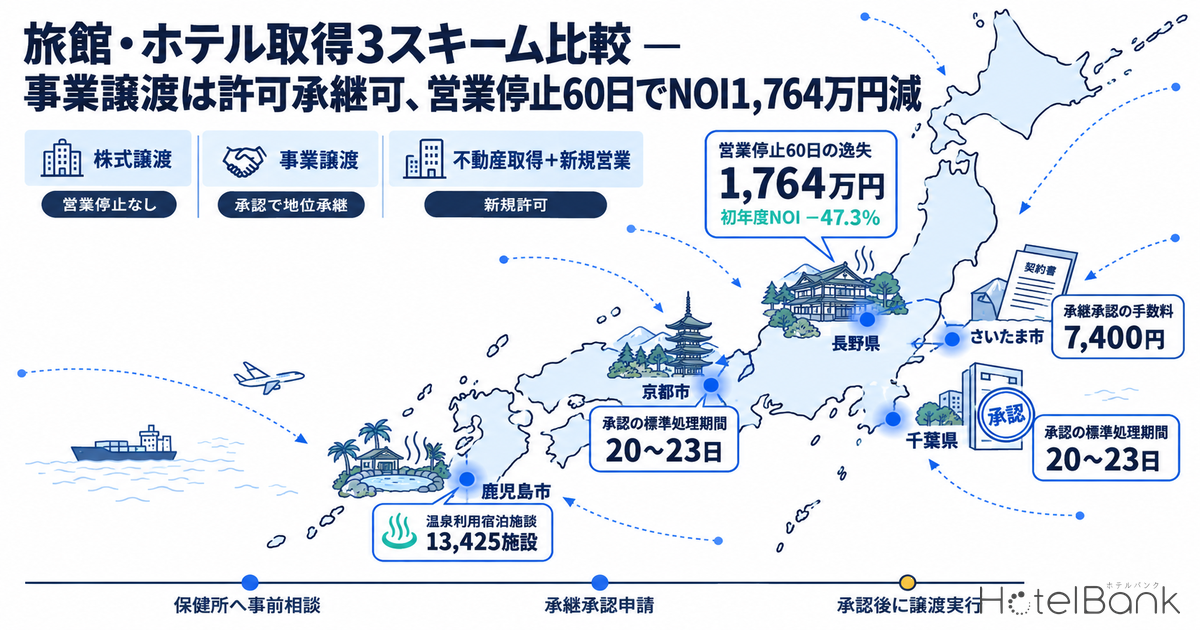
In the acquisition of a hotel or ryokan, how many days pass between the letter of intent and the day you welcome guests under your own name? The answer is determined not by price or by the depth of due diligence, but almost entirely by which deal structure you use. There are three broad ways to buy: purchase the shares of the operating company, take over the business as a going concern, or buy only the real estate and have yourself or another operator run it. Across these three, the treatment of the hotel business license changes — and with it the closing date, the number of days the property cannot operate, and first-year NOI.
On December 13, 2023, the amended Hotel Business Act (旅館業法) came into force, allowing the status of the license holder to be succeeded even in a business transfer. Before that, the transferor had to file a notice of business closure and the transferee had to obtain a new license, which structurally created a period in which the property could not operate. This article confirms that regulatory change against primary sources, converts the cost of each day of suspended operation into yen using a 40-room model, and then sets out — article by article — the practical pitfall that even when the hotel business license can be succeeded, some ancillary permits cannot.
Metric Definitions Used in This Article
- ADR (Average Daily Rate): An estimated settled rate (tax-excluded equivalent), calculated by applying a property-type adjustment factor to the lowest-plan price level that each property publishes on major booking sites (per room, two guests sharing, tax included). Checked against property-level results disclosed by listed hotel REITs (91 properties, most recent 3 months), the median error is about 7%. These are estimates and differ from each property’s actual transaction prices and accounting figures. Area-level ADR is the median of the target properties (the level of a typical property in the area).
- NOI (Net Operating Income): In this article, a simplified estimate of operating-level profit, calculated as room revenue less variable and fixed costs. Before depreciation and interest. Differs from the accounting definition.
- Days of suspended operation: The number of days on which guests cannot be accepted because of a change of operator (license holder). Closures for renovation or repairs are not included.
- Data sources: MetroEngines Research & Consulting / Ministry of Health, Labour and Welfare (MHLW) “Report on Public Health Administration and Services” / Ministry of the Environment “Hot Spring Use Status” / e-Gov Laws and Regulations Search
How this article differs from our earlier coverage
Our earlier articles on succession and licensing cover the overall framework of the Hotel Business Act (its three license categories, the 2018 and 2023 amendments, and how it differs from private lodging), statistics on license counts (98,338 licensed facilities versus 27,248 listed online), the business succession tax system (the December 2027 deadline and share valuation), acquisition vehicles and transfer taxes (direct ownership versus trust beneficiary interests), and the ownership of hot spring rights in Who Owns the Hot Spring? Water Rights and Ryokan Valuation. None of them compares the treatment of the operating license and the succession procedure by acquisition structure, or takes closing feasibility as the central question. This article deals with that alone.
- — Under the amended Hotel Business Act in force since December 13, 2023, the status of the license holder can be succeeded in a business transfer with the approval of the prefectural governor (or equivalent). The approval must be obtained before the transfer takes effect.
- — The closing date is subordinate to the date the public health center completes its review. Standard processing periods are 20 days in Chiba Prefecture and 23 days in Kyoto City, excluding time spent correcting documents.
- — What applies mutatis mutandis to succession approval is the transferee’s disqualification grounds and the location’s environmental requirements; on the wording of the Act, the Cabinet Order standards for structure and equipment are not re-examined.
- — The hot spring use permit and the adult entertainment business license have no provision for succession through a business transfer. A restaurant business license, by contrast, needs only a notification after the fact. The critical path is set by the permit that is hardest to succeed.
- — In a model with 40 rooms, an estimated settled ADR of ¥15,000 and 70% occupancy (an assumed full-year average), a shutdown costs ¥294,000 per day and ¥17.64 million over 60 days (first-year NOI −47.3%) — three orders of magnitude more than the ¥7,400 succession approval fee.
Three ways to buy, three different treatments of the operating license
Operating a hotel business in Japan requires a license from the prefectural governor (or, in cities with their own public health centers and in Tokyo’s special wards, from the mayor or ward head) (Hotel Business Act, Article 3, Paragraph 1). This license is granted not to the property but to the operator. The procedure therefore branches depending on whether the operator changes.
In a share transfer, the corporation that is the operator does not change. Only the shareholders are replaced, so the license does not move. In a business transfer, the operator changes from the transferor to the transferee, so a succession procedure is needed. When only the real estate is bought and the buyer or an operator it appoints runs the business, a new operator appears, so in principle a new license is required.
| Issue | 1. Share transfer | 2. Business transfer | 3. Real estate acquisition + new operation |
|---|---|---|---|
| Operator (license holder) | Unchanged | Transferor → transferee | Buyer or appointed operator becomes a new operator |
| Treatment of hotel business license | Continues as is | Status succeeded with governor’s approval (Art. 3-2) | New license obtained (Art. 3, Para. 1) |
| Nature of procedure | No license procedure (confirm with the competent public health center whether a notice of change of officers is required) | Prior approval, obtained before the transfer takes effect | Prior license; no operation before it is granted |
| Re-examination of structure and equipment standards | None | On the wording of the Act, what applies to approval is the applicant’s disqualification grounds and the location’s environmental requirements; the Cabinet Order standards for structure and equipment can be read as outside its scope | Compliance with Cabinet Order standards examined anew; a fire code compliance certificate and similar documents are required |
| Examples of standard processing period | — | Chiba Prefecture 20 days (excluding weekends and holidays) / Kyoto City 23 days | Saitama City: about 1 month when consultation with other agencies is needed |
| Examples of fees | — | ¥7,400 (Saitama City, Kagoshima City) | ¥24,000 (Saitama City) |
| Suspension of operation | None | None under the rules, if the transfer is executed after approval | No operation until the license is obtained |
| Off-balance-sheet liabilities | Universal succession: past debts, disputes and unpaid overtime are all inherited | Scope of succession can be defined by contract | In principle not inherited |
| Employees | Employment relationships continue unchanged | Transfer requires each employee’s individual consent | New hiring |
| Consumption tax | Transfer of shares is a non-taxable transaction | Buildings, fixtures, etc. taxable; land non-taxable | Buildings taxable; land non-taxable |
| Real estate acquisition tax / registration and license tax | Not incurred, as no real estate is transferred | Incurred if real estate is transferred | Incurred |
Reading the table across reveals the structure of the trade-off. A share transfer does not stop operations for a single day, but takes on off-balance-sheet liabilities wholesale. A real estate acquisition is the furthest removed from off-balance-sheet liabilities, but because the license must be obtained again, a period without operation arises. A business transfer sits in between, and the December 2023 amendment made “keep operating while limiting the scope of succession” a realistic option. That is the starting point of this article.
December 13, 2023: an “approval” route opens for business transfers
Before the amendment, the party taking over a property through a business transfer had to obtain a new license. The transferor filed a notice of closure and the transferee obtained a new license. Between those two procedures there was a period in which nobody was the operator. If the transfer date could not be moved, those days became days of suspended operation.
- Transfer executed
- Transferor files a notice of closure
- Transferee applies for a new license
- Review including structure, equipment and location
- No operation until the license is granted
- Transferor and transferee jointly apply for succession approval
- Governor (or equivalent) reviews the transferee’s disqualification grounds, etc.
- Approval
- Transfer executed after approval → status succeeded
- Governor (or equivalent) inspects business conditions within 6 months of succession
Paragraph 2 of the same Article “The provisions of paragraph (2) of the preceding Article (limited to the part concerning the applicant) and paragraphs (3) through (6) of that Article apply mutatis mutandis to the approval referred to in the preceding paragraph. (Omitted)” (unofficial translation)
Source: e-Gov Laws and Regulations Search, “Hotel Business Act” (Act No. 138 of 1948), checked September 9, 2026
The order of the wording is the practical point. Because the Act says “where approval has been obtained, the transferee succeeds”, approval must be in hand before the transfer takes effect. Kagoshima City also states explicitly that “an application for succession approval must be filed and approval obtained before the business transfer takes effect.” In other words, the closing date is subordinate not to the parties’ convenience but to the date the public health center finishes its review. A deal that has not worked backward from this is left with two choices: push the settlement date back, or execute the transfer before approval and fall back to a new license.
The items to be stated in the application and the documents to be attached are set out in the Enforcement Regulations: the addresses and names of the transferee and transferor (for a corporation, its name, office location and representative’s name), the scheduled date of transfer, the name and location of the facility, and whether any disqualification ground applies, together with a document evidencing the transfer of the hotel business and, if the transferee is a corporation, a copy of its articles of incorporation or act of endowment (Enforcement Regulations of the Hotel Business Act, Article 1-3). The fact that the form asks for the “scheduled date of transfer” also shows that prior application is assumed.
After succession, the authorities follow up. The supplementary provisions of the amending act require that, for the time being, the governor (or equivalent) inspect business conditions at least once before six months have passed from the date the status was succeeded. Buyers are safest launching operations on the assumption that an on-site inspection will take place within six months of closing.
Three types of succession — transfer, merger/split, and inheritance
The succession provisions of the Hotel Business Act fall into three types. The one created in December 2023 is business transfer (Art. 3-2); merger/company split (Art. 3-3) and inheritance (Art. 3-4) existed before. Note that all three are “approvals”, not “notifications”. MHLW likewise explains that for business transfers, “it has become possible to succeed to the status of the operator through an approval procedure, as in the case of mergers, company splits and inheritance.”
| Type | Legal basis | Procedure | Timing | Operation during application |
|---|---|---|---|---|
| Business transfer | Hotel Business Act Art. 3-2 Enforcement Regulations Art. 1-3 | Approval application by transferor and transferee | Before the transfer takes effect | Transfer not yet executed, so the transferor continues operating |
| Corporate merger / split | Hotel Business Act Art. 3-3 Enforcement Regulations Art. 2 | Approval application | Before the merger or split | Continues, as it has not yet taken effect |
| Inheritance | Hotel Business Act Art. 3-4 Enforcement Regulations Art. 3 | Approval application by the heir | Within 60 days of the decedent’s death | From the date of death until notice of approval or refusal, the decedent’s license is deemed to be the heir’s (Para. 2) |
Only inheritance is applied for after the fact, and it comes with a deemed-license provision during the application, because it is designed so that a sudden inheritance does not halt operations. Put the other way, business transfers and mergers/splits have no deemed-license safety net. If the transaction is executed before approval, the succession route closes at that moment.
Succession approval does not re-examine structure and equipment — reading the text
The scope of what applies under Article 3-2, Paragraph 2 matters a great deal in practice. What applies is Article 3, Paragraph 2 “limited to the part concerning the applicant” — that is, the transferee’s own disqualification grounds (mental or physical impairment, commencement of bankruptcy proceedings, certain criminal sentences, years elapsed since revocation of a license, membership of organized crime groups, disqualification of officers, and so on) — plus Paragraphs 3 to 6 (environmental requirements within roughly 100 meters of school grounds and similar sites, consultation with relevant agencies, notice of refusal with reasons, and attachment of conditions).
The part of Article 3, Paragraph 2 that reads “when it is found that the structure and equipment of the facility do not conform to the standards specified by Cabinet Order” is not a part concerning the applicant, so on the wording of the Act it can be read as outside the scope of the succession approval review. This is decisive for a buyer taking over an older ryokan. A new license requires fresh proof of compliance with the current Cabinet Order standards and fire codes, and if any part is non-conforming, capital expenditure comes first. With succession, the existing license simply continues, so that investment drops out of the conditions precedent to closing and the buyer can choose its timing.
⚠ Caveat on interpretation: The above is a reading of the statutory wording; actual practice differs by prefecture, by city with its own public health center, and by special ward. Some offices effectively ask for an on-site check at the time of the approval application, while others complete the process on documents alone. Do not assume that “this structure guarantees succession”; plan on consulting in advance, case by case, with the public health center that has jurisdiction over the property. Standard processing periods also vary — 20 days in Chiba Prefecture and 23 days in Kyoto City — and do not include time spent correcting documents.
The hot spring use permit has no provision for succession through a business transfer
Now that the hotel business license can be succeeded in a business transfer, the practical bottleneck has moved to other permits. The one with the greatest impact is the hot spring use permit.
Offering hot spring water for public bathing or drinking requires a permit from the prefectural governor (Hot Springs Act, Article 15, Paragraph 1). There are only two succession provisions for this permit: corporate merger/split (Art. 16) and inheritance (Art. 17). The Hot Springs Act contains no provision for succession through a business transfer. This means that when an onsen ryokan is taken over by business transfer, the hotel business license can be succeeded, but the transferee can be read as needing to obtain a new hot spring use permit.
Source: e-Gov Laws and Regulations Search, “Hot Springs Act” (Act No. 125 of 1948), checked September 9, 2026
Consider the scale. According to the Ministry of the Environment’s “Hot Spring Use Status, FY2024” (as of end-March 2025), Japan has 13,425 lodging facilities using hot springs, with a total capacity of 1,324,805 guests. There are 2,839 hot spring areas and 27,899 hot spring sources in total. Given that 52,946 facilities hold hotel/ryokan business licenses (MHLW “Report on Public Health Administration and Services, FY2024”), properties with hot springs form the core of the lodging market. Since many succession deals fall into this group, building a schedule around the hotel business license alone is risky.
By contrast, the restaurant business license is the most lenient. Article 56 of the Food Sanitation Act provides that when a licensed business operator transfers its business, or in the case of inheritance, merger or split, the transferee or successor succeeds to the status of the licensed operator, and the successor need only notify the governor without delay, attaching a document evidencing the fact. It is a notification after the fact, not prior approval, so there is no approval to wait for. Even under the same heading of “succession of a business license”, the design philosophy differs completely from one statute to the next.
The adult entertainment business license is close to the Hot Springs Act. The succession provisions of the Act on Control and Improvement of Amusement Business, etc. (風営法) cover inheritance (Art. 7), corporate merger (Art. 7-2) and corporate split (Art. 7-3), all requiring approval from the Public Safety Commission. There is no provision for succession through a business transfer. For properties that run an in-house bar or snack bar and operate a late-night alcohol-serving restaurant business or a specified entertainment restaurant business, this becomes a separate issue.
Checklist: can ancillary permits be succeeded?
| Permit / item to check | Basis | Succession in business transfer | Practical notes |
|---|---|---|---|
| Hotel business license | Hotel Business Act Art. 3 / Art. 3-2 | SucceedablePrior approval | Obtain approval before the transfer takes effect. Standard processing period of roughly 20–23 days depending on the local government |
| Hot spring use permit | Hot Springs Act Art. 15 / Arts. 16 and 17 | No provisionAssume a new permit | Succession provisions exist only for merger, split and inheritance. Also check the validity period of the hot spring component analysis and the notification of posted information (Art. 18) |
| Restaurant business license | Food Sanitation Act Art. 56 | SucceedableNotification after the fact | Notify without delay, attaching a document evidencing the fact. Confirm appointment of a food sanitation supervisor |
| Adult entertainment business license / late-night alcohol-serving restaurant business | Amusement Business Act Arts. 7 to 7-3 | No provisionNew license / notification | Succeedable only through inheritance, merger or split. An issue for properties with a bar, snack bar or karaoke |
| Registration under the International Tourism Hotel Development Act | Under the Japan Tourism Agency | Succession notice | Transfer or lease of the entire business, inheritance and merger are covered by a succession notice |
| Fire code compliance certificate / fire prevention manager | Fire Service Act | — | Notice of re-appointment of the fire prevention manager on change of operator. On the new-license route, the compliance certificate is effectively a precondition |
| Building confirmation / certificate of inspection; use classification | Building Standards Act | — | Whether a certificate of inspection exists, legality of extensions and alterations, extent of non-conformity with current law. Confirm before acquisition if the turnaround plan involves extension or change of use |
| Hot spring rights / water supply contracts | Private-law contracts and custom | — | Own source, piped-in supply contract, or centralized management by a hot spring cooperative? Check contractual transfer restrictions and the cooperative’s consent requirements |
| Booking site listing contracts and review assets | Private-law contracts | — | A change of operator name may change how listing accounts are treated. Confirm in advance whether accumulated review ratings can be carried over |
Using this table is simple. If a deal lines up “succeedable” in every row, a business transfer lets you control the closing date. If even one “no provision” is mixed in, the date on which that permit is newly obtained becomes the critical path. For an onsen ryokan with a snack bar, the overall rate-limiting step is not the hotel business license (approval in 20–23 days) but the timetable for obtaining the hot spring use permit and the adult entertainment business license.
What does a day of shutdown cost? A 40-room model at an estimated settled ADR of ¥15,000
Here we translate the procedural differences into yen. The assumptions are kept simple: 40 rooms, an estimated settled ADR of ¥15,000, 70% occupancy (an assumed full-year average), a variable cost ratio of 30%, and annual fixed costs of ¥70 million. Variable costs are those incurred only when a room is sold — cleaning, linen, amenities, booking commissions, variable utilities and the like. Fixed costs are those that continue even when operations stop — core payroll, maintenance, insurance, taxes and public charges.
What is lost on a day of shutdown is not revenue but contribution margin, because fixed costs do not stop. Daily room revenue is 40 rooms × 70% × ¥15,000 = ¥420,000, of which the contribution margin after variable costs is ¥294,000. That is the loss per day of shutdown.
| Item | 0-day shutdown | 30-day shutdown | 60-day shutdown |
|---|---|---|---|
| Operating days | 365 days | 335 days | 305 days |
| Room revenue | ¥153,300,000 | ¥140,700,000 | ¥128,100,000 |
| Variable costs (30%) | ¥45,990,000 | ¥42,210,000 | ¥38,430,000 |
| Fixed costs | ¥70,000,000 | ¥70,000,000 | ¥70,000,000 |
| First-year NOI | ¥37,310,000 | ¥28,490,000 | ¥19,670,000 |
| NOI decrease | — | −¥8,820,000 | −¥17,640,000 |
| NOI decrease (%) | — | −23.6% | −47.3% |
A 30-day shutdown cuts first-year NOI by 23.6%, and a 60-day shutdown by 47.3%. If the acquisition price is set at 10 times first-year NOI (a 10% yield), a 60-day shutdown is equivalent to 4.7% of the price. An amount of the same order as the brokerage commission moves on nothing more than the order of procedures. For the level of other costs that pile up at acquisition, Hotel Acquisition Costs 7.1%: A 6.5% Gross Yield Becomes 4.65% Net breaks down the components. This estimate excludes ancillary revenue such as meals, banquets and shop sales, so for a ryokan where half-board (dinner and breakfast) is standard, the actual loss will be higher.
Varying the occupancy assumption
70% occupancy assumes a property in good condition of the kind that comes to market as a succession deal. In the Japan Tourism Agency’s “Overnight Travel Statistics Survey”, the 2025 full-year figures (preliminary) put ryokan room occupancy at 38.4% (all types 61.8%, business hotels 75.3%, city hotels 74.2%, resort hotels 56.9%), so the average for the category is considerably lower. The sensitivity to the assumption is as follows.
| Occupancy (assumption) | Daily room revenue | Daily loss (contribution margin) | 30-day shutdown | 60-day shutdown |
|---|---|---|---|---|
| 40% | ¥240,000 | ¥168,000 | ¥5,040,000 | ¥10,080,000 |
| 55% | ¥330,000 | ¥231,000 | ¥6,930,000 | ¥13,860,000 |
| 70% (base) | ¥420,000 | ¥294,000 | ¥8,820,000 | ¥17,640,000 |
The same 60 days can cost 1.4 times more depending on when they fall
So far the year has been averaged out. In reality, losses swing widely depending on whether the shutdown falls in peak or off-peak season. Below is the monthly trend in estimated settled ADR for the ryokan category in Nagano Prefecture, a major concentration of ryokan.
Over the most recent 24 months, the high was ¥15,900 in December 2025 and the low ¥11,500 in March 2025 — a ratio of 1.39 times. Seasonal differences in occupancy amplify this further, so if a shutdown overlaps with the year-end holidays or the autumn foliage season, losses should be expected to exceed the average-based estimate by a wide margin. Conversely, in deals where a delay in obtaining approval cannot be avoided, there is a hard-money case for negotiating to move the transfer date into the off-season.
ADR level at the time of shutdown × days of shutdown: losses range from ¥13.49M to ¥18.71M
Holding occupancy at 70% and replacing the ADR level during the shutdown with measured monthly figures for the Nagano Prefecture ryokan category, the lost contribution margin for the same 60 days ranges from ¥13.49 million to ¥18.71 million. Negotiating the number of shutdown days and negotiating the timing of the shutdown have economic effects of almost the same size.
| ADR level during shutdown | Daily loss | 30-day shutdown | 60-day shutdown | 90-day shutdown |
|---|---|---|---|---|
| Off-peak level ¥11,472 (March 2025, lowest measured month) | ¥224,851 | ¥6,745,536 | ¥13,491,072 | ¥20,236,608 |
| Annual average level ¥12,952 (most recent 24-month average) | ¥253,859 | ¥7,615,776 | ¥15,231,552 | ¥22,847,328 |
| Base assumption ¥15,000 | ¥294,000 | ¥8,820,000 | ¥17,640,000 | ¥26,460,000 |
| Peak level ¥15,912 (December 2025, highest measured month) | ¥311,875 | ¥9,356,256 | ¥18,712,512 | ¥28,068,768 |
Fees run to thousands of yen; a shutdown runs to millions
The fee for succession approval is ¥7,400 and for a new license ¥24,000 (both Saitama City examples), a difference of ¥16,600. Meanwhile, the lost NOI from a 30-day shutdown is ¥8,820,000 — about 368 times the new license fee. The economics of choosing a structure are decided not by fees but by whether operations stop.
License flows versus the properties that come to market
Let us connect the regulatory discussion to the scale of the market. According to MHLW’s “Report on Public Health Administration and Services, FY2024” (as of end-March 2025), 98,338 facilities hold hotel business licenses: 52,946 hotel/ryokan operations (1,782,232 guest rooms), 44,901 simple lodging operations and 491 boarding house operations. During the same fiscal year there were 7,720 new business licenses and 2,817 business closures, and 26 license revocations.
By prefecture, Tokyo has the most licenses at 1,589, followed by Hokkaido (525), Okinawa (524) and Nagano (452). In closures, Nagano (244) and Hokkaido (209) stand out. The ratio of licenses to closures varies widely by region; Nagano, with 452 licenses against 244 closures, has a fast rate of turnover. In reading where the supply of succession deals is deepest, closure counts are as important an indicator as license counts. For the background to closures — the lack of successors and the capital structure of long-established ryokan — Ryokan Succession Crisis: 89 Bankruptcies & 30% Without Heirs in 2025 digs deeper.
Placing these flows on a map shows that the areas supplying succession deals and the areas where new licenses concentrate are different. Circle size shows the number of business licenses, and color shows the number of closures.
Meanwhile, new openings on the basis of listings we could confirm on major booking sites were 1,723 in 2022, 2,012 in 2023, 1,979 in 2024 and 1,745 in 2025. For 2026 we observed 1,425 in January–August, 15.9% above the 1,230 for the same period of the previous year. The average number of rooms per property has ranged between 20 and 30.
Side by side for 2024, there were 7,720 business licenses on the administrative basis versus 1,979 new openings on the listing basis. The gap does not indicate untracked inventory; it reflects different observation criteria. Business license counts may include not only new facilities but also cases where a license was obtained again because the operator changed. In addition, simple lodging operations, which account for the majority of licenses, include many small facilities not listed on major booking sites. Conversely, the listing basis does not capture facilities that are licensed but have not started selling. Subtracting one population from a different one is meaningless; the two should be read side by side as indicators answering different questions.
* Observation characteristics of the listing basis: Booking-site listings appear several months before opening, so counts for recent months will rise as further listings are added. The 2026 figure is not compared directly with full-year figures for 2025 and earlier; comparisons are made for the same period (January–August).
Working backward from closing: buyer and seller timelines
Finally, let us put this on a practical timeline. To close a business transfer without stopping operations for a single day, succession approval must be written into the contract as a condition precedent to settlement. Standard processing periods are 20 days in Chiba Prefecture (excluding weekends and holidays) and 23 days in Kyoto City (excluding days the office is closed and time needed to correct documents); if corrections are requested, the actual number of days can easily exceed a month.
| Approximate timing | Buyer | Seller |
|---|---|---|
| D−120 days or earlier | Choose the structure. Use the ancillary permit checklist to identify what can be succeeded and pinpoint the rate-limiting permit | Take stock of the original license certificate, structural and equipment drawings, certificate of inspection, hot spring analysis report and water supply contracts, and fire-related documents |
| D−90 days | Consult the competent public health center in advance. Confirm the documents required for succession approval and how the review works in practice | Attend and explain the property’s circumstances (history of extensions and alterations, extent of non-conformity) |
| D−60 days | Start new applications for permits with no succession provision, such as the hot spring use permit and adult entertainment business license | Begin briefing employees and obtaining individual consent (a business transfer requires employees to transfer) |
| D−45 days | Apply for succession approval jointly with the transferor. Because the scheduled transfer date must be stated, provisionally fix the settlement date at this point | Submit the documents required for the joint application. Respond to inquiries on disqualification grounds |
| Around D−20 days | Confirm the outlook for approval and finalize the settlement date. Respond immediately to any correction requests | Decide how booking inventory will be handed over. Specify in the contract who will honor reservations after succession |
| Day D | Execute the transfer after obtaining approval. Succession of status takes effect and operations continue | Continue normal operations up to the transfer date |
| Within D+10 days | File a notification if any registered particulars have changed (Enforcement Regulations Art. 4). Also file the succession notice for the restaurant business | — |
| Within D+6 months | Prepare operations on the assumption that the governor (or equivalent) will inspect business conditions | — |
It is also worth adding that the seller’s preparation affects price. A property with its license certificate, drawings, certificate of inspection and hot spring analysis report in order allows the buyer to choose the succession structure. If documents are missing, the buyer has no choice but to assume real estate acquisition plus a new license, and the risk of suspended operation in that case is priced in. Putting documents in order translates directly into upside in the sale price.
Summary
In acquiring a hotel or ryokan, the treatment of the operating license splits three ways depending on the structure. In a share transfer the license does not move and operations do not stop, but off-balance-sheet liabilities are succeeded wholesale. In a business transfer, since the amendment of December 13, 2023, the status of the operator can be succeeded with the approval of the governor (or equivalent), and if approval is obtained first, the deal can close without stopping operations. Real estate acquisition plus new operation keeps the buyer furthest from off-balance-sheet liabilities, but the suspension of operations until the license is obtained must be priced in.
However, what can be succeeded is the hotel business license, not every permit. The hot spring use permit and the adult entertainment business license have no provision for succession through a business transfer, while the restaurant business license needs only a notification after the fact. A deal’s critical path is set by the permit that is hardest to succeed. Since Japan’s 13,425 lodging facilities using hot springs form the core of succession deals, this should be confirmed at an early stage.
And the economics are decided not by fees but by days. In the model with 40 rooms, an estimated settled ADR of ¥15,000 and 70% occupancy (an assumed full-year average), the loss per day of shutdown is ¥294,000: ¥8.82 million for 30 days and ¥17.64 million for 60 days, reducing first-year NOI by 23.6% and 47.3% respectively. Whether you can work backward from a D−90 consultation with the public health center is what creates this difference. In December 2023 the rules opened a route to take over a property without stopping operations. The rest is a matter of capturing it through schedule design.
Related Reading
- Who Owns the Hot Spring? Water Rights and Ryokan Valuation
- Hotel Acquisition Costs 7.1%: A 6.5% Gross Yield Becomes 4.65% Net
- Ryokan Succession Crisis: 89 Bankruptcies & 30% Without Heirs in 2025
References and Sources
■ Laws and regulations (primary sources, checked September 9, 2026; in Japanese)
- Hotel Business Act (旅館業法, Act No. 138 of 1948) — e-Gov Laws and Regulations Search (Art. 3, Art. 3-2, Art. 3-3, Art. 3-4, Art. 7, Art. 8, Supplementary Provisions of the amending act Art. 3)
- Enforcement Regulations of the Hotel Business Act (Ordinance of the Ministry of Health and Welfare No. 28 of 1948) — e-Gov Laws and Regulations Search (Art. 1-3, Art. 2, Art. 3, Art. 4)
- Hot Springs Act (温泉法, Act No. 125 of 1948) — e-Gov Laws and Regulations Search (Art. 15, Art. 16, Art. 17, Art. 18)
- Food Sanitation Act (食品衛生法, Act No. 233 of 1947) — e-Gov Laws and Regulations Search (Art. 56)
- Act on Control and Improvement of Amusement Business, etc. (風営法, Act No. 122 of 1948) — e-Gov Laws and Regulations Search (Art. 7, Art. 7-2, Art. 7-3)
- MHLW “On the 2023 Amendment of the Hotel Business Act” (effective December 13, 2023; procedures for business transfers; inspection within 6 months of succession)
■ Government statistics
- MHLW “Report on Public Health Administration and Services, FY2024” Table 8: Number of facilities and guest rooms for hotel/ryokan operations, and number of facilities, licenses, closures and dispositions for simple lodging and boarding house operations (as of end-March 2025)
- Ministry of the Environment “Hot Spring Use Status, FY2024” (as of end-March 2025: 2,839 hot spring areas, 27,899 sources, 13,425 lodging facilities, capacity 1,324,805 guests)
- Japan Tourism Agency “Overnight Travel Statistics Survey” 2025 full-year figures (preliminary), room occupancy by property type
■ Published materials from local governments and competent authorities
- Chiba Prefecture “Application for Approval of Hotel Business Succession (Transfer)” (standard processing period 20 days in total, excluding weekends and holidays)
- Kyoto City “Procedures for Succession of Status and Changes in the Hotel Business” (standard processing period 23 days)
- Saitama City “Applications and Procedures for the Hotel Business” (new license ¥24,000; succession approval ¥7,400)
- Kagoshima City “Succession of Status in the Hotel Business (Business Transfer)” (fee ¥7,400; approval to be obtained before the transfer takes effect)
- Japan Tourism Agency “Succession Procedures (International Tourism Hotel Development Act)”
- National Tax Agency Tax Answer No. 6201: Non-taxable transactions
■ Data sources
Laws are the statutory texts on e-Gov Laws and Regulations Search (Hotel Business Act and its Enforcement Regulations, Hot Springs Act, Food Sanitation Act, Amusement Business Act; checked September 9, 2026). Numbers of licensed facilities, licenses and closures are from MHLW “Report on Public Health Administration and Services, FY2024”, Table 8 (as of end-March 2025). Hot spring use figures are from the Ministry of the Environment “Hot Spring Use Status, FY2024”. Occupancy by property type is from the Japan Tourism Agency “Overnight Travel Statistics Survey”, 2025 full-year figures (preliminary). Standard processing periods and fees are from published materials of Chiba Prefecture, Kyoto City, Saitama City and Kagoshima City. Monthly estimated settled ADR and new-opening counts are compiled by MetroEngines Research & Consulting (Nagano Prefecture ryokan category, N=498–560 properties, September 2024–August 2026 / new openings on a confirmed-listing basis, 2022–2026).
■ Estimate assumptions
40 rooms, estimated settled ADR ¥15,000, 70% occupancy (assumed full-year average), 30% variable cost ratio, annual fixed costs ¥70 million. Daily room revenue = rooms × occupancy × ADR; daily loss = room revenue × (1 − variable cost ratio), on a contribution-margin basis. First-year NOI = annual room revenue − variable costs − fixed costs (before depreciation and interest), with operating days equal to 365 less shutdown days. ADR sensitivity substitutes measured monthly figures for the Nagano Prefecture ryokan category (low ¥11,472 / average ¥12,952 / high ¥15,912) for the ADR level during the shutdown. The acquisition price is set at 10 times first-year NOI (10% gross yield).
■ Limitations
Administration of the Hotel Business Act differs by prefecture, city with its own public health center and special ward, and the statutory interpretation in this article does not guarantee the outcome of any individual case. Standard processing periods do not include time needed to correct documents. Estimated settled ADR is derived from published prices and differs from each property’s actual transaction prices and accounting figures. The 70% occupancy is an assumption for a succession deal in good condition and differs in level from the category average (ryokan 38.4%). The estimate excludes ancillary revenue such as meals, banquets and shop sales, so for ryokan where half-board is standard, actual losses will be higher. License counts and listing-based new-opening counts come from different populations, and the difference does not indicate untracked inventory.
■ Market data
- MetroEngines Research & Consulting — estimated settled ADR (Nagano Prefecture ryokan category, N=498–560 properties), new-opening counts (confirmed-listing basis, 2022–2026)
Disclaimer: The legal interpretation in this article is an analysis based on statutory texts and materials published by the competent ministries and local governments, and does not guarantee the suitability of any individual case. Because administration of the Hotel Business Act differs by prefecture, city with its own public health center and special ward, in practice please assume prior consultation with the public health center that has jurisdiction over the property and individual review by lawyers, tax accountants and administrative scriveners. All estimates are simplified calculations based on stated assumptions; actual investment decisions require detailed due diligence.