

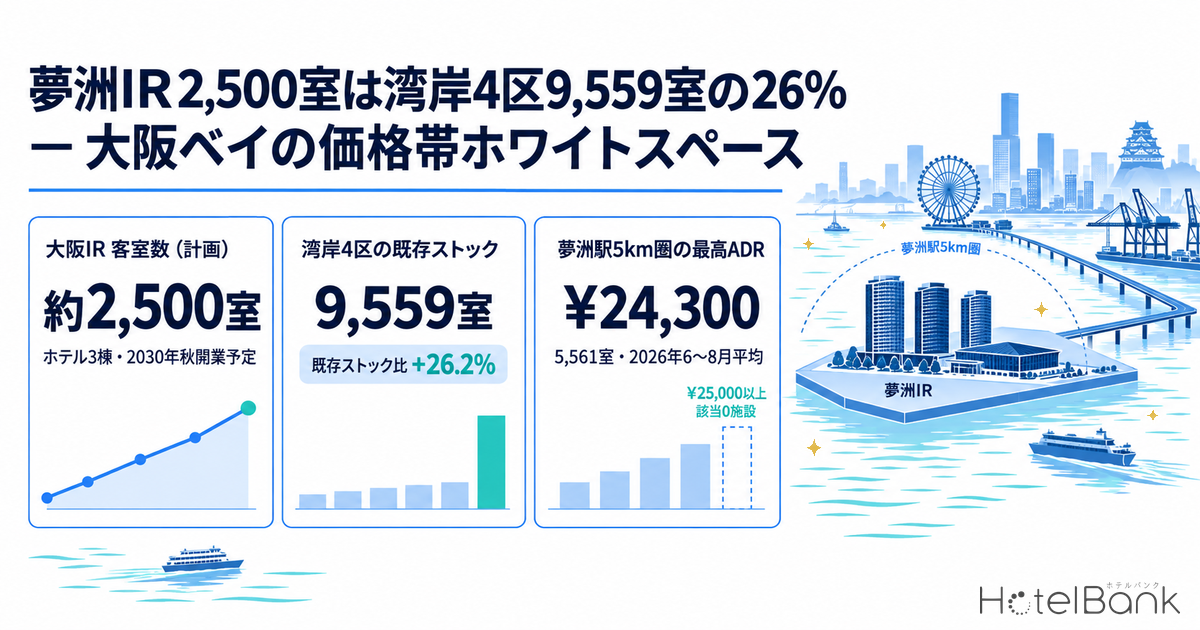
The Osaka IR (integrated resort) on Yumeshima, targeted to open in autumn 2030, will include three hotel buildings with approximately 2,500 guest rooms in total, anchored by an international convention center whose Grand Ballroom will hold more than 6,000 people. In this article, we first confirm these planned figures against official documents, then quantify the existing lodging stock in Osaka Bay by number of properties, room count and estimated settled ADR. The aim is to show how large 2,500 rooms is relative to existing stock, and which price bands are currently thin.
Metric Definitions Used in This Article
- ADR (Average Daily Rate): An estimated settled rate (tax-exclusive equivalent), calculated by applying segment-specific adjustment factors to the lowest-plan rate each property publishes on major booking sites (per room, 2 guests, tax included). Checked against property-level results disclosed by listed hotel REITs (91 properties, most recent 3 months), the median error is about 7%. These are estimates and differ from each property’s actual settled rates and accounting figures. Area-level ADR is the median of the properties covered (the level of a typical property in the area).
- Listed price: The average across all plans, per room for 2 guests (tax included). This is a separate metric from ADR.
- Data source: MetroEngines Research & Consulting
- — The Osaka IR’s three hotels, with approximately 2,500 rooms, equal 26.2% of the existing 9,559 rooms in the four bayside wards. Measured against a 5 km radius the figure is 45.0%, and against a 10 km radius 12.1%: the ratio swings more than threefold depending on the radius chosen.
- — Outside the IR, the bayside supply pipeline stands at zero projects on a building-confirmation-application basis. Across all of Osaka City there are only 4 projects with 1,042 rooms, all in central Kita and Chuo wards.
- — The highest estimated settled ADR within 5 km of Yumeshima Station is ¥24,300 (Jun–Aug 2026 average, N=20 properties). No property exceeds ¥25,000, so the upper band is currently empty.
- — The mid-sized, upscale-midscale band of 100–300 rooms × ¥15,000–¥25,000 contains just one property. The IR itself will fill only the very top corner, so this middle band may remain thin even after opening.
- — Current ADR is in a post-Expo correction phase, with Konohana Ward down 34.5% YoY (August 2026, N=13 properties). This should be read separately, in both timing and cause, from demand building toward 2030.
Osaka IR Plan Figures in Official Documents — About 2,500 Rooms and MICE Capacity of 12,000
First, we confirm the planned figures that anchor this article against official documents. According to the “Plan for the Development of the Specified Integrated Resort Area in Yumeshima, Osaka,” published by Osaka Prefecture and Osaka City, and its summary document (September 12, 2025 edition), lodging will be developed as three hotel buildings with approximately 2,500 rooms in total. The international convention facility is planned around a largest meeting room (Grand Ballroom) with a capacity of roughly 6,000 or more, with the combined capacity of all rooms used for international conferences at roughly 12,000 or more.
The opening date was revised from “around autumn–winter 2029” to “around autumn 2030” in an amended plan submitted to the national government in September 2023. At the same time, the initial investment was raised from about ¥1.08 trillion to about ¥1.27 trillion, and a further plan amendment in September 2025 raised it again to about ¥1.513 trillion to reflect higher construction material and labor costs. Construction is scheduled from April 24, 2025 to around summer 2030, with opening targeted for around autumn. On the operator’s published basis, the project expects about 20 million visitors and about ¥520 billion in revenue annually.
| Item | Published plan figure | Source |
|---|---|---|
| Lodging | 3 hotel buildings, approx. 2,500 rooms in total | Osaka Prefecture / Osaka City “Area Development Plan”; Kanko Keizai Shimbun |
| Convention center (largest room) | Capacity of roughly 6,000 or more | Osaka Prefecture “Area Development Plan” |
| Convention center (all rooms combined) | Capacity of roughly 12,000 or more | Osaka Prefecture “Area Development Plan” |
| Initial investment | Approx. ¥1.513 trillion (equity approx. ¥983 billion, borrowings approx. ¥530 billion) *Approx. ¥1.27 trillion as of the September 2023 amended plan | September 2025 Area Development Plan amendment; Kanko Keizai Shimbun |
| Construction / opening | Groundbreaking April 24, 2025; completion around summer 2030, opening planned around autumn | Osaka Prefecture documents; press reports |
| Expected visitors / revenue | Approx. 20 million per year / approx. ¥520 billion | Operator’s published figures (as reported) |
Source: Compiled by MetroEngines Research & Consulting from Osaka Prefecture’s “Plan for the Development of the Specified Integrated Resort Area in Yumeshima, Osaka” and other published documents
A point to note here is that opening is four years away from the time of writing. This article therefore does not attempt a demand forecast, and limits itself to two observable facts: the ratio to existing stock observable today, and the price bands that are thin today.
111 Properties and 9,559 Rooms in the Four Bayside Wards — 2,500 Rooms Equal 26% of Existing Stock
Next, we establish the existing stock in Osaka Bay, where the IR is located. Within the coverage of MetroEngines Research, a total of 111 properties and 9,559 rooms are registered across the four wards of Konohana, Minato, Suminoe and Taisho. By ward, Konohana, home to USJ, stands out with 51 properties and 5,376 rooms, followed by Suminoe (Sakishima) with 14 properties and 2,555 rooms, Minato (Tempozan) with 28 properties and 1,372 rooms, and Taisho with 18 properties and 256 rooms.
Against these 9,559 rooms, the IR’s three hotels with approximately 2,500 rooms represent 26.2%. A single project would add, in one step, more than a quarter of the existing stock of four wards. Narrowing the scope to a 5 km radius around Yumeshima Station, existing stock is 42 properties and 5,561 rooms, and 2,500 rooms reaches 45.0%. Conversely, widening to a 10 km radius (458 properties, 20,738 rooms) dilutes the ratio to 12.1%. In other words, “how big the IR’s impact is” swings more than threefold depending on which circle you draw.
Source: MetroEngines Research & Consulting (within MetroEngines Research coverage, N=111 properties); IR room count from Osaka Prefecture published documents
| Ward | Properties | Rooms | Est. settled ADR Aug 2026 | YoY | N (properties in ADR) |
|---|---|---|---|---|---|
| Konohana (USJ, Yumeshima) | 51 | 5,376 | ¥23,100 | −34.5% | 13 |
| Suminoe (Sakishima) | 14 | 2,555 | ¥13,100 | −26.2% | 7 |
| Minato (Tempozan) | 28 | 1,372 | ¥11,800 | −30.8% | 11 |
| Taisho | 18 | 256 | ¥9,000 | −27.8% | 2 |
| Four bayside wards, total | 111 | 9,559 | — | — | 33 |
| (Reference) Chuo Ward | — | — | ¥10,300 | −34.6% | 193 |
| (Reference) Kita Ward | — | — | ¥9,900 | −32.3% | 74 |
Source: MetroEngines Research & Consulting (estimated settled ADR for August 2026, settled-month basis. Taisho Ward has only N=2 properties and is shown for reference)
Because only two properties in Taisho Ward are included in the ADR calculation, its rate is best treated as a reference value. With just 256 rooms, the ward is also small in room terms, so in any discussion of bayside supply the effective denominator is the three wards of Konohana, Suminoe and Minato.
Location Within 5 km of Yumeshima Station — 34% Quasi-Industrial, 14% Commercial, Lodging Clustered on Three Islands
Next, we look at the geographic distribution. The map below draws concentric 5 km and 10 km circles centered on Yumeshima Station (34.6480°N, 135.3893°E) and plots the 42 existing properties within 5 km. Circle size represents room count.
Source: MetroEngines Research & Consulting (N=42 properties within 5 km of Yumeshima Station)
What the map shows is that bayside lodging inventory is not a continuous urban area but is clustered in three separate hubs: Universal City (Konohana), Tempozan (Minato) and Sakishima (Suminoe). Yumeshima itself currently has no registered lodging, so the IR will rise as a fourth hub independent of the existing clusters.
In terms of land use, aggregating zoning data from the MLIT Real Estate Information Library for the Osaka City area around Yumeshima Station gives the following mix: quasi-industrial zones are the largest at 34.0% (75 parcels at a 200% floor-area ratio and 52 at 300%), followed by Category 1 residential 16.3%, commercial 14.2% (35 parcels at 400%), Category 2 residential 9.4%, exclusively industrial 7.5% and industrial 6.1% (N=374 parcels). Quasi-industrial and industrial zoning rooted in port and logistics uses accounts for the majority, while commercial zones where larger floor areas can be built are scattered and limited. Land suitable for large-scale lodging development is not widely available, making this an area where a sizeable consolidated block is scarce when it does come to market.
Source: Compiled by MetroEngines Research & Consulting from the MLIT Real Estate Information Library (zoning) (N=374 parcels)
On land prices, official land price data show Konohana Ward up 5.92% year on year and Minato Ward up 6.46%, among the higher growth rates in Osaka City. Demand for employee housing and offices for related companies in anticipation of the IR opening is becoming a competing factor in land acquisition beyond lodging uses, which should be factored in when estimating development costs.
Source: “[2026 Edition] Ranking of Official Land Prices in Osaka City” (Eslead JOURNAL)
Limited Bayside Supply Pipeline Beyond the IR — 4 Projects and 1,042 Rooms in Osaka City, None in the Four Bayside Wards
How much supply, then, is moving in the bayside area other than the IR? Extracting hotel construction project data for Osaka City, based on MLIT’s Building Construction Dynamics Statistics, shows 4 projects totaling 1,042 rooms as of the survey date, limited to 2 projects in Kita Ward (702 rooms) and 2 in Chuo Ward (340 rooms). No projects are currently identified in the four bayside wards of Konohana, Minato, Suminoe and Taisho.
Note, however, that these figures are on a building-confirmation-application basis, and applications are usually filed one to two years before opening. Counts for future years are therefore structurally understated. *Based on confirmation applications as of the survey date. The number of projects and rooms is expected to increase as further applications are filed; please treat these figures as a lower bound for the currently confirmed pipeline.
To see the rhythm of stock formation over a longer timeframe, we check construction starts of lodging buildings in Osaka Prefecture from the e-Stat Building Starts Statistics. The number of buildings peaked at 133 in 2017, with 472,530 ㎡ of floor area, and shrank to 14 buildings and 54,152 ㎡ in 2023. In 2024, floor area recovered to 143,401 ㎡ across 18 buildings, 2.6 times the previous year; while the building count was roughly flat, the size per project has grown. This differs in character from the 2016–2019 phase, when many small lodging facilities broke ground, and suggests development has narrowed to a small number of large projects.
Source: Compiled by MetroEngines Research & Consulting from e-Stat “Building Starts Statistics” (Statistics ID: 0003114490, Osaka Prefecture, accommodation use)
The IR’s three hotels with about 2,500 rooms are an extreme example of this “few but large” trend. Against 143,401 ㎡ of lodging floor area started across Osaka Prefecture in 2024, the IR’s total floor area is reported to be around 850,000 ㎡ (operator figures, as reported), meaning the physical scale of a single project far exceeds the prefecture’s entire annual construction starts.
Current ADR Is in a Post-Expo Correction — Konohana Down 34.5% YoY, to Be Read Separately From the Build-Up Toward 2030
We now shift from supply to demand. Estimated settled ADR for August 2026 is ¥23,100 in Konohana Ward (−34.5% YoY, N=13 properties), ¥13,100 in Suminoe Ward (−26.2%, N=7) and ¥11,800 in Minato Ward (−30.8%, N=11). Central Osaka shows the same pattern: Chuo Ward at ¥10,300 (−34.6%, N=193), Kita Ward at ¥9,900 (−32.3%, N=74), and Osaka Prefecture overall at ¥9,100 (−32.7%, N=653).
These YoY declines are the flip side of rates being pushed sharply higher during Expo 2025 Osaka, Kansai, held from April to October 2025. The current decline should be read as a level change resulting from the 2025 premium falling away, not as a sign of structural demand weakness in the bayside area. It needs to be treated as entirely separate, in both timing and cause, from demand building toward the IR opening in 2030. How the post-Expo correction deepened month by month is examined in our analysis Osaka Settled ADR June 2026: City -26.3%, Business -32.8% Post-Expo.
Source: MetroEngines Research & Consulting (Konohana Ward N=13 properties, Osaka Prefecture N=653 properties. September–December 2026 are estimates based on rates listed as of the survey date)
Konohana Ward’s ADR sits a notch above the other bayside wards because the large hotels near USJ capture leisure demand. The ward’s level, which had risen to ¥35,200 in August 2025, fell to ¥23,100 in August 2026, directly reflecting how large the Expo-period uplift was.
Sensitivity of the IR’s Share — Recasting by Radius and Additional Supply Into Three Cases
All of the ratios so far have used “existing stock observable today” as the denominator. If additional supply is added to the bayside area over the roughly four years until opening, the same 2,500 rooms will represent a smaller share. We therefore lay out how the share moves along two axes: the choice of denominator (radius) and the volume of additional non-IR supply.
*The tables below are mechanical arithmetic on observed room counts, not demand forecasts. The additional supply of +500 / +1,000 rooms uses the 4 projects totaling 1,042 rooms identified across Osaka City as a scale reference, and assumes that half or all of that volume lands in the four bayside wards.
| Denominator scope (existing rooms) | No additional supply | +500 rooms | +1,000 rooms |
|---|---|---|---|
| Within 5 km of Yumeshima Station (5,561 rooms) | 45.0% | 41.3% | 38.1% |
| Four bayside wards (9,559 rooms) | 26.2% | 24.9% | 23.7% |
| Within 10 km of Yumeshima Station (20,738 rooms) | 12.1% | 11.8% | 11.5% |
Source: Existing rooms from MetroEngines Research & Consulting (four bayside wards N=111, 5 km N=42, 10 km N=458 properties); IR rooms from Osaka Prefecture published documents. Shares calculated by MetroEngines
The takeaway is that additional supply only moves the share meaningfully when the radius is narrow. Within 5 km, +1,000 rooms moves the share 6.9 points, from 45.0% to 38.1%, while within 10 km it moves only 0.6 points, from 12.1% to 11.5%. Scope must be stated explicitly when discussing bayside supply because not only the level itself but also its sensitivity to additional supply changes with the scope.
Recasting the same calculation as bayside four-ward stock in 2030 gives the following three cases.
| Case | Assumption | Rooms in 2030 | Increase vs today |
|---|---|---|---|
| Conservative | Non-IR bayside supply stays at zero (= in line with the currently identified pipeline) | 12,059 rooms | +26.2% |
| Mid | +500 rooms in the four bayside wards (half of Osaka City’s planned volume) | 12,559 rooms | +31.4% |
| Upside | +1,000 rooms in the four bayside wards (all of Osaka City’s planned volume) | 13,059 rooms | +36.6% |
Source: Current rooms from MetroEngines Research & Consulting (four bayside wards N=111 properties); IR rooms from Osaka Prefecture published documents. Case figures calculated by MetroEngines
The three cases range from +26.2% to +36.6%, a spread of just over 10 points. As long as the confirmation-application pipeline in the bayside area is zero, the increase in bayside stock by 2030 is determined almost entirely by the IR itself, and this holds even when additional supply is placed on the upside. Put differently, what should be debated within this range is not total volume but the positioning of price bands, which we examine in the next section.
Highest ADR Within 5 km Is ¥24,300 — The Band Above ¥25,000 Estimated Settled ADR Is Currently Empty
This is the core of the article. Of the 42 properties within 5 km of Yumeshima Station, estimated settled ADR for the most recent three months (June–August 2026) could be calculated for 20. Arranging these 20 properties by price band gives the following distribution.
| Est. settled ADR band | Properties | Rooms | Typical property profile |
|---|---|---|---|
| ¥25,000 and above | 0 | 0 | None |
| ¥20,000–24,999 | 4 | 2,599 | Large hotels directly in front of USJ (598–760 rooms) |
| ¥15,000–19,999 | 4 | 241 | Small to mid-sized design and resort properties |
| ¥10,000–14,999 | 6 | 1,014 | Mid-sized hotels in Sakishima and Tempozan |
| Below ¥10,000 | 6 | 929 | Training facilities, lodging-focused hotels, simple lodgings |
| Total | 20 | 4,783 | — |
Source: MetroEngines Research & Consulting (the 20 properties within 5 km of Yumeshima Station for which estimated settled ADR could be calculated; Jun–Aug 2026 average)
The highest estimated settled ADR within 5 km is ¥24,300, and not a single property exceeds ¥25,000. Moreover, the four properties reaching the ¥20,000s all depend on the special location directly in front of USJ, and are skewed toward large room counts of 598–760. The combination of a mid-sized property commanding an upscale rate has barely taken hold in the bayside area.
Source: MetroEngines Research & Consulting (N=20 properties; bubble size = room count. Blue box = empty band WS1, navy box = thin band WS2)
CrowdedOccupied zone
¥8,000–¥15,000 × 200–400 rooms
The band where mid-sized hotels in Sakishima and Tempozan overlap. Built around training, group and business demand, with limited room for new entrants to differentiate.
WS1Upper-midscale to upper tier
Estimated settled ADR of ¥25,000 and above
Zero properties within 5 km. The price band sought by MICE-related demand and international conference organizers does not currently exist in the bayside area.
WS2Mid-sized × upscale midscale
100–300 rooms × ¥15,000–¥25,000
Only one property (128 rooms, ¥17,900). The range that combines scale economies with rate is thin.
The IR’s three hotels are expected to sit at the upper end of this empty band. Conversely, the IR itself will fill only the very top corner, and WS2, the mid-sized upscale-midscale band of “100–300 rooms × ¥15,000–¥25,000”, may remain thin even after the IR opens. Once a MICE facility anchored by a Grand Ballroom for more than 6,000 people is operating, organizers, exhibitors and accompanying staff will need a range of price points. There is room for supply in this middle band as a receptacle for demand that a single top tier cannot absorb.
The geographic feature of bayside inventory being split across three islands also affects price-band design. With access to Yumeshima effectively concentrated on a single rail line, how to translate a location that is “close to the IR but on a different island” into price becomes a key question for operators in the three existing hubs. The available moves differ by hub: pairing with leisure demand on the Universal City side, combining with the MICE cluster around Cosmosquare on the Sakishima side, and connecting with tourist flows on the Tempozan side. Where large developments underway on the Universal City side, such as IHG’s 817-room project on Sakurajima next to USJ, will land in terms of price band is another point to watch.
Summary — Framing the IR in Ratios and Ranges
To sum up the facts confirmed in this article: first, the Osaka IR’s approximately 2,500 rooms equal 26.2% of the existing 9,559 rooms in the four bayside wards, 45.0% of the 5,561 rooms within 5 km of Yumeshima Station, and 12.1% of the 20,738 rooms within 10 km. Because the size of the impact varies greatly with the radius chosen, the scope should always be stated explicitly in any discussion.
Second, the bayside supply pipeline outside the IR is currently zero on a building-confirmation-application basis. Across Osaka City there are only 4 projects with 1,042 rooms, all in central Kita and Chuo wards. However, because confirmation applications are filed one to two years before opening, this figure should be read as a lower bound.
Third, current ADR is in a post-Expo correction phase, down roughly 30% YoY in both bayside and central areas. This is the 2025 premium falling away and needs to be read separately from demand formation toward 2030.
And fourth, the highest estimated settled ADR within 5 km of Yumeshima Station is ¥24,300, the band above ¥25,000 is empty, and the mid-sized upscale-midscale band of 100–300 rooms × ¥15,000–¥25,000 contains just one property. Given the four-year horizon to opening, it is more practical to start from these stock ratios and price-band ranges than from a definitive demand forecast.
⚠ Note on ADR for future dates: ADR figures in this article for September 2026 onward are estimates based on selling prices published on major booking sites as of the survey date, and will change as check-in dates approach. Please note that current levels may not necessarily be realized.
References and Sources
■ Data Sources
Property and room counts are registered inventory within the coverage of MetroEngines Research & Consulting (four bayside wards N=111 properties, within 5 km of Yumeshima Station N=42, within 10 km N=458). Estimated settled ADR is calculated by applying segment-specific adjustment factors to public rates on major booking sites; ward-level figures are for August 2026 on a settled-month basis, and property-level figures within 5 km are June–August 2026 averages. IR plan figures are from Osaka Prefecture and Osaka City published documents; the supply pipeline is from MLIT’s “Building Construction Dynamics Statistics” and e-Stat’s “Building Starts Statistics”; zoning is from the MLIT Real Estate Information Library (N=374 parcels).
■ Calculation Assumptions
The IR share is a mechanical ratio calculated as “approx. 2,500 rooms ÷ existing rooms in each scope,” not a demand forecast. The additional supply (+500 / +1,000 rooms) in the sensitivity table and three-case comparison uses the 4 projects totaling 1,042 rooms identified across Osaka City as a scale reference, and provisionally assumes half or all of that volume lands in the four bayside wards. All YoY comparisons use the same area and the same aggregation conditions, and area-level ADR is the median of the properties covered (the level of a typical property in the area).
■ Limitations and Caveats
(1) Estimated settled ADR is an estimate and differs from each property’s actual settled rates and accounting figures (median error of about 7% when checked against property-level results disclosed by listed hotel REITs, 91 properties over the most recent 3 months). (2) Taisho Ward has only N=2 properties in the ADR calculation and is treated as a reference value. (3) The supply pipeline is on a building-confirmation-application basis; applications are usually filed one to two years before opening, so future years are structurally understated and represent a lower bound. (4) With about four years until opening, this article does not attempt a demand forecast and is limited to observable stock ratios and price-band ranges. (5) ADR for September 2026 onward is estimated from rates listed as of the survey date and will change as check-in dates approach.
■ Market Data
- MetroEngines Research & Consulting — Estimated settled ADR (Konohana N=13 / Minato N=11 / Suminoe N=7 / Taisho N=2 / Chuo N=193 / Kita N=74 / Osaka Prefecture N=653); properties and rooms by area (four bayside wards N=111, within 5 km of Yumeshima Station N=42, within 10 km N=458)
■ Government and Municipal Publications
- Osaka Prefecture, Osaka City and Osaka IR KK, “Plan for the Development of the Specified Integrated Resort Area in Yumeshima, Osaka” (April 19, 2024) (Japanese)
- Osaka Prefecture, Osaka City and MGM Osaka KK, “On the Plan for the Development of the Specified Integrated Resort Area in Yumeshima, Osaka (Summary)” (September 12, 2025) (Japanese)
- Osaka Prefecture IR Promotion Bureau, “Osaka IR (Integrated Resort) Briefing: Staff Presentation Script” (Japanese)
- e-Stat “Building Starts Statistics” (Statistics ID: 0003114490, Osaka Prefecture, accommodation use, 2011–2024)
- MLIT Real Estate Information Library (zoning; Osaka City area N=374 parcels)
- MLIT “Building Construction Dynamics Statistics” (hotel construction projects; Osaka City, 4 projects totaling 1,042 rooms)
■ Press and Industry Sources
- “Osaka IR to Open in Autumn 2030; Amended Plan Submitted to National Government” (Kanko Keizai Shimbun, September 21, 2023) (Japanese)
- “Osaka IR Breaks Ground on Yumeshima — Full-Scale Start Toward Autumn 2030 Opening” (MICE TIMES ONLINE) (Japanese)
- JLL, “Osaka’s IR Area Development Plan Approved — Rising Expectations for the Osaka Market” (Japanese)
- “[2026 Edition] Ranking of Official Land Prices in Osaka City” (Eslead JOURNAL) (Japanese)