

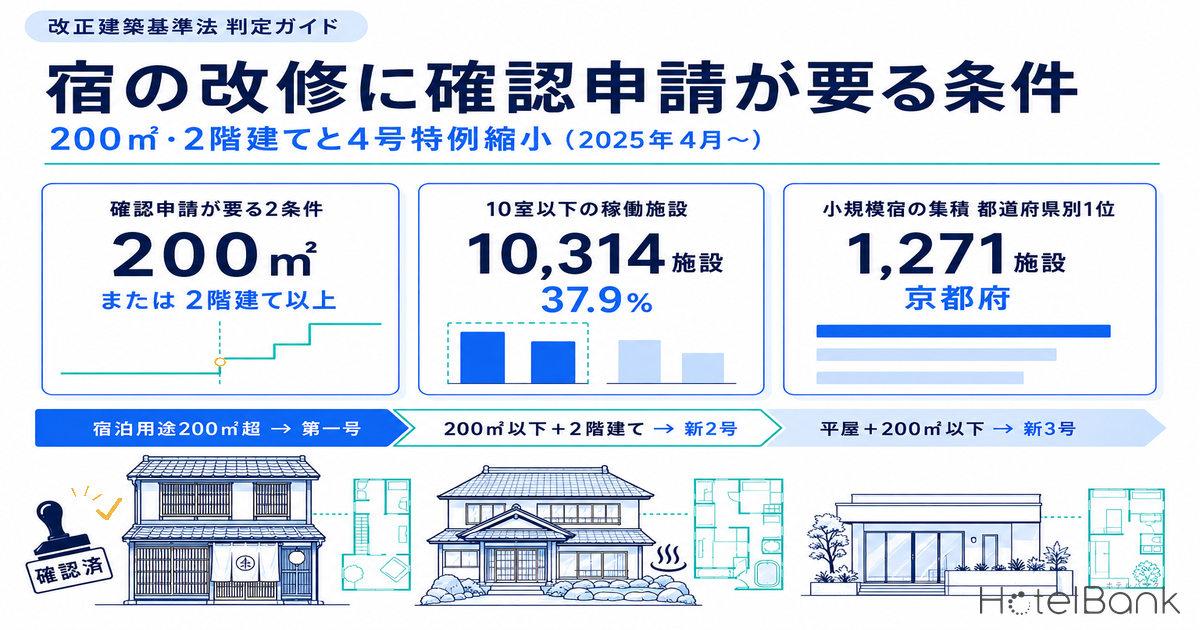
Turning a traditional kominka farmhouse into an inn, converting a vacant house into a whole-house rental, renovating a small aging ryokan to lift its room rates — in recent years a substantial share of new lodging supply in regional Japan has come from exactly this kind of “reworking of existing buildings.” But the amended Building Standards Act (建築基準法), fully in force since April 1, 2025, has sharply changed the procedural cost of that reworking depending on building size. Two conditions are key: the figure “200㎡” and whether the building has “two or more stories.”
Metric Definitions Used in This Article
- ADR (Average Daily Rate): An estimated settled rate (tax-excluded equivalent), calculated by applying category-specific adjustment factors to the lowest-plan price level each property publishes on OTAs and elsewhere (2 guests per room, per-room price, tax included). Checked against property-level results disclosed by listed hotel REITs (91 properties, most recent 3 months), the median error is about 7%. These are estimates and differ from each property’s actual transaction prices and accounting figures. Area-level ADR is the median of the properties covered (the level of a typical property in the area).
- Property and room counts: Of the roughly 168,000 properties in Japan tracked by MetroEngines Research, the population is the approximately 27,000 properties confirmed as operating on OTAs. Ryokan, minshuku and simple lodging houses not listed on OTAs are not included.
- Legal descriptions: Articles of the Building Standards Act are based on the current text in e-Gov Law Search; details of the amendment are based on the Ministry of Land, Infrastructure, Transport and Tourism (MLIT) explanatory materials on the legal framework. Whether the rules apply to a specific project depends on the judgment of the competent designated administrative agency or designated confirmation and inspection body.
- — There are two “200㎡ walls.” If the portion used for lodging exceeds 200㎡, the building is a Category 1 building, and major repairs and major remodeling already required a building confirmation application before the amendment. The band newly affected by the amendment is 200㎡ and under.
- — Two-story wooden buildings moved into the new Category 2. Even with 200㎡ or less of lodging use, a building with two or more stories (or total floor area over 200㎡) has required a confirmation application for major repairs and remodeling since April 2025 — regardless of whether it lies inside or outside a planning area.
- — 37.9% of 27,249 operating properties have 10 rooms or fewer. That is 10,314 properties, concentrated in specific areas: Kyoto 1,271, Okinawa 802 and Nagano 680.
- — This is a supply channel that has not shown up in statistics. Among building plans that include lodging use, those of 200㎡ or less make up just 1.1% (45 cases) of new construction; most small-scale renovations have come through channels that required no confirmation application.
- — More procedures, but a wider range of projects can now get through. The same amendment streamlined retroactive application of current rules to non-conforming existing buildings, exempting major repairs and remodeling from the road-frontage requirement and the restriction on building within roads.
First, the Structure of the Law — Three Categories Determine Whether a Confirmation Application Is Needed
Article 6, Paragraph 1 of the Building Standards Act defines the buildings that require building confirmation in three categories, Items 1 through 3. The amendment fully in force since April 2025 rewrote those categories themselves. The current text reads as follows.
Article 6, Paragraph 1 When a building owner intends to construct a building listed in Item 1 or Item 2 (omitted), intends to carry out major repairs or major remodeling of such a building, or intends to construct a building listed in Item 3, the owner must, before starting the work, (omitted) submit an application for confirmation, obtain confirmation from a building official or deputy building official (omitted), and receive a certificate of confirmation.
Item 1 Special buildings used for the purposes listed in column (i) of Appended Table 1, where the total floor area of the portion used for such purpose exceeds 200 square meters
Item 2 Buildings other than those listed in the preceding item that have two or more stories or a total floor area exceeding 200 square meters
Item 3 Buildings other than those listed in the preceding two items that are located within a city planning area or quasi-city planning area (omitted)
Source: e-Gov Law Search, “Building Standards Act (Act No. 201 of 1950),” current text (unofficial translation by HotelBank)
Two points stand out. First, major repairs and major remodeling are subject to confirmation only for Items 1 and 2; Item 3 mentions only “intends to construct.” Second, the amendment rewrote Item 2 as “buildings that have two or more stories or a total floor area exceeding 200 square meters,” eliminating the distinction between wooden and non-wooden construction.
Before the amendment, wooden buildings with “two stories or fewer, total floor area of 500㎡ or less, height of 13m or less and eaves height of 9m or less” were classified under the old Item 4, and if designed by a licensed architect, review of structural and related provisions was omitted. This was the so-called “Item 4 exemption” (4号特例). Moreover, major repairs and remodeling of old Item 4 buildings were not subject to confirmation at all. MLIT’s explanatory materials summarize the framework of the amendment this way: “Buildings exempt from building confirmation and inspection will be, regardless of wooden or non-wooden construction, single-story buildings with a total floor area of 200㎡ or less located outside city planning areas and similar zones,” and “Buildings for which review of structural and related provisions is omitted will be, regardless of wooden or non-wooden construction, single-story buildings with a total floor area of 200㎡ or less located inside city planning areas and similar zones (new Category 3 buildings).”
In other words, the two-story wooden building — the most common form of small building in Japan — moved from the old Item 4 to the new Item 2 (new Category 2 buildings). Not only was the review exemption removed; major repairs and remodeling were newly brought within the scope of confirmation. Under Article 6-4, Paragraph 1, Item 3, the review exemption now remains only for “buildings listed in Article 6, Paragraph 1, Item 3 that are designed by a licensed architect” — that is, new Category 3 buildings that are single-story and 200㎡ or less.
There Are Two “200㎡ Walls” — For Lodging, Item 1 Applies First
This is the point most easily misread. For lodging facilities, “200㎡” appears in two different contexts with different meanings.
The first is the 200㎡ in Item 1. Hotels and ryokan are special buildings listed in Appended Table 1, column (i), row (2) of the Building Standards Act: “hospitals, clinics (limited to those with facilities for accommodating patients), hotels, ryokan, boarding houses, apartment buildings, dormitories and other similar buildings specified by Cabinet Order.” If the total floor area of the portion used for that purpose exceeds 200㎡, the building falls under Item 1. Item 1 buildings were subject to confirmation even before the amendment, not only for construction but also for major repairs and remodeling. Accordingly, for facilities whose lodging portion exceeds 200㎡, the 2025 amendment added no new procedures. Describing this band as “newly regulated by the amendment” would be incorrect.
The second is the 200㎡ in Item 2. Item 2 begins “other than those listed in the preceding item,” so it only comes into play for buildings whose lodging portion is 200㎡ or less and that do not fall under Item 1. Here the test is not the use portion but the total floor area of the entire building and the number of stories; a building meeting either “two or more stories” or “total floor area over 200㎡” becomes a new Category 2 building.
Overlaying these two walls identifies the band newly affected by the April 2025 amendment: buildings whose lodging portion is 200㎡ or less and that have two or more stories (or total floor area over 200㎡) — two-story wooden kominka and machiya townhouses, whole-house rentals converted from two-story vacant homes, and small ryokan with a handful of rooms. These are precisely the core formats of renovation- and conversion-type lodging. Before the amendment, major repairs and remodeling in this band required no confirmation application; after it, they do.
| Building category (from April 2025) | Typical examples | New construction / extension / reconstruction | Major repairs / remodeling | Structural review exemption |
|---|---|---|---|---|
| Item 1 Lodging portion over 200㎡ |
Mid-size and larger ryokan and hotels, large whole-house rentals | Required | Required (already before the amendment) |
None |
| Item 2 (new Category 2) Other buildings with two or more stories or total floor area over 200㎡ |
Two-story wooden kominka inns and machiya, whole-house rentals converted from two-story vacant homes |
Required | Required (newly covered by the amendment) |
Abolished |
| Item 3 (new Category 3) Single-story, total floor area 200㎡ or less (inside city planning areas etc.) |
Single-story cottages, small single-story guesthouses | Required | Not required | Yes (if designed by a licensed architect) |
| Single-story, 200㎡ or less, outside planning areas | Single-story huts and buildings outside city planning areas etc. | Not required | Not required | — |
Source: Compiled by HotelBank Editorial Team from Building Standards Act Article 6, Paragraph 1 and Article 6-4, and MLIT “Explanatory Materials on the Amended Building Standards Act and Building Energy Efficiency Act”
Note that Items 1 and 2 carry no geographic limitation. Only Item 3 limits itself to “buildings located within a city planning area or quasi-city planning area (omitted).” Even a kominka in a mountain area far outside any urbanization zone becomes a new Category 2 building subject to confirmation nationwide if it has two stories — a point easily overlooked when considering conversions in regional Japan.
What Counts as “Major Repairs”? — Work on More Than Half of One or More Types of Principal Building Parts
What determines whether procedures are needed is neither the cost of the work nor how dramatic it looks, but the definitions in Article 2 of the Act. Item 14 defines major repairs as “repairs carried out on more than half of one or more types of the principal building parts of a building,” and Item 15 defines major remodeling as “remodeling carried out on more than half of one or more types of the principal building parts of a building.” Item 5 defines principal building parts as “walls, columns, floors, beams, roofs or stairs, excluding structurally unimportant partition walls, studs, attached columns, raised floors, lowest-story floors, revolving-stage floors, small beams, eaves, localized small stairs, exterior stairs and other similar building parts.”
The practical implications are clear. Interior-focused renovations such as replacing wallpaper, swapping out plumbing fixtures or refurnishing throughout do not count as major repairs as long as the principal building parts are untouched. On the other hand, work common in kominka restoration — full re-roofing, rebuilding more than half of the exterior walls, redoing most of the floor framing, or replacing stairs — can qualify if it covers more than half of any one type of principal building part. The more thorough the restoration, especially with insulation upgrades or seismic reinforcement, the more likely it is to cross this line.
It also matters that the test turns on two phrases: “one or more types” and “more than half.” Roofs alone, or exterior walls alone, are enough if the work covers more than half of that one type. A plan that touches several parts a little at a time and a plan that fully reworks one part can reach different procedural conclusions even at the same construction cost. For the decision of whether to pursue renovation that reaches principal building parts or to shift to rebuilding, see also Japan’s Pre-1981 Hotel Stock: 236k Rooms, 19.1% — Retrofit or Rebuild.
How Large Is the Affected Band? — Room-Size Distribution of 27,249 Operating Properties
So how many lodging properties could be touched by this line? Of the roughly 168,000 properties in Japan tracked by MetroEngines Research, 27,249 are confirmed as operating on OTAs (as of September 2026). Broken down by room-count band, they look like this.
Source: Compiled by HotelBank Editorial Team from MetroEngines Research (N=27,249 properties)
Properties with 5 rooms or fewer number 4,799 (17.6%), and widening to 10 rooms or fewer gives 10,314 (37.9%). By this count, nearly 40% of operating lodging properties fall in the small band of 10 rooms or fewer. Floor area varies by property, so room count cannot uniquely determine how the law applies, but many properties with 5 rooms or fewer have a lodging portion of around 200㎡ or less and take the form of two-story wooden buildings. In other words, this is the band most likely to fall outside Item 1 and into new Category 2.
Looking inside this band by property type, formats originating from renovation and conversion rank near the top.
| Property type | 1–5 rooms | 6–10 rooms | Total, 10 rooms or fewer |
|---|---|---|---|
| Ryokan | 504 | 2,179 | 2,683 |
| Pension | 459 | 1,143 | 1,602 |
| Minshuku | 583 | 863 | 1,446 |
| Guesthouse | 880 | 326 | 1,206 |
| Vacation rental | 732 | 58 | 790 |
| Machiya | 637 | 20 | 657 |
| Hostel | 333 | 185 | 518 |
| Cottage | 215 | 98 | 313 |
Source: Compiled by HotelBank Editorial Team from MetroEngines Research (operating properties, as of September 2026)
Of 657 machiya properties, 637 (97.0%) have 5 rooms or fewer, and of 790 vacation rentals, 732 (92.7%) do — a composition that is essentially the conversion of existing housing stock. Ryokan, meanwhile, include 2,683 properties with 10 rooms or fewer, 34.6% of all 7,753 ryokan. Investments that buy and renovate long-established small ryokan sit on the same line.
Where Are Small Properties Concentrated? — Kyoto, Okinawa and Nagano Account for About One-Fifth Nationally
Small lodging is not evenly spread across Japan. Narrowing to 10 property types — machiya, guesthouses, vacation rentals, minshuku, pensions, cottages, hostels, dormitories, farm stays and lodges — and counting properties with 10 rooms or fewer by prefecture reveals a strong skew toward the top.
Source: Compiled by HotelBank Editorial Team from MetroEngines Research (10 property types, 10 rooms or fewer, operating properties, N=27,249 properties, as of September 2026)
Kyoto stands out with 1,271 properties, followed by Okinawa with 802 and Nagano with 680. These top three prefectures alone make up a large block of the national distribution of these 10 types at 10 rooms or fewer. The makeup differs — machiya renovations in Kyoto, whole-house rentals in Okinawa, pensions and mountain lodges in Nagano — but they share one trait: renovation of existing buildings is a major channel of new supply. If renovations require confirmation applications, the added steps — involving a designer, preparing structural and energy-efficiency documents, and allowing for review time — go straight onto the project schedule. The denser the concentration, the more the capacity of local design offices and confirmation bodies could become a bottleneck for new supply. Our separate stock map of machiya inns finds that 88% of Japan’s 1,537 machiya lodging properties are concentrated in Kyoto.
Small ryokan draw a different map. Counting only ryokan with 10 rooms or fewer, the list is led by prefectures with hot spring towns: Shizuoka 199, Oita 178, Nagano 157, Gifu 125, Kanagawa 121 and Hyogo 119. Because the clusters of machiya and whole-house rentals do not overlap with the clusters of ryokan, it is closer to reality to expect the impact to be concentrated not in “tourist areas in general” but in “specific areas with dense small-lodging stock.”
Invisible in Supply Pipeline Statistics — Small Renovations Are Around 1% of Building Plans
Another feature of supply in this band is its low statistical visibility. Splitting building-plan data based on MLIT’s “Building Construction Statistics” (建築物動態統計調査) — plans that include hotel or lodging use — by floor-area band produces an extremely skewed composition.
Source: Compiled by MetroEngines Research & Consulting from MLIT “Building Construction Statistics” (only plans with recorded floor area)
Among new-construction plans, 3,631 of the 3,980 with recorded floor area (91.2%) exceed 500㎡, while only 45 (1.1%) are 200㎡ or less. Among non-new-construction plans such as extensions, reconstructions and changes of use (217 cases), 167 of the 189 with known floor area (88.4%) exceed 500㎡, and just 12 are 200㎡ or less.
This does not mean “small lodging supply is actually scarce.” Quite the opposite: set against the fact that 37.9% of operating properties have 10 rooms or fewer, the natural reading is that most supply in the small band has come through channels that don’t appear in building-plan statistics — renovations that required no confirmation application. The April 2025 amendment works to pull part of this hard-to-see supply channel into the visible procedure of confirmation applications.
For practitioners this means higher procedural costs, but for those forecasting supply it means part of the small renovations that sat outside the statistics will start appearing in plan data. That said, future years in the building-plan data are based on confirmation applications, and counts are expected to rise as more applications are added. Current figures should be read as a lower bound of the confirmed pipeline.
Retroactive Application to Non-Conforming Buildings Was Streamlined at the Same Time
Seeing the amendment only as a heavier procedural burden captures just one side. The same series of legal amendments streamlined the retroactive application of current standards when renovating non-conforming existing buildings.
According to MLIT’s explanatory materials, when extending, reconstructing, carrying out major repairs or remodeling, or changing the use of a non-conforming existing building, the entire building was in principle required to conform to current standards, including fire-protection and evacuation provisions and zoning-related provisions for parts spatially and functionally unrelated to the work. In response to criticism that this imposed heavy time and cost burdens on owners, amendments to Articles 86-7 and 87 introduced the following streamlining.
| What was streamlined | Scope of work covered |
|---|---|
| Fire-protection and fire-compartment provisions exempted from retroactive application | Major repairs and remodeling of roofs and exterior walls deemed not to reduce fire and evacuation safety, small extensions and reconstructions (around 50㎡ or less), etc. |
| Road-frontage requirement and restriction on building within roads exempted from retroactive application | Major repairs and major remodeling deemed not to increase the impact on the urban environment |
| For buildings divided into separate wings, retroactive application limited to the relevant wing | Portions separated by highly fire-resistant walls or by connecting corridors with sufficient separation distance |
| Corridor and other evacuation provisions, interior finish restrictions and building-material quality provisions applied only to the extended portion | The portion being extended, etc. |
Source: Compiled by HotelBank Editorial Team from MLIT “Explanatory Materials on the Amended Building Standards Act and Building Energy Efficiency Act” (September 2024)
The second item, the streamlining of the road-frontage requirement, is especially significant for projects turning machiya at the end of narrow alleys, or other existing buildings that do not meet current frontage rules, into lodging. Cases where a plan previously failed on this single point may now have a path forward, within the scope of major repairs and remodeling. In exchange for requiring confirmation applications, the range of projects that can be approved once an application is filed has widened — that is the most accurate way to understand the overall picture. For historic buildings, a separate route also exists: exemption ordinances based on Article 3, Paragraph 1, Item 3 of the Act, under which municipalities can exclude designated historic buildings from the Act’s application.
The 200㎡ for Change of Use Is a Separate Matter — The Scope of Article 87
In conversions, change-of-use procedures are also an issue. Article 87, Paragraph 1 of the Act provides that “when changing the use of a building so that it becomes any of the special buildings under Article 6, Paragraph 1, Item 1 (excluding changes between similar uses designated by Cabinet Order), the provisions of that article (omitted) apply mutatis mutandis.”
The provision applies only to Item 1. Accordingly, even when converting a house into lodging, if the total floor area of the portion used for lodging is 200㎡ or less, no confirmation application is required as a change of use. This did not change with the 2025 amendment. The two are often confused in practice, but “the 200㎡ for change of use” and “the 200㎡ of total floor area used to determine new Category 2” are different tests: the former looks at the floor area of the use portion, the latter at the total floor area of the whole building.
As a result, a two-story wooden project converting a house into lodging of 200㎡ or less can end up with a seemingly contradictory combination: no confirmation application for change of use, but a confirmation application for major repairs if the renovation covers more than half of a principal building part. Designing the work to stay below half of any principal building part avoids the procedure, while seriously upgrading seismic or insulation performance puts the project on the application side. If the path is not chosen at the early design stage, backtracking is expensive. Whether a business license can be obtained and how the specific use is treated depend on the competent designated administrative agency and public health center, so early prior consultation is a prerequisite.
The Payback Environment for Renovation Investment — Rate Levels in Prefectures With Many Small Ryokan
More procedures mean added design fees and review time in the renovation budget. What about the payback side? For prefectures with dense clusters of small ryokan, we compared the estimated settled ADR of the ryokan category year over year.
| Prefecture | Ryokan with 10 rooms or fewer | Aug 2025 ADR | Aug 2026 ADR | YoY |
|---|---|---|---|---|
| Shizuoka | 199 | ¥22,400 | ¥21,500 | -4.0% |
| Oita | 178 | ¥18,700 | ¥17,900 | -3.9% |
| Nagano | 157 | ¥14,400 | ¥14,500 | +1.1% |
| Gifu | 125 | ¥16,400 | ¥16,500 | +0.8% |
| Hyogo | 119 | — | — | — |
| Gunma | 116 | ¥17,500 | ¥18,100 | +3.3% |
| Kyoto | 105 | ¥21,000 | ¥19,700 | -6.3% |
Source: Compiled by HotelBank Editorial Team from MetroEngines Research (ryokan category, prefecture medians; N=Shizuoka 463 / Oita 317 / Nagano 515 / Gifu 234 / Gunma 278 / Kyoto 202 properties)
The direction of rates splits by prefecture. Nagano, Gifu and Gunma stayed positive year over year, while Shizuoka, Oita and Kyoto ended negative. Whether the environment lets renovation-driven value gains show up in rates must be judged area by area, not nationwide, as these results show. If a plan assumes that the added procedural cost will be absorbed by passing it through to rates, the business plan should be built after checking the rate trend at the prefecture level.
Conversely, areas where rates are holding flat or rising provide fertile ground for recovering renovation investment. Each of the six prefectures above has a cluster of 100 or more small ryokan, so in terms of existing stock depth, the pool of renovation projects is large. For capital providers, a framework that looks at a project’s physical conditions (number of stories, total floor area, floor area of the lodging portion) together with the rate environment of its prefecture becomes effective.
Summary — Only Three Numbers Are Needed to Decide
From April 2025, whether renovating a small lodging property requires a confirmation application can be sorted out by checking three points in order.
First, does the floor area of the portion used for lodging exceed 200㎡? If so, it is an Item 1 building, and both construction and major repairs/remodeling were already subject to confirmation before the amendment. This band is unaffected by the amendment.
Second, if 200㎡ or less, does the building have two or more stories, or a total floor area over 200㎡? If either applies, it is a new Category 2 building, and major repairs and remodeling are now newly subject to confirmation — whether inside or outside planning areas.
Third, does the planned work cover more than half of one or more types of principal building parts (walls, columns, floors, beams, roofs, stairs)? If not, it does not count as major repairs or remodeling.
| Step | Number to check | Legal basis | Conclusion |
|---|---|---|---|
| 1 | Does the floor area of the portion used for lodging exceed 200㎡? | Art. 6(1)(i), Appended Table 1 (i)(2) | If so, an Item 1 building. Confirmation was already required before the amendment; no change from the 2025 amendment |
| 2 | If 200㎡ or less, does the building have two or more stories, or a total floor area over 200㎡? | Art. 6(1)(ii) | If either applies, a new Category 2 building. From April 2025, major repairs and remodeling are newly subject to confirmation, inside or outside planning areas |
| 3 | Does the work cover more than half of one or more types of principal building parts (walls, columns, floors, beams, roofs, stairs)? | Art. 2, Items 5, 14 and 15 | If not, it is not major repairs or remodeling, and no confirmation application is required even if steps 1 or 2 apply |
| Reference | For a change of use, does the floor area of the lodging portion exceed 200㎡? | Art. 87(1) | If 200㎡ or less, no confirmation application is required as a change of use. This is a separate test from steps 2 and 3 above and was not changed by the 2025 amendment |
Source: Compiled by HotelBank Editorial Team from Building Standards Act Articles 2, 6(1), 6-4 and 87 (e-Gov Law Search, current text) and MLIT “Explanatory Materials on the Amended Building Standards Act and Building Energy Efficiency Act” (September 2024)
A substantial share of operating lodging properties falls into the band decided by these three points. Properties with 10 rooms or fewer number 10,314, or 37.9% of the total, concentrated in specific areas led by Kyoto, Okinawa and Nagano. At the same time, retroactive application to non-conforming existing buildings has been streamlined, including the road-frontage requirement, so the range of projects that can get through has widened as the procedural entry points increased. Fix the number of stories and floor areas early in renovation planning, and make how far to touch principal building parts an explicit design decision — that is the practical starting point common to renovation-type lodging businesses from April 2025 onward.
This article is a general overview based on published materials; whether the law applies to an individual project depends on the judgment of the competent designated administrative agency and designated confirmation and inspection body. Please read it on the assumption that you will consult a licensed architect and the competent authority early in planning.
Related Reading
References and Sources
■ Legislation (primary sources)
- e-Gov Law Search, “Building Standards Act” (Act No. 201 of 1950), current text — Article 2, Items 5, 14 and 15; Article 6, Paragraph 1; Article 6-4; Article 87; Appended Table 1
■ Government materials
- MLIT Housing Bureau, “Explanatory Materials on the Amended Building Standards Act and Building Energy Efficiency Act” (September 2024, Japanese)
- MLIT Housing Bureau, “On the Amended Building Standards Act” (Japanese)
- MLIT, “Review of the ‘Item 4 Exemption’: Three Key Points” (Japanese)
- MLIT, “Explanatory Materials and Q&A on the Amended Building Energy Efficiency Act and Building Standards Act” (Japanese)
- MLIT, “Building Construction Statistics” — floor-area band composition of building plans
■ Data sources
Legal descriptions are based on the current text of the Building Standards Act in e-Gov Law Search, and details of the amendment on the MLIT Housing Bureau’s explanatory materials (September 2024). The distributions of property counts, room-size bands, property types and locations use as their population the 27,249 properties confirmed as operating on OTAs (as of September 2026), out of the roughly 168,000 properties in Japan tracked by MetroEngines Research. Estimated settled ADR is the median for the ryokan category by prefecture (August 2025: N=Shizuoka 439 / Oita 307 / Nagano 511 / Gifu 230 / Gunma 268 / Kyoto 195 properties; August 2026: N=Shizuoka 463 / Oita 317 / Nagano 515 / Gifu 234 / Gunma 278 / Kyoto 202 properties). The floor-area band composition of building plans is from MLIT’s “Building Construction Statistics.”
■ Calculation assumptions
Room-size bands were tallied in four groups — 1–5 rooms, 6–10 rooms, 11–20 rooms and 21 rooms or more — with “10 rooms or fewer” being the sum of 1–5 and 6–10 rooms. The prefecture tally of small lodging is limited to 10 property types: machiya, guesthouses, vacation rentals, minshuku, pensions, cottages, hostels, dormitories, farm stays and lodges. Estimated settled ADR is an estimated settled rate (tax-excluded equivalent) derived by applying category-specific adjustment factors to each property’s published lowest-plan price level (2 guests per room, per-room price, tax included); YoY compares medians for the same prefecture and the same property type.
■ Limitations and caveats
Floor area and number of stories cannot be uniquely derived from room counts, so the size-band distributions in this article are reference values indicating the size of the band that may be affected, not the result of determining legal applicability. The population is limited to properties confirmed as operating on OTAs and excludes ryokan, minshuku and simple lodging houses not listed on OTAs. ADR figures are estimates and differ from each property’s actual transaction prices and accounting figures. The most recent years of building-plan data are based on confirmation applications, and counts will rise as applications are added, so current figures must be read as a lower bound of the confirmed pipeline. Whether the law applies to an individual project depends on the judgment of the competent designated administrative agency and designated confirmation and inspection body.
■ Market data
- MetroEngines Research — room-size, property-type and location distributions of 27,249 operating properties; estimated settled ADR for the ryokan category (prefecture medians)