

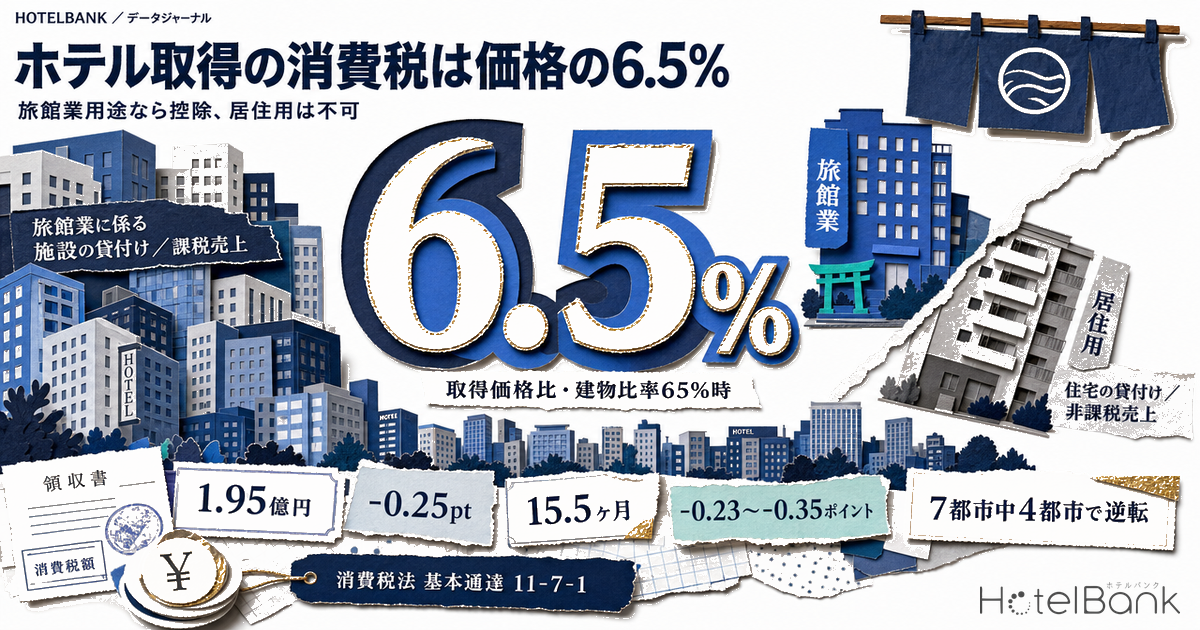
When you acquire a hotel in Japan, the building portion of the purchase price carries 10% consumption tax. On a property with a 65% building ratio, consumption tax alone comes to 6.5% of the acquisition price. On a ¥3.0 billion deal that is ¥195 million; on a ¥5.0 billion deal, ¥325 million — and it leaves as cash on the settlement date. Whether that money can be recovered later depends on whether the building qualifies as “a building that is clearly to be used for the leasing of facilities pertaining to an inns-and-hotels business (旅館業).” If it cannot be recovered, the yield falls by 0.23–0.35 percentage points, and in some cities the expected yield on a hotel drops below that of rental housing. Using the National Tax Agency’s statutes, circulars and Q&A rulings as primary sources, this article isolates consumption tax as the single axis and quantifies the relationship between acquisition-date cash flow and the choice of property use.
Metric Definitions Used in This Article
- ADR (Average Daily Rate): An estimated settled rate (tax-exclusive equivalent), calculated by applying a property-type correction factor to the lowest-priced plan level each property publishes on OTAs (per room, double occupancy, tax-inclusive). Checked against property-level actuals disclosed by listed hotel REITs (91 properties, most recent 3 months), the median error is about 7%. This is an estimate and differs from each property’s actual settled rates and accounting figures. Area-level ADR is the median of the properties covered (the level of a typical property in the area).
- OCC (Occupancy Rate): Rooms sold as a share of total rooms in the area (an estimate based on OTA sales inventory).
- RevPAR: Revenue per available room, calculated as ADR × occupancy. Where this article cites REIT figures, it uses the actual monthly results published by each investment corporation as-is.
- Currency amounts: All acquisition prices in the text are stated on a tax-exclusive basis; consumption tax is shown separately as 10% of the building portion.
- Data sources: MetroEngines Research & Consulting / National Tax Agency / Japan Real Estate Institute / monthly REIT disclosures
When real estate acquisition costs are discussed, consumption tax tends to be set aside as “something you get back later.” Viewed through acquisition-date cash flow, however, consumption tax goes out in an amount comparable to brokerage fees, registration and license tax, real estate acquisition tax and due diligence costs combined. And whether it can be recovered is decided by a single factor: the property’s use classification. For anyone structuring an acquisition, this is a precondition of the funding plan itself.
- — 6.5% of the acquisition price — At a 65% building ratio, consumption tax on the building equals 6.5% of the price. On a ¥3.0 billion (tax-exclusive) deal, ¥195 million leaves as cash on the settlement date.
- — -0.23 to -0.35 percentage points — Without the input tax credit, the Tokyo expected yield falls from 4.1% to 3.85% — equivalent to two to three rounds of movement in the investor survey.
- — Reversal in 4 of 7 cities — Assuming no credit, the effective hotel yield falls below that of studio rental apartments in Kyoto, Sapporo, Fukuoka and Sendai.
- — Up to 15.5 months to refund — Depending on tax-period design and closing timing, the lead time ranges from 4.5 to 15.5 months, and the principal must be funded in the meantime.
- — Up to 100% clawback within 3 years — Converting to residential leasing after the refund claws back 100% of the credit if within one year, and two-thirds if within two years.
How This Differs from Three Earlier Articles — This One Covers Consumption Tax Only
HotelBank has covered the cost structure of hotel acquisitions across several articles. Because each addresses a different issue, we first set out where this article sits.
| Earlier article | Issue covered | Relationship to this article |
|---|---|---|
| Hotel acquisition costs are 7.1% of the price | Build-up of brokerage fees, registration and license tax, real estate acquisition tax and DD costs | Consumption tax was not included in that cost build-up. This article addresses the same “cash leaving at acquisition” from a different angle |
| Three hotel acquisition vehicles — 3.0% for direct ownership, near zero for trust beneficiary interests | Transfer taxes (registration and license tax, real estate acquisition tax) and choice of acquisition vehicle | The vehicle choice moves transfer taxes. Consumption tax follows the building portion regardless of vehicle |
| Hotel condominium tax arbitrage | Deferral of income tax through a 70% building ratio × depreciation | Uses the same variable — building ratio — but that article concerns depreciation (income tax); this one concerns consumption tax |
| This article | Whether the input tax credit is available, and acquisition-date cash flow | — |
The building ratio appears in earlier articles too, but with a different meaning. In the depreciation context, a higher building ratio increases deductible expenses each period and defers income tax. In the consumption tax context, a higher building ratio increases the cash that leaves on the settlement date. The same 70% works in your favor in one context and as a funding burden in the other. Which to optimize depends on the investment horizon and the fund’s cash constraints.
The Framework — The FY2020 Reform Drew the Line at “Is It an Inns-and-Hotels Business?”
First, we confirm the structure of the system against the National Tax Agency’s statutes and circulars. Presenting numbers without pinning this down would be meaningless, so we cite down to the article number.
(1) Consumption tax applies to buildings, not land. If the sale contract separates the consideration for land and building, consumption tax is levied at 10% on the building portion. For the same acquisition price, therefore, a higher building ratio means a larger absolute amount of consumption tax. This is the flip side of the depreciation discussion in the earlier article.
(2) Under the FY2020 tax reform, taxable purchases of residential rental buildings were excluded from the input tax credit. The basis is Article 30(10) of the Consumption Tax Act, and it covers buildings of ¥10 million or more excluding tax (high-value specified assets or adjustment-subject self-constructed high-value assets). It applies to tax on taxable purchases of residential rental buildings made on or after October 1, 2020. Because residential rent is a non-taxable sale, the corresponding taxable purchase of the building is also not creditable — the reform enforced this basic structure of consumption tax at the point of acquisition.
(3) However, buildings clearly to be used for leasing facilities pertaining to an inns-and-hotels business are outside this restriction. Basic Circular on the Consumption Tax Act 11-7-1 lists the following three examples of “buildings clearly not to be used for the leasing of residences.”
| Item | Examples listed in Basic Circular 11-7-1 |
|---|---|
| (1) | Buildings that, given their facilities and condition, are clearly not to be used for the leasing of residences — for example, a building consisting entirely of stores or other business-use facilities |
| (2) | Buildings clearly to be used for the leasing of facilities pertaining to an inns-and-hotels business as defined in Article 2(1) (Definitions) of the Inns and Hotels Act, such as ryokan or hotels |
| (3) | Buildings acquired as inventory assets that clearly will not be used for the leasing of residences while held |
The scope of the inns-and-hotels business referred to here is made more specific by Basic Circular 6-13-4. The inns-and-hotels business under Article 2(1) of the Inns and Hotels Act comprises ryokan/hotel operations, simple lodging operations and boarding-house operations, and “in addition to hotels and ryokan, resort condominiums, vacation rentals and the like that are subject to the Act are not exempt from tax even where the period of use of these facilities is one month or longer.” A note explicitly states that private lodging business (minpaku) under Article 2(3) of the Private Lodging Business Act also falls under the inns-and-hotels business in Article 2(1) of the Inns and Hotels Act and is therefore not tax-exempt.
Conversely, the same circular states that house-leasing and room-leasing businesses are not inns-and-hotels businesses. This is the dividing line. Even when the same building is let by the month, leasing of a facility subject to the Inns and Hotels Act is a taxable transaction, while simple building rental (leasing of a residence) is a non-taxable transaction. And consumption tax on a building used for non-taxable transactions cannot be credited at acquisition. Note that the inns-and-hotels license assumed here became obtainable even for small properties after the 2018 amendment to the Inns and Hotels Act abolished the minimum room-count requirement; according to a separate HotelBank analysis, 51% of the 1,351 lodging facilities opening in 2026 are single-room properties.
(4) Adjustment provisions apply if the use is changed or the building is transferred within three years. For buildings where the credit was denied as residential rental buildings, Article 35-2 of the Consumption Tax Act applies; for buildings credited as used for taxable business, Article 34 or Article 33 applies. Each makes adjustments pivoting on the taxable period of the third year. Details follow below.
(5) Election of taxable-business status, the simplified tax system and the invoice system are also design points. If the acquisition vehicle is a newly established SPC, it has no base period and is in principle a tax-exempt business, which means it cannot receive a refund as is. It must either file a Notification of Election to Become a Taxable Business by the day before the start of the taxable period (for a newly established corporation, by the last day of its first fiscal period), or be capitalized at ¥10 million or more so that the special rule denying exemption to newly established corporations applies. In addition, under Article 12-4 of the Consumption Tax Act, from the taxable period following the one in which a high-value specified asset was purchased until the taxable period that includes the day three years after the first day of the taxable period of acquisition, the business can neither become tax-exempt nor elect the simplified tax system — the so-called “three-year lock.” A vehicle that receives a refund at acquisition will continue filing under the standard method for the following three years.
Acquisition-Date Cash Flow — ¥195 Million Moves on a ¥3.0 Billion Deal
With the framework in place, let us put actual amounts on it. We combined tax-exclusive purchase prices (land + building) of ¥1.0 billion, ¥3.0 billion and ¥5.0 billion with building ratios of 60%, 65% and 70%, and lined up the consumption tax on the building portion. The difference in acquisition-date cash flow between lodging use (creditable) and residential rental (not creditable) is equal to this consumption tax amount.
| Acquisition price (excl. tax) | Building ratio | Building portion (excl. tax) | Consumption tax | Total payment (incl. tax) | % of acquisition price |
|---|---|---|---|---|---|
| ¥1.0bn | 60% | ¥600M | ¥60M | ¥1.060bn | 6.0% |
| 65% | ¥650M | ¥65M | ¥1.065bn | 6.5% | |
| 70% | ¥700M | ¥70M | ¥1.070bn | 7.0% | |
| ¥3.0bn | 60% | ¥1.80bn | ¥180M | ¥3.180bn | 6.0% |
| 65% | ¥1.95bn | ¥195M | ¥3.195bn | 6.5% | |
| 70% | ¥2.10bn | ¥210M | ¥3.210bn | 7.0% | |
| ¥5.0bn | 60% | ¥3.00bn | ¥300M | ¥5.300bn | 6.0% |
| 65% | ¥3.25bn | ¥325M | ¥5.325bn | 6.5% | |
| 70% | ¥3.50bn | ¥350M | ¥5.350bn | 7.0% |
When the building ratio moves 10 points from 60% to 70%, consumption tax rises by 1.0 point as a share of the acquisition price — a ¥50 million difference on a ¥5.0 billion deal. In the earlier hotel condominium article, a 70% building ratio worked as a depreciation advantage; seen from the consumption tax side, the same 70% is the setting that makes the settlement-date funding burden heaviest. If the use is creditable, the tax is ultimately recovered, so this is a cash-flow issue rather than a profit-and-loss issue. If the use is not creditable, the tax is simply added to the acquisition cost.
Translating It into Yield — Without the Credit, 4.1% Becomes 3.85%
The acquisition-date cash difference translates directly into a difference in investment yield. If the tax cannot be credited, it is added to acquisition cost, enlarging the denominator against the same NOI. At a 65% building ratio the denominator becomes 1.065×, and the yield shrinks to 1 ÷ 1.065 = 0.939×.
As the benchmark, we used the expected yields for limited-service hotels in the Japan Real Estate Institute’s “54th Japanese Real Estate Investor Survey” (as of April 2026). In that survey Tokyo stands at 4.1%, down 0.1 points from the previous survey (53rd, October 2025). Nagoya, Kyoto and Fukuoka also fell by 0.1 points.
| Survey district | Limited-service hotel expected yield | No credit 60% building ratio | No credit 65% building ratio | No credit 70% building ratio | Decline (at 65%) |
|---|---|---|---|---|---|
| Tokyo | 4.1% | 3.87% | 3.85% | 3.83% | -0.25pt |
| Osaka | 4.5% | 4.25% | 4.23% | 4.21% | -0.28pt |
| Kyoto | 4.5% | 4.25% | 4.23% | 4.21% | -0.28pt |
| Fukuoka | 4.7% | 4.43% | 4.41% | 4.39% | -0.29pt |
| Nagoya | 4.9% | 4.62% | 4.60% | 4.58% | -0.30pt |
| Sapporo | 5.0% | 4.72% | 4.70% | 4.67% | -0.31pt |
| Naha | 5.0% | 4.72% | 4.70% | 4.67% | -0.31pt |
| Sendai | 5.3% | 5.00% | 4.98% | 4.95% | -0.32pt |
The decline falls within a range of 0.23–0.35 points. How much that range matters becomes clear when compared with the same survey’s time series. From the 53rd to the 54th survey, every district where hotel expected yields moved did so by 0.1 points. In other words, whether consumption tax can be credited is equivalent to two to three rounds of expected-yield movement in the investor survey. A shift the market takes six months to a year and a half to make is being made in one stroke on the settlement date by the use classification alone.
Consumption Tax Erases the Yield Gap Between Hotels and Rental Housing
Going a step further, this level of around 0.3 points is roughly the same order as the spread between hotels and rental housing as asset types. Let us set it beside the expected yields for rental housing (studio type) in the same 54th survey.
| Survey district | Limited-service hotel | Rental housing studio | Rental housing family | Spread (hotel − studio) | Hotel with no credit (65%) | Relationship with no credit |
|---|---|---|---|---|---|---|
| Tokyo (housing: Jonan district) | 4.1% | 3.6% | 3.7% | +0.5pt | 3.85% | Hotel higher |
| Nagoya | 4.9% | 4.5% | 4.5% | +0.4pt | 4.60% | Hotel higher |
| Osaka | 4.5% | 4.2% | 4.3% | +0.3pt | 4.23% | Roughly even |
| Sendai | 5.3% | 5.0% | 5.0% | +0.3pt | 4.98% | Roughly even |
| Fukuoka | 4.7% | 4.5% | 4.5% | +0.2pt | 4.41% | Rental housing higher |
| Sapporo | 5.0% | 4.9% | 5.0% | +0.1pt | 4.70% | Rental housing higher |
| Kyoto | 4.5% | 4.6% | 4.6% | -0.1pt | 4.23% | Rental housing higher |
The result is clear. On the surface, hotels out-yield rental housing by +0.1 to +0.5 points (Kyoto alone at -0.1 points). But on the assumption that consumption tax cannot be credited, the effective hotel yield falls below that of studio rental housing in 4 of the 7 comparable cities (Kyoto, Sapporo, Fukuoka and Sendai). In Tokyo and Nagoya the hotel stays ahead even without the credit, but the gap narrows to +0.25 points in Tokyo and +0.10 points in Nagoya. Consumption tax is not the only tax item that moves yields by this order of magnitude — the same range can be seen in bonus depreciation (48%) and three-year fixed-asset-tax exemptions for hotels in depopulated areas, remote islands and peninsulas.
Refund Timing — Up to 15.5 Months, with Initial Funding Provided In-House
Even when lodging use makes the tax creditable, the consumption tax does not come back on the settlement date. The input tax credit is settled through the return for each taxable period, so the refund arrives only after filing. As stated in National Tax Agency Tax Answer No. 6137, a corporation’s taxable period is its fiscal year, and the final return is due within two months from the day after the end of the taxable period.
So an acquisition just after the start of the fiscal year means waiting up to 12 months to the end of the taxable period, then two months to the filing deadline, and then the refund-processing period on top. Conversely, an acquisition just before year-end means almost no waiting. Where the closing date falls within the fiscal year directly determines how long the initial funds are tied up.
This is where the special provision for (shortened) taxable periods comes in. Per the same No. 6137, a business may elect to divide its taxable period into three-month or one-month periods. For a corporation, each period of three months or one month counted from the first day of the fiscal year becomes one taxable period. To apply, the “Notification of Election/Change of Special Provisions for Consumption Tax Taxable Period” must in principle be filed with the competent tax office by the day before the start of the shortened taxable period. A key practical caution is that filing in a hurry after the acquisition cannot be applied retroactively. Once applied, the election cannot be withdrawn for two years except on discontinuation of business.
| Case | Wait to end of taxable period | To filing deadline | Refund processing (assumed) | Total lead time | Bridge interest (¥195M at 2.5% p.a.) |
|---|---|---|---|---|---|
| Annual filing, acquisition just after start of fiscal year | 12.0 months | 2.0 months | 1.5 months | 15.5 months | ¥6.30M |
| Annual filing, acquisition mid-year | 6.0 months | 2.0 months | 1.5 months | 9.5 months | ¥3.86M |
| Annual filing, acquisition just before year-end | 1.0 months | 2.0 months | 1.5 months | 4.5 months | ¥1.83M |
| 3-month periods, least favorable timing | 3.0 months | 2.0 months | 1.5 months | 6.5 months | ¥2.64M |
| 1-month periods, least favorable timing | 1.0 months | 2.0 months | 1.5 months | 4.5 months | ¥1.83M |
The interest cost itself is ¥6.30 million vs. ¥1.83 million — a difference of only ¥4.47 million, or 0.15% of a ¥3.0 billion deal. The real constraint is not interest but the fact that someone has to front ¥195 million of principal for up to 15.5 months. If held as equity, the IRR denominator swells by that amount; if funded with a bridge loan, additional negotiation over credit lines and collateral is required. The 6.5% of price tends to sit outside both the LTV calculation and the distributable-cash calculation, and it is often not given its own line in the funding plan of an investment committee memo.
Change of Use Within 3 Years — What Is Clawed Back When a Hotel Becomes Monthly Rentals or Residential
If, after receiving a refund at acquisition, the owner ends hotel use within three years and converts the property to monthly apartments or rental housing, part or all of the credited consumption tax is clawed back. With operator withdrawals, shifts in demand, or turnaround deals planned from the outset around a residential-conversion exit, this is a realistic scenario.
Which provision applies depends on how the credit was calculated. If the credit was taken under the itemized method as “required solely for taxable sales,” Article 34 of the Consumption Tax Act applies: when an adjustment-subject fixed asset (¥1 million or more excluding tax) is put to non-taxable business use within three years of the taxable purchase date, the following amounts are deducted from the creditable tax, depending on the period in which the conversion occurs.
| Timing of conversion (from the taxable purchase date) | Ratio deducted | Deduction on ¥195M of consumption tax |
|---|---|---|
| Within 1 year | Full amount of adjustment-subject tax | ¥195M |
| Over 1 year, within 2 years | Two-thirds of adjustment-subject tax | ¥130M |
| Over 2 years, within 3 years | One-third of adjustment-subject tax | ¥65M |
| Over 3 years | No adjustment | ¥0 |
If the credit was calculated under the proportional method or as a full credit, Article 33 of the Consumption Tax Act applies. If the cumulative taxable sales ratio in the third-year taxable period has declined significantly relative to the taxable sales ratio in the taxable period of purchase, an amount corresponding to the difference is deducted from the creditable tax. During hotel operation the taxable sales ratio is close to 100%, but after switching to residential leasing, rent becomes non-taxable sales and the cumulative taxable sales ratio drops sharply. Whichever calculation method is used, the safe reading is that a change of use within three years will trigger an adjustment.
The Reverse Adjustment — A Recovery Route When Acquired for Residential Use
The system is not one-way. For consumption tax that could not be credited on a residential rental building, Article 35-2 of the Consumption Tax Act provides a recovery route. If, by the end of the third-year taxable period, the building is put to taxable rental use (leasing other than of residences) or is transferred, an amount calculated by applying a set ratio is added to the creditable consumption tax on purchases.
The National Tax Agency’s Q&A ruling “Where a residential rental building is used for minpaku services within a certain period after acquisition” addresses exactly this case. A business that acquired a three-storey apartment building and could not credit the tax later began a private lodging business under the Private Lodging Business Act on the ground floor. The NTA answered that “minpaku services” constitute “leasing of facilities” — leasing other than the non-taxable leasing of residences — and that the adjustment applies if the business begins by the end of the third-year taxable period. The amount added is the consumption tax on the building’s taxable purchase multiplied by the taxable rental ratio (the share of rental consideration from the portion put to taxable rental use in the total rental consideration during the adjustment period).
On a transfer, the ratio can be even larger. The taxable-transfer ratio in Article 35-2(2) has “total rental consideration + total transfer consideration” as the denominator and “rental consideration from taxable rental use + transfer consideration” as the numerator. Because the transfer consideration is orders of magnitude larger than rent, the ratio approaches 1.
| Assumption | Amount |
|---|---|
| Consumption tax on the building not credited at acquisition (¥1.95bn building portion × 10%) | ¥195M |
| Period from acquisition to transfer | 2 years |
| Cumulative residential rent (non-taxable sales) over that period | ¥300M |
| Transfer consideration for the building | ¥1.90bn |
| Taxable-transfer ratio = 19.0 ÷ (3.0 + 19.0) | 86.4% |
| Consumption tax added in the taxable period of transfer | ¥168M |
In other words, even if a building is acquired as a residential rental building and the credit is denied, selling within three years brings most of the uncredited amount back in the taxable period of the sale. Whether the credit is available is fixed at acquisition, but where the cash finally lands depends on the holding period and how you exit. For short-term value-add deals, this asymmetry can become a parameter in the investment decision.
All Hotel Revenue Is Taxable Sales — How the Choice of Use Moves the Tax Position
The estimates so far concern the system, but the underlying question — how much revenue hotel use actually generates — can be checked with market data. Hotel room charges are entirely taxable sales, and residential rent is entirely non-taxable sales. That difference is what determines whether the taxable purchase of the building can be credited.
The monthly operating results published by listed hotel REITs are the most verifiable primary information for checking actual hotel revenue. The latest monthly figures disclosed by each investment corporation are as follows.
| Investment corporation | Scope of disclosure | Month | Occupancy | ADR | RevPAR | RevPAR YoY | Annualized RevPAR |
|---|---|---|---|---|---|---|---|
| Japan Hotel REIT Investment Corporation (ジャパン・ホテル・リート投資法人) | 29 hotels with variable rent, etc. | Jul 2026 | 83.1% | ¥21,806 | ¥18,119 | +5.1% | ¥6.61M |
| Hoshino Resorts REIT (星野リゾート・リート投資法人) | Entire portfolio | Jun 2026 | 74.2% | ¥18,478 | ¥13,716 | -6.4% | ¥5.01M |
| Invincible Investment Corporation (インヴィンシブル投資法人) | 101 domestic hotels | Jul 2026 | 86.3% | ¥15,100 | ¥13,039 | +1.2% | ¥4.76M |
| Ichigo Hotel REIT Investment Corporation (いちごホテルリート投資法人) | Entire portfolio | Jul 2026 | 84.4% | ¥9,684 | ¥8,175 | -1.6% | ¥2.98M |
Annualized RevPAR per room ranges from ¥2.98 million to ¥6.61 million. All of this revenue is taxable sales, and the corresponding taxable purchase of the building is creditable. If the same building were let as housing, the rent would be non-taxable sales and the building’s taxable purchase would not be creditable. What the choice of use changes is not only the size of the revenue but also which side of the Consumption Tax Act that revenue stands on.
Market-wide levels can also be confirmed with our own data. The estimated settled ADR for eight major prefectures compiled by MetroEngines Research (12-month average, August 2025–July 2026) is as follows.
| Prefecture | Estimated settled ADR 12-month average | Properties covered (monthly range) | Annualized RevPAR at an assumed 80% occupancy (Aug 2025–Jul 2026, uniform) (reference) |
|---|---|---|---|
| Kyoto | ¥16,600 | N=576–607 | ¥4.84M |
| Tokyo | ¥14,600 | N=1,067–1,145 | ¥4.27M |
| Kanagawa | ¥14,200 | N=542–586 | ¥4.15M |
| Okinawa | ¥11,800 | N=482–508 | ¥3.44M |
| Fukuoka | ¥11,800 | N=460–476 | ¥3.44M |
| Osaka | ¥10,700 | N=623–650 | ¥3.13M |
| Hokkaido | ¥10,100 | N=865–952 | ¥2.96M |
| Aichi | ¥8,800 | N=495–512 | ¥2.58M |
ADR levels differ by nearly 2× between cities, but the structure of consumption tax is the same everywhere. The 6.5%-of-price figure is identical in Kyoto and Aichi. If anything, as seen in the previous section, the higher-yielding regional cities suffer a larger yield decline without the credit (Sendai -0.32 points, Sapporo and Naha -0.31 points, versus -0.25 points for Tokyo). The higher an area’s expected yield, the larger the relative blow from being unable to credit consumption tax.
Tokyo’s estimated settled ADR at the April peak was ¥14,000 in 2024, ¥17,000 in 2025 and ¥17,800 in 2026 — up +27.8% in two years. The one-off 6.5% of consumption tax at acquisition and this rate growth that compounds year after year are different in kind, but in an investment decision both sit on the same cash-flow table. While rate growth runs at a few percent a year, the creditability of consumption tax moves 6.5% in one lump in year one. Sensitivity of the initial IRR is overwhelmingly greater on the consumption tax side.
Checklist for Those Structuring an Acquisition
1. Document that the use is “clear”
Basic Circular 11-7-1(2) requires a building “clearly to be used for the leasing of facilities pertaining to an inns-and-hotels business.” Assemble the Inns and Hotels Act license (ryokan/hotel operations or simple lodging operations), the use clauses in the lease and operator agreements, and the business plan in a form that explains the situation as of the date of the taxable purchase. Per Basic Circular 11-7-2, the determination is based on the situation on the date of the taxable purchase.
2. Divide mixed-use buildings reasonably by floor area
Where a building contains residential units, the credit restriction applies only to the residential rental portion. The NTA’s Q&A ruling calls for division by a standard suited to the building’s actual condition, such as floor-area ratio or construction cost per floor area, with common areas apportioned on the same basis. It also states explicitly that apportioning corridors and entrances used only by the residential rental portion by the building-wide floor-area ratio is not a reasonable division.
3. Design the taxable period before acquisition
The Notification of Election/Change of Special Provisions for the Taxable Period must in principle be filed by the day before the start of the taxable period and cannot be applied retroactively. Settle the relationship between the closing date and the fiscal year, and whether to use the shortened-period provision, together with the funding plan at the LOI stage. Factor in that the election cannot be changed for two years once applied.
4. Taxpayer status of a newly established SPC
A newly established corporation with no base period is in principle tax-exempt and cannot receive a refund as is. Lock in the route at the vehicle-design stage — filing a Notification of Election to Become a Taxable Business, or capitalizing at ¥10 million or more so the special rule for newly established corporations applies. Also sort out whether invoice registration is needed.
5. Align the three-year lock with the exit
Under Article 12-4 of the Consumption Tax Act, from the taxable period following the one in which a high-value specified asset was acquired until the taxable period that includes the three-year date, the business can return neither to tax-exempt status nor to the simplified tax system. Match the timing of any sale, conversion or liquidation against this period.
6. Make the bridge principal and period explicit
The principal to be fronted is 10% of the building portion (6–7% of the acquisition price), and the period is 4.5–15.5 months depending on taxable-period design. Because refunds can be withheld or subject to document requests, build slack into the period. Give it its own line in the funding plan of the investment committee memo.
Summary
Consumption tax on a hotel acquisition moves on the settlement date at a scale of 10% of the building portion — 6.0–7.0% of the acquisition price. That is roughly the same order as the acquisition costs covered in an earlier article (7.1% of price), and larger than the effect of the acquisition-vehicle choice that governs transfer taxes. Yet whether this amount can be recovered hinges on a single point: whether the building is clearly to be used for the leasing of facilities pertaining to an inns-and-hotels business.
Without the credit, the yield falls by 0.23–0.35 points. That equals two to three rounds of expected-yield movement in the real estate investor survey, and in 4 of 7 comparable cities it shrinks the effective hotel yield below that of studio rental housing. Even with the credit, the lead time to refund swings from 4.5 to 15.5 months depending on taxable-period design and closing timing, and the principal must be funded in-house in the meantime. And even after the refund, converting to residential leasing within three years can claw back up to the full amount.
Consumption tax is not “something that comes back later”; it is an investment variable tied to use design, vehicle design, taxable-period design and exit design alike. Whether this line is put into the funding plan at the earliest stage of structuring an acquisition separates the year-one IRR — and how easily the deal gets through the investment committee.
Related Reading
- Hotel Acquisition Costs 7.1%: A 6.5% Gross Yield Becomes 4.65% Net
- Hotel Condominium Tax Arbitrage: Real IRR via 70%+ Building Ratio × Depreciation
References and Sources
■ Data sources
For the system: the National Tax Agency’s interpretive circulars, Q&A rulings and Tax Answers, and the original text of the Consumption Tax Act on e-Gov Laws and Regulations Search (Article 30(10), Article 33, Article 34, Article 35-2 and Article 12-4). Expected yields: limited-service hotel and rental housing figures from the Japan Real Estate Institute’s “54th Japanese Real Estate Investor Survey® (as of April 2026).” Hotel operating performance: monthly operating results published by four listed hotel REITs, and estimated settled ADR for eight major prefectures compiled by MetroEngines Research & Consulting (12 months from August 2025 to July 2026, finalized months only, N=460–1,145 properties).
■ Estimation assumptions
Assumes a 10% consumption tax rate and that the sale contract separates the consideration for land and building. All acquisition prices in the text are tax-exclusive. The no-credit yield is a simple conversion holding NOI constant and adding the consumption tax to acquisition cost (expected yield ÷ (1 + 0.1 × building ratio)). Bridge interest is a simple calculation on a ¥3.0 billion tax-exclusive acquisition price, 65% building ratio (¥195 million consumption tax) and a 2.5% annual funding rate; the 1.5-month refund processing is an assumed value. Annualized RevPAR is RevPAR × 365 days; the reference RevPAR by area assumes a uniform 80% occupancy.
■ Limitations and caveats
The estimates in this article are simple calculations to indicate the scale of the system and do not guarantee the tax amount of any individual transaction. The consumption tax treatment depends on the use clauses in contracts, the type and timing of the Inns and Hotels Act license, the actual structure and facilities of the building, the taxpayer status of the acquisition vehicle, and the credit calculation method (itemized method, proportional method or full credit). No-credit yields are our own conversions, not figures published by the investor survey, and because the scope and aggregation of REIT disclosures differ by investment corporation, their levels are not suitable for simple comparison. Area ADRs are estimates based on OTA public inventory. Any actual consideration requires prior consultation with tax accountants, certified public accountants or other professionals and with the competent tax office.
■ Statutes, circulars and Q&A rulings (National Tax Agency / e-Gov) — Japanese-language sources
- National Tax Agency, “Basic Circular on the Consumption Tax Act, Chapter 11, Section 7: Residential Rental Buildings” (11-7-1 to 11-7-5)
- National Tax Agency, “Basic Circular on the Consumption Tax Act, Chapter 6, Section 13: Leasing of Residences” (6-13-4, scope of the inns-and-hotels business)
- National Tax Agency Q&A ruling, “Where a residential rental building is used for minpaku services within a certain period after acquisition”
- National Tax Agency Q&A ruling, “Restriction on input tax credit for acquisition of a residential rental building part of which is used as a store”
- National Tax Agency, “Basic Circular on the Consumption Tax Act, Chapter 12, Section 4: Adjustment on Conversion from Taxable to Non-Taxable Business Use” (12-4-1)
- National Tax Agency Tax Answer No. 6137, “Taxable Period” (filing deadline and special provisions for the taxable period)
- National Tax Agency, “Outline of the Partial Amendment to the Consumption Tax Act, etc.” (April 2020)
- National Tax Agency, “Response to Fraudulent Consumption Tax Refunds” (enhanced refund review and field audit statistics)
- e-Gov Laws and Regulations Search, “Consumption Tax Act” (Article 30(10), Article 33, Article 34, Article 35-2, Article 12-4)
■ Market data and investor survey
- Japan Real Estate Institute, “54th Japanese Real Estate Investor Survey® (as of April 2026)”
- MetroEngines Research & Consulting — estimated settled ADR (eight major prefectures, August 2025–July 2026)
■ Monthly REIT disclosures
- Japan Hotel REIT Investment Corporation, monthly operating results (July 2026, 29 hotels with variable rent, etc.)
- Hoshino Resorts REIT, monthly operating results (June 2026, entire portfolio)
- Invincible Investment Corporation, monthly operating results (July 2026, 101 domestic hotels)
- Ichigo Hotel REIT Investment Corporation, monthly operating results (July 2026, entire portfolio)