

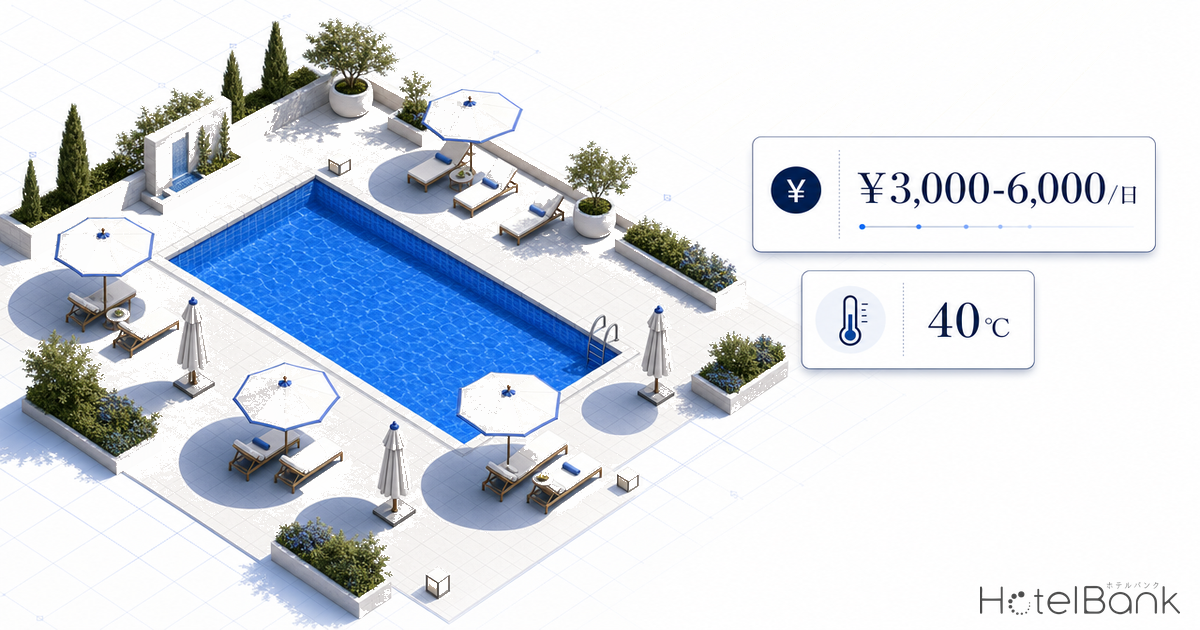
In April 2026, the Japan Meteorological Agency (JMA) formally adopted “extreme-heat day (kokushobi)” — a day with a maximum temperature of 40°C or higher — as an official forecasting term. As of June 30, the Japan Weather Association warned that “localized readings above 40°C are possible via foehn effects immediately after the end of the rainy season and as typhoons approach.” Against this backdrop, hotels in central Tokyo and along the bay are entering a phase in which the operating design of their outdoor garden pools must be recast from “a place to cool off” into “a place to escape the heat.” This article cross-references the review data of 11 garden-pool hotels located in central Tokyo’s 23 wards and in Urayasu, Maihama, Odaiba, Makuhari, and the Osaka bayfront against their summer 2026 selling prices, examining how the invisible capex of “shade infrastructure” propagates through guest satisfaction, repeat intent, and the room for premium pricing.
Metric Definitions Used in This Article
- ADR (average daily rate): The average of publicly listed selling prices compiled by MetroEngines Research. This differs from actual transacted prices (it tends to run about +25–30% higher than the real transacted ADR). Per-room rate for double occupancy (two guests, one room, tax included), averaged across all plans (from room-only to meal-inclusive plans).
- Pool mention rate: The share of guest reviews over the trailing 24 months that touch on the pool (facility_pool), determined by NLP natural-language analysis.
- Shade-infrastructure terms: The number of reviews whose text contains either “parasol” or “shade.”
- Data source: MetroEngines Research / HotelBank Editorial Team research
- — In April 2026 the JMA formally adopted “extreme-heat day (40°C or higher)” as a forecasting term, pushing central-Tokyo and bay-area garden pools into a design shift from “a place to cool off” toward “a place to escape the heat.”
- — Across roughly 69,000 reviews for the 11 target properties, there are 1,731 “pool mentions,” yet references to “shade/parasol” number just 17 — meaning demand-side expectations are structurally lagging in how they are voiced (a ratio of roughly 1.0%).
- — While the bay-area group (Sheraton, Hilton, etc.) achieves a premium price band of ¥50,000+ per night, shade-infrastructure satisfaction has not kept pace with that price band, and three properties show a negative-sentiment share approaching a majority.
- — Shade-infrastructure capex (an assumed ¥15–25M) can generate ¥9.7–14.6M in cumulative revenue at ¥4,500 per set, 50 sets sold per day, 80% utilization, and a 90-day season — a design margin recoverable within two seasons.
- — A three-tier structure (free shade / premium parasol ¥3–4k / private tent ¥6–15k) that maximizes within-rate satisfaction is what will determine the sustainability of the bay-area premium price band.
Summer 2026, When 40°C Extreme Heat Became a Forecasting Term: Garden Pools Shift from “Cooling Off” to “Escaping the Heat”
On April 17, 2026, the JMA newly defined a day with a maximum temperature of 40°C or higher as an “extreme-heat day (kokushobi).” The Japan Weather Association forecasts that summer 2026 will see a cumulative 6–10 locations nationwide reaching extreme-heat status, with a risk of exceeding 40°C via foehn effects immediately after the rainy season ends and as typhoons approach. The Pacific high pressure system is expected to build strongly from late July through August, and central Tokyo and the bay area are no exception.
This climatic shift is fundamentally changing the premises of leisure-pool operation. Whereas the principal satisfaction drivers of a garden pool were once “water quality,” “size,” and “scenery,” under outdoor temperatures around 40°C the new variables that determine satisfaction are “securing shade,” “the perceived temperature of the deck,” and “reducing heatstroke risk.” Indeed, when the HotelBank Editorial Team analyzed roughly 69,000 guest reviews (June 2024–September 2025) across 11 properties, a total of 124 reviews containing “hot” were identified. By contrast, reviews containing “parasol” or “shade” totaled just 17 — only a small fraction has surfaced as an explicit topic. It is precisely this asymmetry that forms the starting point of this article.
Source: Compiled from MetroEngines Research and the HotelBank Editorial Team (N=69,094 reviews, June 2024–September 2025)
Pool Mention Rate and ADR Across the 11 Properties — The Bay-Area Group Stands Out
The subjects of this article are 11 garden-pool hotels located in central Tokyo’s 23 wards and in Urayasu, Maihama, Odaiba, Makuhari, and the Osaka bayfront. Tallying the pool-mention rate (facility_pool tag) against total guest reviews, the two bay-area properties stand out markedly: Sheraton Grande Tokyo Bay at 13.04% and Hilton Tokyo Bay at 10.25%. Hotel East 21 Tokyo, despite its central-Tokyo location, comes in at 24.89%, indicating that by the nature of the property the pool occupies the core of the guest’s motivation to stay.
On the other hand, Conrad Osaka, Hotel New Otani Makuhari, and Tokyo Dome Hotel registered a pool-mention rate of 0%. This suggests that although these facilities are equipped with pools, the pool carries little weight as a topic in guest reviews, or the pool is operated separately from the stay. Notably, Tokyo Dome Hotel ended garden-pool operations at the end of August 2025, so a supply-side withdrawal from demand has already begun — a telling development.
Source: Compiled from MetroEngines Research and the HotelBank Editorial Team (3-day average of selling prices for August 8, 15, and 22, 2026; reviews from the trailing 24 months)
The “Shadow” Behind Pool Mentions — Negative Sentiment Approaches a Majority at Three Bay-Area Properties
A high pool-mention rate does not translate directly into positive evaluation. Decomposed by sentiment, of Sheraton Grande Tokyo Bay’s 363 pool mentions (Pos+Neg tally), 170 (46.8%) are negative; for Grand Nikko Tokyo Bay Maihama, 180 of 269 (66.9%); and for Hilton Tokyo Bay, 104 of 160 (65.0%) are negative. Compared with the luxury tier — ANA InterContinental Tokyo (19.1% negative) and Hotel Chinzanso Tokyo (25.6%) — the pools at the three bay-area properties carry a dual character: “much discussed, but also much criticized.”
The composition of the negative mentions can be inferred from the review text. Actual guest comments repeatedly describe time-of-day avoidance behavior such as “hot during the daytime” and “used it in the evening,” and one Sheraton guest even wrote the shade-pricing gap directly into a review: “shaded sunbeds are paid (from ¥2,200)” while “sunbeds without shade are free.” This shows that an operation of “free seat = in the sun / paid seat = in the shade” has already been introduced in some places, and that under the demand environment of an extreme-heat year the scarcity of shaded seats is surfacing as a price differential.
Source: Compiled from MetroEngines Research and the HotelBank Editorial Team (sentiment analysis of pool-tag mentions, trailing 24 months)
Correlation with the Premium Price Band (¥50,000+ per Night) — The Bay Area Is Already Premium, but Shade Satisfaction Lags
Averaging the selling prices for August 8, 15, and 22, 2026 (three Saturdays) over three days, 10 of the 11 target properties fall into the premium price band above ¥50,000. Hotel Chinzanso Tokyo at ¥193,700 and Conrad Osaka at ¥190,200 both exceed ¥190,000, setting the absolute level of city luxury. The bay-area group operates in a price range of about 60–70% of the luxury level: Sheraton at ¥68,600, Hilton at ¥73,300, and Grand Nikko at ¥57,800.
What deserves attention here is the pace at which the bay-area group’s selling inventory is being absorbed. Looking at the hotel inventory curve (August 15, 2026 check-in), Sheraton Grande Tokyo Bay is at 86.8% occupancy at the 90-day lead time (134/1,016 rooms remaining), and Hilton Tokyo Bay is at 82.7% (143/828 rooms remaining) — both nearly 90% sold three months before the peak. Grand Nikko Tokyo Bay Maihama, at 60.8% (277/707 rooms remaining), is likewise in an early-absorption phase. In a situation of “sells out early = demand is already strong,” upgrading shade infrastructure contributes less to the rate itself than to “selling add-on services within the guest rate” and to “the repeat intent of premium guests.”
Source: Compiled from MetroEngines Research and the HotelBank Editorial Team (August 15, 2026 check-in; converted from remaining-room counts at LT90/60)
Shade-Infrastructure Capex Estimate — The Economic Value of ¥3,000–¥6,000 per Set in Daily Sales
For concrete options in shade infrastructure, the pricing scheme published by Oiso Long Beach is a useful reference. There, a premium day bed (K area) for two runs ¥5,000–¥11,000, Oiso Hills for two runs ¥12,000–¥15,000 per day, and a single sunbed ¥1,000–¥2,000 — a correlation between shade quality and guest rate already built into the price band. Sheraton’s “paid shaded seat from ¥2,200” sits at the entrance to this same scheme.
Here, assuming shade-premium sales of ¥3,000–¥6,000 per set per day, we estimate the economic value at a bay-area hotel on the scale of Hilton Tokyo Bay. At 50 sets sold per day × ¥4,500 average × 80% utilization, that is ¥180,000 in incremental revenue per day, or ¥16.2 million over a 90-day season. Estimating the initial investment in shade awnings, mist fans, premium cabanas, and the like at ¥15–25 million, recovery within one to one-and-a-half seasons comes into view. In addition, a decline in the negative-review rate (Hilton’s current 65% → a hypothetical improvement to 40%) links directly to repeat intent and an uplift in OTA scores.
What matters here is that shade-infrastructure capex is positioned not as “a device to raise the rate” but as “a device to maximize satisfaction within the rate and lift the repeat rate.” The bay-area group has already reached a premium price band; what it needs now is experience design that gets guests to write into their reviews “why the bay-area garden pool was worth ¥70,000, better than the Disney-official option.”
Source: Created by the HotelBank Editorial Team (¥3,000–¥6,000 per set; 90-day operation simulation assuming 80% utilization)
Design Room for Shade-Premium Sales — Maximizing Within-Rate Satisfaction with a Three-Tier Structure
The sales design for shade infrastructure works well as a three-tier structure that differentiates by “seat grade” alone, without eroding the existing guest rate. The first tier is the free seat (deck chair + full sun); the second is the ¥3,000–¥4,500 shaded seat (large parasol + mist + drink coupon); and the third is the ¥5,000–¥8,000 premium cabana (semi-private + table + staff service). Oiso Long Beach has already implemented this structure, and by offering guests a choice — “you can stay for free, but you can choose the quality of shade” — a sense of acceptance toward the additional spend is created.
What is important for the bay-area group is to position this sales design not as mere incremental revenue but as a device that monetizes “experience differences that cannot be fully guaranteed within the room rate.” If a combined set of stay + pool entry + shade-premium seat (¥80,000 + ¥5,000 = ¥85,000) is marketed as “an ¥85,000-per-night package,” a hotel can lift RevPAR while maintaining its bare room rate. It is also worth considering an operation in which premium-seat reservations are completed at the booking stage, with same-day add-on sales restricted to secure capacity.
⚠ A note on ADR for future dates: The August 2026 ADR in this article is the average of selling prices published on OTAs at the time of the survey, and it fluctuates as the check-in date approaches. Please note that prices currently set high may fall through last-minute discounting. For the actual operating figures of shade-infrastructure fees, please check the latest announcements on each hotel’s official website.
Conclusion — A Design Shift from “a Place to Cool Off” to “a Place to Escape the Heat”
The garden pool has long been a device for staging “summer memories” and the “extraordinary.” Yet in summer 2026, with the JMA formally adopting “extreme-heat day” as a forecasting term and days above 40°C predicted as a realistic risk, the role of this device is being substantially recast from “a place to cool off” into “a place to escape the heat.” The review data of the 11 central-Tokyo and bay-area garden-pool hotels lays bare the fact that at the three bay-area properties with pool-mention rates above 10%, negative sentiment reaches nearly half. At the same time, the bay-area group — already in the premium price band (over ¥50,000 per night) — is within range of recovering shade-infrastructure capex (on the order of ¥15–25 million) within one to one-and-a-half seasons through ¥3,000–¥6,000-per-set shade-premium sales.
From an investment-decision standpoint, the most important point is that shade infrastructure is “a device to raise within-rate satisfaction and secure the repeat rate,” not “a device to raise the rate.” A garden-pool business strategy that integrates three things — package design that builds shaded seats in at the booking stage, experience design that strips negative sentiment out of reviews, and optimized staffing of operational personnel during the extreme-heat season — will determine the sustainability of the bay-area premium price band from 2026 onward.
References & Sources
- ■ Data sources
- MetroEngines Research compilation — OTA public selling prices (August 15, 2026 check-in) for the 11 target properties and NLP tag tallies (facility_pool; parasol/shade/hot/sunburn keywords) from roughly 69,000 guest reviews over the trailing 24 months (June 2024–September 2025).
- ■ Estimate assumptions
- The shade-infrastructure capex estimate uses a single scenario: “assumed initial investment ¥15–25M / 50 sets sold per day / 80% utilization / 90-day season (June–September) operation.” Cumulative revenue is calculated linearly at three price levels (¥3,000/¥4,500/¥6,000 per set), on a gross-revenue basis before deducting consumption tax, operating labor costs, and equipment depreciation.
- ■ Limitations and caveats
- (1) ADR is the average of public selling prices, not the real transacted price (tends to run +25–30% higher than actual). (2) The “shade/parasol” extraction from review text is an exact-keyword match, so it may not capture implicit descriptions of heat-avoidance behavior. (3) The ¥15–25M capex range is an estimate based on publicly available industry information and can vary widely with facility scale and the extent to which existing infrastructure is reused. (4) Individual figures such as 86.8% occupancy (August 15, 2026 CI, LT90) are snapshots at the 90-day lead time; same-day inventory fluctuates.
- 2026 heat forecast: 6–10 extreme-heat locations nationwide; above 40°C possible after the rainy season and as typhoons approach (Japan Weather Association tenki.jp, June 30, 2026)
- [Summer 2026] “Extreme-heat day” becomes a JMA forecasting term — the decisions companies should make at 40°C or above (Japan Weather Association, Weather X)
- Extreme-heat report Vol.2: 2026 extreme-heat days — beware strong sunshine after the rainy season and typhoon approaches; localized 40°C possible (Japan Weather Association)
- Oiso Long Beach official — tents & parasols (premium day bed / Oiso Hills pricing)
- Sheraton Grande Tokyo Bay garden pool “Sheraton Summer Splash” (open June 1–September 30, 2026)
- Hilton Tokyo Bay official — garden pool (renovation December 2025–April 2026)
- Tokyo Dome Hotel official — garden pool (operations ended 2025)
- MetroEngines Research — ADR, OTA public selling prices, and guest-review NLP tag tallies for the 11 target properties (facility_pool tag, trailing 24 months)
- HotelBank Editorial Team — parasol/shade/hot/sunburn keyword tallies from roughly 69,000 review texts across the 11 target properties (June 2024–September 2025)