

What stage is lodging demand at right now across the “semiconductor corridor” of Kikuyo, Koshi, Ozu and Higashi Ward of Kumamoto City in Kumamoto Prefecture? TSMC’s first fab entered full-scale mass production at the end of December 2024, and construction of the main building for the second fab began in June 2025. When we trace the construction and operational peaks of these two years through the average daily rate (ADR) per hotel room from public OTA data, the demand curve emerges with remarkable clarity. In this article we compile monthly figures for the 32 months from January 2024 to August 2026, and read the next demand phase — leading up to the expected start-up of TSMC’s second fab in the first half of 2029 — directly from the data.
Metric Definitions Used in This Article
- ADR (Average Daily Rate): The average of listed prices published on OTAs and similar channels. This differs from actual transacted prices. Rate per room for double occupancy (tax included), averaged across all plans (from room-only to plans with meals).
- Coverage area: The four municipalities of Kikuyo, Koshi, Ozu and Higashi Ward of Kumamoto City (the TSMC/JASM semiconductor corridor). Central Kumamoto City (Chuo, Nishi, Minami and Kita wards) is tabulated separately for comparison reference.
- Coverage period: January 2024 to August 2026 (monthly, 32 months).
- Data source: MetroEngines Research
- — ADR peaked at ¥17,800 in September 2025 (+14.6% YoY), the phase where TSMC’s first-fab mass production start and second-fab construction start overlapped.
- — The corridor’s ADR was revised down to the ¥14,800–¥15,800 range in the first half of 2026, the result of price competition as six new properties and roughly 900 rooms were introduced in stages on the supply side.
- — The ADR of the five leading properties adjusted by -12% to -26% from 2024 to 2026 (Candeo Kikuyo -24.0% and Hotel Vista -25.9% being the largest), taking the strongest hit from supply expansion.
- — Ozu is driving corridor demand: the number of properties covered doubled from 8 in 2024 to 16 in 2026, with five of the six new properties concentrated in Ozu.
- — The next demand phase is the ramp-up of second-fab construction and the start of mass production from 2028 to the first half of 2029, with residential-style alternatives such as Grand’X Ozu Kumamoto and the JR Higo-Ozu building running in parallel and affecting how the spoils are shared.
The corridor’s ADR peaked in September 2025, then entered a downward-revision phase
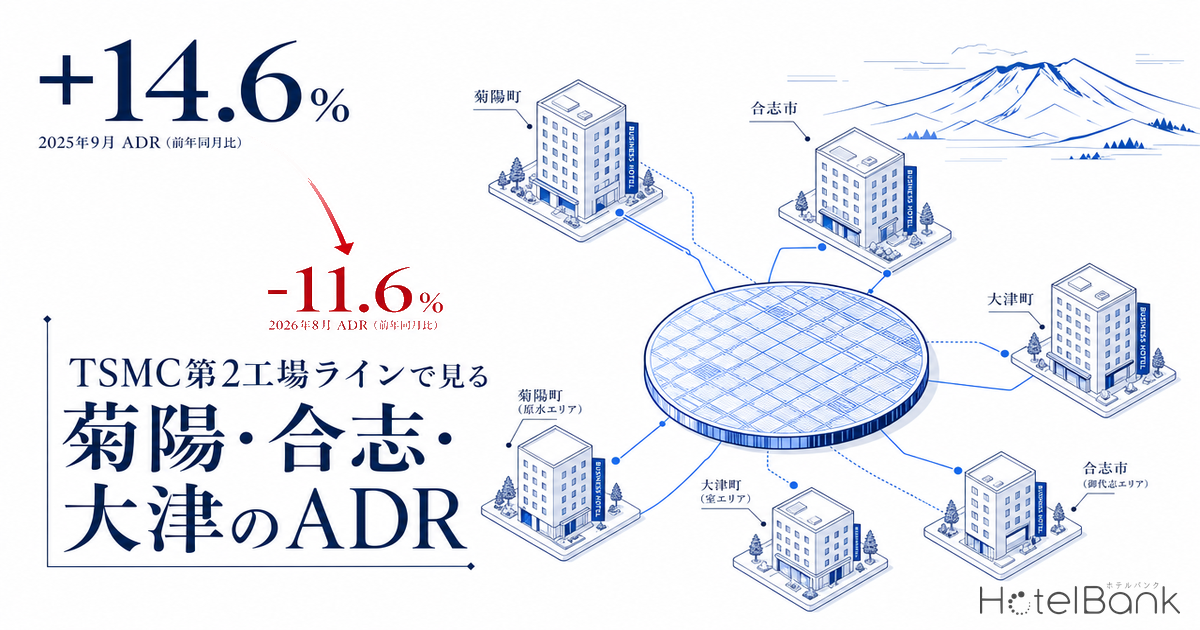
Start with the big picture. The combined ADR (room-count-weighted average) for the four municipalities of Kikuyo, Koshi, Ozu and Higashi Ward of Kumamoto City rose sharply almost exactly as TSMC’s first fab entered full mass production. The monthly average for full-year 2024 was ¥15,600; against that, full-year 2025 rose to ¥16,400 (+4.6% YoY), and the peak was ¥17,800 in September 2025 (+14.6% YoY). This period coincides with the simultaneous emergence of lodging demand from the first fab’s operating and construction-related resident workforce, and from equipment delivery and construction-support demand accompanying the start of second-fab construction.
On the other hand, ADR from the start of 2026 has turned to a downward-revision phase. The average for January–August 2026 was ¥15,200, down 5.7% versus the same period of 2025. In particular, June–August 2026 sank into the ¥14,800–¥15,500 range, with some months down by double digits (-6.6% to -11.6% YoY). Supply that had been running above ¥17,000 during the peak has come back to a level around ¥15,000.
Source: MetroEngines Research & Consulting (N=13–25 properties/month, four municipalities combined)
Comparison with central Kumamoto City: the corridor “rises early and falls early”
To judge whether this movement is specific to the semiconductor corridor or a prefecture-wide trend, we line it up against the ADR path of central Kumamoto City (Chuo, Nishi, Minami and Kita wards). The center is a deeper sample at N=101–123 properties, a population that receives a mix of business and tourism demand across the Kyushu region.
Central ADR was around ¥20,300 in 2024, ¥21,700 in 2025, and ¥21,500 in 2026 (January–August), with year-on-year variation contained to roughly ±3%. This differs clearly from the corridor’s ¥15,600 to ¥16,400 to ¥15,200, confirming that the corridor has a profile that “rises big when it rises and falls big when it falls.” This suggests that business-resident lodging demand is tied to specific processes (fab operation, construction support), so demand peaks and off-peaks structurally tend to come out sharp. Even within the same semiconductor cluster, the peak timing and amplitude profile differ from Chitose (Rapidus) and Hiroshima (Micron).
Source: MetroEngines Research & Consulting (semiconductor corridor N=13–25, central Kumamoto City N=101–123)
ADR by municipality: Ozu drives the corridor’s ADR
Looking at the four municipalities individually, demand is supported mainly by Ozu. Centered on Higo-Ozu Station, Ozu is the area where the largest number of workers building and operating JASM’s first and second fabs have stayed, and the number of properties covered has expanded from 8–9 in 2024 to 16 by August 2026. ADR moved from around ¥17,000 in 2024, to a 2025 peak around ¥18,500, to ¥16,000–17,000 in 2026. Kikuyo (2–3 properties) swings widely across the ¥13,000–¥20,000 range, and because the sample is thin its ADR is prone to fluctuation. Koshi (1 property) rose gently from the ¥9,000s to around ¥11,000. Higashi Ward of Kumamoto City (3–5 properties) held the ¥10,000–¥13,000 range, a notch below the other three municipalities.
| Municipality | Operating properties | Total rooms | 2024 avg. ADR | 2025 avg. ADR | Jan–Aug 2026 avg. ADR |
|---|---|---|---|---|---|
| Ozu | 9 | 984 | ¥17,300 | ¥17,700 | ¥16,500 |
| Higashi Ward, Kumamoto City | 4 | 394 | ¥10,400 | ¥11,700 | ¥12,300 |
| Kikuyo | 3 | 276 | ¥18,700 | ¥17,300 | ¥13,700 |
| Koshi | 1 | 151 | ¥9,200 | ¥10,300 | ¥11,000 |
| Four municipalities combined (weighted avg.) | 17 | 1,805 | ¥15,600 | ¥16,400 | ¥15,300 |
Source: MetroEngines Research & Consulting (property and room counts as of August 2026)
Kikuyo’s 2026 ADR of ¥13,700 has taken the largest downward push, -20.8% from ¥17,300 in 2025. As the location closest to the fab site, this can be read as reflecting the winding-down of the first fab’s initial-operation and large-scale construction-support phase. Ozu, by contrast, has station-front development on the way (Grand’X Ozu Kumamoto, the JR Higo-Ozu building and others), and it is worth keeping in mind that it is being designed as the center of the next demand phase.
Long-stay hotels: the leading properties’ ADR is in a third consecutive year of adjustment
Looking at the annual ADR of Candeo Hotels Ozu Kumamoto Airport (152 rooms, Ozu) and Candeo Hotels Kikuyo Kumamoto Airport (108 rooms, Kikuyo) — two representative properties that have absorbed the corridor’s long-stay demand — an interesting pattern emerges. Both properties have very deep data, at 80,000–130,000 records per property per year, giving high reliability to the rate trend.
| Property | 2024 avg. ADR | 2025 avg. ADR | 2026 avg. ADR | 2024→2026 change |
|---|---|---|---|---|
| Candeo Ozu Kumamoto Airport (152 rooms) | ¥18,500 | ¥18,100 | ¥16,000 | -13.5% |
| Candeo Kikuyo Kumamoto Airport (108 rooms) | ¥20,400 | ¥17,500 | ¥15,500 | -24.0% |
| Vessel Hotel Kumamoto Airport (132 rooms) | ¥18,600 | ¥19,900 | ¥16,200 | -12.9% |
| Hotel Vista Kumamoto Airport (139 rooms) | ¥16,200 | ¥15,400 | ¥12,000 | -25.9% |
| Hotel Route-Inn Aso Kumamoto Airport-Ekimae (207 rooms) | ¥17,600 | ¥17,800 | ¥15,400 | -12.5% |
Source: MetroEngines Research & Consulting
The corridor’s five leading properties all adjusted their ADR by -12% to -26% from 2024 to 2026. Behind this is the surge in new supply. Toyoko Inn Kumamoto Airport (208 rooms) in June 2025, Super Hotel Premier Aso Kumamoto Airport (203 rooms) in June 2025, Workers Hotel Kumamoto Ozu (202 rooms, long-stay specialized) in February 2026, and Tabino Hotel Aso Kumamoto Airport (213 rooms) in April 2026 opened in succession, and the corridor’s total room count expanded more than 1.5x — from around 1,300 rooms as of 2024 to roughly 2,000 rooms in 2026. The falling ADR of existing properties is not because demand disappeared, but can be read as the result of price competition as new options increased on the supply side.
Source: MetroEngines Research & Consulting (index with 2024 ADR = 100)
New supply that opened in 2025, and the reality of the pipeline
Organizing the new properties in the corridor whose OTA listings can be confirmed from 2025 onward yields the following supply lineup. The structure shifted from concentration in 5–6 existing properties to a market where 9–10 properties compete side by side. On the mechanism by which a “supply shock” in a regional city affects ADR, our analysis of the September 2026 supply shock across 34 newly opening hotels is also a useful reference.
| New property | Municipality | Rooms | OTA listing start |
|---|---|---|---|
| Toyoko Inn Kumamoto Airport | Ozu | 208 | 2025-06 |
| Super Hotel Premier Aso Kumamoto Airport | Ozu | 203 | 2025-06 |
| DOMO HOTEL Ozu | Ozu | 21 | 2025-11 |
| Workers Hotel Kumamoto Ozu | Ozu | 202 | 2026-02 |
| Tabino Hotel Aso Kumamoto Airport | Ozu | 213 | 2026-04 |
| THE STILL HOTEL | Ozu | 54 | 2026-04 |
Source: MetroEngines Research & Consulting (based on confirmed OTA listings)
What stands out is that five of the six properties are concentrated in Ozu. With Higo-Ozu Station on the JR Hohi Main Line as the core, long-stay demand from resident workers, single-posting assignees, construction-support crews and researchers is clearly positioned there. As the very name “Workers Hotel” shows, the industry has entered a stage of explicitly targeting “factory-town” hotel demand.
In preparing this article we re-checked the pipelines of major brands, but as of Hyatt Japan’s press material of April 2026, no operating or planned Hyatt-brand property is disclosed for Kikuyo, Koshi, Ozu or Higashi Ward of Kumamoto City. The corridor’s hotel supply is currently composed of the four to five tiers of business hotel, midscale and economy-to-upper.
A scenario estimate of the demand phase toward second-fab start-up
Building on the above, we want to overlay TSMC’s second-fab construction and operation schedule with the corresponding movement in corridor ADR. The current disclosed schedule for the second fab is main construction started in June 2025, completion in March 2028, and mass production starting in the first half of 2029; combined with the first fab, it targets employment of about 3,400 people and a production system of more than 100,000 wafers per month.
If we take the ADR growth rate seen during the first fab’s start-up (from the end of 2024 into 2025) as a benchmark, then from 2028 into the first half of 2029, similar demand expansion accompanying the second fab’s start-up is highly likely. However, its amplitude may not be as large as during the first fab’s start-up. There are three reasons.
First, the supply side has already expanded roughly 1.5x, so a structure is forming in which even if demand rises it is hard to pass through into prices. Second, long-stay specialized formats such as Workers Hotel and DOMO HOTEL have been introduced, and if long-term-contract-based transactions increase, the reflection in published ADR will become gentler. Third, with office and residential supply running in parallel — such as Grand’X Ozu Kumamoto (a large-scale rental residence of 619 units, a 6.5ha development in Ozu) and the JR Higo-Ozu building (scheduled for completion in January 2027) — part of the lodging demand may be absorbed from a “resident-worker style” to a “residence style.”
| Phase | Period | Four-municipality combined ADR | Key events |
|---|---|---|---|
| Construction start to first-fab opening | Jan–Jun 2024 | ¥15,000–¥16,000 | TSMC first-fab opening ceremony (Feb 2024) |
| First-fab mass-production prep | Jul–Dec 2024 | ¥15,400–¥15,900 | Trial and mass-production prep, resident workforce expansion |
| Mass production + second-fab construction peak | Jun–Oct 2025 | ¥16,400–¥17,800 | Second-fab main construction started (Jun 2025), mass production established |
| Adjustment from supply expansion | Nov 2025–present | ¥14,800–¥16,600 | Six new properties / about 900 rooms introduced in stages |
| Second-fab construction ramp-up | 2026–Mar 2028 | To watch | Scheduled completion, construction-support peak, parallel residential supply |
| Second-fab operation | H1 2029 onward | To watch | Mass production starts, ~3,400-person employment system |
Given that ADR reached +14.6% during the first fab’s 2025 operation peak, a low-double-digit ADR upswing is entirely plausible in the second fab’s operation phase in 2028–2029 as well. At that time, however, we will need to watch other metrics in parallel, such as occupancy and the number of available plans. Even if ADR alone looks like it “isn’t rising,” in reality there can be patterns where occupancy stays high and available inventory is tightened.
⚠ A note on ADR for future dates: The ADR in this article is the average of listed prices published on OTAs at the time of the survey, and it fluctuates as the check-in date approaches. Please note that the data for June–August 2026 is based on the available inventory observed at the time of writing, and may change due to last-minute additional sales or dynamic price adjustments.
What this implies for hotel management in the corridor
Organizing the movement of these two years, we can confirm a rhythm specific to TSMC-arrival-type hotel demand. A sharp demand increase (ADR +10% or more) occurs in the 6–12 months just before and after fab operation, after which ADR returns close to its original level as new supply expands and residential-style alternatives appear. When thinking about management in the semiconductor corridor, the key is likely revenue-management design premised on this cycle of “peak → adjustment → next peak.”
Properties that were able to maintain ADR at ¥17,000–¥18,000 during the 2025 peak had, in addition to their existing airport-adjacent and station-close locations, secured contract-based sales flows such as long-stay plans and group-contract plans. Heading into the second fab’s construction-support phase toward 2028 and the mass-production start phase in the first half of 2029, how to combine the two wheels of dynamic pricing on public OTAs and direct-contract-based long-stay plans will be the focal point of the revenue source in the next demand phase. The upside here is large: once the expansion of existing supply settles and demand runs alongside the mass-production start, from the second half of 2028 onward there may be an opportunity for the corridor’s overall ADR to turn up again.
In addition, a concept for a TSMC third fab has begun to be reported in some quarters, and the industrial agglomeration across the Kikuyo, Koshi and Ozu area is seen as continuing on a decade-scale span. For hotel management, rather than chasing single demand periods, portfolio design based on a demand curve spanning the semiconductor life cycle (construction → operation → next-fab construction → mass production) becomes a realistic option.
Summary
The ADR of the TSMC/JASM semiconductor corridor formed a peak (¥17,000–¥17,800, +8.5% to +14.6% YoY) in June–October 2025 when the first fab’s mass-production start and the second fab’s construction start overlapped, then could not fully absorb the new supply that surged from late 2025, and by the first half of 2026 had returned to the ¥14,800–¥15,800 range. This movement is not “demand disappearing” but a price adjustment caused by “supply expanding rapidly,” a fact backed up by the leading existing properties all adjusting ADR by -12% to -26%. The next demand phase is the ramp-up of second-fab construction and the start of mass production in 2028–2029, and while its scale could be on par with or greater than the first fab, how much of the spoils the lodging industry can retain — as residential-style alternatives run in parallel — becomes the watch point toward 2028.
Related reading
References & Sources
■ Data source
Monthly aggregation of publicly listed OTA prices (MetroEngines Research & Consulting), covering the four municipalities of Kikuyo, Koshi, Ozu and Higashi Ward of Kumamoto City, plus central Kumamoto City (Chuo, Nishi, Minami and Kita wards). 32 months from January 2024 to August 2026. Number of properties covered: N=13–25 properties/month (corridor), N=101–123 properties/month (center).
■ Estimation assumptions
ADR = average of publicly listed OTA prices (rate per room for double occupancy, tax included, averaged across all plans). Municipality totals are room-count-weighted averages. Annual ADR is a simple average of monthly averages. The second-fab schedule (completion March 2028, mass production H1 2029) is based on the February 2024 Sony Semiconductor Solutions press release and Toyota Motor press materials. The roughly 3,400 employees is the combined figure for the first and second fabs.
■ Limitations & caveats
(1) ADR is the average of listed prices and differs from actual transacted prices and occupancy. (2) Municipalities with a thin sample (Kikuyo N=2–3, Koshi N=1) have ADR that swings easily with individual properties’ sales-policy changes. (3) Future dates (June–August 2026) are provisional values based on inventory publicly listed on OTAs at the time of the survey, and may change with last-minute additional sales or dynamic price adjustments. (4) Residential and monthly-apartment demand is not reflected in publicly listed OTA ADR, and may therefore understate the actual scale of resident-worker demand.
■ Market data
- MetroEngines Research — Monthly OTA listed-price data for the four Kumamoto municipalities (January 2024 – August 2026, N=13–25 properties/month)
- MetroEngines Research & Consulting — Annual ADR aggregation for individual properties (the corridor’s 5 leading properties + 2 long-stay properties)
■ Industry & development news
- On the construction of JASM’s second fab in Kumamoto (Toyota Motor Corporation)
- On the construction of JASM’s second fab in Kumamoto (Sony Semiconductor Solutions Group)
- Current status and impact of TSMC’s Kumamoto second-fab plan (Regional Economic Research Institute)
- TSMC’s “JASM second fab” under construction in Kikuyo, Kumamoto (total investment approx. ¥2.1 trillion)
- Large-scale mixed-use development “Grand’X Ozu Kumamoto” in the town next to TSMC-arrival Kikuyo (Impress Watch)
- One of the area’s largest rental office buildings, “(tentative) JR Higo-Ozu Building” (scheduled completion January 2027)
- TSMC Kumamoto second fab “construction has begun,” expecting 1,700 jobs (KAB Kumamoto Asahi Broadcasting)
- Kikuyo and Ozu revitalized by TSMC’s factory arrival (Regional Career Kumamoto)
■ Brand information
- Hyatt Japan Co., Ltd., “Press Material, April 2026” — cross-checked against the list of 22 domestically operated hotels totaling 5,066 rooms (no operating or planned properties listed within Kumamoto Prefecture)
Source: Hyatt Japan Co., Ltd., “Press Material, April 2026”