

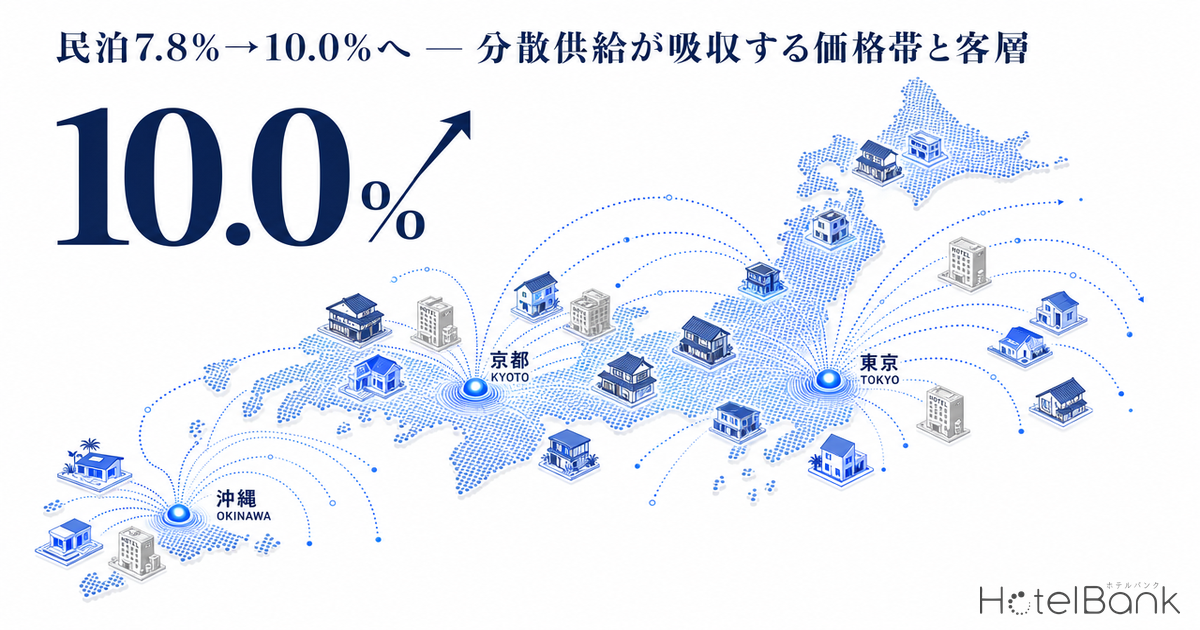
The share of private lodging (minpaku) among the accommodation types used by inbound visitors to Japan has risen from 7.8% to 10.0%, while Western-style hotel rooms slipped slightly from 87.5% to 85.2%. Reading these figures purely as “demand leaking away from hotels” would be premature. In this article, we take the Japan Tourism Agency’s shift in accommodation-type share as a starting point, overlay the 2026 surge in vacation-rental and machiya (traditional townhouse) supply with the “single-room operation” deregulation under the revised Hotel Business Act that took effect on June 15, 2026, and use OTA published-price data to read which price tiers and which customer segments distributed supply is absorbing across the three markets of Kyoto, Okinawa, and Tokyo. To state the conclusion up front: rather than a threat to the hotel sector, this is better understood as a phase of supply diversification in which the market as a whole captures demand segments that had previously been left untapped.
Metric Definitions Used in This Article
- ADR (Average Daily Rate): The average of selling prices published on OTAs and similar channels. This differs from the actual transaction price (against REIT disclosure data it tends to run +25–30% higher than the realized ADR — a structural effect whereby unsold higher-priced plans remain listed on OTAs, pushing the average of published prices above the transaction-based figure). Per-room rate for double occupancy (two guests, one room, tax included), averaged across all plans (from room-only to meal-inclusive plans).
- OCC (Occupancy Rate): The share of sold rooms relative to the total room count in an area (an estimate based on OTA sales inventory).
- Accommodation-Type Share: The composition ratio (on a usage-rate basis) of accommodation facility types used by inbound visitors, per the Japan Tourism Agency’s “Consumption Trend Survey for Foreigners Visiting Japan.”
- Data Sources: Japan Tourism Agency “Consumption Trend Survey for Foreigners Visiting Japan” and “Overnight Travel Statistics Survey”; MetroEngines Research (based on confirmed OTA listings, including new-opening data); monthly operational data from various REITs.
- — The inbound accommodation share of private lodging (minpaku) rose from 7.8% to 10.0%, while Western-style hotel rooms edged down only slightly (87.5%→85.2%) — the picture is not a “zero-sum fight” but a phase of overall market expansion.
- — New distributed supply in 2026 totals 326 vacation rentals and 26 machiya. The “single-room operation” deregulation under the revised Hotel Business Act (effective June 15, 2026) further accelerates small-scale supply.
- — In all three markets — Kyoto, Okinawa, and Tokyo — distributed supply serves the mid-to-upper experiential-value tier. In Kyoto, machiya and vacation rentals cover the middle-to-upper-middle band; in Okinawa, whole-house rentals handle groups and long stays.
- — Even amid supply diversification, hotel rates remain on an upward trend. Japan Hotel REIT (8985) posted an occupancy of 85.8% (as of April 2026, Japan Hotel REIT monthly operational data) and an ADR of ¥21,133 (+4.6% YoY), demonstrating the hotel sector’s resilience (as of April 2026).
- — In conclusion, distributed supply is not a threat to hotels but is better understood as “supply diversification that adds depth to the market,” capturing demand segments that had previously been left untapped.
Minpaku at 10% and Western-Style Hotel Rooms at 85% — Not a Zero-Sum Fight but Market Expansion
According to the Japan Tourism Agency’s “Consumption Trend Survey for Foreigners Visiting Japan,” among the accommodation types used by inbound visitors, the usage rate of private lodging (residential lodging / short-term rentals) rose 2.2 points from 7.8% to 10.0%. Meanwhile, Western-style hotel rooms fell 2.3 points from 87.5% to 85.2%. Looking at the share figures alone, it may appear that demand has shifted from hotels to private lodging, but we must not overlook the fact that the underlying base itself is expanding.
In 2024, the cumulative number of overnight stays by foreign visitors reached a record 164.47 million guest-nights, and in 2025 foreign overnight stays continued to grow at nearly double-digit pace, up 8.2% year on year. In other words, even if the share of Western-style hotel rooms fell to 85.2%, the absolute volume of foreign accommodation demand has kept rising. The decline in share does not mean “hotels lost customers”; it is closer to reality to read it as private lodging and distributed accommodation functioning as the receptacle for newly added demand.
Source: Created by the HotelBank Editorial Team based on the Japan Tourism Agency’s “Consumption Trend Survey for Foreigners Visiting Japan”
Backing up this structure is the resilience of the hotel sector. Japan Hotel REIT Investment Corporation (8985), which operates nationwide, posted operating results as of April 2026 of 85.8% occupancy (ibid.) and an ADR of ¥21,133 (+4.6% YoY), maintaining high levels in both occupancy and rate. If demand were flowing unilaterally from hotels to private lodging, such high occupancy and rising ADR could not coexist. Rather, the consistent interpretation is that distributed supply is absorbing demand that hotels cannot fully capture, along with segments seeking experiential value different from what hotels offer.
New Supply in 2026 — 326 Vacation Rentals and 26 Machiya Point to Decentralization
The expansion of distributed supply is also clearly visible in new-opening data. Tabulating by category the accommodation facilities that newly opened in 2026 (based on confirmed OTA listings) within MetroEngines Research’s coverage, vacation rentals topped all categories at 326 properties. That is more than three times the number of business hotels (97). Machiya also newly appeared at 26 properties, and the picture that emerges is one in which distributed, small-scale formats — hostels (31), guesthouses (30), and cottages (23) — form the core of new supply.
Source: MetroEngines Research & Consulting (based on confirmed OTA listings, N=704 properties)
By region, distributed supply including vacation rentals and machiya is concentrated in Hokkaido (52 properties), Okinawa (50), Tokyo (47), and Kyoto (46). This shows that supply is selectively flowing toward areas where tourism demand is thick and where experiential value such as “staying as if you live there” — through whole-house rentals and machiya — is easy to establish.
One caveat, however, is that this tabulation is based on confirmed OTA listings. Because OTA listings begin appearing several months before opening, the counts for the most recent and subsequent months are likely to rise as further listings come online. The apparently low number of openings in the latter half of 2026 does not mean supply is drying up; it is a matter of observation lead time. Accordingly, the 2026 full-year figure for distributed supply should be regarded as a floor relative to the numbers shown here.
The Revised Hotel Business Act’s “Single-Room Operation” Deregulation Boosts Small-Scale Supply
Supporting this expansion of distributed supply on the regulatory side is the revised Hotel Business Act, which took effect on June 15, 2026. The revision eased the minimum room-count requirement (10 rooms) previously imposed on ryokan/hotel operations, as well as the de facto hurdles for simple-lodging (kan’i shukusho) operations, making it possible to operate as a hotel/inn business (open 365 days a year) from a single room. The minimum floor area per room is set at 7 m² (9 m² where a bed is installed), and the obligation to install a front desk has also been waived under certain conditions.
Until now, operators of small-scale machiya, traditional folk houses (kominka), and whole-house rentals were forced to choose between residential lodging (minpaku), capped at 180 operating days a year, and simple lodging, which carries high structural-equipment hurdles. The revised Hotel Business Act fills this “regulatory gap,” allowing properties on the scale of one to several rooms to be positioned as proper, year-round accommodation facilities. The 2026 increase in supply — 26 machiya and 326 vacation rentals — can be seen as moving in tandem with anticipation of this deregulation. The structural impact of this revision on accommodation formats — in particular the shift toward small-scale machiya, kominka, and villa formats — is likely to deepen going forward.
Kyoto — Machiya and Vacation Rentals Cover the Middle-to-Upper-Middle Band
So which price tiers and customer segments is distributed supply actually absorbing? We examine the three markets from the perspective of price tiers. Starting with Kyoto, the ADR for machiya is ¥54,700 (N=358 properties), vacation rentals ¥56,800 (N=132 properties), and ryokan ¥54,100 (N=170 properties) — all sitting in the middle-to-upper-middle band around ¥55,000. This is clearly above the ¥41,000 of city hotels and the ¥21,200 of business hotels.
Source: Created by MetroEngines Research and the HotelBank Editorial Team
In other words, what machiya and vacation rentals absorb in Kyoto is neither top-tier luxury like deluxe hotels (¥177,900) nor the real demand of business hotels, but rather the segment that “wants an experience one notch above a hotel without paying luxury-hotel prices.” The value of occupying an entire property and experiencing machiya living holds up at this price tier. Kyoto is also an area where debate continues over revising the accommodation tax and dispersing tourism, and high-rate distributed supply with limited room counts is coming to play a role in easing the city’s excess demand while offering high-value-added stays. For city and business hotels, one view is that machiya and ryokan positioned above this price tier raise the “ceiling,” expanding the upside room for their own formats.
Okinawa — Whole-House Rentals Run Alongside Resort Hotels, Capturing Groups and Long Stays
In Okinawa, the structure is somewhat different. The ADR for vacation rentals is ¥38,600 (N=532 properties), slightly above resort hotels (¥34,100). Okinawa supplies vacation rentals on an overwhelming scale — 532 properties — and including cottages (¥28,200, N=131 properties) and guesthouses (¥21,400, N=115 properties), distributed supply forms the thick base of the resort market.
Source: Created by MetroEngines Research and the HotelBank Editorial Team
What Okinawa’s whole-house rentals and vacation rentals absorb is mainly families, groups, and long-stay segments. Group trips, which at per-room-charged hotels would require securing multiple rooms, are completed within a single property at a whole-house rental, and facilities equipped with kitchens make it possible to optimize the cost of a stay through self-catering. Whereas resort hotels mainly capture leisure demand for one night, two guests, vacation rentals complement demand with high flexibility in headcount and length of stay; the two are less competitors than parties sharing the market’s overall leisure demand from different angles. Indeed, resort demand in Okinawa has been firm, and the expansion of distributed supply is not pushing down the rates of existing hotels.
Tokyo — Vacation Rentals Fill the Upper City-Hotel Band, While Business Real Demand Holds Firm
In Tokyo, the ADR for vacation rentals stands at ¥58,800 (N=101 properties), above city hotels (¥42,700). At the same time, the mainstay of Tokyo’s accommodation market remains business hotels, with an overwhelming volume zone of 819 properties at an ADR of ¥20,600 underpinning the market. What distributed supply absorbs in Tokyo is not this business real demand but rather the segment seeking groups or special stays at price tiers above city hotels.
Source: Created by MetroEngines Research and the HotelBank Editorial Team
In the central-Tokyo business domain, multiple chains operate room-focused formats, and that real demand is barely affected by distributed supply. Rather, by having experiential-value supply such as vacation rentals and glamping (¥69,200) fill the band above city hotels, Tokyo’s accommodation market is widening its rate range upward. For existing hotels targeting upper price tiers, this means the pricing ceiling is being lifted, which can lead to opportunities for revenue expansion through tiered pricing.
A Structure Common to All Three Markets — Distributed Supply Serves the “Mid-to-Upper Experiential-Value Tier”
Cutting across the three markets, what becomes visible is a common structure in which distributed supply — machiya, vacation rentals, whole-house rentals — all serve what could be called the “mid-to-upper experiential-value tier”: above the real-demand zone of business hotels and below the top tier of luxury hotels. The table below organizes the ADR positioning of the main formats across the three markets.
| Format | Kyoto | Okinawa | Tokyo |
|---|---|---|---|
| Deluxe Hotel | ¥177,900 | ¥123,500 | ¥105,600 |
| Vacation Rental (whole-house) | ¥56,800 | ¥38,600 | ¥58,800 |
| Machiya | ¥54,700 | — | — |
| Resort Hotel | ¥119,900 | ¥34,100 | ¥54,600 |
| City Hotel | ¥41,000 | ¥24,600 | ¥42,700 |
| Business Hotel | ¥21,200 | ¥16,000 | ¥20,600 |
Source: Created by MetroEngines Research and the HotelBank Editorial Team (April 2026; ADR is double occupancy, tax included, all-plan average)
This “mid-to-upper experiential-value tier” is also an area where the conventional hotel sector has been thin. Business hotels have competed on efficiency and location, and luxury hotels on full service and prestige, while the demand in between — seeking “exclusivity, experience, and flexibility of stay” — was not necessarily fully met by hotels’ standard products. Distributed supply fills this gap, functioning as a receptacle that responds to the diverse stay needs of inbound visitors.
Preferences by Country — Those Who Choose Distributed Formats and Those Who Choose Hotels
There are differing tendencies in accommodation preferences by country. Generally, among traveler segments that often travel as families or groups and that value self-catering and living space during a stay, the preference for distributed accommodation such as whole-house rentals and private lodging tends to be relatively higher. Segments with many long stays or repeat visitors, or those oriented toward “a stay that feels like living in the area” rather than “a hotel in a tourist destination,” also have a high affinity for machiya and vacation rentals.
On the other hand, among segments centered on business or short stays, or those that value front-desk service, in-house facilities, and locational convenience, the preference for Western-style hotel rooms remains strong. The fact that Western-style hotel rooms maintain a high 85.2% share in the Japan Tourism Agency survey reflects the depth of this real demand. The important point is that these represent a division of roles corresponding to different customer segments and different stay purposes — not a relationship in which one drives out the other. As overall inbound demand expands, the structure in which hotels and distributed supply each leverage their strengths to share the market is likely to become even clearer going forward.
ADR Trends in the Three Main Markets — Hotel Rates Stay on an Upward Trend Even Amid Expanding Distributed Supply
Finally, we confirm that even as distributed supply expands, the ADR of the overall market is on an upward trend. Looking at monthly ADR trends in Kyoto, Tokyo, and Okinawa, all are running above the prior-year levels, and Kyoto in particular recorded a sharp rise to ¥49,700 in April 2026, +17.2% year on year. The expansion of distributed supply is not triggering “price destruction” that pushes down existing accommodation rates; rather, it shows that the market as a whole is heading toward higher value-add.
Source: Created by MetroEngines Research and the HotelBank Editorial Team
Conclusion — Not a “Threat” but “Supply Diversification That Adds Depth to the Market”
With private lodging’s share reaching 10.0% and the barriers to entry for small-scale, distributed supply lowered by the single-room-operation deregulation under the revised Hotel Business Act, the structure in which machiya, vacation rentals, and whole-house rentals serve the “mid-to-upper experiential-value tier” is taking hold across the three markets of Kyoto, Okinawa, and Tokyo. What these absorb is neither the real demand of business hotels nor the top-tier demand of luxury hotels, but the segment in between seeking “exclusivity, experience, and flexibility of stay” — an area where the conventional hotel sector had been thin.
Amid inbound demand continuing to set record highs, the fact that hotels maintain high occupancy and ADR shows that distributed supply is not siphoning off demand but adding depth to the market as a receptacle for expanding demand. For hotel operators, reconfirming which customer segments and price tiers their own format is strong in, and harnessing the upper price range that distributed supply lifts into their own pricing strategy, can lead to opportunities for revenue expansion. The expansion of distributed supply should be understood not as a threat but as a phase of supply diversification that broadens the overall market pie and pushes the price range upward.
References and Sources
- Japan Tourism Agency, “Consumption Trend Survey for Foreigners Visiting Japan — Annual Report” (Japan Tourism Agency, MLIT)
- Japan Tourism Agency, “Overnight Travel Statistics Survey” 2025 (Japan Tourism Agency, MLIT)
- “Revised Hotel Business Act to Take Effect on June 15,” Kanko Keizai Shimbun
- Ministry of Health, Labour and Welfare, “On the Revision of the Hotel Business Act”
- Monthly operational data from various REITs (Japan Hotel REIT Investment Corporation, April 2026 operating status)
- MetroEngines Research & Consulting — OTA published-price data (new openings N=704 properties, ADR by format)