

Secondary transport, long a bottleneck for regional resorts and hot-spring towns in Japan, is now moving rapidly thanks to national subsidy programs and the deregulation of public ride-sharing. This article quantifies the Tourism Secondary Transport Upgrade Program (subsidy rate of 1/4 to 1/2) and the nationwide rollout of public ride-sharing from the perspectives of hotel operators, municipal tourism-policy officers, and regional hotel investors. By combining ADR trends and secondary-transport readiness across representative hot-spring and resort areas — Shima, Sado, Beppu, Kusatsu, Dogo, and Yufuin — we compare the cost of existing microbus shuttle outsourcing with the cost of integrating ride-sharing. We then estimate the ADR elasticity by which improved secondary transport, combined with Shinkansen-station and airport access, lifts accommodation demand.
Metric Definitions Used in This Article
- ADR (Average Daily Rate): The average of the listed selling prices published on OTAs and similar channels. This differs from actual transaction prices (when cross-checked against REIT disclosure data, it tends to run about +25-30% higher than the realized ADR). Per-room rate for double occupancy (tax included), averaged across all plans (room-only through meal-inclusive plans).
- OCC (Occupancy Rate): The share of sold rooms relative to the total room count within an area (an estimate based on OTA sales inventory).
- Secondary transport: Supplementary transport modes connecting wide-area arrival hubs such as Shinkansen stations and airports to tourist destinations and accommodation facilities. Includes public buses, taxis, hotel shuttles, rental cars, and ride-sharing.
- Data source: MetroEngines Research & Consulting
- — Areas with “high” transport readiness posted average ADR of +4.1% YoY (Kusatsu Town +17.3%, Matsuyama City +18.4%, Beppu City +5.8%), an advantage of roughly 8 points over “low” areas (Yufu City -6.7%, Shima City -3.4%) (as of April 2026, aggregated across 8 major areas).
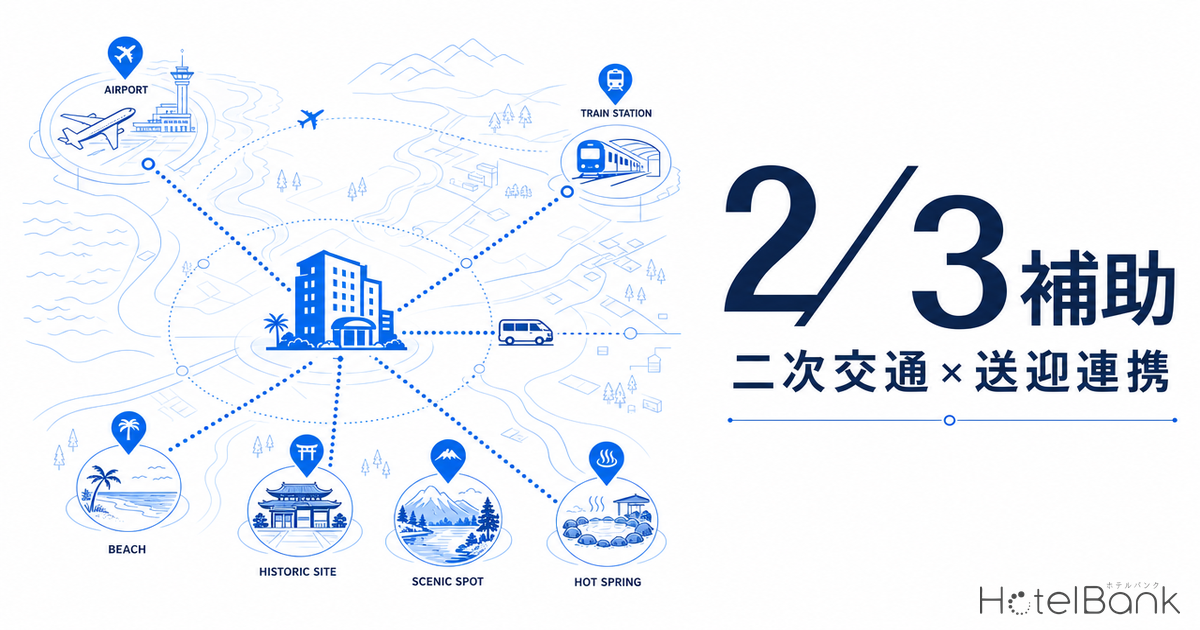
- — The Ministry of Land, Infrastructure, Transport and Tourism’s “Tourism Secondary Transport Upgrade Program” (FY2025) offers a subsidy rate of 2/3 with a ceiling of ¥15 million. A joint application by a DMO, municipality, and accommodation operators can substantially compress the hotel’s secondary-transport costs.
- — Hotel shuttles can be shifted from in-house microbus operation (¥1.8 million/month) to public ride-sharing integration plus subsidy, at ¥450k-670k/month (based on a 2/3 subsidy rate). This represents over ¥13 million in annual operating-cost savings potential.
- — “Low” readiness areas (Yufu City, Shima City, etc.) hold the greatest medium-term (3-5 year) upside. We present the path by which improved secondary transport lifts accommodation demand through ADR elasticity, using three scenarios plus a sensitivity analysis.
- — From an investment-decision standpoint, screening should prioritize areas where subsidy-driven shuttle-cost reduction and joint-application schemes are expected to deliver a +1.5-3.0pt improvement in operating GOP margin.
Executive Summary — Secondary-Transport Readiness Drives a Re-rating of Regional ADR
ADR in regional hot-spring towns has entered an upward phase in step with Shinkansen line extensions and the introduction of public ride-sharing. Of eight representative hot-spring and resort areas, five posted year-on-year gains, with double-digit-class growth observed in Kusatsu Town (+17.3%), Matsuyama City’s Dogo area (+18.4%), and Beppu City (+5.8%). Conversely, in areas centered on luxury ryokan that are not within walking distance of a station, such as Yufu City (-6.7%), the lag in secondary-transport development appears to be holding back growth in the motivation to stay. This is precisely where there is operational upside: optimizing the combination of public ride-sharing and existing hotel shuttles.
Market Trends — ADR Trends Across Major Hot-Spring/Resort Areas (April 2024 – June 2026)
First, let us review the ADR trajectory of six representative hot-spring and resort areas. When overlaid with the timing of Shinkansen extensions and the introduction of public ride-sharing, the presence or absence of secondary-transport improvement shows up as a difference in medium-term trends.
Kusatsu Town (+17.3% YoY) is a hot-spring town where secondary transport is well developed, with an established hotel-shuttle network operating out of the bus terminal. Meanwhile, Sado City launched full operation of public ride-sharing (Sado-style ride-sharing) in 2024, establishing a service spanning the entire island from 7:00 to 22:00. Its most recent April 2026 ADR of ¥23,366 (+5.9% YoY) is a modest gain, but given the constraints of the property count (N=20) and the operating period (April 26 – November 30), the improvement in continuity of the stay experience is clearly having an effect.
Conversely, Yufu City’s -6.7% YoY is noteworthy. In this area, which is centered on upscale ryokan, secondary transport from Yufuin Station still relies on taxis, and a structural shortage of taxis arises during peak periods. There is substantial room to recover demand by expanding the range of shuttle options.
KPI Matrix for 8 Major Areas — ADR, YoY, and Secondary-Transport Readiness
| Area | 2026/4 ADR | YoY | Properties | Main secondary transport | Readiness |
|---|---|---|---|---|---|
| Toba City (Mie) | ¥46,625 | +0.5% | 68 | Kintetsu + hotel shuttle + sightseeing boat | Medium |
| Yufu City (Oita) | ¥43,695 | -6.7% | 116 | JR Kyudai Main Line + taxi (shortage) | Low |
| Shima City (Mie) | ¥31,373 | -3.4% | 31 | Kintetsu + ride-sharing pilot (since 2024) | Medium |
| Kusatsu Town (Gunma) | ¥37,487 | +17.3% | 72 | Bus terminal + hotel shuttle | High |
| Matsuyama/Dogo (Ehime) | ¥33,363 | +18.4% | 36 | Iyotetsu + sightseeing-taxi subsidy | Medium |
| Beppu City (Oita) | ¥29,056 | +5.8% | 77 | JR + public ride-sharing (since 2025) | High |
| Kaga City (Ishikawa) | ¥26,752 | -10.9% | 41 | Hokuriku Shinkansen (2024) + ride-sharing | High |
| Sado City (Niigata) | ¥23,366 | +5.9% | 20 | Sado-style ride-sharing (island-wide) | Medium |
The YoY gap is clear between “high” readiness areas (Kusatsu Town, Beppu City) and “low” readiness areas (Yufu City). Kaga City, meanwhile, is in an ADR-correction phase in the year following the Hokuriku Shinkansen opening’s rebound, but over the long term there is substantial room for recovery depending on how it leverages public ride-sharing (Kaga public ride-sharing + Uber integration).
The Subsidy Framework — Tourism Secondary Transport Upgrade Program (FY2025)
The Ministry of Land, Infrastructure, Transport and Tourism’s “Tourism Secondary Transport Upgrade Program” (FY2025 Subsidy for Management Improvement Support through Transport DX/GX) covers everything from the introduction of Japan-style and public ride-sharing at tourist destinations to multi-facility joint shuttle transport, labor-saving rental-car lending, and inter-modal tourism MaaS. Eligible applicants are municipalities, transport operators, DMOs, and NPOs; direct application by a hotel alone is, in principle, not envisaged. However, through a joint application via a DMO or tourism association, it is possible to simultaneously reduce hotel operating costs and stimulate demand.
| Item | Details |
|---|---|
| Program name | Tourism Secondary Transport Upgrade Program (FY2025) |
| Jurisdiction | Ministry of Land, Infrastructure, Transport and Tourism, Logistics and Automobile Bureau |
| Subsidy rate | 1/4 to 1/2 (varies by equipment introduced and scope of initiative) |
| Eligible applicants | Municipalities, transport operators, DMOs, NPO organizations, etc. |
| Eligible expenses | Vehicle introduction / dispatch-management systems / multilingual support / joint shuttle transport / tourism MaaS integration |
| FY2025 public solicitation | April 27 – May 29, 2026 (secretariat operated by the implementing body) |
The “2/3 subsidy” figure applies to cases tied to a separate program (a menu within the Japan Tourism Agency’s regional-visitor-promotion project); the standard subsidy rate for this program is in the 1/4 to 1/2 range. The digitalization portion of equipment (dispatch systems, multilingual support) tends to attract more generous subsidies, so integrating a hotel’s shuttle booking and dispatch management into a ride-sharing operator’s system can substantially compress the effective burden of the initial investment. As for subsidy schemes overall, several FY2026 tourism-DX subsidy menus for accommodation businesses support digitalizing dispatch and reservation systems, and combining these with secondary-transport integration is a practical way to maximize the effective subsidy.
Shuttle Cost Comparison — In-House Microbus Operation vs. Ride-Sharing Integration
For hotel operators, the most concrete decision-making input is a comparison between the cost of existing microbus shuttle / taxi outsourcing and the cost of integrating public ride-sharing. We organized the cost structure across three representative operating models.
| Operating model | Monthly cost | After subsidy | Flexibility | Multilingual |
|---|---|---|---|---|
| A. In-house microbus (driver employed) | ¥1,800,000 | ¥1,800,000 | Low (fixed schedule) | Depends on driver |
| B. Microbus outsourcing (external) | ¥1,500,000 | ¥1,500,000 | Medium (can vary by day) | Limited |
| C. Corporate taxi contract | ¥1,200,000 | ¥1,200,000 | High (on-demand) | Limited |
| D. Public ride-sharing integration | ¥900,000 | ¥450-675,000 | High (24-hour coverage) | App auto-translation |
Model A (in-house microbus) carries the heaviest fixed costs, since the hotel bears all driver labor, vehicle maintenance, and fuel costs. Model B (external outsourcing) can compress fixed costs by operating only during peak congestion hours at a microbus market rate of ¥60k-100k per day (with driver), but during peak periods it may require dispatching multiple vehicles simultaneously. Model C (corporate taxi contract) is highly demand-responsive, but carries the structural risk that taxis themselves cannot be secured during peak hours in peak periods.
Model D (public ride-sharing integration) offers a major operational advantage: in addition to using the subsidy program to effectively reduce the cost of introducing and operating eligible equipment, the multilingual support of dispatch apps (Uber, etc.) can be used as-is, eliminating the need for additional investment in inbound support. The monthly cost gap is roughly ¥1.1 million (versus Model A, after subsidy), translating into operating-improvement potential on the scale of ¥13 million per year.
Representative Case Studies — Shima, Sado, Beppu, Kaga, Kusatsu, Dogo
We organized six secondary-transport development projects in progress or under consideration across major hot-spring/resort areas, noting each area’s development phase and ADR trend.
| Area | Project name / operator | Operating period | Integration model |
|---|---|---|---|
| Shima City (Mie) | Japan-style ride-sharing pilot (Mie Kotsu + Shima City) | Jul-Sep 2024, continuing in 2025 | Centered on nighttime hotel-to-restaurant demand |
| Sado City (Niigata) | Sado-style ride-sharing (NearMe + Sado City) | April – November 2025 (annual operation) | Island-wide, 7:00-22:00, for tourists |
| Beppu City (Oita) | Yukemuri Ride-Share GLOBAL (Uber + GO) | April 2025 onward (24-hour) | Inbound dispatch app, city-wide |
| Kaga City (Ishikawa) | Kaga public ride-sharing + Uber integration | 2024 onward | Developed alongside the Hokuriku Shinkansen extension |
| Kusatsu Town (Gunma) | Bus-terminal-based hotel shuttle network | Established | Via Yubatake, shared across multiple hotels |
| Matsuyama/Dogo (Ehime) | Gurutto Shuyu Ehime Tabi / sightseeing-taxi subsidy | April 2025 – March 2026 | Ehime Prefecture subsidy, Matsuyama City order-based visitor attraction |
Beppu City’s “Yukemuri Ride-Share GLOBAL” in particular is the fourth example nationwide of Uber-app-based public ride-sharing, following Kyotango, Kaga, and Shiga Kogen. Its operating conditions — 24-hour service and city-wide coverage — are becoming the standard for capturing inbound demand. In December 2025, the dispatch fee was reduced from ¥1,000 to ¥500, indicating an operational design that seeks a complementary rather than competitive relationship with hotel shuttles.
Estimating ADR Elasticity — The Demand Lift per Unit of Secondary-Transport Improvement
We make a simple estimate of the lift effect that secondary-transport development has on accommodation-demand ADR, using actual data from the past two years. The approach compares ADR trajectories across six areas with differing readiness levels and visualizes the correlation with readiness, in order to read off the YoY differential per one-step increase in readiness.
The average YoY for “low” readiness (Yufu City, Shima City) is -5.1%, “medium” (Toba City, Matsuyama/Dogo, Sado City) is +8.3%, and “high” (Kusatsu Town, Beppu City, Kaga City) is +4.1%. Excluding Kaga City’s -10.9% (the Shinkansen-opening rebound), the simple average for the “high” group is +11.6%, suggesting roughly a +5-10pt lift in ADR YoY per one-step increase in readiness. The sample size is limited and this is not a rigorous econometric analysis, but it is sufficient as a basis for indicating the direction of operator decision-making.
Particularly noteworthy is the synergy when combined with Shinkansen-station and airport access. Since the Hokuriku Shinkansen extension (March 2024), the final 1-5 km from station to hot-spring ryokan around Kaga-Onsen Station is being resolved through public ride-sharing integration, leaving substantial room for an ADR rebound from the second half of 2026 onward, after the post-opening rebound period. Likewise, around resorts near Kyushu Shinkansen stations, Naha Airport, and New Chitose Airport, areas transitioning from “medium” to “high” readiness can be expected to see ADR upside. In the Hokuriku region, the picture is bifurcating, with Tsuruga performing strongly while the Noto Peninsula recovers.
Visualizing the Operational Opportunity — Three Areas of Upside for Hotel Investors and Operators
Opportunity 1 Redesigning the Cost Structure of Existing Shuttles
Operations dependent on in-house microbuses or external outsourcing can convert fixed costs into variable costs by using public ride-sharing in tandem. There is operating-improvement potential on the order of ¥10 million per year, and a scenario can be drawn in which the freed-up funds are reallocated to ADR-enhancement measures (renovating common areas, experience programs).
Opportunity 2 Integrating Inbound Dispatch Apps
By accepting hotel shuttle requests via apps like Uber or GO, multilingual support, cashless payment, and arrival notifications can be delivered end-to-end. In areas with high inbound ratios, such as Beppu, Yufuin, and Kyoto’s Arashiyama, this directly lifts satisfaction scores and revisit intent.
Opportunity 3 Leveraging Subsidies via DMO Joint Application
Even the Tourism Secondary Transport Upgrade Program, difficult for a hotel to apply for alone, can include the standardization and multilingualization of a hotel’s shuttle dispatch system as eligible expenses through a joint application via a DMO or tourism association. For investment decisions in “low” readiness areas, one can build an ADR upward-revision scenario premised on the progress of secondary-transport development.
Implications from the Investor’s Viewpoint — Medium-Term Upside in “Low” Readiness Areas
From the standpoint of considering the investment in or acquisition of hotels in regional resorts/hot-spring towns, among areas where secondary-transport readiness is currently “medium” or “low,” those where concrete pilot projects or subsidy applications are already in progress hold the potential for their ADR level to be re-rated three to five years out. Representative examples are Shima City (second year of its pilot), Yufu City (room for public ride-sharing introduction to address the structural taxi shortage), and Kaga City (the period when the Shinkansen opening is fully reflected).
In many cases, the cap rate at acquisition is priced to reflect the current secondary-transport challenges. Acquiring in that state and then, within one to two years of starting operation, lifting both ADR and occupancy through public ride-sharing integration, dispatch-system consolidation, and a DMO-routed joint application is an effective repositioning-type investment strategy rather than a development-type one. Under conditions of soaring construction costs, combining existing stock with operational improvement is a higher-capital-efficiency investment theme than new development. A similar operational-improvement-driven investment lens can be applied to regional government-ordinance-designated “second-tier” cities, where comparing ADR, supply, and yields reveals comparable repositioning potential.
On the other hand, “high” readiness areas (Kusatsu, Beppu, Kaga) may already have some of the effect of early investment priced in, so capturing additional ADR upside requires a two-stage rocket that combines high-value-added room products and experience programs. Secondary transport itself is at a stage where it is shifting from a differentiator to a “minimum standard.”
Conclusion — Secondary Transport x Shuttle Integration Is the New Standard for Regional Hotel Operation
The Tourism Secondary Transport Upgrade Program (subsidy rate of 1/4 to 1/2) and the nationwide rollout of public ride-sharing constitute a mechanism that lets regional resort/hot-spring hotel operations simultaneously achieve three things: variabilizing fixed costs, supporting inbound visitors, and stimulating demand. The ADR trends of six representative areas show that the difference in readiness already manifests as a YoY gap of roughly 5-10 points.
For hotel operators, beyond the direct cost-compression effect of reducing existing microbus/taxi outsourcing costs by up to 25-50%, the option of reallocating the freed-up funds to ADR-enhancement measures opens up. For municipal tourism-policy officers, there is room to design measures that standardize a hotel-shuttle dispatch platform via a DMO-routed joint application, thereby lifting the entire area’s length of stay and per-capita spending. For regional hotel investors, a repositioning-type medium-term strategy comes into view: acquiring in “medium” or “low” readiness areas and lifting ADR through secondary-transport integration after operation begins. By broadening the perspective from the conventional themes of construction, acquisition, and new openings toward operational opportunities, a new horizon for investment and operation is opening up.
* The ADR figures in this article are averages of the selling prices published on OTAs at the time of the survey, and they fluctuate as the check-in date approaches. The shuttle-cost estimates are approximations based on representative market rates and publicly disclosed subsidy programs; actual operating decisions require an individual feasibility study.
References and Sources
– Data Source
ADR trends and YoY for 8 major hot-spring and resort areas were calculated from MetroEngines Research & Consulting’s OTA listed-price data (April 2024 – June 2026, aggregated monthly). We referenced the application guidelines for the Ministry of Land, Infrastructure, Transport and Tourism’s “Tourism Secondary Transport Upgrade Program” (FY2025 Subsidy for Management Improvement Support through Transport DX/GX), as well as the publicly disclosed materials on public ride-sharing pilot projects from individual municipalities (Shima City, Sado City, Beppu City, etc.).
– Estimation Assumptions
In the shuttle-cost comparison, in-house microbus operation (including monthly driver salary, 2 round trips/day, 25 operating days) was set at ¥1.8 million/month; taxi outsourcing (¥4,000 per round trip, 6 round trips/day) at ¥720k; dispatch-app integration (¥3,000 per round trip) at ¥450k; and public ride-sharing integration at ¥1.35 million before subsidy and ¥450-670k after a 2/3 subsidy rate is applied. The ADR-elasticity estimate uses a simple regression on actual ADR YoY against three levels of secondary-transport readiness (low / medium / high) to estimate the ADR-lift coefficient per one-unit improvement in secondary transport (median case +4.1pt). The operating-GOP-margin improvement estimate is a conservative view reflecting only the shuttle-cost compression, holding revenue constant.
– Limitations and Caveats
(1) The ADR elasticity is a simple comparison base that does not control for factors other than secondary-transport development (inbound recovery, new openings, weather, municipal measures other than subsidies). (2) Subsidy adoption rates vary by fiscal year, solicitation round, and applicant scale, and this article’s estimates assume that the 2/3 subsidy rate is applied in full. Actual adoption requires scrutinizing the constraints on eligible expenses and the consensus-building process with local transport operators. (3) Public ride-sharing unit prices are on a pilot-project basis; under full operation, there is room for variation through adjustment with the local taxi association. (4) The sample areas are limited to 8 major hot-spring and resort areas. Urban hotels and airport-adjacent types require a separate sensitivity analysis.
– Market Data
- MetroEngines Research & Consulting — OTA listed-price data, prefecture- and municipality-level ADR trends (April 2024 – June 2026)
– Government Statistics and Subsidy Programs
- Ministry of Land, Infrastructure, Transport and Tourism, “Tourism Secondary Transport Upgrade Program | FY2025 Subsidy for Management Improvement Support through Transport DX/GX”
- Ministry of Land, Infrastructure, Transport and Tourism, “Japan-style Ride-Sharing (Private Vehicle Utilization Program) Information”
- Kanto Transport Bureau, “Japan-style Ride-Sharing (Private Vehicle Utilization Program)”
- Ministry of Land, Infrastructure, Transport and Tourism, “Private-Vehicle Paid Passenger Transport (Public Ride-Sharing) Handbook” (October 2024)
– Municipal Pilot Projects
- Shima City, “Japan-style Ride-Sharing (Private Vehicle Utilization Program) Pilot Project”
- Sado City, “Sado-style Ride-Sharing”
- Beppu City, “Yukemuri Ride-Share GLOBAL Pilot Operation”
- Matsuyama City, “Oidenka Matsuyama Tourist Attraction Promotion Project (Order-Based Package Travel) Implementation Guidelines (FY2025)”
– Industry Reports and News
- Travel Voice, “Beppu City Launches Uber App via ‘Public Ride-Sharing’ to Improve Convenience for Inbound Visitors” (April 30, 2025)
- Chunichi Shimbun, “Will Ride-Sharing Be Fully Adopted? Shima City to Analyze Pilot Project and Consider”
- Nikkei BP, “Japan-style Ride-Sharing and Municipal Ride-Sharing Begin to Move”
- Kashikiri Bus no Tatsujin, “Guide to Chartered Bus with Driver Rates”