

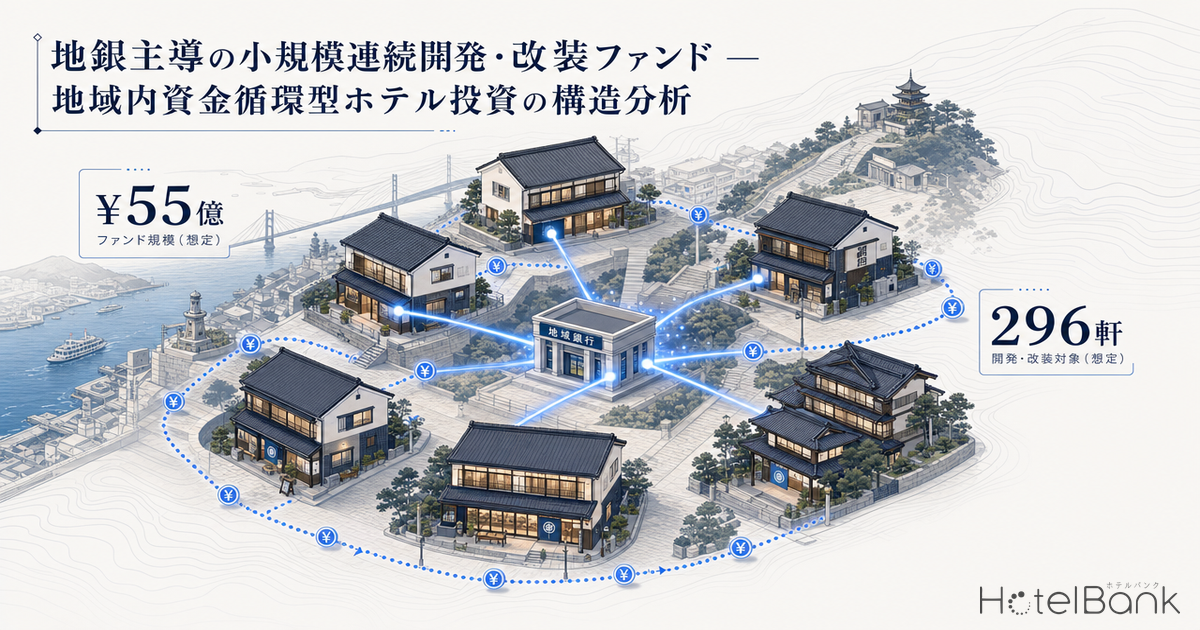
Between 2025 and 2026, a quiet structural shift has been taking place in how capital flows into regional hotels in Japan. Distinct from the “large single-asset acquisitions” historically driven by listed REITs and foreign private equity (PE), a wave of “small-scale, continuous development/renovation” funds led by regional financial institutions is now being formed. Examples include the ¥5.5 billion fund jointly launched by Sumitomo Mitsui Trust Bank and Staple (Onomichi, Hiroshima), non-recourse loans extended by Shimizu Bank and Yamanashi Chuo Bank for Atami ryokan renovation, and distributed-hotel funds combining MLIT (Ministry of Land, Infrastructure, Transport and Tourism), the MINTO Organization, and regional banks for vacant-house renovation. This article quantitatively reads the equity/debt supply structure of these intra-regional capital-circulation schemes against the large-acquisition model used by listed REITs and foreign PE. We back-calculate the conditions under which regional bank non-recourse loans remain viable in a 1%-interest-rate environment via development scenarios, and use new-supply data from MetroEngines Research to test the affinity between the small-scale category bias and fund structuring.
Metric Definitions Used in This Article
- ADR (Average Daily Rate): Average of publicly displayed sale prices on OTAs etc. Differs from actual transaction prices (compared with REIT disclosed data, OTA-published ADR tends to run 25–30% higher than realized ADR). Per-room rate for double occupancy (tax included), averaged across all plans (from room-only to meal-included).
- OCC (Occupancy Rate): Ratio of sold rooms to total rooms in the area (estimate based on OTA-listed inventory). Occupancy figures used in this article’s scenario analysis are assumed inputs.
- LTV: Loan to Value (borrowing ratio against total investment). DSCR: Debt Service Coverage Ratio (annual gross operating profit ÷ annual principal-and-interest payment). GOP: Gross Operating Profit. Non-recourse loan: Loan whose repayment source is limited to the cash flow of the underlying real estate (no recourse against the borrower).
- Data source: MetroEngines Research & Consulting (new-opening data based on OTA-listing confirmation)
- — Regional bank-led small-scale, continuous development/renovation funds are emerging as a new capital-supply layer filling the several tens of millions to several hundred million yen per deal gap that listed REITs and foreign PE cannot cover.
- — The SMTB × Staple ¥5.5 billion fund and the non-recourse loans from Shimizu Bank and Yamanashi Chuo Bank for Atami ryokan renovation are concrete examples of intra-regional capital-circulation schemes.
- — Our small-scale ryokan renovation scenario (20 rooms, ¥600M total investment, LTV 65%) shows that if renovation lifts profitability, DSCR remains around 1.8× even at 2.5% interest and non-recourse financing is fully viable.
- — The key to viability is securing an equity buffer by holding LTV at 60–65%; intra-regional circulation schemes are structurally advantaged because local equity can be sourced.
- — 2026 new openings of 641 hotels average 37 rooms, with vacation rentals accounting for 296 hotels (46%) — a clear small-scale bias that aligns well with the continuous-development design of regional bank funds.
Large Single-Asset Acquisition vs Intra-Regional Capital Circulation — Supply-Structure Differences
Hotel acquisitions by listed REITs and foreign PE are typically “large and single-asset,” ranging from several billion to several tens of billions of yen per property. Hoshino Resorts REIT (3287), for example, operates 61 properties with an ADR of ¥21,583 and an estimated occupancy of 79.3% as of April 2026 — a representative profile of a listed vehicle (Source: the REIT’s monthly operating data; industry benchmark referenced). While this model excels in liquidity and economies of scale, regional small-scale assets — under 10 rooms, around ¥100 million per deal — do not justify the per-transaction cost and tend to fall outside the investment universe. The acquisition headroom that listed REITs cannot reach is itself analyzed by area in our REIT-untapped × supply-tight area headroom map (separate article).
In contrast, the “small-scale, continuous development/renovation” fund model has emerged from 2025 onward. By January 2025, Sumitomo Mitsui Trust Bank and Staple established the fund operating company “GOOD SOIL INC.,” structured as a two-layer development-plus-long-term-holding framework that can continuously launch multiple deals. According to The Nikkei (December 8, 2025), this regional-hotel-focused fund is sized at ¥5.5 billion and includes JTB, Heiwa Real Estate, Gunma Bank, and The Chugoku Bank as investors. What is notable is the design philosophy of “continuous development” at small scale — including food-and-beverage and retail within walking distance — supporting town-making as a surface, not just standalone hotels, on the capital side.
The capital flow also differs structurally. In large single-asset acquisitions, global institutional equity and major-bank/foreign senior debt dominate; capital flows in from outside the region and returns outside the region. In contrast, intra-regional capital circulation has regional banks and shinkin (credit unions) providing debt (non-recourse loans) and local companies, municipal-affiliated funds, and small-lot supporters providing equity, so rents, dividends, and employment stay within the region. Sumitomo Mitsui Trust Bank’s January 2025 disclosure “Initiatives toward Sustainable Regional Development and Capital Circulation” also explicitly states this intra-regional circulation philosophy. For regional banks, against a backdrop of changing core-lending opportunities, this offers new investable assets on both the real-estate debt and fund-equity sides.
| Item | Large Single-Asset Acquisition (Listed REIT · Foreign PE) | Intra-Regional Capital Circulation (Regional Bank-Led Fund) |
|---|---|---|
| Per-deal scale | Several billion to tens of billions of yen | Tens of millions to several hundred million yen (built up via continuous development) |
| Equity provider | Institutional investors, foreign funds | Local companies, municipal-affiliated, small-lot investors |
| Debt provider | Megabanks, foreign senior loans | Regional banks, shinkin non-recourse loans |
| Target assets | Large, prime location, proven operating record | Vacant houses, old folk houses (kominka), small ryokan |
| Capital recycling | Outside the region (global) | Within the region (rent, employment, dividends) |
| Exit strategy | REIT inclusion, large-block sale | Long-term-hold fund, regional succession |
LTV · DSCR · Interest Rate of Regional Bank Non-Recourse Loans — Back-Calculating Viability in a 1% Rate Era
How viable are regional bank non-recourse loans during a rate-hike phase? In April 2026, Shimizu Bank and Yamanashi Chuo Bank jointly extended a non-recourse loan to a private real-estate fund structured by NBI Holdings, with the special-purpose company (NBI Atami Investment LLC) acquiring the Atami ryokan “Atami Sanga” (Source: The Nikkei, April 7, 2026). On the equity side, a typical structure is used with a Tokumei Kumiai (silent partnership) investment from an SBI Securities Group affiliate. The success or failure here hinges on the balance of three factors: LTV (borrowing ratio), DSCR (principal-and-interest coverage ratio), and the interest rate.
In real-estate debt practice, a DSCR below 1.3× leaves thin repayment headroom, and an LTV above 90% raises concerns about price-decline risk. On the other hand, even with a somewhat low DSCR, financing can be viable if LTV is held to 60% or below with sufficient equity (Source: various real-estate securitization explanations). With this in mind, we set up a small-scale ryokan renovation (20 rooms) and ran a sensitivity analysis varying ADR and occupancy to back-calculate DSCR. The table below summarizes MetroEngines Research’s analysis assuming ¥600M total investment, LTV 65%, and a 20-year repayment term.
| Scenario | ADR | Occupancy | Annual GOP | Gross Yield | DSCR at 1.5% | DSCR at 2.5% |
|---|---|---|---|---|---|---|
| Conservative case | ¥25,000 | 65% | ¥35.6M | 5.9% | 1.57 | 1.43 |
| Base case assumed | ¥30,000 | 70% | ¥46.0M | 7.7% | 2.02 | 1.84 |
What this analysis shows is that if renovation lifts both ADR and occupancy, DSCR stays around 1.8× even at 2.5% interest, and non-recourse financing remains fully viable. In contrast, the conservative case (ADR ¥25,000, 65% occupancy) sees DSCR drop to 1.43× at 2.5%, approaching the level at which regional banks’ credit standards may demand additional equity buffer or a debt-service reserve. The key to viability, then, is how much post-renovation earnings power can be lifted and how well LTV is held at 60–65% to secure a buffer. Intra-regional capital circulation has a structural advantage here, since local companies and municipal-affiliated funds can supply thicker equity, making this self-capital buffer easier to secure. The earnings uplift from renovation is also a critical headroom in regional banks’ business-evaluation lending. The current Cap Rate level and the gap with realized NOI are explored in depth in our companion analysis of CBRE’s March 2026 Cap Rate data (separate article).
Distributed Hotels — Per-Building Investment Scale and Yield Tiers, Aggregated Operating Model
Another pillar of intra-regional capital circulation is “distributed hotels” that convert vacant houses and old folk houses (kominka) into guest rooms. The Ministry of Land, Infrastructure, Transport and Tourism, in partnership with regional banks, supports the creation of distributed hotels through vacant-house renovation, and the MINTO Organization’s (General Foundation for Promoting Private Urban Development) management-type town-making funds had grown to 32 nationwide by March 2024 (Source: Travel Voice, June 19, 2024). A representative case is the ¥200 million “Ozu Town-Making Fund” structured in 2020 by Iyo Bank and the MINTO Organization, with the renovated kominka cluster operated as the distributed hotel “NIPPONIA HOTEL Ozu Castle Town.”
The investment characteristics of distributed hotels are that the per-building scale is extremely small and that business viability emerges only when multiple buildings are bundled. We modeled one kominka building (4-room scale) and computed a yield tier by investment scale. At ¥120M per building with ADR ¥30,000 and 60% occupancy, gross yield reaches 7.7%; lifting unit price and occupancy via renovation to ¥150M per building with ADR ¥40,000 and 65% occupancy delivers 8.9% — solid yields despite the small scale. However, on a standalone basis the fixed-cost burden of operations is heavy, and the “aggregated operating-contract model” — sharing front desk, reservations, and housekeeping across multiple buildings — becomes a prerequisite for sustaining yield. A concrete example of profitability improvement via room-reduction rebranding is also examined in our companion analysis of the Hida-Takayama circuit hotel investment opportunity (separate article).
① Standalone Layer
¥100–200M · 7–9% yield
Kominka 4-room scale. Thin margins if operating fixed costs are borne standalone. Aggregated operations required.
② Continuous Development · Aggregated Layer
¥500M–1.5B · multiple buildings bundled
Front desk, reservations, and housekeeping shared to spread fixed costs. Onomichi fund-type continuous development applies here.
③ Renovation Unit-Price Uplift Layer
Renovation lifts ADR +30%, occupancy +5pt
Atami ryokan renovation type. Earnings uplift pushes DSCR up and strengthens resilience to rate hikes.
Supply-Pipeline Analysis — Small-Scale Category Bias and Fund-Structuring Affinity
The properties targeted by intra-regional capital-circulation funds have grown in presence within the actual new-supply data. Within MetroEngines Research’s coverage (OTA-listing confirmed basis), 641 hotels were confirmed as new openings in 2026 with an average of 37 rooms — a small-scale figure — and the vacation-rental category dominates at 296 hotels (46% of the total). It is followed by 24 machiya (traditional townhouses), 20 cottages, 27 guesthouses, and 27 hostels, painting a picture in which small-scale, distributed categories form the core of supply.
This small-scale bias is not a single-year phenomenon. The series runs at 1,963 hotels with an average of 20 rooms in 2024, 1,617 hotels with an average of 25 rooms in 2025, and 641 hotels with an average of 37 rooms in 2026, with vacation rentals consistently the largest category at 831 in 2024, 666 in 2025, and 296 in 2026. The lower count for 2026 reflects the observation-lead-time structure — OTA listings appear only from a few months before opening — and does not mean supply itself is declining. The count for 2026 is expected to rise as more listings are added.
This bias toward small-scale, distributed categories is highly compatible with the structuring of regional bank-led funds. Vacation rentals, machiya, and cottages all have small per-building investment scales and start from the renovation of vacant houses and old folk houses — aligning with the MINTO Organization-type town-making fund and the “continuous development” design of the Onomichi fund. Because this is precisely the size range that listed REITs cannot reach, there is significant room for intra-regional capital circulation equity and debt to fill the supply gap. The more the quality of supply shifts toward small-scale and distributed, the larger the role of regional banks and shinkin in capital provision becomes.
Summary — A New Capital-Supply Layer Borne by Regional Finance
As shown in this article, capital supply for regional hotels is splitting into two layers: “large single-asset acquisition” and “intra-regional capital circulation.” The former has strengths in liquidity and scale, while the latter fills the small-scale, distributed supply gap that listed REITs and foreign PE cannot reach via regional bank/shinkin non-recourse loans and local equity. The SMTB × Staple ¥5.5 billion fund, the Shimizu Bank · Yamanashi Chuo Bank Atami ryokan renovation financing, and the MINTO Organization-type vacant-house renovation funds are all concrete examples of this new layer.
Even in a rate-hike phase, if renovation lifts earnings power to secure DSCR around 1.8× and LTV is held at 60–65%, regional bank non-recourse financing is fully viable. Distributed hotels sustain yield through aggregated operating contracts, and the fact that 2026 new supply is biased toward small-scale categories — led by 296 vacation rentals — is a tailwind for this kind of fund structuring. For regional financial institutions, intra-regional capital circulation through real-estate debt and fund equity should be a promising growth opportunity at a time when their core business environment is changing. For credit officers in business-evaluation lending, broad headroom remains for credit design centered on post-renovation earnings power and equity thickness.
※Note: The scenario analyses in this article are simplified calculations based on public information and assumed inputs; actual investment decisions require detailed feasibility studies on a per-property basis. New-opening data is on an OTA-listing confirmed basis, and because listings appear only from a few months before opening, counts for the most recent month or year may rise with future listings.
Related Reading
References & Sources
■ Data Sources
MetroEngines Research & Consulting’s new-opening data (OTA-listing confirmed basis; 2024: N=1,963 / 2025: N=1,617 / 2026: N=641 hotels) was used as the primary aggregation, with supplementary references to various press reports (The Nikkei, Travel Voice), financial-institution press releases, and publicly disclosed operating indicators of Hoshino Resorts REIT and Invincible Investment Corporation.
■ Calculation Assumptions
The DSCR sensitivity analysis assumes a small-scale ryokan renovation of 20 rooms with ¥600M total investment, LTV 65%, 20-year repayment, and a 30% GOP margin, varying ADR, occupancy, and interest rate to back-calculate annual principal-and-interest coverage. The distributed-hotel yield tier is a gross-yield calculation assuming a 4-room kominka with a 35% GOP margin; occupancy figures are assumed (estimated) inputs.
■ Limitations & Caveats
The scenario analyses in this article are simplified calculations based on public information and assumed inputs; actual investment decisions require detailed feasibility studies on a per-property basis. New-opening data is on an OTA-listing confirmed basis, and because listings appear from a few months before opening, recent months and years may see counts rise as more listings come in. ADR is on a published sale-price basis and differs from transaction prices (tending to run 25–30% higher than transaction ADR).
■ Market Data
- MetroEngines Research & Consulting — new-opening data (OTA-listing confirmed basis; 2024: N=1,963 / 2025: N=1,617 / 2026: N=641 hotels), ADR and estimated occupancy
■ Fund · Financial-Institution Press Coverage
- Regional Community Hotel Investment — Sumitomo Mitsui Trust and Others Launch Small-Scale Continuous-Development Fund (The Nikkei, December 8, 2025)
- [Hiroshima] Staple — Regional Revitalization Real-Estate Fund with Sumitomo Mitsui Trust (The Nikkei)
- Sumitomo Mitsui Trust Bank and Staple Establish Investment Company “GOOD SOIL INC.” (Staple Inc. Press Release)
- Sumitomo Mitsui Trust Bank “Initiatives toward Sustainable Regional Development and Capital Circulation” (January 21, 2025)
- Shimizu Bank and Others — Non-Recourse Loan to Fund for Atami Ryokan Renovation (The Nikkei, April 7, 2026)
■ Public Sector · Town-Making Funds
- MLIT Partners with Regional Banks to Launch Fund Creating Distributed Hotels via Vacant-House Renovation (Travel Voice, June 19, 2024)
- General Foundation for Promoting Private Urban Development (MINTO Organization) — Management-Type Town-Making Fund Support Services
■ Investment Indicators · Construction Costs · REIT Benchmarks
- Hoshino Resorts REIT “Monthly Operating Data (April 2026)” (industry benchmark reference)
- Invincible Investment Corporation Portfolio (GOP-margin reference)
- Onomichi City Land-Price Disclosure and Standard Land Prices (2025)