

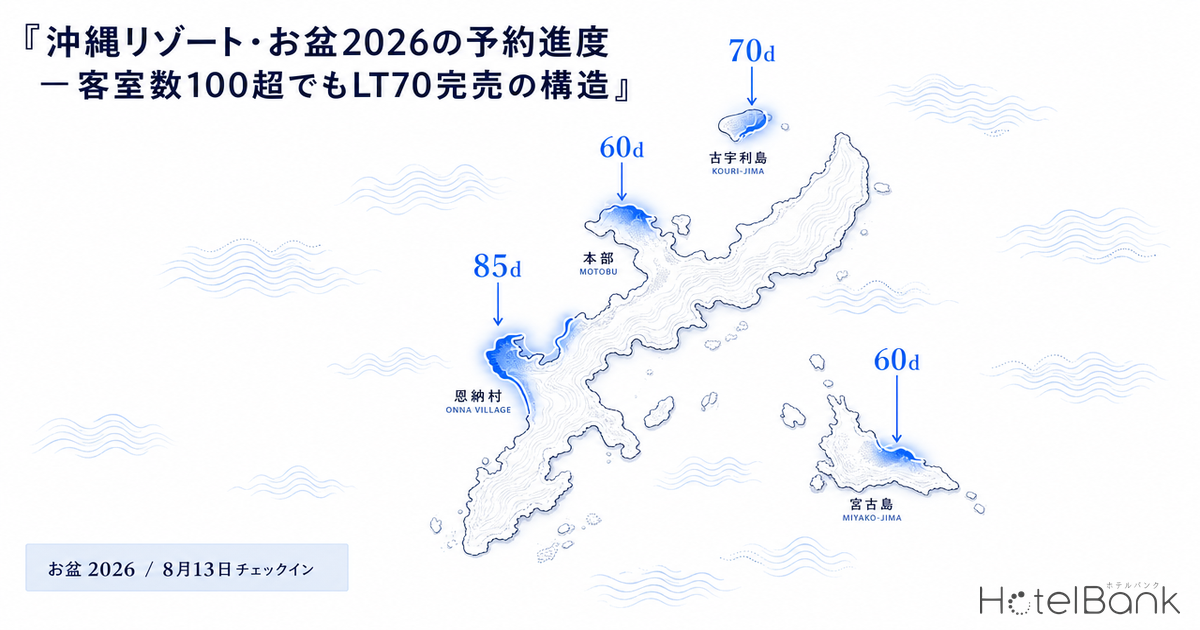
For Okinawa resort hotels with check-in on Thursday, August 13, 2026, we read booking pace from lead-time (LT, days to check-in) trends using remaining-room data tracked by MetroEngines Research. Even at the Obon peak, large-scale properties are moving particularly fast: a 67-room mid-sized resort in Miyakojima tightened its online inventory release roughly three weeks after LT90, with observed signs of supply-demand tightness. This article starts from a universe of 111 Okinawa Prefecture resort hotels (limited to properties where OTA-released inventory is 30% or more of total rooms) and examines how mid-to-large properties are squeezing inventory, combining competitor density and ADR tiers in Miyakojima, Onna Village, and central Okinawa Main Island.
Metric Definitions Used in This Article
- ADR (Average Daily Rate): Average of selling prices published on OTAs and other channels. Differs from actual transaction prices. Per-room rate for double occupancy (tax included), averaged across all plan types (room-only through dining plans).
- OCC (Occupancy): Ratio of sold rooms to total rooms in the area (estimated from OTA inventory).
- LT (Lead Time): Days to check-in. LT0 = same day.
- Early sellout LT: The lead time at which remaining rooms first reached zero (a larger value means earlier sellout).
- Data source: MetroEngines Research
- — A 67-room mid-sized Miyakojima resort sold out once for August 13 Obon check-in in the three weeks from LT90 to LT70. Inventory burn-down for mid-sized properties is structurally accelerating.
- — At LT60, Okinawa Prefecture resort remaining rooms stood at 4,787 (−18.8% vs. LT90); the resort category as a whole is tightening in stages.
- — August Okinawa Prefecture ADR averaged ¥36,587 (YoY +10.5%), the highest level in 18 months. Demand tightness is being reflected in rates.
- — After LT70 sellout, the 67-room property loosened its online inventory release and recovered to 59.7% occupancy (as of June 2026). Supply-demand control implementation is observable.
- — From the competitor density and ADR tiers in Miyakojima, Onna Village, and central Okinawa Main Island, room for new entry and operational efficiency emerges in the mid-sized resort (50–100 rooms) range.
Obon August 13 Check-In: Universe and Area-Wide Booking Pace
We begin by grasping movement across the entire Okinawa Prefecture resort category. For check-in on Thursday, August 13, 2026, MetroEngines Research tracks 473 resort hotels within Okinawa Prefecture. Of these, 231 have actual observation data on OTAs; further narrowing to properties where “OTA-released inventory is 30% or more of total rooms” yields a universe of 111 properties. We restrict to 30%+ because for properties with small OTA-released inventory, reading booking pace from inventory movement is structurally difficult. This article analyzes these 111 properties.
Across the area-wide resort category (228 Okinawa Prefecture properties, 25,126 rooms, observation basis), remaining rooms were approximately 5,892 at LT90 and 4,787 at LT60 — roughly 1,100 rooms (about 18.8% of observed released inventory) burned in three weeks. Okinawa Prefecture resort average ADR hovers in the ¥63,000 range, with ADR essentially flat even amid strong demand. For the Obon peak price band, rates are already near a ceiling on the upside.
Source: MetroEngines Research & Consulting (August 13, 2026 check-in, Okinawa Prefecture resort category 228 properties, 25,126 rooms)
By category, the luxury tier (ADR ¥100,000+, 110 properties, 7,420 rooms) shows similar pace: roughly 260 rooms (25.5%) burned from LT90 to LT60. Prices barely moved from ¥153,100 at LT90. Across the entire universe (1,007 properties, 51,929 rooms, business through ryokan), LT60 remaining rooms were still 14,721 — buffer is thicker due to the larger base, but the pace in the resort and luxury tiers stands out.
Booking-Pace Ranking — First Observed LT70 Sellout Beyond 100 Rooms
Ranking the 111 properties by early sellout LT (the lead time when remaining rooms first hit zero), most of the top spots are taken by small-scale villas and condominiums of 1–10 rooms. This is expected: properties that operate as whole-house rentals on peak days lose their slots early. What stands out, however, is that a mid-sized resort of 67 rooms recorded zero remaining rooms at an LT as large as 70. Among the 111-property universe, only one property meets both “30+ rooms” and “early sellout LT of 60 or higher” — structurally a rare movement.
| Rank | Property | Total Rooms | Early Sellout LT | Sellout Days Observed | Current Vacancy Rate |
|---|---|---|---|---|---|
| 1 | Sunline Chatan Condominium Resort | 1 room | LT90 | 26 days | 0.0% |
| 2 | Petit Resort Kourijima | 3 rooms | LT89 | 6 days | 66.7% |
| 3 | Nata Beach Villa | 10 rooms | LT74 | 3 days | 10.0% |
| 4 | UMI THE K Kourijima | 3 rooms | LT72 | 11 days | 0.0% |
| 5 | Hotel California Miyakojima Resort (ホテルカリフォルニア宮古島リゾート) | 67 rooms | LT70 | 2 days | 40.3% |
| 6 | JUSANDI | 5 rooms | LT66 | 7 days | 0.0% |
| 7 | MIHANA Onna Village | 5 rooms | LT62 | ― | 0.0% |
*Universe = 111 properties meeting “OTA-released inventory at 30%+ of total rooms” within the Okinawa Prefecture resort category (of 473 resort properties in Okinawa, 231 have observation data, of which 111 satisfy the 30% condition). Source: MetroEngines Research.
The rank-5 mid-sized Miyakojima resort (67 rooms) is one order of magnitude larger than other top-ranked properties. Properties of 1–10 rooms sell out instantly with a single booking or one whole-house rental, so even with a large early sellout LT the market-wide implication is limited. By contrast, a 67-room property recording zero remaining rooms at LT70 (73 days before check-in) shows demand absorption is concentrated in a short window on a room-count basis.
Case Observation — 67-Room Resort LT Trajectory: Step-Down and Inventory Release-Back
Looking at the LT trajectory of this 67-room mid-sized Miyakojima resort observation-point-by-observation-point reveals an interesting step structure. At LT90 (initial observation, May 15), remaining rooms were 40 and estimated occupancy was 40.3%. Through LT80, burn-down was a slow roughly one room per day, with 36 rooms remaining at LT80. Then at LT79 (May 26), remaining rooms abruptly dropped to one, and at LT70 (June 4), zero remaining rooms were finally observed. In effect, 40 rooms burned to zero in three weeks.
What stands out is that at LT67 (June 7), remaining rooms recovered to 31. This recovery (5+ rooms, sustained 3+ days) is not a one-off from the cancellation cycle but is presumed to be the hotel additionally releasing OTA inventory. With the Obon peak approaching, the property loosened its initial tight grip by one notch — a suggestive observation from a supply-demand control perspective. At LT59 (June 15), at the time of writing, remaining rooms had returned to 27, with estimated occupancy at 59.7%.
Source: MetroEngines Research & Consulting (31 observation days, May 15 – June 15, 2026)
This movement should be read not merely as the snapshot fact of “sold out at LT70,” but as a booking-pace structure that includes the subsequent inventory release-back. Given check-in is still 58 days away at the time of writing, it is premature to declare a sustained sellout; the cycle of additional releases and re-absorption between LT30 and LT60 needs continued observation. At the same time, the fact that large-scale burn-down took place at the early LT90–70 phase carries meaningful signal that Obon demand for this property is strong.
Miyakojima Area: Competitor Density and ADR Tier
To understand what is happening in Miyakojima, we summarized competitor density within a 5km radius around the 67-room resort. The area contains 200 hotels and 3,219 total rooms (the range tracked by MetroEngines Research, including villas, villa annexes, and condominiums). This scale is comparable to the central Okinawa Main Island resort area, indicating that Miyakojima is not merely a remote island but forms a meaningful hotel cluster.
Lining up the 12 mid-to-large hotels with 50+ rooms by ADR (August 13, 2026 check-in), a clear three-tier structure emerges. At the top, the ¥100,000 band is held by Hilton Okinawa Miyakojima Resort (329 rooms) alone — a single dominant property. The ¥40,000 band has two mid-sized resorts (Palm Springs Miyakojima Resort 53 rooms, and the 67-room resort that is this article’s case). The remaining 8 properties cluster in the mid-to-economy band of ADR ¥15,000–¥35,000.
Source: MetroEngines Research & Consulting (within 5km radius, 50+ rooms, August 13, 2026 check-in)
What stands out in this structure is the room-scale gap between Hilton (329 rooms) and the mid-sized resort cluster (50–67 rooms). Resorts in the 100–250-room range with ADR ¥40,000–¥70,000 are effectively absent within the 5km central Miyakojima trade area (city center to Shimozato district) — a supply gap exists here. Given strong area demand and the observation that a mid-sized 50–70-room resort hit zero remaining rooms at LT70, this suggests that mid-sized, mid-price room demand may not be fully absorbed by current supply.
Furthermore, while the Okinawa Prefecture resort-category average ADR is ¥50,500 (271 properties), the two mid-sized Miyakojima properties were operating below that, in the ¥40,000 range. What early room-occupancy burn-down indicates is that price and location are well-aligned with market needs; through demand-responsive incremental price adjustments and plan-mix revisions, further revenue opportunity can be seen in this range.
Okinawa Prefecture Obon Demand: Direction Shown by 18 Months of ADR
Tracking back 24 months of Okinawa Prefecture ADR shows growth of +10.5% YoY, from ¥33,100 in August 2025 to ¥36,600 projected for August 2026. This trails Kyoto Prefecture (+29.9%) and Hokkaido (+12.9%) and reflects an upward shift in the price band heading into the Obon peak. On a monthly basis, the curve responds to seasonality with July 2026 at ¥33,400 and August at ¥36,600.
Source: MetroEngines Research & Consulting (Okinawa Prefecture all-category average, 1,596–1,805 properties per month)
One caveat: the ADR shown here is the average of public prices posted on OTAs, a snapshot at the survey time. Obon August prices may slip on last-minute discounting of currently-high plans, or alternatively, the high-end plan mix may shift up as remaining rooms deplete, pushing the average further up. The booking-pace observations in this article serve as a clue for reading the direction of that variation.
Reading the Structure: Opportunity in Mid-sized Resorts
Several structural points emerge from the booking pace observed in this article. First, for Okinawa resorts with Obon August 13 check-in, a 67-room mid-sized property observed an LT70 sellout once in three weeks from initial observation, then settled into a 59.7% occupancy state (as of June 2026, MetroEngines remaining-room observation) after inventory release-back. The fact that this movement occurs at a timing more than 30 days out is evidence that demand is concentrating early relative to supply.
Second, while Miyakojima’s competitor density is high at 200 properties and 3,219 rooms within a 5km radius, ADR tiers show a sparsity of resorts in the 100–250 room range at ¥40,000–¥70,000, leaving a supply gap in the mid-sized, mid-price tier. The mid-sized resort that showed early sellout was operating precisely at the edge of this gap, suggesting the market may have room to absorb additional mid-sized resort supply.
Third, in an environment where Okinawa Prefecture Obon August ADR is rising at +10.5% YoY, area-wide demand is reliably accumulating. In a resort category averaging ¥50,500 ADR, a property that built occupancy early at the more accessible ¥40,000 band — orchestrating price and demand in balance — continues to hold upside. How inventory moves between LT30 and LT60, especially the cycle of additional releases and re-absorption in the immediate-pre-peak phase, will be the key to reading the direction of Okinawa resorts as a whole for Obon 2026.
⚠ Note on Forward-Date ADR: The ADRs in this article are averages of selling prices published on OTAs at the survey time and will fluctuate as check-in approaches. Currently-high prices may decline through last-minute discounting, or remaining-room depletion may shift the plan mix and push prices further up — please consider both possibilities.
References & Sources
■ Data Sources
OTA public prices and remaining-room observation data (MetroEngines Research & Consulting, continuous observation late May – June 15, 2026; subject = 111 Okinawa Prefecture resort hotels; universe = properties with OTA-released inventory at 30%+ of total rooms), Japan Tourism Agency Overnight Travel Statistics, JNTO inbound visitor statistics.
■ Assumptions
Occupancy is estimated from OTA-released inventory utilization (remaining / released). LT (lead time) is days to check-in, computed from August 13 (Thursday) as the base date. ADR trend is the Okinawa Prefecture all-category average; year-on-year is same-month comparison.
■ Limitations and Caveats
Because the basis is OTA-released inventory, group, direct, and member-channel inventory is not reflected. Occupancy is an estimate and may differ from actuals. LT70 sellout observation means “one instance of inventory depletion”; the subsequent inventory release-back is at the operator’s discretion.
- MetroEngines Research & Consulting — OTA public price data, remaining-room observation data, estimated occupancy (OCC), booking-curve analysis
- Japan Tourism Agency “Overnight Travel Statistics Survey” (reference, Obon-period demand environment)
- JNTO “Inbound Visitor Statistics” (reference, international demand to Okinawa Prefecture)