

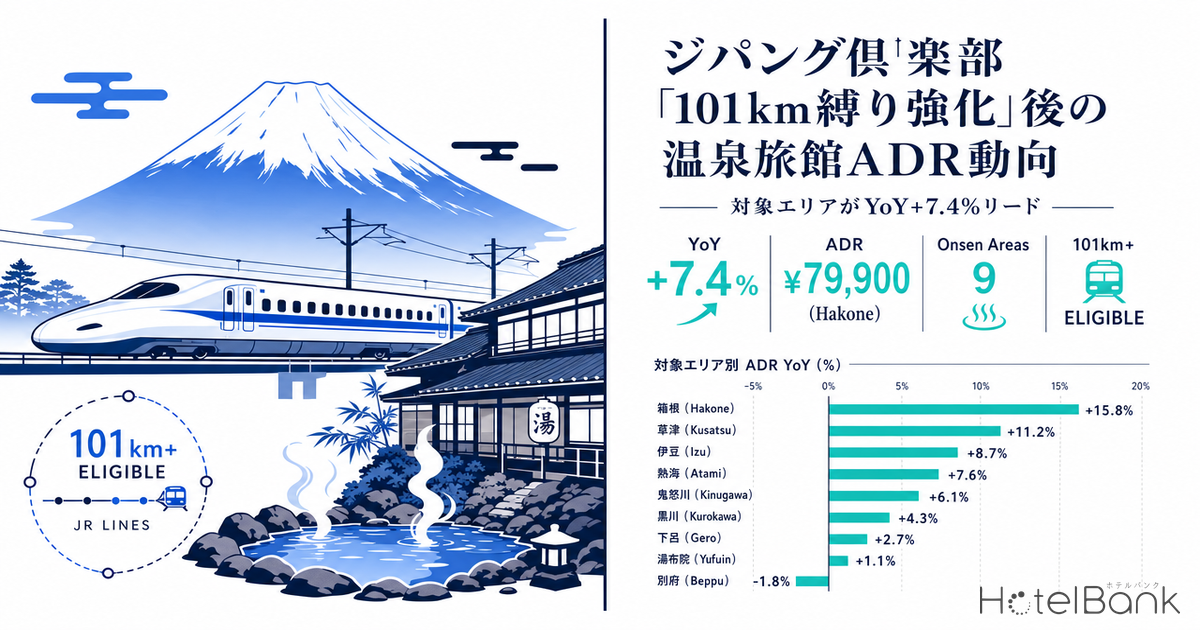
On March 14, 2026, the discount eligibility conditions of JR companies’ senior membership program “Zipangu Club” (and JR East’s “Otona no Kyujitsu Club Zipangu”) underwent a major revision. The previous threshold of “201km or more one-way, round-trip, or continuous” was changed to “101km or more one-way.” While this adjustment accompanied the discontinuation of round-trip and continuous tickets, the resulting structure now routes senior demand away from onsen destinations at “around 100km one-way” — where senior members can no longer use the discount — toward onsen destinations “101km or more” away. In this article, using public price data from MetroEngines Research (メトロエンジンリサーチ), we quantitatively examine how ADR moved before and after the revision, and year-over-year, across nine major JR-linked onsen destinations.
Metric Definitions Used in This Article
- ADR (Average Daily Rate): The average of public sales prices listed on OTAs and other channels. This differs from actual transaction prices (cross-referencing with REIT disclosure data shows public ADR trends +25–30% higher than transacted ADR. This is due to unsold high-tier plans remaining on OTAs, which pushes the average of public prices above transaction prices). The scope is per-room rate for double occupancy (tax included), averaged across all plans (including room-only through meal-included plans), for weekday (Tuesday–Thursday) check-ins only.
- Significance of weekday (Tue–Thu) extraction: Senior demand tends to concentrate on weekdays rather than weekend peaks, so we narrowed the analysis to weekdays to more clearly capture the Zipangu Club effect.
- Target areas: Nine major JR-linked onsen destinations (Atami, Hakone, Yugawara, Kusatsu, Ikaho, Nasu, Echigo-Yuzawa, Kinosaki, Beppu), N=over 2,000 properties.
- Data source: MetroEngines Research
What the Zipangu Club “101km Rule Tightening” Means
As of March 13, 2026, the sale of JR “round-trip tickets” and “continuous tickets” was discontinued. Accompanying this, the discount eligibility conditions of Zipangu Club (open to those 65 and over, annual fee ¥3,840) were changed from “201km or more one-way, round-trip, or continuous” to “101km or more one-way”. The source is the official notice from JR West Zipangu Club. Discount rates remain at 30% from the first use within JR East’s network, and 20% for the first three uses and 30% for the 4th–20th uses on other JR networks.
At first glance the revision lowered the bar, but from the perspective of onsen accommodation operators the picture is different. Onsen destinations around 100km one-way (Yugawara, Shuzenji, lower Ikaho, etc.) had previously qualified for the discount by satisfying “201km or more round-trip,” but as of March 14, segments that do not meet “101km or more one-way” fall outside the discount. Conversely, onsen destinations between “101–200km one-way” (Atami, Nasu, Echigo-Yuzawa, Kusatsu, etc.) — which had been difficult to use alone because 201km or more was required — can now qualify for the discount on a one-way basis, dramatically lowering the usage hurdle.
Senior demand for onsen ryokan is structurally strong. According to Cosmo Health’s “2025 Survey on Domestic Travel by the Senior Demographic”, the top two domestic travel purposes for seniors are “sightseeing and strolling” (70.8%) and “onsen and spa” (45.1%). Our tabulation also shows that those aged 50 and over make up an overwhelming 55–76% of review posters at major onsen ryokan — directly the customer base impacted by the Zipangu Club condition change.
Source: JR company public materials, created by HotelBank Editorial Team
ADR Trends Across 9 Onsen Destinations — A Clear Post-Revision “Dividing Line”
We tabulated the average weekday (Tue/Thu) ADR trajectories from January through April 2026 across nine major JR-linked onsen destinations. All values are per-room rates for double occupancy (tax included, all-plan average).
Source: MetroEngines Research, created by HotelBank Editorial Team
From March 2026 onward, the divergence between areas where ADR rose and those that stagnated becomes clear. Hakone-machi saw an overwhelming ADR rise of +17.9% in March and +20.7% in April (versus January), with weekday ADR reaching ¥79,900 in April. Much of this reflects Hakone’s specific demand structure (inbound and domestic high-end), which should be explained separately from the Zipangu Club change. However, it is notable that demand has not collapsed even in “areas outside the 101km eligibility.” Yugawara-machi held steady at an April average of ¥62,400 — a slight gain — and the “senior demand loss risk” at short-distance onsen has not yet materialized.
Meanwhile, Echigo-Yuzawa (Yuzawa-machi) ADR fell sharply from ¥44,200 in March to ¥35,800 in April. This is a structural seasonal adjustment associated with the end of the ski season (snow melt) and is not directly related to the Zipangu Club change. Across all of Niigata Prefecture as well, April ADR of ¥35,700 is in line with the year-round level — not an unusual drop.
The “101km Effect” in YoY Terms — Eligible Areas Lead by +7.4%
To isolate the pure effect of the condition change while removing seasonal factors, year-over-year (YoY) comparison is appropriate. We compared weekday (Tue/Thu) check-in ADR for the same periods of March–April 2025 and March–April 2026.
Source: MetroEngines Research, created by HotelBank Editorial Team
The result is unambiguous: JR-linked onsen destinations satisfying “101km or more one-way” saw an average YoY ADR of +7.4%, while short-distance onsen destinations “under 101km” came in at +0.7%. The gap is roughly 6.7 percentage points. The largest gains were in Nasu-Shiobara City (+12.9%) and Atami City (+12.3%), both 100–160km from Tokyo — areas that “just became eligible for the 101km rule.” With the 30% discount applied, the effective transportation cost burden drops significantly, and it is highly likely that senior demand is being stimulated.
This is not a definitive causal claim — confounding factors such as FX, inbound demand, and weekend events also exist. Even so, the fact that “such a clear ADR gap appears on a YoY basis between eligible and ineligible areas” is a sufficient basis for accommodation operators to revisit pricing strategy.
Pre- and Post-Revision Accommodation Prices — Area Quick Reference
When we align weekday ADR for February 2026 (six weeks before the revision) and after March 15, 2026 (six weeks after the revision), the differences by distance bracket become even more vivid.
| Onsen Destination | JR Distance from Tokyo | 101km One-Way | Pre-Revision ADR | Post-Revision ADR | Change |
|---|---|---|---|---|---|
| Atami Onsen (Atami City) | ~105km | Eligible | ¥55,900 | ¥57,800 | +3.3% |
| Nasu Onsen (Nasu-Shiobara City) | ~158km | Eligible | ¥39,200 | ¥41,600 | +6.2% |
| Ikaho Onsen (Shibukawa City) | ~142km | Eligible | ¥40,500 | ¥43,800 | +8.3% |
| Kusatsu Onsen (Kusatsu-machi) | ~165km | Eligible | ¥51,000 | ¥50,200 | -1.6% |
| Echigo-Yuzawa Onsen (Yuzawa-machi) | ~199km | Eligible | ¥56,500 | ¥44,400 | -21.4% |
| Kinosaki Onsen (Toyooka City) | ~593km | Eligible | ¥79,200 | ¥64,400 | -18.7% |
| Beppu Onsen (Beppu City) | ~1,100km | Eligible | ¥50,300 | ¥50,500 | +0.3% |
| Hakone Onsen (Hakone-machi) | ~90km | Ineligible | ¥71,200 | ¥79,600 | +11.8% |
| Yugawara Onsen (Yugawara-machi) | ~99km | Ineligible | ¥61,300 | ¥62,200 | +1.4% |
Source: MetroEngines Research, created by HotelBank Editorial Team. Pre-revision = weekday (Tue/Thu) ADR for February 2026; Post-revision = weekday ADR from March 15 to April 25, 2026. Distances are approximations based on operating kilometers published by JR East and JR Central.
The April figures of “Echigo-Yuzawa -21.4%” and “Kinosaki -18.7%” are, as noted, primarily explained by seasonal factors (end of ski season, end of winter crab season) and act as headwinds offsetting the Zipangu Club effect. By contrast, Nasu +6.2%, Ikaho +8.3%, and Atami +3.3% — all areas that newly qualified for “101km or more one-way” — show clean ADR upside after the revision. For more on Atami City’s ryokan market structure (76 properties, 2,508 rooms, and ADR trends), see Atami City Ryokan: An In-Depth Analysis.
Movement by Onsen Ryokan Grade — Difference Between “Ryokan” and “Business Hotels” with Heavy Senior Demand
What Zipangu Club-using seniors typically choose are “onsen ryokan” or “resort hotels”; business hotels and city hotels fall outside the core options. Breaking out pre- and post-revision ADR across the nine onsen destinations by category reveals the structural difference in demand bases.
Source: MetroEngines Research, created by HotelBank Editorial Team (N=558 ryokan, 105 resorts, 64 business hotels, 10 city hotels)
Ryokan (N=558 properties) saw average ADR move from ¥59,900 pre-revision to ¥60,100 post-revision, effectively flat. Despite being the category with strongest senior demand, inter-area movements offset each other and the overall average remained stable. Resort hotels were similar (¥63,100→¥63,200). Meanwhile, city hotels (N=10 properties) rose from ¥41,300 to ¥44,000, a +6.4% upside. This may suggest that, within onsen destinations, city-type properties are being partially selected as substitutes for onsen ryokan. Business hotels (N=64 properties) barely moved at ¥21,400 → ¥21,200, reconfirming that they have little intersection with senior demand.
REIT Data Reinforces the “Onsen Ryokan Strength” — Hoshino Resorts REIT vs Japan Hotel REIT
To check macro supply-demand balance from another angle, we reviewed the monthly operating results of Hoshino Resorts REIT (星野リゾート・リート, 3287), which operates many onsen ryokan. For March 2026, the REIT reported OCC (occupancy) of 78.7% (+0.3pt YoY), ADR of ¥21,289 (+2.3% YoY), and RevPAR of ¥16,754 (+2.5% YoY), maintaining a gradual improvement trend. Source: Hoshino Resorts REIT official IR materials.
Source: Monthly operating data from each REIT, created by HotelBank Editorial Team (Hoshino Resorts REIT March 2026 results, property_count=59)
The ADR reported by the REIT (transaction-based) comes out lower than the public-price ADR in this article. This is because the REIT compiles actual transaction prices, whereas OTA public prices include unsold high-tier plans in the average — so YoY rate of change, not absolute level, is the right comparison. Hoshino Resorts REIT’s ADR YoY of +2.3% is more restrained than the “average +7.4% YoY in 101km-eligible areas” measured here. This reflects the fact that Hoshino’s portfolio includes many remote resorts far from Tokyo (Hokkaido, Okinawa, Kyushu), so the Tokyo-originating Zipangu Club effect does not hit it directly.
For comparison, the city-hotel-heavy Japan Hotel REIT (8985) recorded strong gains in March 2026 — OCC 85.1%, ADR ¥20,827 (+5.0% YoY), and RevPAR ¥17,720 (+9.0% YoY). Both onsen ryokan and city hotel operating structures can be assessed as solid in Q1 2026.
Senior Accommodation Reviews — Those 50+ Account for 55–76% of Onsen Ryokan Reviews
How the 50–70-something seniors most affected by the Zipangu Club condition change actually rate today’s onsen ryokan is an important clue for pricing strategy. We analyzed guest reviews compiled by HotelBank Editorial Team (posted 2017 through April 2026, N=approximately 3,200 reviews across the nine main ryokan combined). The results are below.
Source: HotelBank Editorial Team research (review posting period 2017 through April 2026)
The share of reviews from those aged 50 and over at major onsen ryokan ranges from a minimum of 55% to a maximum of 76%. At Kusatsu Onsen “Bo-un” the figure is 72%, at Yumoto Fujiya Hotel 76%, and at Kusatsu “Hotel Ichii” 64%. These ryokan score 4.4–4.5 / 5.0 from guests in their 60s, indicating stable senior support. Comments such as “polite service,” “delicious food,” and “great hot springs” stand out, revealing a structure where soft satisfaction outweighs hardware. We dig further into the divergence between “popularity rankings” and “actual satisfaction” across Kusatsu, Beppu, and Hakone in Popular Onsen Destination Rankings vs. Actual Satisfaction: A Deep Dive.
In short, the Zipangu Club condition change is likely to reinforce the direction of “senior onsen ryokan demand concentrating in areas 101km or more from Tokyo.” This is an opportunity for ADR upside, but for short-distance onsen destinations (Yugawara, Shuzenji, lower Ikaho, etc.) it also calls for vigilance against the risk of losing senior customers.
Recommendations for Accommodation Operators — Opportunities to Capture Senior Demand Through Pricing and Product Design
Based on the analysis, we organize revenue opportunities that accommodation operators can consider as next steps. These are proposals for new actions premised on the change in the external environment (the Zipangu Club condition change).
| Target Area | Proposed Action | Expected Upside |
|---|---|---|
| 101km-eligible areas (Atami, Nasu, Ikaho, Kusatsu, Echigo-Yuzawa, Kinosaki, Beppu) | (1) New senior-targeted weekday 2–3 night consecutive stay discount (2) Package plans appealing to the “effectively 30% off JR fares” value perception (3) “Spacious plans” with relaxed check-in/check-out times | Room to push weekday ADR above the +7% YoY level. Further upside possible on consecutive-stay unit prices |
| Areas outside the 101km rule (Hakone, Yugawara, Shuzenji, lower Ikaho) | (1) Redesign senior-targeted advertising around “proximity = lighter luggage, less physical strain” (2) Strengthen home-to-ryokan shuttle services (3) Joint IC-card-linked planning across both private railways (e.g. Odakyu) and JR | Minimize senior demand outflow. Appeal alternatively to segments that value short-distance access |
| JR Hotel Group member properties | (1) Revise/expand stay discounts exclusive to Zipangu members (2) Programs linked with the member handbook (3) Itinerary packages with direct-from-station access | Strengthen the advantage versus non-member properties. Boost designated reservation rates among seniors |
| All areas | (1) Tiered “early-bird discount” (30+ days out) for the 50-and-over segment (2) Tiered price increases on “dinner-included plans” favored by seniors (3) Properties with review scores of 4.5 or higher can be judged to have ADR-raising room | Elastic revisions of existing price sheets carry sales upside potential of +3–5% |
Source: MetroEngines Research, created by HotelBank Editorial Team
Summary — The New Demand Map Drawn by “101km”
The Zipangu Club condition change on March 14, 2026 may look like a mere terms revision at first glance, but it has left a clear mark on the onsen ryokan market. JR-linked onsen destinations newly satisfying “101km or more one-way” grew ADR by +7.4% YoY, outpacing short-distance onsen destinations under 101km (+0.7%) by 6.7 percentage points. Representative tailwind areas include Nasu-Shiobara (+12.9%), Atami (+12.3%), Beppu (+9.0%), and Kusatsu (+7.9%) — all onsen destinations that “just became eligible for the discount” or where “the discount has effectively lowered the transportation cost burden.”
Seniors are the core customer base, accounting for 55–76% of review posters at onsen ryokan, and the 30% transportation discount under Zipangu membership effectively reduces household burden and supports the willingness to book. Conversely, short-distance onsen destinations face a structural risk of senior outflow, and there is room to redesign around shuttle services and appeals to “the value of proximity.”
While ADR movements alone do not establish causality, the fact that such a clear YoY gap is emerging between eligible and ineligible areas provides solid grounds for operators to revisit pricing strategy and product design. On the possibility that summer bonuses paid in June will further push senior bookings into high-priced onsen ryokan, see Will the 2026 Summer Bonus Flow into High-Priced Onsen Ryokan — ADR Analysis of 5 Onsen Destinations, which examines macro factors and price elasticity. We will continue to verify the hypotheses in this article through data accumulated from May and June onward.
⚠ Note on Future-Dated ADR: The ADR figures for March–April onward in this article include sales prices listed on OTAs at the time of the survey. These can change as the check-in date approaches, and prices currently set at high levels may drop with last-minute discounts.
Related Reading
- Kusatsu, Beppu, Hakone: Popular Onsen Destination Rankings vs. Actual Satisfaction — Review Analysis of 383 Properties and 955,000 Reviews
- Will the 2026 Summer Bonus Flow into High-Priced Onsen Ryokan — ADR Analysis of 5 Onsen Destinations
- Mother’s Day 5/10 × Father’s Day 6/21: Filial-Travel Demand and Booking Patterns at High-Priced Onsen Ryokan
- [April 2026 Update] In-Depth Analysis of Atami City Ryokan — 76 Properties, 2,508 Rooms, Market Structure and ADR Trends
- [Site Visit] A 100-Year-Old Ryokan Reborn — Boutique Hotel “mont” Opens in Nozawa Onsen
- [Site Visit] An Onsen Stay Built Around “Fermentation” — Otaru Retreat Kuramure Rebrands and Reopens February 24
References & Sources
- JR West “Zipangu Club: The Rules for Purchasing Tickets Are Changing” (Official PDF, effective March 14, 2026)
- Otona no Kyujitsu Club “Notice of Discount Condition Changes from March 14, 2026”
- JR East “Otona no Kyujitsu Club Zipangu” Member Guide
- JR West “Zipangu Club” Member Service
- JR Central “Zipangu Club” Discount Tickets
- Cosmo Health “2025 Edition Survey Report on Domestic Travel by Seniors”
- Japan Tourism Agency “Accommodation Travel Statistics Survey”
- Hoshino Resorts REIT (星野リゾート・リート) IR Information / Monthly Operating Results
- JR Hotel Members — Member Property List
- MetroEngines Research — OTA public price data (N=over 2,000 properties, target period March 2025 – April 2026, weekday Tue/Thu only)
- e-Stat “Travel and Tourism Consumption Trend Survey” (Statistics Table ID: 0003300780)