

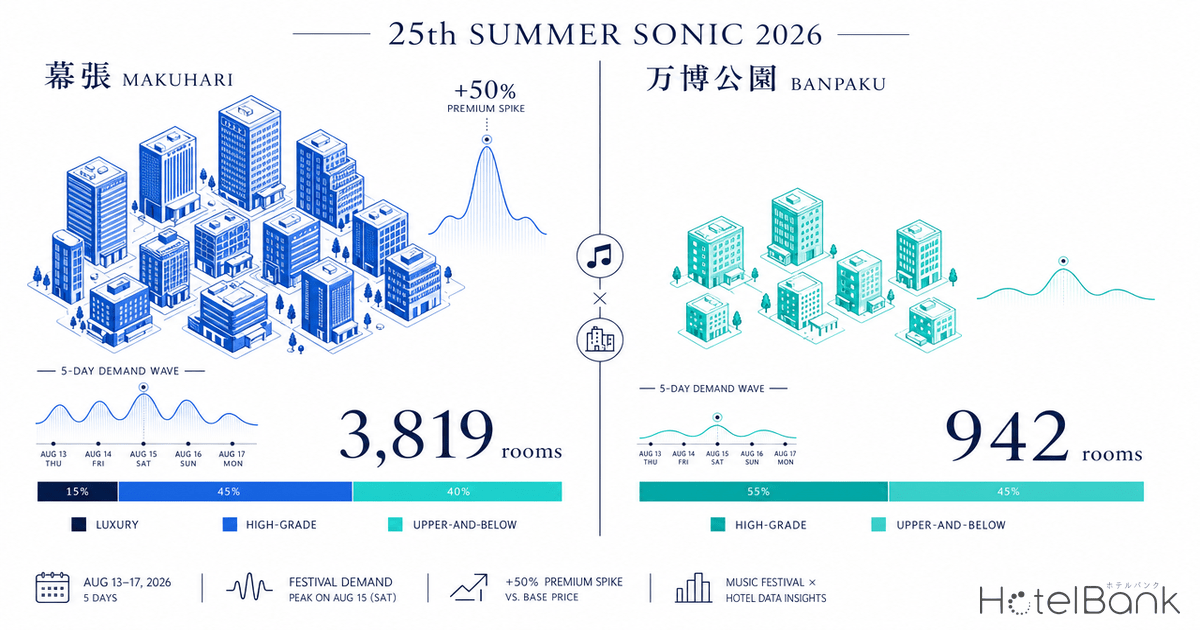
SUMMER SONIC 2026 will be held over three days on August 14 (Fri), 15 (Sat), and 16 (Sun) across two venues — Makuhari Messe & ZOZO Marine Stadium (Tokyo) and Expo ’70 Commemorative Park (Osaka). This year marks the 25th anniversary, and hotel prices around both venues are showing distinctive movement across a five-day window (Aug 13–17) that includes pre- and post-festival overnight demand. In this article, we examine room capacity, grade distribution, five-day consecutive ADR trends, and sold-out rates for hotels within a 5km radius of Makuhari ZOZO Marine Stadium and Expo Commemorative Park, using data from MetroEngines Research.
Metric Definitions Used in This Article
- ADR (Average Daily Rate): The average of publicly listed sales prices on OTAs. This differs from actually transacted prices (when cross-checked against REIT-disclosed data, OTA-listed ADR tends to run roughly +25–30% higher than transacted ADR. This is because unsold higher-priced plans tend to remain visible on OTAs, pushing the public-price average upward relative to actual transaction prices). Per-room rate (tax included) for double occupancy, averaged across all plan types (room-only through meal-inclusive plans).
- Sold-out rate: The share of plans whose OTA bookings had closed at the time of the survey. This differs from a property’s overall room occupancy rate.
- Survey scope: Operational hotels located within a 5km radius (calculated via ST_Distance_Sphere) of Makuhari ZOZO Marine Stadium (lat 35.645 / lng 140.030) and Expo Commemorative Park (lat 34.804 / lng 135.532). Only properties with retrievable price data on MetroEngines Research are aggregated.
- Data source: MetroEngines Research (target-property filtering as of April 30, 2026)
The Structural Asymmetry Highlighted by the 25th Anniversary Edition
SUMMER SONIC 2026 is held simultaneously at the Tokyo venue (Makuhari Messe + ZOZO Marine Stadium) and the Osaka venue (Expo Commemorative Park), but the surrounding hotel capacity differs sharply. Filtering for operating hotels within a 5km radius yields 13 properties / 3,819 total rooms in Makuhari, versus 11 properties / 942 rooms in Expo Park — a roughly 4x gap in capacity. The grade composition is also strikingly different: Makuhari offers a full lineup from luxury through economy, while Expo Park has only a single property at the high-grade tier or above, with the remainder concentrated in upper-grade and below.
In other words, even for the same three-day festival, Makuhari has a thick layer of room inventory to absorb demand, whereas Expo Park is structurally inclined toward a scramble for a limited stock. If the 25th-anniversary edition draws a larger artist roster and audience than a typical year, this asymmetry will translate into a sizable difference in how prices respond.
Source: MetroEngines Research, compiled by HotelBank Editorial Team
| Area | Properties | Total Rooms | Luxury | High-Grade | Upper & Below |
|---|---|---|---|---|---|
| Makuhari ZOZO Marine 5km | 13 | 3,819 | 418 | 2,094 | 1,307 |
| Expo Commemorative Park 5km | 11 | 942 | 0 | 203 | 739 |
Source: MetroEngines Research, compiled by HotelBank Editorial Team
Makuhari Area: How Prices Moved Across Five Days
Aggregating five consecutive days of ADR for 10 properties around Makuhari ZOZO Marine Stadium reveals a clear three-tier structure. The Aug 13 (Thu) pre-festival night sits at roughly ¥25,600, the three festival main days (Aug 14 Fri – Aug 16 Sun) form a peak band of ¥46,000–¥50,300, and the Aug 17 (Mon) post-festival night drops sharply to ¥20,200.
Compared with the average normal-Friday ADR for other weeks in August (¥31,900), the festival-main Aug 14 (Fri) at ¥49,900 represents a roughly +57% premium — not on a year-over-year basis, but against “normal Fridays in the same month.” The peak Aug 15 (Sat) at ¥50,300 is +58%. Even allowing for the 25th-anniversary value-add, room rates are running at roughly 1.5x normal pricing.
What stands out is the trajectory of the sold-out rate. Among the three festival main days, Aug 16 (Sun) registers the highest sold-out rate at 65.0%, indicating that two-night guests (Fri–Sat) and three-night guests (Fri–Sat–Sun) are concentrating their stays through the final Sunday. By contrast, the Aug 14 (Fri) sold-out rate stays at 55.5%, suggesting that pre-festival demand for opening day has partially shifted to the Aug 13 (Thu) night.
Source: MetroEngines Research, compiled by HotelBank Editorial Team
Expo Park Area: Capacity Constraints Behind the Lower Absolute Values
Five-day ADR for the four properties around the Osaka venue at Expo Commemorative Park (those with retrievable OTA price data) runs lower in absolute terms than Makuhari. The three-day average for the festival main days is ¥24,800 — roughly half of Makuhari’s ¥48,700. This directly reflects the difference in lodging composition: Expo Park has no luxury-tier hotels, with the inventory concentrated in upper-grade and below.
However, the picture changes when looking at the premium percentage. Against the average normal-Friday ADR for other weeks in August (¥17,400), the festival Saturday (Aug 15) at ¥26,900 is +55% — virtually identical to Makuhari’s premium. Even when the property grade level is lower, the tightness of the supply-demand balance is much the same on the east and west sides.
Inventory constraints are also pronounced. The total rooms across high-grade through upper-grade hotels around Hotel Hankyu Expo Park come to just 942. Against the historical attendance scale of the Osaka Summer Sonic venue (tens of thousands per day in past editions), the rooms available within 5km are very limited. Many attendees end up dispersing to more distant hotels in Shin-Osaka, Umeda, Senri-Chuo, and similar areas. This is the second factor keeping the absolute ADR around Expo Park subdued.
Source: MetroEngines Research, compiled by HotelBank Editorial Team
How the Mix of Two-Night and Three-Night Guests Shapes Sold-Out Rates
For multi-day events like Summer Sonic, guest stay patterns become diversified. Specifically: (1) two nights Fri–Sat, attending only opening and middle days; (2) two nights Sat–Sun, attending only middle and final days; (3) three nights Fri–Sat–Sun, attending all days; and (4) day-trip plus Sunday post-stay. This mix directly affects the day-by-day sold-out trajectory.
In both Makuhari and Expo Park, the highest sold-out rate falls on Aug 16 (Sun) — the third festival day. Makuhari hits 65.0% and Expo Park 56.8%, both the highest readings during the main festival window. This appears to result from pattern (1) and (3) guests extending into Sunday and overlapping with later-arriving (2) and (4) guests, producing accumulated demand.
Conversely, despite being the festival opening day, Aug 14 (Fri) shows a sold-out rate of 55.5% in Makuhari and 51.6% in Expo Park — lower than the middle and final days. This suggests that pre-festival guests have shifted their inventory consumption forward to Aug 13. In fact, the Aug 13 (Thu) sold-out rates of 45.3% (Makuhari) and 49.3% (Expo Park) are slightly elevated versus the normal-Thursday baseline of 46.4% and 39.9% respectively, supporting the existence of pre-festival night demand.
Source: MetroEngines Research, compiled by HotelBank Editorial Team
Hotel Distribution as Seen on the Map
Mapping the hotel distribution for both areas, Makuhari has large city hotels concentrated within a 1km radius of the venue (ZOZO Marine + Makuhari Messe). Expo Park, on the other hand, has only Hotel Hankyu Expo Park immediately adjacent to the venue, with the remaining lodging dispersed 2km or more away toward Senri and Ibaraki. This physical distance disperses attendees’ lodging choices.
Hotel distribution around Makuhari ZOZO Marine Stadium (blue circles: marker size = room count)
Source: MetroEngines Research, compiled by HotelBank Editorial Team
Hotel distribution around Expo Commemorative Park (blue circles: marker size = room count)
Source: MetroEngines Research, compiled by HotelBank Editorial Team
Nearest-Station Capacity as a Supplementary Indicator
In addition to hotel capacity, nearest-station throughput also influences attendees’ lodging choices. Kaihin-Makuhari Station (JR Keiyo Line) had an average daily ridership of 56,995 passengers (FY2024), the third-largest among intermediate stations on the Keiyo Line, behind Shin-Kiba. Expo Commemorative Park Station (Osaka Monorail), by contrast, sees only 20,247 passengers — about one-third of that capacity.
In other words, Makuhari combines “ample room inventory and high station throughput,” while Expo Park carries the structural weakness of “limited room inventory and limited station throughput.” The former can absorb large peak-day demand, whereas the latter is forced to disperse peak demand into surrounding areas. This also affects pricing strategy: properties with limited inventory around Expo Park can plausibly set more aggressive prices that already factor in concentrated demand.
| Nearest Station | Avg Daily Ridership | 5km Hotel Rooms | Festival Fri–Sun Avg ADR | vs Normal Fri |
|---|---|---|---|---|
| Kaihin-Makuhari Station | 56,995/day | 3,819 | ¥48,700 | +53% |
| Expo Commemorative Park Station | 20,247/day | 942 | ¥24,800 | +42% |
Source: JR East “Daily Station Ridership FY2024,” Osaka Monorail “FY2024 Station Passenger Counts,” MetroEngines Research, compiled by HotelBank Editorial Team
Did the 25th-Anniversary Premium Actually Form?
In conclusion, the 25th-anniversary Summer Sonic 2026 lifted surrounding hotel prices by roughly +50% at both venues, with sold-out rates showing the distinctive pattern of peaking on the third festival day (Sunday). However, the two areas differ clearly in “absolute price level” and “capacity headroom.”
Makuhari shows ¥48,700 ADR with a 57.8% sold-out rate — a “high-rate × moderate inventory consumption” profile. Expo Park shows ¥24,800 ADR with a 53.7% sold-out rate — a “mid-rate × moderate inventory consumption” profile. At first glance Makuhari looks dramatically higher-priced, but this reflects the gap in capacity (3,819 vs 942 rooms) and grade composition (the presence of 418 luxury rooms + 2,094 high-grade rooms). The relative premium percentage is roughly the same.
From a revenue-management perspective, festival demand is a textbook case of “predictable date-specific demand.” Looking ahead to next year’s SUMMER SONIC and similar stadium-and-concert demand, effective levers include: (1) staged price design across the full five-day range that includes pre- and post-festival nights; (2) building 2-night and 3-night package plans; and (3) reserving final-mile pricing headroom aligned with the third-day sold-out peak. The symbolic milestone of the 25th anniversary is more than just a “demand explosion on specific days” — it is also a test of how thoroughly properties can read the demand curve and price it in.
⚠ Note on ADR for Future Dates: The ADR figures in this article represent the average of OTA-listed sales prices at the time of the survey (April 30, 2026), and they shift as check-in dates approach. Prices currently set high may fall through last-minute discounting, while prices may also rise further through revenge-pricing as inventory sells out. Please bear both possibilities in mind.