

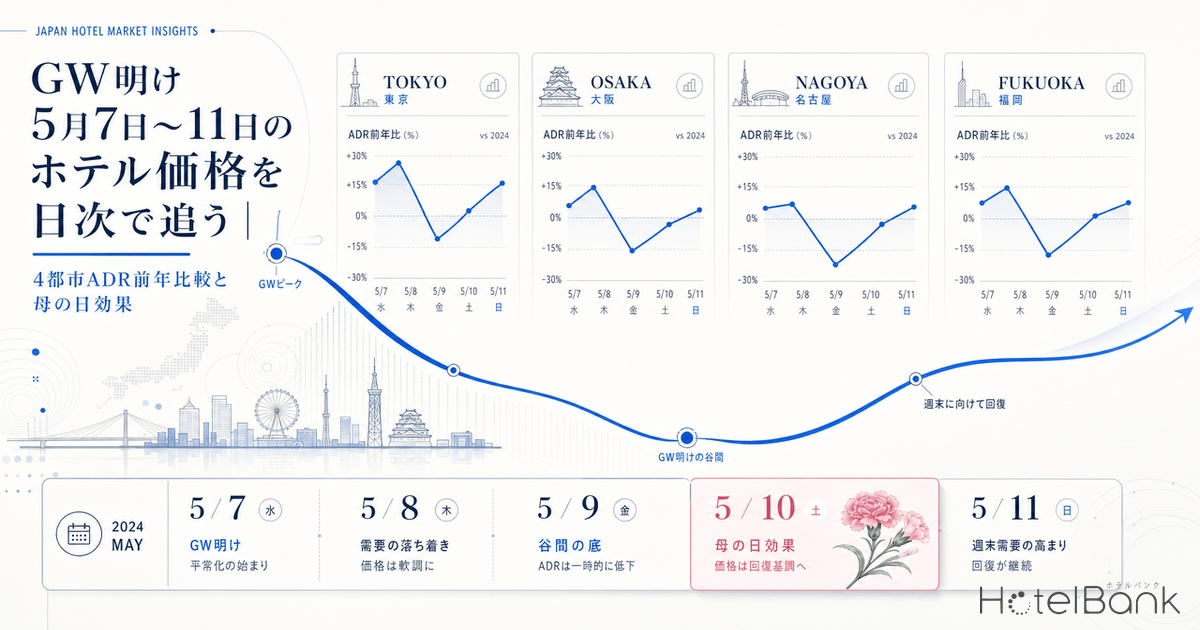
When the Golden Week (GW) holiday rush ends, Japan’s hotel market cools down rapidly. In 2026, the final GW holiday falls on Wednesday, May 6 (a substitute holiday), with regular operations resuming on Thursday, May 7. However, demand picks up again toward the weekend: Saturday, May 9 brings weekend demand, and Sunday, May 10 coincides with Mother’s Day. This article tracks daily ADR (average published rates) for the four major cities of Tokyo, Osaka, Nagoya (Aichi), and Fukuoka from May 7 to May 11, comparing them with the same period last year to verify the realities of the “post-GW valley” and the “Mother’s Day effect” with data.
*Prices are per-room rates (tax included) for double occupancy. ADR figures in this article are averages of public rates being sold on OTAs and elsewhere, and differ from actual transaction prices. Survey scope: N=4,097 properties (Tokyo 1,889; Osaka 867; Aichi 606; Fukuoka 735 / as of May 7, 2026).
Metric Definitions Used in This Article
- ADR (Average Daily Rate): Average of sales prices publicly displayed on OTAs and similar channels. Differs from actual transaction prices. Per-room rates (tax included) for double occupancy, averaged across all plans (room-only through plans with meals).
- Sold-Out Rate: Share of plans on OTAs that had closed reservations as of the survey date. Differs from a property’s overall room occupancy rate.
- Data Source: MetroEngines Research
Sharp Drop from the GW Peak: ADR Falls Up to 47% Across Four Cities
To grasp the overall picture, we first review ADR trends from the GW peak (May 3) to the first day after GW (May 7). Compared with May 3, which marked the highest level during GW, the May 7 ADR dropped 34% in Tokyo, 43% in Osaka, 41% in Nagoya, and 47% in Fukuoka — a substantial decline across all cities. Fukuoka stands out: it recorded the highest ADR among the four cities at ¥53,400 during GW but plunged to ¥28,500 immediately after GW, highlighting the magnitude of the swing.
This sharp decline, however, is a seasonal pattern that repeats every year, and a similar trend was observed in 2025. What matters is how the market recovers from this “valley” and the extent to which it differs from the prior year.
Source: MetroEngines Research, prepared by HotelBank Editorial Team (N=4,097 properties)
Daily ADR May 7-11: Day-of-Week Shift Heavily Skews YoY Comparisons
Looking at daily ADRs from May 7 to 11 by city, 2026 falls on “Thu-Fri-Sat-Sun-Mon” while 2025 ran “Wed-Thu-Fri-Sat-Sun.” This one-day shift in the week structure has a major impact on same-date YoY comparisons and warrants careful attention.
Particularly striking is the ADR for Saturday, May 9. Tokyo posted ¥47,100 (+22.7% YoY same-date), and Fukuoka reached ¥44,900 (+48.7%) — both substantial increases. This is because May 9, 2025 was a Friday whereas May 9, 2026 is a Saturday, with the weekend premium directly inflating the YoY comparison. Conversely, May 10 was a Saturday in 2025 (a high-rate day) but a Sunday in 2026, producing large same-date declines of -22.2% in Tokyo and -38.1% in Osaka.
| City | 5/7 (Thu) | 5/8 (Fri) | 5/9 (Sat) | 5/10 (Sun) Mother’s Day |
5/11 (Mon) |
|---|---|---|---|---|---|
| Tokyo | ¥34,000 +2.6% |
¥37,300 +6.7% |
¥47,100 +22.7% |
¥36,900 -22.2% |
¥38,400 +4.0% |
| Osaka | ¥23,300 -13.2% |
¥25,000 -10.5% |
¥31,600 +4.3% |
¥24,200 -38.1% |
¥24,700 -13.9% |
| Nagoya | ¥24,900 +12.7% |
¥27,400 +18.0% |
¥34,500 +41.6% |
¥26,100 -20.8% |
¥24,300 +2.3% |
| Fukuoka | ¥28,500 +11.9% |
¥32,800 +23.7% |
¥44,900 +48.7% |
¥31,100 -32.9% |
¥30,100 +0.8% |
Source: MetroEngines Research, prepared by HotelBank Editorial Team (% = YoY same-date)
In other words, May 10’s large YoY decline does not signal weakening demand; rather, it is a surface-level fluctuation caused by the difference in weekday alignment. When hotel operators evaluate revenue performance against the prior year, factoring in this day-of-week shift is essential.
Recovery Patterns by City: Fukuoka and Nagoya Substantially Outperform Last Year
To eliminate the day-of-week distortion, let’s compare same weekdays. The chart below aligns Thursday May 7, 2026 with Thursday May 8, 2025; Saturday May 9, 2026 with Saturday May 10, 2025; and so on.
Source: MetroEngines Research, prepared by HotelBank Editorial Team
Fukuoka and Nagoya outperformed the prior year on the Thursday comparison at +7.7% and +7.4% respectively. On the Saturday comparison, Nagoya held firm at +4.4%, while Fukuoka dipped only slightly at -3.2%, closing in on the high level of 2025’s Saturday (the day before Mother’s Day).
Osaka, on the other hand, remains soft even after aligning weekdays. The Thursday comparison shows -16.6% and the Saturday comparison -19.1%, clearly reflecting the rebound from the high baseline during the 2025 Osaka-Kansai Expo period. Tokyo dipped only -2.8% on Thursday and was essentially flat at -0.9% on Saturday, suggesting a stable demand base.
The Reality of Mother’s Day Demand: A Limited “Lift Effect”
In 2026, Mother’s Day falls on Sunday, May 10 (in 2025 it was May 11). Comparing Mother’s Day Sunday-to-Sunday YoY, we see Tokyo +0.2%, Osaka -15.7%, Nagoya +10.0%, and Fukuoka +3.9%. With the exception of Nagoya, no clear price-lift effect from Mother’s Day can be confirmed.
Hotels offer Mother’s Day-specific lunch plans, afternoon tea sets, and stay packages with spa services, but these contribute mainly to restaurant and ancillary facility revenue, with little direct impact on guestroom ADR. Mother’s Day demand likely manifests in the market as “Sunday occupancy maintenance” rather than as a “rise in nightly rates.”
Source: MetroEngines Research, prepared by HotelBank Editorial Team
Reading Supply-Demand Balance from Sold-Out Rates: Demand Concentrates on Saturday
Beyond ADR, the sold-out rate (the share of properties whose inventory has fully sold) also illuminates the supply-demand balance. The sold-out rate for Saturday, May 9 was 33.7% in Tokyo, 30.9% in Fukuoka, 26.9% in Osaka, and 24.5% in Nagoya — clearly higher than weekdays in every city.
| City | 5/7 (Thu) | 5/8 (Fri) | 5/9 (Sat) | 5/10 (Sun) Mother’s Day |
5/11 (Mon) |
|---|---|---|---|---|---|
| Tokyo | 25.7% | 27.1% | 33.7% | 27.4% | 27.5% |
| Osaka | 24.0% | 25.0% | 26.9% | 24.0% | 25.9% |
| Nagoya | 21.6% | 22.8% | 24.5% | 17.8% | 18.3% |
| Fukuoka | 19.7% | 21.8% | 30.9% | 21.4% | 20.8% |
Source: MetroEngines Research, prepared by HotelBank Editorial Team
Notably, the sold-out rate on Mother’s Day (Sunday, May 10) sits at the same level as weekdays. Tokyo at 27.4% and Nagoya at 17.8% are both well below the Saturday peak. In short, Mother’s Day does not have the strength to boost lodging demand; for a Sunday in the post-GW lull, these are typical levels. That said, Nagoya’s Sunday sold-out rate is particularly low at 17.8%, while ADR rose +10.0% YoY same-day-of-week — suggesting a possible pricing strategy of maintaining rates while moderating occupancy.
How to Read Osaka’s YoY Decline
Among the four cities, only Osaka shows YoY same-date declines on virtually every day: -13.2% on May 7, -10.5% on the 8th, -38.1% on the 10th, and -13.9% on the 11th — double-digit drops across the board. Even after aligning weekdays, the declines remain significant at -16.6% on Thursday and -19.1% on Saturday.
The likely backdrop is the impact of the Osaka-Kansai Expo, held from April through October 2025. During the Expo, an enormous influx of demand to Osaka — including inbound visitors — pushed hotel prices up year-round. In 2026, with no Expo in play, the market has reverted to normal demand levels, making the YoY declines stand out by contrast.
Even so, Osaka’s Saturday May 9 ADR of ¥31,600 is by no means a low level for a post-GW Saturday. Osaka’s “YoY decline” should be interpreted not as market weakness but as the flip side of an abnormally high 2025 baseline.
Summary: The Post-GW Valley Recovers in 3 Days; Mother’s Day Effect Lands at Restaurants
The daily ADR data for May 7-11, 2026 confirms three points.
First, the post-GW price drop is sharp but short-lived. Although prices fall 34-47% from the GW peak (May 3) to the first post-GW day (May 7), just two days later — by Saturday May 9 — they have recovered to 70-90% of GW peak levels. Tokyo (¥47,100) and Fukuoka (¥44,900) in particular showed strong rebounds.
Second, day-of-week shifts have an outsized effect on same-date YoY comparisons. Because the 2026 calendar is offset by one day from 2025, same-date comparisons readily produce surface-level distortions. Revenue management requires comparisons on the same weekday or analyses that take the week structure into account.
Third, Mother’s Day’s lift effect on lodging ADR is limited. The Sunday-to-Sunday YoY comparison shows no notable upward shift. Mother’s Day demand tends to flow into ancillary venues — lunch buffets, afternoon teas, and the like — with limited spillover into guestroom ADR.
How to navigate the post-GW valley is an annual challenge for hotel operators. As the data shows, Saturday demand recovers strongly, so the key to revenue improvement lies in how to secure weekday (Thursday and Friday) occupancy. Initiatives by the Japan Tourism Agency to promote “vacation reform” and weekday travel are expected to help narrow these intra-week gaps.
Note on Future-Date ADR: The ADR figures in this article are averages of sales prices publicly listed on OTAs as of the survey date and will fluctuate as check-in dates approach. Please be aware that prices currently set high may decline through last-minute discounts.