

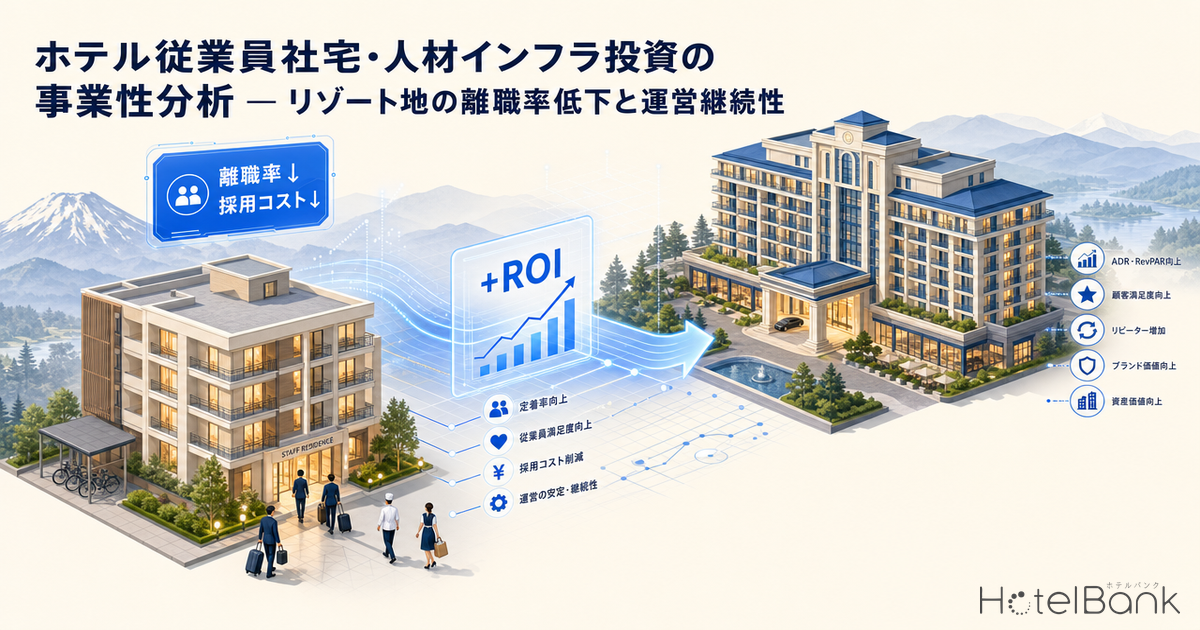
The arrival of the JPY 1,500 hourly wage era and surging dispatch-staff rates have dramatically transformed the labor-cost structure of Japan’s hotel industry. But in resort areas, a more serious problem is unfolding quietly: the structural barrier that staff simply “have nowhere to live.” This article analyzes direct investment by hotel operators in employee housing and dormitories from the dual perspectives of real-estate investment and talent-infrastructure investment, models the financial viability, and explores implications for operator selection.
Metric Definitions Used in This Article
- ADR (Average Daily Rate): The average of listing prices publicly displayed on OTAs. Note that this differs from actual transaction prices (cross-checks against REIT-disclosed data show OTA ADR runs roughly +25 to 30% above actual transaction ADR). Per-room rate for double occupancy (tax-included), averaged across all plans (from room-only to plans with meals).
- OCC (Occupancy Rate): The ratio of sold rooms to total available rooms in the area (estimated from OTA inventory).
- Angle of this article: We address the “stock” (asset investment) of staff housing and dormitories, rather than the “flow” (operating cost) of wages and dispatch rates — a different angle from our coverage on room-cleaning dispatch costs.
- Data sources: MetroEngines Research & Consulting, Japan Tourism Agency / Ministry of Land, Infrastructure, Transport and Tourism statistics, monthly operating results of each REIT.
Executive Summary — “High ADR Without Housing” Is the Biggest Bottleneck in Resort Operations
The ADR growth rate and residential-land-price growth rate in resort areas are now two sides of the same trend. Hakuba (Nagano) topped the 2026 published-land-price ranking for residential land growth nationwide (+33.0%), and Niseko’s residential standard land price rose +13.7% as well. Yet hotel staff working in those same areas earn, on average for the lodging/food-service sector nationally, only about JPY 259,000 per month. In Hakuba and Niseko, where high-end ADRs run JPY 66,000 to JPY 118,000, it has become effectively impossible for employees to secure housing at market rents.
The argument of this article is simple: employee housing and dormitories in resort operations are no longer “fringe benefits” — they are “essential infrastructure that guarantees operational continuity,” and when designed properly, they function as “investment assets” that contribute to cash flow through reduced turnover and recruiting costs. The fact that Hoshino Resorts has expanded its development division by roughly 20 staff over three years and formed a joint fund with DBJ to develop staff housing across Japan reflects exactly this strategic conclusion.
Market Trends — Simultaneous Inflation of Resort ADR and Residential Land Prices Squeezes Operations
Using MetroEngines Research data, we compare peak-month ADRs in major resort destinations: February 2026 (winter peak for Niseko and Hakuba) and April (spring season for Okinawa). Kutchan-cho (Niseko) reaches JPY 89,700, Hakuba JPY 66,400, and Onna-son (Okinawa) JPY 41,800 — all well above the national average (Tokyo at JPY 36,700 in March 2026). Meanwhile, residential land prices in these areas are rising sharply: Hakuba +33.0% (2026 published land prices), Niseko +13.7% (2025 standard land prices), Onna-son +18.7% (standard survey points), driving up the housing-cost burden on employees rapidly.
Hakuba’s residential land prices have ranked among the highest growth rates nationwide for three consecutive years. The +33.0% growth in residential land prices reflects the inflow of demand from foreign investors and domestic high-net-worth buyers for condominiums and second homes. Local residential rents have followed: new apartments inside the village now run JPY 80,000 to 120,000 per month, and detached homes above JPY 200,000 per month are no longer rare. For hotel employees in the village earning a typical take-home pay of around JPY 200,000 per month, living at market rent is simply not viable.
Location Analysis — “Housing Accessibility” and Operational Continuity Risk in Resort Areas
From the perspective of operational continuity risk, we map housing accessibility across four resort locations. Resort areas tend to be evaluated for investment primarily by ADR level, but adding the lens of “can employees actually live in the area?” changes the picture significantly.
| Area | Peak-Month ADR | Residential Land YoY | Market Rent (1LDK) | Housing Accessibility |
|---|---|---|---|---|
| Hakuba (Nagano) | ¥66,400 | +33.0% | ¥80k–120k/month | Extremely difficult |
| Kutchan (Niseko) | ¥89,700 | +13.7% | ¥70k–100k/month | Extremely difficult |
| Karuizawa (Nagano) | ¥33,600 | +12.1% | ¥70k–90k/month | Difficult |
| Onna-son (Okinawa) | ¥41,800 | +18.7% | ¥60k–80k/month | Difficult |
| Sapporo Chuo-ku (reference) | ¥37,300 | +4 to 6% | ¥70k–100k/month | Normal |
In large cities such as Sapporo’s Chuo-ku, ADR may rival resort levels, but rents remain aligned with local wages, so housing does not become a bottleneck for employee acquisition. In contrast, Hakuba, Niseko, and Onna-son have ADRs and rents at “resort prices” while monthly wages remain at the “national average” — meaning that unless hotels provide housing themselves, securing local staff becomes structurally impossible.
Competitive Landscape — Major Chains Are Already Investing in Talent Infrastructure
Hoshino Resorts launched a year-round recruiting program in October 2024 that includes 1st- and 2nd-year university students, reducing post-offer decline rates by approximately 80%. The company operates 72 properties nationwide and provides dormitories and master-leased apartments for regional staff, with rent subsidies offered for the first three years after joining. Its development division has expanded to around 20 staff over three years, with 30 projects running concurrently both domestically and internationally. This is not merely property development — it is a large-scale investment that includes the talent infrastructure (dorms and staff housing) behind it.
Monthly operating results for Hoshino Resorts REIT (3287) show continued solid occupancy across the portfolio. High-rate resort properties such as Hoshinoya Kyoto and Hoshinoya Fuji also maintain stable occupancy — and behind those numbers lies the talent infrastructure of dorms and staff housing. Only with a system that lets staff commute reliably do those operating figures become attainable.
Positioning Analysis — The Structure of Areas Where “High ADR Doesn’t Guarantee Operational Continuity”
A scatter plot of ADR vs residential land price YoY visualizes the relationship between “ADR upside” and “talent-acquisition risk” by area. The further toward the upper right, the more both ADR and land prices are rising simultaneously — a structure in which “revenue opportunity and talent risk advance side by side” from the operator’s perspective.
High Risk Hakuba & Kutchan
ADR JPY 66k–90k, residential land +13 to 33%. New entries without staff housing face severe risk of stalling on talent acquisition shortly after opening.
Mid Risk Karuizawa & Onna-son
ADR JPY 33k–42k, residential land +12 to 18%. Local hiring and expanded commuting radius can partially absorb the gap, but staff-housing readiness is the competitive differentiator.
Normal Sapporo Chuo-ku etc.
ADR and rents are aligned with the local economy. Housing costs can be borne by individuals; staff housing functions as an additional measure for sharpening recruiting competitiveness.
Staff Housing Investment Scenarios — Modeling a 30-Unit Dormitory
We model an employee dormitory investment of 30 rooms in Hakuba across three scenarios. Construction-cost assumptions draw on archi-book’s latest published per-tsubo benchmarks and prevailing resort-construction rates in Nagano Prefecture. For inflation adjustment, we apply compound annual increases of roughly +5% (consistent with the recent uptrend in construction costs) through the opening year.
| Item | A. Wood, low-cost | B. Wood, standard Recommended | C. RC, high-durability |
|---|---|---|---|
| Number of rooms | 30 units | 30 units | 30 units |
| Room size | 15 sqm (4.5 tsubo) | 18 sqm (5.5 tsubo) | 20 sqm (6 tsubo) |
| Common-area ratio | 25% | 30% | 30% |
| Total floor area | 600 sqm | 770 sqm | 860 sqm |
| Cost per tsubo (2024 actual) | ¥1.23M | ¥1.34M | ¥1.74M |
| Construction cost (2024 level) | ¥220M | ¥310M | ¥450M |
| Construction cost (2027 opening, inflation-adjusted) | ¥250M | ¥360M | ¥520M |
| Land acquisition (500 sqm assumed) | ¥50M | ¥50M | ¥50M |
| Total investment (inflation-adjusted) | ¥300M | ¥410M | ¥570M |
| Employee rent contribution (monthly) | ¥25,000 | ¥30,000 | ¥35,000 |
| Annual rent revenue | ¥9.0M | ¥10.8M | ¥12.6M |
| Simple yield (rent only) | 3.0% | 2.6% | 2.2% |
*Simplified model. Actual investment decisions require detailed feasibility studies. Resort-specific construction-cost premiums (logistics, winter-season work restrictions) must be added separately.
On a rent-only basis, the simple yield is just 2 to 3% — not attractive as a pure residential rental investment. But the viability of this investment should be evaluated not by rent alone, but by “reduced turnover-driven recruiting costs” and “secured operational continuity.”
Investment Decision — Effective Yield Including “Recruiting Cost Reduction Effects”
Assume that staff-housing development can improve the lodging-industry turnover rate of 26.6% (1.7x the 15.4% all-industry average) to the all-industry level. For a 30-room hotel with 50 employees, this implies an 11.2 percentage-point reduction in turnover (5.6 fewer departures per year), saving approximately JPY 200,000 per person (recruiting cost JPY 39,000 standard for hospitality part-timers + training cost ~JPY 150,000).
| Effect Category | Annual Value | Basis |
|---|---|---|
| Recruiting & training cost savings | ¥1.12M | 5.6 staff x ~¥200k per person |
| Reduced opportunity loss from turnover | ¥3.0M | ~¥500k/month per vacancy x 6 months |
| Reduced reliance on dispatch / spot labor | ¥6.0M | Higher permanent-staff ratio enabled by housing, avoiding rising dispatch rates |
| Stabilized occupancy | ¥12.0M | Eliminates sales restrictions from labor shortage; equivalent to 3–5% of annual room revenue |
| Total savings | ¥22.12M | |
| Rent revenue | ¥10.8M | Scenario B |
| Total effective revenue | ¥32.92M | |
| Effective yield (vs total investment ¥410M) | 8.0% | Scenario B |
Summing recruiting/training cost savings, reduced opportunity loss, reduced dispatch dependence, and stabilized occupancy, the effective yield in Scenario B reaches approximately 8% — above the typical real-estate yield of resort hotels themselves (generally 5–7%). This suggests that staff-housing investment functions as a positioning that “underpins the yield of the hotel itself.”
Implications for Operator Selection
For investors and landowners considering hotel development in resort areas, the criteria for selecting operators are shifting. Beyond “brand strength” and “ADR track record,” “whether the operator carries its own talent infrastructure” now determines operational continuity.
| Evaluation Axis | Past Weight | 2026+ Weight | Specific Check Items |
|---|---|---|---|
| Brand recognition | ★★★★★ | ★★★★ | OTA conversion power, repeat rate |
| ADR track record | ★★★★★ | ★★★★ | Average ADR and OCC at comparable locations |
| Staff housing readiness | ★★ | ★★★★★ | Track record of staff housing in nearby properties, rent-subsidy schemes |
| Hiring & training systems | ★★★ | ★★★★★ | Turnover-rate track record, sustained new-graduate hiring |
| Foreign-worker utilization | ★★ | ★★★★ | Specified-Skilled-Worker track record, living-support systems |
Foreign-worker utilization is particularly notable: as of the end of December 2024, only 671 Specified Skilled Workers were residing under the “Lodging” category — meaning few operators are effectively leveraging the system. Housing is an even larger bottleneck for foreign-worker intake (language support and life-startup support are essential). Operators able to provide housing as a package can fully utilize the Specified Skilled Worker program.
Risk Factors and Sensitivity Analysis
| Scenario | Base | Recruiting savings -50% | Occupancy stabilization -50% | Construction cost +10% |
|---|---|---|---|---|
| Recruiting & training savings | ¥1.12M | ¥0.56M | ¥1.12M | ¥1.12M |
| Occupancy stabilization | ¥12.0M | ¥12.0M | ¥6.0M | ¥12.0M |
| Other effects | ¥9.0M | ¥4.5M | ¥9.0M | ¥9.0M |
| Rent revenue | ¥10.8M | ¥10.8M | ¥10.8M | ¥10.8M |
| Effective revenue | ¥32.92M | ¥27.86M | ¥26.92M | ¥32.92M |
| Total investment | ¥410M | ¥410M | ¥410M | ¥450M |
| Effective yield | 8.0% | 6.8% | 6.6% | 7.3% |
Even with savings cut in half, effective yield stays at 6.6–6.8%, not falling below the property-level investment yield of the hotel itself. Even with construction costs +10% over plan, yield holds at 7.3% — a sufficient level. This confirms that the investment functions both as “insurance that lowers business risk” and as “a rational real-estate investment.”
Policy Tailwind — A 6x Increase in Japan Tourism Agency Budget Reinforces Viability
In its FY2026 budget request, the Japan Tourism Agency boosted the “Labor-Shortage Countermeasures Initiative for Tourism Destinations and Industry” by 6x to JPY 300 million. The package covers foreign-worker support, capex support, and medium- to long-term management upgrades. Direct subsidies for staff housing are currently limited, but indirect utilization is feasible under the capex-support track. Additionally, the 2023 expansion of Specified Skilled Worker (Type 2) status to the lodging sector creates a path for long-term retention of foreign talent.
Policy action proposal: Building staff housing and dormitories in resort areas aligns with municipalities’ depopulation-countermeasure goals. Municipalities where land-price inflation makes resident lodging-staff retention increasingly difficult — Hakuba, Kutchan, Onna-son — represent fertile ground for operators and investors to negotiate property-tax reductions or flexible zoning interpretations.
Conclusion — “Talent Infrastructure Investment” Is the Next Competitive Edge
Investment in hotel employee housing and dormitories may look like a modest real-estate investment yielding only 2 to 3% on the surface. But once you add the combined effects of reduced turnover, lower recruiting costs, and secured operational continuity, the effective yield reaches approximately 8% — the “lifeline of resort-hotel investment.” The residential land-price increases of +33% in Hakuba, +13.7% in Niseko, and +18.7% in Onna-son have structurally raised talent-acquisition risk, and operators unable to address this will find themselves at a disadvantage in resort competition from 2026 onward.
Investors and landowners should weight “staff-housing readiness” far more heavily in operator selection than they have to date. Major players such as Hoshino Resorts and the DBJ joint fund have already grasped this dynamic and are making up-front investments in talent infrastructure. Mid-tier and emerging operators will increasingly find that their ability to offer a “staff-housing package” determines whether they win or lose development opportunities going forward. The true essence of the JPY 1,500 wage era is not a “cost increase on the flow side” — it is a structural shift where competitive advantage moves to the party that holds the “stock” (housing).
Note on forward-dated ADR: The ADRs in this article are averages of OTA-listed prices at the time of research and will fluctuate as check-in dates approach. Particularly during peak months in resort areas (February in Hakuba/Kutchan, August in Okinawa), both demand and prices remain highly volatile until the last minute.
References & Sources
Market Data
- MetroEngines Research & Consulting — OTA-published price data (municipal-level ADR; N per area noted in the text)
Government Statistics / Public Data
- MLIT “Reiwa 8 (2026) Land Price Publication” (announced March 2026)
- MLIT “Survey on Lodging-Industry Talent Acquisition and Development” (FY2024)
- Japan Tourism Agency “Foreign Worker Acceptance in the Lodging Sector (Specified Skilled Worker)”
- JTA FY2026 Budget Request — Labor-Shortage Measures 6x Increase (TravelVoice)
Land Price / Real Estate Data
- Niseko Hirafu 2026 Published Land Prices (tochidai.info)
- Karuizawa 2026 Published Land Prices (tochidai.info)
- Hakuba 2026 Published Land Prices (tochidai.info)
- Okinawa Residential Land #1 Nationwide for 10 Years (Okinawa Times, 2025)
- Hotel Construction Cost per Tsubo, 2025 Edition (archi-book)
REIT / Industry Reports
- Hoshino Resorts REIT — Portfolio & Monthly Operating Results
- DBJ x Hoshino Resorts Joint Operating Fund (Hotel/Ryokan Renewal Fund)
News / Press Releases
- Lodging/F&B 20% Understaffed; Niseko Hourly Wage Surpasses Chiyoda-ku (Nikkei, January 2025)
- Hoshino Resorts Launches Year-Round Recruiting Regardless of Class Year (PR TIMES, October 2024)
- Operating Status of Major Hotels in Okinawa (Okinawa Development Finance Corporation, Sep 2025)
- Hakuba Among Top Land-Price-Growth Areas Nationwide on Inbound Demand (LIFULL HOME’S)