

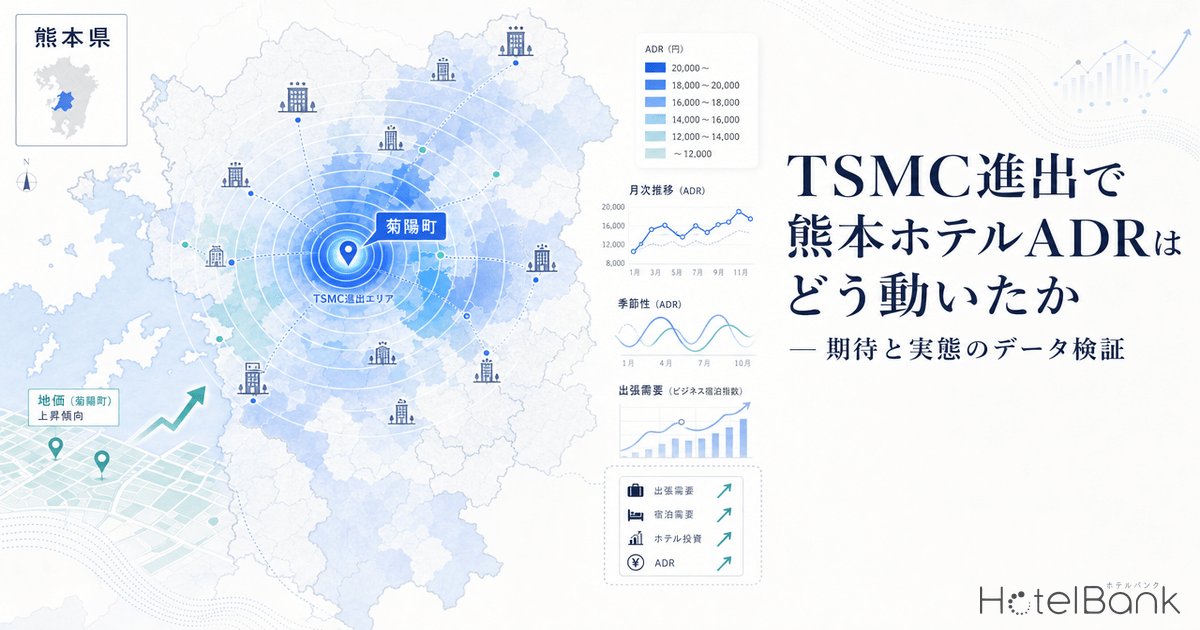
Following the February 2024 launch of TSMC’s Kumamoto Fab 1 (JASM) and the start of construction on the second fab, the economic transformation of Kikuyo Town centered on the semiconductor cluster has been widely expected to bring a “windfall” to the Kumamoto prefecture hotel market as well. However, when we track MetroEngines Research’s published price data on a monthly basis, the rise in ADR (Average Daily Rate) has not been as robust as initial expectations suggested. In this article, we calmly verify the gap between expectations and reality for the Kumamoto hotel market — where the semiconductor narrative has run ahead — based on data, and present the KPIs that hotel investors and operators should truly focus on.
Metric Definitions Used in This Article: ADR (Average Daily Rate) = the average of published selling prices from surveyed properties, which differs from actual transaction prices. Sold-out rate = the share of sales plans for which reservation acceptance had ended at the time of the survey, which differs from a property’s overall room occupancy rate. Prices are per-room rates (tax included) for 2-person, 1-room occupancy.
What Was the Expected “TSMC Windfall”?
Taiwan Semiconductor Manufacturing Company (TSMC), the world’s largest foundry, brought its Fab 1 online in February 2024 in Kikuyo Town, Kumamoto Prefecture, as JASM (Japan Advanced Semiconductor Manufacturing) — backed by Sony Semiconductor Solutions, Denso, and Toyota Motor. Multiple local newspapers have reported that construction of the second fab also began in earnest in 2025. Combined, the two fabs will employ more than 3,000 people, and including the entry of related companies, some estimates place the total employment effect at around 7,500 people.
The formation of this semiconductor cluster was expected to bring a “windfall” to the hotel market under the following scenarios. First, a sharp increase in business-trip-driven corporate demand. Long-term stays in Kumamoto were anticipated from engineers dispatched by the Taiwan headquarters and related suppliers, field engineers from equipment makers, and construction supervisors and workers. Second, a surge in new hotel investment driven by rising land prices and rents. Indeed, Kikuyo Town recorded a notable +14.5% year-on-year increase in the 2025 official land price assessment, and the temperature of the real estate market is extremely high.
Third, spillover effects on tourism. There were expectations that engineers and stakeholders who came to Kumamoto for business would return as repeat visitors with their families, or invite their business partners to Kumamoto, generating ripple demand. Combined, these factors were expected to push up Kumamoto Prefecture’s overall ADR on a sustained basis — that was the typical narrative articulated when TSMC first arrived. So, how did the actual data move? In the next section, we look at the monthly price trajectory.
Kumamoto Prefecture Monthly ADR Trends in Real Data
The monthly ADR for Kumamoto Prefecture compiled by MetroEngines Research stood at ¥25,300 in November 2024, rose to ¥28,600 at the August 2025 summer festival demand peak, but then settled at ¥27,200 in May 2026 and ¥25,200 in June 2026. For those expecting a “permanent unit price lift” from a semiconductor windfall, these numbers may feel somewhat anticlimactic.
Source: Compiled from MetroEngines Research data by HotelBank Editorial Team
As shown in the chart above, ADR exhibits clear seasonality. While unit prices reached the late ¥28,000 range in August 2025 driven by demand for summer festivals and fireworks events held within Kumamoto Prefecture, the months before and after continued to hover around ¥25,000. What is important is that this seasonal peak is a phenomenon that existed before TSMC’s arrival, regardless of the semiconductor cluster. In other words, to extract the pure unit price lift attributable to the semiconductor cluster, we must look at the year-over-year trend with seasonality stripped out.
Focusing on year-on-year comparisons, ADR in May 2026 was up by ¥571 (+2.1%) versus the same month a year earlier, and June 2026 was up only ¥201 (+0.8%). Adjusted for inflation, this is essentially flat in real terms. Compared with other prefectures in Kyushu (which we discuss later), Kumamoto’s ADR growth rate is also nothing extraordinary.
Source: Compiled from MetroEngines Research data by HotelBank Editorial Team
The bar chart of year-on-year growth confirms that Kumamoto Prefecture’s ADR has the character of “rising firmly but gently.” Rather than carrying a dramatic windfall premium, it is moving at roughly the same pace as nationwide inflation and the recovery in tourism — that is closer to the reality.
Why Is the Price Increase Limited? — Structural Factors of Supply and Demand
So, why has ADR growth been so muted despite the formation of a semiconductor cluster? The factors can be broadly decomposed into supply-side and demand-side considerations.
On the supply side, a wave of new hotel openings is keeping the supply-demand balance in check. “Tabino Hotel Kumamoto” opened in April 2025, and several accommodation projects are under construction or in planning near Kikuyo Town. Responding to requests from residents and businesses for “more hotels to be built,” developers have been adding supply. When supply expands in step with demand, prices do not surge — a textbook supply-demand mechanism appears to be at work.
On the demand side, the characteristics of corporate demand are dampening unit price growth. Semiconductor-related business travel, whether by engineers or construction personnel, is centered on consecutive-night and long-term stays. Hotels typically apply discounted rates for long-term guests, so the daily ADR does not rise easily. Instead, revenue is absorbed in the form of higher occupancy (OCC). Unlike leisure demand, which contributes through “short stays at high unit prices,” corporate demand makes the windfall feel diluted when viewed solely through the ADR lens.
From these supply and demand factors, we can summarize that the Kumamoto hotel market has developed a structure where “total revenue is rising, but the standalone ADR lift is limited.” In fact, the sold-out rate observed by MetroEngines Research (the share of sales plans that had ended reservation acceptance at the time of the survey) reached over 20% prefecture-wide as of April 2026, indicating that occupancy is indeed tightening.
→ Business Hotel Price Surge: National ADR Analysis & 10 Cost-Effective Prefectures
Source: Compiled from MetroEngines Research data by HotelBank Editorial Team
Comparing ADR among major Kyushu prefectures, Kumamoto is moving stably at a level on par with Fukuoka, while Nagasaki shows somewhat larger monthly swings driven by cruise and tourism demand. The fact that Kumamoto’s ADR is not showing any unusual surge can also be confirmed from this intra-Kyushu comparison.
The Windfall Is Diluted in Prefecture-Wide Averages — The Need for Area-Level Decomposition
So far we have looked at Kumamoto Prefecture’s overall ADR, but it would be premature to conclude from this alone that “there was no TSMC windfall.” This is because direct demand from the semiconductor cluster is concentrated within Kikuyo Town and a several-kilometer radius around it, so when averaged across Kumamoto Prefecture as a whole (which includes around 650 properties), the premium of any particular area is significantly diluted.
From an investment and operational perspective, the following kind of area-level decomposition is essential.
| Area | Main Demand Source | Expected Price Behavior |
|---|---|---|
| Around Kikuyo Town (Hikari-no-Mori, Haramizu) | TSMC-related corporate travel, construction personnel | Occupancy-led; long-stay discounts limit unit-price gains |
| Central Kumamoto City (Sakuramachi, Toricho-suji) | Tourism, business travel, conventions | Driven by broad-area demand, with strong seasonality |
| Aso, Kurokawa areas | Domestic and inbound tourism | Leisure-led; concentrated in high seasons |
| Around Airport, Mashiki | Transit, business base demand | Airport-access demand; stable trajectory |
Source: Compiled from MetroEngines Research data by HotelBank Editorial Team
As shown above, each area has a different demand character and a different price response. Looking only at the single number “Kumamoto Prefecture ADR” cannot fully capture the micro-level price increases that may be occurring around Kikuyo Town. Investment decisions require finer-grained data at the ZIP code or street-block level. For example, MetroEngines Research holds price data at the property-ID level, and one can confirm that the ADR trajectory differs greatly when filtering only properties located in Kikuyo Town versus only those in the Aso area.
In other words, if the goal is to capture the TSMC windfall, one must continuously track price and occupancy indicators narrowed down to the specific area around Kikuyo Town, not the prefecture-wide monthly average. This is a viewpoint that is equally important for investors, hotel chain development managers, and operators.
Message to Investors — Watch Occupancy More Than ADR
The message for hotel investors, REIT investors, and operators that emerges from this analysis is clear: for the Kumamoto Prefecture hotel market, occupancy growth deserves more attention than ADR growth.
Let us organize the reasons. First, as we have seen, Kumamoto’s ADR is rising at only roughly +0–2% year-on-year, making it difficult to expect dramatic unit-price growth from here. Second, semiconductor-related corporate demand is dominated by consecutive-night and long-term stays, so its contribution to hotel revenue manifests strongly on the occupancy side of the “ADR × OCC” equation. Third, the new hotel openings around Kikuyo Town add supply, so even within that limited area, the structure makes extreme unit-price spikes unlikely.
Given these market characteristics, it is desirable to redefine investment KPIs as follows.
| Conventional View | View to Emphasize for Kumamoto |
|---|---|
| ADR growth rate | Occupancy (OCC) growth rate, especially weekday occupancy |
| Prefecture-wide average unit price | Unit price and occupancy limited to areas near Kikuyo Town |
| Short-term spot bookings | Multi-night ratio, corporate contract ratio, long-stay share |
| RevPAR (combined ADR × OCC) | RevPAR decomposition (separating OCC and ADR contributions) |
Compiled by HotelBank Editorial Team
Looking only at the integrated indicator RevPAR, one cannot tell whether its growth is driven by unit price or by occupancy. Especially in markets driven by corporate demand, decomposing the two is the only way to grasp the essential dynamics of the market. When considering an investment in Kumamoto’s hotels, the scenario “ADR will rise sharply” tends to be overestimated. It is more rational to bet on scenarios such as “occupancy stabilizes at high levels,” “weekday occupancy is lifted from below,” and “year-round revenue stability improves.”
Also, as we have repeatedly emphasized in this article, lowering the granularity of data from prefecture-wide to area-level is the key to capturing the true picture of the TSMC windfall. Prefecture-wide averages are useful for observing macro trends, but they lack the resolution to evaluate localized, structural impacts such as a semiconductor cluster. Neither excessively dismissing the semiconductor narrative nor excessively praising it — coolly reading the data and resetting the indicators worth watching — that is the most constructive approach for engaging with the Kumamoto hotel market.
Summary
This article verified the gap between expectations of a TSMC-driven hotel windfall and actual data, using monthly ADR data from MetroEngines Research. The key takeaways are as follows.
| Issue | Data-Based Conclusion |
|---|---|
| Trajectory of Kumamoto ADR | ¥25,300 (Nov 2024) → ¥27,200 (May 2026). YoY +2.1% — gentle |
| Why unit price rise is limited | Supply expansion from new openings; demand structure dominated by long-term stays |
| Limits of the prefecture-wide average | Windfall is concentrated near Kikuyo Town; diluted in the prefecture-wide average |
| Implication for investors | Watch occupancy more than ADR; narrow the area instead of relying on prefecture averages; decompose RevPAR |
Compiled by HotelBank Editorial Team
The semiconductor narrative carries powerful appeal as a story of economic growth, but to draw out implications for a concrete asset class such as the hotel market, it must always be cross-checked against data. We hope this analysis serves as a starting point for discussion among investors, operators, and development managers engaging with the Kumamoto hotel market. Going forward, we will continue to raise the resolution of the Kumamoto hotel market by tracking the progress of the second Kikuyo Town fab, the entry of related companies, and the monthly data of the JTA’s Accommodation Travel Statistics Survey in parallel.