

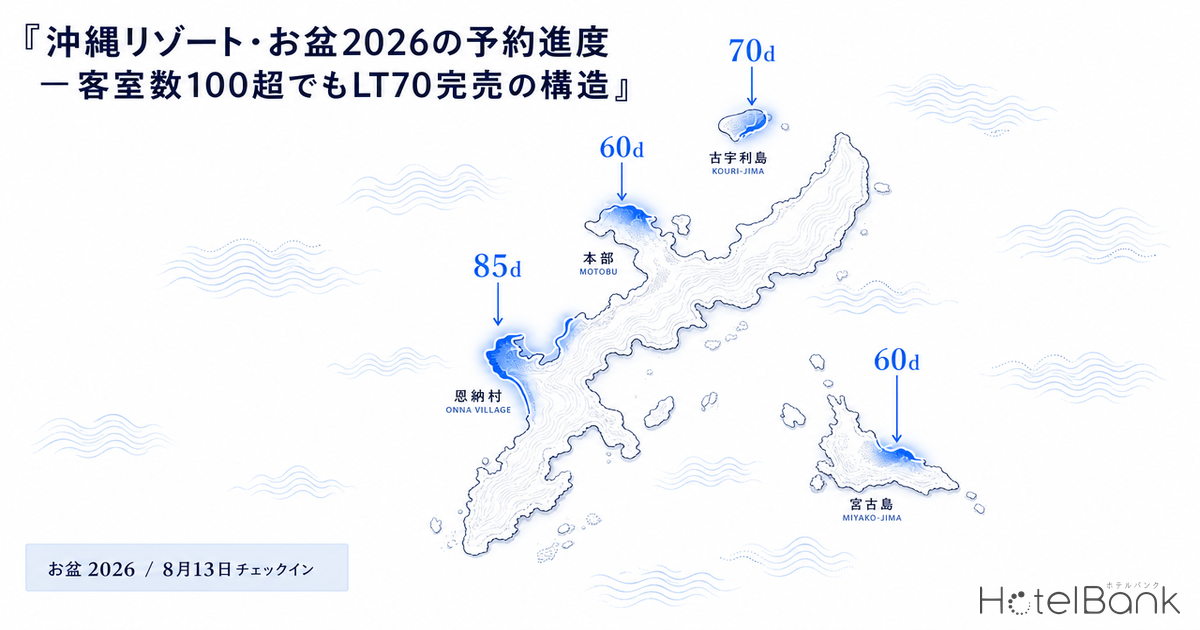
For Okinawa resort hotels with August 13, 2026 (Thursday) check-in, this article reads the booking pace through LT (lead time, the number of days until check-in) transitions based on remaining-inventory data tracked by MetroEngines Research. Even at the Obon peak, large-scale properties are moving particularly fast — for example, a mid-tier resort on Miyakojima with 67 rooms tightened its online-published inventory by one notch in roughly three weeks from LT90, with observational evidence of supply-demand tightening. Starting from a sample of 111 Okinawa resort hotels (restricted to properties whose OTA-published inventory is at least 30% of total rooms), this article examines how mid-scale and larger properties are tightening their inventory, combining competitive density and ADR tier in Miyakojima, Onna Village, and central main-island Okinawa.
Metric Definitions Used in This Article
- ADR (Average Daily Rate): Average of advertised prices on OTAs. Differs from actual transacted prices. Per-room rate for 2 guests/room (tax included), averaged across all plans (room-only through meal-included).
- OCC (Occupancy Rate): Ratio of sold rooms to total rooms in the area (estimated from OTA inventory).
- LT (Lead Time): Number of days until check-in. LT0 = same day.
- Early Sellout LT: The lead time at which remaining inventory first reached zero (the larger the value, the earlier the sellout).
- Data Source: MetroEngines Research
- — A 67-room mid-tier Miyakojima resort hit a sellout for August 13 Obon check-in over the three weeks from LT90 to LT70. Inventory absorption speed at mid-scale properties is structurally accelerating.
- — At LT60, remaining inventory across Okinawa Prefecture resorts stood at 4,787 rooms (down 18.8% vs. LT90), with supply-demand tightening progressively across the resort category as a whole.
- — August Okinawa Prefecture average ADR reached ¥36,587 (YoY +10.5%), the highest level in 18 months. Demand tightness is also reflected in rates.
- — After hitting LT70 sellout, the 67-room observation target loosened its online-published inventory and recovered to occupancy 59.7% (as of June 2026). Active supply-demand control implementation is observable.
- — Based on competitive density and ADR tier in Miyakojima, Onna Village, and central main-island Okinawa, opportunities for new entrants and operational efficiency are suggested in the mid-scale resort (50-100 rooms) range.
August 13 Obon Check-in: Sample and Area-Wide Booking Pace
First, let’s grasp the overall movement of the Okinawa Prefecture resort category. For August 13, 2026 (Thursday) check-in, MetroEngines Research tracks 473 resort hotels across Okinawa Prefecture. Of these, 231 properties have actual observation data on OTAs, and further narrowing the sample to those meeting the condition “OTA-published inventory at least 30% of total rooms” yields 111 properties. The reason for restricting the sample to 30%-plus is that for properties with small OTA-published inventory, it is structurally difficult to read booking pace from inventory movement. This article uses these 111 properties as its analysis target.
For the area-wide resort category (Okinawa Prefecture, 228 properties / 25,126 rooms, observation-based), remaining inventory was approximately 5,892 rooms at LT90 and 4,787 rooms at LT60 — meaning approximately 1,100 rooms (about 18.8% of observed published inventory) were absorbed over three weeks. Okinawa Prefecture’s resort average ADR has been trending in the ¥63,000 range, with ADR roughly flat even amid strong demand. In the Obon peak price band, levels are already near the upside ceiling.
Source: MetroEngines Research & Consulting (August 13, 2026 check-in, Okinawa Prefecture resort category, 228 properties / 25,126 rooms)
By category, the luxury tier (ADR ¥100,000+, 110 properties / 7,420 rooms) shows a similar pace, with approximately 260 rooms (25.5%) absorbed between LT90 and LT60. Prices remained essentially unchanged from the LT90 level of ¥153,100. For the overall sample (1,007 properties / 51,929 rooms, including business hotels through ryokan), remaining inventory at LT60 still stood at 14,721 rooms — buffer is thick due to the larger denominator — but the pace of the resort and luxury tiers stands out.
Booking Pace Ranking — The Structure of First LT70 Sellout Observation Even Above 100 Rooms
When ranking 111 properties by early sellout LT (the lead time at which remaining inventory first reached zero), the upper ranks are mostly occupied by small-scale villas and condominiums with 1-10 rooms. This is as expected — lodgings that operate as single-building rentals on peak days exhaust their inventory at an early stage. What deserves attention, however, is that a mid-tier resort with 67 rooms recorded zero remaining inventory at the substantial lead time of LT70. Among the 111-property sample, only one property meets both “30+ rooms” and “early sellout LT 60+” — structurally a rare movement.
| Rank | Property Name | Total Rooms | Early Sellout LT | Sellout Days Observed | Current Remaining Inventory Rate |
|---|---|---|---|---|---|
| 1 | Sunline Chatan Condominium Resort | 1 room | LT90 | 26 days | 0.0% |
| 2 | Petit Resort Kouri Island | 3 rooms | LT89 | 6 days | 66.7% |
| 3 | Nata Beach Villa | 10 rooms | LT74 | 3 days | 10.0% |
| 4 | UMI THE K Kouri Island | 3 rooms | LT72 | 11 days | 0.0% |
| 5 | Hotel California Miyakojima Resort | 67 rooms | LT70 | 2 days | 40.3% |
| 6 | JUSANDI | 5 rooms | LT66 | 7 days | 0.0% |
| 7 | MIHANA Onna Village | 5 rooms | LT62 | — | 0.0% |
*Sample = 111 properties in the Okinawa Prefecture resort category meeting “OTA-published inventory at least 30% of total rooms” (of 473 resort properties in Okinawa Prefecture, 231 had observation data, of which 111 met the 30% condition). Source: MetroEngines Research.
The 5th-ranked Miyakojima mid-tier resort (67 rooms) is an order of magnitude larger than other top-ranked properties. Lodgings with 1-10 rooms sell out instantly from a single booking or single-building rental, so even with a large early sellout LT, the implications for the overall market tend to be limited. On the other hand, a 67-room-scale property recording zero remaining inventory at LT70 (73 days before check-in) indicates that demand absorption on a room-count basis is concentrated in a short period.
Case Observation — The 67-Room Resort’s LT Trajectory: Step-Down and Inventory Restoration
Examining the LT trajectory of this 67-room Miyakojima mid-tier resort observation by observation, an interesting step structure becomes apparent. At LT90 (early observation, May 15), remaining inventory was 40 rooms with estimated occupancy of 40.3%. From there through LT80, absorption proceeded slowly at roughly 1 room per day, with 36 rooms remaining at LT80. However, at LT79 (May 26), remaining inventory dropped sharply to just 1 room, and at LT70 (June 4), it finally hit zero. By calculation, 40 rooms were absorbed down to zero over three weeks.
Worth noting is that at LT67 (June 7), remaining inventory recovered to 31 rooms. The size of this recovery (5+ rooms, sustained 3+ days) is not a single cancellation cycle but is estimated to reflect the hotel’s release of additional OTA inventory. Heading into the Obon peak’s immediate run-up, the property loosened its initial tightening by one notch — a suggestive observation of supply-demand control. As of this writing at LT59 (June 15), remaining inventory has recovered to 27 rooms with estimated occupancy at 59.7%.
Source: MetroEngines Research & Consulting (31 observation days, May 15 – June 15, 2026)
This movement should be interpreted not merely as the spot fact of “sellout at LT70” but as a booking-pace structure that includes the subsequent inventory restoration. Given that 30 days ahead of check-in remains still in the future (58 days before at the time of writing), it is too early to definitively conclude continued sellout from this point. The cycle of additional release and re-absorption between LT30 and LT60 needs continued observation. On the other hand, the fact that large-scale absorption progressed in the early LT90-70 window is a sufficiently meaningful signal that the property’s Obon demand is strong.
Miyakojima Area: Competitive Density and ADR Tier
To understand what is happening in Miyakojima, we organized competitive density within a 5km radius of the 67-room resort. Hotels within the area number 200, with total room count of 3,219 (the scope tracked by MetroEngines Research, including villas, villa annexes, and condominiums). This scale rivals central main-island Okinawa’s resort areas, indicating that Miyakojima is not merely a remote island but has formed a certain hotel cluster.
Ranking the 12 mid-to-large hotels with 50+ rooms by ADR (August 13, 2026 check-in) reveals a clear three-tier structure. The top ¥100,000 tier is occupied solely by Hilton Okinawa Miyakojima Resort (329 rooms) — a single-property dominance. The ¥40,000 tier comprises two mid-tier resorts (Palm Springs Miyakojima Resort, 53 rooms; the 67-room case-study resort). The remaining 8 properties cluster in the mid-to-economy band of ADR ¥15,000-¥35,000.
Source: MetroEngines Research & Consulting (within 5km radius, 50+ rooms, August 13, 2026 check-in)
What deserves attention in this structure is the room-scale gap between Hilton (329 rooms) and the mid-tier resort cluster (50-67 rooms). Resorts in the 100-250 room scale with ¥40,000-¥70,000 ADR are essentially absent within the 5km radius of Miyakojima’s central commercial zone (city center to Shimoji district), creating a supply gap here. Given strong area demand and the situation where mid-tier 50-70 room resorts record zero remaining inventory at LT70, this suggests the possibility that mid-scale, mid-price-band guestroom demand is not being fully absorbed by current supply.
Also, while the Okinawa Prefecture-wide resort category average ADR was ¥50,500 (271 properties), Miyakojima’s two mid-tier properties were operating below this level in the ¥40,000 range. What the early absorption of occupancy shows is that the balance of price band and location matches market needs, and through demand-responsive incremental price adjustments and plan composition reviews, this can also be viewed as a range with further revenue opportunity in sight.
Okinawa Obon Demand — Direction Indicated by 18 Months of ADR Trajectory
Looking back 24 months at Okinawa Prefecture’s overall ADR trajectory, an increase of +10.5% YoY is observed from August 2025 at ¥33,100 to August 2026 estimated at ¥36,600. This growth rate follows Kyoto (+29.9%) and Hokkaido (+12.9%), with an upward shift in the price band toward the Obon peak season underway. On a monthly basis as well, July 2026 (¥33,400) and August 2026 (¥36,600) draw an ascending curve corresponding to seasonality.
Source: MetroEngines Research & Consulting (Okinawa Prefecture all-category average, target property count per month 1,596-1,805)
What deserves caution is that the ADR shown here is the average of advertised prices listed on OTAs and is a snapshot at the time of investigation. The August Obon price has the possibility of dropping through last-minute discounting on plans currently priced high, and also the possibility of further upside as the composition ratio of higher-priced plans increases with remaining inventory depletion. The observation of booking pace in this article is positioned as a clue to read the direction of that movement.
Reading the Structure — Opportunities Emerging for Mid-Scale Resorts
From the booking pace observed in this article, several structural points emerge. First, in Okinawa resorts for August 13 Obon check-in, a 67-room mid-tier property recorded an LT70 sellout once during the three weeks from early observation, then settled into an estimated occupancy of 59.7% (as of June 2026, MetroEngines remaining-inventory observation) after subsequent inventory restoration. This movement occurring at a timing more than 30 days ahead reads as evidence that demand is concentrated at an early stage relative to supply.
Second, while Miyakojima’s competitive density is high at 200 properties / 3,219 rooms within a 5km radius, the ADR tier shows that resorts in the 100-250 room scale with ¥40,000-¥70,000 ADR are sparse — a supply gap exists in the mid-scale, mid-price band. The fact that the mid-tier resort showing early sellout was operating right at the edge of this gap suggests the market has room to absorb additional mid-scale resort supply.
Third, in an environment where Okinawa Prefecture’s overall August Obon ADR is rising +10.5% YoY, area-wide demand is reliably accumulating. Amid the resort category average ADR trending at ¥50,500, properties that built occupancy early at the more accessible ¥40,000 level continue to have upside as brands that craft a balance between price and demand. How the LT30-60 inventory trajectory — particularly the additional release and re-absorption cycle in the immediate run-up period — moves will be key to reading the overall direction of Okinawa resorts at Obon 2026.
Note on future-dated ADR: The ADR in this article is the average of advertised prices published on OTAs at the time of investigation and changes as the check-in date approaches. Please note both the possibility that currently high-priced plans may fall through last-minute discounting and the possibility of upside as the composition ratio shifts with remaining inventory depletion.
References & Sources
Data Sources
OTA advertised prices and remaining-inventory observation data (MetroEngines Research & Consulting, continuous observation late May – June 15, 2026; target = 111 Okinawa Prefecture resort hotels; sample = properties whose OTA-published inventory is at least 30% of total rooms), JTA Accommodation Travel Statistics, JNTO Inbound Visitor Statistics.
Calculation Assumptions
Occupancy is estimated from the fill rate of OTA-published inventory (remaining / published). LT (lead time) is the number of days until check-in, calculated from August 13 (Thursday) as the base. ADR trajectory uses the Okinawa Prefecture all-category average, with year-over-year comparison on a same-month basis.
Limitations and Caveats
Because the analysis is OTA-published-inventory-based, group, direct-sales, and group-member inventory is not reflected. Occupancy is an estimate and may differ from actuals. The LT70 sellout observation indicates “one-time inventory depletion” — subsequent inventory restoration depends on operational decisions.
- MetroEngines Research & Consulting — OTA advertised price data, remaining-inventory observation data, estimated occupancy (OCC), booking curve analysis
- Japan Tourism Agency “Accommodation Travel Statistics” (reference, Obon-period demand environment)
- JNTO “Inbound Visitor Statistics” (reference, international flight demand to Okinawa Prefecture)