
※Prices are based on per-room rates for double occupancy (tax included). Data is aggregated from publicly available OTA pricing.
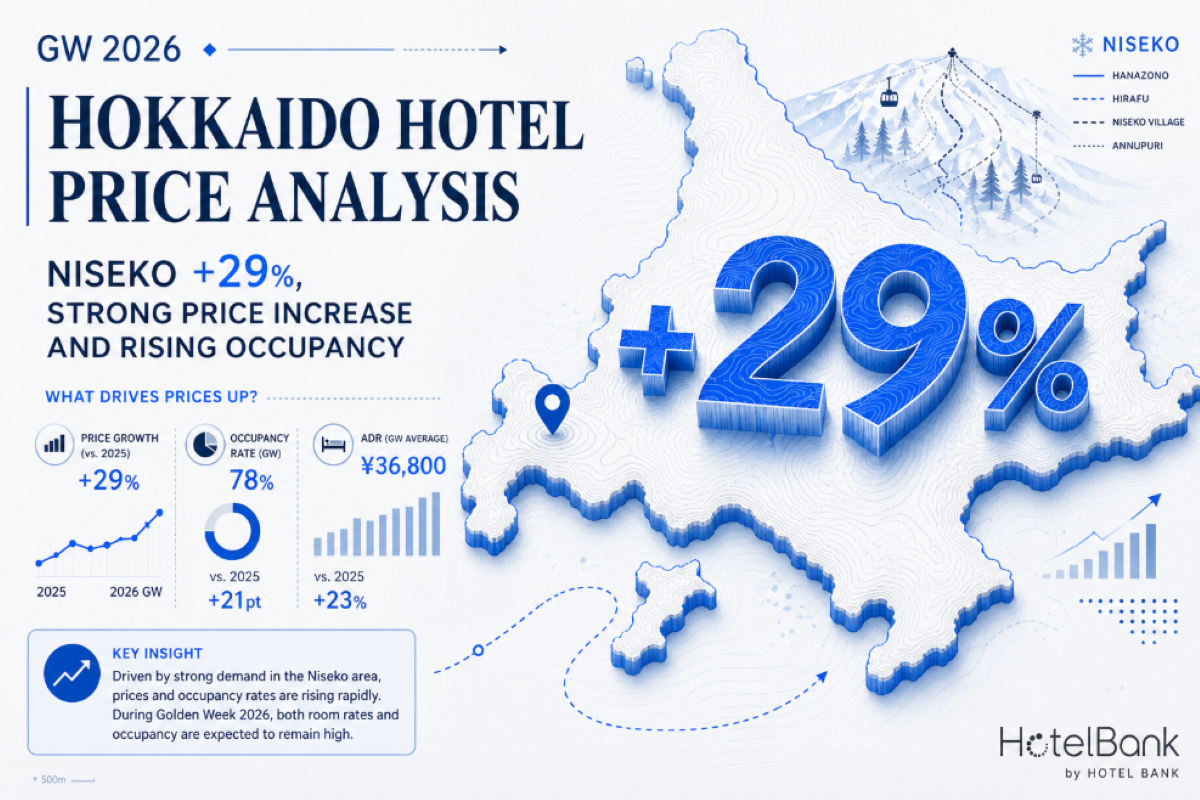
An analysis of hotel pricing in Hokkaido during Golden Week 2026 (April 25 to May 6) shows that the average accommodation rate across the region reached ¥35,700, up +7.7% year-on-year. Notably, Kutchan Town (the core of the Niseko area) recorded a striking increase of +29.1% on average during the holiday period, with peak dates (May 2) surging as high as +35.2%.
This sharp rise is driven by the spillover of inbound demand into the spring season, a wave of new luxury resort openings, and a rapid increase in sell-out rates. Based on a dataset of 1,703,077 plan prices, this article examines pricing trends by area and property type.
Golden Week Pricing Trends Across Hokkaido — Daily Demand Fluctuations
A daily breakdown of hotel pricing across Hokkaido during Golden Week 2026 (April 25 to May 6) reveals a clear demand peak on May 2 (Friday), when average rates reached ¥47,000—up +36.3% from ¥34,500 on the same day last year.
In contrast, prices decline sharply in the latter half of the holiday period, falling from ¥36,300 to ¥30,200 after May 5. The gap between peak and off-peak days reaches as much as ¥16,800, highlighting significant volatility within the period.
In addition, sell-out rates exceeded 20% across all dates in 2026, with peak levels reaching 41.5% on May 3, indicating a substantial tightening of supply during the busiest days.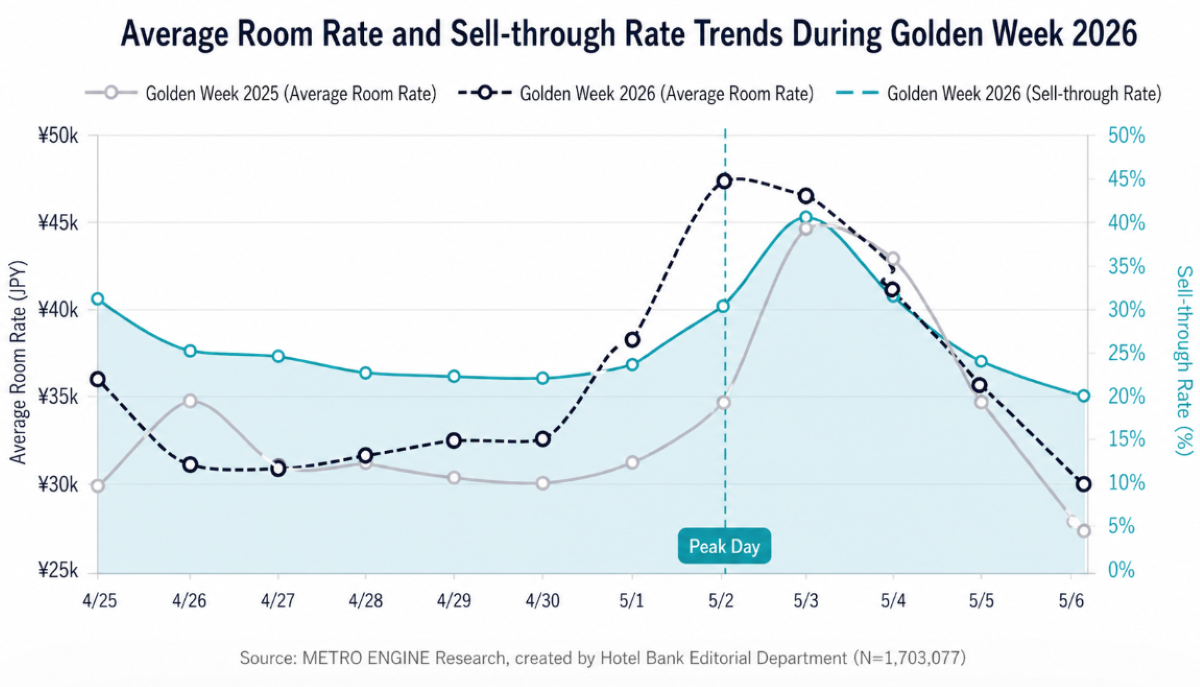
In contrast to Golden Week 2025, when sell-out rates were თითქმის zero, 2026 saw a sharp increase to an average of 27.5%, indicating a significant shift in the supply–demand balance.
In other words, the rise in prices is not simply the result of rate hikes, but rather reflects tightening inventory driven by a genuine increase in demand.
Price Changes by Area — Kutchan Leads with a +29% Surge
A comparison of average Golden Week prices across major areas in Hokkaido shows that Kutchan Town (the core of the Niseko area) recorded the most significant increase, rising +29.1% year-on-year. Rates climbed sharply from ¥43,900 to ¥56,700, signaling a clear shift into a full-fledged resort pricing tier.
This was followed by Otaru City (+19.5%) and Kushiro City (+19.3%), where improvements in accessibility and growing recognition as tourist destinations are likely contributing to the upward trend.
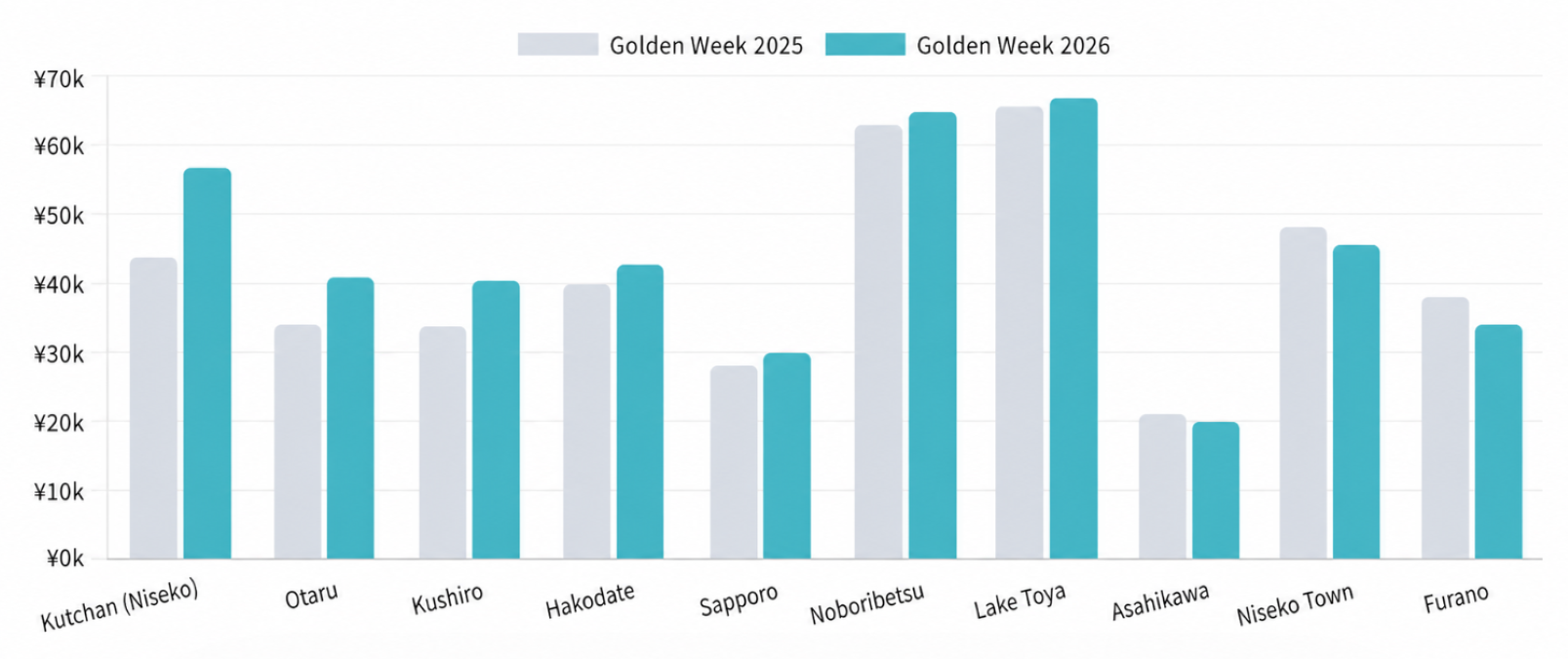
However, not all areas experienced growth. Furano City recorded the largest decline in Hokkaido at -10.9% year-on-year, while Asahikawa City fell by -5.2% and Niseko Town (adjacent to Kutchan) declined by -5.5%.
The drop in Furano and Niseko Town may be partly due to some high-end properties undergoing renovations, as well as a shift in demand toward Kutchan, where demand has become increasingly concentrated within the broader Niseko area.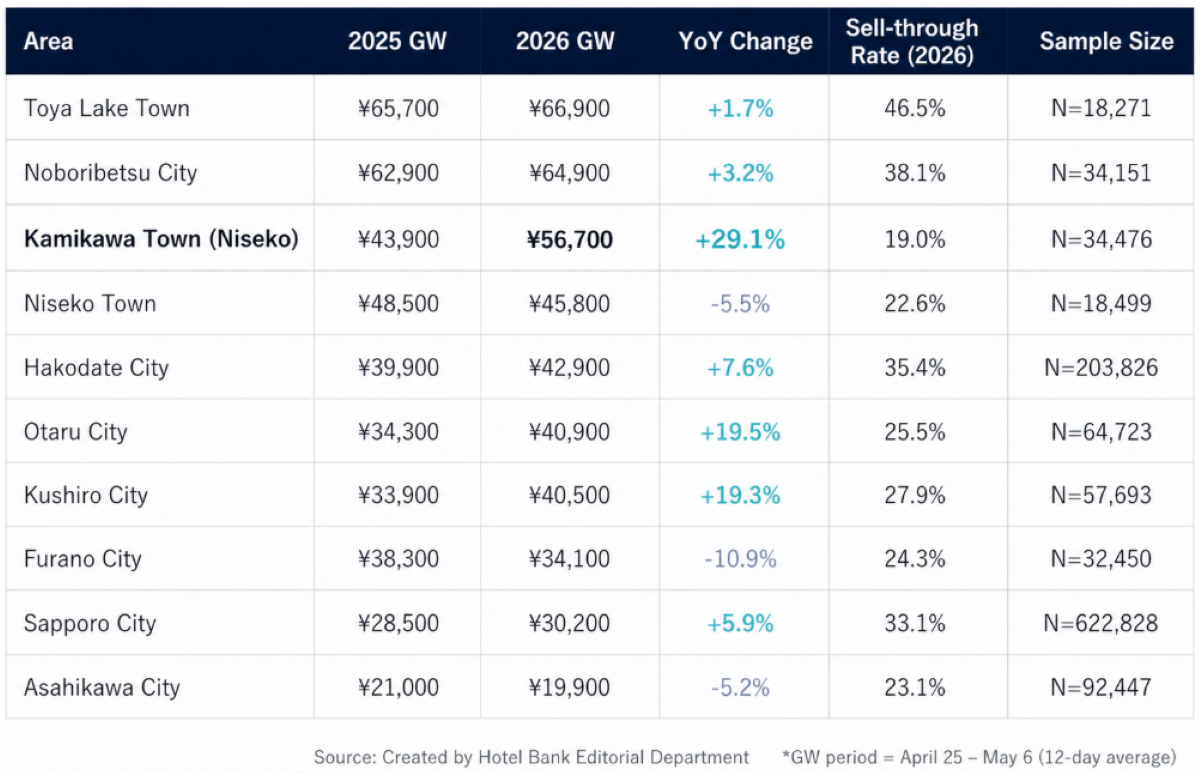
Structural Shifts in the Niseko Area — Luxury Expansion and Supply Constraints
The sharp +29.1% year-on-year increase in Golden Week pricing in Kutchan reflects a broader structural transformation across the Niseko area. From 2025 through 2026, the region has seen a wave of new luxury hotel openings. In 2025, properties such as Nikko Style Niseko HANAZONO, HOTEL LOGIN NISEKO, and Cassia Hirafu Niseko opened, while 2026 is set to welcome ultra-luxury brands including Six Senses Niseko (IHG, 76 rooms) and Capella Niseko.
At the same time, the number of plans available on OTAs has actually declined. During Golden Week, the sample size for Kutchan fell from N=41,262 in 2025 to N=34,476 in 2026, a decrease of 16.4%. This suggests that luxury properties are reducing their reliance on OTA channels and shifting distribution toward direct bookings and high-end, targeted channels.
With supply tightening while demand continues to grow, upward pressure on prices is inevitable. Under the fundamentals of dynamic pricing, reduced inventory directly translates into higher rates.
In addition, three properties within Niseko Village—Kasara Niseko Village Townhouse, Hinode Hills Niseko Village, and The Green Leaf Niseko Village—have been rebranded under the Hilton portfolio. This has likely enhanced international visibility and contributed to an increase in direct bookings from overseas travelers.
Price Changes by Property Type — Condominiums Surge
A comparison of average Golden Week prices by property type shows that condominiums recorded the highest rates at ¥60,500, marking a sharp increase of +57.2% from ¥38,500 in the same period last year. This likely reflects the growing number of high-end condominium-style accommodations in the Niseko area.
Ryokan, by contrast, remained relatively stable at ¥55,300 (+1.6% year-on-year). While maintaining a high absolute price level, the rate of increase has been comparatively modest.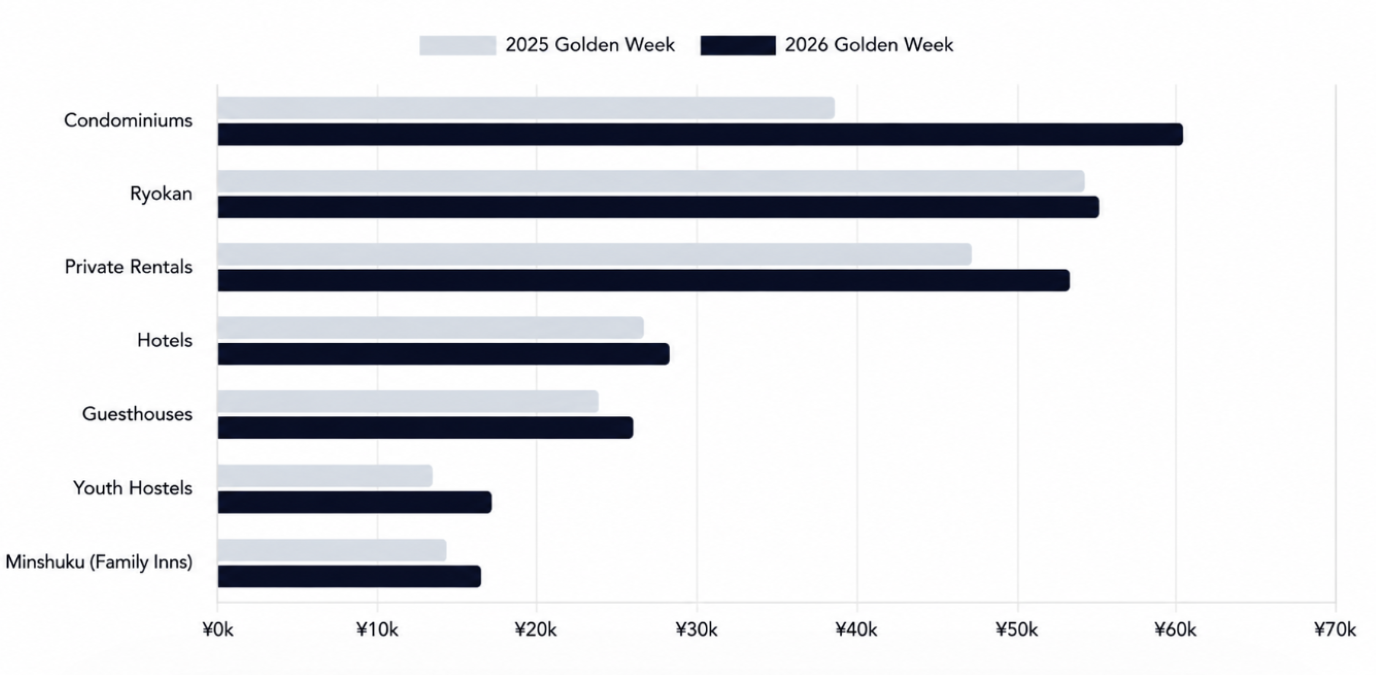 Hotels recorded a steady increase to ¥28,400 (+5.1% year-on-year), with the highest level of supply tightness, as reflected in a 30.0% sell-out rate.
At the same time, price increases have extended to mid- and lower-priced segments, including pensions (¥26,200, +9.8%) and youth hostels (¥17,100, +25.2%). This indicates that accommodation demand across Hokkaido is broad-based, spanning a wide range of property types.
Spillover of Inbound Demand into the Spring Season
Inbound demand in Hokkaido has traditionally been concentrated in the winter ski season (December to February). In recent years, however, its reach has expanded beyond winter. According to tourism baseline data (March 2026) from the Hokkaido District Transport Bureau, the total number of overnight stays by international visitors in Hokkaido continued to hit record highs throughout FY2025, with particularly strong growth during the spring months (April–May).
This trend is also supported by monthly operating data from REITs. Seven properties in the Sapporo area owned by Invincible Investment Corporation recorded ADR levels of ¥18,600 to ¥28,100 and occupancy rates of 93–96% as of February 2026, indicating that strong winter demand has carried over into spring. In addition, fav Hakodate, operated by Kasumigaseki Hotel REIT Investment Corporation, posted ADR of ¥25,400 with an occupancy rate of 74.4%, reflecting growing demand in the Hakodate area.
Hokkaido in spring offers a unique appeal, with cherry blossoms blooming one to two months later than in mainland Japan and the rare opportunity to experience both lingering snow and fresh greenery at the same time. For international travelers, this “off-peak” period following winter presents a sense of value, and the overlap between Golden Week and spring inbound demand has created strong upward pressure on the accommodation market.
Rapid Rise in Sell-Out Rates Signals Tightening Supply
The most notable change during Golden Week 2026 is the sharp increase in sell-out rates. While the sell-out rate across Hokkaido was effectively 0.0% during Golden Week 2025, it surged to an average of 27.5% in 2026, indicating a significant tightening of supply and demand.
By area, the highest sell-out rates were observed in Toyako (46.5%), followed by Noboribetsu (38.1%), Hakodate (35.4%), and Sapporo (33.1%), showing particularly strong inventory pressure in both hot spring destinations and major urban centers.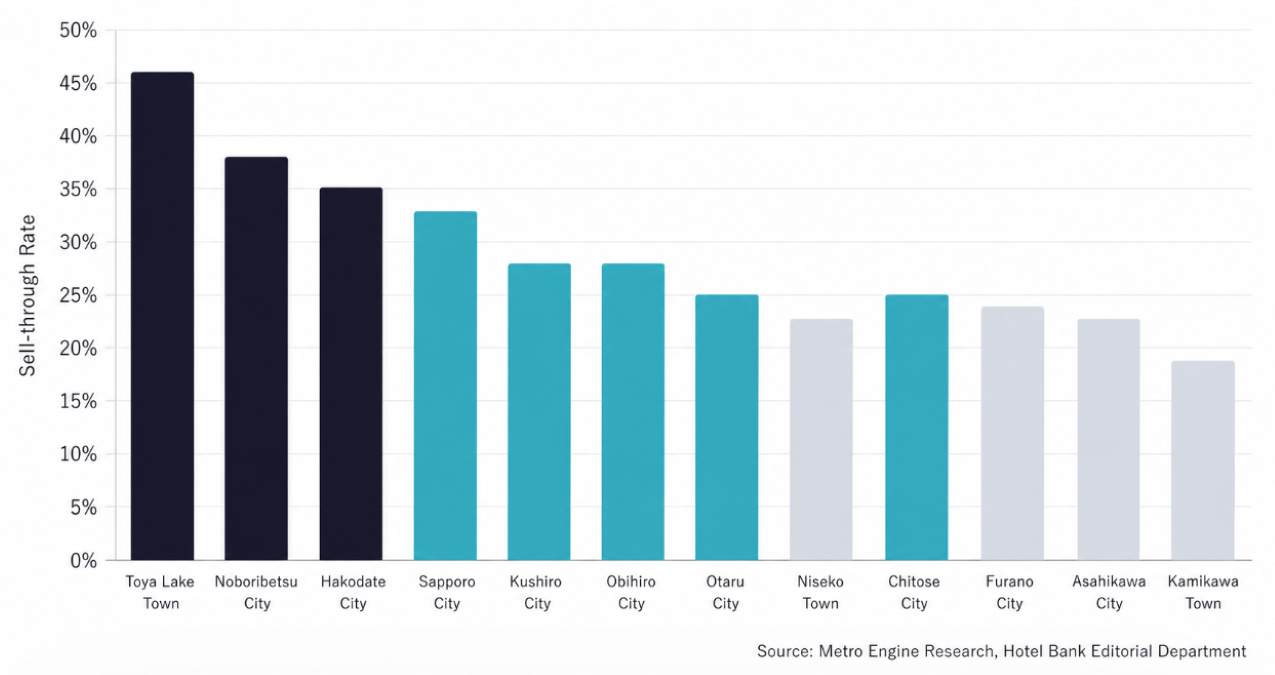 On a daily basis, the sell-out rate peaked at 41.5% on May 3 (Saturday), indicating a significant shortage of available rooms on the core peak day of Golden Week.
This suggests that a substantial volume of latent demand existed—travelers who were unable to secure accommodation despite their intent to stay. It is likely that this unmet demand was absorbed through spillover into surrounding areas or a shift toward day trips.
REIT Data Highlights the Resilience of Hokkaido’s Accommodation Market
Monthly operating data from hotel-focused REITs also confirms the strength of Hokkaido’s accommodation market. As of February 2026, properties in the Sapporo and Otaru areas owned by Invincible Investment Corporation have consistently maintained high occupancy levels.
Hotel MyStays Sapporo Aspen recorded ADR of ¥28,100 with an occupancy rate of 96.1%, while Hotel Sonia Otaru achieved ADR of ¥24,400 and occupancy of 94.0%—both reflecting exceptionally strong performance.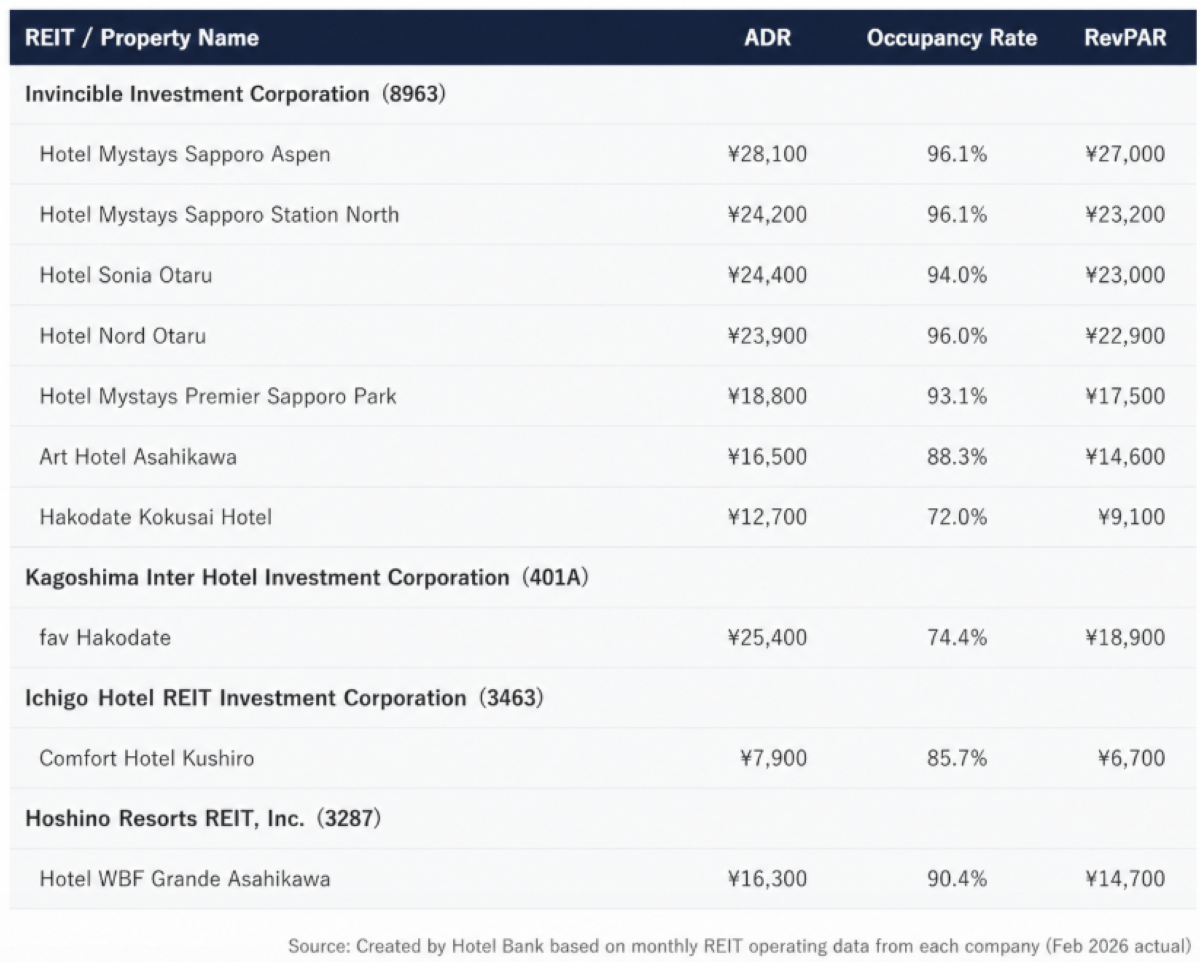 It is particularly noteworthy that hotels across Sapporo are consistently maintaining occupancy rates above 90%. While February is typically the peak of the winter tourism season, the persistence of this level into the Golden Week period aligns with the 33.1% sell-out rate observed in Sapporo during Golden Week 2026.
Although REIT property-level data is disclosed on a monthly basis and does not capture spot data for the Golden Week period itself, it serves as valuable supporting evidence of a structurally strong demand environment.
Conclusion — Hokkaido’s Golden Week Market at a Turning Point from “Volume” to “Value”
During Golden Week 2026, Hokkaido’s accommodation market recorded a solid overall increase of +7.7% year-on-year. However, the underlying performance varied significantly by area. While some locations posted double-digit growth—such as Kutchan (+29.1%), Otaru (+19.5%), and Kushiro (+19.3%)—others, including Furano (-10.9%) and Asahikawa (-5.2%), saw declines.
This growing divergence is driven by the spillover of inbound demand into the spring season and the upward shift in pricing brought about by new luxury resort openings. In particular, the entry of internationally recognized luxury brands such as Six Senses and Capella in the Niseko area is structurally lifting ADR across the region. At the same time, areas that are not capturing concentrated demand are experiencing price declines, highlighting an increasing imbalance in demand distribution across Hokkaido.
The sharp rise in sell-out rates—from 0% in 2025 to 27.5% in 2026—signals that supply constraints are becoming more pronounced. How the upcoming wave of new hotel openings will reshape the supply–demand balance will be a key point to watch. Overall, Hokkaido’s accommodation market appears to be entering a transition from “volume-driven growth” to a focus on “value enhancement.”